

AI Voice Agents: Essential Prompt Strategies for Law Firms
The legal industry, often characterized by its adherence to tradition, is now standing at the precipice of a profound technological shift, particularly in how law firms engage with prospective and existing clients. Consider the recent insights shared by Sarah Chen, managing partner at LexSolutions Group, during a panel discussion at LegalTech NYC 2026. She recounted a period in late 2025 when her firm, like many others, found itself overwhelmed by an influx of inquiries that often went unanswered after hours, leading to significant missed opportunities.
Chen highlighted a critical turning point: the adoption of prompt-built AI voice agents capable of nuanced, context-aware conversations, a stark contrast to the rudimentary interactive voice response (IVR) systems of yesteryear. Her firm's journey from losing potential clients to efficiently qualifying and scheduling them, even outside of business hours, underscores a burgeoning trend that is reshaping the competitive landscape for legal services.
This shift isn't merely about automation; it's about intelligent, ethical, and highly personalized client engagement. The ability to craft precise, effective prompts for AI voice agents has emerged as a paramount skill, transforming what was once a generic chatbot interaction into a sophisticated legal assistant.
Firms that master this art are not just saving costs; they are redefining accessibility and responsiveness, crucial differentiators in today's fast-paced market. The 'Prompt-Built Voice Agents' trend, as highlighted by Trend Hunter, signals a maturation of voice AI, moving beyond simple commands to complex conversational flows that can handle intricate legal queries, qualify leads with precision, and even manage multilingual interactions seamlessly.
This evolution demands a strategic approach, one that integrates technological prowess with a deep understanding of legal ethics and client service.
For law firm owners and attorneys, understanding the mechanics of prompt engineering for AI voice agents is no longer optional; it is an essential component of modern practice management.
The distinction between a generic automated response and a truly intelligent, empathetic AI voice agent lies entirely in the quality and complexity of its underlying prompts. This article delves into the strategies, ethical considerations, and practical applications that will empower your firm to harness the full potential of these transformative tools, ensuring your practice remains competitive, compliant, and client-centric in the age of advanced AI.
Your ability to effectively build and deploy these sophisticated agents will dictate your firm's future efficiency and growth.
The Strategic Imperative: Why AI Voice Agents Matter for Law Firms
The legal industry has historically grappled with the challenge of scaling client communication without compromising quality or increasing overheads. Traditional methods, such as hiring additional administrative staff or relying on third-party answering services, often introduce inconsistencies, higher costs, or slower response times. This friction point became particularly evident during the pandemic, when remote work surged and client expectations for immediate digital interaction skyrocketed.
A 2025 ABA TechReport highlighted that nearly 60% of law firms struggled with after-hours client engagement, directly impacting lead conversion. This data underscores a critical gap that generic phone systems or even human agents, limited by hours and capacity, simply cannot fill.
The advent of sophisticated AI voice agents, powered by large language models (LLMs) from innovators like OpenAI (with their latest GPT models) and Anthropic (with Claude 3.5 Sonnet), offers a compelling solution.
These agents are not merely automated answering machines; they are intelligent conversational interfaces capable of understanding context, processing natural language, and performing complex tasks. Imagine an AI voice agent that can not only answer frequently asked questions about your firm's practice areas but also pre-qualify potential clients based on specific legal criteria, gather essential information for client intake, and even schedule appointments directly into your firm's calendar, all while maintaining a professional and empathetic tone.
Learn more about Essential AI Marketing Tools: Supercharge Your Law Firm's Growth. This level of automation frees up valuable human resources, allowing attorneys and paralegals to focus on high-value legal work, rather than administrative tasks.
Moreover, the competitive landscape demands this evolution. In a market where clients often reach out to multiple firms simultaneously, the firm that responds first, most comprehensively, and most professionally often wins the business.
AI voice agents provide 24/7 availability, ensuring no lead is missed due to time zone differences or after-hours inquiries. This immediate responsiveness significantly improves the client experience, setting a positive first impression and building trust from the outset. According to a Gartner report on enterprise AI adoption, companies leveraging AI for customer service reported an average 30% increase in customer satisfaction and a 25% reduction in operational costs by 2024. For law firms, these metrics translate directly into enhanced reputation, increased client acquisition, and improved profitability, making the strategic deployment of these agents a non-negotiable for future growth.
Ethical Imperatives in Voice AI Deployment
While the benefits are clear, the legal profession operates under stringent ethical guidelines that must inform every technological adoption. The deployment of AI voice agents directly implicates several core ABA Model Rules, particularly Rule 1.1 (Competence), Rule 1.6 (Confidentiality of Information), and Rule 5.3 (Responsibilities Regarding Nonlawyer Assistants).
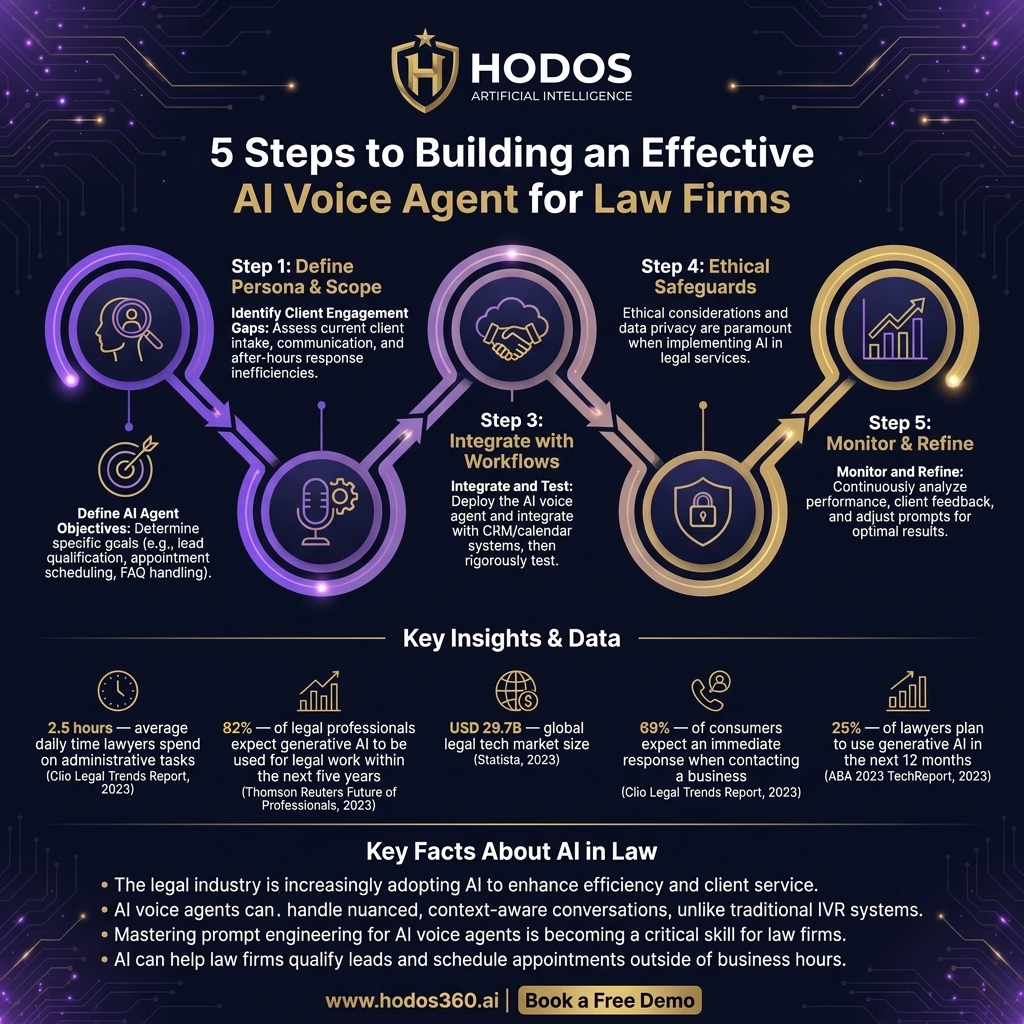
Firms have an ethical obligation to ensure that any technology used in client interactions is competent, maintains client confidentiality, and is adequately supervised. This means that the AI voice agent must be explicitly programmed to avoid providing legal advice, clearly identify itself as an AI, and handle sensitive client data with the utmost security.
The risk of an AI overstepping its bounds or mishandling confidential information is not merely a technical glitch; it's a professional liability.
For instance, a 2023 ethics opinion from the New York State Bar Association cautioned against using AI without proper disclaimers and safeguards, emphasizing the attorney's non-delegable duty to supervise.
Learn more about Legal AI: The Ultimate Guide to Transforming Law Firms. This highlights the human conflict between the desire for efficiency and the need for unwavering ethical compliance. Firms must implement robust internal protocols, including regular audits of AI interactions, clear consent mechanisms for data collection, and a human fallback system for complex or sensitive inquiries that the AI is not equipped to handle.
The EU AI Act, which began phased enforcement in early 2026, further emphasizes transparency and risk management for AI systems, setting a global precedent for responsible AI deployment. Neglecting these ethical considerations can lead to severe reputational damage, regulatory fines, and potential disbarment for attorneys, underscoring that the build of an AI voice agent must be as ethically sound as it is technologically advanced.
Crafting Precision Prompts: Beyond Basic Instructions for Legal AI
The effectiveness of an AI voice agent hinges entirely on the quality of its prompts. Generic, vague instructions will yield generic, unhelpful responses, potentially frustrating clients and undermining the very purpose of the AI. For law firms, prompt engineering is an art and a science, requiring a deep understanding of legal terminology, client psychology, and the specific goals of each interaction.
It’s about more than just telling the AI what to say; it’s about defining its persona, its boundaries, and its decision-making logic. As Dario Amodei, CEO of Anthropic, often emphasizes, "The quality of AI output is directly proportional to the clarity and specificity of the prompt."
This principle is amplified in legal contexts where precision is paramount, and ambiguity can have serious consequences.
Consider the task of client intake. A basic prompt might simply instruct the AI to "collect client information." A precision prompt, however, would be far more detailed: "You are 'LexAssist,' a friendly and professional AI intake specialist for [Firm Name].
Your goal is to gather the prospective client's full name, contact number, email, brief description of their legal issue, and preferred consultation time. Emphasize that you are an AI and cannot provide legal advice. If the client asks for advice, politely redirect them to schedule a consultation with an attorney.
Use empathetic language and ensure confidentiality is maintained. If the issue falls outside our practice areas (e.g., criminal law, immigration), politely inform them and suggest they seek another firm, offering to transfer them to a human operator if they insist on speaking to someone immediately."
This detailed approach ensures the AI voice agent performs its role accurately, ethically, and efficiently, mimicking the behavior of a highly trained human assistant.
Effective prompt writing also involves anticipating conversational flows and potential edge cases. Learn more about AI Voice Assistants: Essential Practical Features for Law Firms.
What if a client becomes agitated? What if they speak a different language? What if they ask a question outside the AI's defined scope? Robust prompts incorporate conditional logic and fallback mechanisms. For instance, a prompt might include: "If the client expresses frustration, acknowledge their feelings and offer to connect them with a human intake specialist.
If the client speaks Spanish, switch to Spanish and continue the conversation, as per our multilingual support capabilities." This level of foresight prevents the AI from breaking down or delivering unhelpful responses, ensuring a seamless and positive client experience. The goal is to build an AI voice agent that sounds human, not just in its voice synthesis, but in its conversational intelligence and responsiveness.
Furthermore, continuous iteration and refinement of prompts are crucial. The legal landscape is dynamic, and client needs evolve. Regularly reviewing transcripts of AI voice agent interactions and feedback from human supervisors allows firms to identify areas for improvement and update prompts accordingly. This iterative process, akin to agile development, ensures the AI remains effective and aligned with the firm's evolving objectives.
Firms like InnovateLaw LLP have reported that their weekly prompt review sessions, involving both legal and technical teams, have led to a 15% increase in lead qualification accuracy over six months, demonstrating the tangible ROI of dedicated prompt management. This ongoing optimization is essential for any firm aiming to leverage these agents for sustained competitive advantage.
Real-World Impact: Law Firms Leveraging AI Voice Assistants for Growth
The theoretical benefits of AI voice agents are increasingly being validated by real-world applications within the legal sector. Take the example of Justice & Partners, a mid-sized personal injury firm in Texas. Historically, they struggled with a high volume of calls after business hours and on weekends, leading to missed opportunities and a backlog of voicemails.
After implementing an AI voice agent specifically designed for initial client screening and appointment booking, they saw a dramatic transformation. Jennifer Lee, a senior partner at Justice & Partners, reported in a recent Bloomberg Law interview that their lead conversion rate improved by 20% within the first quarter of 2026, primarily because their AI voice agent was able to engage prospects instantly, qualify their cases, and schedule consultations, even at 2 AM.
This immediate engagement proved critical in securing clients who might otherwise have called a competitor.
Another compelling case comes from Global Legal Advisors, a boutique firm specializing in international business law. Their challenge was managing inquiries from clients across multiple time zones and in various languages.
A generic answering service was inadequate, and hiring multilingual staff around the clock was cost-prohibitive. By deploying a sophisticated AI voice agent with robust multilingual support, Global Legal Advisors was able to provide 24/7 assistance in English, Spanish, and Mandarin. This not only enhanced their global reach but also significantly improved client satisfaction scores, as reported in their 2025 annual review.
The AI voice agent handled initial screening, routed calls to appropriate departments during business hours, and provided general information, allowing their legal team to focus on complex advisory work. Learn more about AI-Native Law Firms: The Ultimate Guide to Modern Legal Practice. This strategic use of agents showcases how specialized firms can expand their market presence without proportional increases in operational costs.
Beyond client intake, AI voice agents are proving invaluable in streamlining other operational aspects. For instance, some firms are using them to manage internal inquiries, answering common questions from staff about HR policies, IT support, or case management procedures. This frees up administrative staff, who often spend significant time on repetitive queries.
The ability to integrate these AI voice agents with existing AI Law Firm Management System platforms, like HODOS 360, further amplifies their utility. An AI voice agent can seamlessly update client records in the case management system, log billable hours for specific interactions, and even trigger document automation processes based on client-provided information.
This holistic integration transforms the client interaction from a standalone event into a fully integrated step within the firm's broader legal workflow, showcasing the true power of an intelligent builder approach.
The competitive drama in the legal tech space, with companies like Harvey AI securing partnerships with major firms like Allen & Overy, underscores the rapid pace of innovation.
While much attention focuses on AI for legal research and document review, the front-end client interaction provided by AI voice agents represents an equally disruptive, if less visible, revolution. Firms that embrace these technologies early are not just gaining an edge; they are fundamentally reshaping their operational models for greater efficiency, client satisfaction, and market leadership.
The data consistently points to a future where these intelligent agents are not a luxury but a necessity for any firm aiming to thrive.
- ✓Enhanced Client Accessibility: Provide 24/7 availability for client inquiries, ensuring no leads are missed due to time constraints or geographic differences.
- ✓Streamlined Client Intake: Automate the initial screening process, gathering essential information and qualifying leads efficiently before human intervention.
- ✓Improved Operational Efficiency: Free up attorneys and administrative staff from repetitive tasks, allowing them to focus on high-value legal work.
- ✓Consistent Brand Voice: Ensure every client interaction maintains a professional, consistent, and empathetic tone, reinforcing your firm's brand.
- ✓Multilingual Support: Offer seamless communication in multiple languages, expanding your firm's reach to a diverse client base.
- ✓Data-Driven Insights: Collect valuable data from interactions to identify trends, refine marketing strategies, and improve service delivery.
- ✓Cost Reduction: Significantly lower operational costs associated with traditional client service and administrative support.
Integrating Voice AI with Existing Legal Workflows and Systems
The true power of AI voice agents is unleashed when they are not siloed but seamlessly integrated into a law firm's existing technological ecosystem. A standalone AI voice agent, however sophisticated, will only provide limited value if it cannot communicate with your case management system, client relationship management (CRM) software, or billing platforms.
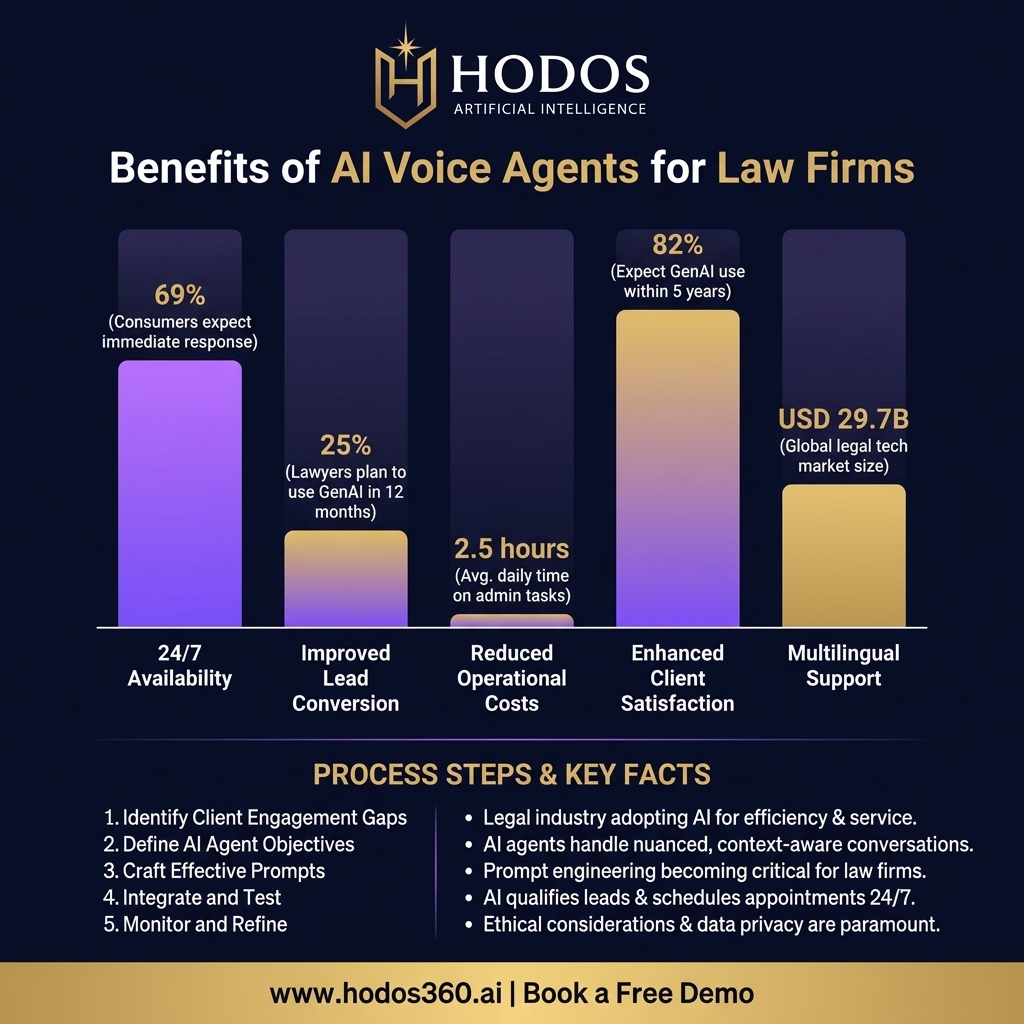
The goal is to create a cohesive digital infrastructure where information flows freely and actions are automated across different systems. This integration transforms the AI voice agent from a simple answering service into an intelligent hub for client interaction and data management, becoming a critical part of your overall AI Law Firm Management System.
For example, when an AI voice agent successfully pre-qualifies a lead and schedules an appointment, that information should instantly populate the firm's CRM, create a new client file in the case management system, and potentially trigger an automated email confirmation to both the client and the assigned attorney.
This eliminates manual data entry, reduces errors, and ensures that the legal team has immediate access to all relevant information before the first consultation. Companies like Clio, which acquired LawYaw in 2021 to bolster its document automation, demonstrate the industry's move towards integrated solutions. A well-built AI voice agent should act as another intelligent input channel for these integrated platforms, further enhancing efficiency and data accuracy.
Learn more about Essential AI Web Development: Harvard's Free Courses for Law Firms. The integration capabilities of platforms like HODOS 360, which offers both AI Voice Assistants and an AI Law Firm Management System, are specifically designed to facilitate this level of operational synergy, providing an end-to-end solution for modern legal practices.
Furthermore, integration extends to document automation and legal workflows. Imagine an AI voice agent that, after a client intake call, automatically initiates the creation of a retainer agreement or a power of attorney document based on the information gathered. This level of automation, triggered by voice interaction, significantly accelerates the onboarding process and reduces the administrative burden on paralegals and legal assistants.
The integration with a firm's calendaring system is also paramount, allowing the AI voice agent to check attorney availability in real-time and book appointments directly, avoiding scheduling conflicts and ensuring efficient use of everyone's time. This intricate web of interconnected systems, with the AI voice agent as a key component, represents the future of efficient and client-centric law firm operations, moving beyond simple phone interactions to complex, value-driven engagements.
The ability to build these sophisticated connections is what sets leading firms apart.
Overcoming Challenges and Ensuring Compliance
Despite the undeniable advantages, implementing AI voice agents in a legal context is not without its challenges. The primary concerns revolve around data security, client confidentiality, and regulatory compliance. Law firms handle highly sensitive information, and any breach or mishandling can have catastrophic consequences. Therefore, choosing an AI voice agent builder or platform that adheres to the highest security standards (e.g., ISO 27001, SOC 2 compliance) and offers robust encryption for all communications and data storage is non-negotiable.
Firms must also ensure that their AI voice agents are configured to comply with specific state bar rules regarding advertising, client communication, and the unauthorized practice of law.
Another significant challenge is ensuring the AI voice agent's accuracy and avoiding bias. AI models, particularly those trained on vast datasets, can sometimes perpetuate biases present in the training data or misinterpret nuances in human language.
For legal applications, where precision and impartiality are critical, this risk must be actively mitigated through careful prompt writing, continuous monitoring, and regular testing. Firms should also establish clear protocols for human oversight, allowing a human agent to intervene or take over a conversation if the AI encounters a particularly complex or sensitive query.
Learn more about AI Voice Assistant: Apple's Essential Siri Reboot Unpacked. This hybrid approach ensures that the client always receives the highest level of service and that ethical boundaries are never crossed, even when the AI voice agent is using advanced capabilities.
Finally, managing the human element—both within the firm and among clients—is crucial.
Some attorneys and staff may initially resist the adoption of AI, viewing it as a threat to their jobs or the personalized nature of legal service. Transparent communication, comprehensive training, and demonstrating the AI's role as an assistant rather than a replacement can help overcome this internal conflict.
Similarly, clients may be hesitant to interact with an AI. Clear disclosure that they are speaking with an AI, coupled with the option to speak with a human at any point, can build trust and ensure a positive experience. The successful integration of AI voice agents is as much about managing people and perceptions as it is about deploying technology; it requires a thoughtful, strategic, and ethically grounded approach to truly unlock its potential for the firm.

Key Takeaways and Next Steps for Your Law Firm
The legal profession is undergoing an undeniable transformation, driven by advancements in artificial intelligence. Prompt-built AI voice agents represent a powerful frontier in this evolution, offering law firms unprecedented opportunities to enhance client engagement, streamline operations, and drive growth. The narrative is clear: firms that strategically embrace and master the art of prompt engineering for these intelligent agents will be best positioned to thrive in an increasingly competitive and technologically advanced legal market.
From ensuring 24/7 client accessibility and optimizing lead qualification to integrating seamlessly with existing legal workflows, the benefits are compelling.
However, success is not merely about adopting the technology; it's about adopting it wisely and ethically. Law firms must prioritize the crafting of precise, context-aware prompts that reflect their brand, adhere to strict ethical guidelines, and anticipate the nuances of legal client interactions.
Continuous monitoring, human oversight, and a commitment to data security are paramount to mitigate risks and ensure compliance. By focusing on these critical elements, your firm can transform its client communication strategy, turning every inquiry into an opportunity and every interaction into a positive brand experience.
To truly unlock the potential of AI voice agents, consider an integrated platform that supports not only advanced voice AI capabilities but also comprehensive law firm management. Solutions like HODOS 360 offer a holistic suite of services, including AI Voice Assistants for 24/7 client engagement, an AI Law Firm Management System for seamless workflow integration, and an AI Marketing Platform to amplify your reach.
This integrated approach allows firms to efficiently build and manage their digital presence, from initial client contact to case resolution, ensuring a cohesive and highly effective operation. The future of legal practice is intelligent, connected, and client-centric – are you ready to lead the way?
Discover how HODOS 360 can empower your firm's AI transformation today.
Frequently Asked Questions
What are prompt-built AI voice agents?+
Prompt-built AI voice agents are sophisticated AI systems designed to engage in natural language conversations, guided by meticulously crafted 'prompts' or instructions. Unlike traditional IVR systems, these agents can understand context, answer complex queries, and perform tasks like lead qualification or appointment booking, making them highly adaptable and effective for specific legal scenarios. Their intelligence comes from the quality of their underlying prompt engineering.
How can AI voice agents benefit my law firm?+
AI voice agents offer numerous benefits, including 24/7 client accessibility, improved lead qualification, streamlined client intake, and reduced operational costs. They free up human staff from repetitive tasks, ensuring consistent, professional client communication, and can handle multilingual interactions. This ultimately leads to increased client satisfaction, higher conversion rates, and a more efficient overall practice, allowing attorneys to focus on core legal work.
What ethical considerations are there for using AI voice agents in law?+
Ethical considerations are paramount. Firms must ensure the AI clearly identifies itself as an AI, avoids providing legal advice, and maintains strict client confidentiality (ABA Model Rule 1.6). Proper supervision (ABA Model Rule 5.3) and competence (ABA Model Rule 1.1) are required. Robust data security, transparent disclosure, and a human fallback option are essential to mitigate risks and comply with professional obligations and emerging regulations like the EU AI Act.
How do I ensure my AI voice agent sounds natural and effective?+
To ensure your AI voice agent sounds natural and is effective, focus on precise prompt engineering. Define a clear persona, tone, and specific instructions for various scenarios. Incorporate conditional logic for complex queries and edge cases. Regularly review interaction transcripts to identify areas for improvement and refine prompts. Testing with real users and providing human oversight are crucial for continuous optimization and a truly human-like conversational experience.
Can AI voice agents integrate with my existing legal software?+
Yes, modern AI voice agents are designed for seamless integration with existing legal software, including case management systems, CRM platforms, and calendaring tools. This allows for automated data entry, client record updates, and workflow triggers (e.g., document automation) based on voice interactions. Integrated platforms, like HODOS 360, provide comprehensive solutions that connect voice AI with your firm's entire digital ecosystem for maximum efficiency and data flow.