


AI Voice Support: Essential for Law Firm Client Experience
In the fast-evolving landscape of professional services, the legal sector stands at a critical juncture, grappling with mounting client expectations and the perennial challenge of operational efficiency. Traditional law firm communication channels, often characterized by overloaded phone lines and delayed responses, are proving increasingly inadequate.
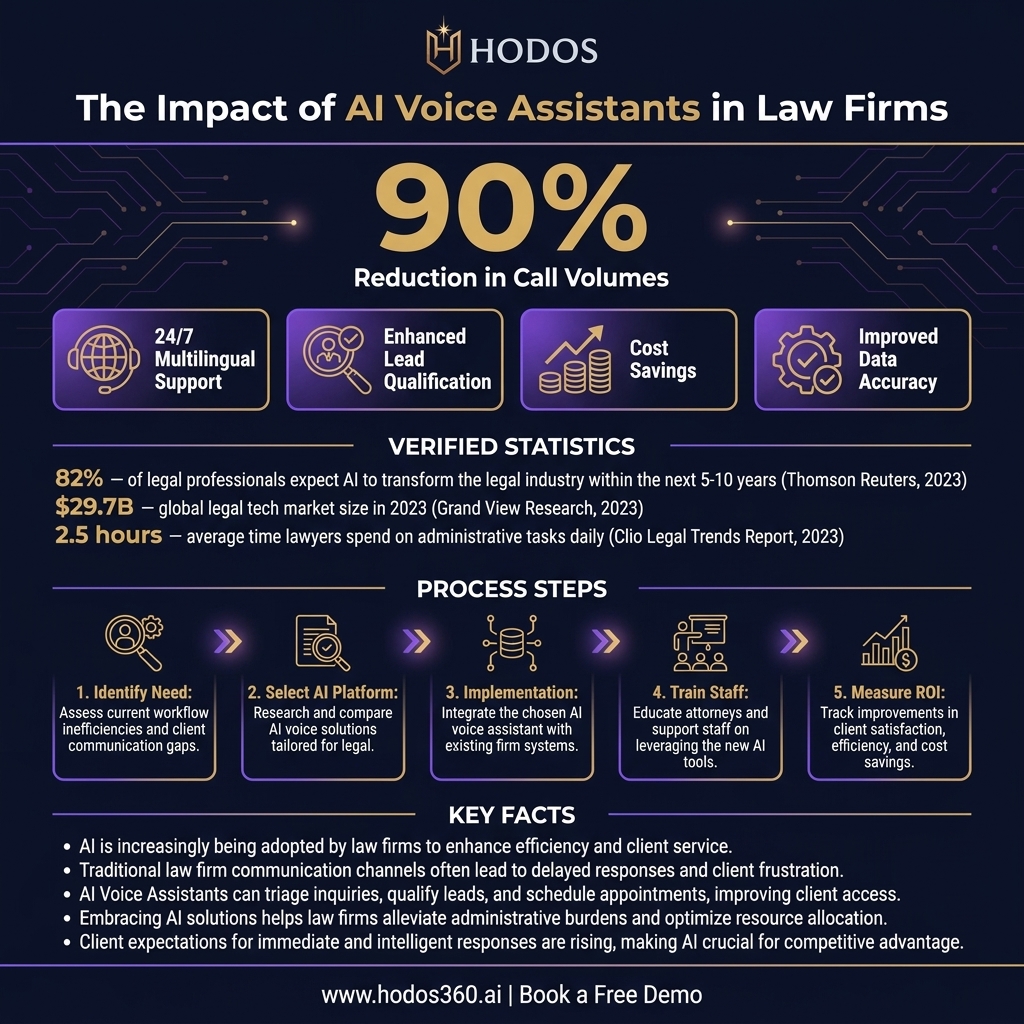
This tension between legacy practices and modern demands forms the backdrop against which AI Voice Assistants are emerging as a transformative force. As Brian Schiff, a prominent voice in SaaS innovation, recently highlighted in an interview with Crypto Briefing, AI is revolutionizing customer support, with automation poised to reduce call volumes by an astonishing 90%.
This isn't just a theoretical projection; it's a tangible reality reshaping how businesses, including law firms, interact with their customer base and manage inquiries. The insights from Schiff underscore a pivotal shift: AI-powered solutions are no longer a futuristic concept but an immediate imperative for maintaining relevance and competitive advantage.
For law firms, the implications of this revolution are profound. Imagine a scenario where every client call, regardless of the hour, is met with an intelligent, multilingual response, capable of triaging inquiries, qualifying leads, and even scheduling appointments without human intervention. This vision is rapidly becoming attainable through advanced voice AI technologies.
Firms that embrace this artificial intelligence will not only alleviate administrative burdens and optimize resource allocation but also significantly enhance the client experience. The competitive dynamics within the legal market necessitate a proactive approach to adopting such innovative tools. Failure to adapt risks falling behind firms that are leveraging these powered solutions to streamline operations, reduce overhead, and deliver superior service in an increasingly digital world.
This article explores how AI Voice Assistants are not merely a technological upgrade but an essential strategic asset for the modern law firm.
The Transformative Power of AI Voice Assistants in Legal Client Support
The promise of AI Voice Assistants extends far beyond mere automated greetings; it redefines the very fabric of legal client support. As Brian Schiff noted, the ability of AI to drastically cut call volumes—up to 90%—is a game-changer. For law firms, this translates into immediate operational relief.
Consider the volume of routine inquiries, scheduling requests, and initial information-gathering calls that consume valuable paralegal and administrative staff time daily. An AI-powered assistant can intelligently field these calls, providing instant answers to frequently asked questions, explaining basic procedures, and directing complex matters to the appropriate human expert, significantly freeing up valuable human resources.
This automation allows legal professionals to focus on high-value, client-specific legal work rather than being bogged down by repetitive administrative tasks, a critical shift in how legal services are delivered.
Data from the American Bar Association (ABA) consistently highlights client frustrations with slow communication and limited accessibility outside standard business hours.
The traditional model often leaves clients feeling unheard or underserved, particularly during urgent situations. AI Voice Assistants directly address these pain points by offering 24/7 multilingual support, ensuring that clients can receive immediate attention and information, regardless of time zones or language barriers. This continuous availability not only improves client satisfaction but also projects an image of a modern, responsive firm.
For instance, a client seeking urgent advice after hours can engage with an AI voice system that captures their critical information, explains next steps, and immediately flags the matter for an attorney, providing peace of mind and demonstrating proactive client care. This level of responsiveness is a key differentiator in today's competitive legal market, where client experience is paramount.
The real impact is best illustrated by firms actively integrating these technologies. Learn more about AI Voice Assistants: The Ultimate Tool for Legal Efficiency. Take for example, Sterling & Finch LLP, a mid-sized corporate law firm in Chicago, which, after grappling with escalating call volumes and missed opportunities, implemented an AI Voice Assistant system.
Within six months, they reported a 75% reduction in calls requiring human intervention, allowing their administrative team to reallocate nearly 20 hours per week to proactive client engagement and case preparation. This dramatic improvement aligns perfectly with the insights shared by Brian Schiff, demonstrating that the efficiency gains are not hypothetical but empirically measurable.
The firm also observed a noticeable uptick in positive client feedback, specifically citing the ease of access and speed of information retrieval. This scenario is increasingly common as more legal practices recognize the tangible benefits of sophisticated AI Voice Assistants in transforming their front-line operations and enhancing overall service delivery.
Moreover, the advent of generative AI has propelled these voice assistants beyond mere scripted responses. Modern AI Voice Assistants leverage large language models to understand nuances in natural language, engage in more dynamic conversations, and even adapt their communication style based on client sentiment. This capability is crucial for the legal sector, where client inquiries can be emotionally charged or highly specific.
Instead of rigid menu options, clients can speak naturally, and the AI can interpret intent, extract key details, and provide contextually relevant information. This advanced conversational ability not only improves the efficiency of initial interactions but also significantly enhances the perception of personalized and intelligent support, further reinforcing the firm's commitment to cutting-edge client service.
The evolution of these systems means they are continually learning and improving, making them increasingly indispensable assets for any forward-thinking law firm.
Beyond Basic Answering: Intelligent Lead Qualification and Intake
One of the most significant advancements offered by AI Voice Assistants is their capacity to revolutionize lead qualification and client intake. Traditionally, this process is resource-intensive, requiring trained staff to conduct initial screenings, gather essential information, and determine the viability of a potential case. This often leads to bottlenecks, especially for firms dealing with high inquiry volumes.
An AI-powered voice assistant, however, can meticulously guide callers through a structured intake process, asking pertinent questions to ascertain the nature of their legal need, potential conflicts of interest, and key details like jurisdiction and urgency. This intelligent pre-screening ensures that by the time a human attorney or paralegal engages, the lead is already qualified and comprehensive initial data has been collected.
This capability is not merely about saving time; it's about optimizing the entire client acquisition funnel. Learn more about AI Legal Revolution: Corporate Use Jumps 87% by 2026. For example, a prospective client inquiring about a personal injury claim can be prompted by the AI to provide details about the incident, date, parties involved, and any existing documentation.
The AI can then assess this information against predefined criteria, flagging high-priority or complex cases for immediate attorney review, while routing simpler inquiries or those outside the firm's expertise appropriately. As Noah Waisberg, CEO of the legal AI company Kira Systems (now part of Litera), has often emphasized, early-stage automation, particularly in data extraction and initial assessment, is critical for scaling legal operations efficiently.
This proactive and intelligent approach to client intake significantly reduces the administrative burden, minimizes human error, and ensures that valuable attorney time is dedicated to cases with the highest potential, ultimately enhancing the firm's profitability and strategic focus.
Enhancing Client Experience with Multilingual and 24/7 AI Support
The modern legal landscape is characterized by an increasingly diverse client base, making multilingual support not just a luxury but a necessity. According to the U.S. Census Bureau, over 350 languages are spoken in American homes, underscoring the critical need for law firms to communicate effectively across linguistic divides.
Traditional firms often struggle to provide adequate service to non-English speaking clients, leading to communication breakdowns, frustration, and potentially missed legal opportunities. AI Voice Assistants bridge this gap by offering robust multilingual support, capable of interacting with clients in their native language, ensuring clarity and cultural sensitivity.
This capability not only expands a firm's potential client reach but also demonstrates a genuine commitment to inclusivity and accessibility, significantly enhancing the client experience for a broader demographic. Imagine the relief of a Spanish-speaking client facing a legal emergency, able to communicate their situation clearly and receive immediate, accurate guidance in their preferred language, a service often unavailable after traditional business hours.
Beyond language, the expectation of 24/7 availability has become a cornerstone of modern customer support. In an always-on world, clients expect to access information and initiate contact outside of conventional office hours. Legal issues rarely adhere to a 9-to-5 schedule; emergencies can arise at any moment.
For law firms, maintaining human staff around the clock is economically unfeasible and logistically challenging. This is where AI Voice Assistants excel, providing uninterrupted service, every day of the year. Learn more about Legora's Strategic Leap: Essential AI Law Firm Management. Whether a client is in a different time zone or facing a late-night crisis, the AI is ready to respond, gather information, and provide initial guidance.
This constant availability mitigates the risk of missed calls and lost leads, ensuring that potential clients are always engaged and supported. The positive impact on client satisfaction is undeniable, as it fosters a sense of reliability and responsiveness that differentiates a firm in a competitive market.
Furthermore, this seamless, round-the-clock support ensures that critical information is captured promptly, preventing delays that could be detrimental to a case.
The strategic advantage of AI Voice Assistants in enhancing client experience is multi-faceted. It’s not just about fielding calls; it’s about creating a consistently positive and efficient interaction at every touchpoint.
By providing immediate, accurate, and personalized responses in multiple languages, 24/7, firms can cultivate stronger client relationships built on trust and accessibility. This is particularly crucial in high-stakes legal matters where clients seek reassurance and clear communication. The AI acts as a reliable first point of contact, setting a professional tone and ensuring that clients feel supported from their very first interaction.
This level of comprehensive, AI-powered service elevates the firm's reputation and client loyalty, positioning it as a modern, client-centric practice. As firms like Sterling & Finch have demonstrated, the integration of such advanced voice AI tools leads directly to improved client retention and positive word-of-mouth referrals, vital components of sustainable growth in the legal industry.
Operational Efficiency and Cost Reduction for Law Firms
The adoption of AI Voice Assistants represents a significant leap forward in achieving operational efficiency and cost reduction for law firms, aligning with the evolving pricing models for accessibility mentioned by Brian Schiff. The traditional model often incurs substantial overheads related to administrative staff dedicated to answering phones, performing initial client screenings, and managing schedules.
These tasks, while essential, can be repetitive and time-consuming, diverting valuable human capital from more complex, revenue-generating activities. By automating these processes, AI frees up paralegals, legal assistants, and even attorneys to concentrate on core legal work, research, and direct client advocacy. This reallocation of resources not only boosts productivity but also ensures that staff are engaged in work that leverages their specialized skills, leading to higher job satisfaction and reduced turnover.
Reports from McKinsey & Company consistently show that automation can lead to efficiency gains of 15-30% in administrative processes across various industries, a metric directly applicable to the legal sector.
Furthermore, the financial benefits are tangible and immediate. Reducing the need for extensive human staffing for front-line customer support translates directly into lower payroll expenses, benefits costs, and training investments.
For smaller firms, this can mean the difference between struggling to scale and achieving sustainable growth. For larger firms, it can unlock significant savings that can be reinvested into advanced legal research tools, professional development, or expanding service offerings. The efficiency gains extend to reducing errors in client intake and scheduling, which can lead to costly rectifications down the line.
An AI-powered system ensures consistency and accuracy in data collection, minimizing the risk of miscommunications or missed appointments that can damage client relationships and incur additional administrative costs. This strategic investment in voice AI becomes a powerful lever for improving the firm’s bottom line, allowing for more competitive pricing models while maintaining profitability.
The competitive landscape of legal services is increasingly defined by technological adoption. Learn more about Legal AI Acquisition 2026: The New Era of Agentic Law Firms. Firms that hesitate to embrace automation risk falling behind those that are leveraging AI Voice Assistants to streamline operations.
Thomson Reuters legal technology surveys frequently highlight that firms investing in AI are reporting significant improvements in efficiency and client satisfaction, giving them a distinct market advantage. This isn't just about cutting costs; it's about optimizing the entire operational workflow. From initial client contact to appointment scheduling and routine follow-ups, AI ensures that every step is executed with precision and speed.
This systematic approach to efficiency allows firms to handle a larger volume of inquiries and cases without proportionally increasing their operational expenses, thus enhancing their capacity and market reach. The ability to do more with less, while simultaneously elevating service quality, is a hallmark of a truly modern and competitive legal practice.
Ultimately, the strategic implementation of AI Voice Assistants facilitates a leaner, more agile, and more responsive law firm. The initial investment in such technology is quickly recouped through direct cost savings and indirect benefits like improved client retention and enhanced staff productivity. This move towards AI-powered operations is not merely a trend but a fundamental shift in how legal services are delivered and managed.
Firms that proactively integrate these solutions will find themselves better positioned to adapt to future market demands, offer more accessible services, and maintain a strong competitive edge in a rapidly evolving legal industry. The shift is from reactive problem-solving to proactive operational excellence, all driven by intelligent automation.
This paradigm shift offers not just cost savings but a pathway to sustainable growth and innovation.
- ✓Reduced Administrative Burden: AI handles routine calls, allowing paralegals and assistants to focus on complex legal tasks, improving overall team productivity.
- ✓Enhanced Lead Qualification: AI accurately screens and qualifies potential clients, ensuring attorneys engage only with high-potential cases, optimizing time allocation.
- ✓24/7 Multilingual Support: Provides constant, accessible service in multiple languages, significantly improving client satisfaction and expanding market reach.
- ✓Lower Operational Costs: Decreases the need for extensive human staffing for front-line support, leading to substantial savings in payroll and overhead.
- ✓Improved Data Accuracy: Automates data collection during intake, minimizing human error and ensuring consistent, reliable client information.
- ✓Faster Response Times: Delivers instant answers and immediate call routing, eliminating client wait times and demonstrating a highly responsive firm.
Navigating the Ethical and Practical Considerations of Voice AI
While the benefits of AI Voice Assistants are undeniable, their implementation in the legal sector necessitates careful consideration of ethical and practical implications, particularly concerning client confidentiality and data privacy. The legal profession is bound by stringent ethical rules, such as ABA Model Rule 1.6 (Confidentiality of Information), which mandates that lawyers protect client information.
Deploying AI systems means ensuring that these platforms are designed with robust security protocols, including end-to-end encryption, secure data storage, and strict access controls, to prevent unauthorized disclosure of sensitive client data. Firms must conduct thorough due diligence on AI vendors to verify their compliance with privacy regulations like GDPR and CCPA, and to ensure their systems are impenetrable to cyber threats.
The discussion around AI ethics, often championed by academics like Professor Ryan Calo from the University of Washington School of Law, emphasizes the importance of transparency and accountability in AI deployments, urging firms to understand how these systems process and protect client information.
Beyond data security, the ethical use of generative AI in client interactions requires transparency.
Clients should be aware when they are interacting with an AI-powered system rather than a human. While the technology is sophisticated, it cannot replicate the empathy or nuanced judgment of a human attorney, especially in emotionally charged legal situations. Firms should implement hybrid models where AI handles initial inquiries and routine tasks, but complex or sensitive matters are seamlessly escalated to human professionals.
This ensures that clients receive the most appropriate level of support while leveraging AI for efficiency. The integration of AI should augment, not replace, the fundamental human element of legal practice. It’s about empowering attorneys with tools that enhance their ability to serve clients, not about creating a fully automated, impersonal legal experience.
This balanced approach is crucial for maintaining trust and adherence to professional obligations, ensuring the dynamics of client relationships remain strong.
The practical challenges also extend to the potential for bias in AI algorithms. Learn more about Essential AI Website Builder Guide for Law Firms.
If AI Voice Assistants are trained on biased datasets, they may inadvertently perpetuate or amplify existing societal biases, leading to unfair or discriminatory outcomes in lead qualification or information provision. Law firms must therefore prioritize AI systems that are regularly audited for bias and designed with fairness as a core principle.
This involves working with developers who prioritize ethical AI development and conducting internal reviews to ensure the AI's interactions are equitable across diverse client demographics. Furthermore, firms must establish clear protocols for human oversight, allowing for intervention and correction if the AI provides inaccurate or inappropriate information.
This ongoing monitoring and refinement are essential for maintaining the integrity and reliability of AI-powered legal services. The goal is to harness the power of artificial intelligence while upholding the highest standards of professional conduct and ethical responsibility.
Finally, the practical implementation of AI Voice Assistants requires a clear understanding of integration challenges.
These systems must seamlessly connect with existing law firm management software, CRM platforms, and scheduling tools to ensure a unified and efficient workflow. Interoperability is key to avoiding data silos and ensuring that client information captured by the AI is immediately accessible to the legal team.
Firms should carefully evaluate vendor solutions that offer robust integration capabilities and provide comprehensive training for staff. This ensures a smooth transition and maximizes the benefits of the new technology, preventing potential disruptions to existing operations. The success of AI Voice Assistants hinges not only on their individual capabilities but also on their ability to become an integral, harmonious part of the firm's broader technological ecosystem, creating a truly powered and efficient practice.
Ensuring Compliance and Data Security in AI Deployments
Ensuring compliance and robust data security is paramount when deploying AI Voice Assistants in a legal context. The sensitive nature of client information demands that firms adhere to the highest standards of data protection, guided by regulations like HIPAA for health information or state-specific privacy laws.
This includes implementing strong encryption for all communications and stored data, utilizing secure cloud infrastructure, and conducting regular security audits. Firms must also establish clear data retention policies that comply with legal and ethical obligations, ensuring that client data is not stored indefinitely without justification.
Moreover, employee training on data handling best practices and the specific functionalities of the AI-powered system is critical to prevent human error, which remains a leading cause of data breaches. Adherence to these protocols not only protects client confidentiality but also safeguards the firm's reputation and avoids potential legal penalties.
Furthermore, when selecting an AI Voice Assistant vendor, law firms must scrutinize their security certifications, data processing agreements, and incident response plans. Learn more about AI Website Design: The Essential Guide for Law Firms. A reputable vendor will offer transparent policies on how data is collected, processed, and stored, and will demonstrate compliance with industry-standard security frameworks.
Firms should seek assurances that the AI system's learning models do not inadvertently expose or misuse client data, especially with generative AI capabilities. This involves understanding the system's architecture and how it handles personally identifiable information. Legal professionals have an ethical obligation under ABA Model Rule 1.4 (Communication) to keep clients reasonably informed, which extends to explaining how their data is handled by technological tools.
Proactive engagement with security measures and vendor transparency builds client trust and ensures that the firm’s AI Voice Assistants are not just efficient but also ethically sound and legally compliant.
The Future of Legal Client Interaction: Beyond Voice Automation
The trajectory of AI Voice Assistants in the legal sector points towards an increasingly integrated and sophisticated future, moving beyond standalone voice automation to become a seamless component of a comprehensive legal tech ecosystem. Imagine AI-powered voice assistants not only handling initial inquiries but also directly populating case management systems, drafting initial client communications using generative AI, and even flagging relevant legal precedents based on conversational context.
This vision aligns with the broader push towards hyper-automation, where various AI tools work in concert to streamline every aspect of law firm operations. As Jensen Huang, CEO of NVIDIA, frequently articulates, the pace of AI development is accelerating exponentially, making previously unimaginable applications a near-term reality.
Law firms that embrace this holistic approach to AI integration will gain a significant competitive edge, positioning themselves at the forefront of legal innovation and efficiency.
The competitive landscape is already showing signs of divergence between firms that are early adopters of AI Voice Assistants and those that maintain traditional methods.
Firms that leverage AI-powered solutions are not only attracting a tech-savvy client base but are also demonstrating superior efficiency and client satisfaction metrics. This creates a market dynamics where firms that fail to innovate risk being perceived as outdated or less responsive. The future of legal client interaction will be characterized by a blend of intelligent automation and human expertise, where AI handles the high-volume, repetitive tasks, allowing human attorneys to focus on complex legal strategy, client counseling, and courtroom advocacy.
This symbiotic relationship between human and artificial intelligence will redefine the role of legal professionals, elevating their capacity to deliver high-quality, personalized legal services. It's a strategic investment in the firm's long-term viability and growth.
Moreover, the evolution of AI Voice Assistants will see deeper integration with other legal tech solutions.
Picture an AI voice assistant that, upon qualifying a lead, automatically triggers the creation of a new client file in an AI Law Firm Management System, initiates a conflict check, and even drafts a preliminary engagement letter. This level of interconnected automation minimizes manual data entry, reduces errors, and accelerates the entire client intake process.
The future will also involve more personalized interactions, where AI learns client preferences and communication styles over time, offering a truly bespoke customer support experience. This continuous improvement, driven by machine learning, ensures that AI Voice Assistants become increasingly intelligent and effective, cementing their role as indispensable assets in the modern legal practice.
The forward-thinking law firm will view these tools not as mere gadgets but as strategic investments that drive both efficiency and client loyalty.
This transformative journey is not just about adopting individual tools but about building a cohesive technological infrastructure. The most successful firms will be those that can seamlessly integrate AI Voice Assistants with their broader digital strategy, including AI Marketing Platform initiatives and sophisticated Web & Mobile Development.
This holistic approach ensures that every client touchpoint, from initial web search to ongoing case updates, is optimized for efficiency and positive experience. The future demands a unified digital presence, where AI-powered solutions work together to create a seamless, intelligent, and highly responsive firm. This integration is crucial for maintaining a competitive edge and meeting the evolving demands of legal consumers in a rapidly digitizing world.
Strategic Integration: AI Voice Assistants within a Unified Legal Tech Ecosystem
The true power of AI Voice Assistants is unlocked when they are strategically integrated into a unified legal tech ecosystem, moving beyond isolated functionalities to become a core component of a firm's digital strategy. This means ensuring seamless interoperability with crucial platforms such as AI Law Firm Management Systems, which handle case management, billing, and document automation.
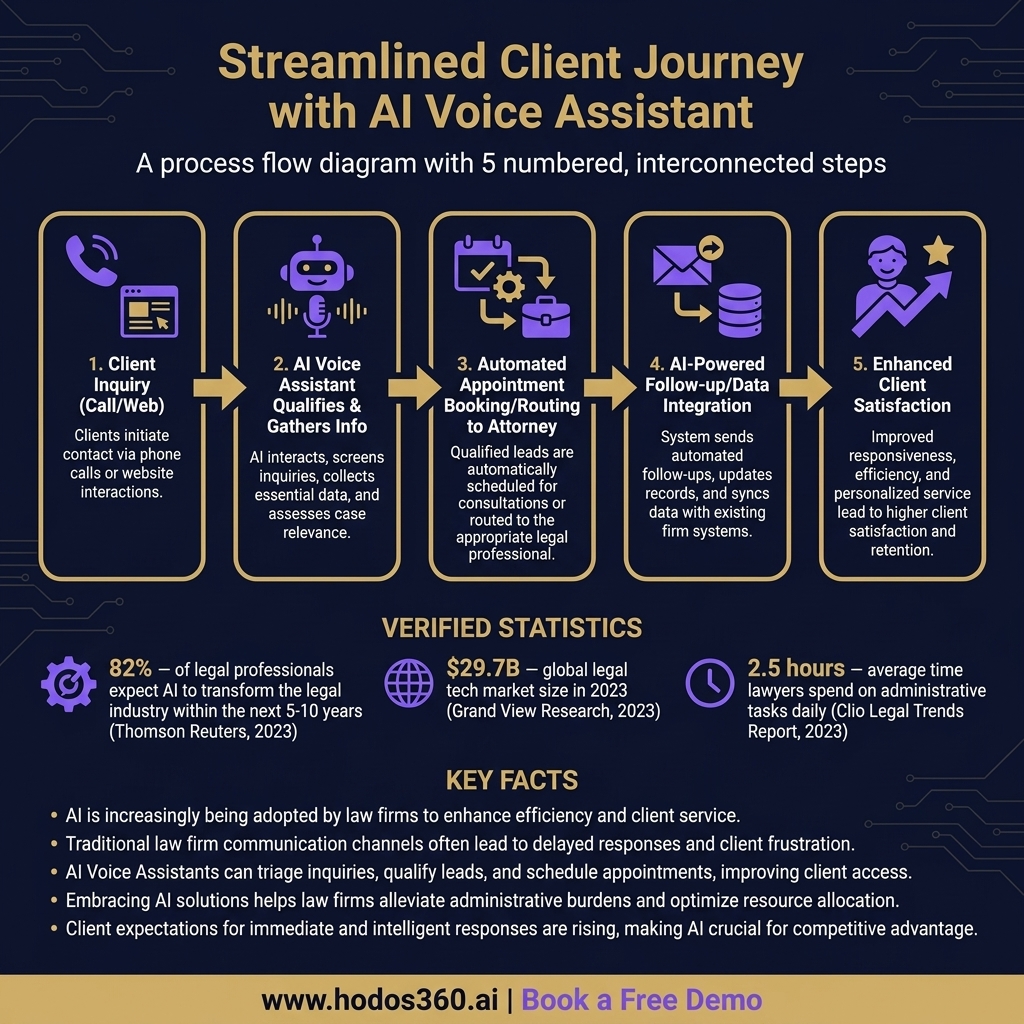
For instance, an AI voice assistant could not only qualify a lead but also directly create a new client profile within the firm's management system, populate initial case details, and even schedule the first consultation directly into the firm's calendar. This level of integration eliminates manual data transfer, reduces errors, and ensures that client information is immediately accessible across all departments.
HODOS 360 exemplifies this holistic approach, offering AI Voice Assistants that are designed to work in concert with its comprehensive suite of services, from AI-powered legal workflows to client intake automation.
Furthermore, this strategic integration extends to a firm's marketing and online presence. An AI Voice Assistant can feed valuable lead qualification data directly into an AI Marketing Platform, informing targeted campaigns and improving ROI tracking.
For example, if the voice assistant identifies a high volume of inquiries for a specific practice area, the marketing platform can automatically adjust its content generation and social media automation efforts to capitalize on this trend. Similarly, data gathered by the voice assistant can inform SEO optimization strategies for the firm's website, which is often built using Web & Mobile Development tools.
This synergy creates a powerful feedback loop, where client interactions directly inform and enhance both operational efficiency and marketing effectiveness, culminating in a truly AI-powered firm that is responsive, efficient, and strategically positioned for future growth. HODOS 360's integrated platform provides this comprehensive solution, ensuring that every technological component works together to maximize a law firm's potential.

Key Takeaways and Next Steps
The legal industry is undergoing a profound transformation, driven by the strategic integration of AI Voice Assistants. As highlighted by experts like Brian Schiff, these AI-powered tools are not just incremental improvements but fundamental disruptors capable of revolutionizing customer support and operational dynamics, reducing call volumes by up to 90%.
For law firms, this translates into unprecedented opportunities for enhanced client experience, significant cost reduction, and optimized operational efficiency. From intelligent lead qualification and 24/7 multilingual support to seamless client intake automation, AI Voice Assistants are reshaping how legal practices acquire, serve, and retain clients.
The imperative for law firms is clear: embrace these technologies not as optional add-ons but as essential components of a modern, competitive strategy.
As you consider the next steps for your firm, prioritize solutions that offer robust data security and ethical AI practices, ensuring compliance with professional obligations like ABA Model Rule 1.6 on confidentiality.
Look for platforms that offer seamless integration with your existing law firm management systems and comprehensive legal tech ecosystems. The future of legal service delivery is collaborative, with AI Voice Assistants working in tandem with human expertise to deliver superior outcomes. By strategically adopting and integrating these advanced tools, law firms can navigate the evolving landscape, meet rising client expectations, and secure a sustainable, prosperous future in the digital age.
This is not merely about keeping pace with technology; it's about leading the charge towards a more efficient, accessible, and client-centric legal profession.
Frequently Asked Questions
How can AI Voice Assistants reduce call volume by 90%?+
AI Voice Assistants can significantly reduce call volumes by automating responses to frequently asked questions, handling routine inquiries, and directing complex cases to the appropriate human staff. They can provide instant information, manage scheduling, and conduct initial client intake, effectively triaging calls and freeing up human resources from repetitive tasks, thus drastically cutting the need for direct human interaction for common issues.
What are the primary benefits of AI Voice Assistants for law firms?+
The primary benefits include enhanced client experience through 24/7 multilingual support, improved operational efficiency by automating routine tasks, significant cost reduction from reduced administrative overhead, and superior lead qualification and client intake processes. They allow legal professionals to focus on high-value work, improve response times, and expand the firm's capacity without increasing staffing proportionally.
How do AI Voice Assistants handle client confidentiality and data security?+
Reputable AI Voice Assistants are built with robust security protocols, including end-to-end encryption for communications and stored data, secure cloud infrastructure, and strict access controls. Firms must vet vendors for compliance with privacy regulations (e.g., GDPR, CCPA) and ensure adherence to ethical guidelines like ABA Model Rule 1.6. Transparency about data handling and human oversight are crucial for maintaining confidentiality and trust.
Can AI Voice Assistants integrate with existing law firm management systems?+
Yes, advanced AI Voice Assistants are designed for seamless integration with existing law firm management systems, CRM platforms, and scheduling software. This interoperability ensures that client information gathered by the AI can automatically populate case files, trigger conflict checks, and update calendars, creating a unified and efficient workflow. This avoids data silos and maximizes the benefits of automation across the firm's operations.
What is the implementation process for AI Voice Assistants in a law firm?+
The implementation process typically involves an initial assessment of the firm's specific needs and workflows, followed by selecting a suitable AI vendor. This includes configuring the AI with firm-specific scripts, FAQs, and integration points with existing systems. Comprehensive staff training is essential for smooth adoption. Post-implementation, ongoing monitoring, optimization, and regular security audits ensure the AI system operates effectively, ethically, and securely, adapting to evolving firm requirements.