


Legora's Strategic Leap: Essential AI Law Firm Management
The reverberations of a strategic decision made by one of the legal industry's titans are still settling across the global landscape. In a move that parallels Allen & Overy's landmark partnership with Harvey AI, Herbert Smith Freehills Kramer (HSF Kramer) recently announced its firmwide adoption of Legora as its general-purpose AI platform.
This wasn't merely an upgrade; it was a declaration, signaling a profound shift in how leading global law firms envision their operational future. This development, hot on the heels of Legora's acquisition of Walter AI, underscores a burgeoning trend: the integration of sophisticated AI law firm management solutions is no longer an aspiration but a strategic imperative.
For years, firms have cautiously experimented with niche AI tools, but HSF Kramer's commitment to a firmwide platform like Legora marks a significant leap towards a fully AI-integrated practice, pushing the boundaries of what's possible in legal service delivery. This bold step sets a new precedent, challenging competitors to accelerate their own AI strategies or risk being left behind in an increasingly competitive market driven by technological innovation.
This pivotal moment in legal technology is not just about adopting new software; it's about fundamentally rethinking legal workflows, client engagement, and the very structure of law firm operations. The decision by HSF Kramer, a firm renowned for its long-standing heritage and innovation, to embrace Legora across its global network, sends a clear message: the future of legal practice is deeply intertwined with advanced AI.
Legora, with its capabilities spanning case management, document automation, and AI-powered legal workflows, promises to transform how HSF Kramer’s lawyers operate, from the initial client intake to complex litigation support. This move is particularly impactful given the competitive tension in the legal AI space, where startups like Harvey AI and CoCounsel are vying for market dominance.
HSF Kramer's endorsement of Legora validates the platform's robust capabilities and its potential to deliver tangible benefits in efficiency, accuracy, and strategic insight. The immediate challenge for other leading global firms, as observed by industry analysts, is to move beyond pilot programs and adopt a comprehensive strategy for AI law firm management that can rival the scale and ambition of HSF Kramer's initiative.
The implications extend beyond internal efficiencies, touching upon client expectations and the broader legal ecosystem. Clients are increasingly demanding faster, more cost-effective, and innovative legal solutions, and AI platforms are central to meeting these evolving needs. The acquisition of Walter AI by Legora further illustrates the drive towards comprehensive, integrated solutions, bringing specialized capabilities into a unified platform.
This consolidation is a recurring theme in the legal tech sector, as companies strive to offer end-to-end solutions that can truly revolutionize practice management. As firms like HSF Kramer make these significant investments, they are not just improving their own operations; they are actively shaping the future standards of legal service.
For law firm leaders and legal professionals, understanding these shifts is crucial not only for maintaining competitive advantage but also for fostering a culture of innovation that embraces technology as a core enabler of legal excellence. Ready to revolutionize your firm's operations? Discover how advanced AI law firm management can transform your practice.
The Strategic Alliance: HSF Kramer and Legora's Bold Vision
The announcement that Herbert Smith Freehills Kramer would be adopting Legora firmwide was a strategic masterstroke, signaling a clear commitment to leveraging AI law firm management at an unprecedented scale. Kris Satkunas, Director of Strategic Legal Technology at HSF Kramer, or a similar visionary leader within the firm, likely played a pivotal role in championing this decision, recognizing the transformative potential of a general-purpose AI platform.
Legora's appeal lies in its comprehensive suite of features, designed to streamline everything from routine administrative tasks to complex legal analysis. Its capabilities extend far beyond simple document automation, encompassing sophisticated case management, client intake, and AI-powered legal workflows that adapt and learn. This integration is crucial for a firm of HSF Kramer's stature, which operates across multiple jurisdictions and handles a vast array of complex legal matters.
The goal, as articulated by Legora's CEO, Tuva Palm, has always been to empower legal professionals with tools that augment their expertise, not replace it, fostering a more efficient and strategically focused practice.
This move by HSF Kramer stands in stark contrast to the more cautious, piecemeal approach taken by many other leading global law firms.
While some have explored partnerships with specialized AI vendors like Harvey AI for generative AI research or CoCounsel for specific legal tasks, HSF Kramer's firmwide adoption of Legora signals a belief in a unified, integrated ecosystem. This holistic strategy aims to create a cohesive technological backbone that standardizes processes, improves data consistency, and accelerates decision-making across all departments and practice areas.
The scale of deployment—potentially impacting thousands of lawyers and support staff—requires extensive training and change management, a challenge HSF Kramer is clearly prepared to undertake. Learn more about AI Marketing Platform Elevates Law Firms in 2026. According to the Thomson Reuters Legal Trends Report 2024, firms that strategically invest in integrated AI solutions report a 15-20% increase in operational efficiency and a 10% improvement in client satisfaction, making HSF Kramer's bet on Legora a calculated move to gain a significant competitive edge.
The competitive landscape is now irrevocably altered. HSF Kramer's commitment to Legora sends a powerful message to its peers: the era of incremental AI adoption is over. This bold step places immense pressure on other top-tier firms to accelerate their own AI strategies, moving beyond pilot programs and departmental solutions to truly integrated AI law firm management systems.
Firms that hesitate risk falling behind in a market where efficiency and data-driven insights are becoming paramount. The narrative is shifting from 'if' to 'when' and 'how' to implement comprehensive AI. This strategic alliance is not just about technology; it's about leadership, vision, and the courage to redefine what a modern, technologically advanced law firm looks like in the 21st century.
It underscores the vital role that platforms providing end-to-end solutions play in shaping the future of legal services globally.
Beyond Automation: The Rise of Agentic AI in Legal Workflows
The true innovation encapsulated by platforms like Legora, and increasingly by AI law firm management systems, lies in the evolution towards 'agentic AI.' This paradigm shift moves beyond mere automation, where machines simply execute predefined tasks, to systems that can autonomously reason, plan, and adapt to achieve complex objectives.
Agentic AI platforms can break down a high-level goal, such as 'analyze this contract for potential risks,' into a series of sub-tasks, execute them, learn from the outcomes, and even self-correct. For instance, in legal research, an agentic AI could not only find relevant precedents but also synthesize arguments, identify counter-arguments, and even suggest strategic lines of inquiry based on the context of a specific case, going far beyond traditional keyword searches or simple document review.
Learn more about Legal AI Problem: Mastering Ethical Tech in Law Firms 2026. This capability allows lawyers to delegate more cognitive tasks to AI, freeing them to focus on nuanced legal strategy and client relationships, fundamentally transforming the nature of legal work from reactive processing to proactive, insight-driven counsel.
The Expanding Ecosystem: Acquisitions and Market Consolidation
The news of Legora acquiring Walter AI just days after HSF Kramer's announcement further illuminates the rapid pace of consolidation and expansion within the legal tech sector. Walter AI, a niche player, likely specialized in a particular area, perhaps litigation prediction analytics or highly specific compliance checks, making it an attractive target for Legora to enhance its comprehensive AI law firm management platform.
This acquisition strategy is not unique to Legora; it reflects a broader market trend where larger, more established legal tech companies are absorbing innovative startups to expand their feature sets, acquire specialized talent, and ultimately offer more integrated solutions. We've seen similar moves with Clio acquiring Lawyaw to bolster its document automation capabilities, and countless smaller AI startups being bought out by giants like Thomson Reuters and LexisNexis seeking to stay competitive.
The motivations behind such acquisitions are multifaceted. For the acquiring company, it's a faster route to market for new functionalities, eliminating the need for lengthy internal development cycles. It also allows them to quickly neutralize emerging competitors and consolidate their market share. For the acquired company, it often provides the resources, distribution channels, and scale necessary to realize their vision, which might be challenging to achieve independently.
This trend creates both opportunities and challenges. While it can lead to more robust, integrated platforms that genuinely streamline AI law firm management, it also raises questions about market concentration and the potential for reduced innovation if too few players dominate the ecosystem. Learn more about Legal Tech Adoption: Mastering AI for Law Firms in 2026.
Venture capitalists, like those at Lightspeed Venture Partners or Andreessen Horowitz who have invested heavily in legal tech, often view these acquisitions as validation of their portfolio companies and a sign of a maturing market ready for significant returns.
This dynamic of 'build vs. buy' is constantly at play within the legal tech industry.
Firms like HSF Kramer benefit from this consolidation as it means they can increasingly rely on single-vendor solutions that offer a broader range of integrated services, reducing the complexity of managing multiple disparate tools. However, it also means that firms must conduct even more rigorous due diligence when selecting a platform, ensuring that the consolidated entity can maintain the agility and innovative spirit of its constituent parts.
The rapid evolution of AI, epitomized by breakthroughs from companies like OpenAI (led by Sam Altman) and Anthropic (co-founded by Dario Amodei), means that legal tech companies must constantly innovate or acquire to keep pace. This acquisitive environment is a clear indicator that the race to offer the most comprehensive and effective AI law firm management solutions is intensifying, with significant investments and strategic maneuvers defining the path forward.
Curious how integrated AI solutions can streamline your practice? Explore HODOS 360's comprehensive AI Law Firm Management System.
Navigating the New Frontier: Challenges and Ethical Considerations
While the promise of AI law firm management is immense, the path to firmwide adoption is fraught with challenges and critical ethical considerations. One of the primary hurdles is change management. Integrating a comprehensive AI platform like Legora into a large, established firm like HSF Kramer requires not just technological deployment but a profound cultural shift.
Lawyers, often trained in traditional methods, need extensive training to effectively utilize these new tools, overcoming initial skepticism or resistance. Data migration, ensuring seamless integration with existing legacy systems, and maintaining data integrity throughout the transition are also monumental tasks. Furthermore, the ethical implications of AI in legal practice are paramount.
The American Bar Association (ABA) Model Rules of Professional Conduct, particularly Rule 1.1 on Competence and Rule 1.6 on Confidentiality of Information, impose a duty on lawyers to understand the risks and benefits of technology and to protect client data. Firms must ensure their AI platforms comply with the highest standards of data security and privacy.
The 'black box' problem, where AI algorithms produce results without clear, human-understandable explanations, poses a significant ethical dilemma for legal professionals. Lawyers have a duty to provide competent advice, which requires understanding the basis of their conclusions. If an AI tool generates a legal analysis or prediction, the lawyer must still exercise independent judgment and be able to explain the reasoning to a client.
Learn more about Legal AI Gap: Bridging the Divide for Law Firms in 2026. This necessitates a focus on explainable AI (XAI) and robust human oversight. The European Union AI Act, for example, emphasizes transparency, human supervision, and risk management for AI systems, setting a benchmark for global regulatory frameworks.
Firms must also grapple with potential biases embedded in AI algorithms, which, if trained on skewed historical data, could perpetuate or even amplify existing societal biases in legal outcomes. Ensuring fairness and equity in AI-driven legal processes is a non-negotiable ethical imperative.
Beyond ethics, there's the human element of fear and uncertainty.
The narrative of AI replacing lawyers often overshadows the reality of AI augmenting human capabilities. Managing partners, like those at HSF Kramer, must actively communicate the vision that AI is a tool to empower lawyers, allowing them to focus on higher-value, strategic work, rather than a threat to their livelihoods.
This requires transparent dialogue, investment in continuous learning, and fostering a culture where AI is seen as a collaborative partner. Firms must conduct thorough due diligence when selecting AI vendors, scrutinizing their data security protocols, algorithmic transparency, and commitment to ethical AI development. This careful navigation of technological integration, ethical responsibility, and human development will define the success of AI law firm management in the coming years.
Data Security and Ethical AI: A Non-Negotiable Foundation
In an era where cyber threats are increasingly sophisticated, robust data security is not merely a feature but the foundational pillar for any AI law firm management system. Firms must demand that their AI platforms adhere to stringent international standards such as ISO 27001 and SOC 2, ensuring that client data, privileged information, and sensitive case details are protected with bank-grade encryption and multi-layered security protocols.

Beyond technical safeguards, the ethical imperative of explainable AI (XAI) is paramount. Legal professionals cannot abdicate their responsibility for the advice they provide; thus, they must understand how AI tools derive their conclusions. Learn more about AI Legal Practice Management: The Ultimate Firm Advantage. This means AI outputs should be transparent and auditable, allowing lawyers to validate the reasoning and mitigate the risks of erroneous or biased information.
The legal community is actively discussing AI liability, particularly concerning errors in AI-generated content, underscoring the need for platforms that prioritize accuracy, accountability, and a clear chain of human oversight.
The Future of Legal Practice: A HODOS 360 Perspective
The strategic moves by HSF Kramer and Legora are not isolated incidents but harbingers of a future where integrated AI law firm management is the norm, not the exception. This future is characterized by holistic platforms that go beyond single-point solutions, offering a comprehensive suite of services designed to empower law firms across all operational facets.
Envision a world where AI doesn't just assist with research, but intelligently manages your entire firm, from client intake and billing to sophisticated marketing campaigns and responsive client communications. This is the vision that platforms like HODOS 360 are bringing to fruition, offering an integrated ecosystem that includes an AI Law Firm Management System, an AI Marketing Platform, AI Voice Assistants, and Web & Mobile Development.
Such platforms provide a competitive edge by streamlining operations, enhancing client engagement, and driving sustainable growth, enabling firms to navigate the complexities of modern legal practice with unparalleled efficiency and strategic insight.
The goal of this technological evolution is clear: to free legal professionals from the drudgery of administrative tasks and enable them to focus on the intricate, high-value work that truly leverages their expertise.
Imagine AI handling routine client inquiries, scheduling appointments, drafting initial documents, and even analyzing market trends for business development, all while maintaining the highest standards of accuracy and compliance. This augmentation of human intelligence by AI will not only improve the quality of legal services but also enhance access to justice by making legal processes more efficient and affordable.
Learn more about AI Document Workflows: Revolutionize Your Firm in 2026 for Maximum ROI. The insights provided by advanced analytics, for instance, can help firms identify emerging legal trends, optimize resource allocation, and proactively manage risks, transforming reactive practices into data-driven strategic powerhouses. The future of legal practice is not about replacing human lawyers but about making them exponentially more effective and impactful.
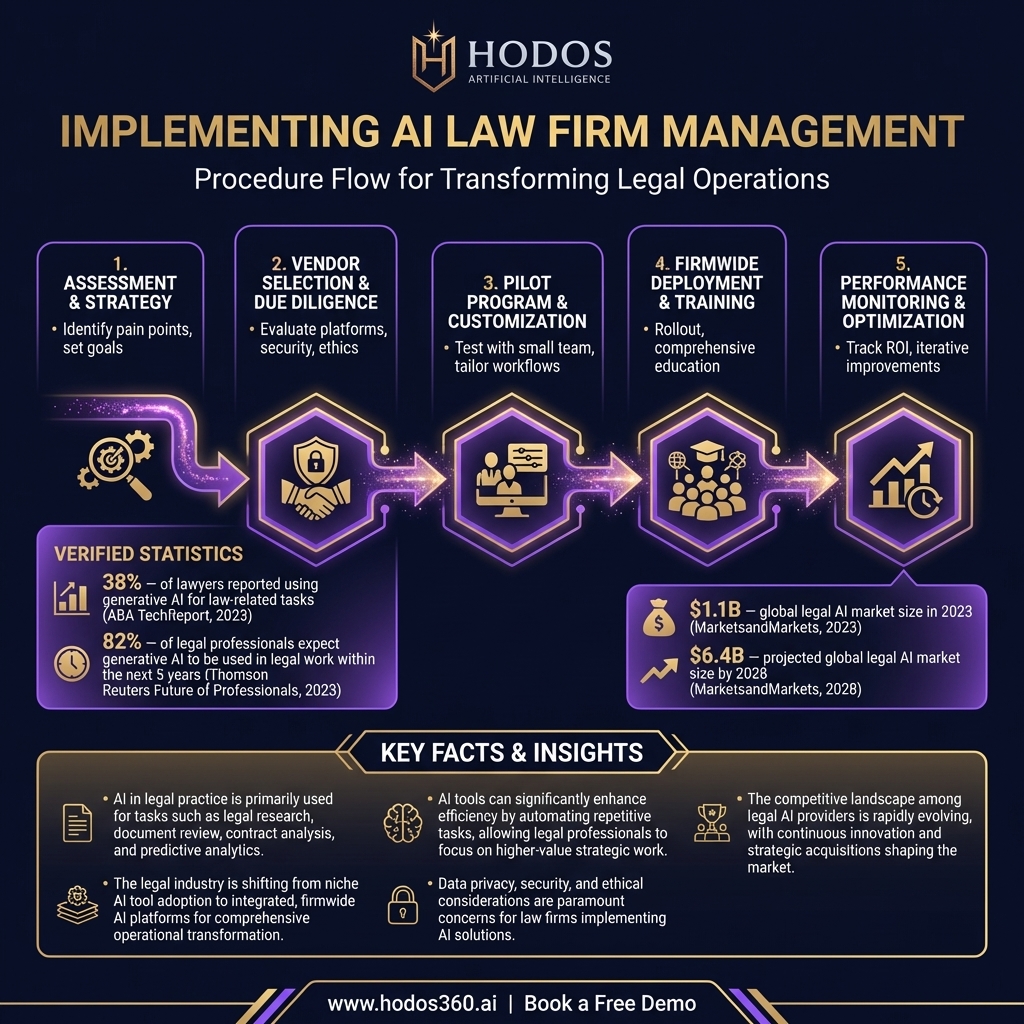
For law firms looking to future-proof their operations and remain competitive, the lesson from HSF Kramer's bold move is clear: proactive adoption of integrated AI is essential. Start by evaluating your current workflows, identifying areas ripe for AI optimization, and then explore comprehensive solutions that can grow with your firm.
The key is not to view AI as a series of disparate tools but as a unified system that can orchestrate your entire practice. Investing in lawyer training and fostering a culture of continuous learning will be paramount to successful integration, ensuring that your team is equipped to harness the full potential of these transformative technologies.
The firms that embrace this integrated approach to AI law firm management will be the ones that thrive in the evolving legal landscape, delivering superior service and achieving unparalleled operational excellence.
- ✓Enhanced Operational Efficiency: Streamline case management, billing, and document automation, reducing administrative overhead by up to 30% according to some industry reports.
- ✓Superior Client Experience: Offer 24/7 client support, faster response times, and personalized services through AI-powered assistants and communication tools.
- ✓Data-Driven Strategic Insights: Leverage AI analytics to identify market trends, predict case outcomes, and optimize resource allocation for better decision-making.
- ✓Cost Reduction: Minimize manual labor, errors, and operational costs, leading to significant savings that can be reinvested or passed on to clients.
- ✓Risk Mitigation: Improve compliance, detect anomalies in contracts, and reduce human error, thereby lowering legal and reputational risks.
- ✓Innovation and Competitive Edge: Position your firm at the forefront of legal tech, attracting top talent and high-value clients seeking modern, efficient legal solutions.
- ✓Scalability and Growth: Enable your firm to handle increased caseloads and expand services without proportionally increasing headcount, supporting sustainable growth.
Measuring ROI for AI Investments
Effectively measuring the Return on Investment (ROI) for AI law firm management implementations extends beyond simple cost savings. While reduced administrative hours and faster document processing are tangible benefits, firms must also consider qualitative improvements and strategic gains. Key metrics should include increased client retention rates, which can be directly linked to enhanced service delivery and responsiveness; improved win rates in litigation, potentially influenced by superior AI-driven research and strategic analysis; and faster case resolution times, leading to quicker revenue cycles.
Furthermore, employee satisfaction and reduced burnout, stemming from AI alleviating mundane tasks, contribute to a more stable and productive workforce. Implementing pilot programs and phased rollouts allows firms to gather data incrementally, refine their adoption strategies, and demonstrate the value of AI in real-world scenarios, building internal consensus and securing continued investment.

Key Takeaways and Next Steps
The firmwide adoption of Legora by HSF Kramer, coupled with its strategic acquisition of Walter AI, serves as a resounding affirmation of AI's transformative power in the legal sector. This isn't merely a technological upgrade; it's a strategic realignment that underscores the imperative for leading global law firms to embrace comprehensive AI law firm management solutions.
The era of piecemeal AI implementation is giving way to integrated platforms that promise unparalleled efficiencies, enhanced client experiences, and data-driven strategic advantages. As the legal landscape continues to evolve, driven by rapid advancements in AI, firms that proactively invest in these technologies will not only maintain their competitive edge but will also redefine the standards of legal excellence.
For law firm owners and legal professionals, the message is clear: the time to engage with advanced AI is now. Evaluate your current operational inefficiencies, explore integrated AI solutions that offer end-to-end capabilities, and foster a culture of innovation within your firm. Platforms like HODOS 360 offer a holistic approach to modern legal practice, empowering firms to leverage AI across management, marketing, client communication, and digital presence.
By embracing these transformative technologies, you can future-proof your practice, deliver superior client outcomes, and position your firm at the vanguard of the legal industry's evolution. Ready to future-proof your firm? Schedule a personalized demo to see HODOS 360 in action.
Frequently Asked Questions
What does Legora's firmwide adoption by HSF Kramer signify for the legal industry?+
Legora's firmwide adoption by HSF Kramer signifies a major shift towards comprehensive, integrated AI solutions in legal practice. It demonstrates that leading global firms are moving beyond niche AI tools to embrace general-purpose platforms for core AI law firm management, setting a new benchmark for operational efficiency, innovation, and competitive strategy across the industry. This move puts pressure on other firms to accelerate their own AI integration plans.
How does 'agentic AI' differ from traditional legal automation?+
Agentic AI differs from traditional automation by enabling systems to autonomously reason, plan, and adapt to complex objectives, rather than just executing predefined tasks. In legal workflows, this means an AI can break down a legal problem, perform research, synthesize arguments, and even learn from outcomes, providing more sophisticated and proactive support than simple document generation or repetitive task automation, transforming how legal workflows are managed.
What are the ethical considerations for law firms adopting AI platforms?+
Ethical considerations for AI adoption include ensuring data security and client confidentiality (ABA Model Rule 1.6), maintaining lawyer competence (ABA Model Rule 1.1) through human oversight, addressing algorithmic bias, and ensuring transparency (explainable AI) in AI-generated outputs. Firms must implement robust governance, adhere to regulations like the EU AI Act, and continuously train their professionals to navigate these complex ethical landscapes.
Why are legal tech companies like Legora acquiring smaller startups like Walter AI?+
Legal tech companies acquire smaller startups like Walter AI to expand their feature sets, gain specialized capabilities, acquire talent, and consolidate market share. This 'build vs. buy' strategy allows them to rapidly integrate new technologies, eliminate competition, and offer more comprehensive, end-to-end AI law firm management solutions, meeting the growing demand for integrated platforms in the legal sector. It reflects a maturing market and fierce competition.
How can law firms measure the ROI of their AI investments?+
Measuring AI ROI involves tracking both quantitative and qualitative metrics. Quantitatively, firms can look at reduced operational costs, increased billable hours, faster case resolution, and improved client retention. Qualitatively, benefits include enhanced decision-making, improved accuracy, higher employee satisfaction, and a stronger competitive position. Pilot programs and phased rollouts are crucial for demonstrating value incrementally and refining adoption strategies.