


AI Web Scraping: Essential Strategies for Legal Intelligence
In the cutthroat world of legal practice, information is power. For decades, law firms have relied on traditional, often manual, methods to gather intelligence—scouring public records, subscribing to expensive databases, and relying on anecdotal evidence. However, as the digital landscape evolves at an unprecedented pace, these methods are proving insufficient. The recent "Digital Journal" article, "AI platforms reshape the web scraping landscape as business intelligence priorities shift," perfectly encapsulates a seismic change that legal professionals can no longer ignore. This isn't just a tech trend; it's a fundamental shift in how law firms can acquire, analyze, and leverage data to gain a decisive competitive edge, moving beyond reactive strategies to proactive, data-driven decision-making.
The advent of sophisticated AI-powered web scraping tools marks a pivotal moment for the legal sector. Imagine a world where a managing partner, like Eleanor Vance of Vance & Associates, can instantly access real-time data on emerging regulatory shifts, competitor fee structures, or even public sentiment surrounding specific legal issues. This was once the realm of science fiction, but today, it's a tangible reality made possible by advanced AI platforms. These tools transcend basic data collection, employing machine learning models to understand context, identify patterns, and extract nuanced insights from vast oceans of unstructured web data. The stakes are high: firms that embrace this technological leap stand to redefine their market position, while those that cling to analog approaches risk being left behind in a rapidly digitizing legal ecosystem.
This transformation is not without its complexities, particularly in an industry as regulated and ethically sensitive as law. The promise of AI web scraping for enhanced legal intelligence is immense, offering unparalleled opportunities for data extraction and competitive analysis. Yet, navigating the intricate web of data privacy laws, ethical guidelines, and terms of service is paramount. This comprehensive guide will delve into the strategic advantages, ethical considerations, and practical implementation of AI-powered web scraping, empowering law firms to harness this potent technology responsibly and effectively. The goal is clear: to equip legal professionals with the knowledge to transform raw data into actionable insights, driving growth and innovation.
The Evolving Landscape of AI Web Scraping in Legal Tech
The shift in the web scraping landscape, as highlighted by recent industry reports, is not merely incremental; it's a paradigm shift driven by artificial intelligence. Traditional web scraping, often reliant on simple scripts and manual oversight, struggled with dynamic websites, anti-bot measures, and the sheer volume of unstructured data. Today, AI web scraping platforms deploy sophisticated crawlers that mimic human browsing behavior, learn from website structures, and adapt to changes, ensuring higher success rates and data quality. This evolution is particularly critical for the legal sector, where precision and comprehensive data are non-negotiable. Firms can now gather data points that were previously inaccessible, from niche legal forum discussions to obscure regulatory filings, providing a richer tapestry for business intelligence.
Leading the charge are innovations from companies like OpenAI and Anthropic, whose advanced large language models (LLMs) are being integrated into specialized scraping tools. These AI-powered tools don't just extract text; they understand its context, categorize information, and even summarize complex legal documents found online. For instance, a firm might use an AI-driven scraper to monitor legislative debates across multiple government portals, instantly flagging proposed changes that could impact client industries. This level of intelligent data extraction transforms raw data into actionable insights, enabling law firms to anticipate market shifts and advise clients proactively, a capability that was once resource-intensive and often reactive.
The impact on data acquisition is profound. Learn more about AI Voice Security: Essential Safeguards for Law Firms. According to a 2024 report by Thomson Reuters Institute, law firms that actively leverage AI for data analytics are 40% more likely to report increased profitability and client satisfaction. This data underscores the competitive imperative for adopting modern scraping techniques. Firms like Linklaters have publicly discussed their investments in AI-driven data strategies, recognizing that the future of legal practice is intertwined with advanced data analytics. This modern approach to scraping is not just about collecting more data, but about collecting the *right* data, with an unprecedented level of efficiency and accuracy, effectively reshaping the entire legal landscape of information gathering.
The competition among legal tech providers to offer superior AI web scraping capabilities is intensifying. Startups are emerging with solutions specifically tailored to legal compliance and the nuances of legal data. These tools are designed to handle the specific challenges of legal research, such as parsing complex statutes or identifying relevant case law citations from public court records, often in multiple jurisdictions. The ability of these platforms to rapidly process and structure vast amounts of information gives firms a significant edge in competitive analysis, allowing them to identify market gaps, assess rival strategies, and refine their own service offerings based on real-time, data-driven intelligence.
Strategic Advantages: Unlocking Legal Market Insights with AI-Powered Data Acquisition
For law firms, the strategic advantages of deploying AI web scraping are multifaceted, extending far beyond simple information gathering. One of the most critical benefits is enhanced competitive analysis. Imagine a firm using AI crawlers to monitor competitor websites, news mentions, and public court dockets to identify their latest client wins, new practice area expansions, or even changes in their fee structures. This intelligence can inform strategic decisions, allowing a firm to adjust its marketing, pricing, or service offerings to maintain or gain market share. For instance, a firm might discover a surge in a competitor's activity in a specific emerging technology sector, prompting them to invest in specialized expertise or targeted marketing efforts. This detailed insight into the market is invaluable for strategic planning.
Beyond competitive intelligence, AI web scraping offers unparalleled capabilities for market trend prediction. By continuously monitoring industry news, regulatory bodies, and economic indicators, AI can identify nascent legal needs or impending regulatory shifts before they become mainstream. For example, a firm specializing in environmental law could use AI to scrape global climate policy proposals, academic research, and corporate sustainability reports, identifying potential areas of future litigation or advisory work related to new green energy mandates. This proactive approach allows firms to develop expertise and services in anticipation of client demand, positioning them as thought leaders and first-movers in emerging legal fields. Learn more about AI Chatbot Psychology: Essential Insights for Law Firms. The ability to forecast and prepare for these changes is a game-changer for long-term growth and stability.
Furthermore, AI-powered data acquisition significantly optimizes client intake and litigation strategy. By scraping public data such as corporate filings, news articles about business expansions, or even social media discussions around specific legal challenges, firms can identify potential clients who are actively seeking legal services. This targeted lead generation is far more efficient than traditional marketing. In litigation, AI can gather public information about opposing counsel's past cases, judges' rulings, or expert witnesses' publications, providing a strategic advantage in developing compelling arguments. According to an ABA TechReport from 2025, firms leveraging advanced data analytics for client acquisition reported a 20% improvement in lead conversion rates, demonstrating the tangible ROI of these technologies.
This modern approach to data extraction is fundamentally reshaping how law firms operate, moving them from reactive service providers to proactive strategic partners. The ability to quickly and accurately gather vast amounts of public data, then process it through AI for deep insights, empowers firms to make more informed decisions across every facet of their business. This includes identifying new practice areas, optimizing resource allocation, and even predicting potential risks or opportunities. The transformation is not just about efficiency; it's about fundamentally changing the competitive dynamics of the legal industry, rewarding those who embrace intelligent data strategies.
Enhancing Practice Management and Workflow Automation
The insights gleaned from AI web scraping are not confined to strategic planning; they can directly feed into and enhance a firm's daily operations and AI Law Firm Management System. Imagine a new client intake process where public data, scraped by AI, automatically pre-fills forms with company details, executive information, and relevant business history, significantly reducing administrative burden and potential errors. This automation not only saves time but also ensures a higher degree of accuracy in client records from the outset. Similarly, for ongoing cases, AI can populate case management systems with relevant public news articles, regulatory updates, or competitor activities, ensuring all team members have access to the most current and comprehensive information. Learn more about AI Voice Clones: The Ultimate Legal Battle for Control. This seamless integration of external data streamlines legal workflows and allows attorneys to focus on high-value legal work rather than data entry or manual research. Firms seeking to further streamline legal workflows with AI can find significant efficiencies here.
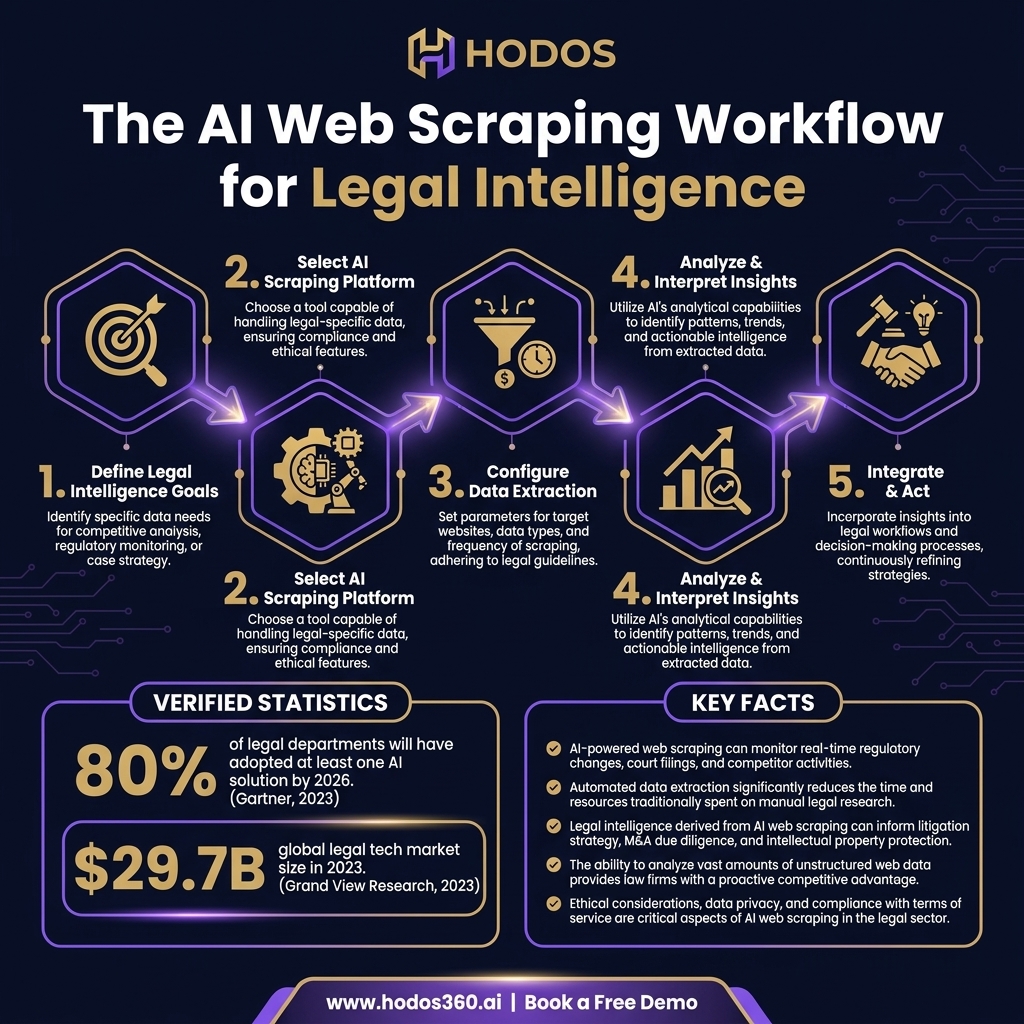
Navigating the Ethical and Legal Complexities of AI Data Extraction
While the benefits of AI web scraping are undeniable, law firms must navigate a complex ethical and legal minefield to ensure compliance and maintain professional integrity. The legality of web scraping often hinges on whether the data is publicly available, if it violates a website's terms of service, and the potential for copyright infringement or privacy violations. A landmark case, hiQ Labs v. LinkedIn (2019), affirmed that scraping publicly available data is generally lawful under the Computer Fraud and Abuse Act (CFAA), but this ruling has nuances and has been subject to ongoing debate and interpretation. Firms must exercise extreme caution, ensuring their data extraction practices do not cross into unauthorized access or data misuse. The ethical imperative extends to client data protection and transparency regarding data sources, aligning with principles outlined in the ABA Model Rule 1.6 (Confidentiality of Information), which emphasizes a lawyer's duty to protect client information.
The rise of global data privacy regulations, such as the EU AI Act and the California Consumer Privacy Act (CCPA), adds layers of complexity. These regulations impose strict requirements on how personal data is collected, processed, and stored, regardless of whether it's publicly available. Firms engaging in AI web scraping must implement robust data governance frameworks that ensure compliance with these laws, including anonymization or pseudonymization of personal data where necessary. This legal drama often involves a tension between the desire for comprehensive data and the fundamental right to privacy, requiring firms to make judicious choices about the scope and nature of their scraping activities. The industry is still grappling with the full implications of these laws for AI-powered data acquisition, making careful legal counsel essential.
Ethical considerations extend to respecting website robots.txt protocols and avoiding actions that could be construed as malicious or disruptive, such as excessive request rates that could overload a server. Learn more about AI Law Firm Expansion: An Ultimate Guide to Growth & Innovation. The legal community itself is divided on the extent to which firms should engage in aggressive data collection, with some arguing for a more conservative approach to uphold the profession's reputation for integrity. This internal conflict highlights the need for clear internal policies and ongoing training for legal professionals on the responsible use of AI web scraping tools. Firms that prioritize ethical compliance not only mitigate legal risks but also build trust with clients and the broader public, reinforcing their commitment to responsible innovation. Understanding AI ethics in legal practice is no longer optional.
The consequences of non-compliance can be severe, ranging from hefty fines and reputational damage to legal challenges and disbarment proceedings. Therefore, any firm considering AI web scraping must conduct a thorough legal and ethical review, ideally with external counsel experienced in data privacy and intellectual property law. This includes assessing the source of the data, the purpose of its collection, and the safeguards in place to protect it. The goal is to leverage the power of AI for legal intelligence while scrupulously adhering to all applicable laws and ethical guidelines, ensuring that technological advancement never compromises the fundamental principles of the legal profession. This balancing act is a defining challenge for modern law firms.
Implementing Robust AI Web Scraping Solutions: Tools and Best Practices
Implementing effective AI web scraping solutions requires a strategic approach that combines the right tools with robust best practices. For law firms, this often means moving beyond basic open-source libraries like Beautiful Soup or Scrapy to specialized commercial AI-based platforms that offer enhanced features such as anti-bot circumvention, dynamic content handling, and built-in data cleaning capabilities. These advanced solutions are designed to tackle the complexities of modern websites and ensure the reliability and integrity of the extracted data. Firms might consider custom-built crawlers developed by expert Web & Mobile Development teams, tailored to specific legal research needs and compliance requirements. This ensures the solution is perfectly aligned with the firm's strategic goals and integrates seamlessly with existing legal tech infrastructure.
Best practices for AI web scraping in the legal context are paramount for both efficiency and compliance. Firstly, always respect robots.txt files, which indicate parts of a website that explicitly forbid automated access. Secondly, implement intelligent rate limiting to avoid overwhelming target servers, which can lead to IP bans or legal action. Thirdly, prioritize data validation and cleaning to ensure the accuracy and relevance of the acquired information, as raw scraped data can often be noisy or inconsistent. Fourthly, consider anonymization or pseudonymization of any personal data extracted to comply with privacy regulations, especially for larger-scale data acquisition projects. Learn more about AI Marketing Automation: Essential Strategies for Law Firms. These practices are not just technical safeguards; they are ethical imperatives that protect the firm's reputation and legal standing.
The role of cloud-based infrastructure cannot be overstated in deploying scalable and efficient AI web scraping solutions. Platforms like AWS, Google Cloud, or Microsoft Azure provide the necessary computational power and storage for processing vast datasets, enabling firms to run multiple AI-powered crawlers concurrently without straining their internal IT resources. This distributed approach facilitates the automation of scraping tasks, allowing for continuous monitoring and real-time data extraction. For a firm seeking to truly future-proof your law firm with AI, leveraging cloud infrastructure for data acquisition is a strategic move that provides flexibility, scalability, and enhanced security, critical for handling sensitive legal information.
At HODOS 360, our Web & Mobile Development services specialize in building custom, compliant AI web scraping solutions specifically for law firms. We understand the unique challenges of legal data acquisition, from navigating complex regulatory landscapes to integrating insights into existing case management and marketing systems. Our approach ensures that firms can ethically and effectively harness the power of AI-powered data extraction to gain a competitive advantage, whether it's for market analysis, lead generation, or litigation support. We focus on creating robust, scalable, and legally compliant tools that transform raw web data into actionable legal intelligence, empowering firms to make smarter decisions and drive growth.
The Role of Cloud Infrastructure in Scalable Scraping
The sheer volume of data available on the web, combined with the computational intensity of AI models, necessitates robust infrastructure for scalable AI web scraping. Cloud platforms provide the elasticity to scale computing resources up or down based on demand, making them ideal for large-scale data acquisition projects. This means a law firm can launch hundreds or even thousands of AI-powered crawlers simultaneously to gather information from diverse sources without worrying about hardware limitations. Learn more about AI App Development Costs: Proven Strategies for Legal Firms. Furthermore, cloud services offer advanced data storage, processing, and security features that are crucial for managing sensitive legal data. This infrastructure ensures not only the speed and efficiency of data extraction but also its secure storage and accessibility for subsequent analysis, providing a reliable foundation for any modern legal intelligence strategy.
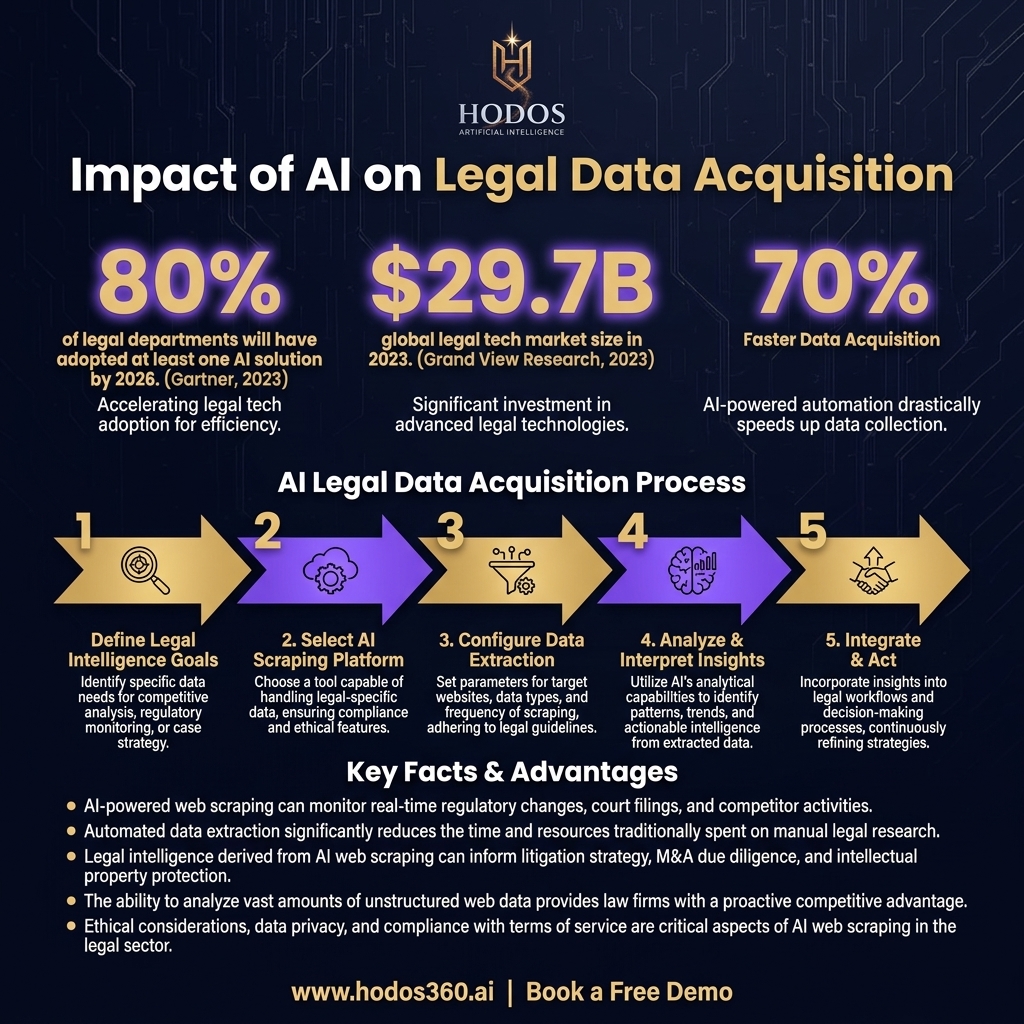
The Future of Legal Intelligence: AI Web Scraping and Beyond
The future of legal intelligence is inextricably linked to the continued evolution of AI web scraping and its integration with other advanced AI technologies. We are moving towards a future where AI-powered tools will not only collect data but also perform sophisticated predictive and prescriptive analytics. Imagine AI identifying patterns in public court records to predict litigation outcomes with a high degree of accuracy, or analyzing market sentiment to advise on the optimal timing for a corporate acquisition. This combined approach, integrating AI web scraping with natural language processing (NLP) and machine learning models, will allow law firms to move from merely understanding the past to actively shaping the future.
Industry leaders and venture capitalists, such as Aileen Lee of Cowboy Ventures, who has invested heavily in legal tech, foresee a future where law firms operate more like data-driven enterprises. The ability to leverage external public data, process it with AI, and derive deep insights will become a core competency for competitive firms. This shift will create a clear divide: firms that embrace these technologies will build significant competitive moats, while those that do not will struggle to keep pace. The ongoing development of more sophisticated crawlers and AI-based models will continue to expand the scope and depth of accessible legal intelligence, making it possible to uncover insights that are currently unimaginable.
The next frontier involves integrating AI web scraping with real-time feedback loops. For instance, data scraped from public sources could instantly update a firm's internal knowledge base, inform the training of internal legal LLMs, or even trigger automated alerts for specific legal professionals based on their practice areas. This dynamic interaction between external data and internal systems will create a highly responsive and adaptive legal practice. The focus will be on creating a seamless flow of intelligence, where every piece of public information can be quickly assessed for its relevance and impact on client matters or firm strategy. This holistic approach to legal intelligence is poised to redefine efficiency and effectiveness in the legal sector.
Ultimately, the future points towards a highly automated and intelligent legal ecosystem where AI web scraping is a foundational component of a firm's digital strategy. It will enable firms to be more agile, more informed, and more responsive to the complex needs of their clients in a rapidly changing world. The ability to continuously monitor, analyze, and act upon vast amounts of public data will be the hallmark of successful legal practices. This strategic advantage, powered by advanced AI, will allow firms to not only survive but thrive in the increasingly competitive and data-driven legal market, cementing their position as leaders in their respective fields.
Integrating AI Scraping with AI Marketing Platforms
The synergy between AI web scraping and AI Marketing Platforms offers a powerful avenue for law firms to refine their outreach and client acquisition strategies. Data extracted through AI scraping—such as public sentiment on specific legal issues, competitor marketing campaigns, or emerging client pain points identified in online discussions—can directly inform and optimize a firm's marketing efforts. This allows for the creation of highly targeted content, personalized ad campaigns, and more effective social media engagement. For example, if AI scraping identifies a surge in public concern over new data privacy regulations, a firm's AI Marketing Platform can automatically generate blog posts, videos, or social media updates addressing these concerns, positioning the firm as a knowledgeable resource. This integrated approach ensures that marketing spend is optimized, reaching the right audience with the right message at the opportune moment, thereby boosting law firm marketing with AI.

Key Takeaways and Next Steps
The transformation of the legal industry by AI web scraping is not a distant prospect but a present reality. For law firms, embracing this technology is no longer optional but a strategic imperative to remain competitive and relevant. The ability to ethically and efficiently acquire vast amounts of public data, extract meaningful insights, and integrate them into core business processes offers an unparalleled advantage. Firms must prioritize understanding the legal and ethical frameworks governing data collection while simultaneously investing in robust, AI-powered tools and expertise. The journey involves evaluating current data strategies, exploring advanced platforms, and committing to a culture of data-driven decision-making. By doing so, law firms can unlock new avenues for growth, enhance client service, and solidify their position as leaders in a rapidly evolving legal landscape. To navigate this complex but rewarding path, consider partnering with experts in Web & Mobile Development who specialize in legal tech. Book a free demo with HODOS 360 to see our AI-powered Web & Mobile Development in action and discover how we can help your firm harness the full power of AI for legal intelligence.
Frequently Asked Questions
Is AI web scraping legal for law firms?+
The legality of AI web scraping for law firms is nuanced. Scraping publicly available data is generally permissible, but firms must adhere to terms of service, copyright law, and data privacy regulations like GDPR and CCPA. Avoiding unauthorized access or excessive requests is crucial. Consulting legal counsel experienced in data privacy is highly recommended to ensure compliance and mitigate risks.
What kind of data can law firms scrape using AI?+
Law firms can scrape a wide array of publicly available data, including competitor websites for service offerings and pricing, news articles for market trends and client opportunities, public court dockets for litigation intelligence, regulatory agency updates for compliance insights, and industry reports for business development. AI enhances this by intelligently extracting and categorizing relevant information.
How do AI platforms improve traditional web scraping?+
AI platforms significantly improve traditional web scraping by handling dynamic website content, bypassing anti-bot measures more effectively, and performing intelligent data extraction. AI-powered crawlers can understand context, categorize information, and even summarize text, turning raw data into actionable insights much more efficiently and accurately than older, rule-based scraping methods. This leads to higher quality, more relevant data.
What are the risks of using AI web scraping for law firms?+
The primary risks include violating website terms of service, infringing on intellectual property rights, and breaching data privacy laws. Non-compliance can lead to legal action, reputational damage, and financial penalties. Technical risks involve IP blocking or receiving poor-quality data. Firms must implement robust legal reviews, ethical guidelines, and technical safeguards to mitigate these risks effectively.
How can HODOS 360 help my firm implement AI web scraping?+
HODOS 360 offers specialized Web & Mobile Development services to build custom, compliant AI-powered web scraping solutions for law firms. We ensure ethical data acquisition, seamless integration with your existing systems, and tailored data extraction to meet your specific legal intelligence needs. Our expertise helps firms navigate complexities, transforming raw web data into strategic insights for competitive advantage and growth.