

Ultimate AI Website Prompts for Law Firms: Design Mastery
The legal industry, often characterized by its adherence to tradition, is undergoing a profound digital transformation. Consider the story of 'LexFront,' a mid-sized litigation firm in Dallas. For years, their website was an afterthought—a static, outdated digital brochure that failed to capture the firm's true expertise or engage potential clients effectively.
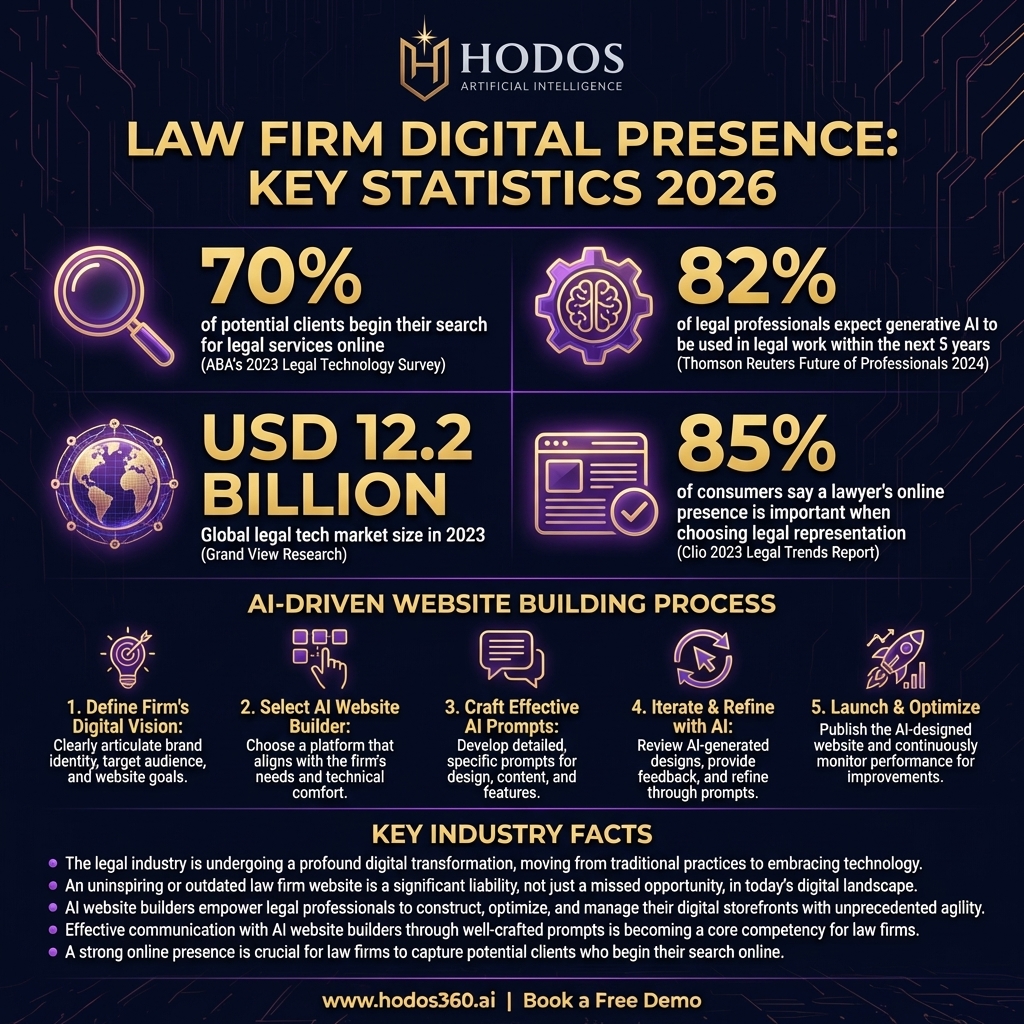
They invested heavily in traditional marketing, yet their online lead generation remained stagnant. This narrative is all too common, highlighting a critical disconnect between a firm's offline reputation and its digital footprint. In an era where 70% of potential clients begin their search for legal services online, as reported by the ABA's 2023 Legal Technology Survey, an uninspiring website is no longer just a missed opportunity; it's a significant liability.
The challenge for firms like LexFront wasn't a lack of ambition, but a lack of accessible, efficient tools to translate their brand into a compelling digital experience. Traditional web development demands substantial time, resources, and often, a hefty budget, making iterative improvements costly and slow.
This created a tension between the need for a dynamic online presence and the practical constraints of legal practice. However, the advent of sophisticated AI website builders is rapidly bridging this gap, offering a revolutionary pathway for law firms to construct, optimize, and manage their digital storefronts with unprecedented agility and precision.
These platforms are not just automating tasks; they are empowering legal professionals to become architects of their own digital destiny.
Today, the ability to effectively communicate with an AI website builder through well-crafted AI website prompts is becoming a core competency for firms aiming for digital excellence.
This isn't about replacing human creativity but augmenting it, allowing legal professionals to articulate their vision and have AI translate it into a stunning, functional website. From conceptualizing intricate legal service pages to integrating secure client portals, the power lies in how you prompt the AI.
This guide will explore how law firms can master prompt engineering to build sophisticated, high-converting websites, transforming their digital presence from a mere formality into a formidable competitive advantage. Ready to elevate your firm's online presence?
The Shifting Sands of Legal Digital Presence: Why AI Web Design Matters
The legal sector has long grappled with the dichotomy of maintaining a traditional, trustworthy image while adapting to the rapid pace of technological change. For years, law firm websites were often static, brochure-ware sites, primarily serving as online business cards. However, the digital landscape has fundamentally shifted.
A 2024 report by Thomson Reuters revealed that over 65% of legal clients now expect a seamless, intuitive digital experience from their law firms, on par with other professional services. This expectation extends beyond mere information; clients seek easy access to services, clear communication channels, and a website that reflects the firm's modern capabilities and client-centric approach.
Firms that fail to meet these evolving expectations risk being overlooked in favor of more digitally savvy competitors, creating a significant human conflict between tradition and innovation.
Traditional web development, while offering bespoke solutions, often comes with prohibitive costs and lengthy timelines. A typical custom website build for a mid-sized law firm can range from $15,000 to $50,000, with development cycles spanning several months.
This financial and temporal burden often deters firms from regular updates or ambitious redesigns, leaving them with outdated platforms. Consider the plight of 'Justice & Co.,' a family law firm in Florida, which spent six months and nearly $30,000 on a new website only to find it wasn't mobile-responsive, a critical oversight in an era where over half of all web traffic originates from mobile devices.
Learn more about Legal AI Adoption: An Essential Guide for Discerning Firms. This scenario underscores the inherent limitations and frustrations of traditional approaches, particularly for firms with limited in-house technical expertise or marketing budgets.
The advent of AI website builders disrupts this paradigm, democratizing access to high-end web design.
These platforms leverage advanced algorithms to interpret user inputs—or AI website prompts—and rapidly generate functional, aesthetically pleasing websites. This efficiency drastically reduces both cost and time-to-market. For instance, a firm can conceptualize, design, and launch a sophisticated website in a fraction of the time and cost compared to traditional methods.
This isn't just about speed; it's about agility, allowing firms to quickly adapt their online presence to new services, market trends, or regulatory changes, maintaining a dynamic and relevant digital footprint. The ability to iterate quickly based on user feedback or market shifts provides a distinct competitive edge, transforming how law firms approach their digital strategy.
A well-constructed prompt can now yield results that once required a team of designers and developers, making sophisticated website design accessible to all.
Mastering the Art of AI Website Prompts for Legal Excellence
The effectiveness of an AI website builder hinges almost entirely on the quality and specificity of the AI website prompts provided. This is where prompt engineering, a skill previously confined to AI researchers, becomes crucial for legal professionals. Think of it not as coding, but as articulating a clear, comprehensive vision to a highly intelligent, albeit literal, assistant.
A vague prompt like 'build a law firm website' will yield generic, uninspired results. Conversely, a detailed prompt that outlines the firm's niche, target audience, desired aesthetic, and key functionalities can produce a truly bespoke digital masterpiece. Learn more about Essential AI Website Builder Guide for Law Firms.
The goal is to move beyond mere keywords and provide context, intent, and examples, much like a high-end design agency would conduct a thorough client brief. This requires a shift in mindset, from expecting magic to meticulously guiding the AI's creative process.
Specificity is paramount when crafting your AI website prompts.
Consider the critical elements that define your law firm: your practice areas (e.g., 'boutique intellectual property litigation firm specializing in patent infringement for tech startups'), your brand identity ('modern, authoritative, and approachable'), your target demographic ('tech founders and venture capitalists seeking sophisticated legal counsel'), and the desired user experience ('intuitive navigation, clear calls to action for consultations, and a secure client portal').
For instance, instead of 'design a contact page,' a superior prompt would be: 'Design a high-converting contact page for a B2B IP law firm, featuring a prominent call-to-action for a free 15-minute consultation, an embedded scheduling tool, clear privacy policy link, and a clean, professional aesthetic using a muted color palette and sans-serif fonts.'
Such detail allows the AI to understand the functional and aesthetic requirements, ensuring the output aligns perfectly with your strategic objectives.
Crafting Client-Centric Design Prompts
Beyond basic functionality, the true power of AI website builders lies in their ability to translate complex design principles into tangible outputs, provided the prompts are sophisticated. To truly build a website that resonates with legal clients, firms must prompt for user experience (UX) and conversion rate optimization (CRO) elements.
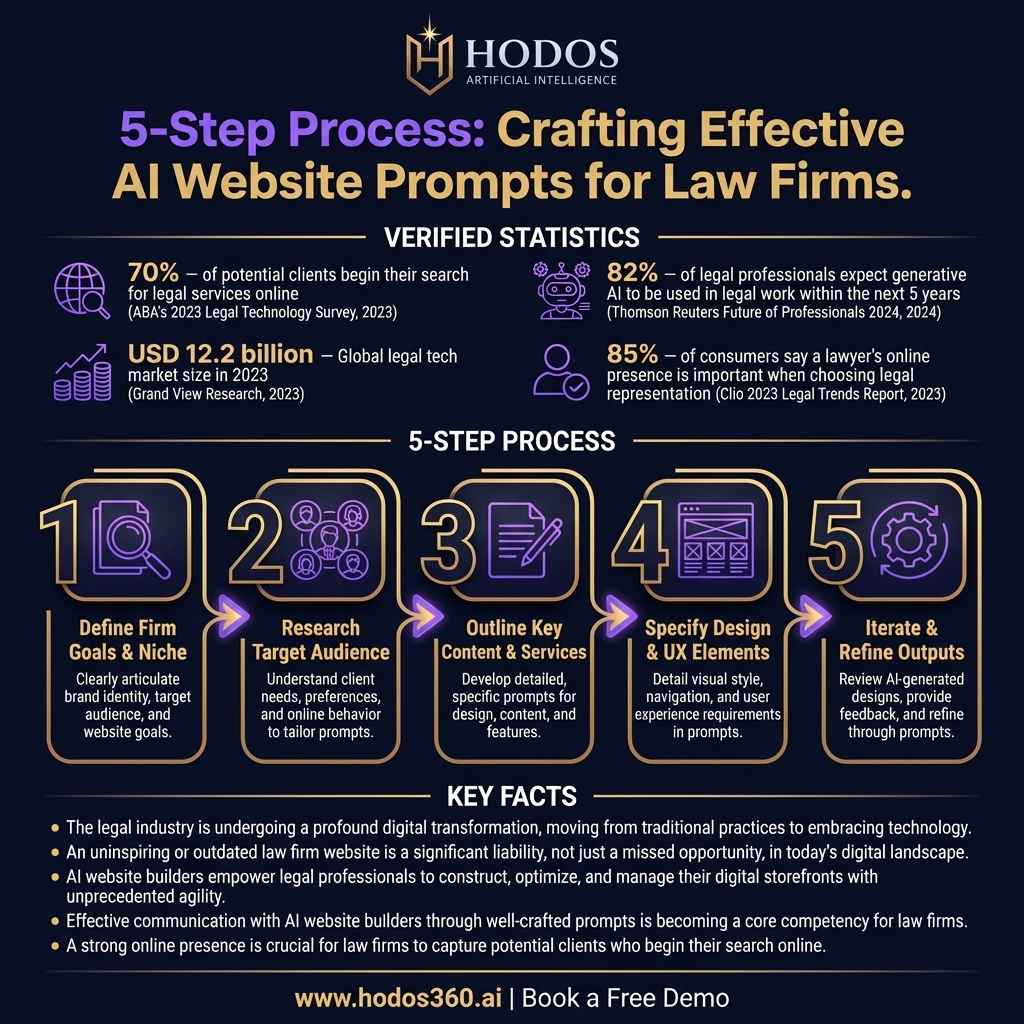
This involves instructing the AI on aspects like visual hierarchy, whitespace usage, mobile responsiveness, and accessibility standards. Learn more about AI Website Coding: An Essential Guide for Law Firms. For example, a prompt could specify: 'Ensure the website is fully responsive across all devices (desktop, tablet, mobile), with fast loading times (under 2 seconds) and adherence to WCAG 2.1 accessibility guidelines for legal compliance.'
Furthermore, consider prompting for emotional resonance: 'Design hero sections that convey trust and authority, using high-quality imagery of diverse professionals and subtle animations rather than flashy graphics.' This level of detail guides the AI to create not just a functional site, but an engaging and trustworthy digital environment that builds client confidence from the first click, ultimately enhancing the firm's digital presence and client acquisition efforts.
The emphasis here is on creating a beautiful yet highly functional experience.
Strategic Content and SEO Prompts to Build Authority
A visually appealing website is only half the battle; its content and search engine optimization (SEO) capabilities determine its visibility and authority. AI website builders, when guided by strategic AI website prompts, can become powerful engines for content generation and SEO implementation. This moves beyond simply populating pages to creating an intelligent, keyword-rich digital asset.
Firms can prompt the AI to generate practice area descriptions, attorney bios, blog posts, and even case study summaries, all infused with relevant legal terminology and optimized for search engines. For instance, a prompt could be: 'Generate a 500-word blog post on "The Nuances of Data Privacy Compliance for Healthcare Providers in 2026," optimized for keywords such as "HIPAA compliance," "data breach litigation," and "healthcare cybersecurity law," maintaining an authoritative yet accessible tone.'
This significantly reduces the burden on legal teams to constantly produce new, SEO-friendly content, allowing them to focus on legal work while the AI strengthens their digital footprint.
Effective SEO requires more than just keywords; it demands technical optimization and strategic content structuring. Learn more about AI Voice Assistants: Essential for Modern Law Firm Efficiency.
Law firms should leverage AI website prompts to ensure their sites adhere to best practices for on-page SEO. This includes prompting for automatically generated meta titles and descriptions that incorporate target keywords, optimized image alt text, and structured data (schema markup) for rich snippets in search results.
For example, a prompt might instruct: 'Implement schema markup for "LegalService" on all practice area pages, including service type, location served, and average client rating, to enhance search engine visibility.' Moreover, AI can assist in content clustering and internal linking strategies, building topical authority around specific legal niches.
By integrating these SEO elements directly into the prompting process, firms can ensure their AI-built website is not only visually striking but also highly discoverable, driving organic traffic and positioning the firm as a thought leader in its respective legal domain.
Integrating Legal-Specific Features and Compliance
The unique demands of the legal profession necessitate specific website features and strict adherence to regulatory compliance. AI website prompts can be engineered to incorporate these critical elements from the outset. This includes prompting for secure client portals, appointment booking systems, and multilingual support for diverse client bases.
For example, a prompt might specify: 'Integrate a secure, HIPAA-compliant client portal accessible via login, allowing document sharing and secure messaging. Learn more about AI Local Search: The Ultimate Visibility Guide for Law Firms. Include an appointment booking widget linked to attorney calendars, offering multilingual options (English, Spanish, Mandarin).'
Furthermore, legal advertising rules, such as those outlined in ABA Model Rule 7.1 (Communications Concerning a Lawyer’s Services), require careful attention to disclaimers, testimonials, and factual accuracy. Prompts can ensure these compliance elements are automatically generated and correctly placed: 'Include a prominent disclaimer regarding attorney-client privilege formation and a clear "past results do not guarantee future outcomes" statement on all testimonial pages, as per state bar guidelines.'
By embedding these legal and functional requirements directly into the AI website prompts, firms can construct a website that is not only effective but also fully compliant and tailored to the unique needs of the legal industry. This ensures the website can truly generate value while adhering to ethical obligations.
The Future is Now: AI's Impact on Law Firm Digital Strategy
The trajectory of AI in web development is one of continuous, rapid evolution, promising even more sophisticated capabilities for law firms. The future isn't just about building static pages; it's about dynamic, personalized digital experiences. Imagine an AI website builder that, based on visitor behavior and demographic data, dynamically adjusts content, calls to action, and even visual elements to better resonate with individual users.
This level of personalization, driven by advanced AI website prompts, could significantly enhance conversion rates and client engagement. Jensen Huang, CEO of NVIDIA, often speaks about the pervasive integration of AI across all industries, stating, 'AI is eating software,' a sentiment particularly relevant to web development.
This means AI will move beyond initial site generation to become an integral part of ongoing website optimization, maintenance, and strategic adaptation, making the initial build just the first step in an ongoing digital journey.
Beyond initial deployment, AI is poised to revolutionize ongoing website management.
Learn more about AI Legal Marketing: Proven Strategies for Law Firm Growth. Firms can leverage AI to conduct real-time A/B testing, identifying which headlines, images, or CTA buttons perform best, and automatically implementing the winning variations. AI-powered analytics can provide deeper insights into user behavior, pinpointing areas for improvement and suggesting proactive changes to the site's structure or content.
This continuous optimization loop ensures the website remains a high-performing asset, constantly adapting to market shifts and client preferences. Firms that embrace these AI-driven maintenance strategies will maintain a significant competitive edge, ensuring their digital presence is always cutting-edge and effective. This proactive approach to website design moves beyond a one-time project to an enduring strategic advantage.
Overcoming Challenges and Maximizing ROI
While the promise of AI website builders is immense, maximizing their ROI requires strategic foresight and skillful prompt engineering. One common challenge is the risk of generating generic content or designs if prompts are too broad. The solution lies in iterative refinement: treating the AI as a collaborative partner, providing feedback, and continuously refining AI website prompts based on initial outputs.
Furthermore, integrating AI-built websites with other legal tech solutions, such as CRM systems or practice management software, is crucial for a cohesive digital ecosystem. Firms like Allen & Overy, known for their early adoption of legal AI, demonstrate that successful integration requires a holistic strategy, not just isolated tech solutions.
By focusing on detailed prompts and seamless integration, law firms can leverage AI website builders to not only reduce development costs and time but also to create a powerful, integrated digital presence that drives client acquisition and enhances operational efficiency, delivering a clear return on investment.
The ability to create beautiful and functional sites quickly is a game-changer.

Key Takeaways and Next Steps for Your Law Firm's Digital Evolution
The era of the static, outdated law firm website is rapidly drawing to a close. In its place emerges a dynamic, AI-powered digital landscape where your firm's online presence is not just a necessity but a strategic differentiator. Mastering AI website prompts is no longer a niche skill but a fundamental capability for law firm owners and marketing teams aiming to build a dominant digital footprint.
By investing time in understanding prompt engineering, you empower your firm to craft bespoke, high-converting websites that reflect your unique value proposition, attract your ideal clients, and streamline your operations. The tension between traditional legal conservatism and digital innovation is resolved by intelligent adoption of these transformative tools, allowing firms to move forward with confidence and agility.
The benefits are clear: reduced development costs, accelerated launch times, enhanced SEO, and the flexibility to rapidly adapt your online strategy. Firms that embrace AI-powered web development are not merely keeping pace; they are setting the pace, outmaneuvering competitors, and securing their position in a competitive legal market.
The power to generate a sophisticated, client-centric website is now at your fingertips, demanding only a clear vision and precise communication with AI. For law firms seeking to leverage these cutting-edge capabilities and build an unparalleled digital presence, platforms like HODOS 360 offer comprehensive AI-powered Web & Mobile Development solutions tailored specifically for the legal industry, enabling you to design, build, and optimize your firm's online success from client intake to case management integration.
Don't just adapt; lead the charge in the digital evolution of legal services. Learn how to build beautiful websites that convert.
Frequently Asked Questions
What are AI website prompts?+
AI website prompts are detailed instructions or queries provided to an artificial intelligence website builder. They guide the AI in generating specific design elements, content, layouts, and functionalities for a website. Effective prompts are precise, contextual, and often iterative, allowing law firms to articulate their vision for a professional, high-converting online presence without needing traditional coding or extensive design expertise. They are the key to unlocking the AI's full potential.
How can AI website builders benefit law firms?+
AI website builders offer significant advantages for law firms by drastically reducing the time and cost associated with website development. They enable rapid prototyping, easy updates, and integrated SEO features, allowing firms to launch and maintain a professional, mobile-responsive website quickly. This efficiency helps law firms enhance their digital presence, attract more clients, and remain competitive in a rapidly evolving legal market, improving their overall client acquisition strategy.
What makes a good AI website prompt for a law firm?+
A good AI website prompt for a law firm is specific, comprehensive, and tailored to legal industry needs. It should detail the firm's practice areas, target audience, desired brand aesthetic, specific functionalities (e.g., client portal, appointment booking), and compliance requirements. Including examples, tone, and desired user experience elements will yield the best results, ensuring the AI generates a website that is both visually appealing and strategically effective for legal marketing.
Can AI website builders help with legal SEO?+
Yes, AI website builders can significantly enhance legal SEO. By using specific AI website prompts, firms can instruct the AI to generate content optimized for relevant keywords, implement technical SEO elements like meta descriptions and schema markup, and improve site structure for better search engine visibility. This helps law firms rank higher in search results, attract more organic traffic, and establish greater authority in their specific legal niches, boosting their digital presence.
Are AI-generated legal websites compliant with ethical rules?+
AI-generated legal websites can be compliant with ethical rules, provided the firm carefully reviews and customizes the content and features. Prompts should specifically request adherence to legal advertising regulations (e.g., ABA Model Rules concerning communications, disclaimers for testimonials). While AI can generate initial content, human oversight is crucial to ensure accuracy, ethical compliance, and appropriate disclaimers are present, maintaining the firm's professional and ethical obligations.