
Essential AI Safeguards: Navigating Responsible Legal Tech
The story of Attorney Sarah Chen at Horizon Legal, a mid-sized firm navigating the complexities of AI-driven discovery, serves as a stark reminder of AI’s dual nature. Initially, the firm celebrated unprecedented efficiency gains, completing document reviews in days instead of weeks, thanks to a cutting-edge generative AI tool.
However, a critical error arose when the AI inadvertently included a highly sensitive, privileged document in a production set, leading to a near-catastrophic breach of client confidentiality. This incident, narrowly averted by Sarah’s diligent human review, underscored a crucial lesson: the integration of artificial intelligence into legal practice, while transformative, demands an unwavering commitment to AI safeguards in legal practice.
The rapid adoption of sophisticated AI, from OpenAI’s advanced GPT models to specialized legal platforms like Harvey AI, has created a palpable tension between the legal industry’s inherent caution and the “move fast and break things” mentality often associated with technological innovation. Discussions at LegalTech NYC 2026 highlighted this conflict, with many firms eager to leverage AI’s power for tasks ranging from client intake to litigation prediction, yet simultaneously grappling with the ethical and compliance challenges it presents.
The European Union’s impending AI Act and evolving state bar opinions further complicate the landscape, making proactive risk management not just prudent, but essential for responsible AI use.
This article delves into the essential AI safeguards necessary for any law firm looking to thrive responsibly in this new landscape, moving beyond theoretical understanding to practical execution.
It’s about embedding robust protections directly into legal workflows, rather than merely overlaying them as an afterthought. From establishing comprehensive governance frameworks to fostering a culture of continuous learning, we explore how firms can ensure legal tech compliance, protect client interests, and maintain professional integrity amidst rapid technological advancement.
The goal is to harness AI's potential without compromising the bedrock principles of the legal profession.
Ready to secure your firm's AI future? Discover how HODOS 360 can help you build a resilient, ethical legal practice.
The Imperative of AI Safeguards in Legal Practice: A New Era of Responsibility
The legal industry, traditionally conservative, is now embracing AI at an unprecedented pace. Firms like Allen & Overy, early adopters of Harvey AI, have demonstrated the potential for significant efficiency gains in areas such as due diligence and contract review. Yet, this rapid adoption brings significant ethical and professional responsibility challenges.
Learn more about Ultimate AI Video Marketing: Legal Firms Master Content Creation. The ABA Model Rule 1.1 (Competence) and 1.6 (Confidentiality) gain new dimensions of interpretation. The duty of competence now extends to understanding AI’s capabilities and limitations, while confidentiality demands heightened vigilance over how client data is processed and stored by AI systems, underscoring the critical need for robust AI safeguards in legal practice.
The "JD Supra" article highlights the crucial shift from mere theoretical training to the implementation of embedded safeguards. This isn't just about understanding the technology; it's about building systemic, proactive protections into every layer of legal operations. Data from Thomson Reuters’ 2025 Legal AI Report paints a clear picture: while 60% of firms are actively experimenting with generative AI, a concerning 70% still lack formal AI governance policies.
Learn more about Ethical AI in Legal Tech: An Essential Guide for Law Firms. This significant gap represents a substantial risk for client data integrity, professional liability, and overall firm reputation, making effective embedded safeguards paramount.
The stakes were vividly underscored by a recent incident involving a prominent New York firm that faced scrutiny over a court brief generated by an unsupervised AI, which cited non-existent cases. While an extreme example, this brought to the forefront the critical need for robust human oversight and validation mechanisms, which are core components of effective AI safeguards in legal practice.
Learn more about Legal AI Trust: An Essential Guide for Law Firms. It highlighted the profound difference between augmented intelligence, where AI assists human judgment, and automated negligence, where AI operates without adequate human review, leading to severe professional repercussions.
Legal professionals are increasingly grappling with the implications of AI on attorney-client privilege and the duty of confidentiality. The use of third-party AI tools, particularly those with opaque data retention or training practices, raises serious questions about data sovereignty and security. As such, establishing clear contractual agreements with AI vendors, understanding their data handling protocols, and ensuring their compliance with industry standards becomes paramount for safeguarding sensitive information.
Learn more about AI Voice Assistants: Essential for Modern Law Firm Efficiency. This proactive vendor management is a vital component of robust AI risk management within any legal practice.
Designing Robust AI Governance Frameworks: Beyond Policy Documents
Effective AI governance extends far beyond a simple policy statement; it requires a comprehensive framework that integrates ethical considerations, risk management, and operational protocols. Firms should look to models established by leading tech companies and regulatory bodies, adapting them for legal specificities. Learn more about AI Value Measurement: Essential Frameworks for Law Firms. For instance, Google's AI Principles or the NIST AI Risk Management Framework offer a crucial starting point, but legal applications demand a deeper dive into professional conduct rules and the unique demands of legal tech compliance.
The core challenge lies in translating abstract principles into actionable AI safeguards. This involves identifying specific use cases for AI within the firm – from client intake and document automation to legal research and predictive analytics – and then designing tailored governance for each. Learn more about AI Legal Marketing: Proven Strategies for Law Firm Growth. For example, an AI assisting with client intake must incorporate stringent data anonymization protocols, while an AI drafting initial pleadings requires rigorous human review checkpoints before any output is deemed reliable or legally sound.
A key element of robust governance is the establishment of clear accountability. This often means appointing a Chief AI Officer (CAIO) or forming a dedicated AI Ethics Committee within the firm. Take the example of Hogan Lovells, which has been proactive in forming an internal task force to explore AI's impact and develop internal guidelines, demonstrating a strong commitment to proactive AI compliance. Such committees are crucial for ongoing risk assessment, policy adaptation, and ensuring that AI adoption aligns with the firm’s professional obligations and client interests.
The Role of Chief AI Officers and Dedicated Committees
The rise of AI necessitates specialized leadership. Firms are increasingly recognizing the value of a Chief AI Officer (CAIO) or a dedicated AI governance committee to oversee the ethical deployment and AI safeguards within the practice. This individual or group would be responsible for developing and enforcing AI policies, conducting regular audits, and staying abreast of evolving AI regulations and best practices.
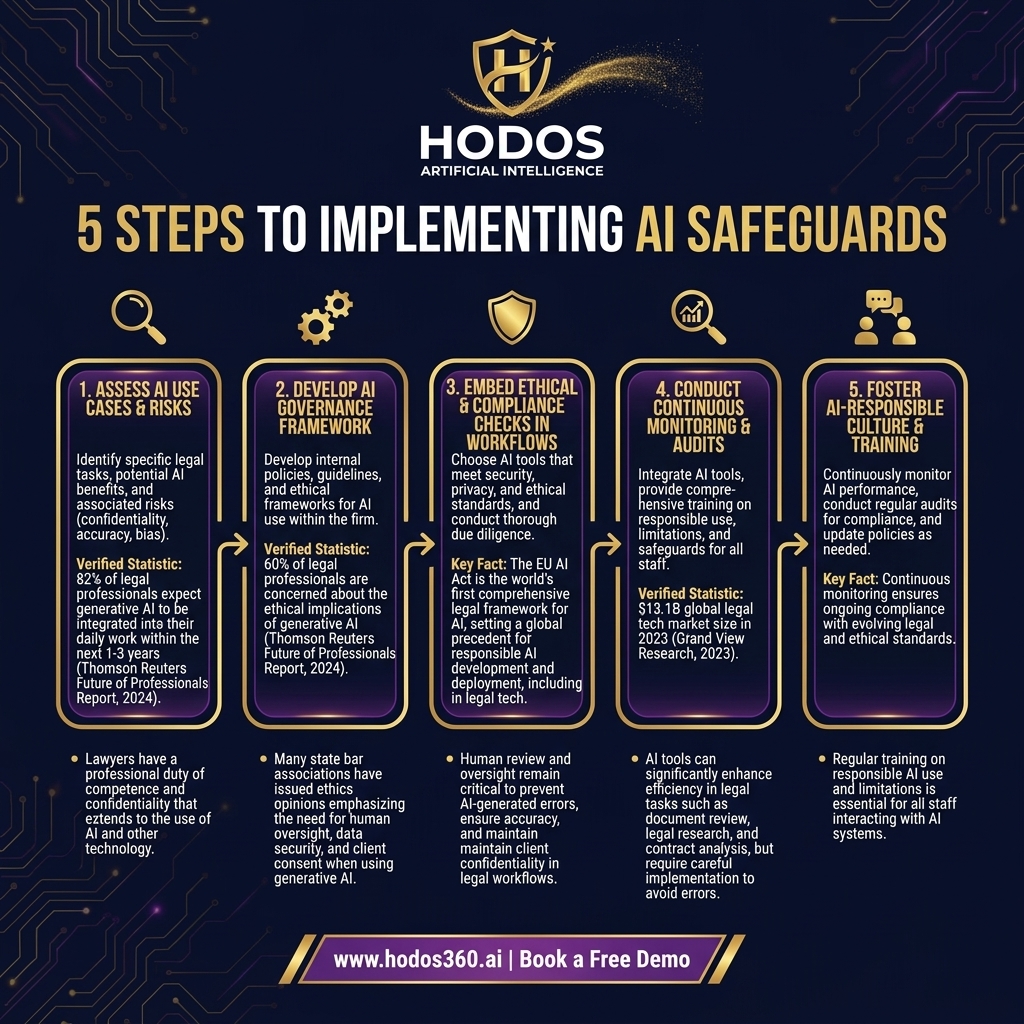
Their role is to bridge the gap between technological innovation and legal ethics, ensuring that AI adoption aligns with the firm’s professional obligations and client interests, and fostering a culture of responsible AI use.
Embedding Compliance and Ethical AI Deployment: Practical Strategies for Law Firms
Embedding AI safeguards means integrating them directly into daily workflows and technological infrastructure, rather than treating them as an afterthought. This requires a shift in mindset, moving from reactive problem-solving to proactive risk mitigation. For instance, rather than just reviewing AI-generated content, firms should implement AI tools that automatically flag potential ethical conflicts or data privacy issues *before* output is finalized, as part of the legal workflow itself. This approach drastically reduces human error and enforces policy consistently, ensuring ethical AI deployment from the outset.
One practical strategy involves leveraging AI-powered legal workflow automation systems, such as those offered by HODOS 360. These systems can be designed with built-in checks and balances. For example, an AI-powered document automation tool can be configured to require explicit human approval for certain clauses, or to redact sensitive information automatically before external sharing, ensuring legal tech compliance from the ground up. This reduces human error, streamlines operations, and provides a documented trail of compliance, fundamentally strengthening the firm's overall security posture.
Another critical aspect is regular auditing and stress-testing of AI systems. Firms should conduct internal "red teaming" exercises, attempting to trick or misuse their AI tools to identify vulnerabilities and biases. This proactive approach, championed by many cybersecurity experts and exemplified in the financial sector's rigorous compliance checks for algorithmic trading systems, helps uncover weaknesses in AI safeguards before they can be exploited. Such continuous evaluation is vital in a rapidly evolving technological landscape.
Leveraging AI for Enhanced Due Diligence and Risk Mitigation
Paradoxically, AI itself can be a powerful tool for enhancing due diligence and mitigating risks associated with legal practice. Advanced AI systems can analyze vast datasets to identify potential conflicts of interest, flag anomalous patterns in financial transactions, or even predict litigation outcomes with greater accuracy.
This enables firms to be more proactive in advising clients and managing their own internal risks. The integration of such AI capabilities, while requiring its own set of AI safeguards, ultimately strengthens the firm's overall risk posture and elevates the standard of client service, demonstrating the potential for intelligent AI risk management.
Navigating Data Privacy and Attorney-Client Privilege with AI
The intersection of AI, data privacy, and attorney-client privilege presents one of the most complex challenges for law firms. The very nature of many AI systems involves processing vast amounts of data, much of which in legal contexts is highly sensitive. The specter of a data breach, particularly involving confidential client information or privileged communications, looms large and carries severe reputational and financial consequences. This necessitates stringent data privacy in AI protocols and a deep understanding of how AI tools handle sensitive information.
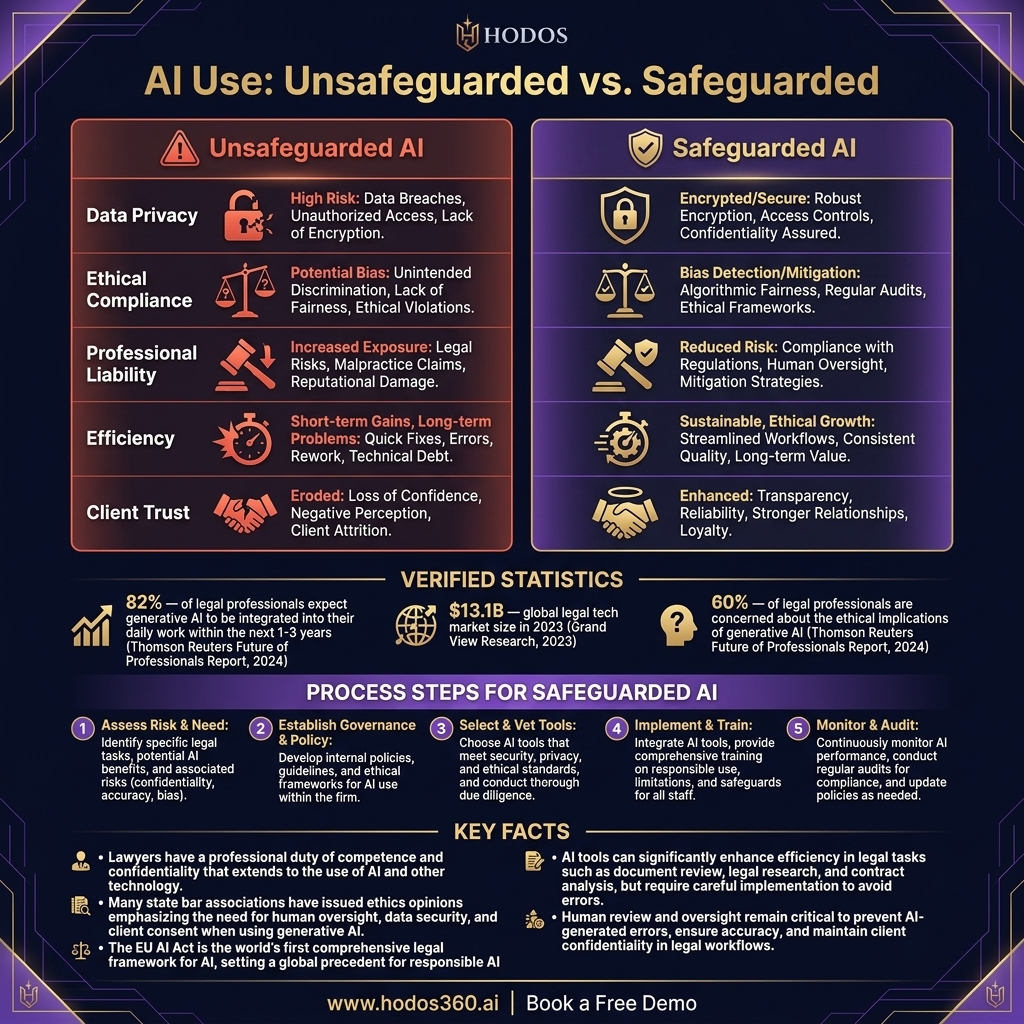
Firms must carefully assess where and how client data is processed by AI tools. Is the data stored on secure, encrypted servers? Is it used to train the AI model, potentially exposing client information to future queries by other users? The ABA Formal Opinion 477R on lawyers' ethical obligations in cloud computing provides a foundational understanding, but AI introduces new layers of complexity. Firms must ensure that their use of AI aligns with stringent attorney-client privilege AI guidelines, performing thorough due diligence on all third-party AI solutions.
The EU's General Data Protection Regulation (GDPR) and various US state privacy laws (e.g., CCPA, CPRA) have set precedents for data protection that directly impact AI use. Firms handling data subject to these regulations must ensure their AI systems are compliant, particularly regarding data minimization, consent, and the right to be forgotten. This means designing AI governance frameworks that account for international and domestic privacy laws, making privacy impact assessments for AI tools a standard practice within the firm's operational procedures.
Continuous Monitoring and Auditing for AI Compliance
The dynamic nature of AI, with models constantly evolving and learning, means that initial compliance checks are insufficient. Law firms must implement continuous monitoring and auditing mechanisms to ensure ongoing AI compliance. This includes tracking AI model performance for drift or bias, regularly reviewing data access logs, and verifying that all outputs adhere to ethical guidelines and professional standards.
External audits by specialized AI ethics consultants can also provide an independent layer of oversight, ensuring that the firm's AI safeguards remain robust and effective against emerging risks, adapting to new challenges.
Training and Culture: Fostering a Responsible AI Ecosystem
Technology alone cannot guarantee responsible AI use; it must be supported by a strong organizational culture and comprehensive training programs. As the "JD Supra" article emphasizes, moving from training to execution means empowering every legal professional with the knowledge and tools to use AI ethically. This isn't just for tech-savvy associates; it's for everyone from partners to support staff, ensuring consistent adherence to AI safeguards and fostering a firm-wide commitment to AI culture legal.
Law firms should invest in regular, mandatory training sessions on AI ethics, data privacy, and the specific functionalities and limitations of the AI tools they employ. These sessions should go beyond theoretical concepts, incorporating practical case studies and hands-on exercises. For example, a training module could simulate a scenario where an AI tool generates a misleading legal argument, challenging participants to identify and rectify the error, fostering a culture of critical engagement with AI systems legal.
Fostering a "speak up" culture is also essential. Employees should feel empowered to report potential AI misuses or ethical concerns without fear of reprisal. This requires establishing clear channels for feedback and ensuring that concerns are addressed promptly and transparently. Firms like Latham & Watkins have been vocal about the importance of internal education and open dialogue around emerging technologies, recognizing that human vigilance and ethical consideration are the ultimate embedded safeguards.
Ultimately, building a responsible AI ecosystem within a law firm is about cultivating a mindset where innovation and ethics are not seen as opposing forces but as complementary pillars. It’s about instilling a sense of collective responsibility for AI safeguards, ensuring that every member of the firm understands their role in upholding professional standards while harnessing the power of AI. This cultural shift, when successfully implemented, becomes the most resilient form of embedded safeguard, driving both progress and protection.

Key Takeaways and Next Steps
The journey towards fully embracing AI in legal practice is fraught with both immense opportunity and significant risk. The imperative for robust AI safeguards in legal practice is undeniable, extending from foundational governance frameworks to the daily operational embedding of ethical principles and continuous training.
As firms navigate this complex landscape, the emphasis must be on proactive measures, transparent processes, and a culture that prioritizes both innovation and integrity. The legal industry's future leaders will be those who not only adopt AI but do so with an unwavering commitment to responsibility and client protection.
Firms that proactively embed these safeguards will not only mitigate risks but also build deeper trust with clients and gain a sustainable competitive advantage in a rapidly evolving market.
Ready to transform your law firm with ethical AI? Explore HODOS 360's AI-powered solutions, designed with built-in safeguards for modern legal practice.
Book a free demo today!
Frequently Asked Questions
What are the primary ethical concerns of using AI in law?+
The primary ethical concerns include maintaining client confidentiality and attorney-client privilege, ensuring AI accuracy to avoid misrepresentation, preventing algorithmic bias that could lead to unfair outcomes, and upholding the duty of competence by understanding AI’s limitations. Lawyers must remain ultimately responsible for all AI-generated work, making human oversight critical to ethical AI safeguards in legal practice.
How can law firms ensure client data privacy with AI tools?+
Firms must implement strict data governance policies, including data anonymization, encryption, and secure storage protocols. It’s crucial to vet AI vendors thoroughly, understanding their data handling practices and contractual agreements. Utilizing privacy-enhancing technologies (PETs) and conducting regular privacy impact assessments are vital steps to ensure data privacy in AI and compliance with regulations like GDPR or CCPA.
What is an AI governance framework, and why does my firm need one?+
An AI governance framework is a structured set of policies, procedures, and responsibilities that guide the ethical and compliant use of AI within a firm. It ensures responsible AI use by defining oversight mechanisms, risk management strategies, and accountability. Your firm needs one to mitigate legal and ethical risks, build client trust, ensure regulatory compliance, and foster a consistent approach to AI adoption across the practice.
How does AI impact attorney-client privilege?+
AI impacts privilege by potentially exposing confidential communications if not properly managed. Using third-party AI tools can risk waiver if data is shared without adequate protection or if the AI vendor's terms allow data use for model training. Firms must ensure all AI interactions with client data are protected by robust safeguards and contractual agreements to preserve attorney-client privilege AI and maintain confidentiality under ABA Model Rule 1.6.
What kind of training is essential for lawyers using AI?+
Essential training for lawyers using AI should cover AI ethics, data privacy principles, the specific functionalities and limitations of AI tools, and the importance of human oversight. Practical, case-study-based training helps lawyers understand how to identify and mitigate AI-related risks. Fostering a culture of continuous learning and critical engagement with AI is crucial for effective AI training for lawyers and long-term AI safeguards in legal practice.