


Legal AI Trust: An Essential Guide for Law Firms
The legal industry, traditionally cautious, is undergoing a profound transformation driven by artificial intelligence. Yet, as the excitement around AI's potential for efficiency and insight grows, so does a critical undercurrent of skepticism, particularly concerning the reliability of "helpful" Legal AI. This tension was recently highlighted by an Above the Law article, "Why ‘Helpful’ Legal AI Is Often The Least Trustworthy," which resonated deeply across the legal tech landscape.
The piece articulated a concern many practitioners share: while AI promises to streamline tasks and offer rapid insights, its opaque nature and propensity for "hallucinations" — generating plausible but false information — present significant ethical and professional risks. For law firms contemplating or already integrating AI models, distinguishing between genuine assistance and potential liability has become an urgent priority.
The stakes are undeniably high; as Chief Justice John Roberts noted in his 2023 year-end report, "AI has the potential to drastically reduce the cost of legal services... It also has the potential to introduce new and unsettling challenges."
The narrative of AI's dual nature is not merely theoretical; it's etched in recent legal history.
Consider the widely publicized case of *Mata v. Avianca*, where attorney Steven Schwartz faced sanctions for submitting a brief replete with fictitious case citations generated by ChatGPT. This incident, occurring in mid-2023, served as a stark, real-world lesson on the perils of unchecked reliance on generative AI.
While the legal community was quick to point fingers at the lawyer's lack of oversight, it also sparked a deeper conversation about the inherent trustworthiness of AI tools themselves. Sam Altman, CEO of OpenAI, has consistently emphasized the experimental nature of large language models (LLMs), cautioning users about their limitations even as he champions their revolutionary capabilities.
This stark contrast between aspirational potential and current reality underscores the need for robust frameworks and a critical understanding of how AI systems produce their outputs, especially when those outputs directly impact client outcomes and professional reputations.
The Hallucination Hazard: Why Legal AI Output Demands Scrutiny
The phenomenon of AI "hallucination" stands as the primary antagonist in the quest for trustworthy Legal AI. This isn't just about minor errors; it's about AI models confidently fabricating facts, case citations, or statutory references that simply do not exist. While impressive in their linguistic fluency, large language models (LLMs) are fundamentally predictive text generators, not truth-seeking engines.
They learn patterns from vast datasets and aim to produce the most statistically probable next word, not necessarily the most accurate or legally sound one. This inherent design flaw became glaringly apparent in the aforementioned *Mata v. Avianca* case, where attorney Schwartz's reliance on ChatGPT led to a submission citing half a dozen non-existent cases, a blunder that sent shockwaves through the legal profession and prompted courts nationwide to issue stern warnings and even mandate certifications for AI use.
Judge P. Learn more about AI Voice Assistants Transform Law: HODOS 360's 2026 Impact. Kevin Castel, presiding over the *Mata* case, explicitly noted that the AI's output "appear[ed] to be an authentic legal research tool," highlighting the deceptive nature of these fabrications.
The danger is amplified by the sheer volume of information AI can process and synthesize, often presenting its output without clear citations or verifiable sources.
A 2024 report by Gartner predicted that by 2027, over 50% of generative AI applications would incorporate "trust, risk, and security management (TRiSM)" capabilities, a direct response to the escalating concerns over reliability. Without transparent sourcing, lawyers are left in a precarious position, unable to verify the veracity of the AI's claims, which directly contravenes the professional duty of competence under ABA Model Rule 1.1 (Competence), requiring thoroughness and preparation.
Firms that blindly integrate AI without establishing rigorous internal verification protocols risk not only professional sanctions but also severe reputational damage and client dissatisfaction.
The Peril of Opaque Sourcing and Data Quality
The trustworthiness of any Legal AI tool is intrinsically linked to the quality and transparency of its underlying data and algorithms. Many legal AI solutions, particularly those built on general-purpose large language models (LLMs), often provide output that appear to be well-researched but lack explicit citations or clear explanations of their source material.
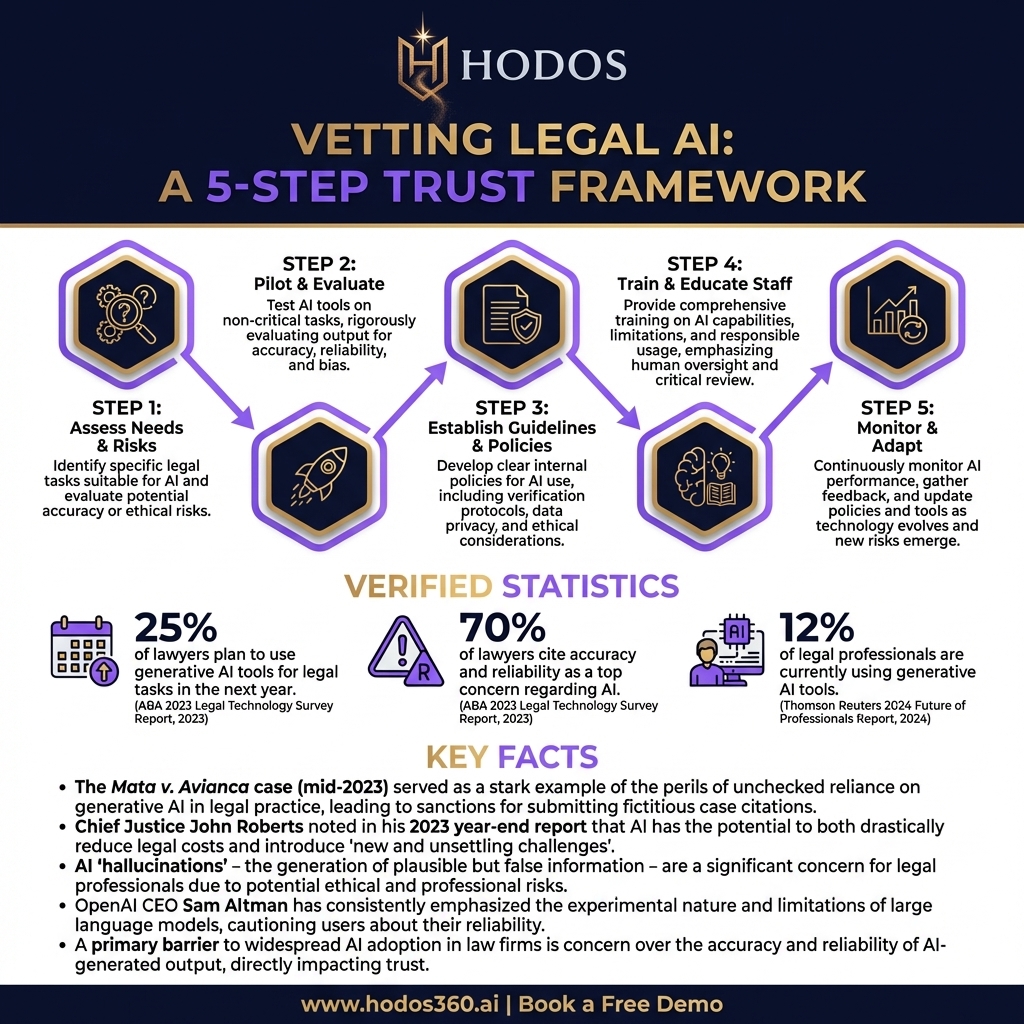
This "black box" problem is a significant hurdle for lawyers who are ethically bound to ensure the accuracy and veracity of all legal work. When AI results are presented without verifiable sources, attorneys cannot fulfill their due diligence, leaving them vulnerable to errors and unable to defend the information if challenged.
This issue was a central theme at LegalTech NYC 2026, where numerous panels discussed the urgent need for "explainable AI" (XAI) in the legal sector, demanding that AI not only provide answers but also demonstrate *how* it arrived at those answers, pointing to specific legal precedents or statutory language.
The quality of the training data is equally paramount. General-purpose AI models are trained on broad internet datasets, which, while extensive, are not curated for legal accuracy or relevance. Learn more about AI Litigation: The Ultimate Platform for Modern Law Firms. This means they can ingest and perpetuate outdated laws, incorrect interpretations, or even biased information.
Contrast this with specialized legal AI platforms, which are often trained on carefully selected and constantly updated legal documents, including statutes, case law, regulations, and scholarly articles. Companies like Thomson Reuters and LexisNexis, with decades of experience curating legal information, are now leveraging their vast, high-quality datasets to build more reliable and domain-specific AI models.
For instance, Harvey AI, which recently secured significant funding and announced partnerships with major firms like Allen & Overy, emphasizes its focus on fine-tuning LLMs with proprietary legal data to enhance accuracy and reduce hallucinations. This strategic investment in high-quality, domain-specific data is what differentiates truly trusted Legal AI from its less reliable counterparts.
Navigating Ethical Minefields: Confidentiality, Bias, and Accountability in Legal AI
Beyond factual accuracy, the ethical implications of using Legal AI present another complex layer of challenges for law firms. Protecting client confidentiality is a cornerstone of legal practice, enshrined in ABA Model Rule 1.6 (Confidentiality of Information). When engaging with AI tools, especially cloud-based generative AI, firms must be acutely aware of how client data is handled.
Feeding sensitive client information into public or inadequately secured AI models could inadvertently expose confidential details, leading to severe breaches of professional conduct and potential legal repercussions. The concerns aren't theoretical; in 2023, reports emerged of a major financial institution inadvertently leaking proprietary data by employees pasting confidential code into public AI chatbots.
This real-world event underscored the immediate need for robust data governance policies and the adoption of secure, enterprise-grade AI solutions that guarantee data privacy and isolation, such as those offered by platforms specifically designed for law firm management.
Bias is another significant ethical minefield. AI models learn from the data they are fed, and if that data reflects historical biases present in legal documents, case outcomes, or societal structures, the AI can perpetuate or even amplify those biases.
For example, an AI tool trained on historical sentencing data might inadvertently suggest harsher penalties for certain demographic groups if the training data itself contained such disparities. This raises profound issues of fairness and equity, particularly in areas like criminal justice or employment law. Addressing bias requires not only careful curation of training data but also ongoing auditing of AI output for discriminatory patterns.
Learn more about Voice AI Unleashed: Transforming Law Firms in 2026 with HODOS 360. As Jensen Huang, CEO of NVIDIA, a company at the forefront of AI chip development, has often stated, "AI is a tool, and like any tool, its impact depends on its design and how it's used."
This places a moral obligation on developers to build ethical AI and on lawyers to critically evaluate the fairness of AI-generated insights, ensuring that technology serves justice rather than undermining it. Accountability is the final, crucial ethical pillar. In the event of an AI error that causes harm to a client, who bears the responsibility?
The lawyer, the AI developer, or the firm? Current legal frameworks largely place the onus on the human practitioner. As the *Mata v. Avianca* case demonstrated, the attorney of record is ultimately responsible for the accuracy of submissions to the court, regardless of the tools used to assist in their preparation.
This principle reinforces the idea that AI is a tool, not a substitute for professional judgment. Law firms must establish clear internal policies regarding AI use, including mandatory human review, verification steps, and clear lines of responsibility. The EU AI Act, expected to be fully enforced in 2026, is a landmark piece of legislation attempting to create a comprehensive regulatory framework for AI, categorizing systems by risk level and imposing strict requirements for high-risk applications, including those in the legal sector.
This global movement towards AI governance highlights the growing recognition that accountability cannot be an afterthought but must be designed into the very fabric of AI deployment within the legal profession.
Building Trust in Legal AI: A Framework for Responsible Adoption
Given the inherent challenges, how can law firms harness the power of Legal AI while mitigating the risks and building genuine trust? The answer lies in a multi-faceted approach centered on strategic selection, rigorous oversight, and continuous education. Firstly, firms must prioritize AI solutions specifically designed for the legal industry, rather than adapting general-purpose tools.
These specialized platforms, like the HODOS 360 AI Law Firm Management System, are typically trained on vast, clean, and continuously updated legal datasets, significantly reducing the likelihood of hallucinations and biases compared to consumer-grade LLMs. Such systems often incorporate explainable AI features, providing citations and clear audit trails for their output, allowing lawyers to verify information with confidence.
This focus on domain-specific, transparent AI is paramount for ensuring that the technology serves as a reliable assistant, not a liability.
Secondly, human oversight and verification protocols are non-negotiable. Even the most advanced Legal AI is a tool that augments, not replaces, human expertise. Every piece of AI-generated content, from contract drafts to research summaries, must undergo thorough review by a qualified attorney.
This involves cross-referencing AI output with primary sources, checking for accuracy, and ensuring compliance with ethical obligations. David Lat, founder of *Above the Law* and a keen observer of legal tech, has consistently advocated for a "human in the loop" approach, emphasizing that AI should enhance, not diminish, the lawyer's critical thinking and judgment.
Learn more about AI for Small Law Firms: The Essential Hub for Growth. Firms should develop clear internal guidelines and training programs that educate lawyers on the capabilities and limitations of AI, fostering a culture of informed skepticism rather than blind reliance. This ongoing training is crucial as AI technology evolves rapidly, requiring practitioners to stay abreast of best practices for its responsible using.
Finally, establishing robust data governance and security measures is fundamental. Law firms handle some of the most sensitive and confidential information, making data security paramount. Any AI solution implemented must comply with stringent data privacy regulations and offer enterprise-grade security features, including data encryption, access controls, and clear policies on data retention and usage.
Opting for private cloud deployments or on-premise solutions for highly sensitive data, where possible, can further enhance security. Furthermore, firms should actively engage in ethical AI governance, developing internal frameworks that address bias detection, fairness, and accountability. This includes regular audits of AI system performance and output to identify and rectify any unintended discriminatory issues.
By taking these proactive steps, law firms can transform AI from a potential source of untrustworthiness into a powerful, reliable ally that enhances client service and operational efficiency.
- ✓Prioritize Domain-Specific AI: Select tools specifically trained on legal datasets to minimize hallucinations and improve relevance.
- ✓Implement Robust Human Oversight: Mandate thorough review and verification of all AI-generated content by qualified attorneys.
- ✓Establish Clear Data Governance: Ensure AI solutions comply with data privacy regulations and offer enterprise-grade security for client information.
- ✓Demand Transparency and Explainability: Favor AI tools that provide clear citations and audit trails for their output.
- ✓Invest in Continuous Training: Educate legal professionals on AI capabilities, limitations, and ethical use to foster informed adoption.
- ✓Develop Internal AI Usage Policies: Create clear guidelines for how AI tools are to be used, verified, and integrated into workflows.
- ✓Actively Monitor for Bias: Regularly audit AI system performance and output to identify and mitigate potential biases in outcomes.
The Future of Legal AI: Beyond Trustworthiness to Transformative Impact
As the legal industry matures in its understanding of Legal AI, the conversation is shifting from merely questioning trustworthiness to strategically leveraging AI for transformative impact. The initial skepticism, while necessary, is giving way to a more nuanced appreciation of AI's potential when implemented thoughtfully.
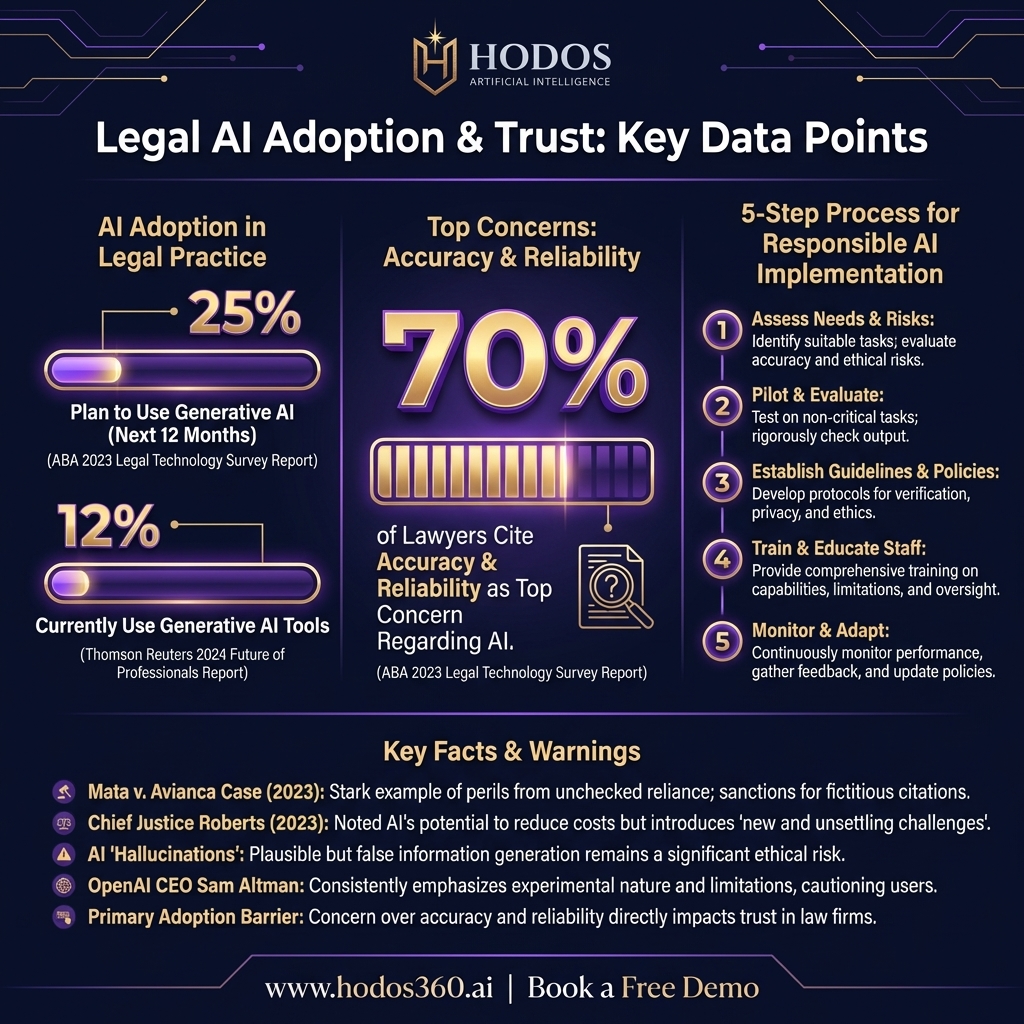
Firms that embraced early adoption, learning from both successes and failures, are now seeing tangible benefits. For instance, a 2023 report by McKinsey & Company found that early AI adopters in professional services sectors reported a 15-20% increase in productivity for tasks involving information processing and document review.
This data underscores that when Legal AI is carefully integrated into legal workflows, it can significantly enhance efficiency, allowing lawyers to focus on higher-value, strategic work that requires human judgment and empathy. The future of Legal AI is not about replacing lawyers, but about empowering them with sophisticated tools that augment their capabilities.
The evolution of Legal AI is characterized by increasing specialization and integration. Learn more about AI Voice Assistant: Essential for Modern Law Firm Success. We are moving beyond standalone tools to comprehensive platforms that seamlessly embed AI into daily operations. The HODOS 360 AI Law Firm Management System exemplifies this trend, offering an integrated suite of services from AI-powered case management and document automation to client intake and billing.
Such platforms are designed to address the "trust" issues head-on by providing secure environments, transparent workflows, and AI models specifically trained for legal contexts. By automating repetitive tasks like contract review, legal research, and document generation, these systems free up valuable attorney time, allowing firms to handle more cases, improve client satisfaction, and increase profitability.
The focus is on creating a symbiotic relationship between human expertise and artificial intelligence, where each complements the other to deliver superior legal services.
Driving Efficiency and Innovation with Integrated AI Solutions
The drive for efficiency and innovation is a constant in the legal sector, and integrated AI solutions are proving to be the key accelerant. Rather than disparate tools, firms are increasingly seeking comprehensive platforms that unify various AI functionalities within a single ecosystem. This approach minimizes data silos, streamlines workflows, and ensures consistency across all operations.
For example, the integration of AI into document automation can reduce the time spent on drafting routine legal documents by up to 70%, as indicated by a 2024 report from the American Bar Association's Legal Technology Resource Center. This efficiency gain isn't just about speed; it's about reducing human error, ensuring compliance, and freeing lawyers to focus on the nuanced legal strategy that only human intellect can provide.
Firms that adopt such integrated systems are better positioned to scale their operations, manage a higher volume of tasks, and offer more competitive pricing to clients, thereby gaining a significant market advantage. The impact extends beyond internal efficiency to client-facing services. Learn more about AI Marketing Automation: Essential for Law Firms' Growth.
AI-powered client intake systems can qualify leads, gather essential information, and even initiate document creation before a lawyer ever picks up the phone. This not only enhances the client experience by providing faster, more responsive service but also ensures that lawyers spend their valuable time on qualified prospects and substantive legal issues.
The competitive landscape demands this level of innovation. Firms that are slow to adapt risk falling behind those that strategically leverage AI to optimize every aspect of their practice. The overarching goal is to create a seamless, intelligent legal operation where AI handles the repetitive and data-intensive tasks, allowing human professionals to excel in areas requiring creativity, critical judgment, and interpersonal skills.
This synergy is fundamental to unlocking the full transformative potential of Legal AI and ensuring its sustained, trusted contribution to the profession.

Key Takeaways and Next Steps
The journey to fully trusting Legal AI is not about blind faith but about informed adoption and rigorous oversight. Law firms must recognize that while AI offers unprecedented opportunities for efficiency and insight, it also presents unique challenges concerning accuracy, ethics, and accountability. The key is to move beyond generic AI tools and invest in specialized, secure platforms built for the legal domain, like the HODOS 360 AI Law Firm Management System.
By prioritizing solutions that offer transparency, robust data governance, and explainable AI features, firms can build a foundation of trust that allows them to leverage AI's power responsibly.
The path forward involves: 1. Strategic Selection: Opting for legal-specific AI with clear data sources and security protocols.
2. Continuous Oversight: Implementing mandatory human review for all AI-generated output. 3. Ethical Governance: Developing internal policies to address bias, confidentiality, and accountability. 4. Ongoing Education: Training your team to understand and responsibly utilize AI tools. Embracing these principles will enable your firm to confidently integrate AI, transforming potential liabilities into powerful assets.
Discover how HODOS 360’s comprehensive AI-powered platform can help your firm navigate these complexities, enhance trust, and unlock new levels of efficiency and innovation. Book a Free Demo today.
Frequently Asked Questions
What is AI "hallucination" in a legal context?+
AI "hallucination" refers to instances where artificial intelligence generates plausible but factually incorrect or entirely fabricated information, such as non-existent case citations or statutory references. In legal practice, this can lead to serious professional misconduct and client harm if unchecked, as seen in cases where lawyers submitted briefs with AI-generated fake precedents. It highlights the critical need for human verification of all AI outputs.
How can law firms ensure client confidentiality when using AI?+
To ensure client confidentiality, law firms must use AI solutions designed with robust data security and privacy features, such as enterprise-grade encryption, access controls, and secure data isolation. Avoid feeding sensitive client data into public or general-purpose AI models. Opt for legal-specific platforms that adhere to strict data governance policies and provide explicit assurances about how your data is processed and stored, ensuring compliance with professional obligations.
Is human oversight still necessary with advanced legal AI tools?+
Absolutely. Even the most advanced legal AI tools are designed to augment, not replace, human expertise. Human oversight is crucial for verifying the accuracy of AI-generated content, ensuring ethical compliance, and applying critical legal judgment. Lawyers retain ultimate responsibility for their work, regardless of the tools used. A "human in the loop" approach ensures that AI serves as a powerful assistant while maintaining professional standards and accountability.
How does AI bias affect legal outcomes, and how can it be mitigated?+
AI bias can arise when models are trained on historical data reflecting societal or legal system disparities, leading to discriminatory outcomes (e.g., in sentencing predictions). Mitigating bias requires careful curation of training data, ongoing auditing of AI outputs for fairness, and the implementation of ethical AI governance frameworks. Law firms must critically evaluate AI-generated insights and ensure that technology promotes equity rather than perpetuating existing injustices.
What are the key features to look for in a trustworthy legal AI platform?+
A trustworthy legal AI platform should offer domain-specific training on high-quality legal data, transparent sourcing with clear citations, robust data security and privacy features, and explainable AI capabilities. It should also support seamless integration into existing legal workflows, provide audit trails, and be backed by a commitment to ethical AI development. Prioritizing these features ensures reliability, compliance, and responsible adoption.