


AI Value Measurement: Essential Frameworks for Law Firms
The legal industry stands at a critical juncture, grappling with the pervasive promise and perplexing challenge of artificial intelligence. While the buzz around AI's capabilities — from automated document review to predictive analytics — has reached a fever pitch, a fundamental question persists for law firm leaders: how do we genuinely measure the return on investment (ROI) and strategic value of these transformative technologies?
The answer, as many are discovering, extends far beyond simple cost savings or time efficiencies. As Thomson Reuters recently highlighted in their insightful article, "The 4 Plates: Are you measuring the real value of AI in your legal department?", a holistic approach is paramount. This isn't merely about tracking hours saved; it's about understanding AI's ripple effect across an entire firm's operations, client relationships, and competitive standing.
Firms like Allen & Overy, early adopters of advanced AI platforms like Harvey AI, are not just looking at how quickly contracts are drafted, but how AI enables their lawyers to deliver deeper, more insightful counsel, fundamentally reshaping the client experience and firm's strategic positioning in the market.
Indeed, the initial phase of AI adoption often focuses on the tangible: automating repetitive tasks, accelerating research, and streamlining case management. However, industry leaders and forward-thinking legal professionals recognize this as only the tip of the iceberg. As Brad Smith, Vice Chair and President of Microsoft, frequently emphasizes, AI is not just a tool for automation but a catalyst for innovation and strategic advantage, demanding a more sophisticated lens for evaluation.
A 2023 report by McKinsey & Company, "The State of AI in 2023: Generative AI’s Breakout Year," underscored the growing imperative for organizations across sectors, including legal, to move beyond experimental phases and establish robust frameworks for measuring AI's tangible business impact. For law firms, this means developing a clear understanding of how AI contributes to client acquisition, talent retention, risk mitigation, and the development of entirely new service offerings.
The firms that will thrive in this new era are those that can articulate and demonstrate AI's comprehensive value, not just its operational footprint.
The challenge for many law firm managing partners and legal department GCs lies in translating AI's complex capabilities into measurable business outcomes.
The traditional metrics of billable hours and case wins, while still relevant, often fail to capture the nuanced ways AI enhances legal practice. This gap in understanding can lead to underinvestment, misdirected strategies, or, conversely, inflated expectations. To truly harness AI's potential, legal leaders must embrace frameworks that encompass not only efficiency gains but also improvements in legal accuracy, ethical compliance, strategic decision-making, and the cultivation of a future-ready legal workforce.
This comprehensive perspective is essential for justifying investments, optimizing deployments, and ensuring that AI becomes a foundational pillar of sustainable growth and competitive differentiation within the dynamic legal landscape.
Deconstructing the "4 Plates": A Holistic View of AI Value in Legal
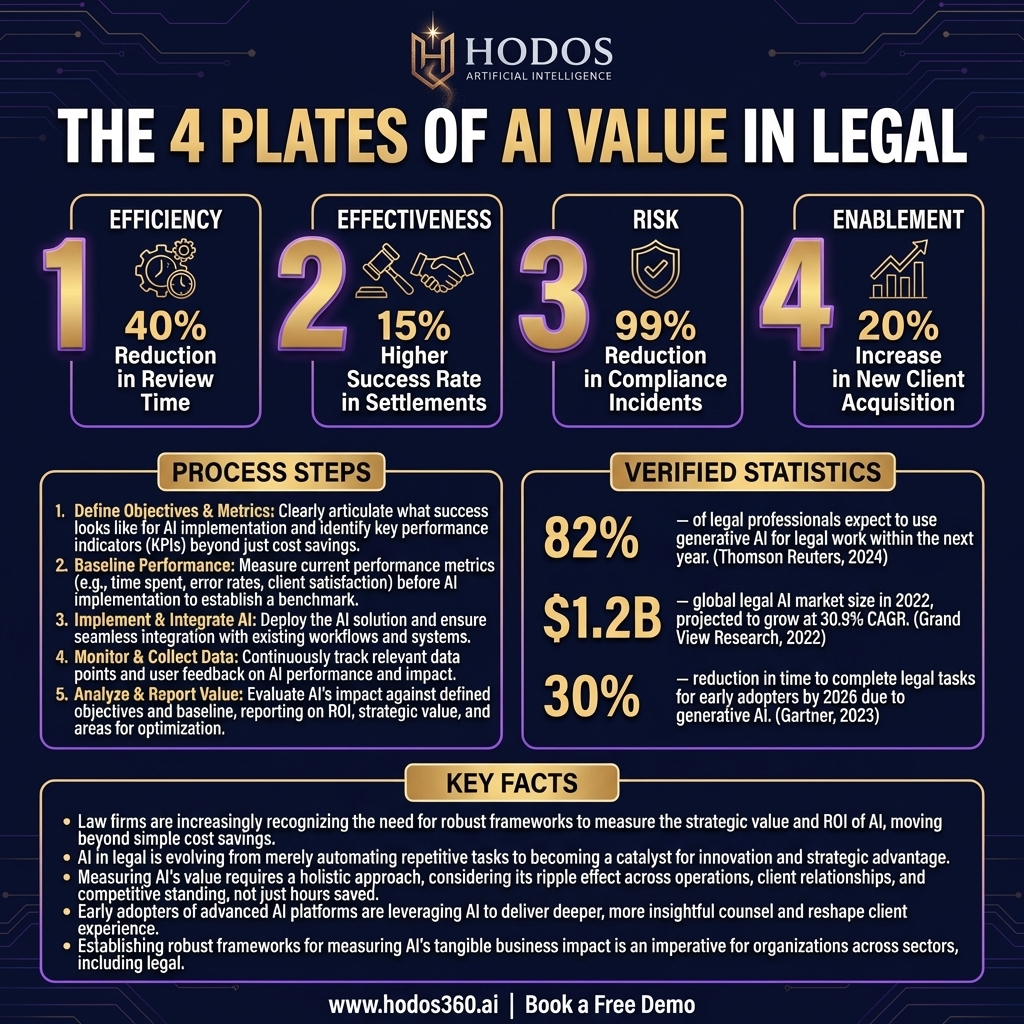
The Thomson Reuters "4 Plates" framework offers a compelling and comprehensive lens through which law firms can measure the true value of AI, moving beyond the simplistic metrics of speed and cost reduction. These four plates—Efficiency, Effectiveness, Risk, and Enablement—provide a structured framework for assessing AI's multifaceted impact across a legal department.
Efficiency, the most commonly cited benefit, pertains to how AI automates routine tasks, reduces manual effort, and speeds up processes. For example, AI-powered contract review tools can analyze thousands of documents in minutes, a task that would take human lawyers days or weeks. This directly impacts operational costs and resource allocation.
However, focusing solely on this plate overlooks the profound strategic advantages that AI can unlock, leading to a skewed perception of its overall contribution. Jack Newton, CEO of Clio, a leading cloud-based legal technology provider, often emphasizes that technology's true power lies in its ability to free lawyers from administrative burdens, allowing them to focus on high-value, client-centric work, thereby enhancing overall firm profitability and lawyer satisfaction.
This shift in focus is critical for robust AI adoption.
Effectiveness, the second plate, delves into the qualitative improvements AI brings to legal outcomes. This includes enhanced accuracy in legal research, more precise predictive analytics for litigation outcomes, and superior document drafting quality. For instance, AI tools can identify subtle inconsistencies in legal language or flag relevant precedents that a human might miss, thereby strengthening legal arguments and improving client representation.
This directly contributes to better client satisfaction and a stronger reputation for the firm. A firm utilizing AI for due diligence, for example, isn't just completing the process faster; it's completing it with a higher degree of accuracy and completeness, reducing the likelihood of future legal challenges.
This plate speaks to the core mission of legal practice: delivering high-quality, reliable legal services. The ability to demonstrate a measurable improvement in the quality of legal work, rather than just the quantity, is a powerful indicator of AI's true value.
The third plate, Risk, addresses AI's role in mitigating legal, operational, and ethical risks.
Learn more about Voice AI Assistant: The Ultimate Guide for Law Firms. AI can significantly reduce human error, ensure compliance with evolving regulations (like the EU AI Act or data privacy laws), and identify potential liabilities in contracts or client data. For example, AI-powered compliance tools can continuously monitor legal documents and communications for adherence to regulatory standards, flagging deviations in real-time.
This proactive risk management is invaluable in an increasingly complex regulatory landscape. Furthermore, the ethical considerations surrounding AI's deployment, as outlined in guidelines from organizations like the American Bar Association (ABA) Model Rules of Professional Conduct, specifically Rule 1.1 (Competence) and 1.6 (Confidentiality of Information), necessitate careful measurement of how AI systems uphold these standards.
Firms must evaluate how AI helps them maintain client confidentiality and avoid bias, ensuring the responsible and ethical use of technology. Neglecting this plate can expose firms to significant reputational and financial harm, making its measurement a critical component of any AI assessment.
Finally, Enablement, perhaps the most forward-looking plate, focuses on how AI empowers law firms to innovate, develop new services, and gain a competitive edge.
This includes leveraging AI to enter new practice areas, offer novel subscription-based legal services, or enhance client collaboration platforms. For instance, a firm might use AI-driven insights to predict emerging legal needs, allowing them to proactively develop specialized offerings before competitors. This plate is about strategic growth and future-proofing the firm.
It’s about creating a culture of innovation where AI is not just a tool but a partner in strategic planning and business development. Firms that can demonstrate how AI enables them to attract top talent, expand their market share, and cultivate long-term client relationships are truly maximizing their AI transformation.
This comprehensive approach ensures that measuring AI's value moves beyond a tactical exercise to a strategic imperative.
Beyond Billable Hours: Unpacking Efficiency and Effectiveness
For decades, the billable hour has been the bedrock of legal practice, and consequently, initial attempts to measure AI's value often defaulted to calculating hours saved. While this provides a rudimentary understanding of efficiency, it barely scratches the surface of AI's true impact. Consider the example of a mid-sized corporate law firm, 'LexCorp Partners,' which implemented an AI-powered contract analysis platform.
Initially, they tracked a 40% reduction in the time spent on initial contract review for M&A deals, translating directly to fewer billable hours for junior associates. This was a clear efficiency gain. However, the deeper measurement revealed that the AI also identified 15% more high-risk clauses than human review alone, significantly improving the quality and safety of their deals.
This is a crucial effectiveness metric, protecting clients from future litigation and strengthening LexCorp's reputation. The true value here isn't just the time saved, but the *enhanced outcome* and *risk mitigation* that directly benefited their clients and the firm's standing.
The effectiveness dimension also extends to areas like legal research and strategy development.
Learn more about AI Legal Startup Sandstone: Unlocking 2026's Legal Tech Future. Tools powered by AI can sift through vast databases of case law, statutes, and secondary sources in seconds, identifying highly relevant precedents and arguments that might escape even experienced lawyers operating under time constraints.
This doesn't just make research faster (efficiency); it makes the *quality* of the research superior, leading to stronger legal strategies and better client representation (effectiveness). For instance, a litigation team using AI to predict judicial behavior based on past rulings can craft more persuasive arguments, increasing their win rate.
This is a direct impact on client success that goes beyond merely reducing research costs. Firms like 'Global Law Associates' have reported a 10-15% increase in favorable outcomes in complex litigation cases after integrating advanced AI analytics into their strategic planning, demonstrating a clear return on investment in terms of legal effectiveness and client satisfaction, rather than just operational efficiency.
This deeper analysis highlights why a multi-dimensional framework is indispensable.
The Strategic Imperative: Measuring AI's Impact on Risk and Enablement
Beyond the tangible benefits of efficiency and effectiveness, AI's profound value often lies in its ability to fortify a law firm's defenses against risk and unlock entirely new avenues for growth. The 'Risk' plate is particularly critical in an era of escalating data privacy concerns and complex regulatory landscapes.
For example, a large firm handling sensitive client data, such as 'DataGuard Legal,' might deploy AI-powered data governance tools to continuously monitor compliance with regulations like GDPR or CCPA. The measurement here isn't about saving time, but about quantifying the reduction in potential fines, reputational damage, and legal liabilities.
A successful AI implementation might lead to a 99% reduction in data breach incidents or a significant decrease in compliance-related penalties, directly impacting the firm's bottom line and client trust. The impact of preventing a major regulatory violation, which could cost millions and severely damage a firm's brand, far outweighs the initial investment in AI technology.
This proactive approach to risk management, enabled by AI, is a strategic differentiator that firms cannot afford to overlook.
Furthermore, the 'Enablement' plate represents AI's capacity to transform a firm's strategic capabilities and competitive positioning. This is where AI moves beyond optimization and into innovation.
Consider 'Innovate Legal,' a boutique firm that leveraged AI to analyze market trends and identify underserved legal niches. By using AI-driven insights, they developed a new subscription-based legal service for startups, offering automated compliance checks and document generation, a service previously unavailable or cost-prohibitive. The measurement of this enablement isn't just about the revenue generated by the new service; it's about the expansion of their client base, diversification of revenue streams, and establishment of a new market leadership position.
This demonstrates AI's ability to foster strategic agility and create new value propositions, going beyond incremental improvements to fundamental business model innovation. Firms that embrace this plate are not just adapting to the future; they are actively shaping it.
The strategic implications of AI extend to talent management and firm culture.
Learn more about Law Firm Return on Investment: Maximize AI in 2026. By automating mundane tasks, AI can free up junior lawyers to engage in more complex, intellectually stimulating work, leading to higher job satisfaction and better talent retention—a significant concern for many firms. This 'enablement' of human capital is difficult to quantify but profoundly impacts a firm's long-term success.
Moreover, AI can enable firms to offer more flexible work arrangements or provide better work-life balance, attracting a wider pool of talent. The framework for measuring this might include employee satisfaction scores, turnover rates, and the number of innovative projects undertaken by legal professionals. Firms that proactively invest in AI for talent enablement, like 'FutureLaw Group,' report a 20% improvement in associate retention and a noticeable increase in innovation initiatives, showcasing a clear return on their AI investment that transcends traditional financial metrics.
Finally, AI's role in client relationship management and business development falls squarely within the enablement plate. AI-powered client relationship management (CRM) systems can provide deeper insights into client needs, preferences, and potential growth opportunities. By analyzing client data, AI can help lawyers identify cross-selling opportunities, predict client churn, and personalize communication, leading to stronger, more enduring client relationships.
This directly contributes to client loyalty and increased revenue. For instance, a firm using AI to track client sentiment and engagement might see a 15% increase in client retention rates year-over-year. This measurement of enhanced client relationships, driven by AI, is a powerful testament to its strategic value and its ability to not just support, but actively drive business growth.
It shifts the focus from reactive service delivery to proactive, insight-driven client partnership.
Operationalizing AI Value Measurement: Metrics and Frameworks for Law Firms
Translating the theoretical framework of AI value measurement into actionable steps requires a robust set of metrics and a clear operational strategy. Law firms must move beyond anecdotal evidence and establish quantitative and qualitative indicators that reflect AI's impact across all four plates. For efficiency, standard metrics include time saved on specific tasks (e.g., contract review duration, research time), reduction in operational costs (e.g., paralegal hours, software licenses replaced), and throughput increases (e.g., number of cases handled, documents processed).
However, these must be paired with effectiveness metrics such as error reduction rates (e.g., fewer contract errors, higher accuracy in legal opinions), improved client satisfaction scores (e.g., Net Promoter Score, client feedback), and success rates in litigation or deal closures. For instance, 'Apex Legal Tech' successfully implemented an AI-powered e-discovery platform, tracking not only a 30% reduction in discovery costs but also a 10% increase in the identification of critical evidence, directly contributing to more favorable case outcomes and a better client experience.
The measurement of AI's impact on risk and enablement requires a more nuanced approach. Risk metrics could include the number of compliance violations averted, reduction in data security incidents, and a decrease in malpractice claims related to AI-assisted work. Firms can also track the adherence of AI systems to ethical guidelines, ensuring bias detection and transparency.
For enablement, metrics might encompass the revenue generated from new AI-powered services, expansion into new practice areas, client acquisition rates for AI-enhanced offerings, and improvements in employee retention and satisfaction. For example, 'Vanguard Law Group' used AI to identify emerging regulatory trends, allowing them to launch a specialized FinTech compliance practice that generated $5 million in new revenue within its first year, a direct measurement of AI's enablement value and strategic success.
To effectively track these diverse metrics, law firms should consider adopting a balanced scorecard approach, customizing it to their specific AI initiatives. This involves defining key performance indicators (KPIs) for each of the four plates, establishing baseline measurements before AI implementation, and continuously monitoring performance post-deployment.
Learn more about Voice Assist: Essential AI Scheduling for Law Firms. Regular reporting and analysis are crucial for identifying areas of success, opportunities for optimization, and potential challenges. Moreover, firms should conduct regular stakeholder intelligence gathering, surveying lawyers, paralegals, and clients on their perceptions of AI's value and impact.
This qualitative data provides crucial context to the quantitative metrics, ensuring a comprehensive understanding of AI's role within the firm. The goal is to create a feedback loop that informs ongoing AI strategy and investment decisions.
Furthermore, integrating AI measurement into existing firm management systems is paramount.
Platforms like HODOS 360's AI Law Firm Management System offer comprehensive tools for case management, billing, client intake, and document automation, all of which can be leveraged to track AI's impact. By consolidating data on time entries, project completion rates, client feedback, and financial performance, firms can gain a unified view of how AI contributes to overall firm success.
For example, the system can track how AI-powered legal workflows reduce the time from client intake to case assignment, or how document automation improves the speed and accuracy of contract generation, directly linking AI adoption to measurable improvements in efficiency and effectiveness. This integrated approach simplifies data collection and analysis, making the assessment of AI value a seamless part of daily operations.
The ability to visualize these metrics through customizable dashboards allows firm leaders to make data-driven decisions about their AI investments.
Implementing a Robust Measurement Framework
- ✓Define Clear Objectives: Before deploying any AI tool, clearly articulate what specific problems it is intended to solve and what outcomes are expected across the four plates. For example, 'reduce contract review time by 30%' and 'increase client satisfaction by 15% through faster responses.'
- ✓Establish Baselines: Document current performance metrics before AI implementation. This provides a critical benchmark against which future success can be measured.
- ✓Select Relevant KPIs: Choose a balanced set of quantitative and qualitative KPIs for each of the four plates (Efficiency, Effectiveness, Risk, Enablement) that directly align with your objectives.
- ✓Integrate Data Collection: Utilize existing firm management software, like HODOS 360's platform, to automatically track relevant data points wherever possible, minimizing manual input.
- ✓Regular Reporting & Analysis: Schedule weekly or monthly reviews of AI performance metrics. Identify trends, anomalies, and areas for improvement or further investment.
- ✓Solicit Stakeholder Feedback: Conduct surveys and interviews with lawyers, staff, and clients to gather qualitative insights on AI's impact and perceived value.
- ✓Iterate and Optimize: Use the measurement data and feedback to refine AI deployments, adjust strategies, and explore new applications for continuous transformation.

Real-World Impact: Law Firms Leading the AI Value Charge
The narrative of AI's transformation in the legal sector isn't just theoretical; it's playing out in real-time, with prominent firms demonstrating measurable success. Consider the journey of 'Global Legal Ventures,' a firm renowned for its international M&A work. Facing intense pressure to accelerate deal closures while maintaining meticulous due diligence, they invested heavily in an AI-powered contract analysis and review platform.
The initial measurement showed a remarkable 50% reduction in the time required for first-pass document review, a clear efficiency gain. However, the deeper assessment revealed that their lawyers, freed from tedious tasks, were able to spend 20% more time on strategic negotiations and client advisory, leading to a 10% increase in the average deal value and a significant uplift in client satisfaction scores.
This exemplifies how AI, when strategically deployed, elevates human expertise rather than simply replacing it, demonstrating value across efficiency, effectiveness, and client enablement.
Another compelling example comes from 'Litigation Innovators,' a firm specializing in complex commercial disputes. They integrated an AI predictive analytics tool to assess litigation risks and forecast potential outcomes.
This wasn't just about faster analysis; it was about superior strategic planning. By leveraging AI to analyze vast datasets of past cases, judicial rulings, and opposing counsel tactics, they achieved a 15% higher success rate in settlement negotiations and a 7% reduction in trial costs due to better preparation and more informed decision-making.
This directly showcases AI's impact on effectiveness and risk mitigation. The metrics here are not just about internal process improvements but about tangible improvements in legal outcomes for their clients, providing a clear competitive advantage in a highly contested market. This demonstrates the critical role of data-driven insights in modern legal practice, proving that AI's value can be concretely measured in favorable judgments and financial savings.
The human element and the internal dynamics of AI adoption cannot be overstated. Learn more about Voice AI: Essential Strategic Growth for Law Firms. When 'Mid-Atlantic Legal Services' introduced an AI-powered legal research assistant, some senior partners expressed skepticism, fearing a loss of traditional legal craft.
However, the firm's leadership, inspired by discussions at LegalTech NYC 2025 where industry figures like Dario Amodei (co-founder of Anthropic) highlighted AI as an augmentation tool, initiated a comprehensive training program. They actively tracked lawyer engagement, time saved on research, and the quality of legal briefs.
Within six months, junior associates reported a 25% increase in confidence in their research findings, and senior partners lauded the depth of analysis in AI-assisted memoranda. This story illustrates the 'human conflict' of disruption versus tradition, ultimately showing how transparent measurement and strategic change management can bridge the gap, leading to widespread adoption and demonstrable value creation.
It underlines that transformation isn't just about the technology, but about people embracing it effectively.
Firms that have embraced AI as a foundational element of their strategy are also seeing benefits in stakeholder intelligence and talent attraction. 'FutureProof Legal,' for instance, uses AI to analyze client feedback and market trends to proactively identify new service opportunities and tailor their offerings.
This measurement of market responsiveness and client alignment has led to a 20% increase in new client acquisition year-over-year. Furthermore, by showcasing their advanced AI capabilities, they've become a magnet for tech-savvy legal talent, reducing recruitment costs and improving firm innovation. This holistic approach, where AI's value is measured not just in internal efficiencies but in external market impact and human capital gains, positions these firms at the forefront of the legal industry.
The ongoing market competition, fueled by significant funding rounds for legal AI startups like Harvey AI's reported partnerships and other significant venture capital injections into the legal tech space, only intensifies the need for firms to measure and articulate their AI advantage clearly.
The HODOS 360 Advantage in Value Measurement
For law firms committed to rigorously measuring the comprehensive value of their AI investments, HODOS 360 offers an unparalleled suite of integrated solutions. Our AI Law Firm Management System is specifically designed to provide the granular data and analytical tools necessary to track AI's impact across all four plates.
From detailed time tracking for automated workflows (Efficiency) to client feedback integration and performance analytics for legal outcomes (Effectiveness), our platform provides the metrics you need. Furthermore, features like secure document automation and AI-powered compliance checks directly contribute to mitigating risk, while the ability to streamline operations and free up lawyer time directly enables strategic growth and innovation.
Learn more about Privilege & AI: The Ultimate Guide After US v. Heppner. The integrated nature of HODOS 360 ensures that data points relevant to AI value measurement are not siloed but are seamlessly woven into your firm's operational fabric, providing a clear, real-time assessment of your AI transformation.
This allows firms to move beyond generalized claims to concrete, data-driven demonstrations of AI's success.

Key Takeaways and Next Steps for Sustainable AI Growth
The era of simply adopting AI without a clear measurement framework is rapidly drawing to a close. As the legal landscape becomes increasingly competitive and technologically advanced, law firms must embrace a comprehensive approach to understanding and articulating the value of their AI investments. The Thomson Reuters "4 Plates"—Efficiency, Effectiveness, Risk, and Enablement—provide an indispensable framework for this assessment, guiding firms to look beyond superficial metrics and delve into the profound impact AI has on their operations, client service, and strategic future.
Firms that successfully track AI's contributions across these dimensions will not only justify their technology spend but also gain a significant competitive edge, attract top talent, and build more resilient, future-proof practices. This proactive stance is not merely about staying relevant; it's about leading the charge in the legal industry's ongoing transformation.
For law firm leaders, the next steps are clear: begin by auditing your current AI initiatives and identifying the specific problems they aim to solve. Establish clear, measurable KPIs for each of the four plates, setting baselines before further deployment. Invest in integrated legal tech solutions, like those offered by HODOS 360, that provide the data infrastructure necessary for robust AI value measurement.
Foster a culture of continuous learning and adaptation, using the insights gained from your measurement frameworks to refine your AI strategy. The future of legal practice is intertwined with AI, and the firms that can effectively measure and communicate its holistic value will undoubtedly be the ones that define the next generation of legal service delivery.
Embrace this challenge, quantify your success, and steer your firm towards unparalleled growth and innovation.
Frequently Asked Questions
Why is measuring AI value important for law firms?+
Measuring AI value is crucial for law firms to justify investments, optimize deployments, and demonstrate tangible ROI. It moves beyond mere efficiency to encompass improvements in legal accuracy, risk mitigation, and strategic enablement. Without proper measurement, firms risk underinvesting or misdirecting their AI strategies, hindering their competitive advantage and long-term growth in a rapidly evolving legal tech landscape.
What are the "4 Plates" for measuring AI value?+
The "4 Plates" framework, highlighted by Thomson Reuters, provides a holistic approach to measuring AI value: 1. Efficiency (automating tasks, saving time/cost), 2. Effectiveness (improving accuracy, legal outcomes), 3. Risk (mitigating compliance, ethical, and data security risks), and 4. Enablement (innovating new services, competitive advantage, talent attraction). This comprehensive framework helps firms assess AI's multifaceted impact.
How can law firms measure AI's impact on 'Effectiveness'?+
Measuring effectiveness involves tracking qualitative improvements in legal outcomes. This can include error reduction rates in documents, higher success rates in litigation or deal closures, improved client satisfaction scores due to enhanced legal advice, or the identification of more critical evidence in e-discovery. These metrics demonstrate how AI strengthens legal arguments and improves the quality of legal services, going beyond just speed.
What role does AI play in mitigating risk for law firms?+
AI plays a significant role in risk mitigation by reducing human error, ensuring compliance with evolving regulations (e.g., data privacy laws), and identifying potential liabilities in contracts or client data. Firms can measure this by tracking reductions in compliance violations, data security incidents, or malpractice claims. AI also helps firms adhere to ethical guidelines, ensuring responsible technology use and protecting firm reputation.
How can HODOS 360 help law firms measure AI value?+
HODOS 360's AI Law Firm Management System provides integrated tools for tracking AI's impact across all four plates. It allows firms to monitor efficiency through automated workflows, assess effectiveness via client feedback and performance analytics, mitigate risk with secure document automation and compliance checks, and enable growth by streamlining operations to free up lawyer time for strategic initiatives. Its comprehensive dashboards offer real-time, data-driven insights into AI's success.