

General AI Alone: Essential Reasons It Isn't Enough for Legal Work
The legal industry stands at an inflection point, navigating the transformative waves of artificial intelligence. For months, headlines have heralded the arrival of powerful large language models (LLMs) like OpenAI’s GPT-4 and Anthropic’s Claude 3, showcasing their ability to generate human-like text, summarize documents, and even pass bar exams. This surge in general AI capabilities has led many to ponder, and some to prematurely conclude, that a single, versatile AI could soon handle the multifaceted demands of legal practice. Yet, as a recent article in Artificial Lawyer aptly highlighted, the reality is far more nuanced: general AI alone is not enough for legal work.
This isn't merely a cautionary tale; it's a critical distinction shaping the future of legal technology. While the sheer processing power and broad knowledge base of general-purpose AI are undeniable, the legal domain operates on layers of precedent, statutory interpretation, ethical obligations, and human judgment that generic algorithms cannot fully grasp. Consider the high-stakes environment of a courtroom or the intricate drafting of a multi-million dollar merger agreement—tasks where a single misinterpretation or 'hallucination' by an AI could lead to catastrophic consequences. The tension between the promise of expansive AI and the specific, often unforgiving, requirements of law creates a compelling narrative for firms looking to innovate responsibly.
This article delves into why general AI, despite its impressive feats, falls short in critical legal applications and why purpose-built, specialized AI solutions are not just beneficial, but essential for law firms aiming for true efficiency, accuracy, and ethical compliance. We'll explore the specific pitfalls of generic AI in legal workflows, emphasize the irreplaceable role of human legal judgment, and outline how firms can build resilient practices by integrating AI that is designed with legal precision in mind. The goal is not to dismiss AI, but to understand its proper, powerful application within the intricate tapestry of legal service delivery. The path forward for legal professionals involves discerning the right AI for the right task, thereby enhancing, rather than compromising, the quality of legal work. Discover how to leverage specialized AI effectively to transform your firm’s operations and client service.
- ✓Table of Contents
- ✓1. The Crucial Distinction: General vs. Specialized AI in Legal
- ✓2. Beyond the Hype: Where General AI Falls Short in Legal Workflows
- ✓3. The Imperative of Legal Judgment and Ethical AI
- ✓4. Building Resilient Practices: Integrating Purpose-Built AI Solutions
- ✓5. Key Takeaways and Next Steps for Law Firms
The Crucial Distinction: General vs. Specialized AI in Legal
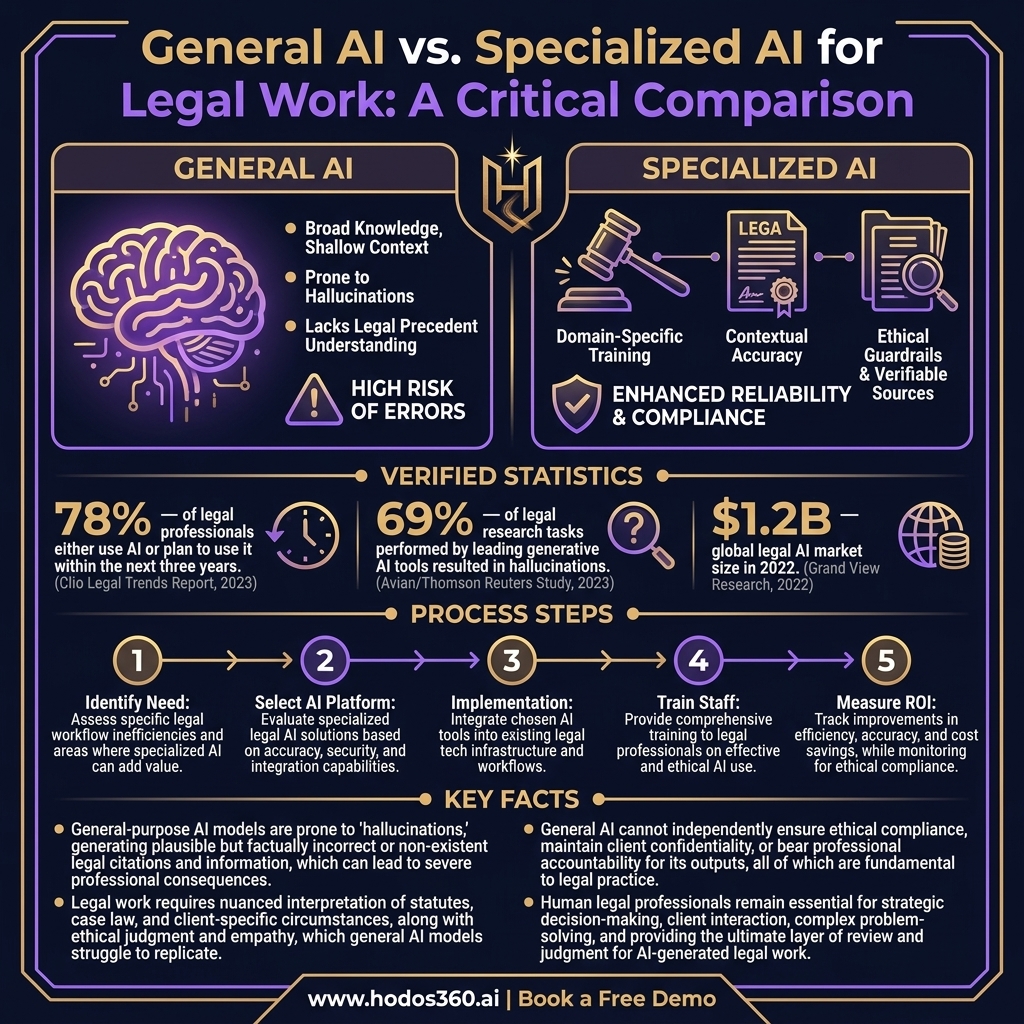
The debate around AI in legal often conflates two fundamentally different paradigms: general artificial intelligence and specialized AI. General AI, exemplified by large language models (LLMs), is designed to perform a wide range of cognitive tasks, from creative writing to basic coding, by identifying patterns in vast datasets. Visionaries like Sam Altman, CEO of OpenAI, speak of a future where Artificial General Intelligence (AGI) could rival or surpass human cognitive abilities across virtually all tasks. While these advancements are revolutionary for many industries, the legal sector presents unique challenges that generic models, by their very nature, are not equipped to handle with the necessary precision and reliability. Their training data, though immense, is broad and lacks the deep, contextual legal understanding crucial for accurate legal analysis.
Specialized AI, on the other hand, is purpose-built and rigorously trained on domain-specific datasets—in this case, legal texts, statutes, case law, contracts, and scholarly articles. This narrow focus allows it to develop a profound understanding of legal terminology, nuances, and precedents. Companies like Harvey AI, which famously partnered with Allen & Overy to deploy its specialized legal AI platform, demonstrate the efficacy of this approach. Harvey AI's models are not trying to write poetry; they are focused on tasks like contract analysis, regulatory compliance, and litigation prediction, where accuracy and contextual understanding are paramount. Learn more about AI Adoption: Essential Strategies for Law Firms to Lead. The difference is akin to a general physician versus a neurosurgeon: both are doctors, but one possesses a highly concentrated expertise essential for specific, complex operations. For legal professionals, relying on general AI alone for critical tasks introduces unacceptable levels of risk.
The inherent limitation of general AI lies in its probabilistic nature. It generates responses based on statistical likelihood rather than factual certainty or legal authority. This often leads to 'hallucinations'—convincing yet entirely fabricated information—a phenomenon that is manageable in creative writing but disastrous in legal research or document drafting. A 2023 report by Gartner predicted that by 2027, generative AI hallucinations would lead to at least one major legal dispute globally, underscoring the tangible risks. Specialized AI, conversely, is engineered with safeguards, verifiable sources, and often integrates with legal databases to ensure accuracy and traceability, aligning with the rigorous demands of legal practice. It’s about building trust through verifiable output, a non-negotiable in law.
Beyond the Hype: Where General AI Falls Short in Legal Workflows
Despite the impressive capabilities of general AI in tasks like summarization and content generation, its application to core legal workflows often reveals significant shortcomings. Consider the intricacies of contract review: a general LLM might identify clauses, but it often struggles with the nuanced interpretation of boilerplate language, the implications of specific jurisdiction-dependent terms, or the identification of missing clauses based on industry best practices. This lack of deep contextual legal reasoning means that while AI alone doesn't improve legal workflows in a generic sense, a specialized tool, trained on millions of legal contracts, can pinpoint critical deviations and suggest legally sound alternatives with far greater accuracy and reliability. The problem isn't the technology itself, but its unspecialized application.
Legal research is another area where the limitations become stark. While a general AI can scour vast amounts of text, it may fail to identify the most relevant precedents from specific jurisdictions, distinguish between binding and persuasive authority, or understand the subtle evolution of case law over time. This makes it challenging for general AI to provide truly useful legal insights or to be ready for important legal tasks without extensive human oversight and correction, which negates much of the promised efficiency gain. A Thomson Reuters survey in 2023 revealed that while 82% of legal professionals were exploring generative AI, accuracy and reliability remained their top concerns, directly addressing the 'hallucination' risk and contextual misinterpretations prevalent in general models.
The Cost of Generic Solutions Implementing generic AI solutions in a legal setting can lead to unforeseen costs and risks. Learn more about AI for Legal Teams: Essential Needs & Strategic Adoption. The time spent correcting AI-generated errors, verifying sources, and mitigating potential liabilities can quickly outweigh any initial efficiency gains. Firms that rush to adopt broad AI tools without proper specialization risk not only financial losses but also significant reputational damage. Imagine a client receiving advice based on an AI's fabricated case law, or a contract containing a critical error missed by a generic review tool. Such scenarios underscore why general-purpose AI isn't enough for legal work and highlight the imperative for tools that understand and respect the specific demands of the legal profession. The cost of generic solutions isn't just financial; it's a cost to client trust and professional integrity. The focus must be on solutions that augment, rather than undermine, the attorney's role.
The Imperative of Legal Judgment and Ethical AI
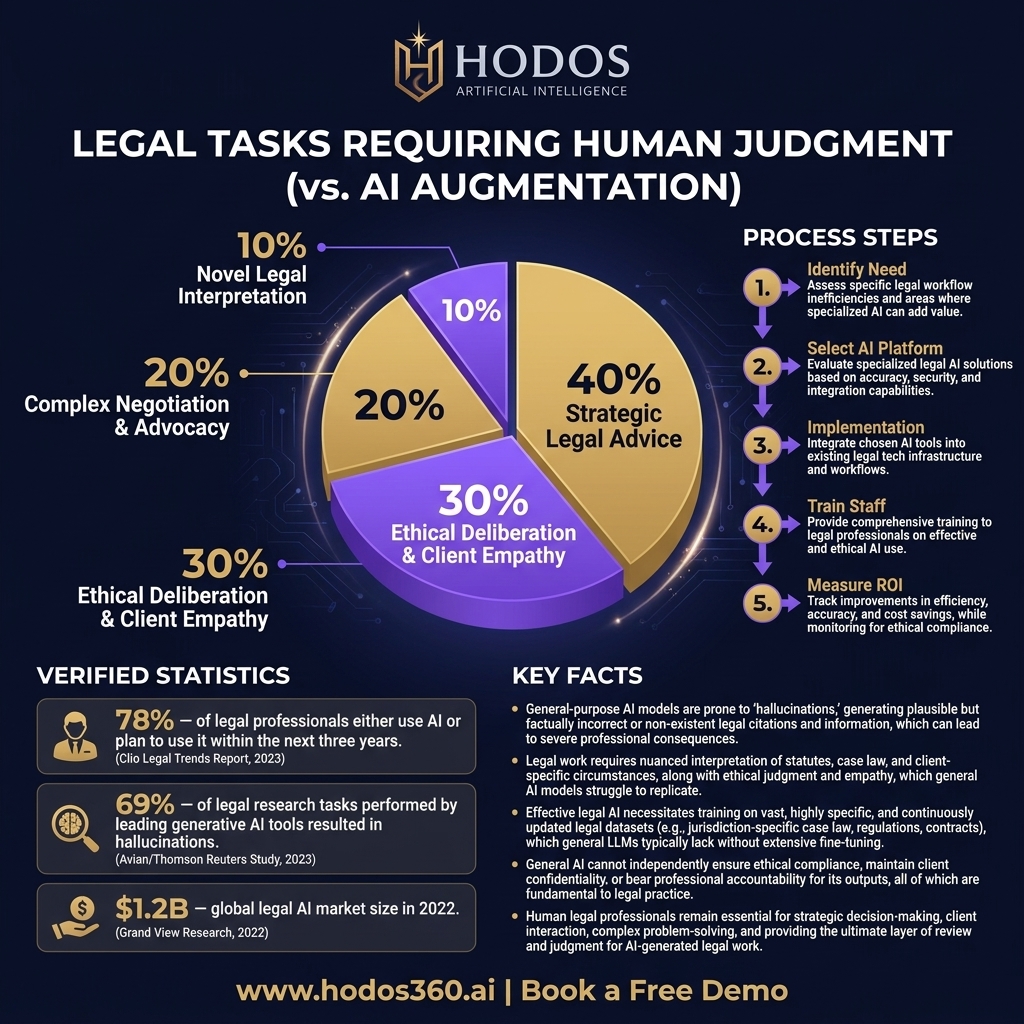
At the heart of legal practice lies human judgment—a complex blend of experience, intuition, ethical reasoning, and empathy that AI, particularly general AI, cannot replicate. As Dharshi Harindra rightly articulated, AI doesn't replace judgment. It can process data, identify patterns, and even predict outcomes, but it cannot exercise the discretion required to advise a client on a morally ambiguous case, negotiate a sensitive settlement, or craft a compelling argument rooted in human experience. These are areas where the human lawyer's unique capacity for strategic thinking, emotional intelligence, and ethical deliberation remains resilient and irreplaceable. The legal profession is as much about human interaction and trust as it is about statutes and precedents, and generic AI simply lacks the depth of comprehension to navigate these complexities.
The ethical implications of deploying general AI in legal contexts are profound and far-reaching. Issues like client confidentiality (governed by ABA Model Rule 1.6), the unauthorized practice of law (UPL, addressed by ABA Model Rule 5.5), and the duty of competence (ABA Model Rule 1.1) become immediate concerns. A general AI, lacking a legal license or an understanding of professional responsibility, cannot ethically or legally provide legal advice. Its output, if unchecked, could inadvertently violate these rules, exposing firms to severe penalties. Learn more about AI Back Office: The Essential Guide to Legal Firm Automation. The EU AI Act, currently in its enforcement phase, underscores the global trend towards stringent regulation of AI, particularly in high-risk sectors like law, demanding transparency, accuracy, and human oversight.
Navigating the Nuances of Legal Ethics with AI Specialized AI, designed with ethical guardrails and transparent methodologies, offers a path forward. These tools are built to augment human capabilities, not replace them. For instance, an AI-powered document review system can flag potentially sensitive information for attorney review, ensuring compliance with confidentiality rules, but the final decision on redaction or disclosure rests with the human. Similarly, AI can assist in legal research, but the attorney remains responsible for verifying its accuracy and applying it judiciously to the client's specific circumstances. This collaborative model ensures that AI serves as a powerful assistant, enhancing efficiency and accuracy, while preserving the ethical integrity and important judgment that define legal professionalism. The integration of AI must always uphold the core tenets of the legal profession, with human oversight as the ultimate arbiter of ethical conduct.
Building Resilient Practices: Integrating Purpose-Built AI Solutions
For law firms looking to truly optimize their operations and enhance client service, the answer lies in embracing specialized, purpose-built AI solutions rather than relying on general AI alone. This strategic approach involves integrating AI tools that are specifically designed to address the unique challenges and requirements of the legal industry, thereby creating resilient and competitive practices. The market is evolving rapidly, with platforms emerging that offer a suite of integrated services tailored for legal professionals, moving beyond generic AI capabilities to deliver precise, actionable intelligence across various firm functions. This shift is critical for firms that want to remain competitive in an increasingly tech-driven landscape.
These purpose-built platforms often consolidate multiple AI-powered services into a single, cohesive ecosystem. For example, an AI Law Firm Management System can streamline case management, automate document generation, optimize client intake, and manage billing with legal-specific workflows. Such systems are trained on vast legal datasets, ensuring that the automation and insights they provide are accurate and compliant with legal standards. This contrasts sharply with attempting to adapt a general-purpose AI, which would require extensive customization and still lack the inherent legal context. Learn more about Legal AI Divide: Bridge the Gap, Thrive in 2026's Digital Era. The goal is to free up attorneys from repetitive, administrative tasks, allowing them to focus on high-value, judgment-intensive work.
The HODOS 360 Advantage: Tailored for Legal Excellence Platforms like HODOS 360 exemplify this specialized approach, offering an integrated suite of AI-powered services designed exclusively for law firms. From its AI Law Firm Management System that streamlines operations with AI-powered legal workflows, to its AI Marketing Platform for targeted client acquisition, and AI Voice Assistants providing 24/7 multilingual support, HODOS 360 understands that general AI alone doesn't improve legal workflows effectively. Instead, it provides solutions meticulously crafted to meet the precise demands of legal practice. This includes Web & Mobile Development with AI-powered website building, ensuring a seamless digital presence optimized for legal client engagement. By integrating these specialized tools, law firms can achieve unparalleled efficiency, enhance client experience, and maintain a competitive edge, all while upholding the highest standards of accuracy and ethical responsibility. This comprehensive, integrated strategy is what truly makes AI useful for the legal sector.

Key Takeaways and Next Steps for Law Firms
The narrative around AI in legal must move beyond the allure of general AI alone and toward a clear understanding of specialized, purpose-built solutions. While general-purpose AI has opened doors to incredible possibilities, its inherent limitations in precision, contextual legal understanding, and ethical reasoning make it insufficient for the complex and high-stakes environment of legal practice. Law firms must recognize that true innovation and competitive advantage stem from adopting AI technology that is specifically designed to enhance legal workflows, support human judgment, and ensure compliance with professional responsibilities. The future belongs to firms that strategically integrate AI, not as a replacement for human expertise, but as a powerful augmentation.
For law firm owners and legal professionals, the next steps are clear and actionable. First, conduct a thorough assessment of your firm's specific needs and identify areas where specialized AI can genuinely improve efficiency and accuracy, such as in document automation, client intake, or legal research. Second, explore and pilot integrated legal tech platforms that offer tailored, AI-powered solutions, rather than attempting to force generic tools into a legal mold. Learn more about Voice AI Revolution 2026: Agentic Platforms Transform Law Firms. Third, invest in training your legal and administrative staff to effectively utilize these new technologies, fostering a culture of continuous learning and adaptation. Finally, always maintain robust human oversight, ensuring that AI-generated outputs are reviewed, verified, and integrated judiciously into legal advice and services. By embracing specialized AI, firms can build resilient practices that are not only efficient but also ethically sound, positioning themselves for sustained success in an evolving legal landscape. Unlock your firm's full potential with purpose-built AI solutions.
Frequently Asked Questions
What is the main difference between general AI and specialized AI for legal work?+
General AI, like large language models, is designed for broad tasks and patterns across vast datasets, often lacking legal context and prone to 'hallucinations.' Specialized AI, however, is purpose-built and rigorously trained on specific legal datasets (statutes, case law), ensuring precision, contextual understanding, and adherence to legal standards, making it far more reliable for critical legal tasks.
Can general AI really 'hallucinate' in a legal context, and what are the risks?+
Yes, general AI can 'hallucinate,' meaning it generates plausible but false information. In a legal context, this poses severe risks, such as citing non-existent case law, misinterpreting statutes, or fabricating facts. Such errors can lead to incorrect legal advice, malpractice claims, reputational damage, and significant financial losses for law firms and their clients.
How can AI improve legal workflows without replacing human lawyers?+
Specialized AI improves workflows by automating repetitive tasks like document review, client intake, and legal research, freeing lawyers to focus on high-value, judgment-intensive work. It acts as a powerful assistant, enhancing efficiency and accuracy, but human lawyers remain essential for strategic advice, ethical deliberation, client empathy, and the ultimate exercise of legal judgment and responsibility.
What ethical considerations should law firms prioritize when adopting AI?+
Law firms must prioritize client confidentiality (ABA Model Rule 1.6), avoid the unauthorized practice of law (ABA Model Rule 5.5), and uphold the duty of competence (ABA Model Rule 1.1). This means ensuring robust human oversight for AI-generated output, verifying accuracy, and using AI tools that respect data privacy and comply with regulations like the EU AI Act, always maintaining professional responsibility.
How do specialized AI platforms like HODOS 360 address these challenges?+
HODOS 360 addresses these challenges by offering an integrated suite of AI-powered services specifically tailored for law firms. Its AI Law Firm Management, Marketing, Voice Assistants, and Web/Mobile Development solutions are built on legal-specific data and workflows, ensuring accuracy, compliance, and contextual relevance. This specialized approach ensures AI augments legal practice effectively, without the pitfalls of generic AI.