


Legal AI: Essential Tools Completing Rules-Based Engines
The legal profession, often characterized by its adherence to precedent and structured methodologies, is navigating a pivotal moment in technological evolution. A recent article in Legal Futures aptly titled, "The best legal AI doesn’t replace rules-based engines – it completes them," encapsulates a critical insight that is reshaping how law firms approach innovation.
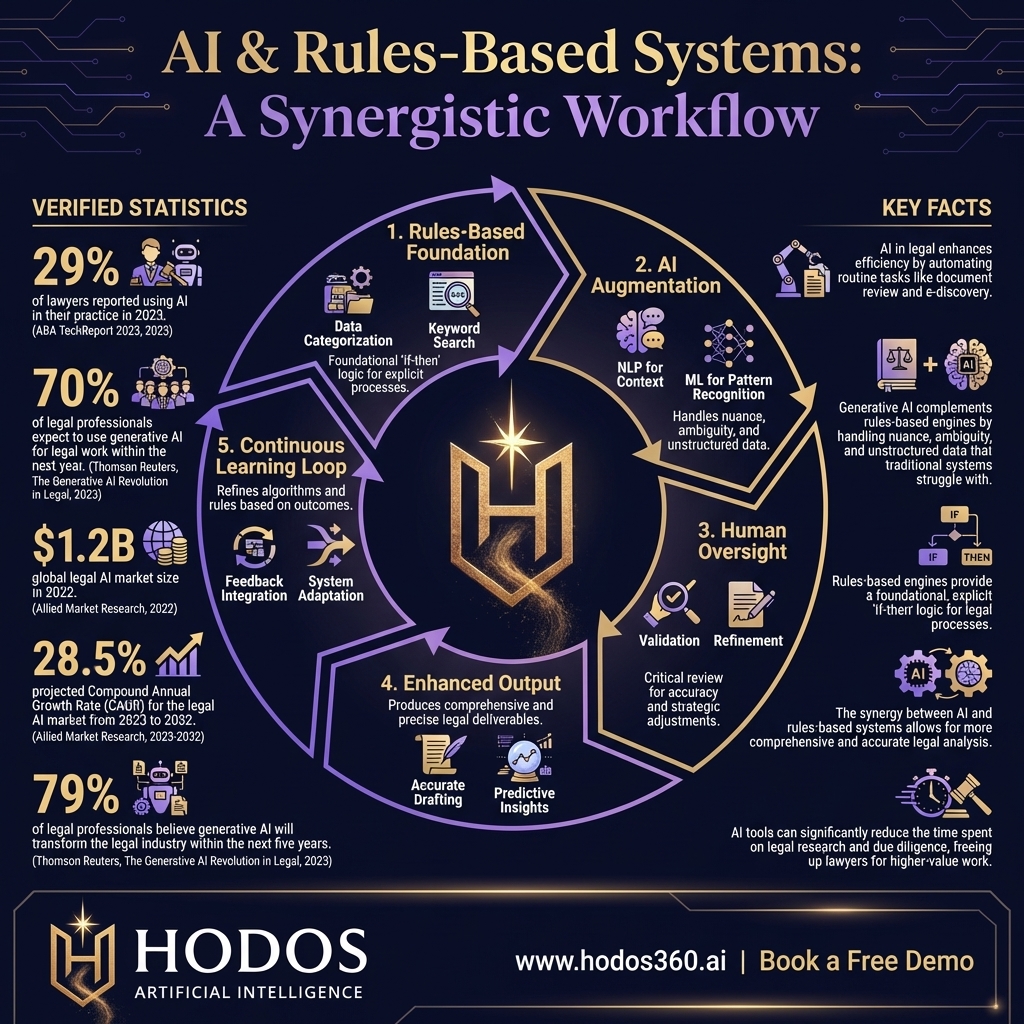
This isn't a zero-sum game between old and new, but rather a synergistic dance where cutting-edge artificial intelligence augments and refines the foundational logic of traditional legal systems. For years, the industry relied on meticulously crafted rules-based engines for tasks ranging from e-discovery filtering to basic contract clause identification, systems built on explicit 'if-then' logic.
While robust, these systems often struggled with nuance, ambiguity, and the sheer volume of unstructured data inherent in legal practice. The advent of sophisticated legal AI, particularly generative AI, offers a powerful antidote to these limitations, not by rendering rules obsolete, but by providing the cognitive leap necessary to tackle the complexities they couldn't.
Consider the journey of a firm like Baker McKenzie, which has been at the forefront of integrating AI into its global operations. Their early experiments with rules-based contract analysis tools provided a baseline for efficiency, automating the identification of standard clauses. However, these systems frequently flagged 'false positives' or missed subtle contextual variations, requiring significant human oversight.
The real transformation began when they layered advanced machine learning and natural language processing (NLP) models on top of these existing structures. As Michael Moradzadeh, CEO of Refine AI, a company focused on legal document intelligence, pointed out at LegalTech NYC 2026, "The true power isn't in ditching your established rules, but in empowering them with intelligence that can understand intent, context, and even predict potential issues that a rigid rule might overlook."
This sentiment underscores a growing consensus: the most effective legal technology ecosystem is one where the precision of rules-based logic is elevated by the interpretive and predictive capabilities of modern legal AI. Law firms that embrace this integrated approach are not just keeping pace; they are setting new benchmarks for efficiency, accuracy, and client service, transforming their operations from client intake and case management to document automation and complex legal workflows.
The challenge lies in understanding how to strategically weave these technologies together to unlock their full potential. To truly thrive in this new era, law firms must move beyond the simplistic 'replace or be replaced' narrative and instead focus on how intelligent systems can complete and elevate their existing frameworks.
This strategic integration is not merely an upgrade; it's a fundamental reimagining of legal service delivery.
The Symbiotic Relationship: How Legal AI Amplifies Rules-Based Systems
Rules-based engines have long been the backbone of early legal tech, designed to automate repetitive tasks by following predefined conditions. These systems, often built on intricate flowcharts and decision trees, excel at tasks with clear, unambiguous parameters, such as identifying specific clauses in a contract, categorizing documents based on keywords, or flagging compliance issues against a fixed regulatory framework.
Their strength lies in their determinism; given the same input, they will always produce the same output, making them reliable for tasks where consistency is paramount. However, this very strength also highlights their primary limitation: a lack of flexibility. They cannot infer, understand context, or adapt to novel situations outside their programmed rules.
When a contract uses slightly different phrasing for a standard clause, or when new legislation introduces unforeseen complexities, rules-based systems often fail, requiring constant, labor-intensive updates and human intervention. This brittleness can lead to significant bottlenecks, particularly in areas of law characterized by evolving language and nuanced interpretation.
The real breakthrough occurs when these foundational rules-based systems are augmented by advanced legal AI, specifically machine learning (ML) and natural language processing (NLP) models. Learn more about Essential AI Website Builder Guide for Law Firms. These AI capabilities provide the 'intelligence' that rules-based systems lack.
For instance, while a rules engine might be programmed to find every instance of "force majeure," an NLP-powered AI can understand variations like "acts of God" or "unforeseeable circumstances" and contextualize their impact. This symbiotic relationship was a key topic at the Thomson Reuters Synergy conference in 2025, where industry leaders discussed how AI bridges the gap between structured data and the inherent ambiguity of legal language.
As Andrew Hammond, SVP of AI and Data Science at Thomson Reuters, articulated, "Our legal AI tools are designed not to replace the precise logic of a rules engine, but to give it the contextual awareness and predictive power it needs to truly shine." This integration allows firms to leverage the speed and consistency of rules for straightforward tasks, while deploying AI to handle the more complex, nuanced, and unstructured aspects of legal work, effectively turning rigid systems into intelligent, adaptive frameworks.
The result is a more comprehensive and robust automation solution that significantly reduces manual effort and improves accuracy across the board.
The Evolving Role of Legal Professionals with AI
This integration fundamentally shifts the role of legal professionals. Instead of spending countless hours on tedious, repetitive tasks that a rules-based system can handle, or manually correcting the limitations of such systems, lawyers can now focus on higher-value, strategic work. The AI acts as an intelligent co-pilot, sifting through vast amounts of data, identifying patterns, and even drafting initial responses, allowing attorneys to dedicate their expertise to complex legal analysis, client strategy, and advocacy.
This transformation is not about diminishing human judgment but elevating it by freeing up cognitive load from mundane activities. According to the ABA TechReport 2024, firms leveraging AI for document review reported an average time savings of 30-40%, directly translating to more time for client interaction and strategic planning.
This shift is crucial for attracting and retaining top legal talent, as it offers a more intellectually stimulating and impactful career path.
The human element remains indispensable, especially in overseeing and training these sophisticated AI systems. Learn more about Essential Legal AI Access: NELLCO's Broad Impact.
Legal professionals are essential for refining AI models, ensuring their outputs align with legal accuracy and ethical standards, and interpreting the nuances that even the most advanced AI might miss. This oversight is not merely a safeguard against errors but an active participation in the continuous improvement of the AI's capabilities.
For example, a senior partner might review AI-generated contract drafts, providing feedback that helps the system learn and adapt to the firm's specific style and client preferences. This collaborative model, where the lawyer's expertise guides and validates the AI's output, is where the true power of integrated legal AI lies.
It transforms legal practice from a purely human endeavor into an augmented intelligence model, where the best of human intellect and artificial intelligence combine to deliver superior outcomes.
Generative AI's Paradigm Shift: Beyond Traditional Legal Automation
The emergence of generative AI, powered by large language models (LLMs) like OpenAI's GPT series or Anthropic's Claude, represents a significant leap beyond the capabilities of traditional rules-based engines. While rules engines operate on explicit instructions, generative AI learns from vast datasets of text, allowing it to understand context, generate human-like text, summarize complex documents, and even draft legal arguments from scratch.
This capability has moved legal technology from mere automation to true augmentation, enabling tasks that were previously impossible for machines. For instance, a generative AI can synthesize information from multiple disparate sources—case law, statutes, expert commentary—to provide a comprehensive answer to a complex legal query, a feat far beyond the scope of a rules-based system.
The impact of this technology is perhaps best exemplified by companies like Harvey AI, which secured significant funding and forged a landmark partnership with Allen & Overy, demonstrating the legal industry's rapid adoption of advanced generative models for legal research and drafting. Their success highlights the market's demand for AI that can handle the subjective and creative aspects of legal work.
This paradigm shift is not without its challenges. The "hallucination" problem, where generative AI produces factually incorrect or nonsensical information, remains a significant concern. Learn more about Agentic Marketing: The Ultimate Guide for Law Firms. As Dario Amodei, CEO of Anthropic, has often emphasized in interviews, robust safeguards and continuous validation are crucial.
This is where the integration with rules-based systems becomes invaluable. While generative AI can draft a complex legal brief, a rules engine can then be employed to cross-reference citations, check for specific compliance keywords, or ensure adherence to formatting guidelines, acting as a critical validation layer.
This layered approach mitigates the risks associated with standalone generative AI, ensuring that the creative power of LLMs is grounded in accuracy and legal rigor. Firms that understand this distinction are strategically positioning themselves to harness the full potential of both technologies, creating a robust framework that leverages the strengths of each while offsetting their respective weaknesses.
The goal is not just to automate, but to elevate the quality and reliability of legal output, fostering a new era of augmented legal intelligence.
Unleashing Productivity: Practical AI Tools for Modern Law Firms
The practical applications of integrated legal AI span nearly every facet of law firm operations, driving unprecedented gains in productivity and client satisfaction. Take, for example, client intake. Traditionally a laborious, manual process involving multiple forms and data entries, AI-powered systems can now automate initial data collection, identify potential conflicts of interest, and even perform preliminary lead qualification based on predefined criteria.
This not only streamlines the onboarding process but also ensures a consistent, high-quality client experience from the very first interaction. Similarly, in case management, AI-powered legal workflows can automatically assign tasks, track deadlines, and generate progress reports, freeing up lawyers and paralegals from administrative burdens.
According to a recent survey by Clio, firms leveraging integrated practice management software with AI features reported a 25% increase in billable hours and a 30% reduction in administrative overhead, demonstrating the tangible benefits of smart automation.
Document automation, a cornerstone of efficiency, is further revolutionized by AI.
While rules-based templates have long existed, generative AI can now dynamically draft complex documents, from initial complaints to intricate transactional agreements, by understanding the specific context and nuances of a case. Learn more about AI Voice Assistant: Essential for Modern Law Firm Success. This capability, integrated within platforms like HODOS 360's AI Law Firm Management System, allows firms to generate highly customized and legally sound documents in a fraction of the time.
Beyond internal operations, AI also transforms how law firms connect with clients and market their services. HODOS 360's AI Marketing Platform, for instance, leverages AI for everything from creating compelling video content to automating social media posts and analyzing campaign ROI, ensuring firms can effectively reach and engage their target audience.
Furthermore, AI Voice Assistants provide 24/7 client support, handling inquiries, booking appointments, and qualifying leads, ensuring no potential client is missed, regardless of time zone or language barrier. These advanced legal AI tools are not just about doing tasks faster; they're about doing them smarter, with greater accuracy and strategic foresight.
Integrating AI for Seamless Legal Workflows
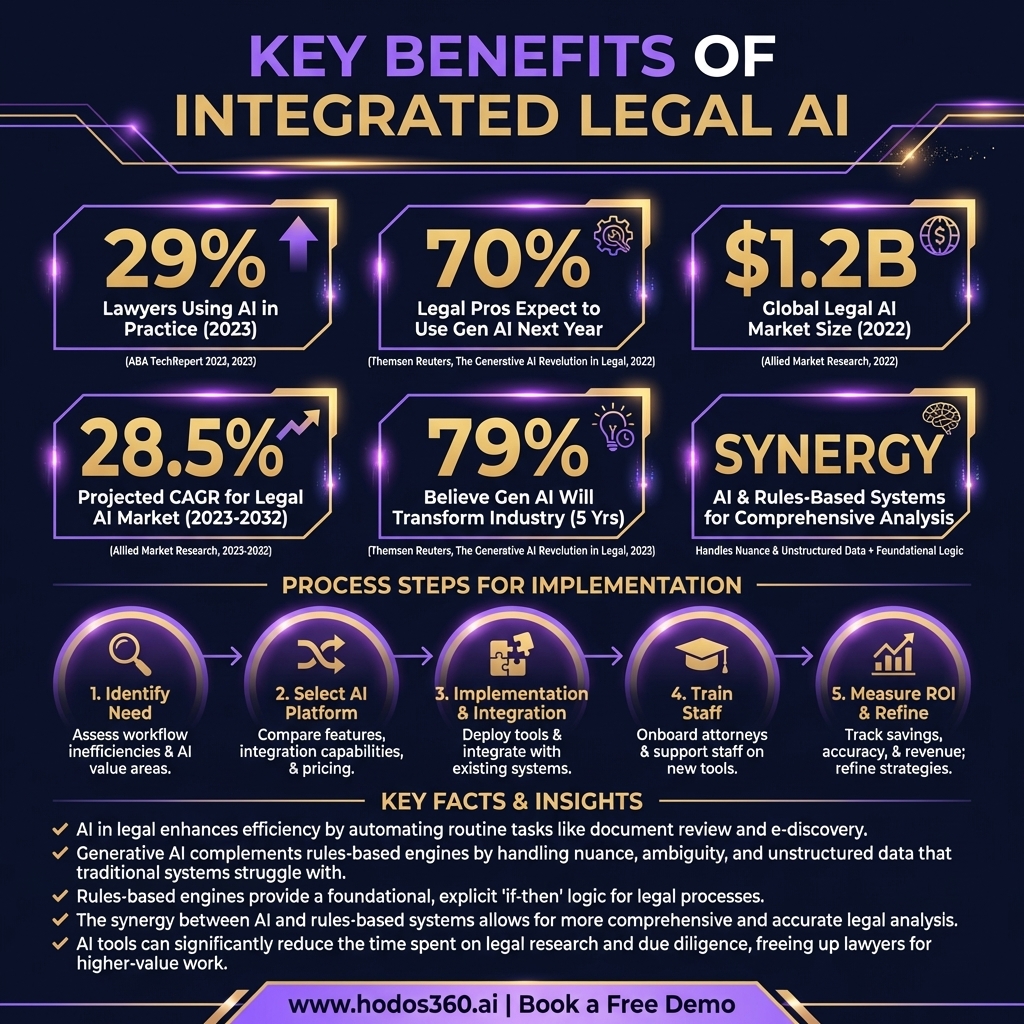
- ✓Streamlined Client Intake: AI automates initial data capture, conflict checks, and lead qualification, reducing manual effort and improving client experience.
- ✓Enhanced Case Management: AI-powered workflows automatically assign tasks, track deadlines, and generate progress reports, boosting operational efficiency.
- ✓Intelligent Document Automation: Generative AI dynamically drafts and customizes legal documents, accelerating creation while maintaining high legal standards.
- ✓Proactive Legal Research: AI synthesizes vast legal datasets, identifying relevant precedents and statutes with unparalleled speed and accuracy.
- ✓Optimized Legal Marketing: AI creates engaging content, automates social media, and analyzes campaign performance to maximize client acquisition.
- ✓24/7 Client Communication: AI Voice Assistants handle inquiries, schedule appointments, and provide multilingual support, ensuring continuous client engagement.
- ✓Predictive Analytics for Strategy: AI analyzes case data to identify trends, predict outcomes, and inform strategic decision-making.
Navigating the Complexities: Ethics, Regulation, and Responsible AI
While the benefits of legal AI are undeniable, its integration into legal practice introduces complex ethical and regulatory considerations that demand careful attention. The potential for AI to 'hallucinate' or produce biased outputs, stemming from the data it was trained on, raises serious questions about accuracy and fairness.
Client confidentiality, a cornerstone of legal ethics, is also paramount; firms must ensure that data shared with AI systems remains secure and compliant with rules like ABA Model Rule 1.6 (Confidentiality of Information). The responsibility for AI-generated errors ultimately rests with the attorney, as highlighted by Federal Rule of Civil Procedure 26, which places a duty on lawyers to ensure the accuracy of disclosures and factual content.
This necessitates a robust framework of human oversight, validation, and continuous training to mitigate risks and uphold professional standards. Firms must implement clear policies for AI use, emphasizing that AI is a tool to assist, not replace, human judgment and ethical obligations.
Moreover, the regulatory landscape for AI is rapidly evolving.
The European Union's AI Act, set to become fully enforceable, establishes a comprehensive framework for AI governance, categorizing AI systems by risk level and imposing strict requirements for high-risk applications. Learn more about AI Legal Revolution: Corporate Use Jumps 87% by 2026. While direct legal services might not always fall into the 'high-risk' category, the principles of transparency, accountability, and data governance embedded in such legislation will undoubtedly influence global best practices.
Law firms must stay abreast of these developments, ensuring their AI adoption strategies align with emerging legal and ethical guidelines. This proactive approach includes conducting thorough due diligence on AI vendors, understanding the provenance and biases of their training data, and ensuring that AI systems are explainable and auditable.
The goal is to harness AI's power responsibly, safeguarding client interests and maintaining the integrity of the legal profession. As Professor Gillian Hadfield of the University of Toronto has often argued, "Responsible AI isn't just about avoiding harm; it's about building trust and ensuring the technology serves justice, not undermines it."
This requires a commitment to ethical design and continuous vigilance from legal professionals.
Ensuring Ethical AI Implementation in Practice
To ensure ethical and compliant AI implementation, law firms should adopt a multi-faceted strategy. Firstly, comprehensive training for all legal professionals on AI capabilities, limitations, and ethical guidelines is essential. This includes understanding potential biases, the importance of verifying AI outputs, and the strict adherence to client confidentiality.
Secondly, firms must establish clear internal protocols for AI usage, specifying which tasks can be delegated to AI, the level of human review required, and data handling procedures. This might involve creating a dedicated AI ethics committee or appointing an AI compliance officer. Thirdly, engaging with AI providers who prioritize transparency and explainability in their models is crucial.
Learn more about Law Firm Mobile App Development: An Essential Blueprint for Growth. Firms should demand clear documentation on how AI systems are trained, what data they use, and how they arrive at their conclusions. Finally, continuous monitoring and auditing of AI performance are vital to identify and address any unintended biases or errors.
This proactive approach not only mitigates risks but also builds client trust and strengthens the firm's reputation as a responsible innovator in the legal tech space. The integration of AI is not a one-time event but an ongoing commitment to ethical stewardship and professional excellence.

Strategic Imperatives: Future-Proofing Your Legal Practice with Integrated AI
The narrative is clear: the most successful law firms of tomorrow will be those that master the art of integrating advanced legal AI with their existing rules-based and human-centric systems. This strategic imperative is not merely about adopting new tools; it's about fundamentally rethinking legal service delivery.
Firms that embrace this integrated approach will gain a significant competitive advantage, characterized by enhanced efficiency, superior client outcomes, and a more fulfilling work environment for their legal teams. The ability to leverage AI for rapid document generation, predictive analytics in litigation, and intelligent client communication will differentiate leading practices from those that lag.
This isn't just about keeping up; it's about setting the pace in a rapidly evolving legal landscape. As the market continues to consolidate and client expectations for speed and value intensify, the strategic deployment of AI will become a non-negotiable component of a thriving legal business model.
Firms must invest in not just the technology itself, but in the training and cultural shifts necessary to fully capitalize on its potential.
Ultimately, the future of legal practice is one of augmented intelligence, where the precision of rules-based logic and the interpretive power of human expertise are amplified by the analytical and generative capabilities of AI.
Platforms like HODOS 360, with their comprehensive suite of AI Law Firm Management, AI Marketing, AI Voice Assistants, and Web & Mobile Development services, exemplify this integrated vision. They offer a holistic ecosystem where AI isn't a standalone gimmick but a deeply embedded intelligence that completes and elevates every aspect of a law firm's operations.
By embracing this strategic integration, law firms can future-proof their practices, deliver unparalleled value to clients, and redefine what's possible in the pursuit of justice. The journey requires vision, commitment, and a willingness to evolve, but the rewards—in terms of efficiency, growth, and impact—are profound.
The time to act is now, transforming the challenge of technological change into an opportunity for unprecedented innovation and success within the legal profession.
Frequently Asked Questions
How does legal AI complement rules-based engines?+
Legal AI, particularly machine learning and NLP, complements rules-based engines by providing contextual understanding, pattern recognition, and the ability to handle ambiguity. While rules engines excel at deterministic tasks, AI adds flexibility and intelligence, allowing for more nuanced analysis and adaptive responses, effectively bridging the gap between structured logic and complex legal language.
What are the primary benefits of integrating AI into law firm operations?+
Integrating AI offers numerous benefits, including enhanced productivity through automated tasks like client intake and document generation, improved accuracy in legal research and analysis, better client engagement via AI voice assistants, and strategic insights from predictive analytics. This frees legal professionals to focus on higher-value, strategic work.
What ethical considerations should law firms be aware of when using AI?+
Law firms must address potential AI biases, data privacy concerns (per ABA Model Rule 1.6), and the risk of 'hallucinations' or incorrect outputs. Ensuring human oversight, implementing robust validation processes, and adhering to evolving regulatory frameworks like the EU AI Act are crucial for responsible and ethical AI deployment.
How does generative AI differ from traditional rules-based legal tech?+
Generative AI, powered by LLMs, can understand context, generate human-like text, and synthesize information for tasks like drafting and summarization. In contrast, rules-based tech operates on predefined 'if-then' logic. Generative AI offers creative and interpretive power, while rules-based systems provide deterministic precision, making them powerful when combined.
Can small law firms afford to implement advanced legal AI solutions?+
Yes, many AI solutions are now offered on subscription models, making them accessible to small and medium-sized firms. Platforms like HODOS 360 provide scalable, integrated AI services that streamline operations and offer a significant ROI, allowing smaller firms to compete effectively with larger counterparts without prohibitive upfront costs.