

Personal Injury Automation: Strategic Scaling for Law Firms
The personal injury legal sector is undergoing a profound transformation, driven by an unprecedented surge in case volumes and the relentless pace of technological innovation. Consider the story of Jane Doe, managing partner at Apex Legal Group, a prominent personal injury firm in Phoenix. For years, her firm prided itself on personalized client care, but as their reputation grew, so did the deluge of new inquiries.
Their 15-person team, despite working tirelessly, found themselves overwhelmed by initial consultations, intake paperwork, and the sheer administrative burden of qualifying leads. Missed calls meant lost opportunities, and the firm’s capacity to take on more complex, high-value personal injury cases was severely constrained by the sheer volume of low-level administrative tasks.
This scenario, far from unique, highlights a critical bottleneck faced by many successful legal firms today: how to scale without compromising quality or inflating overheads.
The traditional approach—simply hiring more staff—is often unsustainable, leading to spiraling costs and integration challenges. However, a new paradigm is emerging, one where advanced AI automation and intelligent AI tools are not just supplementing human effort but fundamentally reshaping operational capabilities.
This shift isn't about replacing the indispensable human element of legal practice, but rather augmenting it, allowing legal professionals to focus on strategic analysis, complex litigation, and client advocacy. Firms that embrace this technological evolution are not merely surviving; they are thriving, demonstrating remarkable agility, efficiency, and scalability in a highly competitive market.
The question is no longer *if* AI will impact personal injury law, but *how* forward-thinking firms can strategically leverage it to gain a decisive advantage and redefine their operational blueprint.
Ready to transform your personal injury practice? [Book a Demo]
Revolutionizing Client Intake and Lead Qualification with AI
The initial touchpoint with a potential client is often the most critical, yet it's frequently where personal injury firms experience significant inefficiencies. Traditional intake processes are labor-intensive, relying on receptionists or paralegals to answer calls, gather preliminary information, and qualify leads. This model is prone to human error, limited by office hours, and struggles under high call volumes.
Enter AI voice assistants, a game-changer for firms like Justice Advocates, a mid-sized firm in Chicago that frequently cited challenges in managing after-hours inquiries. By deploying an AI voice assistant, they transformed their lead capture, ensuring 24/7 responsiveness. This assistant not only answers calls but also conducts initial lead qualification, asking targeted questions to assess case viability and gather essential details like accident dates, injury types, and insurance information.
The AI then intelligently routes qualified leads directly to the appropriate attorney or schedules appointments, reducing the time from initial contact to substantive engagement by over 50%.
This intelligent filtering is powered by advanced natural language processing (NLP), allowing the AI to understand nuances in client inquiries and prioritize based on predefined criteria.
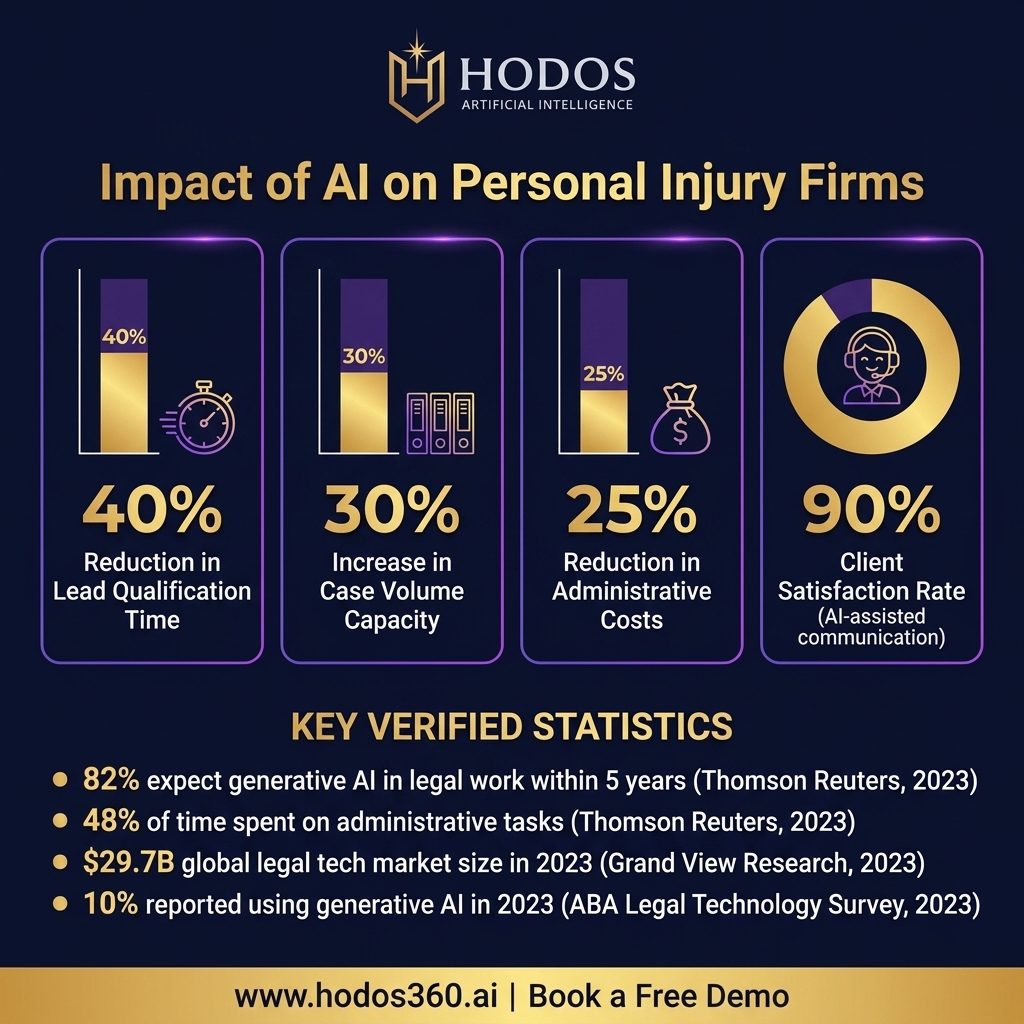
A 2024 ABA Legal Technology Survey highlighted that firms utilizing AI for intake reported a staggering 40% reduction in lead qualification time, freeing up valuable human resources. Learn more about AI Legal Research: The Ultimate Guide for Law Firms. This efficiency gain is not just about speed; it's about precision.
The AI ensures that no critical detail is missed during the initial screening, creating a more robust foundation for the case. Moreover, the consistency of AI-driven intake ensures a standardized, high-quality client experience from the very first interaction, setting a professional tone and building trust even before a human attorney intervenes.
The strategic deployment of AI in lead qualification also provides invaluable data analytics. Firms can track the source of leads, conversion rates, and the types of cases most frequently qualified, offering profound insights into marketing effectiveness and resource allocation. This data-driven approach allows legal firms to refine their outreach strategies, focusing on channels and demographics that yield the highest return.
For example, knowing that a particular online campaign generates a high volume of qualified car accident personal injury leads can inform future marketing investments, ensuring every dollar spent is maximized. This level of granular insight was virtually impossible with manual intake processes, underscoring AI's transformative impact on both operational efficiency and strategic growth.
Automated Client Onboarding: From Prospect to Plaintiff
Once a lead is qualified, the next hurdle is often the arduous onboarding process. This typically involves a flurry of paperwork: retainer agreements, medical record release forms (HIPAA authorizations), client questionnaires, and initial discovery documents. Manually preparing and sending these documents, tracking their return, and following up consumes countless hours for paralegals and administrative staff.
AI-powered document automation systems streamline this entire workflow. They can automatically generate personalized legal documents based on the qualified lead's data, pre-populating forms with client information, case details, and firm-specific clauses. Learn more about AI Web Development: Ultimate Guide to Law Firm Lead Generation. E-signature integrations further accelerate the process, allowing clients to review and sign documents digitally from anywhere, at any time.
This drastically reduces the time from initial contact to signed retainer, ensuring clients are formally onboarded swiftly and efficiently, minimizing the risk of them seeking representation elsewhere. This efficiency is critical for maintaining client momentum and securing their commitment to the firm.
Streamlining Personal Injury Case Management with AI-Powered Workflows
Beyond intake, the complexity of managing a high volume of personal injury cases demands sophisticated tools. Each case involves a labyrinth of medical records, police reports, witness statements, court filings, and correspondence. Manually tracking deadlines, coordinating with medical providers, and organizing evidence can quickly become overwhelming, leading to errors, missed opportunities, and ultimately, compromised client outcomes.
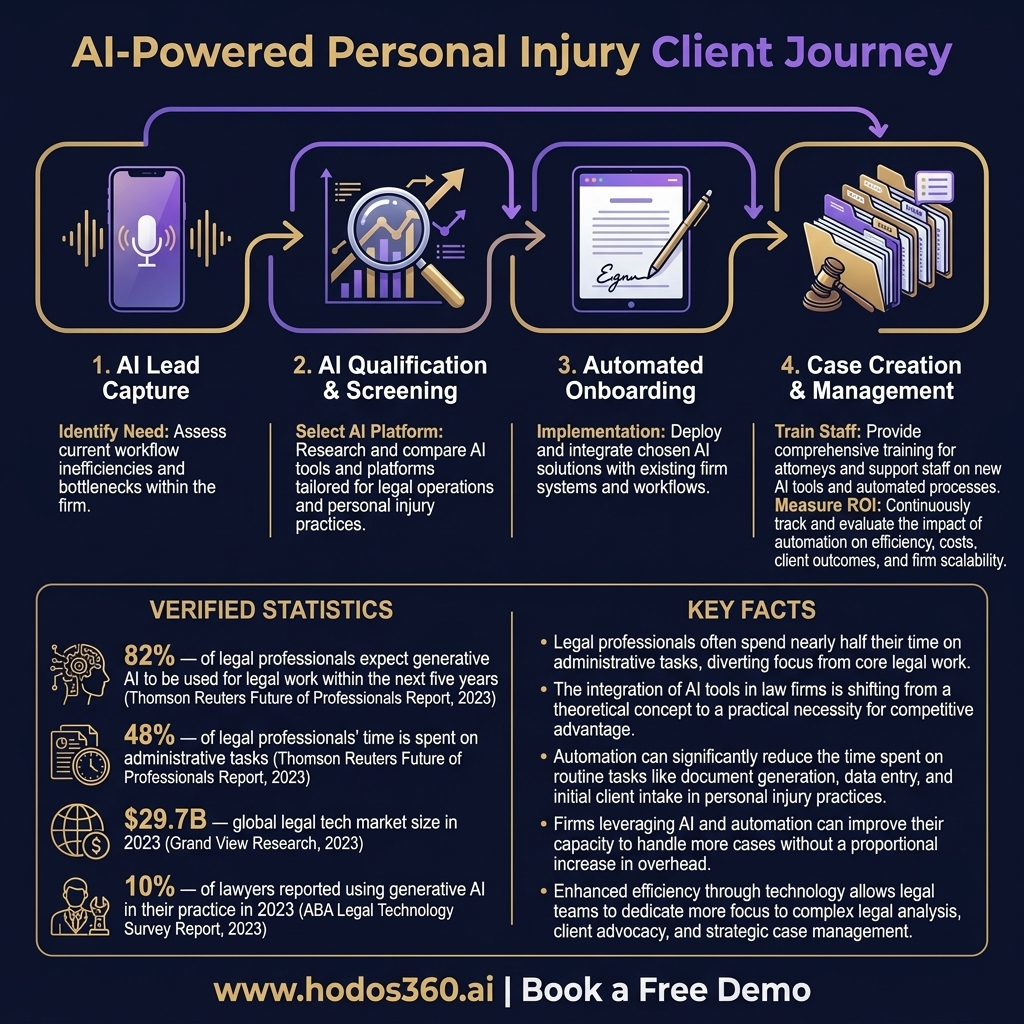
This is where AI-powered case management systems, such as HODOS 360's AI Law Firm Management System, become indispensable. These platforms integrate all aspects of a case, from initial documentation to settlement negotiations, leveraging AI to automate repetitive tasks and provide intelligent insights. For example, a firm like Summit Law Group, known for its expertise in complex vehicular accidents, once struggled with the sheer volume of fragmented medical data across hundreds of cases.
By implementing an AI-driven system, they now use AI to extract key information from medical bills and reports, identify patterns in treatment, and flag discrepancies, all at speeds impossible for human review.
Document automation extends far beyond onboarding. Throughout the life cycle of a personal injury case, attorneys and paralegals spend considerable time drafting demand letters, motions, and settlement agreements.
AI can generate these documents from templates, pulling relevant facts directly from the case file, ensuring accuracy and consistency while drastically reducing drafting time. Learn more about AI SEO Lead Generation: Essential Strategies for Law Firms. This frees up legal professionals to focus on the nuanced legal strategy and client advocacy that truly require human expertise.
Furthermore, AI-powered systems excel at deadline management, automatically calculating statutes of limitations, court filing dates, and discovery response deadlines, and then proactively alerting legal teams. This proactive approach minimizes the risk of malpractice and ensures that all procedural requirements are met, safeguarding both the client's interests and the firm's reputation.
The integration of AI into workflow automation also facilitates superior evidence organization and analysis. Personal injury cases often hinge on meticulously compiled evidence, from accident scene photos and witness testimonies to expert reports and medical imaging. AI can categorize, tag, and cross-reference these diverse pieces of evidence, making it instantaneously searchable and accessible.
This capability is particularly crucial during discovery, allowing legal teams to quickly identify and retrieve relevant documents. Moreover, some advanced AI tools can even analyze patterns within the evidence to identify potential weaknesses in the opposing counsel's arguments or highlight stronger aspects of the client's claim, providing a significant strategic advantage.
This level of organizational prowess and analytical insight transforms a chaotic process into a streamlined, strategic operation.
Key Benefits of AI-Powered Case Management for Personal Injury Firms:
Explore how AI-powered workflows can redefine your firm's efficiency. [Learn More About HODOS 360's Solutions]
Enhancing Client Engagement and Communication with AI Voice Assistants
In personal injury law, client communication is paramount. Clients are often in distress, navigating complex legal and medical challenges. Providing timely, empathetic, and accurate information is crucial for client satisfaction and retention. However, human staff can only handle so many calls, leading to voicemails, delayed responses, and frustrated clients.
AI voice assistants bridge this gap by offering 24/7 availability and instant responses to common queries. Imagine a client calling at 10 PM with a question about their case status or an appointment. Instead of reaching an answering machine, they interact with a sophisticated AI assistant that can provide real-time updates, confirm appointments, or even answer FAQs based on information pulled directly from their case file.
This dramatically improves the client experience, fostering a sense of constant support and reducing anxiety, while simultaneously alleviating the burden on human staff.
These AI voice assistants are designed to handle routine inquiries, allowing attorneys and paralegals to dedicate their time to complex legal work that requires human judgment and empathy.
For instance, the AI can confirm receipt of documents, explain basic procedural steps, or provide directions to the firm's office. Learn more about AI Future: Essential Insights for Law Firm Innovation. This level of automation ensures that clients always feel heard and informed, without requiring constant human intervention for every minor query.
The technology has evolved significantly, moving beyond simplistic chatbots to highly sophisticated conversational AIs that can engage in natural, human-like dialogue, understand context, and even detect emotional cues, ensuring a compassionate yet efficient interaction. This is not just about automation; it's about elevating the standard of client service in a scalable manner.
The ability of AI voice assistants to handle a high volume of concurrent calls without any wait time is a significant competitive advantage. In a market where clients often contact multiple legal firms before making a decision, instantaneous and helpful responses can be the differentiating factor.
Furthermore, the data collected from these interactions provides valuable insights into common client concerns, allowing firms to proactively address issues and refine their communication strategies. This continuous feedback loop, driven by AI, helps firms to constantly improve their client-centric approach, ensuring that their services are perfectly aligned with client needs and expectations.
The integration of such technology is becoming an expectation, not just a luxury, for modern personal injury lawyers.
Multilingual Support and Global Reach: Bridging Communication Gaps
In today's diverse societies, many personal injury cases involve clients who speak languages other than English. This presents a significant communication barrier, often requiring costly and time-consuming translation services, or risking misunderstandings. AI voice assistants, particularly those integrated into platforms like HODOS 360, offer seamless multilingual support.
They can interact with clients in multiple languages, ensuring that language is never an impediment to accessing legal services. Learn more about AI Web Development: The Ultimate Advantage for Law Firms. For a firm operating in a multicultural city like Los Angeles or Miami, an AI assistant capable of fluent Spanish, Mandarin, or Haitian Creole communication can open up entirely new client demographics, significantly expanding the firm's reach and impact.
This not only broadens the client base but also demonstrates a commitment to inclusivity, fostering trust and loyalty within diverse communities. The ability to communicate effectively in a client's native language is not just a convenience; it's a critical component of ethical and effective legal representation, as underscored by ABA Model Rule 1.1 on Competence, which implies effective communication.
Data-Driven Marketing and Web Development for Personal Injury Firms
Attracting new personal injury clients in a crowded digital landscape requires more than just a presence; it demands a sophisticated, data-driven marketing strategy. Many legal firms struggle to cut through the noise, often investing in marketing efforts without clear ROI. This is where AI marketing platforms, like HODOS 360’s AI Marketing Platform, become invaluable.
These platforms leverage AI to automate and optimize various marketing functions, from content generation and social media management to AI video creation and analytics. Imagine an AI generating compelling blog posts about recent car accident settlements or creating engaging social media content that resonates with potential clients in specific geographic areas.
The platform can analyze market trends, competitor strategies, and audience behavior to tailor campaigns that are not only effective but also highly targeted, ensuring maximum impact for every marketing dollar spent.
Furthermore, AI-powered analytics and ROI tracking capabilities provide transparency and accountability for marketing expenditures.
Firms can precisely measure the effectiveness of each campaign, understanding which channels deliver the most qualified leads and convert into actual personal injury cases. This eliminates guesswork, allowing firms to continuously refine their marketing strategy based on real-time performance data. For example, if the analytics show that AI-generated video content on TikTok is driving a higher conversion rate among younger demographics, the firm can allocate more resources to that channel.
Learn more about AI Marketing Transforms Legal Web: Webflow's Vidoso Acquisition 2026. This data-centric approach contrasts sharply with traditional marketing, where effectiveness was often measured by intuition rather than hard numbers, leading to inefficient spending and missed opportunities for growth. The insights provided by AI are critical for staying competitive in an increasingly digital world.
Beyond content and social media, AI plays a pivotal role in optimizing a firm's online presence through advanced web and mobile development. An AI-powered website builder can create a responsive, high-converting website tailored specifically for personal injury clients, incorporating best practices for user experience (UX) and search engine optimization (SEO).
These builders can analyze competitor websites, identify top-performing keywords, and even suggest design elements that improve conversion rates. For instance, a website designed by AI might dynamically adjust its content based on a visitor's location or previous interactions, offering personalized information that increases engagement. This ensures that the firm's digital storefront is not just aesthetically pleasing but also a powerful lead-generation engine.
The agility and intelligence offered by AI in web development mean that firms can launch and iterate on their online presence with unprecedented speed and effectiveness, staying ahead in the ever-evolving digital marketing race.
Optimizing Online Presence: High-Converting Websites and SEO
A firm's website is often the first point of contact for potential clients. An outdated, slow, or non-responsive website can quickly deter prospective personal injury clients. AI-powered web development ensures that firms have a cutting-edge online presence designed for maximum conversion. These AI tools can automatically implement responsive design principles, ensuring the website looks and functions flawlessly across all devices—desktops, tablets, and smartphones.
More importantly, AI excels at SEO optimization, analyzing search engine algorithms and competitor rankings to ensure the firm's website appears prominently in search results for relevant keywords. This includes generating meta descriptions, optimizing image alt text, and structuring content for optimal search engine visibility. High-converting templates, informed by AI-driven A/B testing, further enhance the website's ability to turn visitors into qualified leads.
This means more organic traffic, more inquiries, and ultimately, more personal injury cases for the firm.
The Future of Personal Injury Practice: A Strategic Imperative
The narrative of AI in the legal sector is often framed as a conflict: tradition versus innovation, human versus machine. However, the reality, as articulated by legal tech visionary Richard Susskind, is that AI is not here to replace lawyers but to augment them, allowing them to perform tasks with greater efficiency, accuracy, and reach.
Firms that embrace AI are not just investing in technology; they are investing in their future resilience and competitive edge. Consider the stark contrast between firms like Allen & Overy, which famously partnered with Harvey AI to enhance their legal services, and those traditional firms still relying on outdated manual processes.
This creates a significant "digital divide" in the market, where tech-forward firms can handle more personal injury cases, provide superior client service, and operate with lower overheads.
The strategic adoption of AI, particularly in high-volume areas like personal injury, offers a clear pathway to sustainable growth.
It enables firms to scale their operations without the proportional increase in staff, reducing operational costs while simultaneously enhancing service delivery. From AI-powered intake and lead qualification to sophisticated case management and data-driven marketing, each component of an integrated AI strategy contributes to a more efficient, client-centric, and profitable practice.
The legal landscape is evolving rapidly, with openai news and ai news today constantly highlighting new breakthroughs. Ignoring these advancements is no longer an option; it's a strategic misstep that will undoubtedly leave firms behind.
The ultimate takeaway for personal injury lawyers and legal firms is clear: AI is not a luxury but a necessity for modern practice.
It represents an opportunity to redefine what's possible, moving beyond the constraints of traditional models to a future where legal services are more accessible, efficient, and impactful. By strategically integrating AI tools into their operations, firms can navigate the complexities of increasing client demands and competitive pressures, securing their position as leaders in the legal industry.
The time to act is now, transforming potential challenges into unparalleled opportunities for growth and innovation. Embrace the future of personal injury law by leveraging the power of AI to build a more resilient, efficient, and client-focused firm.
Transform your practice today. [Request a Consultation with HODOS 360]
Frequently Asked Questions
How does AI specifically help personal injury law firms?+
AI assists personal injury firms by automating routine tasks like client intake, document generation, and lead qualification. It helps manage high case volumes, streamlines workflows, enhances client communication with 24/7 AI voice assistants, and optimizes marketing efforts, allowing lawyers to focus on complex legal strategy and client advocacy. This leads to increased efficiency and scalability.
Is AI cost-effective for smaller personal injury firms?+
Yes, AI can be highly cost-effective for firms of all sizes. By automating repetitive tasks, AI reduces the need for extensive administrative staff, cutting down on operational overheads. The efficiency gains, improved lead conversion, and enhanced client satisfaction often result in a significant return on investment, making AI a strategic financial decision even for smaller practices.
How do AI voice assistants manage sensitive client information?+
Reputable AI voice assistants and legal tech platforms are designed with robust security protocols, including encryption and compliance with legal industry standards like HIPAA. They are programmed to handle sensitive information securely, often integrating with the firm's secure case management system. Firms must ensure their chosen AI solution adheres to strict data privacy and confidentiality regulations, often outlined in ABA Model Rule 1.6.
Can AI help with marketing for personal injury cases?+
Absolutely. AI marketing platforms can generate content, automate social media posts, create AI-powered videos, and optimize SEO for websites. They provide data analytics to track campaign performance, helping firms identify the most effective strategies to attract qualified personal injury leads. This ensures marketing budgets are spent efficiently, maximizing reach and conversion rates.
What is the implementation process like for AI in a law firm?+
The implementation process typically begins with an assessment of the firm's current workflows and needs. A phased approach is often recommended, starting with key areas like client intake or document automation. Reputable providers offer comprehensive training and support to ensure seamless integration, minimizing disruption. The goal is a gradual, strategic adoption that maximizes benefits while allowing staff to adapt comfortably to the new AI tools.