


AI Adoption: The Ultimate Guide for Law Firm Success
The legal industry stands at a pivotal juncture, marked by the accelerating pace of technological innovation. Nowhere is this more evident than in the strategic embrace of artificial intelligence by leading law firms. A recent headline from Legal IT Insider, "Driving adoption: Akin rolls out NetDocuments’ AI suite firmwide," underscores a critical shift: the transition from pilot projects to full-scale enterprise AI execution.
This move by Akin Gump Strauss Hauer & Feld, an Am Law 100 powerhouse, is not merely a technical upgrade; it represents a profound commitment to embedding AI into the very fabric of its operations, impacting everything from document review to case management. Jeff Westcott, Akin's London-based Director of Innovation and AI, highlighted the firm's deliberate approach, emphasizing "handrails, not handcuffs" – a philosophy that prioritizes responsible implementation while fostering innovation across its vast repository of over 65 million documents.
This strategic rollout signals a clear message: AI is no longer a futuristic concept but a present-day imperative for competitive advantage.
This trend aligns with broader industry data reflecting a surge in legal tech investment and adoption. According to a 2024 report by McKinsey & Company, firms that strategically integrate AI are experiencing significant gains in efficiency, accuracy, and client satisfaction, reporting up to a 30% reduction in time spent on routine tasks.
The narrative is clear: firms that operationalize AI are not just optimizing; they are redefining their service delivery models and client engagement strategies. The competitive landscape is intensifying, with early adopters like Akin Gump setting a new standard for operational excellence. This shift creates a palpable tension between traditional methodologies and the transformative potential of AI, challenging legal professionals to adapt or risk being outmaneuvered.
The question is no longer *if* AI will impact your practice, but *how* comprehensively and effectively you will integrate it.
For law firm owners, attorneys, and legal professionals, understanding the intricacies of successful AI adoption is paramount. This comprehensive guide delves into the strategic imperatives, practical implementation challenges, and tangible benefits of embedding AI into legal workflows.
We will explore how firms are moving beyond theoretical discussions to achieve real-world results, drawing lessons from pioneering efforts like Akin's NetDocuments deployment and examining the broader ecosystem of AI-powered legal solutions. From enhancing client intake to streamlining document automation and optimizing marketing efforts, the journey towards AI-driven excellence is multifaceted.
It demands a clear vision, a robust strategy, and a commitment to leveraging technology responsibly to unlock unprecedented levels of productivity and client value.
The Strategic Imperative of AI Adoption in Modern Law Firms
The push for AI adoption within the legal sector is driven by a confluence of market forces, evolving client expectations, and the relentless pursuit of operational efficiency. Law firms operate in an increasingly competitive environment where clients demand greater transparency, faster turnaround times, and demonstrable value for their legal spend.
A 2023 Thomson Reuters Future of Legal Report highlighted that over 60% of corporate legal departments expect their law firms to leverage technology, including AI, to reduce costs and improve service delivery. This expectation is a significant driver for firms to invest in AI, moving beyond traditional methods that are often time-consuming and resource-intensive.
Firms that embrace AI are gaining a distinct competitive edge. Consider the strategic partnership between Allen & Overy and Harvey AI, announced in late 2022, which saw the firm integrate Harvey’s generative AI platform across its global practice. This collaboration, personally championed by the firm's leadership, showcased a proactive approach to deploying cutting-edge AI for tasks ranging from contract analysis to regulatory compliance.
Similarly, the acquisition of Casetext by Thomson Reuters for approximately $500 million in 2023 underscored the immense value and market demand for AI-powered legal research and writing tools like CoCounsel. Learn more about AI Legal Tech: The Essential Guide to Funding and Growth. These events are not isolated incidents; they are symptomatic of a broader industry shift, where AI is no longer a luxury but a fundamental component of a modern legal practice.
Firms failing to adapt risk falling behind in terms of efficiency, cost-effectiveness, and ultimately, client retention. This proactive engagement with AI is crucial for maintaining relevance and ensuring long-term success in a rapidly evolving legal landscape.
Ready to explore how AI can transform your practice?
Discover how HODOS 360's AI Law Firm Management System can streamline your operations, from case management to document automation. Our platform is designed to integrate seamlessly into your existing workflows, providing AI-powered tools that enhance productivity and client service. Learn more about our comprehensive suite of solutions today.
Navigating the Implementation Landscape: Lessons from Leading Firms
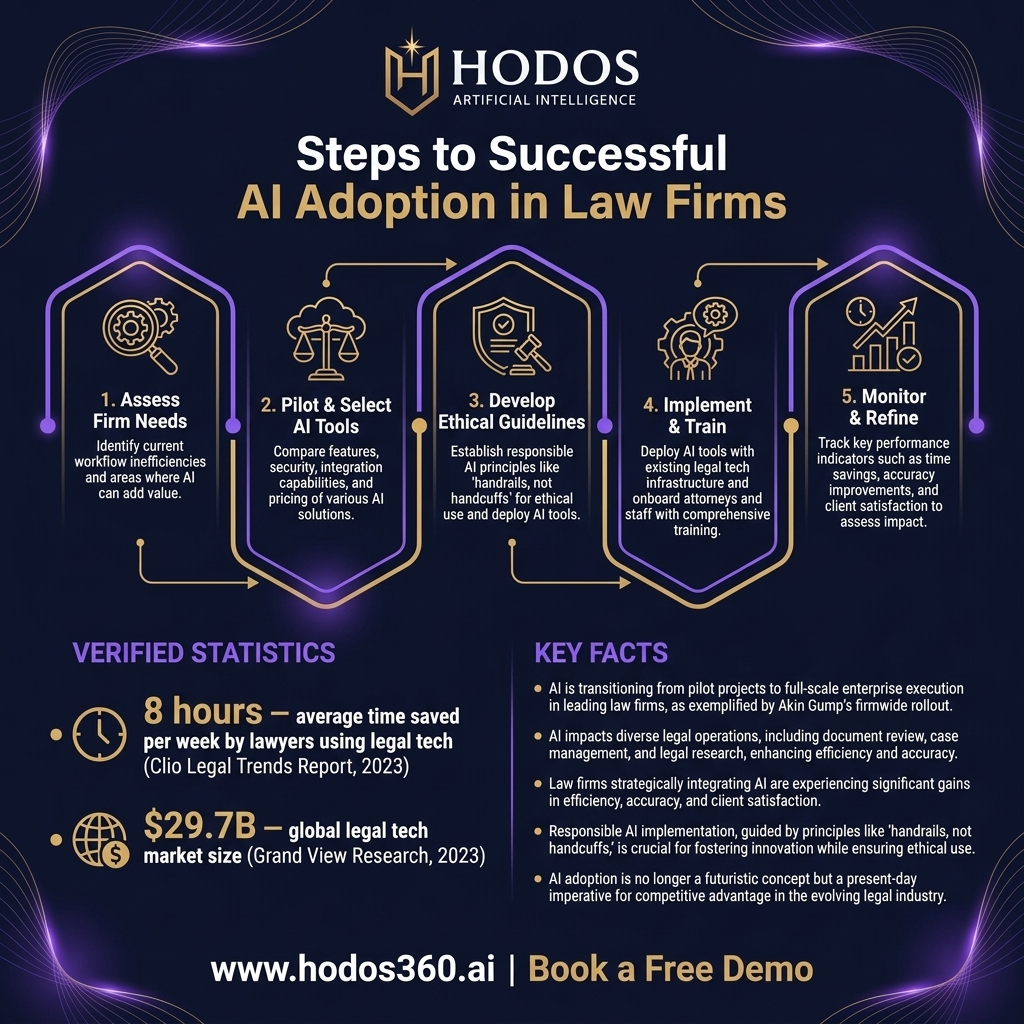
Successfully embedding AI into a law firm's operations requires more than just purchasing software; it demands a strategic approach to implementation, change management, and a deep understanding of ethical considerations. Akin Gump's firmwide rollout of NetDocuments' AI suite provides valuable insights into this complex process.
Their decision to operationalize AI across 65 million documents, rather than in isolated pilots, demonstrates a commitment to enterprise-level transformation. Jeff Westcott's emphasis on "handrails, not handcuffs" speaks to a nuanced strategy: providing robust frameworks and guidelines for AI use while empowering attorneys to explore its capabilities.
This approach helps mitigate common fears around AI, such as job displacement or loss of professional judgment, by framing AI as an augmentative tool rather than a replacement. The firm meticulously planned training programs, ensuring that legal professionals understood how to leverage NetDocuments' AI tools like "Smart Answers" for rapid legal research and "PatternBuilder" for document generation, thereby maximizing adoption rates and user proficiency.
One of the primary challenges in AI adoption is overcoming internal resistance and fostering a culture of innovation. Many firms face skepticism from seasoned attorneys who are comfortable with traditional methods. According to the 2024 ABA TechReport, while 70% of legal professionals acknowledge the importance of AI, only 35% report actively using it in their daily practice, citing concerns about reliability, data security, and the "black box" nature of some AI tools.
Firms like Akin have addressed this by involving key stakeholders early, demonstrating AI's practical benefits through pilot projects, and championing success stories. Learn more about Ultimate AI in MarTech: Predictive Power for Law Firms. Moreover, the leadership's visible commitment, such as Akin's Managing Partner Kim Koopersmith endorsing the initiative, is crucial in signaling the strategic importance of AI.
This top-down support, combined with bottom-up engagement, creates a fertile ground for successful AI integration.
Beyond technical integration, firms must navigate the ethical implications of AI. The ABA Model Rules of Professional Conduct, specifically Rule 1.1 (Competence), impose a duty on lawyers to keep abreast of changes in the law and its practice, including the benefits and risks associated with relevant technology.
This extends to understanding how AI tools handle client data, ensure confidentiality (Rule 1.6), and avoid biases in legal analysis. Firms must establish clear internal policies and governance frameworks, akin to those being developed in response to the EU AI Act, to ensure responsible and ethical deployment.
This includes vetting AI vendors for data security protocols, understanding the provenance of training data, and implementing human oversight mechanisms to review AI-generated outputs. The goal is to leverage AI’s power while upholding the highest standards of professional responsibility and client trust.
Overcoming Resistance and Fostering a Culture of Innovation
The human element is often the most critical, yet most overlooked, aspect of technological transformation. Resistance to change, driven by fear of the unknown or concerns about job security, can derail even the most well-planned AI initiatives. Successful firms like Akin Gump have proactively addressed this by emphasizing AI as an augmentation tool, designed to free up lawyers from mundane tasks, allowing them to focus on higher-value strategic work.
Transparent communication, comprehensive training, and demonstrating tangible benefits are key. Learn more about AI Web Development: Essential Collaboration for Law Firms. Firms should create internal champions for AI, individuals who can articulate its value and guide their peers through the learning curve. This approach helps demystify AI and builds a collective understanding that technology is a partner in delivering superior legal services, not a threat to the profession itself.
The Tangible Benefits: Efficiency, Accuracy, and Client Satisfaction
The real-world impact of AI adoption in law firms translates into significant, measurable benefits across multiple dimensions. One of the most immediate and profound advantages is the dramatic increase in operational efficiency. AI-powered tools can process and analyze vast quantities of data—documents, precedents, statutes—at speeds impossible for human attorneys.
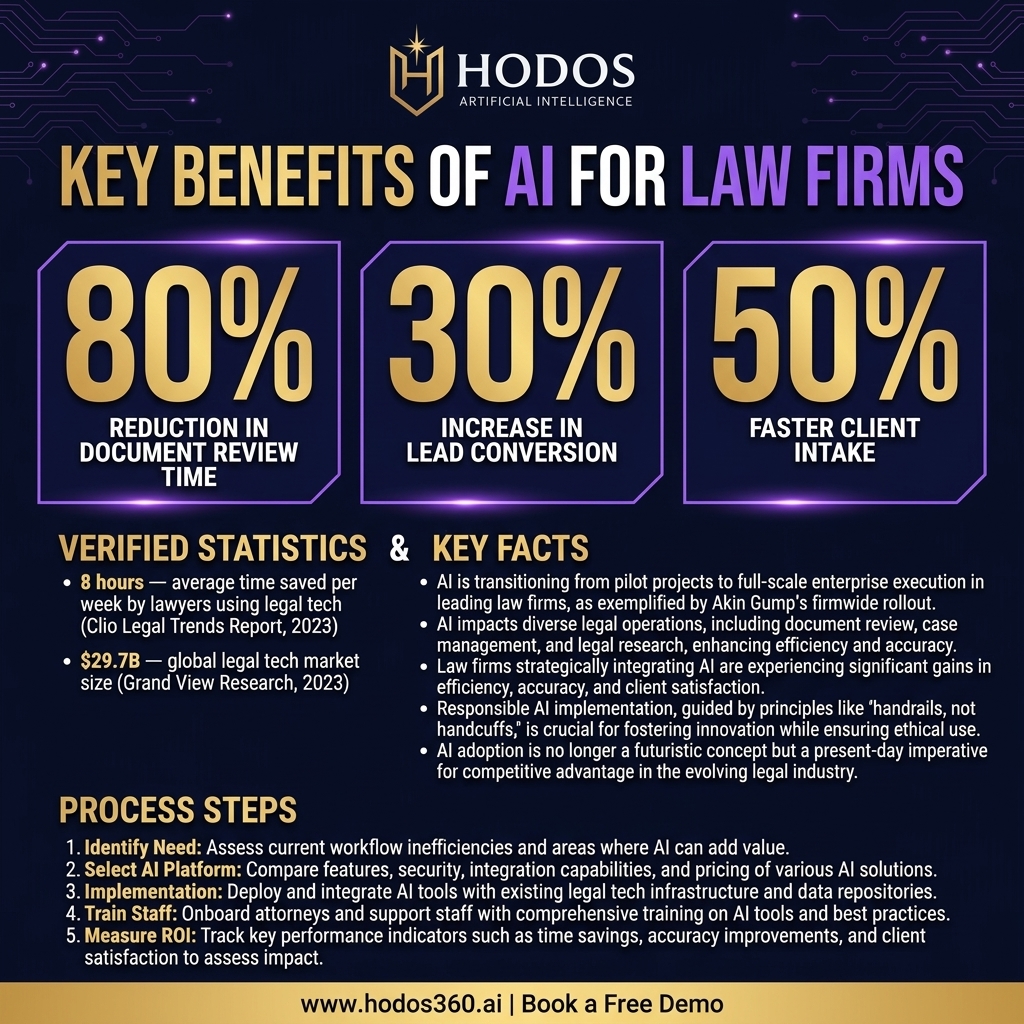
For instance, AI in e-discovery can reduce review times by up to 80%, allowing firms to handle larger cases with fewer resources and respond to discovery requests far more quickly. This efficiency directly impacts profitability by reducing billable hours on routine tasks and freeing up legal talent for more complex, strategic work.
Moreover, AI's ability to automate repetitive administrative functions, such as data entry for client intake or scheduling, further streamlines back-office operations, contributing to overall firm productivity.
Beyond speed, AI significantly enhances accuracy and consistency in legal work. Human error, while inevitable, can have costly consequences in legal practice.
AI-driven contract review platforms can identify missing clauses, inconsistent terminology, or potential risks with near-perfect precision, far exceeding the capabilities of manual review. Similarly, AI-powered legal research tools can unearth relevant case law and statutes that might be missed by traditional keyword searches, providing attorneys with a more comprehensive and accurate foundation for their arguments.
This improved accuracy not only reduces the risk of costly mistakes but also strengthens the quality of legal advice provided, building greater trust and confidence with clients. Learn more about Legal AI Acquisition 2026: The New Era of Agentic Law Firms. The consistency that AI brings to processes ensures a standardized, high-quality output across all matters, regardless of the individual attorney handling the task.
Ultimately, the cumulative effect of increased efficiency and accuracy leads to significantly enhanced client satisfaction. Clients benefit from faster resolution times, more predictable legal costs, and a higher quality of service. Firms can pass on some of the efficiency gains as cost savings, making their services more competitive.
Furthermore, by automating routine tasks, attorneys can dedicate more time to client interaction, strategic counseling, and developing deeper client relationships. This client-centric approach, empowered by AI, allows firms to deliver greater value, respond more proactively to client needs, and build a reputation for innovation and excellence.
The ability to leverage AI for tasks like predictive analytics can also help firms advise clients on potential outcomes, offering a level of foresight previously unattainable. The future of legal practice is intelligent and integrated. Learn more about HODOS 360's comprehensive AI solutions for law firms, designed to elevate your client experience and operational efficiency.
- ✓Automated Document Review: AI drastically reduces the time and cost associated with reviewing large volumes of legal documents, identifying relevant information and anomalies with high precision.
- ✓Enhanced Legal Research: AI-powered platforms can quickly scan vast legal databases, statutes, and case law to provide attorneys with comprehensive and highly relevant research results, including predictive analytics on case outcomes.
- ✓Streamlined Client Intake: AI systems can automate the collection of client information, perform initial conflict checks, and even qualify leads, making the onboarding process faster and more efficient.
- ✓Intelligent Contract Analysis: AI can identify key clauses, extract data, highlight risks, and ensure compliance in contracts, significantly speeding up due diligence and transactional work.
- ✓Predictive Analytics: Leveraging historical data, AI can forecast litigation outcomes, judge tendencies, and settlement ranges, empowering attorneys with data-driven strategic insights.
- ✓Automated Billing & Time Tracking: AI integration can simplify and optimize billing processes, accurately tracking time spent on tasks and generating invoices, reducing administrative overhead.
- ✓Personalized Legal Marketing: AI can analyze market trends and client data to create highly targeted marketing campaigns, optimizing content generation and social media engagement for better ROI.
Future-Proofing Your Practice: Emerging Trends in Legal AI
The landscape of legal AI is not static; it is constantly evolving, with new advancements emerging at a rapid pace. Generative AI, spearheaded by models like OpenAI’s GPT-4 and Anthropic’s Claude 3, represents the next frontier, promising even more transformative capabilities. These models can draft legal documents, summarize complex cases, and even assist in creating persuasive arguments, moving beyond mere data analysis to content creation.
Firms must stay abreast of these developments, understanding how to ethically and effectively integrate generative AI into their workflows. The key is to leverage these tools to augment human creativity and judgment, not replace it, ensuring that the attorney remains at the core of the legal process.
The rapid pace of innovation, often driven by visionary leaders like Sam Altman, CEO of OpenAI, means that what was cutting-edge yesterday may be standard practice tomorrow, necessitating continuous learning and adaptation.
Regulatory developments are also shaping the future of legal AI. The European Union's AI Act, which came into full effect in early 2026, sets a global precedent for regulating AI, particularly high-risk applications.
This legislation mandates strict requirements for transparency, data quality, human oversight, and cybersecurity for AI systems. For law firms, this means a heightened responsibility to ensure that the AI tools they use, especially those handling sensitive client data or impacting legal outcomes, comply with these evolving regulatory frameworks.
Learn more about AI in MarTech: The Ultimate Guide to Predictive Power. Firms must conduct thorough due diligence on their AI vendors and establish robust internal governance policies to navigate this complex regulatory environment. Adherence to these standards is not just about compliance; it's about building trust with clients and demonstrating a commitment to responsible technology use.
As AI continues to mature, we are likely to see increased specialization and integration. AI will become less about standalone tools and more about embedded intelligence within comprehensive legal tech platforms. This trend points towards AI-powered legal operating systems that seamlessly connect various firm functions – from client intake and case management to billing and marketing.
The focus will shift to creating a holistic, AI-driven ecosystem that optimizes every aspect of a law firm's operations. This integrated approach, championed by platforms like HODOS 360, will provide a competitive edge by unifying disparate tools into a cohesive, intelligent workflow, allowing firms to leverage AI's full potential across their entire practice.
The ability to adapt to these emerging trends and strategically integrate advanced AI solutions will be critical for future-proofing any legal practice.
Ethical Considerations and Responsible AI Deployment
The power of AI comes with significant ethical responsibilities, particularly in the legal field where accuracy, fairness, and confidentiality are paramount. Concerns around AI 'hallucinations' (generating false information), algorithmic bias, and data privacy must be proactively addressed. Firms must ensure that AI tools are trained on diverse, unbiased datasets and that mechanisms for human review and override are always in place.
Learn more about AI Websites: Essential Digital Growth for Law Firms. Transparency about AI's use with clients is also crucial, fostering trust and managing expectations. Adhering to ethical guidelines, such as those put forth by the ABA Task Force on AI and the Legal Profession, is not merely good practice but a professional imperative, safeguarding both client interests and the integrity of the legal system.
Integrating AI for Holistic Law Firm Management
The true potential of AI in the legal sector is realized when it is not merely a standalone tool but an integrated component of a holistic law firm management strategy. This means leveraging AI across all operational silos, transforming disparate functions into a cohesive, intelligent ecosystem.
Beyond document management and legal research, AI is revolutionizing client intake, marketing, and even the fundamental ways firms interact with their clientele. Consider how AI can optimize the client journey from the very first touchpoint. AI voice assistants, for example, can provide 24/7 phone answering, qualify leads, and book appointments, ensuring no potential client is missed and initial interactions are efficient and professional.
This not only enhances client experience but also significantly boosts lead conversion rates, directly impacting a firm's growth trajectory. The integration of such services demonstrates a forward-thinking approach to client acquisition and retention.
Furthermore, AI's application extends powerfully into the realm of legal marketing and business development.
An AI Marketing Platform can automate social media outreach, generate targeted content, and analyze campaign performance with unparalleled precision. By tracking ROI, firms can optimize their marketing spend, focusing on strategies that yield the highest returns. AI-powered website building and SEO optimization ensure that a firm's online presence is not only visually appealing but also highly discoverable and conversion-focused.
Responsive design and high-converting templates, infused with AI insights, can transform a website from a static brochure into a dynamic lead-generation engine. This comprehensive application of AI, from initial client contact to ongoing engagement, illustrates how technology can drive both operational efficiency and business growth simultaneously.
For law firms striving for excellence, the future lies in embracing platforms that offer integrated AI solutions across the entire practice. These platforms provide a centralized hub for case management, billing, document automation, and AI-powered legal workflows, ensuring seamless operation and data synergy. By connecting these functions, firms can gain invaluable insights into their performance, identify bottlenecks, and make data-driven decisions.
The synergy created by such integrated systems allows firms to move beyond piecemeal tech solutions to a truly intelligent and interconnected operational framework. This holistic approach is not just about adopting individual AI tools; it's about building an AI-powered infrastructure that supports every facet of a modern, successful law firm, preparing it for the challenges and opportunities of the years to come.
The Role of AI in Enhancing Client Experience and Business Development
In today's client-driven legal market, an exceptional client experience is a key differentiator. AI plays a transformative role in elevating this experience, moving beyond mere efficiency to personalized and proactive service. AI-powered client portals offer secure, 24/7 access to case updates and documents, fostering transparency and reducing the need for constant phone calls.
Voice assistants can provide instant answers to common queries, improving responsiveness. On the business development front, AI analyzes market trends and client demographics to identify new opportunities and tailor service offerings. This data-driven approach allows firms to anticipate client needs and position themselves strategically, ensuring sustainable growth and a competitive edge.

Key Takeaways and Next Steps
The journey of AI adoption in law firms, exemplified by pioneering efforts like Akin Gump’s firmwide NetDocuments rollout, is a testament to the legal industry’s evolving landscape. It underscores that AI is no longer a nascent technology but a mature, indispensable tool for competitive legal practice.
Firms that embrace AI strategically—moving beyond pilots to enterprise-wide operationalization—are poised to achieve unparalleled levels of efficiency, accuracy, and client satisfaction. The lessons learned from leading firms highlight the critical importance of a thoughtful implementation strategy, robust change management, and a proactive approach to ethical considerations.
As generative AI continues to advance and regulatory frameworks solidify, continuous learning and adaptation will be paramount for future-proofing your practice. The imperative is clear: integrate AI not as an add-on, but as a foundational element of your firm’s strategic vision, allowing legal professionals to focus on the intricate, human-centric aspects of law while AI handles the analytical heavy lifting.
Embrace the future of legal excellence. Contact HODOS 360 today for a personalized consultation on AI adoption strategies and discover how our integrated AI-powered platforms can empower your firm.
Frequently Asked Questions
What does 'AI adoption' mean for a law firm?+
AI adoption for a law firm refers to the strategic integration and operationalization of artificial intelligence technologies into various aspects of its practice. This includes leveraging AI for tasks such as document review, legal research, case management, client intake, and marketing. It signifies a shift from traditional manual processes to AI-powered workflows designed to enhance efficiency, accuracy, and overall service delivery, moving beyond experimental pilots to firmwide implementation for sustained benefits.
What are the primary benefits of AI adoption for law firms?+
The primary benefits of AI adoption for law firms include significant improvements in operational efficiency, leading to reduced time and cost for routine tasks like document review and legal research. It also enhances accuracy, minimizing human error and improving the quality of legal work. Ultimately, these benefits translate into increased client satisfaction due to faster service, predictable costs, and higher-quality legal outcomes, providing a crucial competitive advantage in the market.
What challenges might law firms face during AI implementation?+
Law firms might face several challenges during AI implementation, including internal resistance from attorneys comfortable with traditional methods, concerns about data security and client confidentiality, and the need for significant initial investment in technology and training. Additionally, ensuring ethical AI deployment, managing algorithmic bias, and complying with evolving regulations like the EU AI Act require careful planning and ongoing oversight to avoid potential pitfalls and maximize success.
How can law firms effectively start their AI adoption journey?+
Law firms can effectively start their AI adoption journey by first identifying specific pain points or areas where AI can deliver immediate, tangible value, such as document automation or client intake. They should then conduct thorough research to select reputable AI vendors and pilot solutions on a smaller scale to gather feedback and build internal champions. Crucially, firms must invest in comprehensive training for their staff and establish clear ethical guidelines and governance frameworks for responsible AI use.
What role do integrated platforms like HODOS 360 play in AI adoption?+
Integrated platforms like HODOS 360 play a crucial role by offering a comprehensive suite of AI-powered services that cover various aspects of law firm operations, from management and marketing to voice assistance and web development. Instead of piecemeal solutions, these platforms provide a cohesive ecosystem where AI tools for case management, client intake, document automation, and marketing analytics work synergistically. This holistic approach simplifies adoption, ensures data consistency, and maximizes the overall impact of AI across the entire firm.