


AI Agents Search: The Essential API for Real-Time Legal Web Data
The legal profession, traditionally reliant on extensive research and precedent, is undergoing a profound transformation. In an era where information can change by the minute, the ability to access real-time web data is no longer a luxury but a strategic imperative. This shift is vividly underscored by recent developments, such as Search Router's launch of its Search API in India, specifically designed to help AI agents access real-time web information. This move signals a global acknowledgment of the critical gap between the static knowledge base of large language models (LLMs) and the dynamic, ever-evolving landscape of current events, legislation, and market trends. For law firms, this capability is not just about speed; it's about accuracy, relevance, and ultimately, the quality of legal advice and services delivered.
Imagine a scenario where a corporate law firm, advising a client on a cross-border merger, needs to instantly verify the latest regulatory changes in a specific jurisdiction, or a litigation team requires immediate updates on a developing court ruling. Traditional methods, involving manual searches across multiple databases and news sources, are time-consuming and prone to delays. The advent of AI agents, powered by sophisticated search APIs, promises to revolutionize this process by providing instant, contextualized access to the freshest web information. These agents, unlike their predecessors, are no longer confined to their pre-trained data cut-offs; they can actively 'crawl' and 'search' the live web, bringing unparalleled depth and immediacy to legal tasks.
This evolution is particularly pertinent for law firms looking to enhance their web and mobile development strategies. A firm's digital presence – from its client intake portals to its internal knowledge management systems – can be dramatically improved by integrating AI agents that can access and process real-time data. This article will delve into how these advanced search APIs are not just a technical upgrade but a fundamental shift in how legal professionals interact with information, offering a new frontier for innovation and efficiency. Firms that embrace this technology will not only streamline operations but also redefine client expectations, setting a new standard for legal service delivery.
Ready to transform your firm's digital capabilities with cutting-edge AI? Discover how real-time search APIs can elevate your web and mobile platforms. [Learn more about HODOS 360's Web & Mobile Development solutions.]
The New Frontier: Why Real-Time Search is Crucial for Legal AI Agents
The promise of AI in law has long been tempered by a significant limitation: the inherent lag in their training data. While foundational models from companies like OpenAI, led by CEO Sam Altman, or Anthropic, co-founded by Dario Amodei, possess vast knowledge, their information is only as current as their last training cycle. This creates a critical disconnect in fast-moving legal contexts. For instance, a sophisticated legal AI agent designed to analyze contract clauses might miss recent legislative amendments or new case precedents if it cannot access real-time information. This challenge is what industry experts mean when they say web search for AI agents is 'hitting a wall' – the wall of outdated data. Firms need solutions that allow their AI to go beyond static knowledge, providing dynamic, up-to-the-minute insights that reflect the legal world as it exists right now.
Consider the groundbreaking work by companies like Harvey AI, which partnered with global giants like Allen & Overy to deploy generative AI for legal work. Learn more about Voice AI: Essential Transformation for Modern Legal Workflows. While immensely powerful, the effectiveness of these AI agents in advising on complex, time-sensitive matters – such as emerging cryptocurrency regulations or evolving data privacy laws – is directly proportional to their ability to ingest the latest information. This is where real-time search APIs become indispensable. They act as dynamic conduits, allowing AI agents to query the live internet, sift through new publications, regulatory announcements, and judicial decisions, and integrate that information into their analytical frameworks. This capability transforms AI from a historical reference tool into a proactive, predictive assistant, capable of providing truly current and relevant legal counsel.
Bridging the Information Gap: From Static Models to Dynamic Insights
The shift from static models to dynamic insights represents a paradigm leap for legal technology. Traditionally, firms would rely on platforms like Thomson Reuters Westlaw or LexisNexis for comprehensive, curated legal databases. While invaluable, these often have update cycles, and the sheer volume of new information published daily necessitates a more agile approach. Real-time search APIs, like those launched by Search Router, empower AI agents to perform targeted, on-demand web search, effectively acting as super-powered legal research assistants. They can monitor specific legal news feeds, track legislative debates, or even follow public sentiment related to a case, all in real-time. Learn more about AI Voice Assistants: The Essential Evolution of Legal Client Interaction. This allows law firms to build AI-powered workflows that are not just efficient but also exceptionally well-informed, ensuring that legal advice is always based on the most current understanding of the law and its context.
For legal professionals, this means an end to the frustration of finding relevant but outdated information. Instead, AI agents can provide a consolidated, vetted stream of current data, significantly reducing the time spent on preliminary research. This capability is not just about faster information retrieval; it's about enabling a deeper, more nuanced understanding of complex legal scenarios by integrating the latest developments directly into the AI's analytical process. It's about moving beyond simply answering questions based on stored data to actively engaging with the evolving legal landscape, allowing firms to anticipate changes and proactively advise clients.
Building Smarter Legal Web & Mobile Platforms with Search APIs
For law firms, the integration of real-time search APIs into their web and mobile development strategies offers a transformative opportunity. Imagine a client intake portal that, upon a new client's input, automatically cross-references the latest regulatory requirements relevant to their case, flagging potential conflicts or necessary disclosures instantaneously. Or consider a mobile application for attorneys that provides real-time updates on court dockets, legislative changes, or even breaking news affecting their clients' industries. These are no longer futuristic concepts but tangible applications made possible by empowering AI agents with direct, unlimited access to the web. HODOS 360’s Web & Mobile Development service is specifically designed to help firms build such sophisticated, AI-powered digital presences, ensuring they remain at the forefront of legal innovation.
The benefits extend beyond client-facing applications. Learn more about Essential AI Marketing Automation for Law Firms: Boost Growth. Internally, AI-powered knowledge management systems can leverage these APIs to keep internal legal libraries perpetually updated, automatically ingesting new statutes, case law, and scholarly articles as they are published. This reduces the administrative burden on paralegals and junior associates, allowing them to focus on higher-value tasks. Furthermore, for marketing efforts, AI agents can monitor competitor activities, track legal industry news, and even analyze social media sentiment around specific legal topics in real-time, feeding this data into an AI marketing platform for highly targeted content generation and social media automation. This seamless integration of real-time data across various firm operations is what truly defines a modern, digitally advanced legal practice.
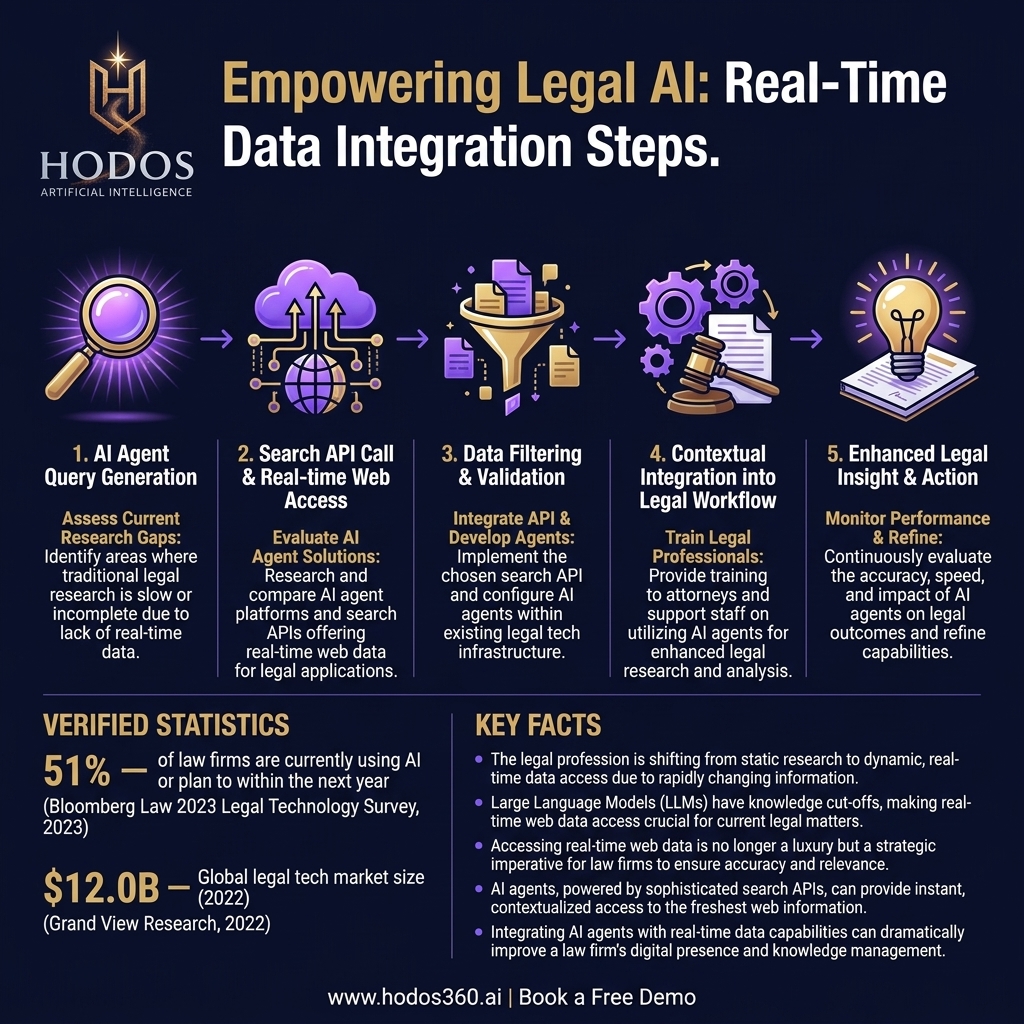
- ✓Enhanced Client Intake: AI agents access real-time regulatory changes to ensure compliance and streamline client onboarding.
- ✓Dynamic Legal Research: Instant access to the latest case law, statutes, and legal news, moving beyond static databases.
- ✓Proactive Case Management: AI monitors relevant public records and news feeds for immediate alerts on developing situations.
- ✓Intelligent Document Automation: Documents are generated with the most current legal provisions, reducing manual review and risk.
- ✓Personalized Client Portals: Deliver tailored, up-to-the-minute information to clients through responsive web and mobile interfaces.
- ✓Competitive Market Intelligence: AI agents search for competitor strategies and industry trends, informing firm positioning and service offerings.
- ✓Optimized SEO for Law Firms: Content generation tools leverage real-time search trends to create highly relevant and discoverable legal content.
Navigating the Regulatory Landscape and Ethical AI Agent Deployment
While the technological capabilities of real-time search APIs for AI agents are immense, their deployment in the legal sector is not without significant ethical and regulatory considerations. The legal profession, bound by strict rules of professional conduct, must ensure that the use of AI upholds the highest standards of competence, confidentiality, and integrity. For instance, ABA Model Rule 1.1 on Competence mandates that lawyers provide competent representation, which now implicitly extends to understanding the risks and benefits of technology. The unsupervised access of AI agents to vast swathes of unfiltered web data raises concerns about accuracy, bias, and the potential for 'hallucinations' – where AI generates plausible but incorrect information. As Katherine Forrest, a former federal judge now at Gibson Dunn, has frequently emphasized, human oversight remains paramount, especially when AI is influencing legal advice or client decisions.
The regulatory environment is also rapidly evolving. Learn more about Legal AI ROI: Proven Strategies for Measuring Investment Return. The European Union AI Act, for example, sets stringent requirements for high-risk AI systems, which could include legal AI agents, focusing on transparency, human oversight, and robustness. Law firms must not only adopt these powerful tools but also develop robust internal protocols for their ethical deployment, ensuring data privacy is protected (e.g., in line with GDPR or CCPA) and that clients are fully informed about how AI is being used in their matters. This includes establishing clear lines of accountability and regularly auditing AI agent outputs to verify their factual basis and adherence to professional standards. The challenge lies in harnessing the power of these tools while safeguarding the fundamental principles of justice and client trust.
Is your firm prepared for the ethical challenges of AI? Navigate the complexities of AI deployment with confidence. [Explore HODOS 360’s AI Law Firm Management System for secure and compliant workflows.]
Ensuring Data Integrity and Preventing Hallucinations
The potential for AI agents to hallucinate or retrieve misinformation from the web is a critical concern, especially when they have unlimited access to diverse sources. To mitigate this, law firms must implement sophisticated data validation and verification mechanisms. This includes employing multiple search APIs or cross-referencing information against established, authoritative legal databases. For example, an AI agent might retrieve a piece of information from a less reputable source; a robust system would then automatically check this against sources like official government legal portals or recognized industry reports. Learn more about Context Matters AI: Essential for Legal Accuracy & Insight. Furthermore, the design of the AI model itself needs to prioritize factual grounding, incorporating techniques that penalize speculative or unverified outputs. Pioneering legal tech companies are building frameworks that allow human legal professionals to easily review and correct AI-generated insights, creating a feedback loop that continuously improves the agent's accuracy and reliability. This blend of cutting-edge technology and vigilant human oversight is essential for maintaining trust and professional responsibility.
The Strategic Imperative: Law Firms Advancing the AI Frontier
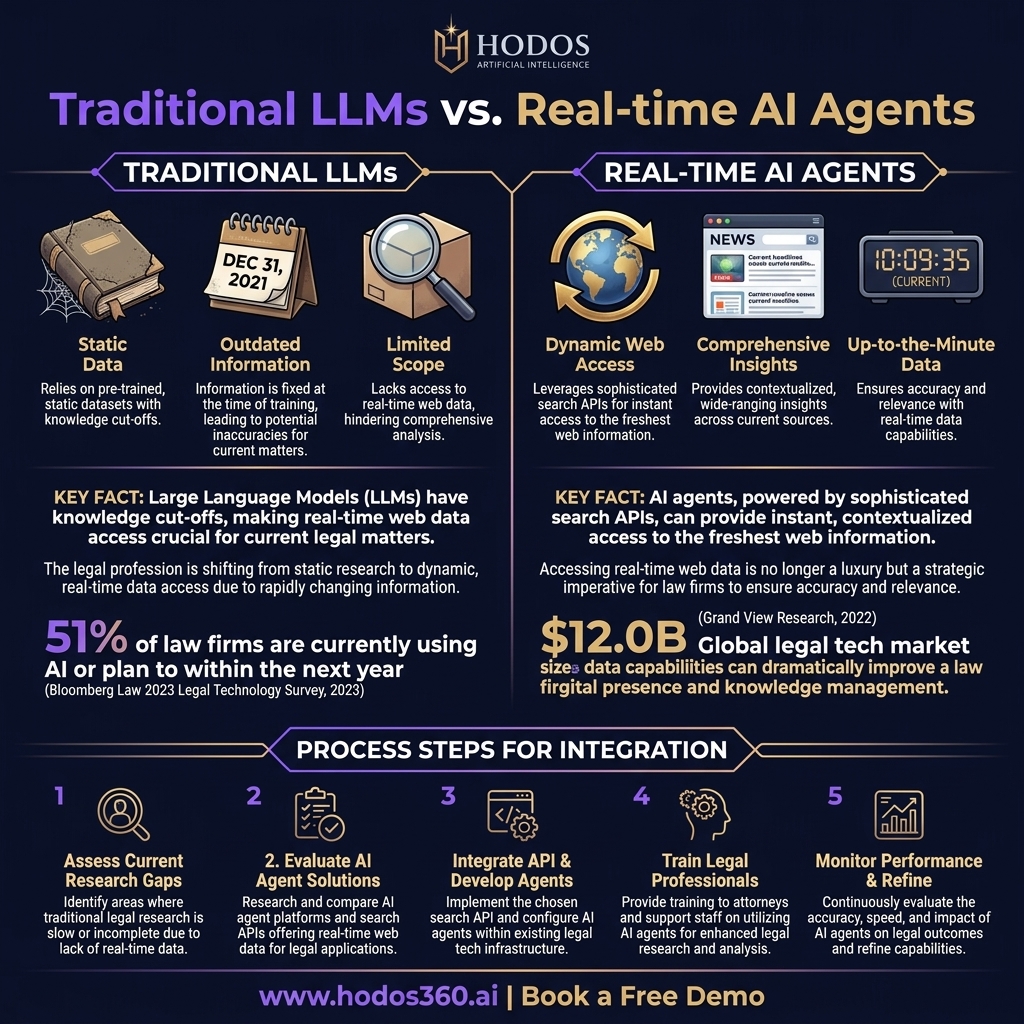
The adoption of real-time search APIs for AI agents is not merely a technological upgrade; it's a strategic imperative for law firms aiming to stay competitive and relevant in an increasingly digital world. A recent McKinsey report on AI adoption in professional services revealed that firms leveraging advanced AI tools are reporting significant gains in efficiency (up to 30%) and a notable increase in client satisfaction due to faster, more accurate service delivery. Firms that hesitate to advance into this frontier risk being outpaced by more agile competitors who are already investing in these capabilities. The competition isn't just between law firms; it's also between the underlying AI platforms, with major players like Google and Microsoft continually refining their search APIs to provide richer, more contextualized data to AI agents. Law firms need to proactively learn about and integrate these tools, not just to survive, but to thrive and capture new market share.
Moreover, the ability to rapidly build and deploy AI agents that can access unlimited real-time data enables law firms to offer entirely new services. Learn more about Conversational AI: Ultimate Guide for Legal Teams. Imagine a predictive analytics service that forecasts litigation outcomes based on real-time court data and public sentiment, or a compliance monitoring service that alerts corporate clients to new regulatory risks as they emerge. These are high-value offerings that differentiate a firm and solidify its reputation as an innovator. Law firms like Linklaters, known for their early adoption of legal tech, are already exploring how AI agents can augment their teams, allowing human lawyers to focus on complex strategy and client relationships, while AI handles the intensive data gathering and preliminary analysis. This strategic foresight is crucial for future-proofing legal practice and ensuring long-term growth and profitability.
Future-Proofing Legal Practice: Beyond Basic AI Tools
The future of legal practice lies far beyond basic AI tools that simply automate repetitive tasks. It's about AI agents that function as true augmentations of human intelligence, capable of sophisticated reasoning based on the most current information available. Firms that are advancing this frontier are not just looking at single instances of AI use but are integrating these capabilities across their entire operational framework. This holistic approach ensures that every aspect of the firm, from client acquisition to case resolution, benefits from real-time intelligence. It’s about creating a truly intelligent law firm where information flows seamlessly, insights are generated proactively, and strategic decisions are always data-driven. The investment in these advanced search APIs and the development of intelligent AI agents will be a defining characteristic of leading law firms in the coming years, distinguishing those who merely adapt from those who truly innovate.

Key Takeaways and Next Steps
The launch of real-time search APIs for AI agents marks a pivotal moment for the legal industry. This technology empowers law firms to transcend the limitations of static data, enabling their AI to access and process the dynamic information of the live web. For legal professionals, this translates into unprecedented accuracy, speed, and depth in legal research, client advice, and operational efficiency. Firms that embrace this frontier will not only streamline their workflows but also differentiate themselves in a competitive market, delivering superior outcomes and building stronger client relationships. The imperative is clear: invest in capabilities that allow your firm to build smarter, more responsive web and mobile platforms powered by real-time intelligence.
To effectively leverage this powerful shift, law firms must partner with technology providers that understand the unique demands of the legal sector. HODOS 360 offers a comprehensive suite of AI-powered services, including advanced Web & Mobile Development, specifically tailored to integrate these real-time search capabilities. Our platform helps firms build bespoke, AI-powered websites and mobile applications that are not only responsive and SEO-optimized but also deeply integrated with dynamic data streams. By advancing your digital infrastructure with HODOS 360, your firm can ensure its AI agents are always operating with the most current information, securing a competitive edge and future-proofing your practice.
Ready to equip your firm's AI with real-time web intelligence? [Book a free demo with HODOS 360 today to see our Web & Mobile Development solutions in action.]
Frequently Asked Questions
What are real-time search APIs for AI agents?+
Real-time search APIs (Application Programming Interfaces) are tools that allow AI agents, particularly large language models, to access and retrieve up-to-the-minute information directly from the live internet. Unlike traditional LLMs that rely on static, pre-trained datasets, these APIs enable AI agents to perform dynamic web searches, bringing current news, legal updates, regulatory changes, and other evolving data directly into their analytical processes. This capability is crucial for ensuring the relevance and accuracy of AI-generated insights in fast-changing fields like law.
How do these APIs benefit law firm web and mobile development?+
Integrating real-time search APIs significantly enhances a law firm's web and mobile platforms. It allows for the creation of AI-powered client portals that provide current regulatory advice, internal knowledge management systems that are constantly updated with the latest case law, and responsive legal research tools that draw from the live web. This improves the accuracy of information, streamlines client intake, automates the updating of legal documents, and ensures that all digital interactions are based on the most current legal landscape, boosting efficiency and client satisfaction.
What are the ethical considerations when using AI agents with real-time web access?+
Ethical considerations include ensuring data accuracy and preventing AI hallucinations, which occur when AI generates plausible but incorrect information. Law firms must implement robust validation mechanisms, maintain human oversight, and adhere to professional conduct rules like ABA Model Rule 1.1 on Competence. Data privacy (e.g., GDPR, CCPA compliance) is also paramount, requiring careful management of how AI agents access and process sensitive information. Transparency with clients about AI usage is also essential to maintain trust and professional integrity.
Can real-time search APIs help with legal marketing and SEO?+
Absolutely. Real-time search APIs empower AI marketing platforms to monitor current legal trends, competitor activities, and public sentiment in real-time. This dynamic data can be used to generate highly relevant and timely content for blogs, social media, and email campaigns. By understanding what legal topics are currently trending, firms can optimize their SEO strategies, create content that answers immediate client needs, and increase their online visibility, ultimately attracting more qualified leads and strengthening their brand authority in the legal sector.
What is the future outlook for AI agents and real-time data in law?+
The future outlook is transformative. AI agents with real-time data access will move beyond simple information retrieval to offer predictive analytics, proactive compliance monitoring, and highly personalized legal services. This will allow lawyers to focus on complex strategy, negotiation, and client relationships, while AI handles the intensive, dynamic data analysis. The legal profession will see increased efficiency, reduced costs, and enhanced decision-making, leading to a more accessible and effective legal system overall. Firms that embrace this technology will define the next generation of legal service.