
AI Agents: Essential Security for Law Firm Web Development
The digital frontier for law firms is constantly expanding, driven by innovations in artificial intelligence. However, as AI agents become indispensable tools in software development, a new and critical vulnerability has emerged. As reported by SC Media, 'The highest risk for AI agents is the software development organization' itself. This pronouncement sends a stark warning to the legal sector, where the integrity and confidentiality of client data are not merely best practices but ethical and legal imperatives. The promise of faster, more efficient web and mobile development through AI agents comes with the inherent flight risk of introducing subtle yet profound security flaws, jeopardizing everything from client portals to internal management systems.
Consider the recent global headlines surrounding vulnerabilities discovered in widely used open-source libraries, some of which were developed or assisted by AI coding agents. While specific incidents involving AI-generated code leading to law firm breaches are still emerging, the precedent set by major cybersecurity incidents, such as the 2017 NotPetya attack that heavily impacted firms like DLA Piper, underscores the catastrophic potential of software supply chain weaknesses. In an era where a single data breach can lead to millions in fines, reputational damage, and a fundamental erosion of client trust, law firms cannot afford to overlook the security risk posed by the very tools designed to enhance their digital presence. The implications for data integrity and client confidentiality are profound, demanding a proactive approach to AI agents in web development.
Law firm leaders, from managing partners to IT directors, must recognize that their firm's digital infrastructure, including its public-facing website and client portals, is a primary target. The convenience of AI-powered coding and rapid application development must be balanced against stringent security protocols. This article delves into the specific risks AI agents pose to legal web development and outlines essential security strategies for building a truly resilient digital presence. It's not just about building a website; it's about building an unassailable digital fortress for your firm and your clients.
AI Agents and the Evolving Threat Landscape in Software Development
The proliferation of AI agents in software development has been meteoric. Tools like GitHub Copilot, Amazon CodeWhisperer, and Google's AlphaCode are rapidly changing how code is written, debugged, and deployed. Microsoft CEO Satya Nadella has frequently championed these AI tools as key drivers of developer productivity, suggesting they will unlock unprecedented levels of innovation. For law firms, this translates to the promise of faster deployment of client intake forms, more dynamic case management interfaces, and sophisticated client portals built with remarkable speed. However, this acceleration introduces complex layers of potential vulnerabilities, making the security risk a top-tier concern for any organization, especially those handling sensitive legal data.
These AI agents operate by suggesting, generating, and even autonomously writing code based on vast datasets of existing code. While this speeds up development, it also means that any insecure patterns, common vulnerabilities, or even deliberate malicious code present in the training data could be inadvertently replicated or propagated. A study published by researchers from Stanford University in 2023 highlighted how often AI-generated code contained security flaws, often due to the AI prioritizing functionality over security best practices. This phenomenon presents a significant challenge for auditing and quality control, transforming the traditional software development pipeline into a potential vector for systemic cyber threats.
Moreover, the very nature of AI agents — their ability to adapt and learn — can be a double-edged sword. While beneficial for improving performance, it also means that an AI agent could, theoretically, 'learn' to bypass security checks or introduce subtle backdoors if exposed to adversarial training data or if its objective function is misaligned with security goals. This emergent behavior, often unpredictable, creates a flight risk where vulnerabilities might not be immediately apparent to human developers, leading to a false sense of security. The legal sector, bound by stringent ethical obligations like ABA Model Rule 1.6 on client confidentiality, faces immense pressure to ensure that their digital infrastructure, built with these advanced tools, is impervious to such sophisticated and evolving threats.
The Challenge of AI Overreliance and Code Vulnerabilities
The ease with which AI agents can generate code often leads to an overreliance by developers, who may trust the AI's output without conducting thorough manual reviews. This trust can be misplaced. Research from the cybersecurity firm Snyk in 2024 indicated that AI-generated code snippets often contained known vulnerabilities, similar to those found in human-written code, but sometimes harder to detect due to the sheer volume and complexity of AI output. This creates a scenario where vulnerabilities are not just introduced but are potentially obscured within large codebases, escalating the security risk.
Furthermore, the opaque nature of some AI models means that understanding *why* a particular piece of code was generated, or *how* it might interact with other system components, can be challenging. Learn more about AI Website Building: The Essential Guide for Law Firms. This lack of interpretability hinders effective debugging and security auditing. For a law firm developing a new client portal or an internal document management system, such hidden vulnerabilities could expose sensitive case files or client PII, leading to severe ethical breaches and potential regulatory non-compliance, jeopardizing the firm's data integrity.
The Specific Security Risks of AI Coding Agents for Law Firms
Law firms operate under unique and stringent requirements for data security and client confidentiality. Unlike general businesses, a legal practice handles privileged communications, sensitive personal information, and confidential case strategies, all of which are subject to strict ethical guidelines and regulatory frameworks. When AI agents are employed in web development for these firms, the security risk profile intensifies significantly. A compromised client portal, for instance, could lead to the exposure of attorney-client communications, violating professional obligations and potentially leading to malpractice claims. The ABA Standing Committee on Ethics and Professional Responsibility has consistently emphasized the attorney's duty to protect client information, a duty directly impacted by the security of the firm's digital infrastructure.
The risks extend beyond mere data exposure. An exploited vulnerability in a law firm's website or mobile application, perhaps introduced by an AI coding agent, could serve as a gateway for more sophisticated cyberattacks. Imagine an attacker leveraging a flaw to inject malicious code, leading to ransomware that encrypts all case files, or a phishing campaign targeting the firm's clients. Learn more about AI Voice Assistant: Essential for Modern Law Firms. The financial implications are staggering, not just from the ransom or recovery costs, but from potential regulatory fines under data privacy laws like GDPR, CCPA, or upcoming state-specific statutes. A 2023 report by Thomson Reuters highlighted that cybersecurity is a top concern for law firms, with many still struggling to implement robust defenses against evolving threats, including those posed by advanced AI tools.
Moreover, the reputational damage from a breach can be irreversible. Client trust is the bedrock of any legal practice, and a perceived failure to protect their information can destroy years of diligent relationship building. The legal profession, often seen as traditional and risk-averse, is now at the forefront of the digital transformation, making it imperative to embrace AI responsibly. This means not just adopting new technologies, but rigorously vetting their security implications, especially when they touch the core of client interactions and data management. Failure to do so represents a significant flight risk to the firm's longevity and standing in the legal community.
Mitigating AI Agent Risks: Best Practices for Secure Web Development
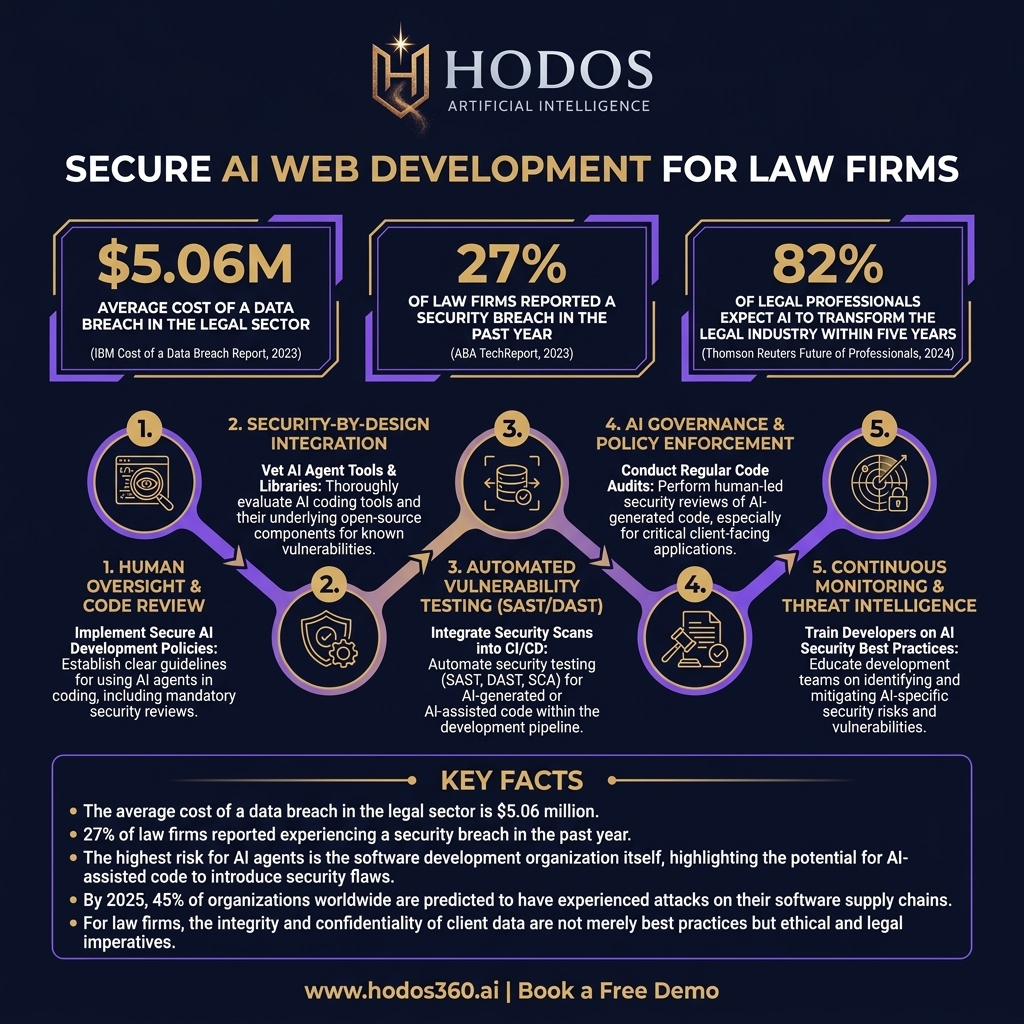
To counteract the inherent security risk of AI agents in software development, law firms must adopt a multi-layered approach to cybersecurity. The first and most critical step is to maintain robust human oversight. While AI can accelerate coding, human developers must rigorously review and validate all AI-generated code for potential vulnerabilities, adherence to secure coding standards, and compliance with data privacy regulations. This involves implementing mandatory code reviews, static analysis tools (SAST) that can identify common security flaws, and dynamic analysis tools (DAST) that test applications in real-time for weaknesses. The goal is to ensure that efficiency gains from AI do not come at the expense of comprehensive security.
Implementing a 'security-by-design' philosophy is also paramount. This means integrating security considerations at every stage of the web development lifecycle, from initial planning and architecture to deployment and ongoing maintenance. For law firms, this translates to designing client portals with end-to-end encryption, implementing strong access controls, and ensuring that all data storage complies with legal and ethical standards. Regular penetration testing by independent security experts can identify vulnerabilities that might be overlooked by internal teams or AI agents, providing an external validation of the system's cyber resilience. These measures are not merely technical; they are integral to fulfilling the ethical duty of competence under rules such as Federal Rules of Civil Procedure Rule 26, which implicitly requires robust data management practices.
Furthermore, investing in continuous security training for development teams is crucial. Developers working with AI agents need to understand the unique attack vectors associated with these tools, how to prompt them securely, and how to interpret and validate their outputs effectively. This includes staying updated on the latest ai news and emerging threats. Establishing clear policies for AI agent usage, including guidelines for data input and output, and ensuring that AI models themselves are secure and trained on trusted datasets, forms the backbone of a proactive defense strategy. This holistic approach ensures that the benefits of AI in development are fully realized without compromising the firm's security posture or client trust.
Implementing Robust AI Governance and Oversight
Effective AI governance is not just about technology; it's about establishing clear policies, roles, and responsibilities for the deployment and management of AI agents. For law firms, this means creating internal guidelines that dictate how AI coding tools can be used, what types of data they can access, and the mandatory review processes for all AI-generated code. Referencing frameworks like the NIST AI Risk Management Framework can provide a structured approach to identifying, assessing, and mitigating risks associated with AI systems, ensuring data integrity and compliance.
This oversight extends to the procurement of AI-powered development tools. Firms must conduct due diligence on vendors, assessing their security practices and commitment to responsible AI development. Learn more about AI Coding Assistant Security: Ultimate Shield for Law Firms. Regular audits of AI agent activities, including log analysis and performance monitoring, are essential to detect anomalies or unauthorized behavior. This proactive governance minimizes the flight risk associated with rapid AI adoption and ensures that the firm's use of AI aligns with its ethical obligations and security objectives, reinforcing client trust.
Building Cyber Resilience: HODOS 360's Approach to Secure Digital Infrastructure
At HODOS 360, we understand the unique challenges law firms face in navigating the digital transformation while upholding the highest standards of security and ethics. Our Web & Mobile Development service is engineered from the ground up with cyber resilience at its core, specifically addressing the security risk introduced by advanced AI agents in software development. We leverage cutting-edge AI ourselves, not just for speed and efficiency, but to build in robust security protocols that anticipate and neutralize emerging threats. Our AI-powered website building processes incorporate continuous vulnerability scanning and automated security checks, far beyond what traditional development methods offer, ensuring every line of code contributes to an impenetrable digital fortress.
Our approach ensures that while your firm benefits from AI-driven rapid development and responsive design, it does so within a framework of ironclad security. We integrate advanced threat detection systems that constantly monitor for anomalies, potential breaches, and sophisticated attack vectors, providing real-time protection against evolving cyber threats. This proactive stance is crucial in today's landscape, where ai news today frequently reports on new forms of cyber exploits. Learn more about B2B Marketing: Proven Strategies for AI Content Scale. HODOS 360's high-converting templates are not just aesthetically pleasing and optimized for SEO; they are meticulously crafted with security in mind, providing a secure foundation for your firm's online presence and safeguarding client trust.
By partnering with HODOS 360, law firms gain access to a comprehensive suite of legal tech innovation that prioritizes data integrity. Our platform ensures that your firm’s website and mobile applications are not only modern and highly functional but also compliant with the strictest data privacy regulations. We build systems designed to protect sensitive client information from unauthorized access, loss, or disclosure, reinforcing your firm's ethical obligations and professional reputation. This integrated approach to secure web development provides peace of mind, allowing firms to focus on their core legal practice while knowing their digital assets are protected by industry-leading security measures.
Protecting Client Data in an AI-Driven Development Environment
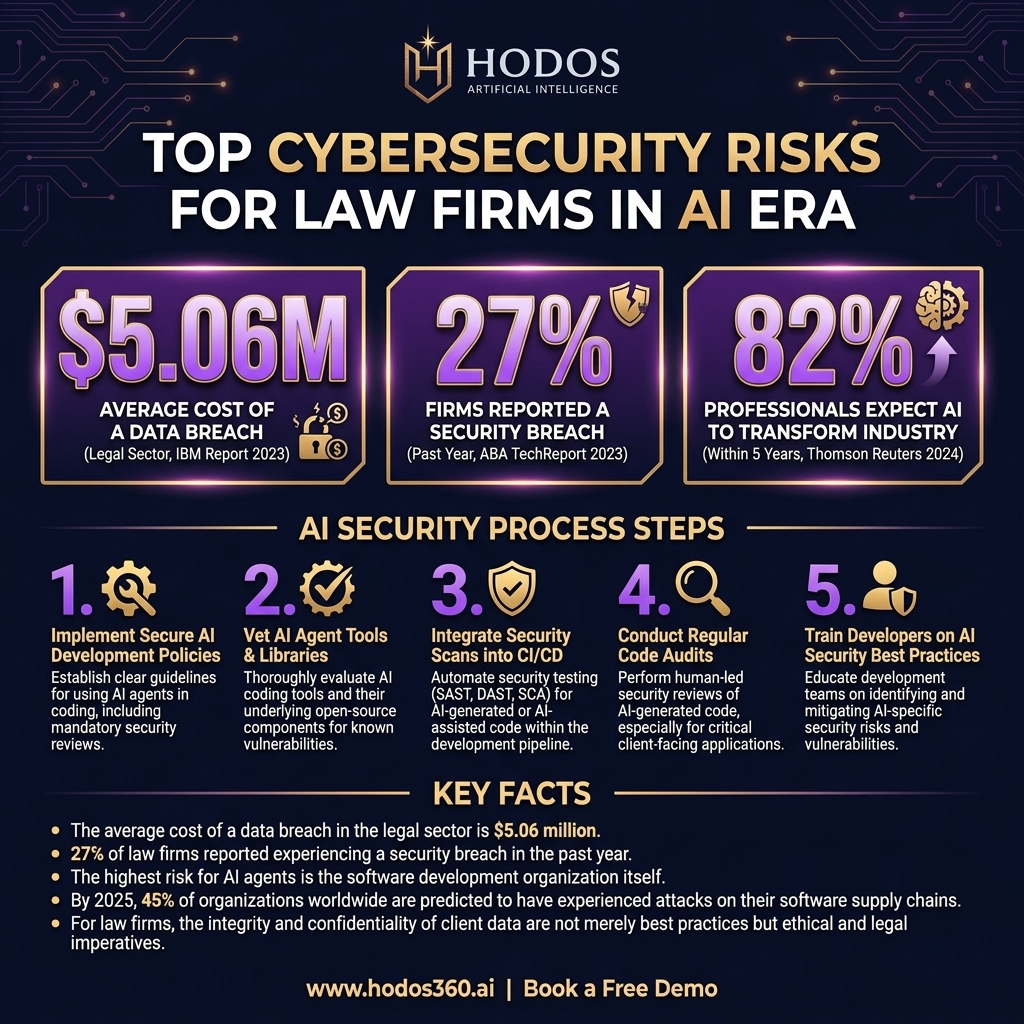
The cornerstone of any law firm's operation is the sacred trust of client confidentiality. In an AI-driven development environment, protecting this data integrity requires more than just standard cybersecurity. It demands a specialized approach that understands the unique vulnerabilities and regulatory requirements of the legal sector. HODOS 360's Web & Mobile Development service meticulously integrates features like end-to-end encryption for all data in transit and at rest, multi-factor authentication for sensitive portals, and granular access controls, ensuring that only authorized personnel can access client information.
Our commitment extends to ensuring compliance with critical data protection laws, including GDPR, CCPA, and HIPAA where applicable. By building websites and applications with these regulations in mind, we help law firms meet their legal and ethical obligations, mitigating the security risk of non-compliance. This proactive defense of client trust through secure web development is fundamental to our platform, allowing law firms to confidently leverage AI for growth without compromising their most vital asset: client data.
The Future of Secure Legal Web Development with AI
The trajectory of AI agents in software development points towards increasing sophistication and autonomy. As these agents become more capable of complex problem-solving and code generation, the corresponding need for adaptive and intelligent security measures will intensify. The future of secure legal web development will likely involve an 'AI vs. AI' dynamic, where defensive AI systems are deployed to detect and neutralize threats posed by malicious AI or AI-introduced vulnerabilities. This ongoing 'arms race' necessitates continuous innovation and vigilance, a reality highlighted by every major ai news update.
Law firms must recognize that cyber resilience is not a one-time project but an ongoing commitment. This involves staying abreast of the latest ai news today, investing in cutting-edge security technologies, and fostering a culture of security awareness throughout the firm. The EU AI Act, expected to be fully enforced in the coming years, will further solidify regulatory expectations around the responsible use of AI, including its application in software development. This legislation, alongside existing data privacy laws, will drive the need for transparent, auditable, and secure AI practices, particularly for sectors handling sensitive data like legal services.
Ultimately, the future belongs to law firms that can strategically harness the power of AI for efficiency and innovation while simultaneously building an impenetrable digital fortress. This requires a nuanced understanding of both the opportunities and the security risk presented by AI agents. Firms that proactively engage with secure legal tech innovation will not only protect their clients and reputation but will also gain a competitive edge in a rapidly evolving market, establishing themselves as leaders in ethical and secure digital practice.

Key Takeaways and Next Steps
The emergence of AI agents in software development marks a paradigm shift, offering unparalleled efficiency but introducing significant new security risk vectors, particularly for law firms. The imperative to safeguard client confidentiality and maintain data integrity demands a proactive, comprehensive approach to web development security. Overreliance on AI without robust human oversight and stringent validation processes is a flight risk that no legal practice can afford. Firms must implement security-by-design principles, conduct continuous monitoring, and establish strong AI governance frameworks.
Embracing legal tech innovation responsibly means partnering with providers who deeply understand both the legal sector's unique needs and the complexities of AI-driven cybersecurity. Solutions that integrate advanced security protocols directly into the web development process are no longer a luxury but a necessity for building and maintaining client trust in the digital age. By prioritizing cyber resilience and intelligent security measures, law firms can confidently navigate the future, leveraging AI for growth while ensuring their digital infrastructure remains a bastion of security.
- ✓Human Oversight is Non-Negotiable: Always review and validate AI-generated code for security flaws and best practices.
- ✓Implement Security-by-Design: Integrate security measures from the very inception of any web or mobile development project.
- ✓Continuous Monitoring & Testing: Utilize SAST, DAST, and regular penetration testing to identify and remediate vulnerabilities.
- ✓Robust AI Governance: Establish clear policies for AI agent usage, data access, and model security within your firm.
- ✓Prioritize Data Integrity & Compliance: Ensure all development adheres to ethical obligations and regulatory requirements like GDPR, CCPA, and ABA Model Rules.
- ✓Invest in Specialized Legal Tech: Partner with platforms like HODOS 360 that offer AI-powered web development with built-in, industry-specific security.
Frequently Asked Questions
What are AI agents in software development?+
AI agents are sophisticated AI programs that can autonomously perform tasks traditionally done by human developers, such as generating code snippets, debugging, or even building entire software components. They learn from vast datasets of existing code and documentation to assist or automate various stages of the software development lifecycle, aiming to increase efficiency and speed up deployment of applications and websites for businesses, including law firms.
Why are AI agents considered a high security risk for law firms?+
For law firms, AI agents pose a high security risk because they can inadvertently introduce vulnerabilities or insecure coding patterns into websites and applications handling highly sensitive client data. Any flaw could lead to data breaches, violate client confidentiality (ABA Model Rule 1.6), and result in severe reputational damage or regulatory fines, making robust security protocols in web development absolutely critical.
How can law firms mitigate the security risks of AI in web development?+
Law firms can mitigate these risks through several strategies: implementing rigorous human oversight for all AI-generated code, adopting a 'security-by-design' approach, conducting continuous security testing (SAST, DAST, penetration testing), establishing clear AI governance policies, and ensuring all development adheres to data privacy regulations. Partnering with secure legal tech providers also ensures specialized protection.
What is 'AI overreliance' and why is it dangerous?+
'AI overreliance' occurs when developers trust AI-generated code without sufficient scrutiny, assuming it is inherently secure or bug-free. This is dangerous because AI agents can replicate insecure patterns from their training data or introduce subtle, hard-to-detect vulnerabilities. For law firms, this could lead to hidden flaws in client-facing applications, exposing sensitive data and compromising client trust.
How does HODOS 360 address AI agent security in its Web & Mobile Development?+
HODOS 360's Web & Mobile Development service integrates advanced AI-powered security protocols directly into its website building process. This includes continuous vulnerability scanning, automated security checks, and robust threat detection systems. Our high-converting templates are engineered with security-by-design principles, ensuring data integrity, compliance with legal standards, and comprehensive protection against AI-introduced vulnerabilities for law firms.