
AI Coding Assistant Security: Ultimate Shield for Law Firms
The digital landscape of legal practice is evolving at an unprecedented pace, driven by the transformative power of artificial intelligence. Law firms globally are increasingly leveraging AI tools, from sophisticated AI law firm management systems to AI-powered web and mobile development, to enhance efficiency and client service. However, this rapid adoption comes with inherent risks, starkly highlighted by the recent 'Shai-Hulud' worm attack. This incident, as reported by Rescana, exposed a profound vulnerability in the software supply chain, demonstrating how the session hijack of an AI coding assistant can compromise SaaS code repositories, spreading malicious packages across the npm ecosystem and affecting countless digital platforms, including those critical to legal operations.
The Shai-Hulud attack is not merely a technical anomaly; it represents a seismic shift in the cybersecurity threat model that legal professionals must understand. It exploited the very tools designed to accelerate development, turning them into conduits for widespread compromise. For a sector built on confidentiality, integrity, and client trust, such an event is a clarion call. Firms developing custom client portals, secure communication platforms, or advanced marketing websites must recognize that their digital infrastructure is only as strong as its weakest link, often residing deep within the software supply chain. The implication is clear: the AI coding assistant security practices of every vendor and internal development process now directly impact a firm's ethical and legal obligations to protect sensitive data.
The stakes couldn't be higher. In an era where data breaches can lead to catastrophic reputational damage, hefty regulatory fines, and the erosion of client confidence, understanding and mitigating these advanced threats is paramount. This article delves into the Shai-Hulud worm attack, dissecting its mechanics and broader implications for legal tech. We will explore how law firms can fortify their web and mobile development security, implement proactive vulnerability management, and navigate the complex landscape of regulatory compliance in the face of evolving software supply chain attacks. The goal is not just to react to threats, but to build a resilient, secure digital future for legal practice, ensuring that innovation does not come at the expense of security.
The Shai-Hulud Worm Attack: A New Era of Supply Chain Compromise
The 'Shai-Hulud' worm attack, named evocatively after the giant sandworms of Frank Herbert's Dune, signifies a new, insidious frontier in cyber warfare. Rescana's in-depth analysis revealed that attackers ingeniously leveraged a session hijack of an AI coding assistant. This sophisticated maneuver allowed them to gain unauthorized access to developer accounts, subsequently injecting malicious code into hundreds of legitimate software packages within the npm ecosystem. Learn more about AI Patent Tools: Essential Strategies for IP Law Firms. This wasn't a brute-force attack; it was a targeted compromise of the very tools developers use, making it exceptionally difficult to detect at the initial stages. The implications for supply chain compromise are profound, as software components often rely on a complex web of third-party libraries.
The attack vector demonstrated a chilling understanding of modern software development practices. By compromising development environments and leveraging automated processes, the Shai-Hulud worm rapidly spread by authenticating to the npm registry as the compromised developer. This allowed the injection of stealthy code into other popular packages, creating a ripple effect across countless applications and services. Firms like OpenAI and Anthropic, while at the forefront of AI development, are also acutely aware of the security challenges inherent in complex software ecosystems. Learn more about Legal Tech Adoption: Mastering AI for Law Firms in 2026. The incident underscores that even cutting-edge AI tools, when integrated into a supply chain, become potential points of vulnerability if not rigorously secured. The attack highlighted how critical SaaS code repositories are as targets.
Experts like Richard Susskind, renowned for his work on the future of legal services, have long emphasized the need for lawyers to understand technology. This extends not just to using AI, but to appreciating its underlying infrastructure and vulnerabilities. The Shai-Hulud incident is a stark reminder that the digital tools powering legal innovation, from client intake systems to document automation, are built upon layers of code, each a potential point of malicious packages or a session hijack. Learn more about AI Marketing Automation: Essential Lead Flow for Law Firms. The legal sector's increasing reliance on cloud-based legal tech platforms means that a software supply chain attack like Shai-Hulud can have far-reaching consequences, affecting client data, operational continuity, and compliance.
The incident prompted a rapid response from the cybersecurity community, with organizations like CISA issuing warnings and guidance on detecting and mitigating similar attacks. The focus shifted from perimeter defense to internal controls and continuous monitoring of dependencies. For law firms, this means not just securing their own networks, but scrutinizing the security posture of every third-party vendor and integrated service. Learn more about AI Voice Assistants: The Essential Evolution of Legal Client Interaction. The Shai-Hulud worm has fundamentally changed how we perceive software trust, demanding an elevated level of diligence in vulnerability management and a proactive approach to legal tech cybersecurity that anticipates sophisticated, multi-stage compromises.
Safeguarding Your Digital Foundation: Web & Mobile Development Security for Law Firms
For law firms, their web and mobile presence is more than just a marketing tool; it's a critical interface for client communication, document exchange, and often, a core component of their service delivery. Client portals, secure messaging apps, and custom legal workflow tools built for mobile access are repositories of highly sensitive information. The Shai-Hulud attack vividly illustrates that even if a firm's internal network is fortified, vulnerabilities within the software components used for web & mobile development can expose client data to serious risks. Learn more about AI Marketing: The Strategic Advantage for Law Firms. This necessitates a comprehensive approach to security that spans the entire development lifecycle, from initial coding to deployment and ongoing maintenance.
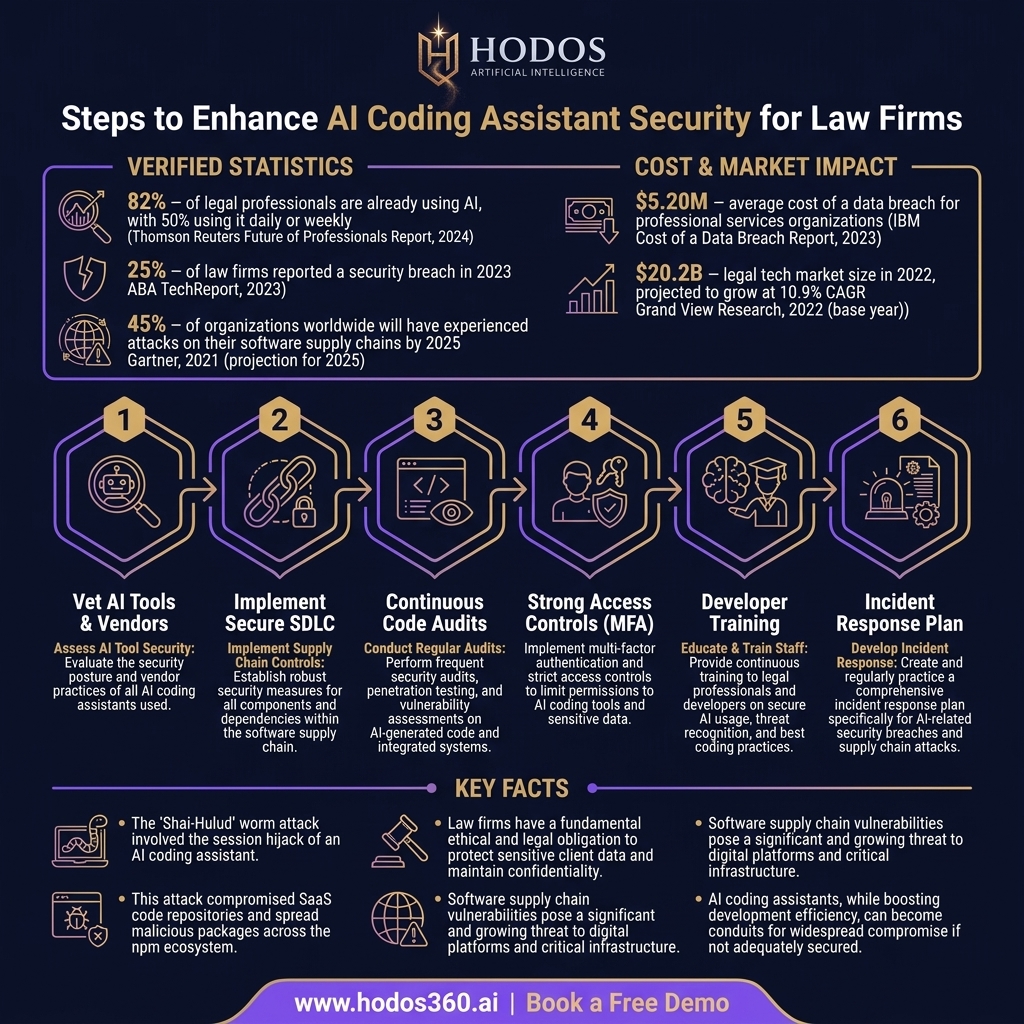
The integration of AI coding assistants into development workflows, while offering unprecedented speed and efficiency, introduces new layers of complexity to security. These tools, designed to generate, complete, and debug code, can inadvertently propagate vulnerabilities if they operate on compromised systems or ingest untrusted inputs. A recent ABA report highlighted that over 25% of law firms experienced a data breach in the past year, with external attacks being a primary cause. Learn more about AI Marketing: The Ultimate Guide to Law Firm Growth & Automation. This statistic underscores the persistent threat landscape and the critical need for firms to adopt a proactive stance on web development security, meticulously vetting all tools and components, especially those with AI capabilities, to prevent potential data breaches.
Protecting your digital foundation requires more than just basic firewalls and antivirus software. It demands a secure development lifecycle (SDLC) that embeds security considerations at every stage. This includes rigorous code reviews, automated security testing, dependency scanning for malicious packages, and continuous monitoring of deployed applications for anomalies. Firms must also consider the security posture of their hosting providers and content delivery networks. Neglecting these aspects can turn a firm's most innovative digital assets into its greatest liabilities, jeopardizing not only client data but also the firm's reputation and financial stability.
Law firms must actively champion a culture of security among their development teams, whether internal or external. This involves providing training on secure coding practices, understanding the risks associated with third-party libraries, and staying informed about emerging threats like supply chain attacks. The investment in robust AI coding assistant security and secure web & mobile development is not an optional expense but a fundamental requirement for maintaining ethical obligations and operational integrity in the 21st century legal landscape. Firms seeking to leverage technology without compromising security should explore robust secure web development solutions that prioritize data protection from the ground up.
The Legal and Ethical Imperatives of Cybersecurity in Legal Tech
The legal profession operates under stringent ethical obligations that directly intersect with cybersecurity. ABA Model Rule 1.1 on Competence mandates that lawyers understand the benefits and risks associated with relevant technology. This extends to the security of systems used for client data, including web and mobile applications. Furthermore, Model Rule 1.6 on Confidentiality of Information requires lawyers to make reasonable efforts to prevent the inadvertent or unauthorized disclosure of, or unauthorized access to, information relating to the representation of a client. A supply chain compromise through an AI coding assistant security flaw directly implicates these core duties, potentially leading to professional misconduct claims.
Beyond ethical rules, regulatory compliance frameworks like HIPAA, GDPR, CCPA, and various state data breach notification laws impose significant legal responsibilities on law firms. A data breach stemming from a compromised web application or a malicious package in the npm ecosystem could trigger extensive reporting requirements, costly investigations, and substantial fines. For instance, the EU AI Act, expected to be fully enforced by 2027, will introduce new layers of accountability for AI systems, including those used in legal tech development. Firms must demonstrate due diligence in securing their entire digital footprint, including the third-party components that power their applications.
Navigating Regulatory Compliance and Client Trust
The challenge of navigating regulatory compliance in an era of evolving cyber threats is immense. Firms must not only adhere to existing laws but also anticipate future regulations, especially concerning AI governance and data privacy. The reputational damage from a security incident can be irreparable, eroding client trust built over decades. Clients expect their legal counsel to be at the forefront of data protection, especially when entrusting them with highly sensitive information. A proactive approach to legal tech cybersecurity, incorporating robust vulnerability management and a secure web & mobile development strategy, is therefore not just a best practice but a fundamental necessity for business continuity and client retention.
The financial ramifications of a breach are equally daunting. According to a 2023 IBM report, the average cost of a data breach reached $4.45 million globally, with highly regulated industries often facing even higher costs. For law firms, these costs include forensic investigations, legal fees, credit monitoring for affected clients, and potential litigation. Investing in robust AI coding assistant security and comprehensive software supply chain attacks defenses is a strategic imperative that protects both the firm's balance sheet and its invaluable intangible asset: its reputation for integrity and trustworthiness. It is essential to continuously assess the security of client data protection measures.
Building Resilient Legal Tech: Best Practices for Firms in the AI Era
In the wake of incidents like the Shai-Hulud worm attack, law firms must proactively build resilience into their legal tech infrastructure. This begins with a commitment to a secure development lifecycle (SDLC) for all custom web & mobile development. Every stage, from design to deployment, must integrate security checks, threat modeling, and code analysis. This includes rigorously vetting all open-source libraries and third-party components, ensuring they are free from malicious packages and regularly updated. Firms should adopt a 'shift-left' security approach, catching vulnerabilities early in the development process rather than after deployment, significantly reducing the risk of a supply chain compromise.
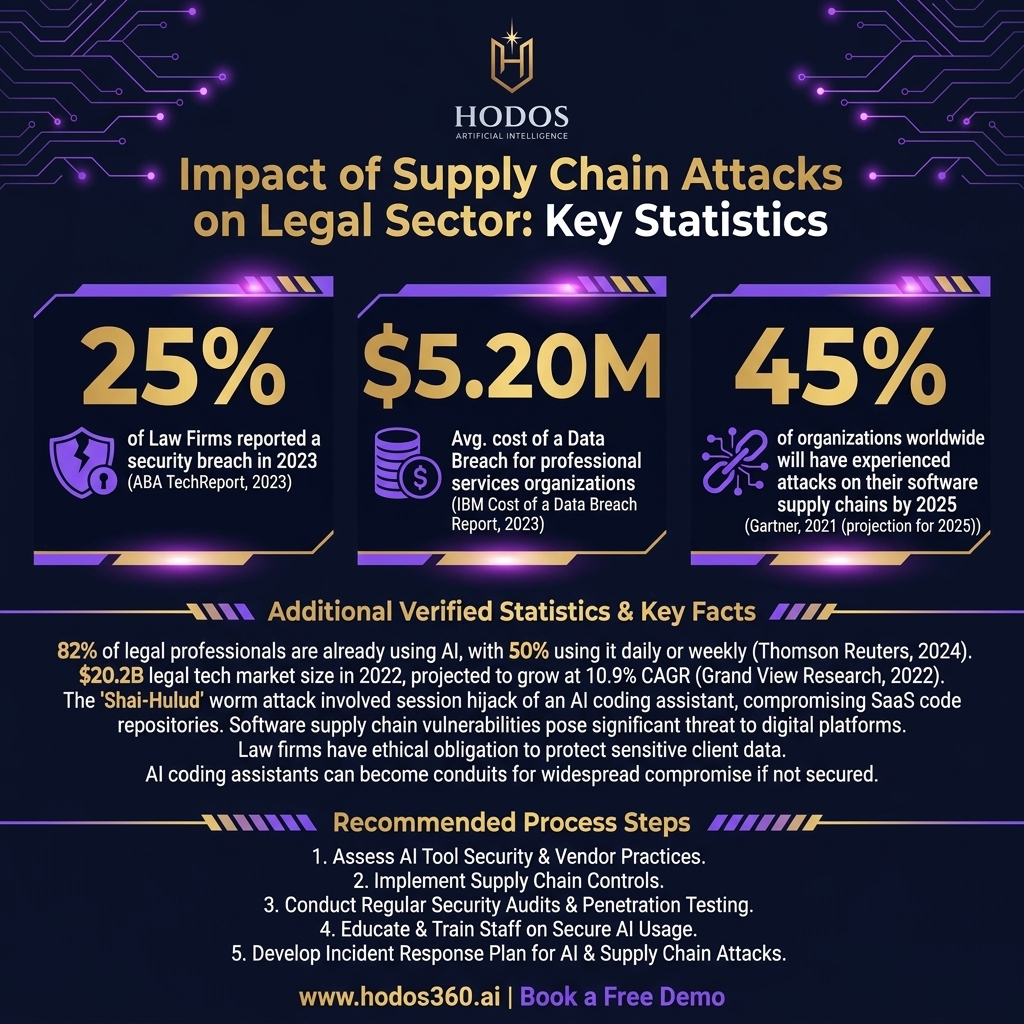
Implementing strong vendor risk management is crucial. Law firms often rely on a multitude of SaaS providers and external developers. It is imperative to conduct thorough due diligence on these partners, assessing their AI coding assistant security practices, their adherence to industry standards like the NIST Cybersecurity Framework, and their incident response capabilities. Contracts should include clear clauses regarding data security, breach notification, and liability. Firms should also demand transparency regarding the use of AI tools in development and the security measures in place to prevent session hijack or other forms of compromise within their SaaS code repositories.
Implementing Secure AI Development Lifecycles
The rise of generative AI demands specialized security considerations. For firms using AI coding assistants, this means implementing strict access controls, monitoring API usage, and ensuring that sensitive client data is never exposed to public models. Training for developers on secure AI usage, understanding potential prompt injection attacks, and validating AI-generated code for vulnerabilities are becoming non-negotiable. This proactive stance helps mitigate risks associated with AI coding assistant security and safeguards against the propagation of flaws within the legal tech stack. HODOS 360, for example, integrates robust security protocols into its AI-powered website building and legal workflow solutions, providing firms with a fortified foundation.
Proactive Vulnerability Management and Auditing
Continuous vulnerability management and regular security audits are essential for maintaining a strong defense. This involves automated scanning tools, penetration testing, and independent security assessments of all web & mobile development projects. Firms should also establish a robust incident response plan, including clear communication protocols for data breaches and a rapid recovery strategy. Regular employee training on cybersecurity best practices, phishing awareness, and the secure use of AI tools is equally vital. Mary K. Ryan, a former chair of the ABA Standing Committee on Cybersecurity, has consistently emphasized that human factors are often the weakest link in any security chain, making education paramount.
- ✓Adopt a Zero-Trust Architecture: Assume no user or system, inside or outside the network, is trustworthy without verification, especially for access to SaaS code repositories.
- ✓Implement Multi-Factor Authentication (MFA): Essential for all accounts, particularly those with access to development environments and sensitive data, preventing session hijack.
- ✓Regular Security Audits and Penetration Testing: Conduct frequent assessments of your web & mobile development applications and infrastructure to identify and remediate vulnerabilities.
- ✓Supply Chain Risk Management: Vet all third-party libraries, open-source components, and vendor security postures to protect against malicious packages and software supply chain attacks.
- ✓Developer Training and Awareness: Educate development teams on secure coding practices, AI security risks, and the latest threat intelligence, including the nature of the Shai-Hulud worm.
- ✓Data Encryption: Ensure all sensitive client data, both in transit and at rest, is encrypted using strong, modern encryption standards.
- ✓Incident Response Plan: Develop and regularly test a comprehensive plan for detecting, responding to, and recovering from data breaches and other security incidents.

Key Takeaways and Next Steps
The Shai-Hulud worm attack serves as a potent reminder that the digital transformation of the legal industry, while offering immense opportunities, also introduces sophisticated new risks. The intricate web of software dependencies, coupled with the rapid integration of AI coding assistants, creates fertile ground for supply chain compromise if not managed with extreme diligence. For law firms, the imperative is clear: proactive, comprehensive web & mobile development security is no longer a luxury but a foundational element of ethical practice and business continuity. The future of legal tech demands a security posture that is as innovative and forward-thinking as the technology it seeks to protect.
By embracing a secure development lifecycle, diligently vetting third-party components, and prioritizing continuous vulnerability management, law firms can build resilient digital platforms that safeguard client confidentiality and firm integrity. The lessons from the Shai-Hulud worm incident compel us to look beyond traditional cybersecurity measures and adopt a holistic strategy that addresses the unique challenges of the AI era. Firms that invest in robust legal tech cybersecurity will not only protect themselves from devastating data breaches but will also reinforce their reputation as trusted, forward-thinking legal partners.
HODOS 360 is committed to empowering law firms with secure and innovative digital solutions. Our Web & Mobile Development service, including AI-powered website building and high-converting templates, is engineered with security at its core, understanding the unique regulatory compliance and ethical demands of the legal sector. We help firms navigate the complexities of modern cyber threats, ensuring their digital presence is not only cutting-edge but also impervious to the evolving landscape of software supply chain attacks and AI coding assistant security risks. Protect your firm's future by building on a foundation of trust and advanced security.
Frequently Asked Questions
What was the Shai-Hulud worm attack and why is it relevant to law firms?+
The Shai-Hulud worm attack involved the session hijack of an AI coding assistant, leading to malicious code injection into SaaS code repositories and the npm ecosystem. For law firms, it's relevant because their web and mobile applications, often built using similar components, could be exposed to supply chain compromise, risking sensitive client data and violating ethical duties. It highlights the need for robust AI coding assistant security and web development security.
How do AI coding assistants pose a security risk for law firm web development?+
While beneficial, AI coding assistants can introduce security risks if they operate on compromised systems, ingest untrusted inputs, or generate vulnerable code. A session hijack of such an assistant, as seen in the Shai-Hulud attack, can lead to malicious packages being injected into a firm's digital assets. This necessitates strict access controls, secure coding practices, and continuous vetting of AI-generated code to ensure AI coding assistant security.
What are the ethical and legal obligations for law firms regarding cybersecurity?+
Law firms have ethical obligations under ABA Model Rules 1.1 (Competence) and 1.6 (Confidentiality) to protect client data and understand technology risks. Legally, they must comply with data privacy regulations like HIPAA, GDPR, and state data breach laws. A data breach due to poor web development security or supply chain compromise can lead to professional misconduct claims, regulatory fines, and significant reputational damage, underscoring the importance of legal tech cybersecurity.
What steps can law firms take to enhance their web and mobile development security?+
Firms should adopt a secure development lifecycle (SDLC), conduct rigorous vendor risk management for third-party tools and services, and implement continuous vulnerability management through regular audits and penetration testing. Strong AI coding assistant security measures, multi-factor authentication, and developer training on secure coding practices are also crucial. These steps help protect against software supply chain attacks and safeguard client information.
How can HODOS 360 help law firms address these web development security concerns?+
HODOS 360 offers Web & Mobile Development services, including AI-powered website building, designed with advanced security protocols tailored for the legal sector. Our platform helps firms build robust, high-converting digital presences while addressing supply chain compromise risks and AI coding assistant security concerns. We integrate secure development practices and provide tools that align with regulatory compliance, ensuring firms can innovate safely and protect sensitive client data.