

AI Answering Service: The Ultimate Guide for Law Firms
The digital gavel has fallen on traditional legal practice. Consider the dilemma faced by Sarah Chen, managing partner at the bustling mid-sized firm, Chen & Associates, specializing in complex litigation. For years, her firm wrestled with the perennial challenge of missed calls, particularly after hours or during peak litigation periods.
A single missed call, as a 2023 Thomson Reuters report highlighted, can represent a lost lead worth thousands, if not tens of thousands, of dollars in potential revenue for law firms. Chen & Associates had invested heavily in a live answering service, but the costs were escalating, the service quality was inconsistent, and the firm still struggled with qualifying leads effectively.
This human-centric bottleneck created a palpable tension within the firm: the desire to scale and serve more clients constantly clashed with the operational limitations of a finite, human workforce. The market was clearly *looking* for a better *service*.
This scenario isn't unique to Chen & Associates; it’s a narrative echoed across countless legal *businesses* in 2026. The shift in client behavior, fueled by the instant gratification culture of platforms like Amazon and Uber, means legal clients now expect similar responsiveness from their attorneys.
They want answers, appointments, and information at their convenience, not just during standard *business* hours. This fundamental change has exposed the vulnerabilities of traditional client communication models, pushing law firms to seek innovative solutions. Learn more about AI Web Design: Essential Agentic Workflows for Law Firms.
The question is no longer *if* AI will impact legal *services*, but *how* rapidly firms can integrate it to gain a competitive edge. The recent Tycoonstory Media article, "What Is the Best AI Answering Service for Businesses in 2026?", underscores this urgent demand, signaling a critical juncture for legal professionals to re-evaluate their client engagement strategies.
Enter the era of the AI *answering service* – a sophisticated, intelligent solution designed not merely to answer *calls*, but to manage, qualify, and route them with unparalleled efficiency and precision. These advanced systems are far removed from the robotic, frustrating Interactive Voice Response (IVR) systems of yesteryear.
Today's AI voice assistants leverage cutting-edge natural language processing (NLP) and machine learning to understand complex queries, engage in meaningful conversations, and perform tasks that were once the exclusive domain of highly trained *receptionists*. For law firms, this represents a paradigm shift: a move from reactive, labor-intensive client intake to a proactive, AI-powered system that ensures no lead slips through the cracks, every client feels valued, and operational costs are optimized.
Learn more about AI Ethics: Essential Safeguards for Law Firm Accountability. The strategic adoption of such technology is no longer a luxury but a necessity for firms aiming to thrive in the competitive legal landscape of the mid-2020s. Ready to revolutionize your client communication? Discover how HODOS 360's AI Voice Assistants can transform your firm.
The Evolution of Legal Client Communication: Beyond Human Receptionists
For decades, the human receptionist stood as the gatekeeper of the law firm, the first voice a potential client heard, and often the architect of their initial impression. While invaluable, this model came with inherent limitations: the constraints of a 40-hour work week, susceptibility to human error, and the significant overhead of salaries, benefits, and training.
As firms grew, so did the demand for *answering services*, leading to the proliferation of outsourced call centers. However, these often lacked the specialized legal knowledge and personalized touch critical for a discerning legal client. Learn more about AI Adoption: The Essential Shift for Modern Law Firms.
The tension between maintaining a professional image and managing escalating operational costs became a constant source of friction for managing partners. This challenge was particularly acute for *small business* law firms, where every dollar and every client interaction was crucial.
The first wave of automation, primarily in the form of rudimentary IVR systems, promised efficiency but often delivered frustration. Clients navigating endless menus found themselves in a technological labyrinth, frequently hanging up before reaching a human. This experience soured many on the idea of automated *answering*.
However, the landscape has dramatically shifted with the advent of sophisticated AI. Learn more about AI Legal Tech: Essential Strategies for Market Growth. Modern AI voice assistants, powered by advancements in large language models (LLMs) from companies like OpenAI (with its GPT series) and Anthropic (with Claude), possess an unprecedented ability to understand context, nuance, and even emotional cues in human speech.
Jensen Huang, CEO of NVIDIA, has frequently spoken about the exponential progress in AI's conversational capabilities, emphasizing how these technologies are moving from mere transcription to true comprehension and interaction. This leap means AI can now perform tasks previously thought impossible for machines, fundamentally redefining the potential of an automated *receptionist*.
The transition from basic IVR to intelligent AI voice assistants marks a pivotal moment for legal *businesses*. These systems are not just answering *calls*; they are engaging in dynamic, helpful conversations. They can screen potential clients based on specific legal criteria, provide general information about firm specialties, and even manage initial conflict checks by integrating with client databases.
This level of interaction ensures that when a human attorney eventually steps in, they are engaging with a pre-qualified, informed lead, significantly reducing wasted time and increasing conversion rates. Learn more about Voice AI: The Essential Shift for Modern Law Firms. Firms that have been slow to adopt these technologies risk falling behind competitors who are leveraging AI to optimize every aspect of their client journey.
The competition is fierce, and firms that embraced AI early, like those seen at LegalTech NYC 2025, are already reporting significant gains in efficiency and client satisfaction.
Furthermore, the globalized nature of modern legal practice demands multilingual capabilities. Traditional *receptionists* or even most outsourced *answering services* struggle to provide consistent, high-quality support in multiple languages without significant additional cost. AI voice assistants, however, can be trained to converse fluently in dozens of languages, instantly expanding a firm’s reach and ensuring that potential clients, regardless of their native tongue, receive the same professional and empathetic initial contact.
Learn more about AI Legal Assistant 2026: Revolutionizing Law Firm Efficiency. This capability is not just about convenience; it's about inclusivity and market expansion, allowing firms to tap into diverse client bases that were previously inaccessible or prohibitively expensive to serve. The ability of AI to adapt and learn from each interaction further refines its performance, making it an increasingly indispensable asset for any forward-thinking legal practice.
AI's Leap: From Scripted Responses to Dynamic Interactions
The most significant advancement in modern AI *answering software* lies in its ability to move beyond rigid, scripted responses. Early automated systems were frustrating because they forced users into predefined pathways. Today's AI, particularly those built on transformer architectures, can understand and generate human-like text and speech, allowing for fluid, natural conversations.
Dario Amodei, CEO of Anthropic, has consistently emphasized the development of AI models that are not only powerful but also 'helpful, harmless, and honest.' This focus on safety and utility means that an AI voice assistant can handle unexpected questions, rephrase inquiries for clarity, and even express empathy, mimicking the nuances of human interaction.
For a law firm, this translates to a vastly improved client experience, where callers feel heard and understood, rather than processed. The *service* provided is elevated, making the *business* more appealing.
Unpacking the Core Features of a Superior AI Answering Service for Law Firms
A truly superior AI *answering service* for law firms goes far beyond simply picking up the *phone*. It's a sophisticated ecosystem of features designed to optimize every aspect of client communication and firm operations. At its heart is 24/7 availability, ensuring that no potential client *calls* go unanswered, regardless of time zones or holidays.
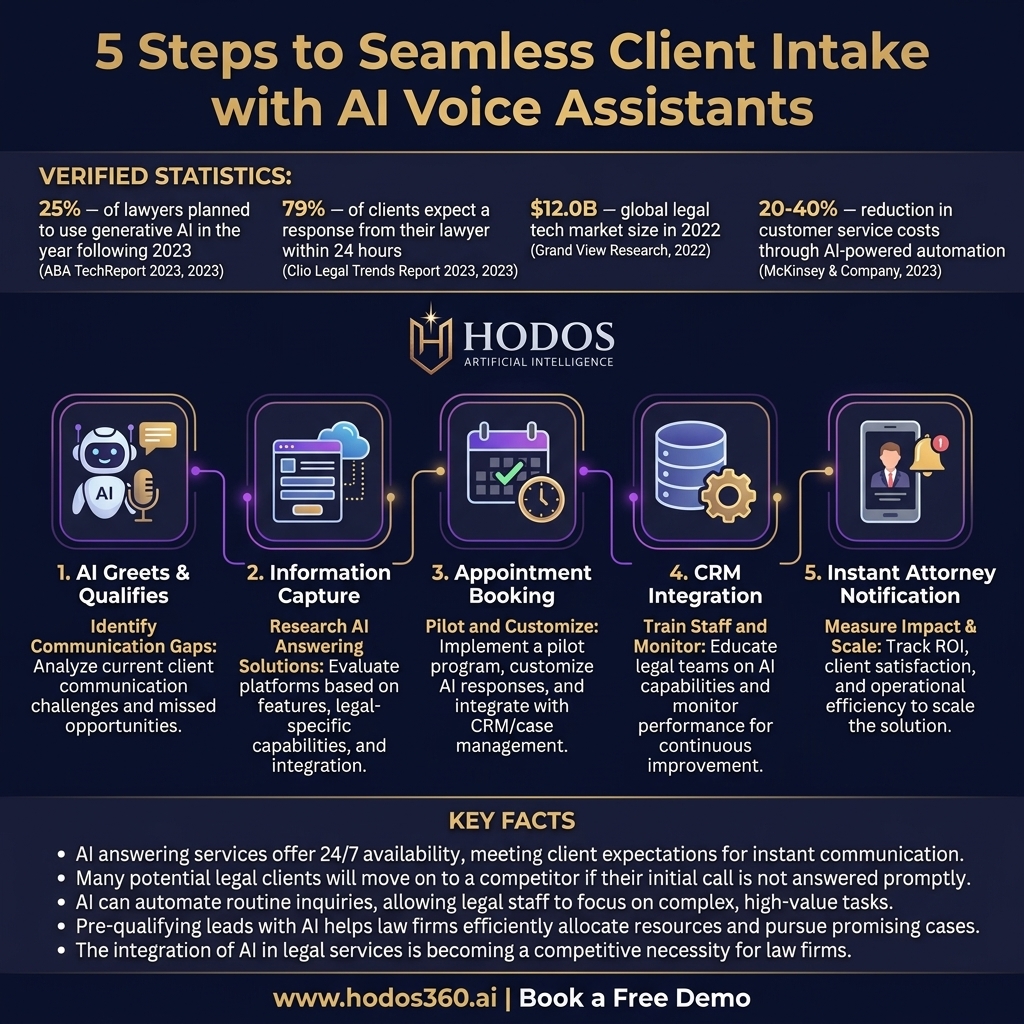
This round-the-clock presence is critical; a 2024 ABA Legal Technology Survey Report indicated that nearly 60% of potential clients expect an immediate response, and almost 30% attempt to contact firms outside of traditional *business* hours. An AI assistant fills this gap, acting as a tireless, always-on *receptionist*.
Furthermore, advanced multilingual support is now standard, allowing firms to serve diverse populations without needing a costly, rotating staff of human translators. This capability alone can open up significant new market segments for firms, from *small business* practices to large international firms.
Intelligent call routing is another cornerstone feature. Instead of a generic answering machine, an AI voice assistant can skillfully qualify leads based on predefined criteria—practice area, urgency, potential case value, geographic location—and route them to the most appropriate attorney or department. This pre-screening saves attorneys invaluable time, ensuring they only engage with genuinely prospective clients who fit the firm’s profile.
Lead qualification extends to gathering essential information like contact details, a brief summary of the legal issue, and even preliminary conflict-of-interest data, all before a human ever intervenes. This streamlined process ensures that every interaction is productive and moves the potential client closer to retaining the firm's *services*.
The system is constantly *tested* and improved through machine learning, making it smarter with every interaction.
Seamless appointment booking is also a game-changer. Rather than playing phone tag, clients can schedule consultations directly with the AI, which integrates with the firm’s existing calendar system (e.g., Clio, MyCase). The AI can check attorney availability, offer suitable time slots, send reminders, and even collect initial intake forms, all autonomously.
This not only enhances the client experience but also frees up administrative staff to focus on more complex tasks. The best AI *answering services* also offer robust integration with existing legal tech platforms, including case management systems, CRM *software*, and document automation tools. This interconnectivity creates a unified workflow, ensuring that client data captured by the AI is immediately accessible across the firm’s entire digital ecosystem, minimizing data entry errors and maximizing efficiency.
Firms are constantly *looking* for these types of integrated solutions.
Finally, sophisticated analytics and reporting capabilities are vital. A top-tier AI *answering service* provides detailed insights into call volumes, lead conversion rates, client satisfaction scores, and peak calling times. This data empowers law firm leaders to make informed strategic decisions about marketing spend, staffing, and *service* offerings.
For instance, if analytics reveal a high volume of calls for a specific practice area during evenings, the firm can adjust its marketing efforts or allocate resources accordingly. This data-driven approach transforms client communication from an operational necessity into a strategic asset, providing actionable intelligence that can drive firm growth and profitability.
The ability to track ROI and optimize *services* is a major advantage for any *business*.
- ✓24/7 Client Engagement: Ensures no calls are missed, providing round-the-clock support and information to potential and existing clients, significantly improving responsiveness and client satisfaction.
- ✓Enhanced Lead Qualification: Automatically screens and qualifies incoming leads based on predefined criteria, ensuring attorneys only engage with high-value prospects and reducing time spent on unsuitable inquiries.
- ✓Seamless Appointment Scheduling: Integrates directly with firm calendars to book consultations, send reminders, and collect initial client information without human intervention, streamlining the intake process.
- ✓Cost Reduction & Efficiency Gains: Dramatically lowers operational costs associated with human receptionists and administrative staff, while simultaneously increasing efficiency by automating repetitive communication tasks.
- ✓Multilingual Client Support: Offers instant communication in multiple languages, expanding the firm's reach to diverse client bases and ensuring equitable access to legal services.
- ✓Improved Client Experience & Retention: Delivers consistent, professional, and personalized interactions, leading to higher client satisfaction, stronger relationships, and increased retention rates.
- ✓Integration with Legal Tech Ecosystem: Connects effortlessly with existing case management, CRM, and document automation software, creating a unified and efficient digital workflow for the entire firm.
The Economic Impact: ROI and Scalability for Modern Legal Practices
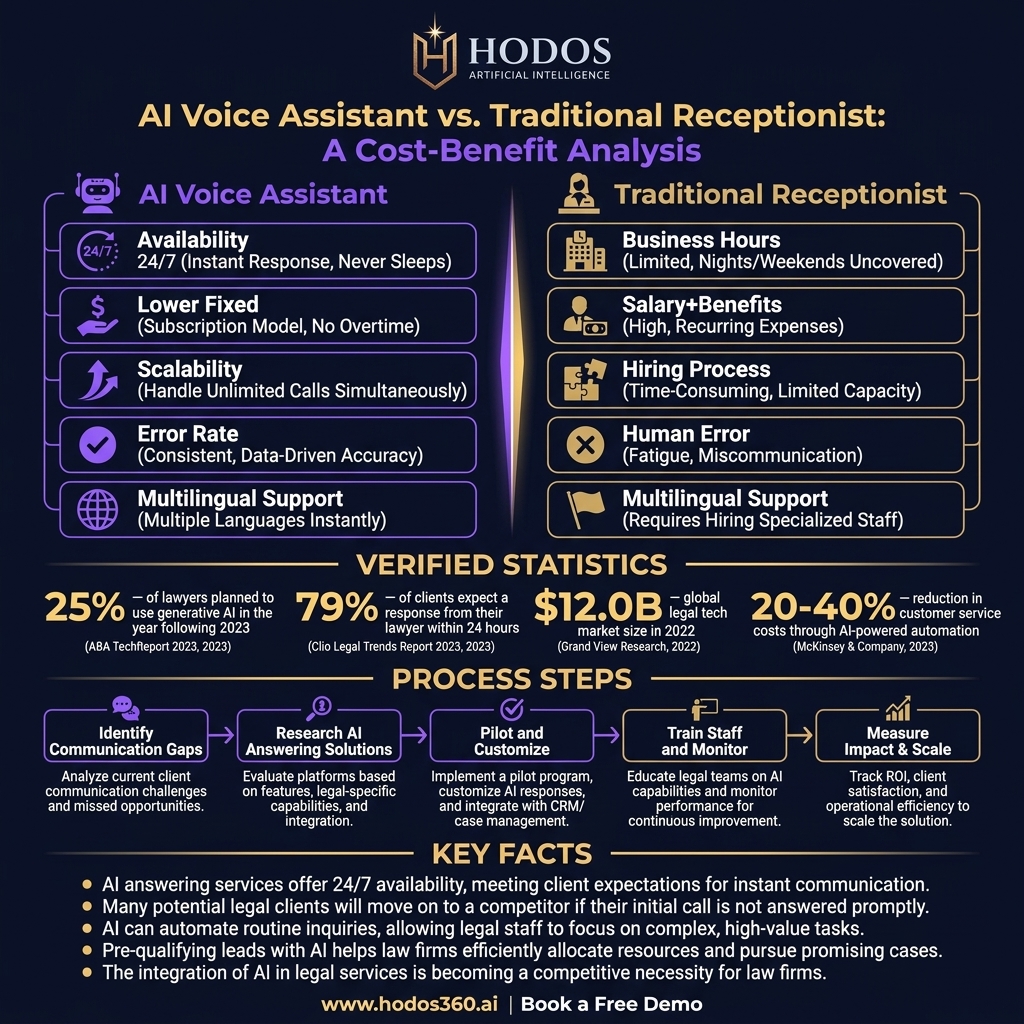
The economic rationale for adopting an AI *answering service* is compelling, particularly for law firms grappling with rising operational costs and the imperative to scale efficiently. A human *receptionist* can cost a firm upwards of $50,000-$70,000 annually in salary, benefits, and overhead, often limited to a 40-hour work week.
In contrast, an AI voice assistant offers a fixed, significantly lower monthly subscription, operating 24/7 without sick days, vacations, or performance fluctuations. A 2023 report by McKinsey & Company on automation in professional *services* estimated that AI-powered solutions could reduce operational costs by 20-30% for tasks involving repetitive communication.
For a law firm, this translates into substantial savings that can be reinvested into growth, attorney compensation, or marketing. This cost-efficiency is a primary driver for many *small business* law firms *looking* to maximize their budget.
Beyond direct cost savings, the scalability offered by AI is transformative. Law firms experience fluctuating call volumes—spikes during major case filings, after successful marketing campaigns, or during specific legal events. A human workforce struggles to adapt to these surges without incurring significant overtime costs or experiencing burnout, which can lead to missed *calls* and dissatisfied clients.
An AI *answering service*, however, can instantaneously scale its capacity to handle thousands of simultaneous inquiries without any degradation in performance or additional cost per call. This elasticity ensures that the firm can capitalize on every opportunity, regardless of its magnitude. Companies like LegalZoom and Rocket Lawyer have demonstrated the power of automation in scaling legal *services* to a mass market, and now, sophisticated AI platforms bring similar scalability advantages to individual law firms, enabling them to compete more effectively.
The return on investment (ROI) extends beyond mere cost reduction to revenue generation. By ensuring every call is answered, every lead is qualified, and appointments are booked efficiently, AI directly contributes to an increase in client intake and, consequently, billable hours. Consider the data: a firm that converts just two additional qualified leads per month, each resulting in a $5,000 case, generates an extra $120,000 in annual revenue.
When juxtaposed against the relatively modest investment in an AI *answering service*, the ROI becomes undeniably attractive. This strategic asset helps firms not only retain existing clients through superior *service* but also aggressively pursue new *business* without overstretching their human resources. The financial argument for AI is no longer hypothetical; it's a proven pathway to sustainable growth and enhanced profitability for legal practices.
Furthermore, the indirect benefits, though harder to quantify, are equally significant. Improved employee morale, as administrative staff are freed from repetitive tasks to focus on more engaging, high-value work, contributes to a more positive and productive firm culture. The enhanced professional image projected by a firm that offers seamless, 24/7 client support also strengthens its brand in a competitive market.
Firms that have *tested* and *compared* various solutions often find that the comprehensive benefits of AI extend far beyond the initial cost-saving projections. Curious about the ROI for your firm? Explore a personalized demo of HODOS 360's AI Voice Assistants and see the savings firsthand.
Navigating the Competitive Landscape: What to Look For
When evaluating the myriad of AI *receptionists* and *answering services* available, law firms must look beyond basic functionality. Key considerations include the AI's natural language understanding capabilities, its ability to integrate seamlessly with existing legal tech stacks (such as Clio, MyCase, or NetDocuments), and its customization options.
Can the AI be trained with firm-specific legal terminology, intake forms, and FAQs? Data security and compliance are paramount, as discussed in the next section. Firms should also assess the vendor's commitment to ongoing development and customer support. The market is increasingly *compared* by features like multilingual support, advanced lead qualification, and intuitive user interfaces.
A thorough evaluation, perhaps through pilot programs or extensive demos, is crucial to finding the best fit for a firm's unique needs and ensuring the chosen *software* truly enhances operations.
Data Security, Ethics, and Compliance in AI Answering
For law firms, the adoption of any technology that handles client communications immediately raises critical questions about data security, privacy, and ethical compliance. The legal profession operates under stringent confidentiality rules, such as ABA Model Rule 1.6 (Confidentiality of Information), which dictates that a lawyer shall not reveal information relating to the representation of a client unless the client gives informed consent or the disclosure is impliedly authorized.
This rule extends to all third-party vendors and *software* solutions a firm employs. Therefore, any AI *answering service* must demonstrate robust security protocols, including end-to-end encryption for all communications, secure data storage, and strict access controls. Furthermore, providers should be transparent about their data handling practices, including where data is stored, who has access, and for what duration.
Firms must conduct thorough due diligence, perhaps even requiring specific contractual clauses that address data ownership and breach notification procedures.
Beyond technical security, ethical considerations are paramount. The use of AI in client interactions necessitates transparency. Clients should ideally be informed when they are interacting with an AI, not a human. This ensures informed consent and maintains trust, which is the bedrock of the attorney-client relationship.
The European Union's AI Act, which is set to be fully enforced in the coming years, provides a comprehensive framework for regulating AI systems, particularly those deemed 'high-risk.' While the direct application to legal *answering services* may vary, its principles of transparency, human oversight, and accountability offer a valuable blueprint for ethical AI deployment globally.
Law firms, as custodians of sensitive information, must proactively ensure their AI partners adhere to the highest ethical standards, not just the minimum legal requirements. This is crucial for all *businesses* in the legal sector.
Compliance with various regulatory frameworks, such as HIPAA for firms handling medical information or state-specific data privacy laws, adds another layer of complexity. The chosen AI *answering service* must be capable of configuration to meet these diverse compliance needs. For instance, if a firm operates across different jurisdictions, the AI solution must be flexible enough to handle varying consent requirements or data retention policies.
The potential for AI to inadvertently generate or store privileged information also requires careful consideration. Firms should consult with their malpractice insurers and legal ethics committees to ensure that the deployment of AI aligns with all professional obligations. The proactive management of these risks is not just about avoiding penalties; it’s about preserving the firm’s reputation and maintaining client trust.
The careful selection of *software* is therefore paramount.
The concept of 'human in the loop' is crucial here. While AI can handle the vast majority of routine inquiries, there must always be a clear escalation path to a human attorney or staff member for complex, sensitive, or truly novel situations that the AI is not equipped to handle.
This ensures that the AI acts as an augmentative tool, enhancing human capabilities rather than replacing critical human judgment. The goal is to leverage AI for efficiency while preserving the invaluable human element of legal *service*. Firms must evaluate AI providers not just on their technological prowess, but also on their commitment to ethical AI development and their understanding of the unique compliance landscape of the legal profession.
This holistic approach ensures that the AI *answering service* becomes a trusted extension of the firm, not a potential liability. This is an area where HODOS 360 excels, offering compliant and secure AI Voice Assistants.
Ensuring Client Trust: Transparency and Human Oversight
Building and maintaining client trust is paramount. This means being transparent about the use of AI. A simple disclosure, such as "You're currently speaking with an AI assistant; if you prefer to speak with a human, please say 'agent,'" can go a long way. Furthermore, human oversight is non-negotiable.
Regular review of AI interactions, particularly those that were escalated, helps identify areas for improvement and ensures the AI is performing as intended. This iterative feedback loop, where human attorneys and staff continuously refine the AI's performance, is essential for its long-term success and for upholding the firm's ethical obligations.
The integration of AI should strengthen, not weaken, the attorney-client bond, ensuring clients always feel they have access to human expertise when needed for their legal *service*.

Key Takeaways and Next Steps for Your Firm's Future
The legal landscape of 2026 demands more than just legal acumen; it requires technological foresight and strategic adoption. The best AI *answering service* is no longer a futuristic concept but a present-day imperative for law firms aiming to optimize client communication, enhance operational efficiency, and drive sustainable growth.
From ensuring 24/7 client engagement and intelligent lead qualification to providing multilingual support and robust data analytics, these AI voice assistants are fundamentally redefining how legal *businesses* interact with their clients. The economic advantages, coupled with the scalability and enhanced client experience, present a compelling case for immediate integration.
Firms that embrace this technological shift will not only streamline their operations but also solidify their competitive position in an increasingly digital world, ensuring they are well-prepared for the future of legal *services*.
For law firm owners and legal professionals, the journey towards an AI-powered future begins with a clear understanding of your firm’s specific needs and a thorough evaluation of available solutions. Prioritize vendors that offer a comprehensive suite of features, strong integration capabilities with your existing legal tech stack, and an unwavering commitment to data security and ethical AI deployment.
Remember, the goal is not to replace the human element but to augment it, freeing up your valuable attorneys and staff to focus on complex legal work that truly requires their expertise. The strategic adoption of an AI *receptionist* is a significant step towards building a more resilient, efficient, and client-centric legal practice.
Ready to elevate your firm's client experience and operational efficiency? Partner with HODOS 360 for cutting-edge AI solutions designed for the legal industry.
Frequently Asked Questions
What is an AI answering service for law firms?+
An AI answering service for law firms is an advanced virtual assistant that uses artificial intelligence to handle incoming calls, qualify leads, book appointments, and provide information 24/7. It leverages natural language processing to understand and respond to client inquiries, integrating seamlessly with existing firm systems to streamline client intake and communication processes.
How does AI handle sensitive client information securely?+
Reputable AI answering services for law firms employ robust security measures, including end-to-end encryption, secure data storage, and strict access controls, often complying with industry standards like HIPAA and ABA Model Rules. Firms should partner with providers transparent about their data handling practices and committed to upholding client confidentiality and data privacy.
Can an AI voice assistant integrate with my existing CRM?+
Yes, a key feature of a superior AI voice assistant for law firms is its ability to integrate with existing legal CRMs and case management systems (e.g., Clio, MyCase). This ensures that all client data captured by the AI, from initial inquiries to booked appointments, is automatically synced across your firm's digital ecosystem, minimizing manual data entry and errors.
What's the typical ROI for implementing an AI answering service?+
The ROI for implementing an AI answering service can be substantial. Firms typically see significant cost reductions by replacing or supplementing human receptionists, while increasing revenue through improved lead conversion rates and 24/7 availability. Savings on operational costs and increased billable hours often lead to a positive ROI within months, depending on firm size and call volume.
How is an AI voice assistant different from a traditional answering service?+
Unlike traditional answering services, which rely on human operators with limited legal knowledge, an AI voice assistant offers 24/7 intelligent interaction, multilingual support, and deep integration with legal tech. It can qualify leads, book appointments autonomously, and provide data analytics, offering a more efficient, scalable, and cost-effective solution tailored specifically for the legal industry's unique demands.