


AI Legal Tech: Essential Strategies for Market Growth
The legal landscape is in the midst of its most profound transformation in generations, largely propelled by the relentless march of artificial intelligence. Just a few years ago, the notion of AI playing a central role in law firms was met with a mixture of skepticism and cautious optimism.
However, as the latest report from Global Venturing, titled "How AI is expanding the legal tech market," unequivocally demonstrates, that era of hesitation is firmly behind us. Today, AI Legal Tech is not merely a tool for incremental efficiency gains; it is a fundamental catalyst reshaping the entire legal services industry, unlocking unprecedented growth and redefining what's possible for legal professionals.
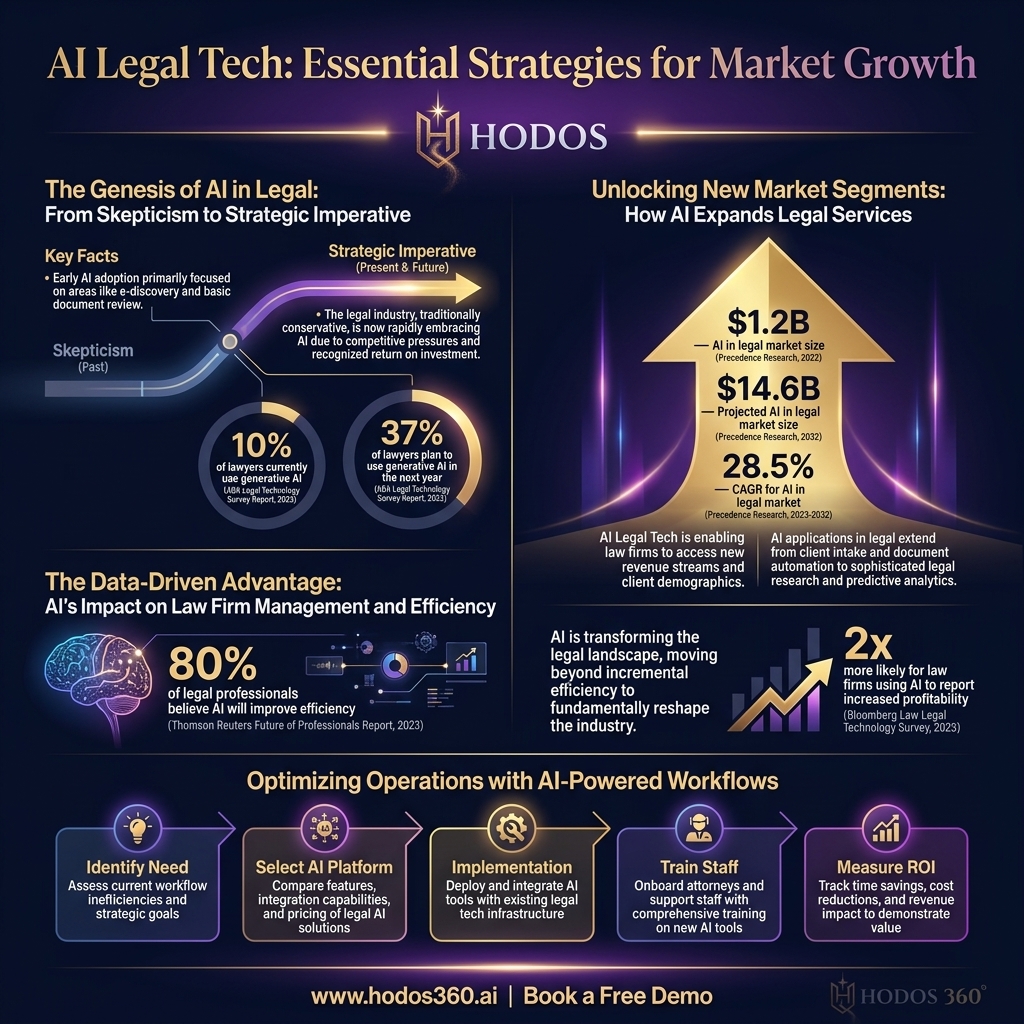
The numbers tell a compelling story of an industry on the cusp of an explosive expansion. The legal technology market, valued at approximately $28.7 billion in 2025, is projected to surge to over $69.6 billion by 2033, demonstrating a compound annual growth rate (CAGR) exceeding 12.2%.
This isn't just about bigger software budgets; it reflects a deep-seated integration of AI across all facets of legal practice, from client intake and document automation to sophisticated legal research and predictive analytics. Firms that once questioned the ROI of AI are now racing to adopt it, recognizing that embracing this technological wave is not just about staying competitive, but about accessing entirely new revenue streams and client demographics.
The Genesis of AI in Legal: From Skepticism to Strategic Imperative
The legal industry, often characterized by its conservatism, was initially slow to embrace technological disruption. Early forays into AI Legal Tech, primarily in areas like e-discovery and basic document review, were met with caution. Pioneers like Monica Zent, founder of Foxwordy, advocated for greater tech adoption years ago, yet widespread integration remained elusive.
Many senior partners at traditional firms, like those at Kirkland & Ellis, expressed valid concerns about data security and ethical implications. This period of skepticism, however, served as a crucial incubation phase, allowing the technology to mature and demonstrate its undeniable value proposition through tangible results and increasingly sophisticated applications.
The turning point arrived with the explosion of generative AI, particularly following the public launch of OpenAI's ChatGPT. This moment marked a dramatic shift from niche applications to a broader understanding of AI's potential. Learn more about Future Ready Lawyer: Essential AI Confidence for Legal Professionals.
The partnership between Harvey AI and global legal giant Allen & Overy in 2023 was a watershed moment, validating the enterprise-level applicability of advanced AI solutions. As Winston & Strawn partner Dan Binstock observed, "Generative AI has shifted the entire paradigm. It's no longer just about doing things faster, but about doing things fundamentally differently."
This spurred a rapid acceleration in adoption, with the Thomson Reuters Institute's 2024 State of the Legal Market Report highlighting a substantial uptick in technology investments. The market quickly realized that ignoring AI was a far greater risk than embracing it, leading to a scramble for competitive advantage.
Unlocking New Market Segments: How AI Expands Legal Services
One of the most transformative impacts of AI Legal Tech is its ability to unlock entirely new market segments and democratize access to legal services. Historically, many small and medium-sized businesses (SMBs) and individual clients found legal services prohibitively expensive. AI-powered platforms are changing this dynamic by automating document creation, streamlining compliance, and providing affordable initial guidance.
While companies like LegalZoom pioneered accessible legal documents, AI now takes this a step further, offering intelligent customization. Furthermore, tools like LexisNexis's Context and Casetext's CoCounsel (now part of Thomson Reuters) leverage sophisticated algorithms to analyze vast datasets, allowing lawyers to predict litigation outcomes with greater accuracy and formulate more robust strategies.
This level of predictive insight creates new advisory service lines, enabling firms to provide proactive, data-driven counsel.
Beyond service delivery, AI is fundamentally changing how law firms acquire and retain clients. Learn more about Voice Assist: Essential AI Scheduling for Law Firms. The digital age demands a robust online presence and sophisticated marketing strategies.
AI marketing platforms, such as HODOS 360's AI Marketing Platform, empower firms to create highly targeted campaigns, generate engaging content (including AI video creation), automate social media outreach, and track ROI with precision. The Clio 2024 Legal Trends Report consistently highlights the critical importance of digital marketing and client-centric approaches.
By leveraging AI to identify ideal clients, craft personalized messages, and optimize conversion funnels, firms can significantly improve their client acquisition rates, penetrate new geographic markets, and build stronger client relationships, expanding their client base and overall market reach.
The Data-Driven Advantage: AI's Impact on Law Firm Management and Efficiency
The internal operations of law firms have historically been characterized by manual processes, extensive paperwork, and time-consuming administrative tasks. Charley Moore, CEO of Rocket Lawyer, has long emphasized the critical need for streamlined, tech-driven operations. AI is now providing the answer, transforming everything from client intake to billing and document management.
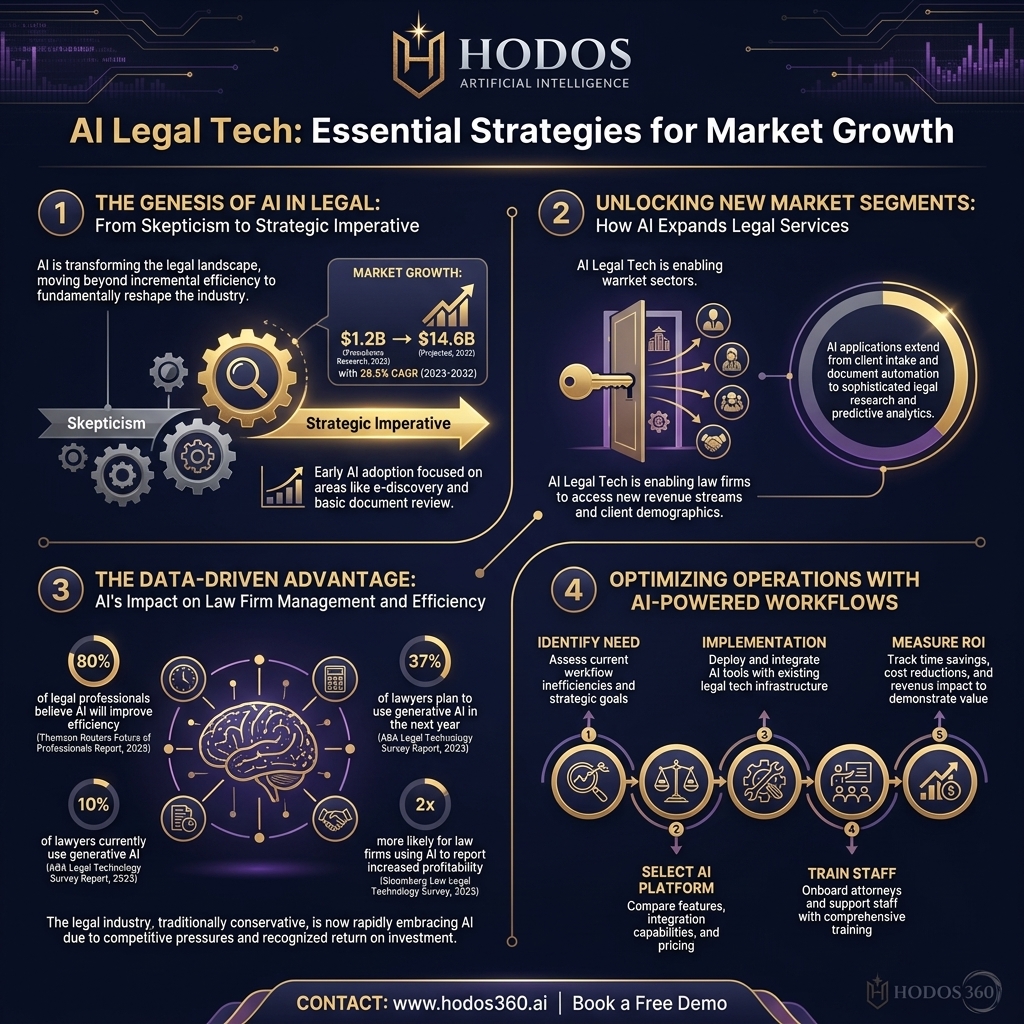
By automating repetitive tasks, AI Legal Tech frees up legal professionals to focus on strategic thinking and complex problem-solving. AI-powered law firm management systems, like the HODOS 360 AI Law Firm Management System, are at the forefront of this revolution. These integrated platforms automate client intake, generate documents with precision, manage case workflows, and even power legal research.
Gartner predicts that by 2027, generative AI will automate up to 30% of routine legal tasks, significantly reducing administrative burden. Learn more about Voice AI Assistant: The Ultimate Guide for Law Firms. Firms leveraging these systems report significant return on investment, not just in terms of time saved but also in improved client satisfaction.
Firms like Dentons, through its Nextlaw Labs initiatives, have demonstrated how strategic investment in legal tech can yield substantial cost reductions and improved profitability, a trend reflected in the "Legal Tech Spending Surges 9.7%" observed in recent industry reports. Beyond task automation, AI provides powerful analytics that offer insights into firm performance, resource allocation, and profitability, enabling agile business decisions and sustainable growth.
Here are some key areas where AI is revolutionizing law firm operations:
- ✓Automated Client Intake: AI systems streamline the onboarding process by collecting, verifying, and organizing client information, reducing manual data entry.
- ✓Intelligent Document Automation: Generate complex legal documents, contracts, and filings in minutes, pre-populated with case-specific data, ensuring accuracy and compliance.
- ✓AI-Powered Legal Workflows: Automate multi-step processes from discovery to trial preparation, ensuring tasks are completed efficiently and deadlines are met.
- ✓Enhanced Case Management: Centralized AI platforms provide a holistic view of cases, tracking progress, managing deadlines, and allocating resources effectively.
- ✓Predictive Billing and Expense Tracking: AI can analyze historical data to improve billing accuracy, forecast expenses, and identify potential revenue leakage.
- ✓AI-Driven Research and Analytics: Utilize AI to rapidly sift through vast legal databases, identify relevant precedents, and provide strategic insights for litigation and advisory work.
- ✓Compliance Monitoring: AI tools continuously monitor regulatory changes and alert firms to potential compliance risks, helping maintain adherence to evolving legal standards.
Optimizing Operations with AI-Powered Workflows
The true power of AI in law firm management lies in its ability to orchestrate complex legal workflows. Unlike simple automation, AI-powered workflows are adaptive, learning from past interactions and making intelligent suggestions. This seamless integration minimizes human intervention in routine processes, significantly reducing errors and ensuring a consistent, high-quality client experience.
Learn more about AI SEO Lead Generation: Essential Strategies for Law Firms. The efficiency gained allows legal teams to move cases forward more rapidly, leading to quicker resolutions and increased client satisfaction. Furthermore, AI can monitor the progress of these workflows, identify bottlenecks, and suggest optimizations, providing continuous improvement to a firm's operational backbone.
Client Engagement in the AI Era: Voice Assistants and Digital Presence
Modern clients expect instant gratification and 24/7 accessibility, a paradigm shift from traditional legal practice. Accenture's research consistently highlights that customer experience is a key differentiator, and the legal sector is no exception. Firms that fail to meet these evolving expectations risk losing potential clients to more technologically agile competitors.
This demand for immediate interaction extends beyond just answering calls; it encompasses lead qualification, appointment booking, and providing preliminary information, often outside standard business hours. AI Legal Tech provides the scalable solution, bridging the gap between client expectations and firm capacity.
AI Voice Assistants, like those offered by HODOS 360, are revolutionizing client engagement by acting as a virtual front desk available around the clock.
These sophisticated assistants can answer common questions, qualify leads, book appointments, and even provide multilingual support. Learn more about AI for Small Law Firms: The Essential Hub for Growth. For a law firm, this means no missed calls, no lost leads, and a professional, responsive image even after hours.
Firms leveraging AI voice assistants have reported significant increases in booked consultations and improved client satisfaction, often seeing a 20-30% increase in lead conversion. Complementing this is the critical role of a robust digital presence. HODOS 360's Web & Mobile Development services focus on building AI-powered, responsive websites that are not only visually appealing but also highly converting and optimized for search engines (SEO).
Revolutionizing Client Intake with AI Voice
The initial client intake process is often a bottleneck. AI voice assistants transform this by handling initial queries, gathering essential information, and pre-qualifying leads with remarkable efficiency. This not only speeds up the process but also provides a consistent, professional experience for every prospective client.
Learn more about AI Assistant: Essential Tool for Law Firm Staffing Shortages. Imagine a potential client calling at 10 PM and being able to quickly assess their needs, confirm jurisdiction, and book an appointment for the next morning, all through an intelligent, empathetic AI. This capability ensures that valuable leads are captured instantly and routed appropriately, maximizing conversion rates.
Building a High-Converting Digital Footprint
A high-converting digital footprint is more than just a beautiful website; it's a strategically designed ecosystem engineered to attract, engage, and convert visitors into clients. This involves robust SEO optimization, intuitive user experience (UX) design, and compelling, AI-generated content that speaks directly to client needs.
Integrating AI analytics allows firms to understand visitor behavior, optimize landing pages, and personalize content delivery, further enhancing conversion rates. This holistic approach ensures that every aspect of the online presence works in concert to build trust, demonstrate expertise, and ultimately drive client acquisition, making the digital presence a powerful engine for market expansion.
Navigating Ethical AI and Regulatory Landscapes
While the benefits of AI Legal Tech are undeniable, the rapid evolution of this technology also presents significant ethical and regulatory challenges. Leaders like Sam Altman, CEO of OpenAI, have consistently highlighted the need for robust governance and safety frameworks. For law firms, this translates into a heightened responsibility to understand AI tools, particularly concerning client confidentiality, data privacy, and potential for bias.
The duty of competence (ABA Model Rule 1.1) now explicitly includes technological competence, requiring lawyers to stay abreast of relevant technologies and their inherent risks. This means not blindly adopting AI, but critically evaluating its fitness for purpose and ensuring adequate oversight.
Regulatory bodies worldwide are actively working to establish guidelines for AI, with the European Union's AI Act representing a landmark piece of legislation.
While the U.S. has yet to pass comprehensive federal AI legislation, state bar associations and the American Bar Association (ABA) are issuing guidance on ethical AI use. For instance, ABA Model Rule 1.6 (Confidentiality of Information) mandates that lawyers take reasonable steps to protect client information, a challenge amplified by cloud-based AI solutions.
Firms must implement robust data security protocols and ensure that their AI vendors comply with the highest standards of data protection. Ultimately, the human element remains irreplaceable. As Dario Amodei, CEO of Anthropic, often emphasizes, human oversight and judgment are crucial for critical decisions, fostering an environment where innovation thrives within a framework of responsibility.