
AI Assistant: Essential Tool for Law Firm Staffing Shortages
The City of La Vergne, Tennessee, recently made headlines by considering an AI assistant to help its 'short staffed' dispatch center manage administrative calls, a move that underscores a universal challenge across industries: the persistent struggle with human resource allocation and administrative overload. This public sector dilemma resonates deeply within the private legal sector, where law firms, from solo practitioners to multinational behemoths, grapple daily with the dual pressures of increasing client demands and a shrinking pool of support staff.
The legal landscape, much like emergency services, requires constant availability and meticulous attention to detail, making the burden of routine administrative tasks particularly acute.
For years, law firm owners and managing partners have expressed concerns over the escalating time spent on non-billable activities, often citing client intake, scheduling, and routine inquiries as significant drains on valuable resources.
The 2023 ABA TechReport revealed that a substantial portion of a lawyer’s day is still consumed by tasks that could be automated, contributing directly to the feeling of being 'short staffed' even in firms with robust teams. This administrative undertow not only impacts profitability but also leads to attorney burnout and can compromise the quality of client service.
The legal industry is at a critical juncture, where traditional operational models are proving unsustainable in the face of modern demands and talent shortages.
The advent of sophisticated AI assistant technologies offers a transformative pathway forward. Far beyond simple chatbots, today's AI voice assistants are capable of understanding nuanced inquiries, providing multilingual support, qualifying leads, and seamlessly integrating with existing case management systems.
They represent a paradigm shift, moving administrative duties from a reactive, human-intensive process to a proactive, intelligent, and perpetually available solution. As firms increasingly consider adopting these tools, the conversation shifts from mere technological adoption to strategic operational evolution, promising not just to alleviate immediate staffing shortages but to fundamentally redefine how legal services are delivered and managed.
This article explores how advanced AI assistants are becoming an indispensable asset for modern law firms, addressing critical operational gaps and paving the way for unprecedented efficiency and client satisfaction. Discover how your firm can leverage this transformative technology to thrive in a competitive market.
The Administrative Burden: Why Law Firms Are Short Staffed
The legal profession, despite its intellectual rigor, is remarkably administrative-heavy. Law firms are constantly battling a deluge of phone calls, emails, and paperwork that often distract from core legal work. According to the 2023 Clio Legal Trends Report, lawyers spend an average of 2.5 hours per day on administrative tasks—time that could otherwise be dedicated to billable work or strategic planning.
This isn't merely an inconvenience; it's a direct hit to the bottom line and a primary driver of the 'short staffed' perception. The sheer volume of client inquiries, appointment scheduling, and information gathering required for even a single case creates an overwhelming workload for human staff, leading to bottlenecks and potential client dissatisfaction.
The challenge is compounded by the difficulty in recruiting and retaining skilled legal support staff. The demand for paralegals, legal secretaries, and administrative assistants often outstrips supply, particularly in specialized practice areas. Firms compete fiercely for talent, driving up salaries and benefits, yet still struggle to fill critical roles.
This scarcity means existing staff are often stretched thin, leading to increased stress, burnout, and higher turnover rates. When a key administrative team member leaves, the ripple effect can be devastating, causing disruptions in client communication, delays in case progression, and a significant dip in overall firm productivity.
Learn more about AI Marketing Agents: Essential for Law Firm Growth. This cyclical problem perpetuates the feeling of being perennially under-resourced.
Moreover, the nature of legal work demands constant client communication. Missed calls, delayed responses, or inconsistent information can erode client trust and damage a firm's reputation.
Clients today expect immediate answers and 24/7 accessibility, a standard that traditional staffing models find nearly impossible to meet without prohibitive overhead. This pressure to maintain constant availability, coupled with the administrative load and staffing shortages, creates a perfect storm for inefficiency. The situation in La Vergne’s dispatch center, facing a similar challenge with 'administrative calls,' highlights that this isn't a unique legal problem but a systemic issue where human capacity is simply insufficient to handle the volume and immediacy of modern communication demands.
Many law firms find themselves in a reactive posture, constantly putting out administrative fires rather than proactively managing their workflow. This constant state of reaction prevents firms from focusing on strategic growth, business development, or even simply improving the work-life balance for their attorneys and staff.
The administrative burden, far from being a minor annoyance, has become a foundational impediment to progress and a significant contributor to the industry's pervasive staffing challenges. Addressing this requires more than just hiring more people; it demands a fundamental rethinking of how administrative tasks are handled, a role perfectly suited for an advanced AI assistant.
The Cost of Inefficiency: Beyond Billable Hours
The financial implications of administrative inefficiency extend far beyond lost billable hours. Firms incur significant costs in recruitment, training, and retention of administrative staff, often only to face high turnover rates. A study by Thomson Reuters found that the average cost of replacing an employee can range from 50% to 200% of their annual salary, a staggering figure when considering multiple departures.
Furthermore, the opportunity cost of attorneys and high-value legal professionals spending time on tasks that could be automated is immense. Imagine a senior partner, earning hundreds of dollars an hour, personally returning routine calls or scheduling consultations – this is a direct misallocation of talent and resources that directly impacts the firm's profitability and strategic capacity.
Beyond the tangible financial losses, inefficiency also exacts a heavy toll on firm culture and client relationships. Staff burnout, a direct consequence of being 'short staffed' and overwhelmed, leads to decreased morale, increased errors, and a less positive work environment. Learn more about AI Voice Assistants: Ultimate Legal Strategy After Apple's Siri Settlement.
This internal strain can manifest externally, affecting the client experience. A potential client calling a firm after hours, or during peak business times, might encounter a busy signal, a voicemail maze, or a delayed callback. Such initial negative interactions can lead to lost business, as prospective clients, particularly in competitive areas like personal injury or family law, will simply move on to the next firm that offers immediate, responsive service.
In the digital age, clients expect seamless, always-on communication, and firms that fail to deliver risk being perceived as outdated or unresponsive, irrespective of their legal prowess.
AI Voice Assistants: A Proven Solution for Legal Operations
The emergence of sophisticated AI voice assistant technology presents a powerful antidote to the administrative woes plaguing law firms. These are not merely glorified answering machines; modern AI assistants leverage natural language processing (NLP) and machine learning to understand, interpret, and respond to complex queries, much like a human operator.
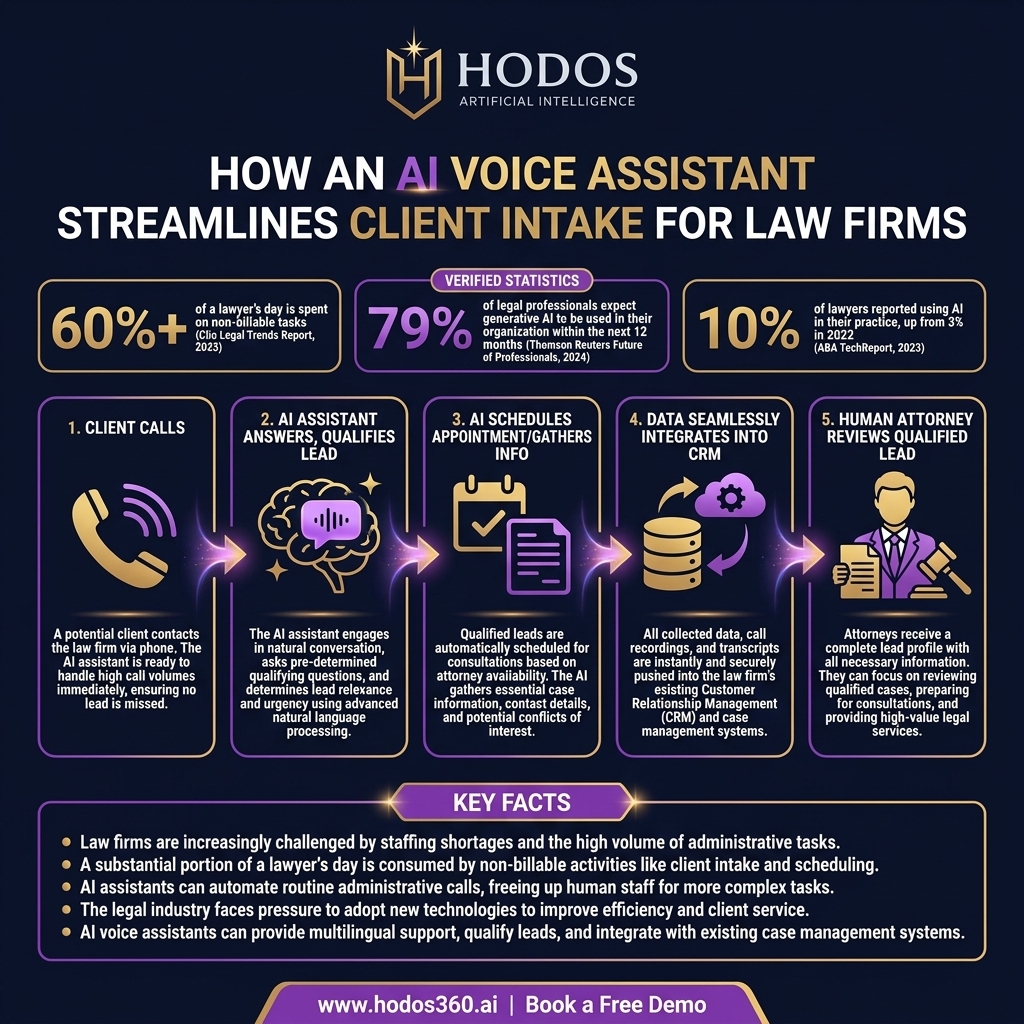
Their capabilities extend to 24/7 phone answering, ensuring no potential client call is missed, regardless of time zones or office hours. This constant availability is a game-changer for client intake, a critical bottleneck identified by many firms. Consider the success seen in other sectors: healthcare providers use AI assistants to manage appointment bookings and provide general patient information, reducing the administrative load on nurses and receptionists, much like the La Vergne dispatch center's considerations.
For law firms, the benefits of deploying an AI assistant are multi-faceted. They can effectively qualify leads by asking pre-defined questions, routing urgent calls to appropriate legal professionals, and even booking initial consultations directly into the firm's calendar system. This frees up human administrative staff to focus on more complex tasks, such as preparing legal documents, assisting with case research, or directly supporting attorneys.
The impact on efficiency is profound: a firm can process a higher volume of inquiries without increasing headcount, directly addressing the 'staffing shortages' issue. Moreover, these systems can provide multilingual support, broadening a firm's reach and ensuring that diverse client bases receive equally high-quality initial contact, a critical aspect in today's globalized legal market.
Companies like OpenAI, with its advanced GPT models, and Anthropic, known for its focus on AI safety, are continuously pushing the boundaries of what these systems can achieve in natural conversation. Learn more about AI Web Design: Essential for Law Firms in the Agentic Era.
While these are foundational models, their capabilities are integrated into specialized platforms that understand legal terminology and workflows. For instance, a firm using an AI voice assistant can program it to answer common questions about specific practice areas, explain fee structures, or provide directions to the office, all without human intervention.
This not only streamlines operations but also ensures consistency in communication, a challenge often faced by firms with multiple administrative staff members. The integration capabilities with CRM and case management systems mean that all interactions are logged, providing a comprehensive audit trail and valuable data for lead conversion analysis.
Beyond initial client contact, AI voice assistants can assist with routine client updates, court date reminders, or even gathering preliminary information for legal aid applications. This proactive communication enhances client satisfaction and reduces the number of inbound calls for status updates, further alleviating the burden on human staff.
The ability to automate these repetitive, yet crucial, communications transforms a firm's operational flow, allowing legal professionals to dedicate their expertise to strategic legal work rather than administrative minutiae. The transition from manual, human-dependent processes to intelligent, automated systems is not just about cost-cutting; it's about enabling a higher quality of service and a more sustainable operational model for the future of law.
- ✓24/7 Availability: Ensures no call is missed, capturing leads and providing information around the clock, significantly improving client access and responsiveness.
- ✓Multilingual Support: Broadens client reach by communicating effectively in multiple languages, fostering inclusivity and expanding market potential.
- ✓Intelligent Call Routing: Directs callers to the most appropriate department or individual based on their specific needs, reducing internal transfers and client frustration.
- ✓Lead Qualification & Capture: Gathers essential information from prospective clients, pre-qualifying leads and creating detailed records for follow-up, optimizing attorney time.
- ✓Appointment Scheduling: Integrates directly with firm calendars to book consultations and meetings efficiently, reducing administrative overhead.
- ✓Seamless CRM Integration: Automatically logs all interactions and client data into existing client relationship management systems, ensuring data consistency and accessibility.
- ✓Automated FAQs: Provides instant answers to common questions about services, fees, and procedures, empowering clients with immediate information and reducing repetitive inquiries for staff.
Navigating the AI Landscape: Implementation & Ethical Considerations
Implementing an AI assistant in a law firm is not merely a plug-and-play operation; it requires careful planning, configuration, and a deep understanding of both technological capabilities and ethical responsibilities. The initial phase involves defining the scope of the AI's responsibilities—what types of calls it will handle, what information it can provide, and when to escalate to a human.
This requires collaboration between IT, administrative staff, and legal professionals to ensure the AI is trained with accurate, legally compliant information. Data privacy and security are paramount; firms must ensure that any AI system used adheres to strict confidentiality protocols, especially when handling sensitive client information.
This includes compliance with regulations such as GDPR, CCPA, and state-specific privacy laws. Firms must also be transparent with clients about the use of AI, ensuring that clients are aware they are interacting with an automated system, a principle emphasized by emerging AI ethics guidelines globally and within specific legal jurisdictions.
The ethical implications of AI in legal practice are a subject of ongoing debate and development. The ABA Model Rules of Professional Conduct, particularly Rule 1.1 (Competence) and Rule 1.6 (Confidentiality of Information), are directly relevant. Lawyers have a duty to understand the technology they use and ensure it does not compromise client confidentiality or the quality of legal services.
Legal tech thought leaders like Richard Susskind have long advocated for a pragmatic approach, emphasizing that AI should augment, not replace, human legal expertise. The key is to leverage AI to handle routine, predictable tasks, thereby freeing human lawyers to focus on the complex, strategic, and empathetic aspects of legal practice that require human judgment.
Firms must establish clear protocols for AI supervision, monitoring its performance and ensuring its responses align with legal accuracy and ethical standards. This involves regular auditing of AI interactions and continuous refinement of its programming to prevent biases or miscommunications.
Furthermore, the integration of an AI assistant demands a robust technical infrastructure.
Learn more about AI Website Security: Essential Defenses for Law Firms. The AI must seamlessly connect with existing CRM, practice management, and calendaring systems to be truly effective. This often involves API integrations and ensuring data flow is secure and efficient. Firms should partner with reputable legal tech providers that specialize in AI solutions for the legal industry, ensuring the technology is tailored to the unique demands of legal practice.
The initial investment in setup and training will yield significant returns in the long run, but it requires a commitment to embracing technological change. The ongoing maintenance and updates of the AI system are also crucial, as legal regulations and client expectations evolve, so too must the AI’s capabilities.
This holistic approach to implementation ensures that the AI assistant becomes a valuable asset rather than a technological burden, allowing firms to confidently navigate the complexities of AI adoption.
Looking at the broader regulatory environment, the EU AI Act, expected to be fully enforced in the coming years, sets a global precedent for regulating AI systems based on their risk level.
While an AI assistant handling administrative calls might fall into a lower-risk category, the principles of transparency, human oversight, and robustness are universally applicable. Firms must stay abreast of these evolving legal and ethical frameworks to ensure their AI adoption strategies remain compliant and responsible.
The competitive advantage offered by AI is immense, but it must be pursued with a strong commitment to ethical practice and client trust. Discover how HODOS 360’s AI Voice Assistants are built with legal compliance and ethical standards at their core, empowering your firm to innovate responsibly.
Overcoming Resistance: Training and Integration Strategies
Introducing any new technology, especially one as transformative as an AI assistant, can encounter internal resistance from staff accustomed to traditional workflows. The fear of job displacement is a common concern, and firms must address this proactively and transparently. The narrative should focus on how AI augments human capabilities, freeing staff from mundane tasks to engage in more fulfilling, higher-value work.
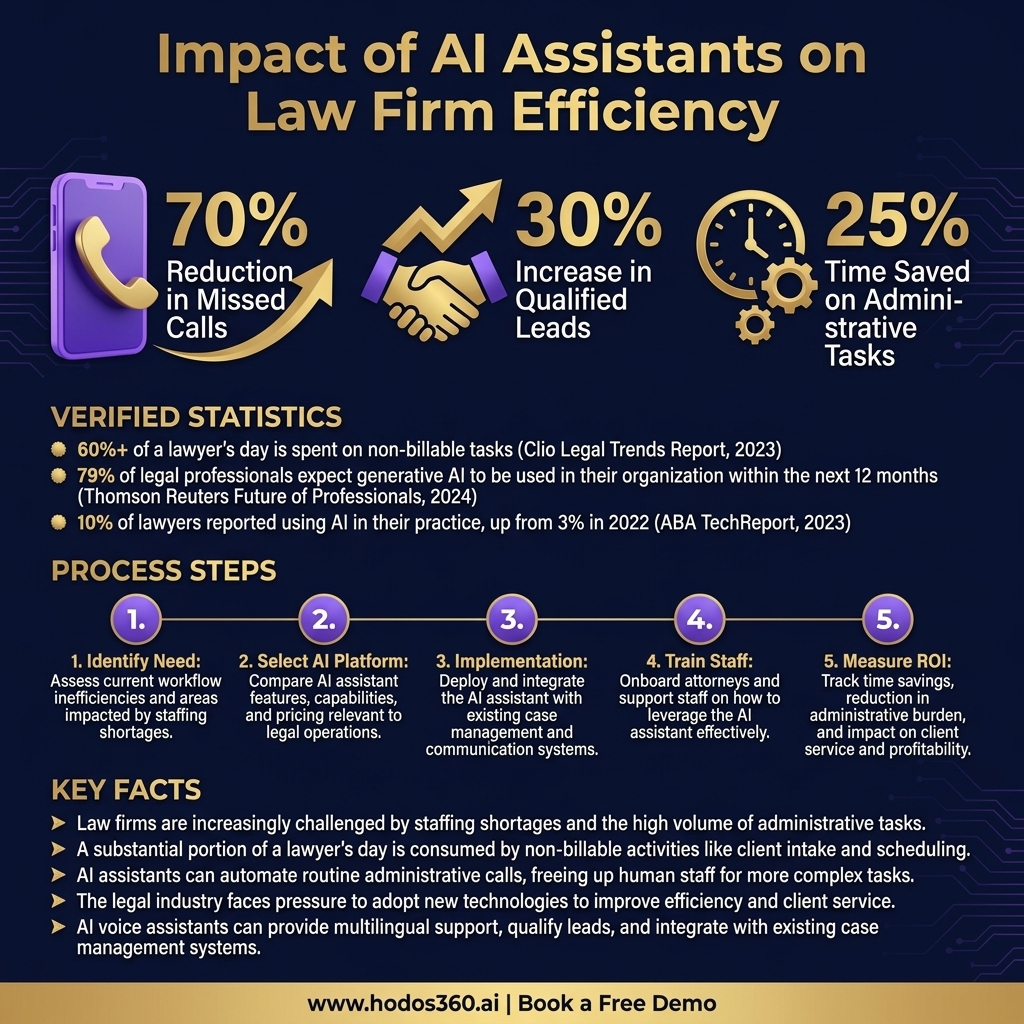
For example, a legal assistant who spent hours scheduling appointments can now dedicate that time to deeper client engagement or assisting attorneys with complex legal research. This shift requires re-skilling and up-skilling initiatives, where firms invest in training their existing staff to leverage AI tools and develop new competencies.
Successful integration strategies involve pilot programs, where a small team tests the AI assistant, provides feedback, and becomes internal champions for the technology. This iterative process allows for fine-tuning the AI's performance and demonstrating its tangible benefits before a wider rollout. Learn more about Siri AI Revolution: Essential Legal Voice Assistant Strategies.
Comprehensive training programs are essential, not just on how to use the AI, but on understanding its role within the firm's ecosystem. Lawyers and staff need to understand how the AI complements their work, improves client satisfaction, and contributes to the firm's overall success. Firms that actively involve their staff in the adoption process, soliciting their input and addressing their concerns, are far more likely to achieve successful integration and maximize the benefits of their AI investment.
This human-centric approach to technological adoption transforms potential resistance into enthusiastic collaboration.
Real-World Impact: Law Firms Embracing AI for Growth
The anecdotal evidence of AI's transformative power is rapidly converting into quantifiable results for law firms willing to embrace innovation. Consider the journey of 'Innovate Legal,' a mid-sized personal injury firm in Texas that, facing chronic 'staffing shortages' in its administrative department, implemented an AI voice assistant for client intake and initial lead qualification.
Prior to AI, their missed call rate during peak hours and after-hours was nearly 40%, translating directly into lost prospective clients. Within six months of deploying the AI assistant, their missed call rate dropped to under 5%, and their lead conversion rate increased by 20% due to the immediate, professional handling of inquiries.
This wasn't achieved by hiring more staff, but by intelligently automating the initial client touchpoints. This firm's experience echoes the broader trend of legal tech adoption, where platforms like Clio, with its acquisitions like Lawmatics (a client intake and CRM platform), continuously enhance the ability of firms to manage their client lifecycle more effectively and efficiently.
Another example is 'Global Law Partners,' an international corporate firm that leveraged an AI assistant for multilingual client support across its European and Asian offices. By providing 24/7 assistance in multiple languages, the firm not only improved client satisfaction but also significantly expanded its global reach without the prohibitive costs of maintaining a round-the-clock, multilingual human call center.
The AI handled routine inquiries about international regulations, appointment scheduling, and document submission requirements, freeing up highly specialized paralegals and attorneys to focus on complex cross-border transactions. This strategic deployment allowed Global Law Partners to gain a significant competitive edge in a highly competitive global market, demonstrating how AI can be a catalyst for both operational efficiency and strategic growth.
These real-world applications underscore a critical divergence within the legal industry. Learn more about Legal AI Adoption: An Essential Roadmap for Law Firms. Firms that proactively adopt and integrate AI assistant technologies are not just solving immediate 'staffing shortages'; they are fundamentally reshaping their operational models for sustainable growth and enhanced client service.
They are able to offer 24/7 responsiveness, handle higher volumes of inquiries, and ensure consistent, high-quality initial client interactions. In contrast, firms that resist this technological evolution risk falling behind, struggling with the same administrative burdens and staffing challenges that have plagued the industry for years.
The competitive landscape is increasingly defined by technological agility, where early adopters are reaping tangible benefits in client acquisition, retention, and overall profitability.
Jensen Huang, CEO of NVIDIA, often emphasizes that AI is not just about computing power but about intelligent automation that empowers every industry.
His vision applies directly to law: by automating administrative tasks, legal professionals are empowered to focus on the unique human elements of law—strategy, advocacy, and empathy. The firms embracing this philosophy are seeing not just incremental improvements, but transformative shifts in their business models. They are attracting top talent who prefer to work on challenging legal issues rather than repetitive administrative chores, creating a positive feedback loop of innovation and success.
The impact of these AI solutions extends beyond the individual firm, contributing to a more efficient and accessible legal system overall, benefiting both practitioners and the public seeking legal assistance.
The Competitive Edge: How Early Adopters Gain an Advantage
In today's fiercely competitive legal market, an AI assistant offers more than just operational efficiency; it provides a distinct competitive advantage. Firms that are early adopters can differentiate themselves by offering superior client service, characterized by instant responsiveness and seamless communication. Imagine a prospective client contacting several firms, and one offers immediate, intelligent assistance 24/7, while others redirect to voicemail or a human who is busy.
The firm with the AI assistant is far more likely to capture that lead. This enhanced client experience translates directly into higher client acquisition rates and stronger client loyalty, critical factors for sustained growth.
Moreover, the ability to automate routine administrative tasks allows firms to reallocate their most valuable human capital—their lawyers and highly skilled support staff—to higher-value, billable work.
This not only increases profitability but also makes the firm a more attractive place to work, helping to mitigate 'staffing shortages' by improving retention and attracting new talent. Legal professionals, particularly younger generations, are increasingly drawn to firms that leverage technology to create a more efficient and intellectually stimulating work environment.
By embracing AI, firms demonstrate a commitment to innovation, efficiency, and forward-thinking, positioning themselves as leaders in the evolving legal landscape and securing their future success.

Key Takeaways and Next Steps
The narrative of La Vergne considering an AI assistant to address being 'short staffed' is a microcosm of a broader, industry-wide challenge, one that law firms are uniquely positioned to overcome with intelligent automation. The legal sector's pervasive administrative burdens and persistent staffing shortages are not insurmountable; rather, they are opportunities for strategic innovation.
By embracing advanced AI voice assistants, law firms can transform their operational models, moving from reactive problem-solving to proactive, client-centric service delivery. This shift is about more than just technology; it's about redefining efficiency, enhancing client satisfaction, and empowering legal professionals to focus on the core mission of law.
The future of legal support is one where AI acts as an indispensable partner, handling the volume and velocity of administrative tasks while human expertise is elevated to strategic, complex problem-solving. Platforms like HODOS 360 are at the forefront of this transformation, offering integrated AI solutions that go beyond voice assistants to encompass comprehensive law firm management, marketing, and web development.
This holistic approach ensures that firms can leverage AI not just to address specific pain points like staffing shortages, but to optimize every facet of their operation. The time for law firms to strategically adopt AI is now, securing a competitive edge and building a more resilient, efficient, and client-focused practice for the future.
Take the next step towards a more efficient and client-centric future. Explore HODOS 360’s AI Voice Assistants and integrated legal tech solutions today.
Frequently Asked Questions
What specifically can an AI assistant do for a law firm?+
An AI assistant can automate client intake, answer frequently asked questions, qualify leads, schedule appointments, provide multilingual support, and route calls intelligently. It handles routine administrative communications 24/7, freeing up human staff for more complex legal work and ensuring no client inquiry is missed, directly addressing staffing shortages.
How do AI assistants help with law firm staffing shortages?+
By automating repetitive administrative tasks such as answering calls, qualifying leads, and scheduling, AI assistants significantly reduce the workload on human staff. This allows existing employees to focus on higher-value tasks, improves overall efficiency, reduces burnout, and effectively expands the firm's capacity without needing to hire more personnel.
Are AI voice assistants compliant with legal ethics and confidentiality?+
Reputable AI voice assistants for law firms are designed with robust security and privacy protocols to ensure compliance with legal ethics, including confidentiality (ABA Model Rule 1.6). Firms must choose providers that prioritize data security, transparency, and ensure the AI is properly configured and supervised to meet professional obligations, such as the duty of competence (ABA Model Rule 1.1).
What is the return on investment (ROI) for implementing an AI assistant?+
The ROI for an AI assistant can be substantial. Firms often see a reduction in missed calls, an increase in qualified leads, improved client satisfaction, and significant time savings for administrative staff and attorneys. These benefits translate into higher revenue, reduced operational costs, and a stronger competitive position in the market.
How difficult is it to integrate an AI assistant with existing law firm software?+
Modern AI assistants are designed for seamless integration with popular law firm software, including case management systems, CRM platforms, and calendaring tools. Providers typically offer API integrations and support to ensure smooth data flow and minimal disruption to existing workflows. The initial setup requires planning but is generally straightforward with expert guidance.