
AI App Builders: Ultimate Guide for Law Firm Innovation
The legal industry, often perceived as resistant to rapid technological shifts, is currently undergoing a profound transformation, propelled by the advent of artificial intelligence. For years, law firms have grappled with the limitations of off-the-shelf software, struggling to adapt generic tools to their highly specialized and nuanced workflows.
This challenge has fueled a demand for more agile, customizable solutions, a void now being filled by cutting-edge AI app builders. Imagine a scenario like that faced by "LexCorp Legal," a mid-sized firm in Chicago, which, despite a robust client base, found itself losing ground to more tech-forward competitors.
Their rival, "Innovate Law," had recently unveiled a custom client portal, built with AI, that offered real-time case updates, secure document exchange, and even AI-powered initial query responses – a stark contrast to LexCorp's clunky email and phone-based communication. This growing disparity, highlighted by the recent AIMultiple article "Top 10 AI App Builders: Lovable, Cursor & v0," underscores a critical shift: the future of legal practice isn't just about adopting AI, but about building with it.
This burgeoning ecosystem of AI app builders represents a paradigm shift, empowering law firms to move beyond mere adaptation and into the realm of creation. No longer are bespoke applications the exclusive domain of large enterprises with vast IT budgets. Platforms like Lovable, Cursor, and v0 by Vercel are democratizing development, offering intuitive interfaces and AI-driven assistance that enable legal professionals, or their dedicated tech teams, to craft tailor-made solutions.
From automating complex document workflows and client intake processes to designing sophisticated internal management tools and interactive client portals, these builders are the digital architects of the modern law firm. This guide delves into how these innovative tools are not just enhancing efficiency but are fundamentally reshaping the competitive landscape, offering a tangible path for firms to innovate, streamline operations, and deliver unparalleled client service in an increasingly digital world.
Discover how your firm can leverage this transformative technology.
Ready to transform your firm's digital capabilities? Explore how HODOS 360’s Web & Mobile Development services can bring your custom AI app vision to life.
The Transformative Power of AI App Builders in Legal Practice
The legal sector, historically cautious, is now confronted with an undeniable mandate for digital innovation. The pressure isn't just external, driven by tech-savvy clients and competitive market forces, but internal, from attorneys and staff demanding more efficient, intuitive tools. Traditional legal practice management software, while foundational, often falls short in addressing highly specific, nuanced firm requirements.
For instance, a boutique intellectual property firm might need a specialized database to track patent filings across multiple jurisdictions, a feature not readily available in generic platforms. Learn more about AI Marketing: The Ultimate Guide to Law Firm Growth & Automation. This is where AI app builders emerge as game-changers, offering the flexibility to create precisely such custom solutions.
According to the 2023 ABA TechReport, over 50% of law firms anticipate increased investment in AI technologies, signaling a clear recognition of its potential to revolutionize development and operational efficiency. Firms that embrace these builders are not just adopting technology; they are actively shaping their digital future, moving from consumers of software to creators of bespoke legal applications.
The true power of these AI app builders lies in their ability to democratize sophisticated technology. Gone are the days when building a custom application required a team of highly specialized software engineers and a budget stretching into six or seven figures. Modern builders like Lovable are designed with user-friendliness at their core, often leveraging low-code or no-code interfaces enhanced by AI.
This means legal professionals, or at least those with a foundational understanding of their firm's operational needs, can participate directly in the design and development process. Learn more about Agentic Marketing: The Ultimate Guide for Law Firms. Consider the firm of "Sterling & Associates," who, after years of struggling with a fragmented client intake system, used an AI-powered builder to create a unified portal that automatically routes inquiries, conducts initial lead qualification, and even drafts preliminary engagement letters.
This shift has not only slashed intake times by 30% but also significantly improved client satisfaction, demonstrating a clear return on investment that generic tools could never achieve.
Moreover, the integration of generative AI within these app builders adds another layer of transformative capability. Imagine an AI app builder that not only helps structure the application's logic but also suggests code snippets, optimizes database queries, or even drafts user interface elements based on natural language prompts.
This dramatically accelerates the development cycle, allowing firms to deploy new tools and features in weeks rather than months. Learn more about AI SEO: Ultimate Content Strategy for Law Firms. Jensen Huang, CEO of NVIDIA, has frequently emphasized the democratization of AI, stating that "every company will become an AI company."
For law firms, this translates to leveraging AI to build their own internal and client-facing applications, fostering a culture of innovation that permeates every aspect of their practice. This proactive approach to development ensures that legal service delivery remains agile, responsive, and ultimately, superior.
The long-term impact of AI app builders extends beyond immediate efficiency gains. They enable firms to experiment with new service models, offer unique client experiences, and even venture into new legal niches that demand highly specialized digital tools. For instance, a firm specializing in environmental law could build an AI application to monitor regulatory changes in real-time, or a family law practice could design an empathetic, AI-guided resource portal for clients navigating complex personal situations.
Learn more about Agentic AI Unleashed: 2026's Power in Legal Work. This capability to innovate and customize is no longer a luxury but a strategic imperative. As the legal market continues to evolve, driven by technological advancements and shifting client expectations, firms that master the art of building their own AI-powered solutions will be the ones that thrive, setting new benchmarks for service excellence and operational efficiency.
Navigating the Landscape: Key AI App Builders and Their Legal Applications
The burgeoning market of AI app builders presents a diverse array of tools, each with unique strengths. Understanding these nuances is crucial for law firms seeking to invest in custom development. Platforms like Lovable, Cursor, and v0 by Vercel, highlighted in recent tech discussions, represent the vanguard of this movement.
Lovable, for instance, focuses on rapid prototyping and full-stack development from natural language, making it ideal for legal professionals who need to quickly conceptualize and deploy web applications or internal tools without extensive coding knowledge. Learn more about AI Voice Assistants: Essential for Modern Law Firms.
A law firm could leverage Lovable to build a dynamic client intake form that adapts based on user responses, or a simple internal dashboard for tracking case deadlines and team assignments, all with minimal technical overhead. Its emphasis on speed and ease of use means firms can iterate quickly, refining their applications based on real-world feedback.
Cursor, on the other hand, positions itself as an AI-first code editor, deeply integrating large language models to assist developers directly in the coding process. While requiring more technical expertise than a no-code builder, Cursor significantly boosts the productivity of legal tech teams or external development partners by suggesting code, identifying bugs, and even refactoring existing codebases.
For firms looking to build more complex internal applications—such as a specialized contract analysis tool that integrates with existing document management systems, or a predictive analytics engine for litigation outcomes—Cursor can accelerate the development cycle. Learn more about Flowise for Law Firms: Essential Guide to Visual AI Workflows.
Its ability to understand context and generate relevant code snippets based on a prompt makes it an invaluable asset for more intricate legal tech projects, offering a bridge between human ingenuity and AI-powered development.
Then there is v0 by Vercel, which specializes in generating production-ready user interfaces and components directly from text prompts. For law firms, this means quickly designing and implementing visually appealing and highly functional front-ends for client portals, legal research tools, or internal dashboards. Imagine a firm needing to revamp its client communication portal; v0 could rapidly generate a modern, responsive design with features like secure messaging, document upload, and interactive calendars, all based on a few descriptive sentences.
This capability significantly reduces the time and resources typically associated with UI/UX design and implementation, allowing firms to focus on the core legal logic of their applications. The emphasis on high-quality, production-ready output ensures that the resulting applications are not just functional but also professional and user-friendly, crucial for maintaining client trust and brand reputation.
The strategic choice among these builders often depends on a firm's internal capabilities and the complexity of the desired application. For firms with limited technical staff, no-code tools like Lovable offer an immediate entry point into custom development. For those with dedicated tech teams or a willingness to partner with specialized agencies, Cursor and v0 provide advanced capabilities for building more sophisticated, deeply integrated solutions.
The common thread, however, is the power of AI to streamline and accelerate every stage of the application development lifecycle. As Sam Altman, CEO of OpenAI, has often articulated, AI's goal is to augment human potential, not replace it. These AI app builders exemplify this philosophy, empowering legal professionals to build tools that enhance their practice, improve client service, and drive operational efficiency in ways previously unimaginable.
Lovable, Cursor, and v0: Tailoring Solutions for Legal Workflows
Each of these prominent AI app builders offers distinct advantages that can be strategically applied to specific legal workflows. Lovable, with its intuitive, natural language interface, excels at rapidly transforming ideas into functional web applications. For instance, a small firm could use Lovable to create a custom lead qualification app that guides potential clients through a series of questions, automatically assessing their needs and routing them to the appropriate attorney, significantly reducing the burden on administrative staff.
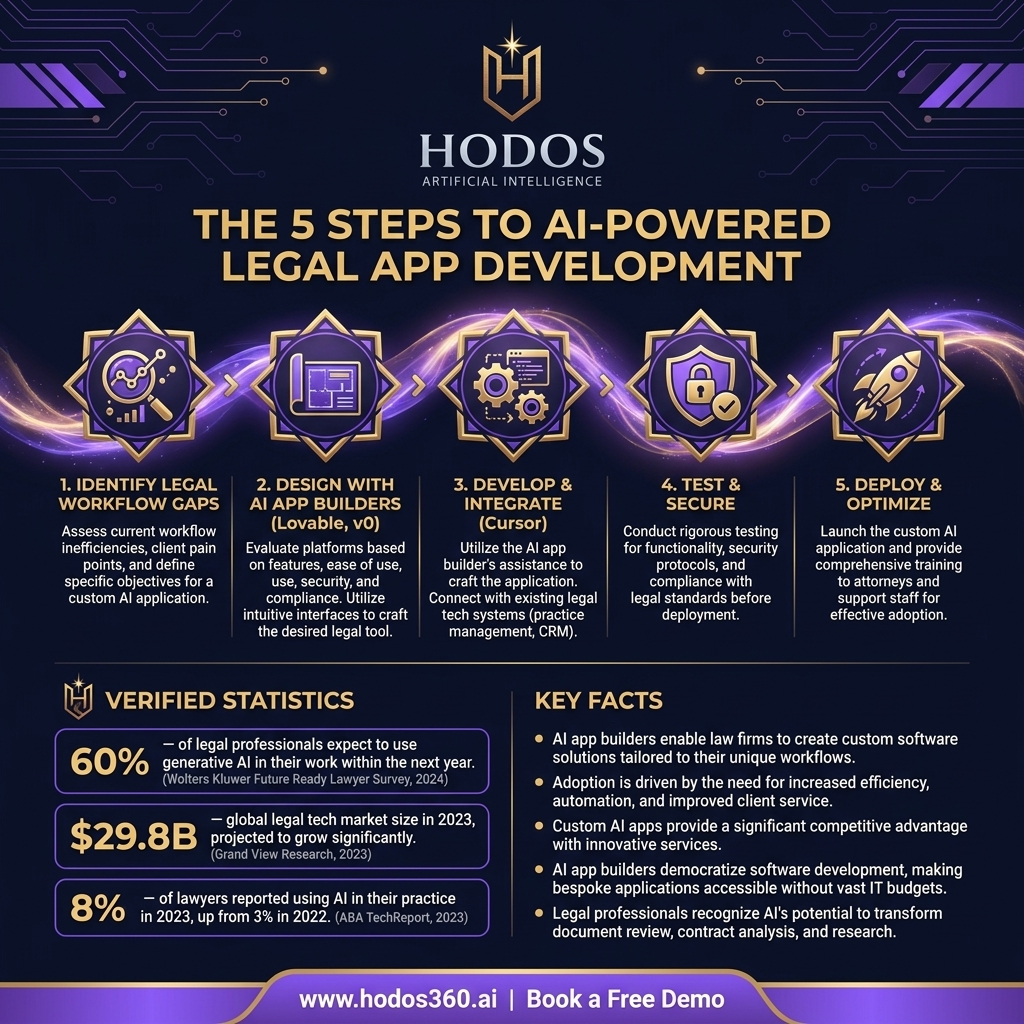
This rapid prototyping capability allows firms to test and refine solutions quickly, making it an agile tool for improving client intake and initial consultation processes. The focus on speed and simplicity makes it an accessible entry point for firms keen on quick wins in development.
Cursor, as an AI-first code editor, provides a powerful environment for legal tech developers within larger firms or for external consultants building complex, specialized tools. Consider a scenario where a firm needs to build a proprietary document review application capable of identifying specific legal clauses and anomalies across thousands of contracts.
Cursor's AI assistance can help developers write more efficient code, debug intricate logic, and integrate with existing legal databases, accelerating the creation of such a sophisticated system. Its ability to intelligently complete code and suggest improvements based on the project's context makes it invaluable for detailed, code-intensive legal development projects, ensuring accuracy and reducing development time for bespoke solutions.
V0 by Vercel, on the other hand, is a game-changer for the user experience (UX) and user interface (UI) design of legal applications. When building a client portal, the aesthetic appeal and ease of navigation are paramount for client adoption and satisfaction. V0 allows firms to generate professional, responsive UI components directly from text prompts, ensuring that custom applications not only function flawlessly but also look modern and are intuitive to use.
This means a firm can quickly design a beautiful and effective client dashboard, a secure document sharing interface, or an interactive legal resource hub, all without deep expertise in front-end coding. The synergy of these tools—Lovable for rapid deployment, Cursor for deep development, and v0 for polished design—offers a comprehensive ecosystem for law firms to tailor powerful, AI-driven solutions for every facet of their practice, from backend efficiency to client-facing engagement.
Unlock unparalleled efficiency and client satisfaction. See how HODOS 360’s AI Law Firm Management System integrates seamlessly with custom web and mobile solutions.
Strategic Implementation: Building AI-Powered Legal Applications
Implementing AI app builders effectively within a law firm requires a strategic, phased approach, far beyond simply choosing a tool. The initial step involves a thorough assessment of existing workflows to identify pain points and areas ripe for AI-driven automation or enhancement. This isn't just about digitizing current processes but reimagining them through an AI lens.
For example, many firms struggle with the manual collation of discovery documents; an AI-powered application could automate the categorization, redaction, and even initial analysis of these documents. This requires active participation from legal professionals who understand the intricacies of their work, collaborating with tech teams or external development partners.
The success hinges on clearly defined objectives and an understanding of how AI can genuinely augment legal expertise, rather than merely replacing human tasks. Ethical considerations, particularly regarding data privacy and the responsible use of AI in legal decision-making, must be paramount from the outset, aligning with principles laid out in the ABA Model Rules of Professional Conduct, specifically Rule 1.6 concerning client confidentiality.
Once needs are identified, the design phase begins, often involving iterative prototyping. This is where the power of AI app builders truly shines. Legal teams can provide natural language prompts describing desired features, and the AI can generate initial wireframes or code snippets. For instance, a prompt like "create a secure client portal with document upload, messaging, and a calendar for court dates" can rapidly yield a functional prototype.
This iterative approach allows for continuous feedback and refinement, ensuring the final application precisely meets the firm's operational and client service needs. Security is non-negotiable in legal tech development. Firms must ensure that any chosen builder and the resulting applications comply with stringent data protection regulations, such as the General Data Protection Regulation (GDPR) or the California Consumer Privacy Act (CCPA), depending on jurisdiction and client base.
This often involves robust encryption, access controls, and regular security audits, moving beyond basic functionality to encompass comprehensive data governance.
The development and testing phases demand a blend of technical prowess and legal insight. While AI app builders simplify coding, specialized legal knowledge is essential to ensure the application's logic aligns with legal requirements and best practices. For example, an AI-powered contract drafting tool must be trained on vast datasets of legally sound documents and adhere to specific jurisdictional nuances.
Beta testing with a diverse group of attorneys and staff is critical to identify usability issues, validate the application's legal accuracy, and ensure seamless integration with existing systems. Firms like Allen & Overy, known for their partnership with Harvey AI, exemplify this collaborative approach, where legal experts work hand-in-hand with AI developers to create impactful tools.
This human-in-the-loop strategy ensures that AI applications are not only technically sound but also legally robust and practically useful for the end-users—the attorneys themselves.
Finally, deployment and ongoing optimization are crucial for long-term success. Rolling out a new AI application requires careful change management, comprehensive training for staff, and a clear communication strategy for clients. Post-deployment, continuous monitoring, performance analysis, and gathering user feedback are vital for identifying areas for improvement and further development.
The legal landscape is constantly evolving, and so too must the tools that support it. AI app builders facilitate this agility, allowing firms to easily update features, integrate new AI models, and scale their applications as their needs grow. This continuous cycle of innovation ensures that the firm's AI-powered tools remain cutting-edge, contributing to sustained efficiency and a distinct competitive advantage in the legal market.
From Concept to Code: Best Practices for Legal Tech Development
Embarking on legal tech development with AI app builders requires adherence to several best practices to ensure success and mitigate risks. Firstly, user-centric design is paramount. Engage legal professionals from the outset to define clear user stories and requirements. What specific problems are they trying to solve?
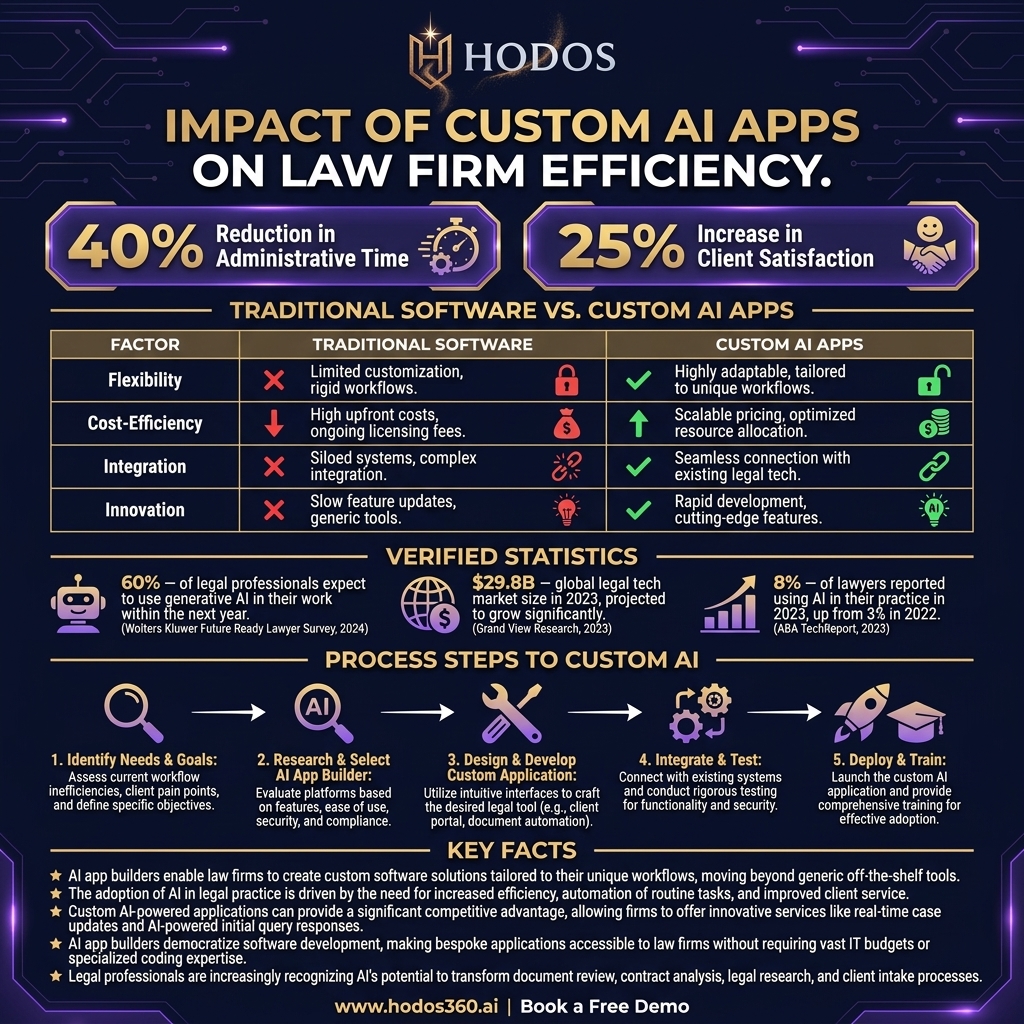
How will the application integrate into their daily workflow? This ensures the resulting tool is genuinely useful and adopted by the team. Secondly, prioritize security and compliance. Before any development begins, establish a robust data governance framework. This includes identifying sensitive client data, implementing strong encryption, and ensuring the application’s architecture complies with relevant legal and ethical standards, such as those outlined in the ABA Model Rule 1.6 on client confidentiality.
Thirdly, adopt an iterative development approach. Instead of aiming for a perfect, large-scale solution from day one, start with minimum viable products (MVPs). Use AI app builders like Lovable to quickly prototype core functionalities, gather feedback from end-users, and then refine and expand. This agility allows for faster deployment of useful tools and reduces the risk of investing heavily in solutions that don't meet actual needs.
Fourthly, leverage AI responsibly. While AI app builders offer powerful capabilities, human oversight remains critical, especially in legal contexts. Ensure that AI-generated content or decisions are always reviewed by a qualified legal professional. This "human-in-the-loop" approach is essential for maintaining accuracy, ethical standards, and accountability, particularly when dealing with client matters.
Finally, focus on integration and scalability. The new AI application should ideally integrate seamlessly with existing legal tech infrastructure, such as practice management systems, document management systems, or research tools. Consider the long-term growth of your firm and ensure the chosen AI app builders can scale with increasing data volumes and user demands.
Platforms that offer robust APIs and cloud-native architecture are generally more adaptable. By following these best practices, law firms can harness the full potential of AI app builders to create innovative, secure, and highly effective legal applications that truly transform their practice.
The Competitive Edge: How Custom AI Apps Drive Law Firm Growth
In today's fiercely competitive legal landscape, differentiation is key to sustainable growth. Firms that embrace custom AI app builders are not just keeping pace; they are actively carving out a significant competitive edge. This advantage manifests in several critical areas, primarily through vastly improved efficiency and enhanced client experiences.
Imagine a firm that can onboard new clients in minutes, automate the drafting of routine legal documents, or provide clients with 24/7 access to case updates through a bespoke mobile application. These capabilities, once the exclusive domain of large, tech-forward corporations, are now accessible to firms of all sizes thanks to the democratization of development offered by AI app builders.
A recent report by McKinsey & Company projected that generative AI could add trillions of dollars in value to the global economy, with significant productivity gains across industries, including professional services. Law firms leveraging these tools are directly tapping into this productivity dividend, translating into lower operational costs and higher profit margins.
Beyond internal efficiency, custom AI applications significantly elevate the client experience, which is increasingly a primary differentiator in the legal market. Clients today expect transparency, accessibility, and responsiveness from their legal providers, mirroring their experiences with other service industries. A custom-built client portal, perhaps developed using AI app builders like v0 for its intuitive design, can offer secure communication channels, streamlined document sharing, and real-time progress tracking, fostering greater trust and satisfaction.
This not only retains existing clients but also acts as a powerful magnet for new business. Firms that can demonstrate a commitment to leveraging innovative tools to serve their clients better stand out from competitors still reliant on outdated processes. This is the human conflict at play: firms that embrace this technological wave are perceived as modern, forward-thinking, and client-centric, while those clinging to tradition risk being left behind.
Furthermore, custom AI applications enable law firms to innovate their service offerings and explore new revenue streams. For example, a firm could design an AI-powered legal tool to offer subscription-based compliance checks for small businesses, or a specialized application that assists in complex data privacy audits, tasks that would be prohibitively time-consuming and expensive using traditional methods.
This expansion into niche, tech-enabled services not only diversifies the firm's portfolio but also positions it as a thought leader and innovator in its field. The ability to rapidly develop and deploy these new tools using AI app builders means firms can be agile in responding to market demands and emerging legal challenges.
HODOS 360, through its Web & Mobile Development services, empowers law firms to realize these ambitions, providing the expertise to build and optimize bespoke AI-powered websites and mobile applications that drive growth and secure a lasting competitive advantage.
The shift towards custom AI development also fosters a culture of innovation within the firm itself. Attorneys and staff, empowered by tools that automate mundane tasks, can dedicate more time to complex legal analysis, strategic thinking, and client engagement. This not only improves job satisfaction but also attracts top talent who are looking for technologically advanced workplaces.
The narrative arc here is clear: firms that invest in AI app builders are not just buying software; they are investing in a future where technology amplifies human legal expertise. They are moving from a reactive stance to a proactive one, using AI to predict client needs, optimize legal processes, and ultimately, redefine what it means to deliver world-class legal services.
This strategic foresight, enabled by accessible development tools, is the ultimate driver of sustained growth and market leadership.
Measuring Success: ROI and Impact of AI-Driven Web & Mobile Solutions
Measuring the return on investment (ROI) for AI-driven web and mobile solutions in a law firm extends beyond simple cost savings; it encompasses a holistic view of operational efficiency, client satisfaction, and market positioning. Quantifiable metrics include a significant reduction in administrative overhead, often seen in automating client intake, document assembly, or billing processes.
Firms can track the time saved on these tasks, translating directly into billable hours freed up for attorneys. For instance, an AI-powered client intake system could reduce the average intake time from hours to minutes, a measurable gain in efficiency. Client satisfaction scores, often gathered through surveys, can show a direct correlation with the adoption of user-friendly, responsive digital tools like a custom client portal.
Higher satisfaction leads to greater client retention and positive referrals, both critical for growth.
Beyond direct cost and client metrics, the impact on lead generation and conversion rates from web and mobile platforms is a key indicator of success. An AI-powered website, built with high-converting templates and SEO optimization provided by services like HODOS 360, can attract more qualified leads.
Tracking website traffic, conversion rates from initial inquiries to retained clients, and the effectiveness of AI-driven marketing content provides clear data on the tools’ impact on business development. Furthermore, the strategic value of being perceived as an innovative, tech-forward firm cannot be overstated. While harder to quantify immediately, this reputation attracts top talent and high-value clients, contributing to long-term growth and market share.
Firms should establish clear KPIs (Key Performance Indicators) before development begins, allowing for continuous monitoring and a clear demonstration of the tangible benefits derived from their investment in AI app builders and custom digital solutions.

Key Takeaways and Next Steps for Legal Professionals
The legal profession stands at a pivotal juncture, where the strategic adoption of AI app builders is no longer a futuristic concept but an immediate imperative for firms seeking to remain competitive and relevant. The insights gleaned from the evolution of tools like Lovable, Cursor, and v0 underscore a fundamental truth: the capacity to build, adapt, and innovate with AI is becoming as crucial as legal acumen itself.
Firms that embrace these builders are not just streamlining operations; they are fundamentally reshaping their service delivery models, enhancing client engagement, and unlocking unprecedented levels of efficiency. The competitive landscape is being redrawn, favoring those who are proactive in leveraging AI to create bespoke solutions that address their unique challenges and client needs.
For law firm owners and legal professionals, the next steps are clear and actionable. First, conduct an internal audit to identify specific workflows that are ripe for AI-powered automation or enhancement. Prioritize areas where efficiency gains can have the most significant impact on profitability and client satisfaction.
Second, explore the diverse ecosystem of AI app builders, considering their ease of use, integration capabilities, security features, and suitability for your firm's technical expertise and budget. Don't be afraid to experiment with different tools through pilot projects. Third, foster a culture of innovation within your firm, encouraging attorneys and staff to actively participate in the design and development of new AI applications.
Finally, consider partnering with experts who specialize in legal tech development and AI integration, such as HODOS 360's Web & Mobile Development services. Leveraging external expertise can accelerate your firm's journey, ensuring that your custom AI-powered websites and mobile applications are not only cutting-edge but also secure, compliant, and perfectly tailored to propel your firm into a future defined by intelligent legal practice.
Frequently Asked Questions
What exactly are AI app builders and how do they differ from traditional software development?+
AI app builders are platforms that leverage artificial intelligence, often including generative AI and machine learning, to assist in the creation of applications. Unlike traditional software development which requires extensive coding, these tools can generate code, design interfaces, and automate workflows from natural language prompts or low-code interfaces, significantly accelerating the process and making custom solutions more accessible to non-developers.
How can law firms ensure data security and compliance when using AI app builders?+
Data security and compliance are paramount. Firms must choose AI app builders with robust security features, including encryption, access controls, and compliance certifications (e.g., ISO 27001). It's crucial to understand the builder's data handling policies, ensure local data storage options if needed, and conduct regular security audits of both the platform and the custom applications developed, adhering strictly to regulations like GDPR or CCPA.
What kind of applications can law firms build using these AI tools?+
Law firms can build a wide range of applications. This includes custom client intake portals, automated document assembly tools, internal knowledge management systems, case management dashboards, legal research assistants, compliance monitoring applications, and secure client communication platforms. The flexibility of AI app builders allows for highly specialized development to address unique firm needs.
Is technical expertise required to use AI app builders like Lovable or v0?+
The level of technical expertise varies. Many AI app builders, such as Lovable, are designed with low-code or no-code interfaces, making them accessible to legal professionals with minimal coding experience. Others, like Cursor, are AI-powered code editors that augment experienced developers. For advanced or complex projects, partnering with legal tech development specialists is often recommended to maximize the tools' potential.
What is the typical ROI for law firms investing in custom AI-powered applications?+
The ROI from custom AI-powered applications for law firms can be substantial. It often includes significant reductions in operational costs through automation, increased efficiency in legal workflows, improved client satisfaction and retention, and enhanced lead generation from superior digital platforms. While specific figures vary, firms often report gains in productivity, faster case resolution times, and a stronger competitive position in the market.