


AI Back Office: The Ultimate Guide for Law Firms
Just last month, Sarah Chen, a managing partner at a mid-sized litigation firm in Dallas, found herself staring at another overflowing inbox, a pile of unfiled client documents, and a calendar booked solid with administrative tasks rather than client consultations. Her firm, 'Chen & Associates,' was grappling with the perennial challenge facing countless legal practices: how to scale operations and improve client service without exponentially increasing overhead. This isn't an isolated incident; it's a common narrative across the legal sector, a sector historically characterized by its manual, labor-intensive back-office processes.
The recent buzz around startups like Lawdie, highlighted by Legal IT Insider's 'Startup Corner,' underscores a pivotal shift. Lawdie, an 'AI back office for law firms,' represents a growing wave of innovative legal tech companies dedicated to eradicating these operational bottlenecks. These new platforms are not just about automating simple tasks; they are about reimagining the entire operational backbone of a law firm, from client intake and billing to document generation and sophisticated case management. This evolution promises to transform the daily realities of legal professionals, moving them from rote administrative work to strategic legal counsel.
For law firm owners and attorneys, understanding the capabilities and strategic implications of an AI back office for law firms is no longer optional—it's essential for competitive survival and growth. This comprehensive guide will delve into how these advanced AI tools are reshaping law firm management, enhancing operational efficiency, and ultimately redefining what it means to run a modern legal practice. The goal is to move beyond mere automation to truly intelligent legal operations that drive profitability and elevate client satisfaction. We will explore the core features, real-world impacts, and crucial considerations for firms looking to integrate this transformative technology.
### Table of Contents 1. The Rise of AI Back Office Solutions: A New Era for Legal Operations 2. Beyond Automation: Core Capabilities of AI-Powered Law Firm Management 3. Navigating the Legal Tech Landscape: Key Players and Strategic Adoption 4. Learn more about AI Design Tools: Ultimate Guide to Web & Mobile Transformation. The Tangible Impact: ROI, Efficiency, and Client Satisfaction 5. Key Takeaways and Next Steps
The Rise of AI Back Office Solutions: A New Era for Legal Operations
For decades, the legal industry's back office has been a labyrinth of manual processes, often seen as a necessary evil rather than a strategic asset. From time-consuming client onboarding paperwork to complex billing cycles and document management, these administrative burdens have historically consumed a significant portion of a firm's resources and lawyer time. The traditional model, relying heavily on human input for repetitive tasks, has been inherently inefficient, prone to errors, and a major drain on profitability. This operational drag meant that lawyers, whose expertise commands high fees, were often mired in tasks that offered little to no direct legal value to their clients.
The advent of sophisticated AI technologies is now fundamentally disrupting this status quo. Startups like Lawdie are at the forefront, building comprehensive AI back office for law firms that move beyond simple task automation. As the Legal IT Insider article highlighted, these platforms are designed to manage everything from 'billing and matter management to document generation and file routing' with intelligent algorithms. This isn't just about digitizing existing processes; it's about introducing predictive capabilities, machine learning-driven insights, and autonomous workflows that actively optimize operations, reducing the need for constant human oversight and intervention. These AI tools are learning from vast datasets of legal operations, identifying patterns, and suggesting improvements that were previously impossible to discern manually.
Legal tech leaders have long envisioned this transformation. Learn more about Essential AI Legal Adoption: Akin's Firmwide Success Blueprint. Jack Newton, CEO of Clio, has consistently advocated for an 'operating system for law firms' that integrates all core functions, and AI is the missing link making this vision a reality. He often emphasizes that the future of legal practice lies in leveraging technology to create more efficient, client-centered experiences. According to the Thomson Reuters 2024 State of the Legal Market Report, a significant portion of law firms (over 40%) are actively exploring or implementing AI solutions specifically to enhance operational efficiency and improve client service delivery. This data underscores a critical shift: AI is no longer a futuristic concept but a present necessity for competitive law firm management.
This new era of legal tech solutions, driven by advanced AI, promises to free lawyers from the administrative grind. By intelligently automating and optimizing core back-office functions, firms can reallocate valuable human capital towards strategic legal work, client development, and complex problem-solving. The goal is to transform the back office from a cost center into an engine of efficiency and strategic advantage, enabling firms to deliver higher quality legal services at a more competitive cost, ultimately enhancing both their bottom line and their reputation in a crowded market.
Beyond Automation: Core Capabilities of AI-Powered Law Firm Management
The true power of an AI back office for law firms lies in its ability to integrate and intelligently manage a wide array of operational tasks, transforming them from fragmented, manual processes into seamless, interconnected AI workflows. This goes far beyond the basic automation of repetitive tasks; it involves AI-driven learning, prediction, and optimization across the entire practice. For instance, platforms are now capable of not just generating a document but understanding its context, suggesting relevant clauses based on past cases, and routing it for appropriate approvals, all while ensuring compliance with internal and external regulations. This holistic approach to legal operations management is what sets modern AI solutions apart.
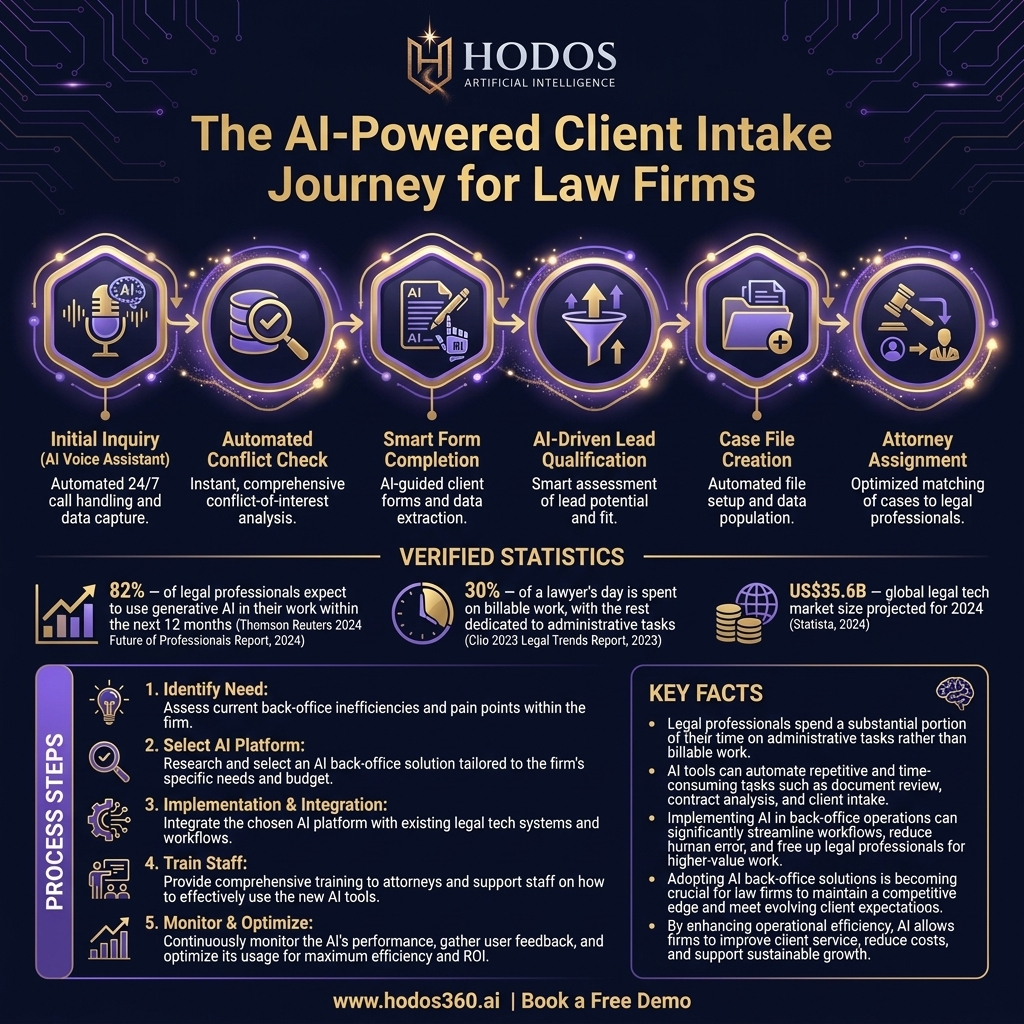
### Streamlining Client Intake and Case Management One of the most immediate and impactful areas for AI is client intake. Traditionally, this process is fraught with manual data entry, conflict checks, and initial client qualification, often leading to delays and missed opportunities. AI-powered systems can automate the entire intake journey, from initial lead capture through AI voice assistants that qualify potential clients 24/7, to automated form completion and intelligent conflict-of-interest checks against vast internal and external databases. For example, HODOS 360's AI Law Firm Management System integrates these functionalities, ensuring that new clients are onboarded swiftly and accurately, freeing up paralegals and attorneys from tedious administrative burdens. This not only enhances efficiency but also significantly improves the client's first impression of the firm, setting a professional and technologically advanced tone.
Beyond intake, AI revolutionizes case management. Instead of manually assigning tasks or tracking deadlines, AI-powered systems can intelligently route documents, assign tasks to the most suitable team members based on their workload and expertise, and provide proactive alerts for critical deadlines. AI can analyze historical case data to offer predictive insights into case timelines and potential outcomes, helping firms manage client expectations and allocate resources more effectively. Learn more about AI Voice Calls: Ultimate Efficiency for Law Firms. This level of intelligent practice management software transforms reactive management into a proactive, data-driven strategy, ensuring no detail is overlooked and every case progresses optimally.
### Data-Driven Decision Making and Predictive Analytics Perhaps the most transformative aspect of an AI back office for law firms is its capacity for advanced data analysis and predictive analytics. These systems aggregate vast amounts of operational data – from billing hours and case outcomes to client satisfaction scores and marketing ROI. By applying machine learning algorithms, the AI can identify patterns, uncover inefficiencies, and provide actionable insights that human analysis might miss. For example, a firm can use AI to identify which types of cases are most profitable, which clients have the highest retention rates, or where resource allocation is suboptimal. Firms like Allen & Overy, known for their partnership with Harvey AI for sophisticated contract analysis, are now extending this data-driven approach to their internal operations, gaining a competitive edge.
The impact of this data-driven approach is profound. It enables firm leaders to make informed strategic decisions about everything from staffing and marketing investments to fee structures and niche practice area development. According to the ABA Legal Technology Survey Report, firms utilizing advanced analytics reported significant improvements in resource allocation and overall profitability. This shift empowers firms to move away from guesswork and towards evidence-based strategies, ensuring sustainable growth and resilience in a rapidly changing legal landscape. This predictive capability is a game-changer, allowing firms to anticipate future needs and challenges rather than merely reacting to them.
- ✓AI-Powered Legal Workflows: Automates complex, multi-step legal processes from start to finish, learning and optimizing with each iteration.
- ✓Automated Billing & Expense Tracking: Intelligently captures billable hours, categorizes expenses, and generates invoices, reducing manual errors and improving cash flow.
- ✓Intelligent Document Assembly & Management: Creates, reviews, and organizes legal documents with AI, ensuring accuracy, compliance, and easy retrieval.
- ✓Predictive Resource Allocation: Analyzes workload, lawyer expertise, and project timelines to optimally assign tasks and manage team capacity.
- ✓Compliance Monitoring & Risk Management: Proactively identifies potential compliance issues and flags risks within operations or client matters, reducing exposure.
- ✓Enhanced Security Protocols: Utilizes AI to detect and prevent data breaches, ensuring client confidentiality and data integrity across all systems.
- ✓Client Relationship Management (CRM) Integration: Seamlessly connects operational data with client interactions, providing a 360-degree view of client relationships and improving service.
Ready to transform your firm's operations with cutting-edge AI? Discover how an integrated AI back office can streamline your practice and empower your team. Book a Free Demo with HODOS 360 Today!
Navigating the Legal Tech Landscape: Key Players and Strategic Adoption
The legal tech landscape, particularly concerning the AI back office for law firms, is a vibrant and rapidly evolving ecosystem. On one side, established practice management software providers like Clio, MyCase, and PracticePanther are aggressively integrating advanced AI capabilities into their existing platforms, leveraging their extensive user bases and data. Clio, for instance, has been steadily acquiring companies to enhance its offerings, demonstrating a commitment to comprehensive AI integration. On the other side, a new generation of legal startups is emerging, hyper-focused on specific AI applications that redefine traditional legal tasks, as exemplified by Lawdie's specialized approach to back-office automation.
This dynamic environment is fueled by significant investment and technological breakthroughs. We've seen massive funding rounds for foundational AI companies like OpenAI, whose large language models underpin many legal AI tools, and specialized legal AI firms like Harvey AI, which secured substantial backing for its generative AI legal assistant. Perhaps the most telling indicator of market consolidation and validation was Thomson Reuters' acquisition of Casetext for approximately $500 million in 2023. This move signals that major legal information providers recognize the immense value and strategic imperative of integrating sophisticated AI into their core offerings, further legitimizing the market for advanced AI tools in legal practice.
For law firms, navigating this landscape presents a strategic dilemma: should they 'build' their own custom AI solutions, 'buy' off-the-shelf products, or opt for a hybrid approach? As Brad Blickstein of the Blickstein Group often points out, firms need to carefully assess their unique needs, existing infrastructure, and risk tolerance. Learn more about Interactions API: Essential Gemini Interface for Legal Tech. While larger firms with significant R&D budgets might explore custom builds or partnerships, most small to mid-sized firms will find greater value in adopting proven, integrated platforms that offer comprehensive AI law firm management. The key is to select solutions that are not only powerful but also user-friendly, secure, and adaptable to the firm's specific workflows and client demands.
Strategic adoption also involves a phased approach. Rather than attempting a wholesale overhaul, firms can identify specific pain points within their back office – such as inefficient document automation or cumbersome client intake processes – and implement AI solutions to address those first. This iterative approach allows firms to gradually integrate AI, measure its impact, and build internal expertise and confidence. It's crucial to remember that technology alone isn't a silver bullet; successful implementation requires a clear strategy, robust change management, and continuous training for lawyers and staff to fully leverage the power of these transformative legal tech solutions.
The Tangible Impact: ROI, Efficiency, and Client Satisfaction
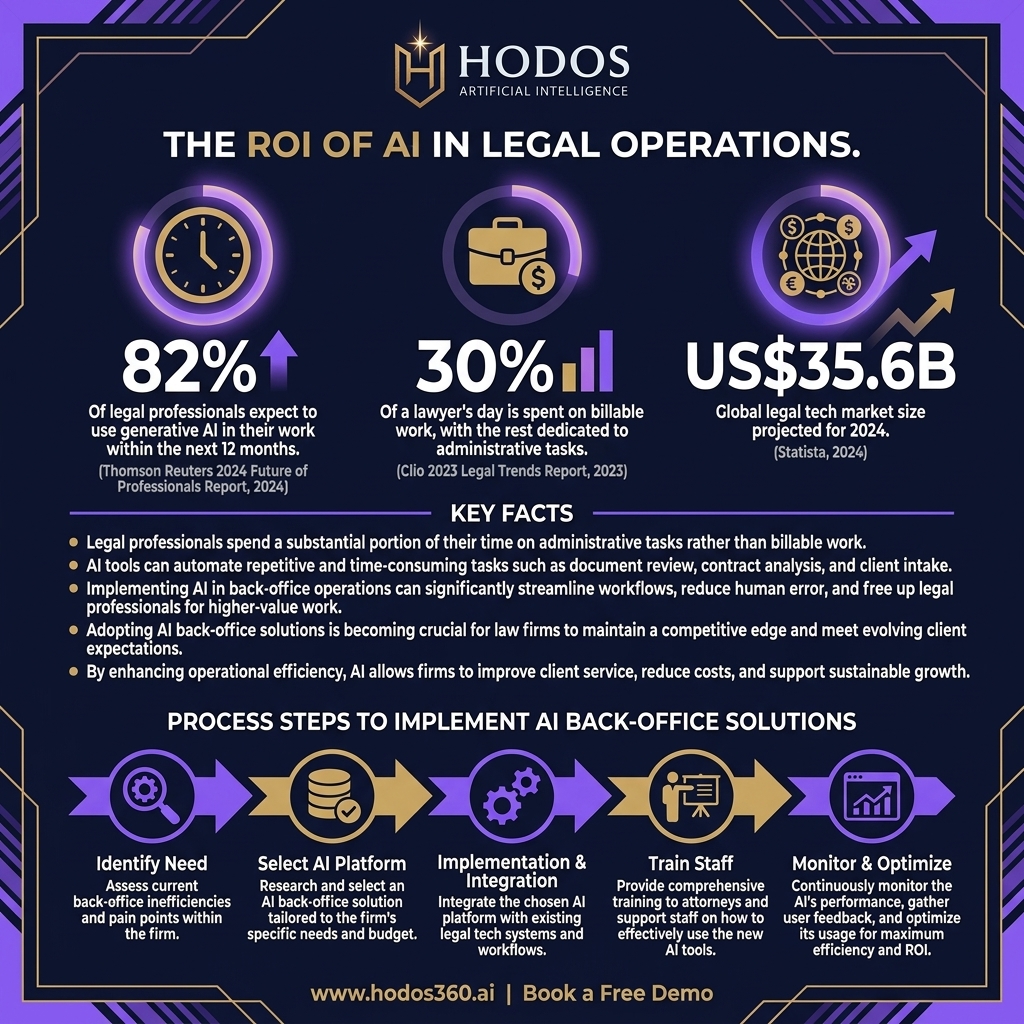
The adoption of an AI back office for law firms is not merely about staying current with legal tech trends; it's about realizing tangible benefits that directly impact a firm's bottom line and competitive standing. The return on investment (ROI) from these AI tools can be substantial, primarily driven by dramatic increases in operational efficiency and a significant reduction in administrative overhead. For example, a McKinsey Global Institute report on AI's impact on productivity suggests that industries adopting AI can see productivity gains of 1.4% annually, with legal services being a prime candidate for such improvements due to the high volume of structured data and repetitive tasks. This translates into more billable hours for lawyers, lower operating costs, and ultimately, higher profit margins for the firm.
Beyond financial metrics, AI frees legal professionals from the mundane. By automating tasks like scheduling, initial client communication, and document review, AI allows lawyers and paralegals to dedicate more time to complex legal analysis, strategic planning, and direct client engagement – the high-value work that truly leverages their expertise and education. This shift not only improves individual job satisfaction but also enhances the overall quality of legal services provided. Firms like Seyfarth Shaw, known for their early adoption of process improvement and technology, have demonstrated how streamlining operations allows their legal teams to focus on delivering superior client outcomes, not just processing paperwork.
Ultimately, the client experience is profoundly enhanced. With an AI back office for law firms, clients benefit from faster response times, more transparent communication, and more efficient case progression. Automated client intake, for instance, means less waiting and a smoother onboarding process. Predictive analytics can provide more accurate timelines and cost estimates, fostering greater trust and satisfaction. Learn more about AI Legal Page Generators: The Ultimate Guide for Firms. In a market where client expectations for responsiveness and efficiency are continually rising, firms that leverage AI to deliver superior service will undoubtedly gain a significant competitive advantage. This focus on client satisfaction is a critical differentiator in today's legal market, and AI plays a crucial role in achieving it.
### Addressing Ethical Concerns and Data Security While the benefits of an AI back office for law firms are clear, it's imperative to address the ethical considerations and data security challenges inherent in using advanced AI tools with sensitive client information. The ABA Model Rules of Professional Conduct provide a framework, particularly Rule 1.1 (Competence), which requires lawyers to stay abreast of the benefits and risks associated with relevant technology, and Rule 1.6 (Confidentiality of Information), which mandates protecting client data. Firms must ensure that any AI solution they adopt is compliant with these rules and incorporates robust security measures to protect against data breaches and unauthorized access.
Implementing AI also necessitates strict adherence to data privacy regulations such as GDPR and CCPA, depending on jurisdiction. Law firms are custodians of highly sensitive information, making data security paramount. Reputable AI providers in legal tech understand these stringent requirements and build their platforms with enterprise-grade security, encryption, and compliance features. However, firms also bear the responsibility of due diligence, ensuring their AI partners meet these standards and establishing internal protocols for AI use, including human oversight of AI-generated content and decisions. The goal is to harness AI's power responsibly, maintaining client trust and upholding professional obligations.

Key Takeaways and Next Steps
The emergence of the AI back office for law firms marks a transformative moment in the legal industry. It's a shift from merely automating individual tasks to creating intelligent, interconnected AI workflows that redefine law firm management. From streamlining client intake with AI voice assistants and enhancing document automation to providing data-driven insights for strategic decision-making, these AI tools are proving to be indispensable for firms aiming for sustained growth and competitive advantage. The narrative of firms like Sarah Chen's, once bogged down by administrative overhead, is now being rewritten by the power of smart legal tech.
For law firm owners and managing partners, the message is clear: embracing AI is no longer a luxury but a strategic imperative. The competitive landscape is rapidly evolving, with early adopters already reaping significant benefits in terms of operational efficiency, profitability, and client satisfaction. Ignoring this trend risks falling behind. Learn more about AI Marketing: The Ultimate Guide for Law Firms. The critical next step is not just to observe but to actively engage with the technology, understanding its potential to revolutionize your firm's legal operations.
To begin your journey, consider identifying key pain points within your current back-office processes. Research reputable providers offering comprehensive AI law firm management solutions, ensuring they align with your firm's specific needs and ethical obligations. Invest in training your lawyers and staff to maximize the utility of these new AI tools, fostering a culture of innovation and continuous improvement. The future of legal practice is here, powered by AI, and firms that strategically adopt these solutions will be the ones that thrive. Explore how an integrated platform can elevate your practice and prepare you for the challenges and opportunities ahead.
Unlock unparalleled efficiency and strategic growth for your law firm. Explore HODOS 360's comprehensive AI solutions. Schedule a personalized consultation today!
Frequently Asked Questions
What specifically does an AI back office do for a law firm?+
An AI back office automates and optimizes core administrative functions like client intake, billing, document generation, case management, and compliance checks. It uses AI to learn from data, predict outcomes, and provide insights, moving beyond simple automation to intelligent workflow management. This frees up lawyers to focus on high-value legal work, improving efficiency and reducing operational costs significantly.
How does AI improve client intake and satisfaction?+
AI streamlines client intake by automating forms, performing conflict checks instantly, and using AI voice assistants for 24/7 lead qualification and appointment booking. This reduces client waiting times and manual errors, creating a smoother, more professional onboarding experience. Clients benefit from quicker responses, transparent processes, and ultimately, more focused attention from their legal team, boosting overall satisfaction.
Are AI back office solutions secure and ethically compliant?+
Reputable AI back office solutions are built with enterprise-grade security, including advanced encryption and compliance features to protect sensitive client data. Ethically, law firms must ensure their chosen AI tools adhere to ABA Model Rules, particularly regarding competence and confidentiality. Human oversight remains crucial, and firms must perform due diligence on providers and establish internal protocols for responsible AI use.
What kind of ROI can a law firm expect from adopting AI back office tools?+
Law firms can expect substantial ROI primarily through increased operational efficiency, reduced administrative costs, and improved billable hours. AI automates repetitive tasks, allowing lawyers to focus on higher-value work. This leads to higher profit margins, faster case progression, and enhanced client satisfaction, which can attract new business and improve client retention. Productivity gains can be significant, as evidenced by industry reports.
How does an AI back office help with data-driven decision making?+
An AI back office aggregates and analyzes vast amounts of operational data, identifying patterns and insights that inform strategic decisions. It can pinpoint profitable practice areas, optimize resource allocation, forecast case outcomes, and track marketing ROI. This empowers firm leaders to move from anecdotal evidence to data-backed strategies for growth, staffing, and financial planning, ensuring more informed and effective management.