


AI Design Tools: Ultimate Guide to Web & Mobile Transformation
The architectural world, a realm traditionally characterized by meticulous hand-drawn plans and complex CAD software, is currently undergoing a seismic shift, as evidenced by recent reports like "AI tools changing how architects design in Revit" on MSN. Visionaries such as Patrik Schumacher, principal of Zaha Hadid Architects, have long advocated for computational design, but the current wave of AI, powered by breakthroughs from companies like OpenAI and NVIDIA, is moving beyond mere automation to truly generative capabilities.
This transformation, where AI assists in conceptualization, iteration, and optimization, isn't confined to drafting tables and rendering farms; it presents a compelling parallel for the legal sector, particularly in the critical domain of web and mobile development. Law firms, often seen as bastions of tradition, are now at an inflection point where their digital presence is not just a brochure, but a dynamic, intelligent gateway to client engagement and business growth.
For too long, many law firms have relied on static, often outdated websites that fail to meet the sophisticated demands of today's digitally native clients. The legal landscape is intensely competitive, with clients increasingly expecting seamless, intuitive, and personalized online interactions. Just as architects are leveraging AI to explore different design ideas and accelerate workflows in Revit, legal professionals can harness similar AI design tools to build responsive, high-converting, and SEO-optimized web and mobile platforms.
The challenge isn't merely to have an online presence, but to cultivate a vibrant digital ecosystem that reflects the firm's expertise, values, and client-centric approach, making the journey from initial inquiry to retained client as smooth as possible.
The integration of artificial intelligence into web and mobile development is no longer a futuristic concept; it's a present-day imperative.
Firms that embrace this technological leap are not just keeping pace; they are setting new industry standards. By adopting AI-powered website building and advanced AI design tools, law firms can overcome historical hurdles of high development costs, slow deployment cycles, and suboptimal user experiences. This comprehensive guide will delve into how AI is fundamentally transforming the future of digital design for legal practices, enabling them to craft powerful online identities that attract, engage, and convert their ideal clients in an increasingly digital-first world.
The time for law firms to leverage these capabilities is already here, allowing them to explore innovative ways to connect with their audience and streamline their operations.
The Shifting Sands of Digital Presence: Beyond Static Websites
The digital landscape for law firms has evolved dramatically from the early days of simple online listings. What was once considered adequate—a basic website with attorney bios and practice areas—is now an insufficient digital footprint. Today's legal consumers, especially younger demographics, expect a sophisticated and interactive online experience that mirrors the ease and personalization they encounter with leading consumer brands.
According to the ABA Legal Technology Survey Report (2023), a significant percentage of clients begin their search for legal services online, with many valuing firms that offer robust digital communication channels and transparent information. Firms that fail to adapt risk becoming invisible in a crowded market, struggling to attract new leads and retain existing clients who seek convenience and clarity in their legal interactions.
This necessitates a fundamental re-evaluation of how law firms approach their web and mobile presence, moving beyond mere information dissemination to active client engagement and conversion.
The imperative for a dynamic digital presence extends beyond just client acquisition; it deeply impacts firm management and operational efficiency.
Learn more about Legora's Strategic Leap: Essential AI Law Firm Management. A modern website, powered by AI design tools, can integrate seamlessly with client intake systems, automate appointment scheduling, and provide secure client portals for document exchange. This holistic approach transforms the website from a passive marketing tool into an active business engine.
Firms like Gunderson Dettmer, known for their work with startups, exemplify how a digitally savvy approach can attract a specific, tech-forward client base. Their online platforms are designed not just to inform but to facilitate collaboration and streamline legal processes, reflecting a broader trend where digital infrastructure is seen as a strategic asset rather than just an IT expense.
The competition is fierce, and firms that embrace these transforming technologies are gaining a significant edge.
From Brochureware to Business Engines: Client Experience Reinvented
The transition from 'brochureware' to a 'business engine' is fundamentally about prioritizing the client experience (CX) and user interface (UI). Modern legal websites must be intuitively navigable, visually appealing, and highly functional across all devices. This means investing in responsive design, fast loading times, and clear calls to action.
Legal tech experts often cite principles similar to those championed by Don Norman, co-founder of Nielsen Norman Group, who emphasizes user-centered design. For law firms, this translates to understanding client pain points and designing digital pathways that offer solutions—whether it's easy access to FAQs, direct scheduling with an attorney, or a simple contact form that captures essential information efficiently.
The goal is to reduce friction and build trust from the very first digital interaction.
Furthermore, an effective digital presence leverages personalization to enhance client engagement. Learn more about AI to Create a Website: The Ultimate Guide for Law Firms. Imagine a website that dynamically adjusts content based on a visitor's location or their previously viewed practice areas, guiding them more effectively to relevant services.
This level of sophistication, often powered by AI design tools, ensures that each potential client feels understood and valued, increasing the likelihood of conversion. When firms provide a seamless, high-quality digital experience, they not only attract more leads but also reinforce their professional image, setting a benchmark for service quality that extends beyond legal advice to the entire client journey.
This is where AI-powered web development truly excels, making it easier for law firms to explore innovative ways to serve their clients.
AI-Powered Website Building: A Paradigm Shift for Law Firms
The emergence of AI-powered website building platforms marks a significant paradigm shift, democratizing access to professional web development for law firms of all sizes. These platforms leverage advanced algorithms to automate much of the design and development process, from initial layout generation to content optimization and technical SEO.
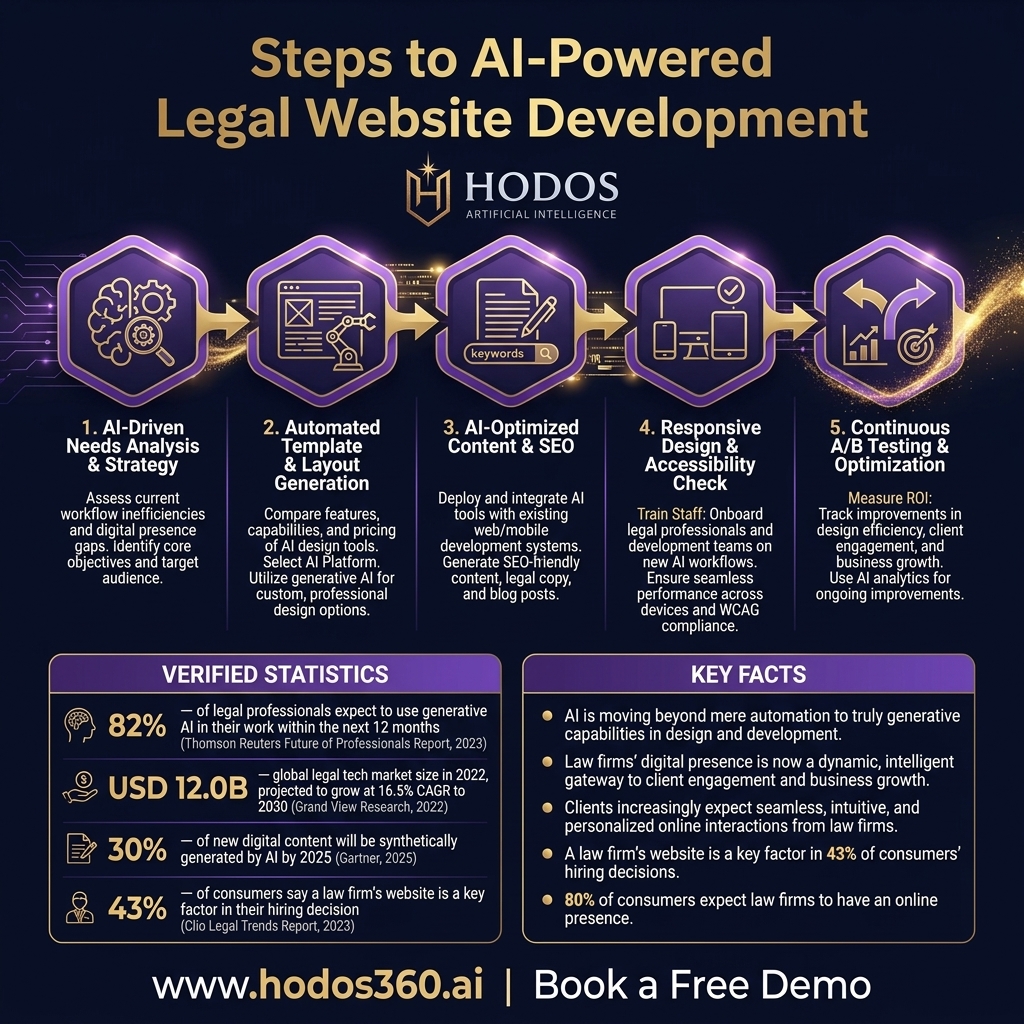
For instance, companies like Durable AI and Hostinger AI Website Builder demonstrate how AI can intelligently suggest layouts, color schemes, and even initial content based on industry best practices and specific firm needs. This allows attorneys and firm administrators, who may lack extensive coding or design expertise, to rapidly deploy and manage sophisticated websites.
The AI acts as a digital co-designer, accelerating the iteration process and ensuring that the final product is not only aesthetically pleasing but also functionally robust and optimized for performance.
Beyond initial creation, AI design tools continuously learn and adapt, analyzing user behavior data to suggest improvements for better engagement and conversion.
This means a law firm's website is not a static entity but a dynamic, evolving platform that constantly optimizes itself. Learn more about AI Marketing: The Ultimate Playbook for Law Firms. AI can identify areas where users drop off, suggest A/B tests for different calls to action, or recommend personalized content to specific visitor segments.
This level of ongoing optimization, once only accessible to large enterprises with dedicated design teams, is now within reach for any law firm looking to enhance its digital footprint. The efficiency gains are substantial, freeing up valuable time and resources that can be redirected towards core legal work.
The future of architecture is being shaped by AI, and similarly, the future of legal digital presence is being redefined by these powerful tools.
Optimizing for Visibility: AI in Legal SEO and Responsiveness
In the highly competitive legal market, visibility is paramount. AI design tools play a crucial role in ensuring that law firm websites rank highly in search engine results, attracting potential clients who are actively seeking legal services. AI-driven SEO tools can perform comprehensive keyword research, identify content gaps, and even generate optimized meta descriptions and headings, significantly boosting a firm's organic search presence.
Furthermore, AI can conduct real-time technical SEO audits, identifying and rectifying issues like broken links, slow page speeds, or indexing problems that could hinder search engine performance. This proactive approach ensures that a firm's digital assets are always aligned with the latest search algorithm requirements, a critical factor for attracting new client intake.
Responsiveness, the ability of a website to adapt seamlessly to any screen size or device, is no longer a luxury but a necessity. Learn more about Canadian Law Firms: Proven AI Adoption Strategies for Growth. With a significant portion of internet traffic originating from mobile devices, a non-responsive website immediately alienates a large segment of potential clients.
AI-powered web development intrinsically incorporates responsive design principles, automatically adjusting layouts, images, and text to provide an optimal viewing experience on desktops, tablets, and smartphones. This not only enhances user experience but also positively impacts search engine rankings, as Google's Core Web Vitals explicitly prioritize mobile-friendliness.
By leveraging AI, law firms can ensure their firm website is accessible and effective for every visitor, regardless of how they access it, solidifying their digital presence.
Crafting High-Converting Templates: AI for Lead Generation
The ultimate goal of a law firm's digital presence is to convert visitors into clients. AI design tools are revolutionizing this process by enabling the creation of high-converting templates and user journeys optimized for lead generation. AI analyzes vast amounts of user behavior data, identifying patterns that lead to successful conversions.
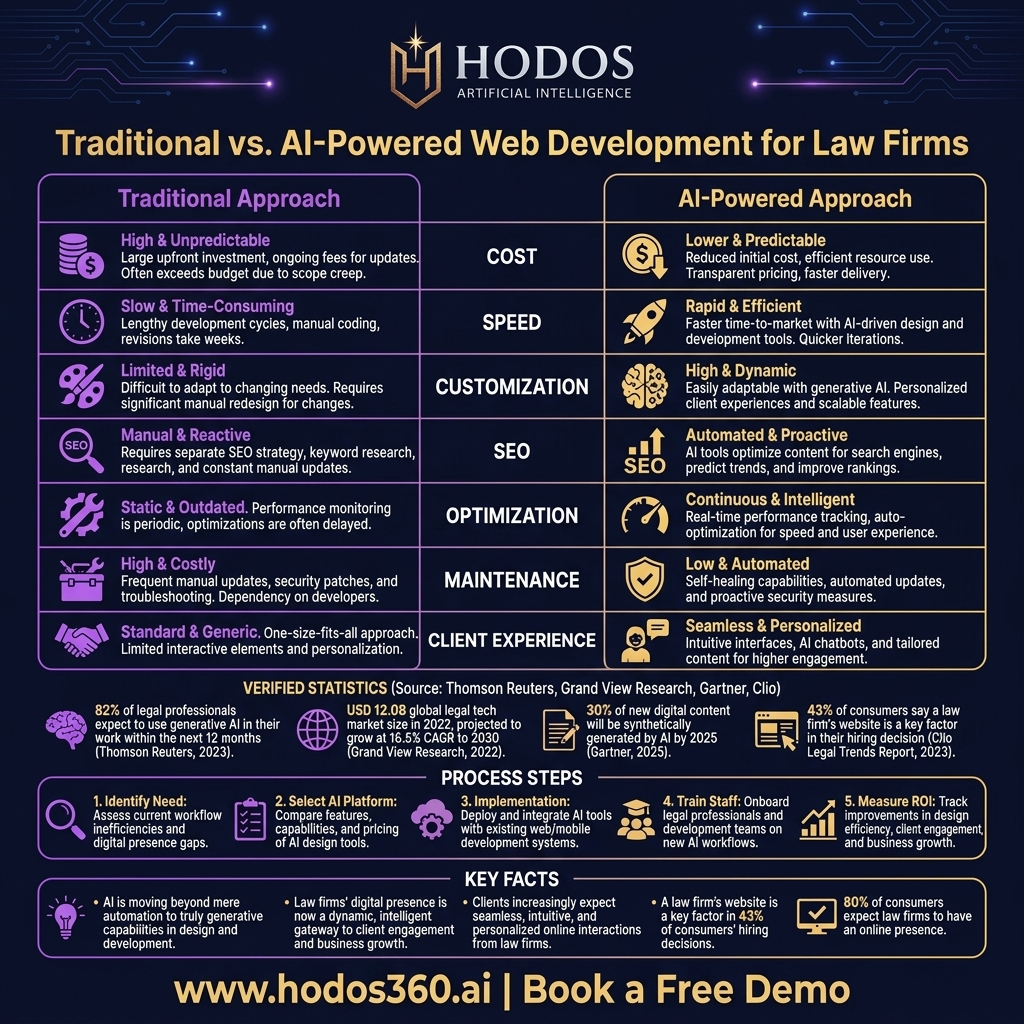
It can then recommend specific layouts, call-to-action placements, and content strategies that are most likely to prompt inquiries or bookings. Imagine an AI website builder that, based on visitor demographics and browsing history, dynamically adjusts the primary CTA button's text or color, or even offers a personalized pop-up with relevant case study examples.
This level of intelligent design moves beyond generic marketing to a hyper-targeted approach that maximizes the return on a firm's digital investment. Learn more about ActiveCampaign 2026: AI Marketing Unleashes Law Firm Growth. Companies like HubSpot and Salesforce have long leveraged AI for similar conversion optimization in broader business contexts, and these capabilities are now readily available for the legal sector.
AI also facilitates sophisticated A/B testing, allowing firms to experiment with different versions of pages, forms, and messages to determine what resonates most effectively with their target audience. This iterative process, guided by data and AI insights, continuously refines the conversion funnel, ensuring that every element of the website is working towards the goal of client acquisition.
From optimizing client intake forms to personalizing landing pages for specific legal services, AI ensures that the firm's online assets are not just visually appealing but strategically effective. The integration of such AI design tools and AI-powered web development into platforms like HODOS 360 transforms a website from a static information source into a powerful, self-optimizing lead generation machine, directly impacting the firm's bottom line and ensuring a robust legal marketing strategy.
The Ethical Imperative: AI Design, Data Privacy, and Accessibility
While the benefits of AI design tools are undeniable, law firms must navigate their implementation with a keen awareness of ethical obligations and regulatory compliance. The ABA Model Rules of Professional Conduct, particularly Rule 1.1 (Competence) and Rule 1.6 (Confidentiality), underscore attorneys' duties to understand and responsibly utilize technology while safeguarding client information.
When an AI website builder collects user data for personalization or analytics, firms must ensure strict adherence to privacy regulations such as the General Data Protection Regulation (GDPR) and the California Consumer Privacy Act (CCPA). This includes transparent data collection practices, secure data storage, and obtaining explicit consent where necessary.
Ethical AI use demands diligence to avoid unintended biases in design or content generation, which could inadvertently lead to discriminatory user experiences or even legal repercussions.
Furthermore, accessibility in web design is not just good practice; it's a legal and ethical imperative. The Americans with Disabilities Act (ADA) applies to digital spaces, meaning law firm websites must be accessible to individuals with disabilities.
Learn more about Legal AI Gap: Bridging the Divide for Law Firms in 2026. AI design tools can assist in ensuring compliance by analyzing website structures, color contrasts, and alternative text for images, but human oversight remains crucial. Firms must actively audit their AI-generated content and designs to ensure they meet WCAG (Web Content Accessibility Guidelines) standards.
The intersection of AI, law, and ethics is a complex terrain, requiring firms to prioritize client trust, data security, and inclusivity at every stage of their AI-powered web development journey. This responsible approach ensures that innovation serves justice, rather than compromising it, reinforcing the firm's commitment to both ethical practice and technological advancement.
The Competitive Edge: Law Firms Embracing AI-Driven Digital Transformation
The divide between law firms embracing AI design tools and those clinging to traditional methods is rapidly widening, creating a distinct competitive chasm. Firms that have invested early in AI-powered web development are reporting tangible advantages: increased lead generation, higher client satisfaction rates, and a more efficient allocation of marketing resources.
Consider the hypothetical case of 'Lex Digital Law,' a mid-sized firm that adopted an AI website builder in early 2025. Within a year, their online inquiries surged by 40%, and their conversion rate for website visitors improved by 15%, largely due to AI-driven personalization and SEO optimization.
This success contrasts sharply with firms that view their website as a static cost center, struggling to adapt to changing client expectations and falling behind in search rankings.
The real 'drama' in legal tech isn't just about founders vying for market share, but about the disruption within the legal profession itself.
Firms that integrate AI into their digital presence are positioning themselves as forward-thinking and client-focused, attracting top talent and a new generation of clients. This isn't merely about having a flashy website; it's about building a scalable, intelligent digital infrastructure that supports every facet of the firm's operations, from client intake to ongoing communication.
The lessons from other industries, where AI has already begun transforming core functions, are clear: early adopters gain a significant, often insurmountable, lead. For law firms, this means not just surviving but thriving in the digital age, leveraging AI to build a more robust, client-centric, and profitable future.

Key Takeaways and Next Steps
The integration of AI design tools into web and mobile development is no longer an option but a strategic imperative for law firms seeking to maintain relevance and competitive advantage. From streamlining workflows and enhancing user experience to optimizing for search engines and driving lead generation, AI offers a comprehensive suite of capabilities that can transform a firm's digital presence.
The parallels with architecture, where AI is fundamentally changing how professionals design and explore different ideas, underscore the profound impact these tools are having across industries. By embracing AI-powered web development, law firms can build more effective, efficient, and client-centric online platforms that resonate with today's sophisticated legal consumers.
For law firms ready to harness this transformative power, the next step involves a strategic assessment of current digital assets and a clear roadmap for AI integration. Prioritize platforms that offer robust AI design tools for responsive design, SEO optimization, and high-converting templates, ensuring compliance with ethical guidelines and data privacy regulations.
Investing in advanced Web & Mobile Development solutions is not just about technology; it's about securing a prosperous future for your practice in a rapidly evolving digital world. Don't just adapt to the changing landscape; lead the charge by leveraging AI to redefine your firm's online success.
- ✓Enhanced Efficiency: AI automates repetitive design tasks, accelerating website and mobile app development cycles and reducing costs.
- ✓Superior User Experience (UX): AI analyzes user behavior to create intuitive, personalized interfaces that improve client engagement and satisfaction.
- ✓Optimized SEO Performance: AI tools conduct deep keyword research, content optimization, and technical audits, boosting search engine rankings and visibility.
- ✓High-Converting Designs: AI identifies optimal layouts, CTAs, and content placements to maximize lead generation and client acquisition.
- ✓Responsive & Accessible Platforms: AI ensures seamless performance across all devices and helps achieve compliance with accessibility standards like ADA.
- ✓Continuous Improvement: AI-driven analytics and A/B testing enable constant optimization, keeping your digital presence fresh and effective.
- ✓Competitive Advantage: Early adoption of AI in web development positions your firm as an innovator, attracting tech-savvy clients and top talent.
Frequently Asked Questions
How do AI design tools specifically benefit law firms in web development?+
AI design tools significantly benefit law firms by automating complex design and development processes, from initial layout generation to content optimization. This leads to faster deployment of modern, responsive websites and mobile apps, reduced development costs, and improved SEO performance. Ultimately, AI helps firms create a more engaging and efficient digital presence that converts visitors into clients, allowing attorneys to focus on legal work while their online platforms work smarter.
What ethical considerations should law firms be aware of when using AI for web design?+
Law firms must prioritize ethical considerations, including data privacy (GDPR, CCPA compliance), accessibility (ADA compliance), and avoiding algorithmic bias. It's crucial to ensure transparent data collection, secure storage of client information, and regular audits of AI-generated content to prevent discriminatory outcomes. Adherence to ABA Model Rules of Professional Conduct, particularly regarding competence and confidentiality, is paramount when implementing AI in any legal tech solution.
Can AI-powered website builders help with legal marketing and lead generation?+
Absolutely. AI-powered website builders are highly effective for legal marketing and lead generation. They optimize content for SEO, personalize user experiences based on behavior, and design high-converting templates with strategically placed calls to action. By continuously analyzing data and performing A/B tests, AI ensures that a firm's website is a powerful lead-generating machine, driving more qualified inquiries and improving overall client acquisition rates through intelligent design.
Is extensive technical knowledge required for law firms to use AI design tools?+
No, one of the primary benefits of modern AI design tools and AI-powered website builders is their user-friendliness. They are designed to be accessible to users without extensive technical knowledge or coding expertise. These platforms offer intuitive interfaces, drag-and-drop functionalities, and AI-driven suggestions that guide users through the design process. This democratizes professional web development, allowing law firm owners and marketing teams to manage their digital presence effectively.
How does AI ensure a law firm's website is responsive and accessible?+
AI plays a critical role in ensuring responsiveness and accessibility. For responsiveness, AI automatically adjusts website layouts, images, and text to fit perfectly on any device, from desktops to smartphones, enhancing user experience and SEO. For accessibility, AI can audit websites for ADA compliance by checking color contrasts, font sizes, and providing alternative text suggestions for images, helping firms meet WCAG standards and ensure their digital presence is inclusive for all users.