


AI Document Automation: An Essential Shift for Law Firms
The legal technology landscape is in a perpetual state of evolution, driven by relentless innovation and strategic consolidations. A recent headline-grabbing event, Relativity's acquisition of Gavel—a company renowned for its AI-native drafting and document automation capabilities integrated directly into Microsoft Word—underscores a profound shift in how legal professionals will interact with their core tools.
This move is not merely a corporate transaction; it represents a strategic imperative by a major player like Relativity, traditionally dominant in e-discovery, to extend its artificial intelligence platform into the very fabric of daily legal practice. For law firms, this signals a future where document creation, contract review, and legal intelligence are seamlessly interwoven, promising unprecedented levels of efficiency and accuracy.
Dorna Moini, Gavel's founder and CEO, has long championed the idea of empowering legal professionals through intuitive automation, and her vision, now integrated into Relativity's expansive ecosystem, promises to accelerate the adoption of sophisticated AI document automation across the industry.
This acquisition highlights a broader trend: the convergence of specialized legal AI tools into comprehensive platforms.
Law firms, from boutique practices to global enterprises, are increasingly seeking integrated solutions that can manage the entire lifecycle of legal data, from client intake and case management to complex document generation and review. The demand for AI document automation is surging as firms grapple with rising operational costs, increasing caseloads, and the imperative to deliver faster, more cost-effective services.
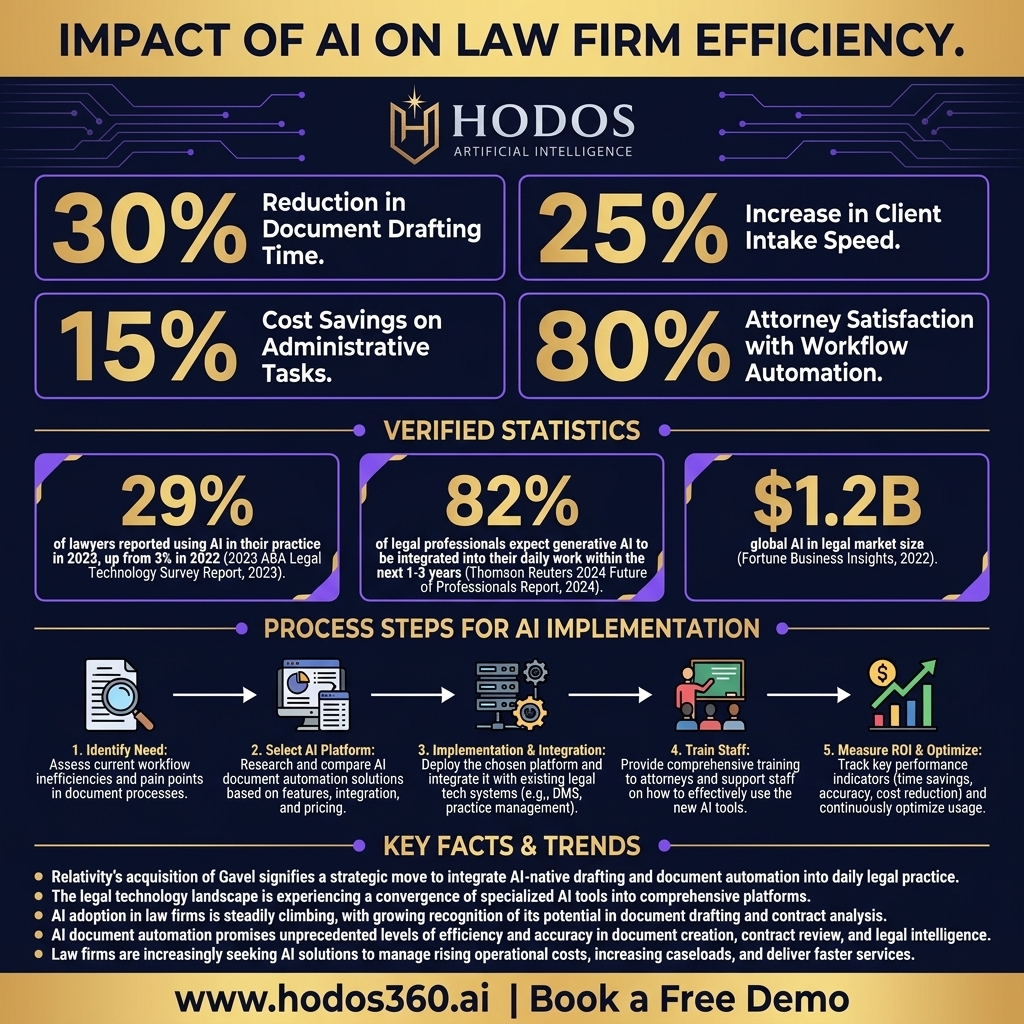
According to the 2023 ABA Legal Technology Survey Report, adoption of AI in law firms is steadily climbing, with a growing recognition of its potential beyond e-discovery, particularly in areas like document drafting and contract analysis. The strategic move by Relativity, a company with a market capitalization reflecting its leadership in legal data, to acquire Gavel, a nimble innovator in document automation, exemplifies the industry's commitment to bridging the gap between advanced AI capabilities and practical, everyday legal workflows.
The implications for legal professionals are far-reaching. The integration of Gavel's AI-powered drafting directly into Microsoft Word, the ubiquitous tool for legal document creation, means that attorneys can leverage sophisticated automation without disrupting their established workflows. This is a game-changer for contract review, legal research, and the generation of standardized legal documents, promising to free up valuable attorney time from repetitive, low-value tasks.
As Mike Gamson, CEO of Relativity, stated upon the acquisition, their aim is to create a 'seamless and intuitive' experience that extends their AI platform's intelligence directly to where legal professionals do their work. This article will delve into the strategic significance of this acquisition, explore the transformative power of AI document automation, discuss its practical applications for law firms, and address the challenges and opportunities that lie ahead in this rapidly evolving sector.
The Strategic Imperative: Why Firms Embrace AI Document Automation
The drive towards AI document automation is not a fleeting trend but a fundamental strategic imperative for law firms seeking competitive advantage and sustainable growth. The legal industry, historically slow to adopt technological advancements, is now experiencing an accelerated pace of digital transformation, largely propelled by advancements in artificial intelligence.
Firms are facing mounting pressure to enhance efficiency, reduce costs, and improve service delivery in an increasingly complex and competitive legal market. Manual document drafting and contract review are notorious bottlenecks, consuming significant billable hours and prone to human error. A Thomson Reuters report indicated that legal professionals spend up to 40% of their time on administrative tasks, a substantial portion of which involves document-related work.
AI document automation offers a powerful antidote, enabling firms to streamline these processes, ensure consistency, and reallocate attorney time to higher-value, client-centric activities.
Major players in the legal tech space are recognizing this shift, leading to a wave of strategic acquisitions and partnerships. Learn more about AI-Powered Web Development: Essential SaaS Optimization for Law Firms.
Beyond Relativity's move, we've seen similar strategic plays by industry giants like Thomson Reuters, which has consistently invested in AI-driven legal research and workflow solutions, and even case management providers like Clio, which acquired Lawyaw to bolster its document automation capabilities. These consolidations reflect a broader understanding that integrated AI solutions are key to unlocking the next generation of legal productivity.
This market competition and the rapid innovation from legal tech startups create a dynamic environment where firms that embrace AI document automation stand to gain a significant edge over those clinging to traditional, manual processes. The conflict between disruption and tradition is playing out in real-time, with early adopters already reporting substantial gains in productivity and client satisfaction.
Gavel's Edge: Bridging AI and Microsoft Word Workflows
Gavel's unique value proposition, and what made it an attractive acquisition target for Relativity, lay in its seamless integration with Microsoft Word. For decades, Word has been the undisputed standard for legal document creation, and attorneys are deeply embedded in its ecosystem. Gavel’s approach to AI document automation didn’t force users into a new, unfamiliar interface; instead, it brought sophisticated AI capabilities directly to where lawyers already work.
This 'in-Word' experience meant that attorneys could leverage AI-powered drafting, automate repetitive clauses, and generate complex documents with greater speed and accuracy, all within their familiar environment. This strategy significantly lowers the barrier to entry for AI adoption, making the technology immediately accessible and practical for everyday legal tasks.
Dorna Moini, Gavel’s visionary founder, built the company with a clear mission: to empower legal professionals by democratizing access to powerful automation tools. Learn more about AI Specialist Unveiled: Essential Guide for Law Firms. Her focus on user experience and practical applications resonated deeply within the legal community, particularly among firms looking for solutions that enhance rather than disrupt existing workflows.
By extending Relativity's powerful AI platform into Microsoft Word through Gavel, the combined entity creates a potent force for transforming how legal data is managed, analyzed, and utilized throughout the entire legal process. This integration promises to move beyond simple document assembly, enabling AI to intelligently suggest clauses, identify inconsistencies, and even flag potential risks during the drafting and contract review stages, thereby significantly enhancing legal intelligence and reducing the potential for human error.
Beyond E-Discovery: Expanding the AI Platform for Legal Data
Relativity has long been synonymous with e-discovery, providing a robust platform for managing vast amounts of legal data, from initial collection to production. The acquisition of Gavel, however, signals a deliberate and strategic expansion beyond its traditional stronghold. This move positions Relativity as a more comprehensive legal data platform, one that can now address the entire spectrum of legal information management, including the creation and drafting phases.

By integrating AI document automation, Relativity aims to offer a holistic solution that starts at the genesis of legal documents and extends through their lifecycle, enhancing both pre-litigation and transactional workflows. This broader vision acknowledges that legal data isn't just about discovery; it's about every piece of information a law firm generates and manages, from client intake forms to final court filings.
This expansion is crucial for law firms seeking to consolidate their tech stacks and avoid fragmented solutions. A fragmented approach often leads to data silos, inefficiencies, and increased security risks. Learn more about Voice AI Adoption: Essential for Law Firms' Future Growth. A unified AI platform for legal data, as envisioned by Relativity and now augmented by Gavel, promises to create a single source of truth for all legal information.
This means that insights gained from e-discovery can inform drafting, and automated document generation can feed into more efficient case management. The goal, as articulated by industry leaders like Mike Gamson, is to create an intelligent ecosystem where data flows seamlessly, providing attorneys with continuous legal intelligence and automation capabilities.
This strategic shift reflects the growing demand for platforms that can deliver end-to-end solutions, driving higher productivity and better outcomes across all practice areas, from litigation to corporate transactions.
The concept of a truly integrated AI platform for legal data is rapidly moving from aspiration to reality. Historically, legal tech solutions often operated in isolation, requiring manual data transfers or complex integrations. However, the modern law firm demands a connected environment where AI powers every stage of a matter.
Consider the implications: an AI-powered platform could automatically extract key data points from an initial client intake, use that data to pre-populate relevant clauses in a contract, and then, if litigation arises, seamlessly transfer that document into an e-discovery review. Learn more about Legora's Strategic Leap: Essential AI Law Firm Management.
This level of interconnectedness, driven by advanced AI, not only saves time but also significantly reduces the risk of errors and ensures consistency across all legal work products. Firms are increasingly seeking vendors that can offer this comprehensive approach, moving away from point solutions towards integrated ecosystems that reflect the complexity and interconnectedness of modern legal practice.
This trend is further supported by observations from Gartner and McKinsey, which consistently highlight the value of integrated platforms in driving digital transformation across professional services industries.
The Ripple Effect: How AI Document Automation Transforms Law Firm Operations
The transformative impact of AI document automation extends far beyond simply drafting contracts faster. It creates a ripple effect across virtually every aspect of law firm operations, fundamentally reshaping how legal services are delivered and managed. From client intake to billing, and from case management to compliance, AI-powered tools instill a new level of efficiency and precision.
By automating the generation of routine documents, client communications, and court filings, attorneys and paralegals are freed from tedious, repetitive tasks, allowing them to focus on strategic thinking, complex problem-solving, and direct client engagement. This not only boosts internal productivity but also translates into faster turnaround times for clients, enhancing overall satisfaction and firm reputation.
A study by the ABA Legal Technology Resource Center found that firms leveraging automation tools reported significant improvements in workflow efficiency and client service delivery, underscoring the tangible benefits of this technology.
The integration of AI document automation into a broader AI Law Firm Management System, such as the one offered by HODOS 360, creates a synergistic effect.
Learn more about AI Litigation Workflows: Essential for Modern Law Firms. Imagine a system where a new client's information, entered once during intake, automatically populates all necessary engagement letters, conflict checks, and initial case documents. This eliminates redundant data entry, minimizes errors, and ensures compliance with firm policies and ethical obligations.
For instance, adherence to ABA Model Rule 1.1 (Competence) is bolstered as technology helps ensure accuracy and thoroughness in document preparation, reducing the risk of oversight. The efficiency gains are not just about speed; they are about enhancing the quality and reliability of legal work, providing a consistent, high-standard output that clients expect.
This holistic approach to automation is what truly differentiates leading law firms in today's competitive landscape, allowing them to scale operations without proportionally increasing overhead.
- ✓Streamlined Client Intake: Automate the creation of engagement letters, conflict waivers, and initial client questionnaires, reducing onboarding time by up to 50%.
- ✓Accelerated Document Drafting: Generate complex contracts, pleadings, and motions using AI templates and clause libraries, cutting drafting time by 30-70%.
- ✓Enhanced Accuracy and Consistency: Minimize human error and ensure legal documents adhere to firm standards and legal requirements, reducing the risk of costly mistakes.
- ✓Improved Case Management: Integrate document generation with case management systems to automatically link documents to relevant matters and deadlines.
- ✓Optimized Billing and Cost Control: Reduce non-billable hours spent on administrative tasks, allowing attorneys to focus on value-added work, leading to more transparent and efficient billing.
- ✓Better Compliance and Risk Management: Ensure legal documents incorporate the latest regulatory updates and firm-specific policies, mitigating compliance risks.
Enhancing Client Service and Attorney Focus
Ultimately, the adoption of AI document automation is about re-centering the legal practice around what truly matters: the client and the attorney's intellectual work. By offloading routine, document-intensive tasks to AI, attorneys gain back invaluable time to engage more deeply with clients, develop innovative legal strategies, and pursue professional development.
This shift transforms the attorney's role from a document processor to a strategic advisor, significantly increasing job satisfaction and reducing burnout. Clients, in turn, benefit from faster service, more transparent processes, and a higher quality of legal advice, as their legal team is less burdened by administrative overhead.
This leads to stronger client relationships and a more positive perception of the legal profession as a whole.
The ability to deliver legal services with greater speed and precision also directly impacts a firm's bottom line and its capacity for growth. Learn more about Conversational AI: Ultimate Guide for Legal Teams.
Firms can take on more matters without necessarily hiring additional staff, thereby improving profitability and scalability. Moreover, the enhanced efficiency allows firms to offer alternative fee arrangements, providing greater cost predictability to clients, which is a significant competitive advantage. The focus shifts from charging for time spent on drafting to charging for the value delivered, aligning client and firm interests more closely.
This paradigm shift, enabled by AI document automation, is not just about technological advancement; it's about redefining the economics and human experience of legal practice, fostering a more sustainable and client-centric model for the future.
Navigating the Future: Challenges and Opportunities in Legal AI Adoption
While the opportunities presented by AI document automation are immense, law firms must also navigate a complex landscape of challenges. Ethical considerations, data security, and the need for continuous attorney training are paramount. The ABA Model Rule 1.6 (Confidentiality of Information), for instance, demands rigorous attention to how client data is handled by AI systems, requiring firms to ensure that vendors employ robust encryption, access controls, and data privacy protocols.
The potential for 'hallucinations' or inaccuracies in AI-generated content also necessitates a strong human oversight component, emphasizing that AI is a tool to augment, not replace, human legal expertise. Furthermore, the initial investment in AI solutions, coupled with the time required for implementation and training, can be a deterrent for some firms, particularly smaller practices with limited resources.
However, the long-term ROI often far outweighs these initial hurdles, as demonstrated by early adopters.
Firms must also contend with the rapidly evolving regulatory environment surrounding AI. The EU AI Act, recently enforced, sets a precedent for comprehensive AI governance, and similar legislation is anticipated in other jurisdictions, including the United States.
This means legal professionals must stay abreast of new compliance requirements, ensuring that their use of AI tools adheres to evolving legal standards. The challenge lies in balancing innovation with responsibility, leveraging the power of AI while mitigating its inherent risks. Firms that proactively address these challenges, investing in secure, ethical AI solutions and comprehensive training programs, will be best positioned to capitalize on the transformative power of AI document automation.
This proactive approach includes conducting thorough due diligence on AI vendors and establishing clear internal policies for AI usage.
A Look Ahead: The Convergence of Legal Tech and GenAI
Looking ahead, the legal tech industry is poised for an even more profound transformation with the accelerating convergence of specialized legal AI with generative AI (GenAI), powered by large language models (LLMs). The capabilities demonstrated by general-purpose LLMs from companies like OpenAI (led by Sam Altman) and Anthropic (co-founded by Dario Amodei) are beginning to filter into legal-specific applications, promising a new era of intelligent document creation and analysis.
This means AI won't just automate templates; it will be able to understand context, synthesize complex legal arguments, and even draft original content with minimal human input, subject to rigorous review. The integration of GenAI into platforms like Relativity's and solutions from HODOS 360 will enable unprecedented levels of predictive analytics and automated content generation, fundamentally altering the nature of legal work.
This future will see AI platforms becoming even more intuitive and powerful, capable of learning from a firm's specific legal documents and adapting to its unique style and preferences. The focus will shift from simple automation to intelligent augmentation, where AI acts as a co-pilot for legal professionals, offering insights, drafting assistance, and strategic recommendations in real-time.
The competition among legal tech providers will intensify, driving further innovation and specialization. Firms that invest in flexible, future-proof AI solutions will be best equipped to adapt to this evolving landscape, leveraging the full potential of GenAI to deliver superior client outcomes and maintain a competitive edge.
The journey of legal AI is just beginning, and its trajectory points towards a future where technology and human expertise are deeply intertwined, creating a more efficient, equitable, and intelligent legal system.

Key Takeaways and Practical Steps for Law Firms
The acquisition of Gavel by Relativity is a clear signal: AI document automation is no longer a luxury but a strategic necessity for law firms. The benefits—from enhanced efficiency and reduced costs to improved client satisfaction and attorney well-being—are compelling. Firms must proactively evaluate their current workflows, identify areas ripe for automation, and explore comprehensive AI solutions that integrate seamlessly into their operations.
Investing in platforms that offer a unified approach to legal data, from intake to e-discovery and beyond, will be crucial for long-term success. It's not just about adopting a tool; it's about embracing a new operational paradigm that leverages technology to amplify human expertise and deliver exceptional legal services.
For law firm owners and attorneys, the time to act is now. Start by conducting an internal audit of your document-intensive processes. Research reputable AI legal tech providers and consider platforms that offer broad capabilities, like HODOS 360's AI Law Firm Management System, which provides integrated case management, document automation, and AI-powered legal workflows.
Prioritize solutions with strong security features and a clear roadmap for future AI advancements, including generative AI. Embrace continuous learning and training for your team to maximize the benefits of these powerful tools. By strategically adopting AI document automation, your firm can navigate the complexities of the modern legal landscape, drive efficiency, and position itself for sustained growth and leadership.
Frequently Asked Questions
What is AI document automation in the legal context?+
AI document automation in legal refers to using artificial intelligence to streamline the creation, review, and management of legal documents. This includes generating contracts from templates, automating clause selection, extracting key data, and ensuring consistency across various legal texts. It significantly reduces manual effort and minimizes errors, allowing legal professionals to focus on higher-value tasks.
How does the Relativity-Gavel acquisition impact law firms?+
The acquisition extends Relativity's powerful AI platform, traditionally focused on e-discovery, into everyday document creation within Microsoft Word. For law firms, this means access to more integrated, AI-powered tools for drafting and contract review, promising enhanced efficiency, accuracy, and a more seamless workflow without disrupting existing document creation habits. It signals a move towards comprehensive legal data management.
What are the primary benefits of AI document automation for law firms?+
Primary benefits include significant time savings in drafting and review, reduced operational costs, improved document accuracy and consistency, enhanced compliance, and freeing up attorneys to focus on strategic, client-facing work. It also allows firms to scale operations more efficiently and offer more predictable, value-based pricing models to clients, boosting overall client satisfaction.
What ethical considerations should law firms keep in mind when using AI for documents?+
Law firms must prioritize data confidentiality (ABA Model Rule 1.6), ensure AI systems maintain client privacy, and verify the accuracy of AI-generated content to uphold their duty of competence (ABA Model Rule 1.1). Robust oversight, vendor due diligence, and clear internal policies for AI usage are essential to mitigate risks and ensure ethical practice.
How can law firms begin adopting AI document automation?+
Firms should start by assessing their most document-intensive processes and identifying pain points. Next, research AI legal tech providers offering integrated solutions that align with their needs, focusing on user-friendliness and security. Implement a pilot program, provide comprehensive training for staff, and gradually scale adoption across the firm. This strategic approach ensures a smooth transition and maximizes ROI.