


AI Driven Web Scraping: Essential for Modern Law Firms
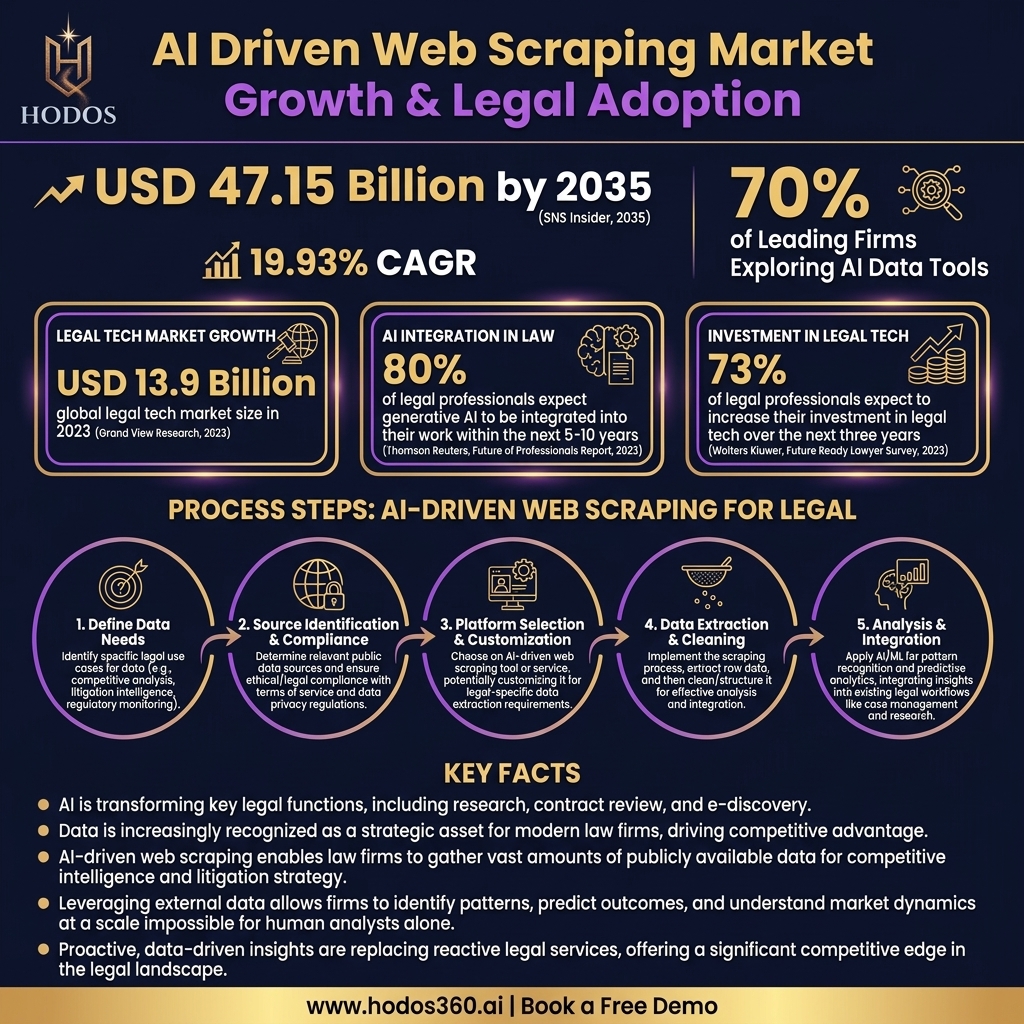
The legal landscape is undergoing an unprecedented transformation, driven by the relentless march of artificial intelligence. A recent report from SNS Insider forecasts the AI driven web scraping market size to exceed an astounding USD 47.15 billion by 2035. This isn't merely a statistic for tech giants; it's a clarion call for law firms to recognize data as their most potent, yet often untapped, strategic asset.
For decades, legal research relied on traditional databases and manual aggregation, a process that was not only time-consuming but also inherently limited in scope and speed. Today, firms are beginning to understand that competitive advantage, client acquisition, and even the very foundation of case strategy can be dramatically improved by leveraging vast oceans of publicly available data, intelligently extracted and analyzed by AI.
This burgeoning market signifies a critical juncture for legal professionals. Firms that embrace sophisticated AI-powered data extraction tools are positioned to gain a significant edge, moving beyond reactive legal services to proactive, predictive counsel. Consider the insights shared by Jerry Ting, CEO of Evisort, who often emphasizes that "data is the new oil for legal."
This isn't just about finding documents; it's about identifying patterns, predicting outcomes, and understanding market dynamics at a scale impossible for human analysts alone. The challenge, however, lies not just in adopting the technology, but in understanding its strategic implications, ethical boundaries, and how to integrate it seamlessly into existing legal workflows to truly harness its power.
Ready to explore how AI-driven data can transform your firm's strategy? Discover HODOS 360's Web & Mobile Development solutions.
The Strategic Imperative: AI Driven Web Scraping for Legal Advantage
The legal sector's increasing demand for data-driven insights is the primary force behind the surging AI driven web scraping market. Law firms are no longer content with anecdotal evidence or limited datasets; they require comprehensive, real-time intelligence to navigate complex cases, understand market shifts, and preempt client needs.
This shift is particularly evident in areas like M&A due diligence, where identifying hidden liabilities or market sentiment from news articles, social media, and regulatory filings can make or break a deal. Firms like Allen & Overy, known for their embrace of legal tech, have been at the forefront of exploring how advanced analytics, often fueled by sophisticated data extraction, can enhance their transaction advisory services, offering clients a depth of insight previously unattainable.
The global market is growing rapidly, with demand for these tools skyrocketing.
Beyond transactional work, litigation support has been profoundly impacted. Imagine a scenario where an AI system scrapes millions of court filings, public records, and news reports to identify patterns in judicial decisions, opponent strategies, or jury sentiments.
This capability, once the realm of science fiction, is now a reality. Paul Hastings, for instance, has invested heavily in data analytics to refine its litigation strategies, allowing partners to present arguments backed by statistical probabilities and real-world precedents derived from vast data pools. This moves legal practice from an art based on experience to a science augmented by data, offering clients a more predictable and robust defense or offense.
Learn more about AI Voice Assistants: Essential Practical Features for Law Firms. The report highlights this global growth, with the market valued to reach billions, underscoring the urgency for firms to adopt this technology.
Moreover, the competitive landscape for law firms themselves is being reshaped.
AI driven web scraping allows firms to monitor competitor pricing, service offerings, client reviews, and even recruiting patterns. This competitive intelligence provides a granular view of the market, enabling firms to identify niches, optimize their marketing strategies, and retain top talent. As Jensen Huang, CEO of NVIDIA, often states, "The more data you have, the better your AI is."
This rings true for legal applications, where the quality and volume of data directly correlate with the accuracy and utility of the insights generated. Firms that fail to collect and analyze this external data risk operating in a vacuum, making decisions based on incomplete or outdated information, while their competitors gain significant market share.
This strategic shift isn't just about efficiency; it's about redefining value. Clients today expect more than just legal expertise; they expect business acumen and foresight. Firms that can leverage AI-driven data to provide predictive insights into regulatory changes, emerging legal risks, or market opportunities will be the ones that thrive.
This demand for data-driven counsel is a growing trend, and the report shows this market segment continues to expand during the forecast period.
Beyond Basic Data: Unlocking Deeper Insights
Traditional web scraping often involves simple data extraction, pulling specific fields from predictable website structures. However, AI driven web scraping elevates this by employing natural language processing (NLP) and machine learning to understand context, sentiment, and relationships within unstructured data. This means an AI can not only extract names and dates from a news article but also determine the sentiment towards a company, identify key stakeholders, and link related events across multiple sources.
For legal professionals, this capability translates into a deeper understanding of complex narratives. Instead of just knowing *what* happened, AI can help discern *why* and *what might happen next*. Learn more about AI Website Builder: Essential Strategies for Law Firm Growth. This predictive power is invaluable for anticipating legal challenges, advising clients on proactive compliance, and even identifying potential M&A targets or intellectual property infringements before they escalate.
The insights gained are not merely data points but actionable intelligence that can fundamentally alter strategic decisions and client outcomes, making the firm an indispensable advisor rather than just a service provider.
Navigating the Ethical and Regulatory Landscape of Legal Data Extraction
While the potential of AI driven web scraping is immense, law firms must navigate a complex web of ethical and regulatory considerations. The collection and use of publicly available data, especially at scale, can quickly intersect with privacy laws like GDPR (General Data Protection Regulation) in Europe and CCPA (California Consumer Privacy Act) in the United States.
Firms must ensure that their data extraction practices comply with these statutes, avoiding the scraping of personal identifiable information (PII) without consent or legitimate interest, and respecting website terms of service. As Dario Amodei, co-founder of Anthropic, often emphasizes the importance of safety and ethical AI, legal professionals must apply the same rigor to data acquisition.
Furthermore, the legal profession's own ethical rules provide crucial guardrails. ABA Model Rule 1.6 on Confidentiality of Information, while primarily focused on client data, underscores the broader principle of responsible information handling. More directly, ABA Model Rule 4.4, Respect for Rights of Third Persons, cautions against methods of obtaining evidence that violate the legal rights of a third person.
Learn more about Essential AI Vibe Coding: Elevate Law Firm Web Development. This rule can be interpreted to include improper data harvesting. Firms must implement robust data governance policies, conduct thorough privacy impact assessments, and ensure their AI tools are configured to operate within these legal and ethical boundaries, minimizing the risk of reputational damage or regulatory fines.
The enforcement of legislation like the EU AI Act, which came into full effect in early 2026, further complicates the landscape, introducing new requirements for transparency, accountability, and human oversight for AI systems, including those used for data extraction. This means firms can't simply deploy off-the-shelf scraping tools without due diligence; they must understand the underlying AI models, their data sources, and their potential biases.
The responsibility falls on the firm to ensure that every step of the data lifecycle—from collection to analysis to application—adheres to the highest standards of legal and ethical conduct. This commitment is not just about compliance; it's about maintaining trust, which is the bedrock of the legal profession.
Fueling Innovation: AI Web Scraping and Your Firm's Digital Presence
The data gleaned from AI driven web scraping isn't just for internal strategy; it's a powerful catalyst for enhancing a law firm's external digital presence. HODOS 360's Web & Mobile Development services exemplify how this collected intelligence can be transformed into a dynamic, client-centric online experience.
By understanding market trends, client demographics, and competitor strategies through scraped data, firms can build AI-powered websites that are not only aesthetically pleasing and responsive but also highly optimized for lead generation and client engagement. This means tailoring content, identifying high-converting templates, and implementing SEO strategies that directly reflect the needs and search behaviors of potential clients.
Consider how scraped data can inform the design of a specialized practice area page. If AI analysis of competitor sites and legal forums reveals a surge in demand for, say, environmental litigation in a specific industry, a firm can rapidly deploy targeted content, case studies, and attorney bios on its website, optimized to capture that emerging interest.
This agility is a direct result of data-driven insights. Learn more about AI Marketing Platform Elevates Law Firms in 2026. Companies like Clio, which regularly innovates in legal practice management, understand the synergy between client data and digital experience, constantly refining their platforms to offer more integrated solutions.
The goal is to create a digital storefront that actively attracts, informs, and converts prospects into clients, rather than passively waiting for inquiries.
Furthermore, the insights from web scraping can fuel the development of custom mobile applications for clients, offering secure portals for case updates, document sharing, and direct communication.
Imagine an app that provides clients with real-time legal news relevant to their industry, curated based on AI-analyzed market data. This level of personalized service not only enhances client satisfaction but also strengthens loyalty and positions the firm as a cutting-edge leader. To harness the full potential of data and elevate your firm's digital presence, schedule a consultation with HODOS 360 today.
- ✓Enhanced SEO Optimization: Use scraped keyword data to rank higher in search results for specific practice areas and client queries.
- ✓Personalized Client Journeys: Tailor website content and user experience based on insights into client needs and pain points.
- ✓Dynamic Content Generation: Automatically update website sections with relevant legal news, case studies, or regulatory changes identified by AI.
- ✓Competitive Digital Benchmarking: Analyze competitor websites for design trends, content strategies, and user engagement metrics.
- ✓AI-Powered Lead Generation: Design web forms and chatbots that are informed by common client questions and conversion pathways identified through data.
- ✓Responsive Design Informed by User Behavior: Optimize mobile and desktop experiences based on how users interact with similar legal sites.
Actionable Intelligence: Integrating Scraped Data into Legal Workflows
The true value of AI driven web scraping for law firms is realized not just in the data itself, but in its seamless integration into daily legal workflows. Raw data, however vast, remains inert until it's transformed into actionable intelligence that informs decision-making and automates processes.
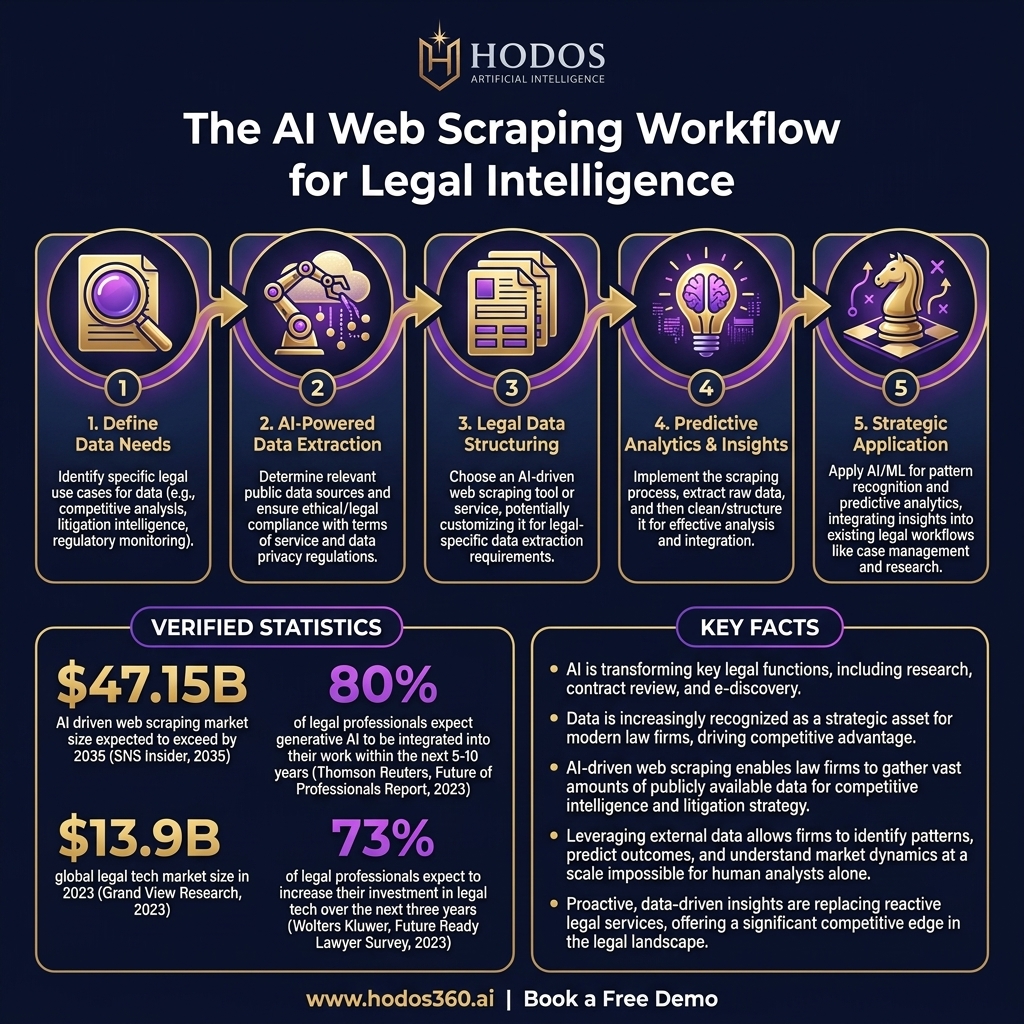
This integration is where platforms like HODOS 360's AI Law Firm Management System become indispensable. Imagine a system where scraped regulatory updates automatically trigger alerts for relevant clients, or where market intelligence on a specific industry feeds directly into a firm's business development pipeline, identifying potential leads before they even know they need legal help.
This level of integration moves beyond simple data storage to creating intelligent, interconnected systems. For example, in intellectual property, AI can continuously scrape patent databases, news articles about emerging technologies, and even academic papers. This data can then be automatically funneled into a firm's IP management system, alerting attorneys to potential infringement risks or new patent opportunities for their clients.
As Sam Altman, CEO of OpenAI, frequently highlights the transformative power of AI in augmenting human capabilities, this principle applies directly to legal professionals. By offloading the arduous task of data collection and initial analysis to AI, attorneys are freed to focus on higher-value strategic thinking and client interaction, significantly boosting overall firm productivity and client satisfaction.
Effective integration also demands robust data governance and interoperability. Firms must ensure that the data collected via scraping is clean, structured, and compatible with their existing case management, billing, and document automation systems. Learn more about AI Marketing Automation: The Ultimate Guide for Law Firms.
This often requires custom API development or specialized connectors, a service that is critical for maximizing the ROI of AI investments. Without proper integration, even the most sophisticated AI driven web scraping tools can become isolated silos of information, failing to deliver their full potential.
The goal is to create a unified data ecosystem where insights flow freely, empowering every facet of the firm's operations, from intake to litigation to client relationship management.
The strategic implementation of AI scraping also involves continuous refinement. The legal landscape, technological capabilities, and ethical guidelines are constantly evolving.
Firms must adopt an agile approach, regularly reviewing and updating their scraping strategies, data processing techniques, and compliance protocols. This iterative process ensures that the AI tools remain effective, ethical, and aligned with the firm's overarching business objectives. It's not a one-time setup but an ongoing commitment to leveraging data as a core strategic asset, allowing firms to stay ahead of the curve in a rapidly changing world.
Enhancing Case Strategy and Litigation Support
In litigation, the ability to anticipate and react swiftly is paramount. AI-driven web scraping transforms this by providing attorneys with an unparalleled view into relevant legal precedents, judicial tendencies, and even public sentiment surrounding specific issues or parties. By scraping court dockets, legal news aggregators, and academic journals, AI can identify obscure but impactful rulings, track the success rates of particular legal arguments, and even analyze the public perception of a client or opposing counsel.
This granular insight enables attorneys to craft more robust case strategies, prepare for potential challenges, and predict outcomes with greater accuracy, giving them a distinct advantage in the courtroom.
Moreover, for complex, multi-jurisdictional cases, the sheer volume of data involved can be overwhelming. Learn more about AI Mistakes: Ultimate Guide to Lawyer Liability & Safeguards.
AI scraping can quickly aggregate information from diverse legal systems and databases, identifying commonalities or conflicts that might take human researchers weeks or months to uncover. This efficiency not only reduces costs but also allows legal teams to focus on the nuances of the law rather than the mechanics of data collection, leading to more thorough and effective litigation support.
Revolutionizing Client Acquisition and Market Growth
Client acquisition in the digital age demands more than traditional networking; it requires a data-driven approach. AI driven web scraping allows law firms to identify emerging legal needs, track industry-specific regulatory changes, and monitor business growth patterns to proactively target potential clients. By analyzing news feeds, industry reports, and company announcements, AI can flag businesses undergoing expansion, facing new compliance burdens, or involved in disputes, signaling a potential need for legal services before a formal request for proposal is even issued.
This predictive client acquisition strategy transforms marketing from a broad-brush approach to a highly targeted, efficient process.
Furthermore, by scraping competitor websites and legal directories, firms can identify underserved markets or popular service offerings that they might not currently emphasize. This market intelligence is invaluable for refining service portfolios, adjusting pricing strategies, and developing compelling value propositions that resonate with specific client segments.
The result is not just more clients, but the *right* clients, leading to sustainable market growth and a stronger, more specialized practice.

The Future-Proof Law Firm: Embracing Data-Driven Transformation
The trajectory of the AI driven web scraping market, projected to reach over USD 47.15 billion by 2035, is a clear indicator of its indispensable role in the future of legal practice. For law firms, this isn't an optional upgrade but a strategic imperative to remain competitive and relevant.
The narrative of legal tech is no longer about *if* AI will impact the profession, but *how quickly* firms can adapt and integrate these powerful tools. Those that champion data-driven decision-making, ethical AI deployment, and seamless technological integration will not only survive but thrive, setting new benchmarks for efficiency, insight, and client service.
The journey towards becoming a truly data-powered law firm begins with recognizing the vast potential of publicly available information, ethically collected and intelligently analyzed. It requires investing in the right tools, fostering a data-literate culture, and partnering with technology providers that understand the unique demands of the legal sector.
By embracing AI-driven web scraping and integrating it with robust web and mobile development, law firms can transform raw data into a powerful engine for growth, innovation, and unparalleled legal strategy. Don't get left behind in the data revolution. Visit HODOS360.ai to learn more about our comprehensive AI solutions for law firms.
Frequently Asked Questions
What is AI driven web scraping and how does it benefit law firms?+
AI driven web scraping uses artificial intelligence, including natural language processing and machine learning, to intelligently extract and analyze vast amounts of data from websites. For law firms, this means gaining deeper insights into market trends, competitive strategies, judicial precedents, and client needs, far beyond what manual research can achieve. It enhances litigation support, due diligence, and business development by turning raw data into actionable intelligence.
What are the ethical considerations for law firms using web scraping?+
Law firms must carefully navigate privacy laws like GDPR and CCPA, ensuring they do not scrape personal identifiable information without legitimate grounds. Adherence to ABA Model Rules, particularly 1.6 (Confidentiality) and 4.4 (Respect for Third Persons' Rights), is crucial. Firms must also respect website terms of service and implement robust data governance to ensure ethical and compliant data acquisition and use, safeguarding client trust and firm reputation.
How can AI web scraping enhance a law firm's digital presence?+
Insights from AI web scraping can inform a firm's web and mobile development strategy. By understanding client search behaviors and market demand, firms can build AI-powered websites with optimized SEO, personalized content, and high-converting templates. This data-driven approach ensures a firm's online presence actively attracts, engages, and converts potential clients, making its digital storefront a powerful tool for growth and client acquisition.
Can AI driven web scraping be integrated with existing legal tech systems?+
Yes, for maximum impact, AI driven web scraping should be seamlessly integrated with existing legal tech systems like case management, document automation, and client intake platforms. This allows scraped data to directly feed into legal workflows, automating alerts, enriching case files, and informing strategic decisions. Effective integration transforms raw data into a unified, actionable intelligence ecosystem, enhancing efficiency across the firm's operations.
What future trends should law firms expect in AI web scraping?+
Law firms should anticipate continued advancements in AI's ability to understand context, predict outcomes, and automate complex data analysis. Future trends will likely include more sophisticated sentiment analysis, cross-platform data synthesis, and increasingly robust ethical AI frameworks. Firms should prepare for a future where AI-driven insights become standard for competitive intelligence, strategic planning, and delivering proactive, predictive legal counsel to clients.