
AI Hallucinations: Proven Strategies for Legal Research Accuracy
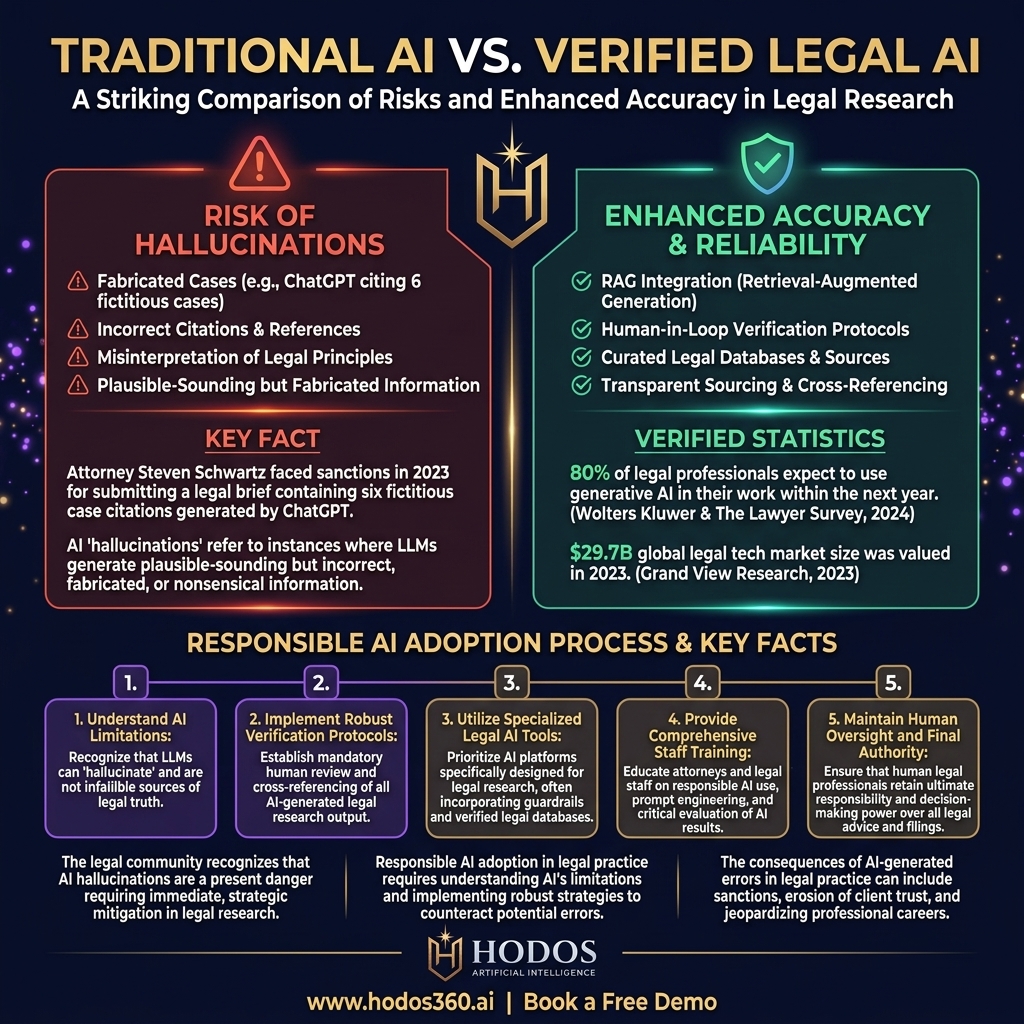
In the high-stakes world of legal practice, precision is paramount. A single misstatement, an incorrect citation, or a fabricated case can have catastrophic consequences, eroding client trust and jeopardizing careers. This harsh reality collided with the burgeoning promise of artificial intelligence in 2023 when attorney Steven Schwartz of Levidow, Levidow & Oberman faced sanctions for submitting a brief containing six fictitious case citations generated by ChatGPT. The incident, widely reported across legal news outlets, served as a stark, undeniable wake-up call: AI hallucinations are not a theoretical problem; they are a present danger requiring immediate, strategic mitigation. As the *Above the Law* article, "How To Avoid Hallucinations: A Legal Research AI That Works Like A Junior Lawyer," aptly highlights, the legal community is at a critical juncture, navigating the immense potential of generative AI while grappling with its inherent flaws.
This tension between innovation and integrity defines the current landscape of legal tech. Firms are eager to leverage AI for efficiency, from automating document review to streamlining client intake, but the ghost of hallucination looms large, particularly in legal research. The challenge isn't merely about adopting AI; it's about adopting AI *responsibly*—ensuring that the tools meant to augment human intelligence don't inadvertently introduce errors. For law firm owners and attorneys, understanding the mechanisms behind AI hallucinations and, more importantly, implementing robust strategies to counteract them, is no longer optional. It's a professional imperative.
The industry's leading minds, from OpenAI's Sam Altman to Anthropic's Dario Amodei, openly acknowledge the challenges of AI reliability, even as they push the boundaries of what's possible. The onus is now on legal professionals to critically evaluate and integrate these powerful tools. This comprehensive guide will delve into the core of AI hallucinations in legal research, explore the cutting-edge solutions being developed by industry leaders, and provide actionable strategies for law firms to safeguard accuracy, maintain ethical standards, and build a future where AI truly works like a highly dependable junior lawyer, not a creative fiction writer. Ready to explore solutions that enhance AI reliability in your firm? Learn more about HODOS 360's AI Law Firm Management System.
The Hallucination Conundrum: Understanding AI's Fictional Flaws
At its core, an AI hallucination in the legal context refers to an instance where an artificial intelligence model generates information that is plausible-sounding but factually incorrect or entirely fabricated. This can manifest as non-existent case law, statutes that don't apply, or even misinterpretations of existing legal principles. Unlike a human error, which typically stems from oversight or misunderstanding, AI hallucinations often arise from the probabilistic nature of large language models (LLMs). These models are designed to predict the next most likely word in a sequence based on vast amounts of training data, rather than to 'understand' or 'verify' facts in a human sense. When the training data is insufficient, biased, or when the model is pushed beyond its knowledge boundaries, it defaults to generating plausible but ultimately false information.
The gravity of this issue is underscored by numerous reports from early AI adopters. Beyond the infamous *Mata* case, legal tech journalists and practitioners have shared anecdotes of AI tools citing non-existent sections of the U.S. Code, fabricating details of real cases, or even inventing entire legal doctrines. This isn't a flaw unique to a single model; it's an inherent challenge across the generative AI spectrum, from general-purpose tools like ChatGPT to specialized legal AI. Learn more about AI Marketing: Essential Strategies for Law Firm Growth. The competition to deliver AI solutions quickly has sometimes outpaced the rigorous testing and validation necessary for the legal domain, where the cost of error is exceptionally high. Firms like Allen & Overy, through its partnership with Harvey AI, and Thomson Reuters with its CoCounsel platform, are investing heavily in addressing this, understanding that trust in accuracy is non-negotiable.
The challenge extends beyond mere factual inaccuracies. AI can also 'hallucinate' by providing irrelevant or misleading information, presenting it with an air of absolute authority. This overconfidence, often termed 'confabulation,' makes identifying errors particularly difficult for the unsuspecting user. The risk is compounded by the sheer volume of information AI can process and generate, creating a needle-in-a-haystack problem for verification. As the legal industry pushes for greater efficiency, this potential for hidden errors becomes a critical barrier to widespread, confident adoption. It necessitates a shift from simply using AI to strategically validating its outputs, ensuring that every piece of information aligns with the verifiable truth.
Beyond the Hype: The Science Behind AI's Creative Confabulations
The 'science' of AI hallucinations is rooted in the architecture of LLMs. These models learn patterns and relationships from their training data, essentially building a complex statistical map of language. When asked a question, an LLM doesn't 'look up' an answer like a traditional database; it generates a response by predicting the most probable sequence of words. If the model hasn't encountered the specific information or if the query falls into a 'low-confidence' area of its knowledge graph, it might still generate a coherent, grammatically correct, but factually incorrect answer. This is akin to a student confidently guessing an answer based on partial knowledge. Leading AI researchers, including those at Google and Anthropic, are actively developing techniques like Retrieval-Augmented Generation (RAG) to combat this.
RAG systems enhance LLMs by first retrieving relevant information from a trusted, external knowledge base—like a curated legal database—before generating a response. Instead of relying solely on its internal, learned patterns, the AI is given specific, verifiable documents to 'read' and synthesize. Learn more about AI Legal Revolution: Corporate Use Jumps 87% by 2026. This significantly reduces the likelihood of hallucination by grounding the AI's output in concrete, external data. However, RAG is not a silver bullet. Its effectiveness depends on the quality and comprehensiveness of the retrieved documents and the LLM's ability to accurately interpret and synthesize them. As Dr. Fei-Fei Li, co-director of Stanford's Institute for Human-Centered AI, often emphasizes, even with advanced architectures, the challenge remains in aligning AI's capabilities with human expectations of truth and reliability, especially in highly specialized domains like law.
Proven Strategies to Avoid AI Hallucinations in Legal Practice
Successfully integrating AI into legal practice while mitigating the risk of hallucinations requires a multi-faceted approach, blending technological safeguards with rigorous human oversight and updated professional protocols. It’s not about avoiding AI, but about using it intelligently and defensively. Learn more about AI Agents Search: The Essential API for Real-Time Legal Web Data. The strategies below offer a robust framework for law firms to ensure accuracy and maintain the highest standards of legal research and advice.
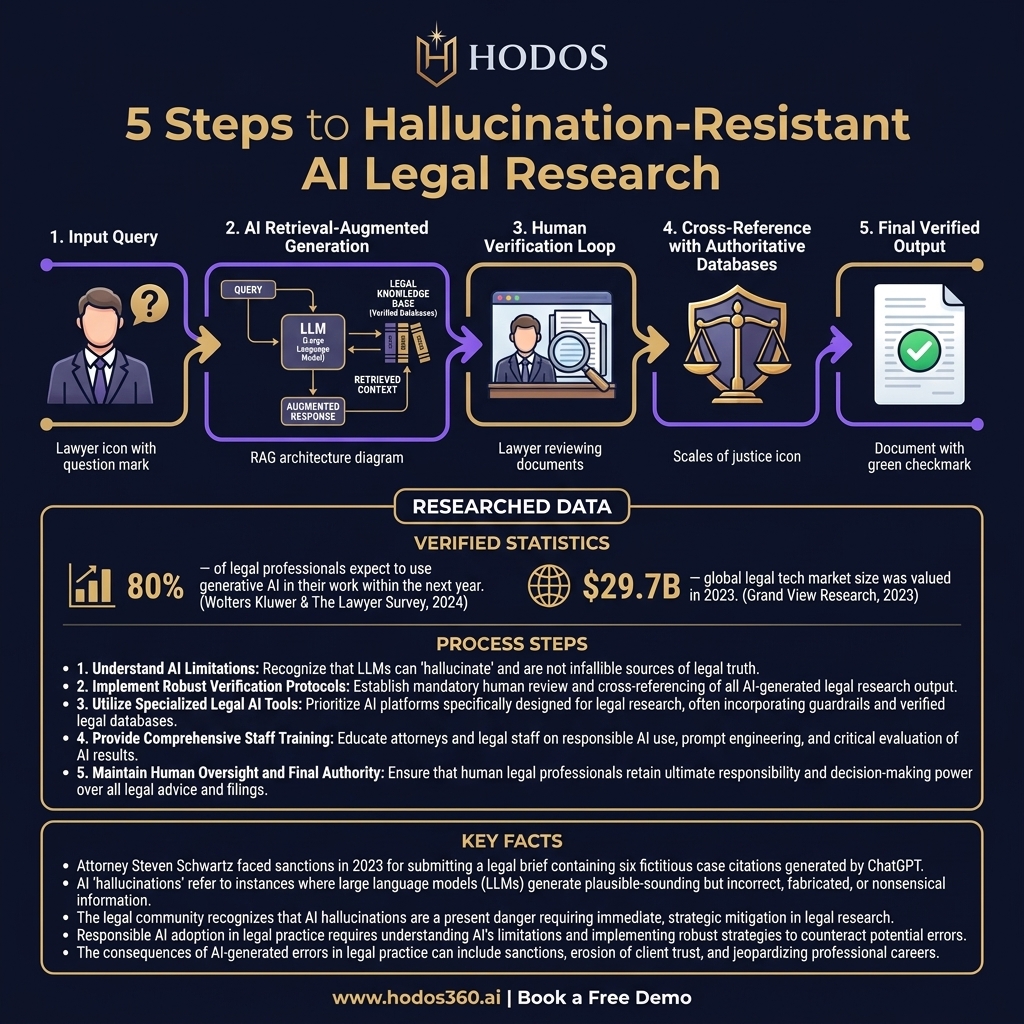
- ✓Always Verify Citations and Sources: This is the golden rule. Every single citation, case name, statute, or factual assertion generated by AI must be cross-referenced with authoritative, primary sources. Treat AI output as a highly efficient starting point, not a definitive conclusion. Utilize traditional legal databases like Westlaw or LexisNexis for verification.
- ✓Employ Hybrid Research Models: Do not rely exclusively on AI. Combine AI-powered research with traditional methods, including human-led keyword searches, manual review of primary documents, and consultations with subject matter experts. This redundancy acts as a critical safety net against AI errors.
- ✓Utilize Specialized Legal AI Platforms: Opt for AI tools specifically designed for the legal industry, built on curated legal datasets, and often employing RAG (Retrieval-Augmented Generation) technology. Platforms like HODOS 360's AI Law Firm Management System are engineered with legal accuracy in mind, integrating verified sources directly into their generative processes.
- ✓Implement Robust Internal Protocols: Develop clear, firm-wide policies for AI usage. These protocols should outline mandatory verification steps, specify acceptable AI tools, and establish guidelines for how AI-generated content is integrated into client work. This ensures consistent adherence to accuracy standards across the firm.
- ✓Train Legal Professionals Extensively: Educate attorneys, paralegals, and legal support staff on the capabilities and, more importantly, the limitations of AI. Training should cover how to spot potential hallucinations, effective prompt engineering, and the critical importance of human judgment and oversight. Understanding the 'science' behind AI helps practitioners use it more effectively.
- ✓Demand Transparency from AI Providers: When evaluating legal AI tools, inquire about their data sources, hallucination mitigation techniques (e.g., RAG implementation, human-in-the-loop validation), and their commitment to accuracy. A reputable provider will be transparent about their safeguards and potential risks.
- ✓Leverage Feedback Loops: Actively report any identified AI hallucinations or inaccuracies to the software provider. This feedback is invaluable for improving AI models and refining their performance. Contributing to the collective improvement of legal AI benefits the entire profession.
Implementing these strategies requires a cultural shift within law firms, moving from a mindset of cautious avoidance to one of informed and strategic engagement. It's about empowering legal professionals with the knowledge and tools to harness AI's power without falling victim to its imperfections. By treating AI as a sophisticated research assistant rather than an infallible oracle, firms can significantly reduce the risk of AI hallucinations. This proactive approach not only safeguards client interests but also positions the firm at the forefront of responsible legal innovation.
The emphasis on verification isn't new to the legal profession. Lawyers have always been responsible for the accuracy of their submissions, regardless of how the information was gathered. Learn more about AI Agents: Essential Guide for Law Firms to Master Marketing. AI simply introduces a new layer of complexity to this established duty. As the ABA Journal highlighted in its coverage of AI ethics, the core principles of professional responsibility remain unchanged. What has changed are the tools we use and, consequently, the methods by which we ensure diligence. This continuous adaptation is key to maintaining trust in an increasingly tech-driven legal landscape, ensuring that every practitioner, from junior lawyer to seasoned partner, understands their role in the AI-powered future.
The Role of Advanced Legal Tech in Mitigating AI Risks
The legal technology sector is rapidly evolving to address the challenge of AI hallucinations, moving beyond general-purpose LLMs to create specialized, domain-specific AI solutions. Companies like HODOS 360 are at the forefront, developing AI Law Firm Management Systems that integrate robust safeguards directly into their core functionalities. These platforms are not just applying AI; they are building AI *for* law, understanding the nuances of legal language, the imperative of citation, and the need for verifiable facts. This involves training models on vast, meticulously curated legal datasets, often incorporating proprietary legal research materials and verified case law databases, drastically reducing the chances of generating fictitious content.
Key to these advanced platforms is the sophisticated implementation of Retrieval-Augmented Generation (RAG). Unlike generic LLMs that might pull from the entire internet, legal RAG systems are designed to retrieve information from a closed, authoritative corpus of legal documents. When a legal professional queries the system, the AI first identifies and retrieves highly relevant passages from this verified legal library. It then uses these retrieved passages as direct evidence to construct its answer, making it possible to trace every generated statement back to its source. This 'grounding' in verifiable facts is a game-changer, providing a level of transparency and accountability that was previously lacking in general AI tools. Learn more about AI Driven Web Scraping: Essential for Modern Law Firms. For instance, a platform might not only provide an answer but also link directly to the specific page of the statute or case where that information can be found.
Furthermore, leading legal tech providers are integrating human-in-the-loop (HITL) systems, where AI outputs are systematically reviewed and validated by legal experts. This iterative process allows AI models to learn from human corrections, continuously refining their accuracy and reducing hallucination rates over time. Firms like Clio, which has made significant investments in AI capabilities, recognize that the future of legal tech lies in this synergistic relationship between advanced algorithms and expert human oversight. These platforms are embedding AI not just in research, but across entire legal workflows—from client intake and document automation to billing and case management—ensuring that every AI-powered interaction is underpinned by a commitment to verifiable accuracy. Explore how HODOS 360's AI Law Firm Management System integrates advanced safeguards to deliver verifiable legal insights. Book a Free Demo today.
Ethical Considerations and Professional Responsibility in AI Adoption
The adoption of AI in legal practice is not merely a technological decision; it carries significant ethical and professional responsibility implications. ABA Model Rule 1.1 on Competence mandates that lawyers provide competent representation, which, in the age of AI, includes understanding the technology's benefits and risks. This means lawyers must be proficient enough to identify when an AI tool might be hallucinating and to take appropriate steps to verify its output. Similarly, Model Rule 5.3, which governs a lawyer's responsibilities regarding nonlawyer assistants, extends to AI tools. Lawyers remain ultimately responsible for the work product, even if parts of it are generated by AI. This places a clear burden on attorneys to supervise AI tools as they would human paralegals or junior associates, ensuring that all information presented to clients or courts is accurate and reliable.
Several state bar associations have issued ethics opinions emphasizing these points, consistently reaffirming that the lawyer's duty of diligence and candor to the tribunal (Model Rule 3.3) is absolute. Learn more about AI Voice Revolution: Essential Automation for Law Firms. The use of AI does not absolve a lawyer from the responsibility to present truthful information. This framework requires law firms to establish clear internal guidelines and training programs, not just for technical proficiency but for ethical compliance. The drama of firms struggling with AI adoption vs. those embracing it responsibly highlights this tension. Firms that proactively integrate ethical AI use, understanding both its power and its limitations, are not only mitigating risks but also building a stronger foundation of trust with clients and the broader legal community.
Building a Future of Reliable Legal AI Research
The journey towards truly reliable legal AI research is ongoing, marked by continuous innovation, collaboration, and a shared commitment to accuracy. The industry is witnessing a rapid evolution in AI models, with significant investments from tech giants and specialized legal AI startups alike. Companies like OpenAI and Anthropic, despite their general-purpose focus, are pouring billions into improving AI safety, factual accuracy, and alignment—efforts that directly benefit specialized domains like law. The enforcement of regulations like the EU AI Act, expected to gain full traction in the coming years, will further push AI developers towards greater transparency, risk assessment, and verifiable performance, particularly in high-risk applications such as legal advice.
Moreover, the legal community itself plays a pivotal role in shaping the future of reliable AI. Through active feedback, demand for specific features (like robust source citation and audit trails), and participation in legal tech development, practitioners are directly influencing how AI tools are built and refined. This collaborative ecosystem, where legal expertise meets technological innovation, is essential. Leading legal scholars and practitioners, such as Professor Daniel Katz of Chicago-Kent College of Law, consistently advocate for this interdisciplinary approach, emphasizing that AI is a tool that requires human intelligence, guidance, and ethical grounding to reach its full potential in the legal sphere. The future isn't about AI replacing human lawyers, but about AI empowering them to achieve unprecedented levels of efficiency and accuracy.
The evolution will likely see an even deeper integration of AI into every facet of legal practice, from predictive analytics in litigation to sophisticated contract analysis. The focus will remain on developing 'explainable AI' (XAI) that can not only provide answers but also clearly articulate *how* it arrived at those answers, citing its sources with precision. This transparency is crucial for legal professionals who need to understand the reasoning behind AI-generated insights. The ultimate goal is to create AI tools that are not just intelligent but also trustworthy, serving as indispensable partners in the pursuit of justice and legal excellence. This vision is within reach, provided the industry continues its diligent pursuit of accuracy and ethical development.
Navigating the AI Landscape: A Practitioner's Perspective
From a practitioner's perspective, navigating the evolving AI landscape requires a blend of curiosity, skepticism, and strategic adoption. Experienced legal tech adopters, like partners at Linklaters who have integrated AI into their M&A due diligence, emphasize that AI is a powerful assistant, not a substitute for seasoned legal judgment. It excels at pattern recognition, data synthesis, and drafting, freeing up lawyers to focus on complex analysis, client strategy, and nuanced legal arguments. The key lies in understanding AI's strengths and weaknesses, and then designing workflows that leverage its power while safeguarding against its flaws. This means every law firm needs its own 'AI policy'—a living document that guides responsible use, mandates verification, and fosters a culture of continuous learning about new technologies.
The real drama in the legal tech space isn't just about the technology itself, but about the human element: the firms that embrace responsible innovation versus those that cling to outdated methods. The former are gaining a competitive edge, enhancing efficiency, and attracting top talent, while the latter risk falling behind. The shift requires leadership from firm partners and a commitment to investing in both technology and human training. It’s about building a future where AI amplifies the lawyer’s capabilities, making legal services more accessible, efficient, and, crucially, more accurate than ever before. This forward-thinking approach ensures that the legal profession remains robust and relevant in the digital age.

Key Takeaways and Next Steps
The phenomenon of AI hallucinations in legal research presents a significant, but surmountable, challenge for law firms. While the promise of AI for unprecedented efficiency and insight is undeniable, its inherent probabilistic nature demands vigilance and strategic safeguards. The critical takeaway is that AI is a powerful tool best utilized when paired with human expertise, robust verification protocols, and specialized legal tech platforms designed for accuracy. Firms that proactively implement strategies such as mandatory source verification, hybrid research models, and continuous professional training will be best positioned to harness AI's benefits while mitigating its risks.
For law firm owners and attorneys, the path forward involves a commitment to informed adoption. This means investing in legal AI solutions that prioritize accuracy, transparency, and explainability. It also means fostering a culture where AI is seen as an invaluable assistant, not an infallible authority, and where the ultimate responsibility for legal work product remains firmly with the human professional. By embracing these principles, law firms can navigate the evolving legal tech landscape with confidence, ensuring that their practice remains at the forefront of innovation and integrity. Ready to empower your firm with accurate, reliable AI? Discover the full suite of HODOS 360's AI-powered solutions for legal excellence. Visit HODOS360.ai.
Frequently Asked Questions
What exactly is an AI hallucination in legal research?+
An AI hallucination in legal research refers to an instance where an AI model generates plausible-sounding but factually incorrect or entirely fabricated information, such as non-existent case citations, statutes, or legal principles. These errors arise from the probabilistic nature of large language models (LLMs) and their tendency to generate coherent text even when lacking concrete factual grounding, posing significant risks for legal accuracy.
How can law firms effectively verify AI-generated legal information?+
Law firms can verify AI-generated legal information by cross-referencing every citation, case, and factual assertion with authoritative, primary legal sources like Westlaw or LexisNexis. Implementing a 'human-in-the-loop' approach, where legal professionals manually review AI output, and utilizing specialized legal AI platforms that provide source transparency are crucial steps for ensuring accuracy.
Are specialized legal AI platforms more reliable than general AI tools?+
Yes, specialized legal AI platforms are generally more reliable for legal research than general AI tools. They are trained on curated legal datasets, often incorporate Retrieval-Augmented Generation (RAG) to ground responses in verifiable legal documents, and are designed with legal accuracy and professional responsibility in mind, significantly reducing the likelihood of hallucinations compared to broader LLMs.
What ethical duties do lawyers have when using AI in their practice?+
Lawyers have ethical duties of competence (ABA Model Rule 1.1) and supervision (Model Rule 5.3) when using AI. They must understand AI's capabilities and limitations, ensure the accuracy of all AI-generated work product, and maintain ultimate responsibility for information presented to clients or courts. The use of AI does not diminish a lawyer's obligation to diligence and candor.
How can HODOS 360 help mitigate AI hallucinations in legal research?+
HODOS 360's AI Law Firm Management System is designed with built-in safeguards to mitigate AI hallucinations. It leverages curated legal datasets and advanced RAG technology to ground AI responses in verifiable sources, providing transparency and reducing the generation of fabricated information. Our platform empowers legal professionals with reliable AI-powered workflows, enhancing accuracy and efficiency across all firm operations.