


AI's Profound Impact: Essential Lessons for Legal Firms
The legal profession, often seen as a bastion of tradition, is now navigating an unprecedented era of technological disruption. As the "Above the Law" article aptly notes, "AI’s Impact On Legal Is A Known Unknown," drawing parallels to the interstate highway system – a monumental infrastructure project whose full societal ramifications weren't entirely foreseen at its inception.
This sentiment resonates deeply across the legal landscape, from solo practitioners to global behemoths like Allen & Overy, which famously partnered with Harvey AI. The question is no longer *if* AI will impact legal, but *how profoundly* it will reshape every facet of practice, from intricate legal research to the fundamental economics of law firms.
This isn't just about efficiency gains; it's about a redefinition of legal competency, client expectations, and the very structure of legal services delivery. The legal profession finds itself at a crossroads, where strategic engagement with AI isn't just an option but an essential prerequisite for future relevance and competitive advantage.
The analogy of the interstate highways is particularly potent because it highlights the dual nature of innovation: immediate, visible changes coupled with unseen, long-term societal shifts. Just as the highways revolutionized commerce and travel, AI is fundamentally altering how legal work is performed, managed, and monetized.
Early adopters, like Clifford Chance, have integrated AI tools into various departments, reporting significant time savings on due diligence and contract review. Yet, for every firm embracing this technological wave, others remain hesitant, grappling with ethical implications, data security, and the sheer pace of innovation.
Understanding AI's long-term implications is essential for law firms navigating this new frontier.
Ready to explore AI's transformative power for your firm? [Learn More About HODOS 360's AI Solutions]
The Interstate Analogy: Navigating AI's Uncharted Legal Territory
The "known unknown" described by Above the Law perfectly encapsulates the current sentiment surrounding AI in legal. While we recognize AI's potential, its ultimate trajectory and the full scale of its impact on the legal profession remain subjects of intense debate and evolving understanding. This isn't merely a theoretical discussion; it's a practical challenge facing law firm leaders.
The initial wave of AI adoption has focused on automating repetitive tasks: document review, e-discovery, and basic contract analysis. Platforms like Kira Systems, now part of Litera, have demonstrated how AI can significantly reduce time spent on M&A due diligence, cutting review times by 20-90% according to some reports – a dramatic shift from traditional manual processes.
This efficiency gain is tangible, but it's just the first exit ramp on the AI highway.
The deeper ramifications, much like the unforeseen urban sprawl and economic shifts caused by the interstates, are only beginning to surface. Learn more about Voice AI: Ultimate Competitive Landscape for Law Firms.
The rise of sophisticated large language models (LLMs) like OpenAI's GPT-4, championed by CEO Sam Altman, and Anthropic's Claude 3, led by Dario Amodei, has shifted the conversation from automation to augmentation and even autonomous legal reasoning. These models are not just finding patterns; they are generating text, summarizing complex cases, and drafting legal arguments.
This development brings with it a fresh set of lessons regarding the nature of legal work itself. Firms that integrate these tools effectively are seeing a competitive edge, as evidenced by reports from Thomson Reuters, which indicate a growing divide between tech-forward firms and those lagging behind, particularly in client acquisition and service delivery.
The true power of AI lies not in replacing lawyers, but in empowering them to focus on higher-value, strategic work that demands human judgment.
Transforming Law Firm Management with AI: Beyond Basic Automation
The initial promise of AI in law firm management was rooted in efficiency. Today, that promise has matured into comprehensive operational transformation. Modern AI-powered management systems, like the HODOS 360 AI Law Firm Management System, integrate case management, billing, client intake, and document automation into a cohesive ecosystem.
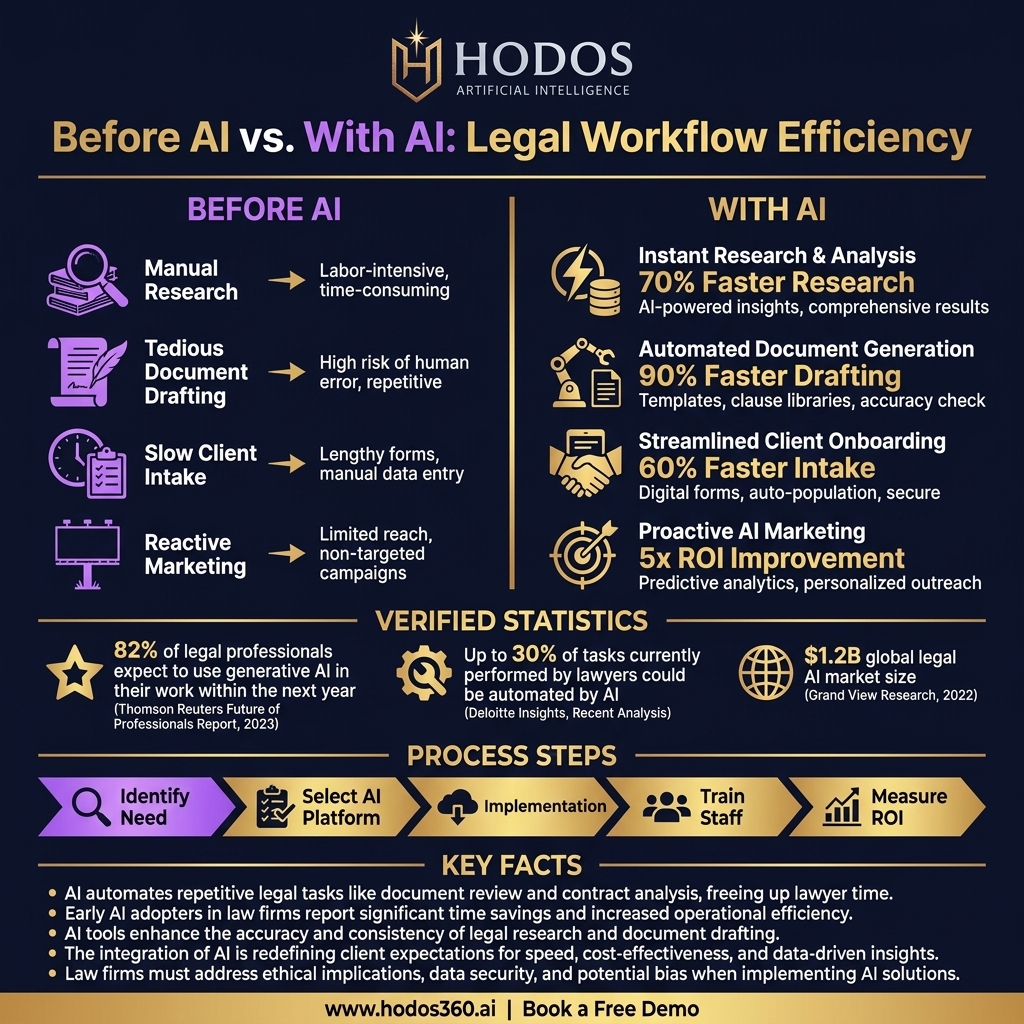
This goes far beyond rudimentary task automation. Consider client intake: traditionally laborious, involving multiple forms and manual conflict checks. With AI, a system can ingest client information, auto-populate forms, conduct instant conflict checks against firm databases, and even suggest initial legal strategies, all within minutes.
This not only streamlines onboarding but significantly enhances the client experience.
The impact extends deeply into the operational fabric of a firm. Learn more about AI Legal Ethics: Essential Guide to Avoiding Blunders. Billing, for example, often consumes valuable attorney time. AI can track billable hours more accurately, categorize expenses, and identify billing discrepancies.
Document automation, a cornerstone of legal technology innovation, has evolved from simple template filling to intelligent document generation, where AI can draft complex contracts, pleadings, and motions based on specific case details and legal precedents. This drastically reduces drafting time and minimizes human error, freeing up lawyers to dedicate their expertise to strategic thinking and client advocacy.
A 2023 ABA report highlighted that firms utilizing AI for document automation reported a 30% increase in productivity for routine tasks, enabling them to handle a higher volume of cases without proportional increases in headcount.
AI-Powered Legal Workflows and Predictive Analytics
Beyond individual task automation, AI is revolutionizing entire legal workflows and introducing the power of predictive analytics. Imagine an AI system that can analyze historical case data, judicial tendencies, and opposing counsel's patterns to predict litigation outcomes. Companies like LexisNexis and Thomson Reuters are heavily investing in these areas, offering tools that provide data-driven insights for litigation strategy.
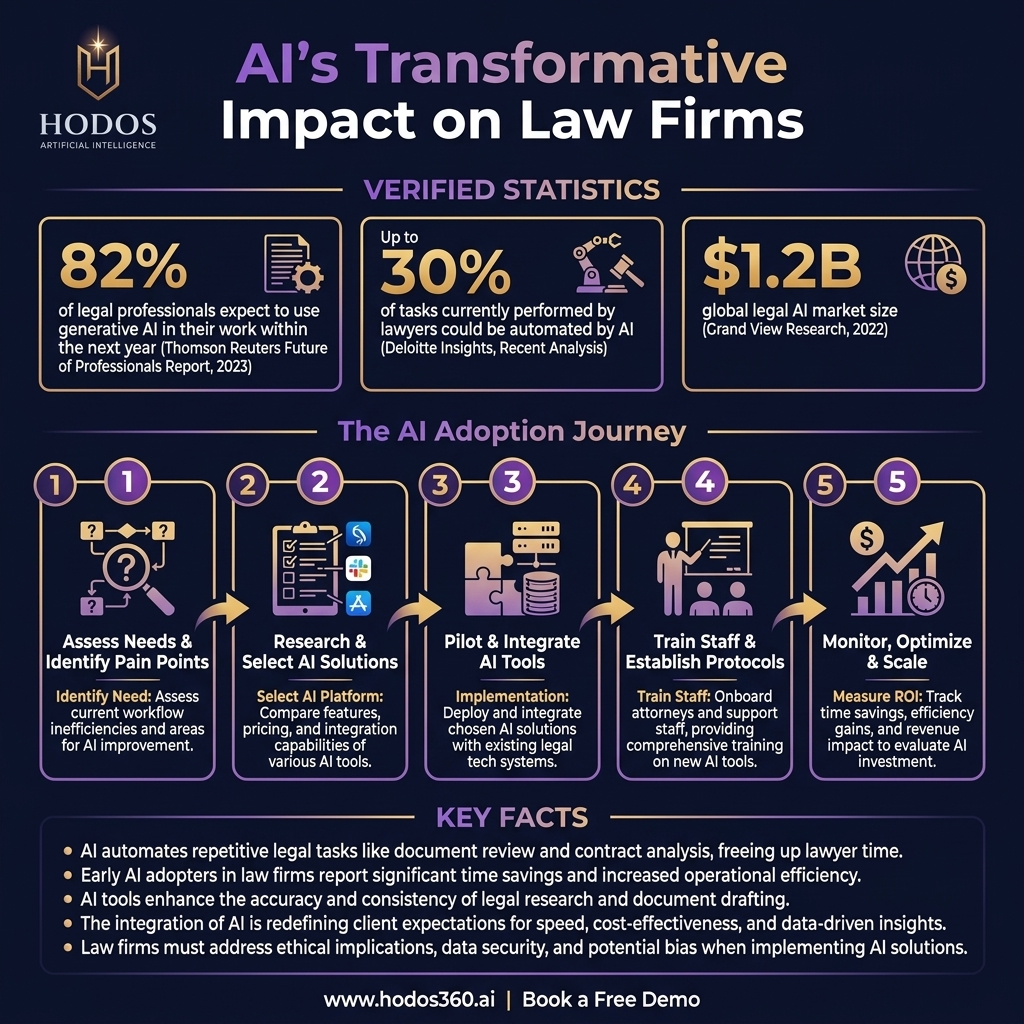
For example, a litigator might use AI to analyze thousands of past motions to dismiss in similar jurisdictions, identifying the most successful arguments. This level of research and strategic insight was previously unattainable.
This predictive capability also extends to practice management. Learn more about AI App Development: Essential for Law Firms' Digital Future.
AI can forecast future caseloads, optimize resource allocation, and even identify potential client churn risks. By analyzing client communication patterns, AI can flag clients who might be disengaging, allowing firms to intervene proactively. This proactive approach to law firm management moves beyond reactive problem-solving to strategic foresight, enabling firms to anticipate challenges and opportunities before they fully materialize, thereby enhancing their overall impact and competitiveness.
Unlock unparalleled efficiency and strategic insights. [Request a Demo of HODOS 360's AI Law Firm Management System]
Enhancing Client Engagement and Marketing with Artificial Intelligence
In today's competitive legal landscape, client engagement and effective marketing are paramount. Artificial intelligence is providing law firms with unprecedented tools to connect with clients, generate leads, and build their brand. Firms are now leveraging AI for everything from personalized client communication to sophisticated social media campaigns.
Imagine an AI marketing platform that not only generates compelling content but also analyzes engagement metrics across various channels, predicting which types of content resonate most with specific client demographics. This level of granular insight allows firms to tailor their messaging, ensuring maximum effect and ROI.
Beyond content generation, AI is transforming the very first point of contact with potential clients. AI Voice Assistants are now capable of 24/7 phone answering, lead qualification, and appointment booking. Learn more about AI Software Development's **Revolutionary** 2026 Shift. This means a potential client calling at 2 AM can receive immediate, intelligent assistance, have their lead qualified, and even book an initial consultation without human intervention.
This dramatically improves responsiveness and ensures no lead is missed. Furthermore, these AI assistants can offer multilingual support, expanding a firm's reach to diverse communities. The data collected can then be fed back into an AI marketing platform to refine targeting and messaging, creating a virtuous cycle of continuous improvement in client acquisition, a crucial aspect of modern legal innovation.
Web & Mobile Development: AI-Powered Online Presence
A strong online presence is non-negotiable for modern law firms. AI is now integral to web & mobile development, enabling firms to create high-converting, SEO-optimized digital storefronts with unprecedented ease. AI-powered website builders can analyze competitor sites, identify optimal design elements for legal services, and even generate content snippets, ensuring the firm's website ranks highly in search engine results.
This isn't just about aesthetics; it's about functionality and visibility. Responsive design, ensuring a seamless experience across all devices, is now often automated or significantly accelerated by AI tools, ensuring potential clients can easily access information.
The integration of AI extends to the user experience itself.
Learn more about AI Marketing Automation: Essential Lead Flow for Law Firms. Chatbots on websites, powered by advanced natural language processing, can answer common questions, guide visitors, and even conduct preliminary intake, feeding qualified leads directly to the legal team. This combines the best of artificial intelligence with practical web design principles, creating a powerful digital gateway for law firms.
Firms leveraging these AI-driven development tools can launch sophisticated, high-performance websites faster and at a lower cost than traditional methods, giving them a distinct advantage in attracting and retaining clients.
The Ethical Imperative: AI, Competence, and Professional Responsibility
As AI's capabilities expand, so too do the ethical considerations for legal professionals. The "known unknown" extends to the legal and ethical frameworks that govern AI's use. The American Bar Association (ABA) has been at the forefront of this discussion, with updates to its Model Rules of Professional Conduct emphasizing technological competence.
ABA Model Rule 1.1, Comment [8], for instance, explicitly states that "maintaining the requisite knowledge and skill ordinarily requires a lawyer to keep abreast of changes in the law and its practice, including the benefits and risks associated with relevant technology." This isn't a suggestion; it's a professional obligation.
Lawyers using AI tools, whether for legal research, document review, or client communication, must understand their underlying mechanics, limitations, and potential biases.
The human element remains critical. While AI can draft a motion, the ultimate responsibility for its accuracy, ethical implications, and strategic soundness rests squarely with the attorney.
This was highlighted in the widely reported case of *Mata v. Learn more about Legal AI Problem: Mastering Ethical Tech in Law Firms 2026. Avianca, Inc.* in 2023, where a lawyer submitted a brief citing non-existent cases generated by a generative AI tool, leading to sanctions.
This incident served as a stark reminder that AI is a tool, not a substitute for human diligence and verification. The impact of AI on the legal profession necessitates a recalibration of how lawyers approach their duties of competence, confidentiality (ABA Model Rule 1.6), and supervision (ABA Model Rule 5.1 and 5.3).
Firms must establish clear guidelines for AI usage, provide comprehensive training, and implement robust review processes. The EU AI Act, expected to be fully enforced by 2027, will also introduce stringent regulations for high-risk AI systems.
Ensuring Data Security and Client Confidentiality in AI Adoption
The adoption of AI tools, particularly those that process sensitive client data, brings paramount concerns regarding data security and client confidentiality. Law firms are custodians of highly sensitive information, and any breach can have devastating consequences. When integrating AI solutions, firms must perform rigorous due diligence on vendors, ensuring compliance with stringent data protection regulations such as GDPR, CCPA, and HIPAA where applicable.
This involves understanding how AI models are trained, where data is stored, and what security protocols are in place.
The Federal Rules of Civil Procedure, particularly Rule 26, which governs discovery, also implicitly underscore the need for careful management of electronically stored information (ESI). Lawyers must ensure that their use of AI aligns with their obligations to protect client data and maintain privilege.
This means having clear internal policies on data input into AI systems, especially public-facing generative AI tools, and ensuring that any confidential client information is adequately anonymized or processed within secure, private environments. The long-term effect of AI on legal practice will largely depend on the profession's ability to harness its power responsibly, safeguarding core ethical principles while embracing technological progress.
Future-Proofing Your Practice: Strategic Adoption of AI
The path forward for law firms is clear: strategic adoption of AI is not optional, but essential for future-proofing their practice. The competition is no longer just local; it's global, driven by firms leveraging artificial intelligence to deliver services faster, more cost-effectively, and with greater precision.
Firms that resist this wave risk being left behind, much like those businesses that failed to adapt to the internet revolution decades ago. The key is not to implement AI for AI's sake, but to identify specific pain points and strategic opportunities where AI can deliver tangible value.
This requires a cultural shift, encouraging experimentation, continuous learning, and investment in legal technology infrastructure.
Leaders like Mary O'Carroll, Chief Relationship Officer at AdvanceLaw and former Director of Legal Operations at Google, consistently advocate for a proactive approach to technology adoption, emphasizing that legal professionals must evolve their skill sets to work alongside AI.
This means training lawyers and staff not just on how to use AI tools, but how to critically evaluate their outputs, understand their limitations, and integrate them ethically into their workflows. The future of the legal profession will involve a hybrid model, where human intelligence is augmented by artificial intelligence, creating a more efficient, accessible, and ultimately more just legal system.
The firms that thrive will be those that view AI not as a threat, but as a powerful partner in delivering exceptional legal services.

Key Takeaways and Next Steps
The journey into AI's "known unknown" parallels the transformative impact of the interstate highways, promising both profound advancements and unforeseen challenges for the legal profession. From streamlining law firm management and enhancing client engagement to navigating complex ethical landscapes, artificial intelligence is redefining what it means to practice law.
For firms seeking to not just survive but thrive in this new era, strategic integration of advanced AI solutions is paramount. This involves embracing tools that automate routine tasks, provide predictive insights, and empower legal professionals to focus on the highest value work. HODOS 360 stands at the forefront of this transformation, offering a suite of AI-powered services designed specifically for law firms.
Our AI Law Firm Management System, AI Marketing Platform, AI Voice Assistants, and Web & Mobile Development services provide a comprehensive framework for firms to harness AI's full potential. By leveraging these integrated solutions, law firms can unlock unparalleled efficiencies, enhance client acquisition, and ensure they remain competitive and relevant.
The time to act is now, to move beyond merely acknowledging AI's presence to actively shaping its beneficial effect on your practice.
Ready to transform your practice with cutting-edge AI? [Schedule Your Free HODOS 360 Consultation Today!]
Frequently Asked Questions
How is AI primarily impacting legal research?+
AI is revolutionizing legal research by significantly speeding up the process of sifting through vast amounts of data, case law, and statutes. Tools powered by natural language processing can identify relevant precedents, summarize complex documents, and even highlight potential arguments, allowing lawyers to conduct more thorough and efficient research in a fraction of the time. This augmentation frees up attorneys to focus on strategic analysis rather than exhaustive manual review.
What ethical considerations should law firms prioritize when adopting AI?+
Law firms must prioritize competence, confidentiality, and supervision. Lawyers have a duty to understand AI tools' capabilities and limitations, ensure client data privacy, and diligently verify AI-generated content to prevent errors or misrepresentations. Firms should establish clear policies for AI use, provide ongoing training, and maintain robust review processes to uphold professional standards and avoid sanctions, as emphasized by ABA Model Rule 1.1, Comment [8].
Can AI truly help with client acquisition and marketing?+
Absolutely. AI marketing platforms can analyze market trends, generate targeted content for social media and blogs, and track ROI, ensuring marketing efforts are highly effective. AI Voice Assistants offer 24/7 client answering, lead qualification, and appointment booking, ensuring no potential client is missed. This combination creates a powerful, data-driven approach to attract and retain clients, significantly boosting a firm's market presence.
How does AI contribute to law firm operational efficiency?+
AI streamlines operations by automating repetitive tasks across case management, billing, client intake, and document automation. It can auto-populate forms, conduct conflict checks, track billable hours, and draft routine legal documents, drastically reducing manual effort and human error. This allows staff and lawyers to focus on higher-value work, improving overall productivity, reducing overhead, and enhancing profitability.
What is the long-term outlook for AI in the legal profession?+
The long-term outlook suggests a transformative shift toward an AI-augmented legal profession. AI will continue to automate routine tasks, provide predictive insights for strategy, and enhance access to justice. Lawyers will evolve into strategic advisors, leveraging AI as a powerful co-pilot. Firms that proactively integrate AI and adapt their skill sets will be best positioned for growth, innovation, and sustained competitive advantage in a rapidly evolving legal landscape.