


AI Law Firm Expansion: An Ultimate Guide to Growth & Innovation
The legal industry witnessed a significant milestone recently with the announcement that AI law firm Norm Law, a pioneering AI-native practice, has opened its Washington, D.C. office. This strategic move, widely reported by LawFuel.com and other legal news outlets, isn't just another firm expanding its footprint; it represents a profound shift in how legal services are conceived, delivered, and scaled. Founded by visionary John Nay, Norm Law's expansion into the heart of U.S. regulatory power signals a new era where artificial intelligence isn't merely a tool but the foundational operating system of legal practice. This development ignites crucial questions for every law firm owner and attorney: How are AI-native models redefining competition? What does strategic expansion look like in an AI-powered world? And how can traditional firms adapt to this rapidly evolving landscape to ensure sustainable growth and innovation?
Norm Law's decision to establish a D.C. presence, bringing on board experienced partners Katelyn Kimber and Lindsey Savage, positions it directly at the nexus of technology and policy. This move underscores a critical trend: as AI permeates every sector, the legal industry's engagement with its ethical, regulatory, and practical implications becomes paramount. Firms that understand and leverage AI's capabilities, from automating routine tasks to generating sophisticated legal analysis, are poised to gain a decisive advantage. The tension between the traditional, human-centric model and the emerging AI-driven approach is palpable, creating both challenges and unparalleled opportunities for those willing to embrace change. The imperative is clear: firms must either evolve or risk being outmaneuvered by agile, technologically advanced competitors who are already reshaping the future of law.
Ready to transform your practice with cutting-edge AI? Discover how HODOS 360 can empower your firm's growth and efficiency. [Book a Free Demo Today!]
The Rise of the AI-Native Law Firm Model
The concept of an AI law firm is moving beyond mere augmentation to full-fledged native integration. Unlike traditional firms that adopt AI tools to enhance existing processes, an AI-native firm is built from the ground up with artificial intelligence embedded in its very DNA. This fundamental difference allows for a complete reimagining of workflows, resource allocation, and service delivery. Norm Law, for instance, operates with a unique blend of human lawyers, legal agents, and AI engineers. This interdisciplinary approach allows for the rapid development and deployment of sophisticated AI models that can tackle complex legal tasks, from regulatory compliance to contract analysis, with unprecedented speed and accuracy. The model announced by John Nay aims to create a more efficient, scalable, and cost-effective legal service, challenging the long-held assumptions about billable hours and lawyer productivity.
This shift isn't isolated. Major players are also moving aggressively into the AI space. Learn more about AI-Native Law Firms: Essential Blueprint for Future Legal Success. Harvey AI, a legal tech startup backed by OpenAI, notably partnered with global giant Allen & Overy in 2023, showcasing how even the largest, most established firms are seeking to integrate advanced AI capabilities. Similarly, Linklaters announced its own generative AI platform, 'Nexa,' developed with the support of Microsoft Azure OpenAI Service. These developments highlight a growing recognition across the legal sector that AI is not a fleeting trend but a core component of future legal strategy. According to a 2024 Thomson Reuters report, over 60% of large law firms are actively exploring or implementing generative AI solutions, up from less than 10% just two years prior, indicating a rapid acceleration in adoption. The race is on to define what a modern, technologically advanced legal practice truly looks like, and firms that hesitate risk falling behind the curve in efficiency and client service.
The Strategic Imperative of Geographic Expansion
Norm Law's decision to open its Washington, D.C. office is a masterclass in strategic positioning. D.C. is not just a major legal market; it's the epicenter of U.S. federal regulation and policy-making. For an AI law firm focused on navigating complex regulatory landscapes, being in Washington provides unparalleled access to legislative developments, regulatory agencies, and influential policymakers. This proximity allows firms to anticipate changes, influence policy discussions, and provide real-time, highly informed counsel to clients grappling with emerging technologies like AI itself. The firm’s new partners, Katelyn Kimber and Lindsey Savage, bring significant experience in areas critical to the intersection of technology and law, further strengthening Norm Law's capability to operate effectively in this high-stakes environment.
This move also reflects a broader trend in the legal industry where firms are expanding to be closer to key client bases or regulatory hubs. Learn more about Legal AI Funding: Essential Strategies for Law Firms. However, the AI-native approach offers a unique advantage. With AI-powered workflows and document automation, a firm can establish a physical presence with a leaner operational footprint, focusing human talent on high-value strategic work rather than administrative overhead. This allows for more agile and cost-effective expansion. The ability of AI agents to perform extensive research, draft initial documents, and manage case details means that the human lawyers in the D.C. office can dedicate their expertise to client relationships, advocacy, and high-level strategic advice, maximizing the impact of their physical presence. This model allows for more precise and impactful resource allocation, differentiating AI-native firms in competitive markets.
Leveraging AI for Unprecedented Operational Excellence
The true power of an AI law firm lies in its ability to harness artificial intelligence for unparalleled operational excellence. Beyond simple document review, AI is revolutionizing core aspects of law firm management, from client intake and case management to billing and legal research. AI-powered platforms can automate the initial client intake process, gathering essential information and even performing preliminary conflict checks, freeing up valuable paralegal and attorney time. Case management systems integrated with AI can predict case durations, identify critical deadlines, and suggest optimal strategies based on vast datasets of past litigation. This level of predictive analytics and automation dramatically reduces administrative burdens and allows legal professionals to focus on the nuanced, human-centric aspects of their work.
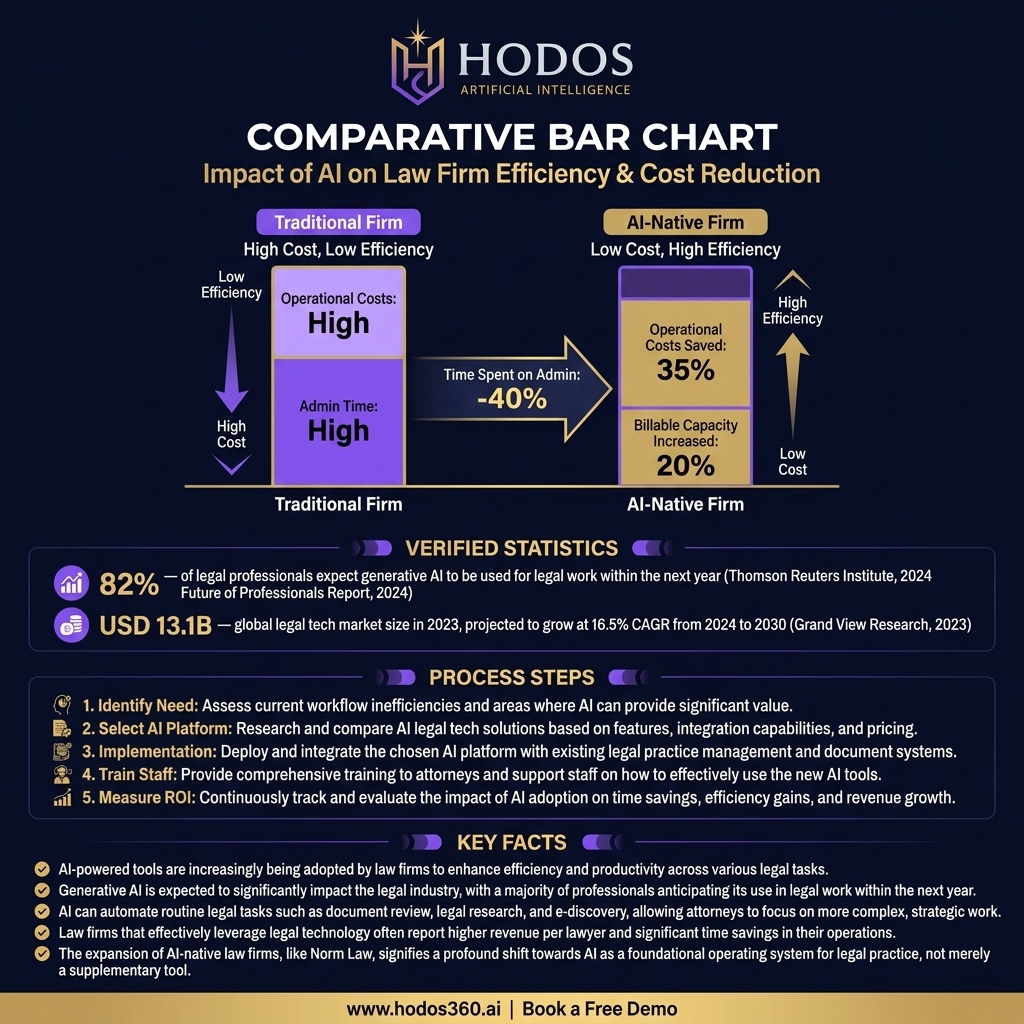
Consider the impact on document automation and legal workflows. Generative AI can draft initial versions of contracts, pleadings, and discovery responses, significantly accelerating the drafting process. Learn more about Essential AI Web Development: Harvard's Free Courses for Law Firms. This doesn't replace the lawyer; it empowers them to refine and strategize, rather than starting from a blank page. Billing, traditionally a time-consuming task, can be streamlined through AI that accurately tracks time spent on various tasks, cross-references with client agreements, and even identifies potential billing errors before they occur. According to a 2025 report by Gartner, firms fully leveraging AI for operational tasks can see a 30-40% reduction in overhead costs and a 20% increase in billable capacity per attorney. This efficiency gain is not just about cost savings; it's about reallocating resources to strategic growth and client satisfaction, providing a competitive edge in a saturated market. For firms seeking to optimize these processes, an integrated AI Law Firm Management System, like those offered by HODOS 360, becomes an indispensable asset, orchestrating everything from document creation to complex legal workflows.

Unlock the full potential of your firm with HODOS 360's AI-powered solutions. From seamless case management to strategic marketing, we've got you covered. Learn more about AI Legal CRM: Essential Strategies for Exposed Firm Data. [Explore Our Services!]
Data-Driven Insights and Predictive Analytics
The traditional legal practice often relies on intuition and experience, but an AI law firm integrates robust data analytics to drive decisions. AI can analyze vast quantities of legal data—case precedents, judicial rulings, legislative histories, and even juror behavior—to provide actionable insights. This capability extends beyond mere research; it enables predictive analytics that can forecast litigation outcomes, assess the likelihood of success for different legal strategies, and identify potential risks before they materialize. For example, AI can analyze historical patent litigation data to advise clients on the optimal jurisdiction for filing a lawsuit or estimate the potential damages in an intellectual property dispute. This shifts legal advice from reactive to proactive, empowering attorneys to guide clients with unprecedented foresight.
Furthermore, AI-driven analytics are transforming business development. By analyzing client data and market trends, AI can identify new service opportunities, pinpoint potential client segments, and even personalize marketing outreach. Learn more about Ultimate Website Builders: Essential for Modern Law Firms. This isn't just about efficiency; it's about strategic advantage. Firms can make data-backed decisions on everything from staffing needs to geographical expansion, ensuring that resources are deployed where they will yield the greatest return. The ability to measure ROI on marketing campaigns or track the effectiveness of different legal strategies provides a level of business intelligence previously unimaginable in the legal sector. This data-first approach, championed by firms like Norm Law, is quickly becoming a benchmark for innovation and growth.
Navigating the Ethical and Regulatory Landscape of AI in Law
As the AI law firm model gains traction, the ethical and regulatory challenges become increasingly complex. The legal profession, bound by strict rules of professional conduct, must grapple with issues such as client confidentiality, data privacy, the unauthorized practice of law, and the potential for algorithmic bias. The ABA Model Rules of Professional Conduct, particularly Rule 1.1 on Competence and Rule 1.6 on Confidentiality of Information, demand that attorneys understand the risks associated with technology. The use of generative AI, for instance, raises concerns about the accuracy of outputs—often termed 'hallucinations'—and the potential for disclosing confidential client data if not managed securely. Firms must implement robust data governance policies and ensure that AI tools are used ethically and responsibly, with human oversight always in place.
Globally, regulatory bodies are racing to catch up. The European Union's AI Act, set to be fully enforced by 2027, provides a comprehensive framework for governing AI, classifying systems by risk level and imposing stringent requirements for high-risk applications. While the U.S. Learn more about AI Marketing: The Ultimate Guide to Law Firm Growth & Automation. has yet to pass comprehensive federal AI legislation, various states and federal agencies are exploring guidelines. For instance, the National Institute of Standards and Technology (NIST) has published an AI Risk Management Framework, and state bar associations are issuing guidance on the ethical use of AI. For example, the State Bar of California's Formal Opinion No. 2023-1, though not directly a rule, provides valuable insights into lawyers' ethical duties when using generative AI. Firms must stay abreast of these evolving regulations and ethical opinions, ensuring their AI adoption strategies are compliant and transparent. Failure to do so not only risks sanctions but also erodes client trust and damages reputation, a far greater cost than any efficiency gain.
Cultivating AI Talent and Expertise
The emergence of the AI law firm necessitates a new kind of legal professional. The demand for 'legal engineers'—individuals who bridge the gap between legal expertise and technological development—is soaring. These professionals are crucial for customizing AI platforms, developing internal AI tools, and ensuring seamless integration of technology into legal workflows. Firms can no longer rely solely on traditional law school graduates; they must either recruit talent with combined legal and technical skills or invest heavily in upskilling their existing workforce. This involves training attorneys and staff not just on how to use AI tools, but how to understand their underlying mechanisms, interpret their outputs critically, and identify opportunities for further AI integration.
This shift also redefines the role of the traditional lawyer. Instead of being replaced, attorneys are evolving into strategic advisors and critical evaluators of AI-generated content. They become the ultimate arbiters of accuracy, ethics, and legal strategy, leveraging AI to enhance their capabilities rather than diminish them. Firms that proactively invest in continuous learning programs, create dedicated AI task forces, and foster a culture of technological adoption will be best positioned to attract and retain top talent. This human-AI collaboration is not just about efficiency; it's about creating a more intellectually stimulating and impactful legal practice, where complex problem-solving remains at the forefront, supported by intelligent automation. The competitive market for these specialized roles is intense, with companies like OpenAI, Anthropic, and NVIDIA investing heavily in AI research, driving up the demand for skilled engineers and prompting a similar talent war in legal tech.
Future-Proofing Your Practice: A Strategic Roadmap
For law firms looking to future-proof their practice in an era dominated by the AI law firm, a clear strategic roadmap is essential. The first step is to conduct a comprehensive audit of existing operations to identify areas where AI can deliver the most significant impact, whether in document automation, legal research, or client management. This isn't a one-time project but an ongoing commitment to innovation. Firms must foster a culture that embraces technological change, encouraging experimentation and continuous learning among all staff. Investing in pilot programs for new AI tools and gathering feedback from early adopters can provide invaluable insights before full-scale implementation. The journey towards becoming an AI-powered firm is iterative, requiring agility and a willingness to adapt.
Secondly, strategic partnerships with legal tech providers are crucial. Building proprietary AI solutions from scratch can be prohibitively expensive and resource-intensive for most firms. Collaborating with specialized vendors allows firms to leverage best-in-class technology without the immense development burden. This also enables firms to stay updated with rapid advancements in AI, ensuring their technology stack remains competitive. Finally, firms must focus on differentiating their human value. While AI can handle routine tasks, the uniquely human elements of law—empathy, strategic judgment, client relationship building, and complex ethical reasoning—remain irreplaceable. By offloading mundane tasks to AI, lawyers can dedicate more time to these high-value activities, strengthening client loyalty and enhancing their professional satisfaction. This dual approach of aggressive AI adoption combined with a renewed focus on human excellence is the blueprint for enduring success in the evolving legal market.

Key Takeaways and Next Steps
The opening of Norm Law's Washington, D.C. office is a stark reminder that the future of legal practice is here, and it’s deeply intertwined with artificial intelligence. The rise of the AI law firm model demands that all legal professionals re-evaluate their operational strategies, talent acquisition, and ethical frameworks. Embracing AI is no longer optional; it's a strategic imperative for growth, efficiency, and maintaining a competitive edge. Firms must move beyond simply acknowledging AI's potential to actively integrating it into their core operations, focusing on ethical deployment, continuous learning, and strategic expansion.
To thrive in this new era, law firms should prioritize investing in robust AI-powered practice management systems that streamline workflows, automate administrative tasks, and provide data-driven insights. They must also cultivate a workforce equipped with both legal acumen and technological literacy, fostering a culture of innovation. The legal landscape is being redefined, not by technology alone, but by how intelligently and ethically humans wield it. By taking proactive steps, firms can transform challenges into opportunities, securing their place as leaders in the next generation of legal service delivery. [Schedule a Consultation with HODOS 360!]
Frequently Asked Questions
What is an AI-native law firm?+
An AI-native law firm is built from the ground up with artificial intelligence as its core operational system, rather than simply augmenting existing processes with AI tools. These firms integrate AI across all functions, from legal research and document automation to case management and client intake, often employing legal engineers alongside traditional lawyers to optimize AI models and workflows for maximum efficiency and innovation.
How does AI facilitate law firm expansion?+
AI facilitates expansion by enabling leaner, more efficient operations. AI-powered systems can automate routine tasks, manage vast amounts of data, and provide predictive analytics, reducing the need for extensive human resources in new offices. This allows firms to strategically open new locations, like Norm Law's D.C. office, with a focus on high-value human expertise, while AI handles the scalable, repetitive work, making expansion more cost-effective and agile.
What are the ethical concerns of using AI in legal practice?+
Ethical concerns include ensuring client confidentiality and data privacy, preventing algorithmic bias in legal analysis, avoiding the unauthorized practice of law by AI tools, and maintaining attorney competence in overseeing AI outputs. The ABA Model Rules require lawyers to understand the risks and benefits of technology, emphasizing the need for human oversight, transparency, and robust data governance to mitigate potential ethical pitfalls and maintain professional responsibility.
How can traditional law firms compete with AI-native firms?+
Traditional firms can compete by strategically adopting and integrating AI into their operations, focusing on areas like practice management, document automation, and legal research to enhance efficiency and client service. They should invest in upskilling their workforce, fostering a culture of innovation, and leveraging their existing human expertise for complex strategy and client relationships. Partnerships with legal tech providers are also key to staying competitive and future-proofing their practice.
What role do legal engineers play in an AI law firm?+
Legal engineers are crucial in an AI law firm, bridging the gap between legal expertise and technology. They develop, customize, and integrate AI systems into legal workflows, ensuring these tools are effective, compliant, and tailored to specific legal needs. Their role involves everything from data architecture and model training to process optimization and ethical AI deployment, enabling the firm to build and maintain its AI-powered operational backbone and deliver innovative legal solutions efficiently.