


AI Legal CRM: Essential Strategies for Exposed Firm Data
In early 2026, the legal tech world buzzed with the story of Sterling & Hayes, a mid-sized corporate law firm lauded for its early adoption of advanced AI solutions. They had invested heavily in an AI-powered CRM overlay, expecting a seismic shift in client engagement and business development.
Yet, six months in, managing partner Eleanor Vance confessed at a private industry roundtable, "We thought AI would be our silver bullet, but it felt more like a magnifying glass, exposing every crack in our client data. Our 'personalized' outreach was riddled with inaccuracies, leading to more client frustration than engagement."
This candid admission echoed sentiments shared by many, culminating in the recent JD Supra article, "AI Won’t Fix Legal CRM. It Will Expose It," a stark reminder that technology, however powerful, is only as good as the foundation it builds upon.
The narrative of AI as a panacea for outdated systems often overshadows the critical prerequisite: data integrity.
For years, legal CRM platforms, while designed to centralize client information, frequently became sprawling data graveyards—repositories of incomplete, inconsistent, or stale entries. A 2025 report by the ABA's Legal Technology Resource Center revealed that over 60% of law firms surveyed reported significant issues with data quality in their CRM systems, citing everything from duplicate client records to outdated contact information and incomplete matter histories.
When firms like Sterling & Hayes introduce AI into such environments, the algorithms, designed to identify patterns and personalize interactions, instead produce confident, yet flawed, outputs. As Matthew Parfitt, a prominent legal tech consultant, aptly put it, "AI is very good at producing polished output from mixed inputs," meaning it will confidently generate a personalized email based on incorrect data, inadvertently alienating the very clients it aims to attract.
This isn't a condemnation of AI, but rather a crucial pivot point for law firms. The challenge isn't whether to adopt AI in legal marketing and CRM, but how to prepare the underlying infrastructure for its effective deployment. The firms that succeed with AI-enabled business development will be those that treat data governance as an operating imperative, not an afterthought.
They understand that AI doesn't magically cleanse data; it merely highlights the urgent need for a robust, human-driven strategy to ensure accuracy, relevance, and ethical compliance. The focus must shift from simply acquiring AI tools to strategically cultivating the data environment where these tools can genuinely thrive, reshaping client relationships and firm growth.
The Unveiling Truth: Why AI Exposes Flawed Legal CRM Data
The core premise of the JD Supra article resonates deeply within the legal industry. For decades, many law firms have relied on CRM systems that, while functional, often lacked the rigorous data input protocols and continuous maintenance necessary for high-fidelity information. These systems, designed primarily for contact management and basic matter tracking, were not built to withstand the scrutiny of advanced analytics.
When an AI algorithm is fed a dataset rife with inconsistencies—such as multiple entries for the same client with differing contact details, or incomplete records of past interactions—it cannot discern the 'correct' information. Instead, it processes what it's given, leading to outputs that, while syntactically perfect, are factually incorrect.
This phenomenon was vividly illustrated when 'Legacy Legal Partners,' a firm mentioned anonymously in a recent LegalTech NYC 2026 panel, found their AI-driven email campaigns inadvertently targeting deceased clients or sending irrelevant practice area updates due to outdated client segmentation.
This exposure by AI is not a bug; it's a feature.
It forces firms to confront the hidden costs of their data debt. Learn more about Legal AI Trust: An Essential Guide for Law Firms. According to a 2024 Gartner report, poor data quality costs businesses, on average, $12.9 million annually. For law firms, this translates into not just operational inefficiencies but also significant reputational damage and lost client opportunities.
Imagine an AI-powered voice assistant, designed for 24/7 client support, attempting to book an appointment for a client whose contact information is incorrect, or routing a call based on an outdated matter status. The result is a broken client experience that erodes trust, rather than building it.
The promise of AI lies in its ability to unlock unprecedented insights and efficiencies, but this potential remains untapped, or worse, becomes counterproductive, when the underlying data is compromised. The firms that are already succeeding understand this fundamental truth.
The Cost of Neglecting Data Integrity
Neglecting data integrity carries far-reaching consequences beyond mere operational hiccups. Financially, it manifests in wasted marketing spend on misdirected campaigns, inefficient resource allocation, and ultimately, lost revenue from client attrition. Reputational damage, however, can be even more severe. In an era where client experience is paramount, an AI-powered interaction gone wrong can quickly sour a long-standing relationship.
Learn more about Legal AI Gap: Bridging the Divide for Law Firms in 2026. Consider the ethical implications, too, as outlined in ABA Model Rule 1.1 (Competence), which implicitly requires attorneys to understand the benefits and risks associated with technology. Providing inaccurate information, even inadvertently through an AI system, could raise questions about a firm's diligence.
Furthermore, compromised data security, often linked to poor data governance, can lead to breaches that violate client confidentiality, a breach of ABA Model Rule 1.6 (Confidentiality of Information), and incur substantial regulatory fines under frameworks like GDPR or the California Consumer Privacy Act (CCPA).
Beyond Automation: Building a Robust Foundation for AI-Enabled Growth
The path to truly leveraging AI in legal CRM begins not with software installation, but with a meticulous overhaul of existing data. This process, often referred to as data cleansing or data hygiene, involves identifying and rectifying errors, removing duplicates, standardizing formats, and enriching incomplete records.
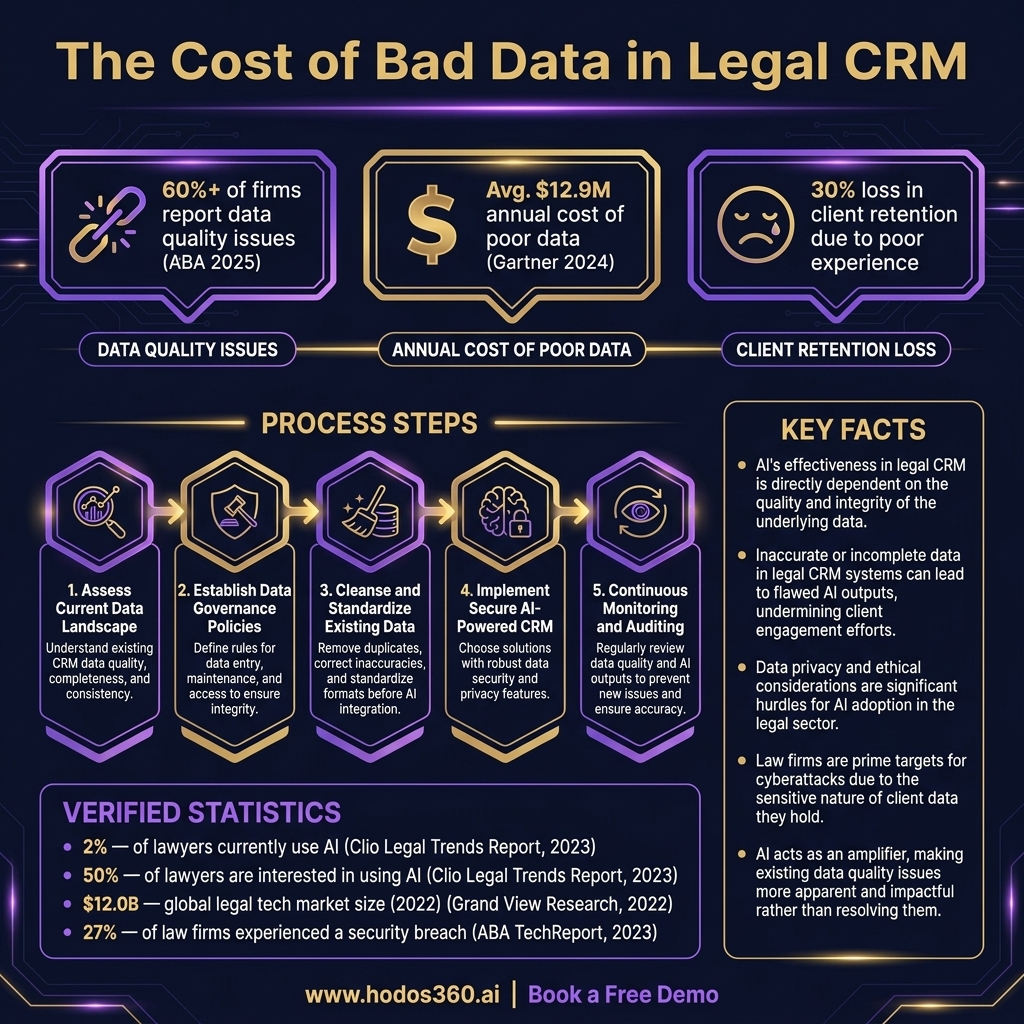
Firms must develop clear protocols for data entry and maintenance, ensuring that every piece of information—from client intake forms to communication logs and billing details—is accurate and up-to-date. Jack Newton, CEO and founder of Clio, a leading legal practice management platform, has frequently emphasized the importance of data quality, noting that "the power of legal tech is directly proportional to the quality of the data it processes."
His company's success, in part, stems from providing tools that encourage and facilitate structured data input, enabling more intelligent reporting and automation. Without this foundational work, AI's advanced capabilities remain underutilized or, worse, become a liability.
Building this robust foundation also necessitates a shift in firm culture, moving from viewing data entry as a clerical task to recognizing it as a strategic imperative.
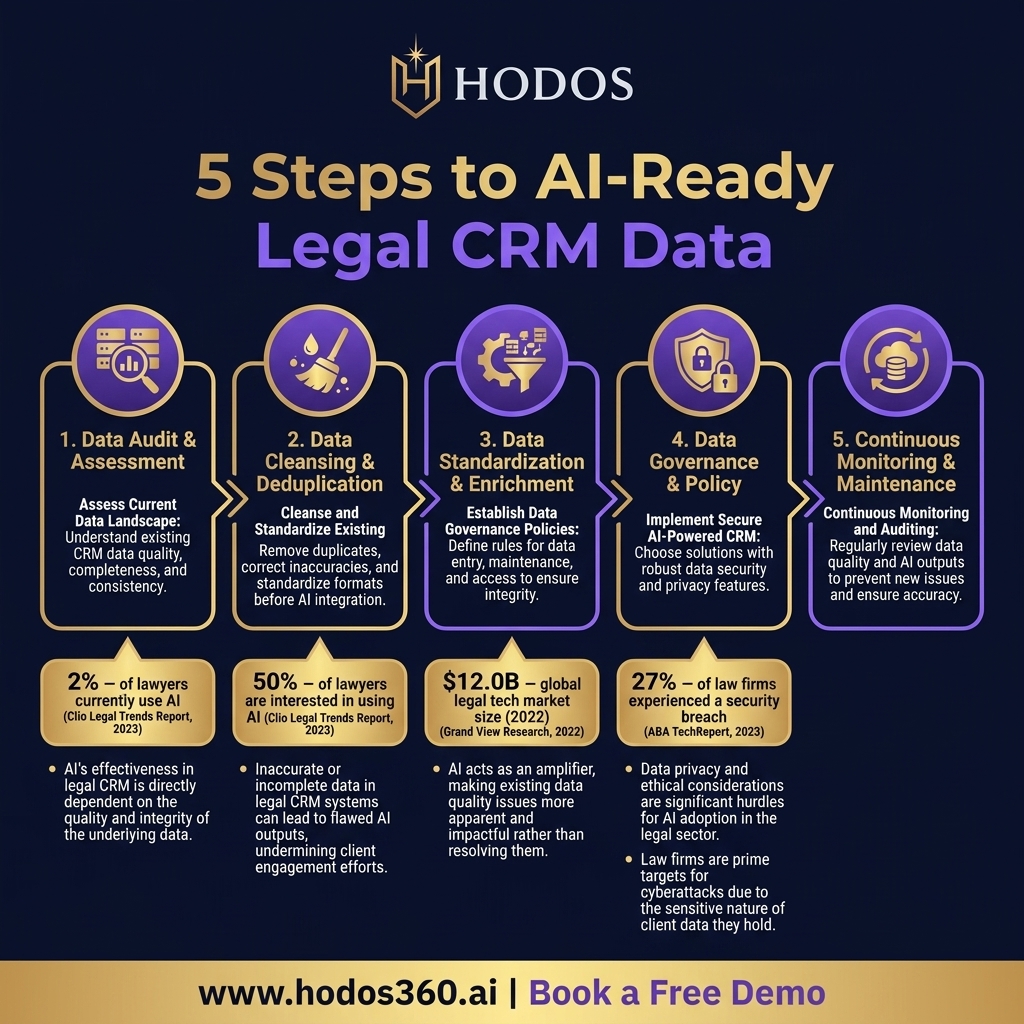
This involves training staff, from paralegals to senior partners, on data governance best practices. Learn more about AI Voice Assistant: Essential for Modern Law Firm Success. Firms must invest in tools and processes that support ongoing data validation and enrichment. For instance, implementing automated checks for data consistency, integrating with external data sources for contact verification, and establishing regular data audit schedules are crucial.
A firm that can confidently assert the accuracy of its client data is one that is truly prepared for AI. This proactive approach ensures that when AI is finally deployed, it’s working with a reliable source of truth, maximizing its potential for personalized marketing, efficient client intake, and predictive analytics that drive business development.
Implementing a Proactive Data Audit
A proactive data audit is indispensable before any significant AI implementation. This involves a systematic review of your entire CRM database. Start by defining key data points critical for client engagement and business development, such as client contact information, matter types, communication history, billing preferences, and referral sources.
Utilize data visualization tools to identify anomalies, duplicates, and missing fields. Learn more about Voice AI: The Essential Leap for Law Firm Client Engagement. Engage cross-functional teams, including marketing, intake, and legal staff, to ensure a holistic review, as each department interacts with client data differently.
Establish clear data ownership and accountability, ensuring that specific individuals are responsible for the accuracy and maintenance of particular data segments. This granular approach ensures that when AI tools are integrated, they operate on a verified foundation, enabling precision in client outreach and operational efficiency.
Strategic Data Governance: The Cornerstone of Successful AI Adoption
Strategic data governance is not merely about data cleanliness; it encompasses the entire lifecycle of information within a law firm, from collection and storage to usage, sharing, and eventual archival. It involves establishing clear policies, procedures, and responsibilities for managing data assets. This is particularly critical in the legal sector, where client confidentiality and data privacy are paramount.
The enforcement of regulations like the EU AI Act in early 2026 further underscores the need for robust governance, requiring transparency and accountability in how AI systems process data. Firms must develop comprehensive data retention policies, ensure compliance with evolving privacy laws, and implement robust security measures to protect sensitive client information.
This framework ensures that AI tools are not only effective but also operate within ethical and legal boundaries, safeguarding client trust and firm reputation.
Establishing a data governance committee, comprising representatives from IT, marketing, legal, and compliance, can be highly effective. Learn more about Essential AI Web Development: Build Legal Apps with Ease.
This committee would be responsible for defining data standards, overseeing data quality initiatives, and making decisions regarding data access and usage. For instance, they would determine how client matter data is anonymized for marketing analytics or how AI-generated content is vetted for accuracy and ethical compliance.
Firms like 'Innovate Legal Group,' recognized for their forward-thinking approach, have invested in dedicated data stewards who work closely with their AI teams. This structured approach to governance minimizes risks associated with AI deployment, such as algorithmic bias or data breaches, while maximizing the strategic value derived from their data assets.
It's about building trust in the data, which in turn builds trust in the AI-driven insights.
Leveraging AI Marketing Platforms for Authentic Client Engagement
Once a firm has established a robust data foundation, the true power of AI marketing platforms can be unleashed. Platforms like HODOS 360's AI Marketing Platform offer a suite of tools designed to transform client engagement, from AI video creation and social media automation to content generation and sophisticated ROI tracking.
With clean, well-governed data, these tools can move beyond generic outreach to deliver highly personalized and relevant communications. Imagine an AI generating a tailored video message for a prospective client, referencing their specific industry challenges and previous interactions, or an automated social media campaign that targets precise demographics with content directly addressing their legal pain points, all informed by accurate client profiles and historical data.
This level of personalization, previously impossible at scale, fosters authentic engagement and strengthens client relationships.
However, the success hinges entirely on the quality of the input data. Firms that attempt to use these advanced platforms on flawed CRM data will find their efforts not only wasted but potentially damaging.
Learn more about Essential AI Website Builder Guide for Law Firms. Instead of targeted messaging, they might inadvertently send irrelevant offers, misspell client names, or reference outdated legal issues. This is where the JD Supra article’s point about AI exposing flaws becomes most evident. Conversely, firms leveraging platforms like HODOS 360 with a pristine data foundation can achieve unprecedented levels of efficiency and effectiveness.
They can track the ROI of every marketing dollar with precision, optimize campaigns in real-time based on actual engagement data, and predict future client needs with greater accuracy, turning marketing from a cost center into a powerful growth engine. The ability to measure the true impact of AI-enabled business development is a game-changer.
Measuring ROI in AI-Powered Marketing
Measuring the Return on Investment (ROI) for AI-powered marketing initiatives requires moving beyond traditional vanity metrics. With clean data and sophisticated analytics, firms can track granular metrics such as client acquisition cost per channel, client lifetime value, conversion rates from specific AI-generated content, and engagement rates on personalized communications.
Tools within advanced AI Marketing Platforms allow for A/B testing of AI-generated content, attribution modeling across various touchpoints, and predictive analytics that forecast future lead generation and client retention. This data-driven approach enables continuous optimization, ensuring that marketing spend is efficiently allocated to strategies that yield the highest returns and directly contribute to the firm's bottom line.
The ability to demonstrate tangible ROI is critical for securing ongoing investment in AI technologies.
The Future-Ready Law Firm: Integrating AI for Sustainable Success
The journey toward becoming a future-ready law firm in the age of AI is multifaceted, demanding a holistic approach that integrates technology, data strategy, and human expertise. AI is not a magic wand that instantly transforms outdated practices; rather, it is a powerful amplifier. For firms that have invested in solid data foundations and robust governance, AI can amplify their strengths, enabling unparalleled efficiency, deeper client insights, and more effective marketing.
For those that have neglected their data, AI will simply amplify their weaknesses, leading to frustration and disillusionment. The competitive landscape is already reshaping, with firms that prioritize data quality gaining a significant edge. As Dario Amodei, co-founder of Anthropic, often discusses, the responsible deployment of powerful AI systems requires meticulous attention to the inputs and the ethical frameworks governing their operation.
The true success stories in AI adoption are emerging from firms that view AI as an integral part of a larger, carefully constructed ecosystem. They understand that AI-enabled business development isn't just about the tools themselves, but about the strategic vision, the commitment to data excellence, and the continuous adaptation of processes.
These firms are not just reacting to technological shifts; they are proactively shaping their future, building sustainable growth models that leverage AI to enhance, rather than replace, human ingenuity. The opportunity for law firms to succeed with AI is immense, provided they embrace the fundamental truth: AI won't fix bad data; it will expose it, giving firms the clearest possible mandate to build better.

Key Takeaways and Next Steps
The message from the legal tech community is clear: AI is transformative, but its efficacy in legal CRM and marketing is directly proportional to the quality of your underlying data. Firms must move beyond superficial AI adoption to a deep commitment to data integrity and strategic governance.
Start with a comprehensive data audit, establish clear data entry protocols, and invest in continuous data hygiene. Once your data foundation is solid, leverage advanced AI marketing platforms to unlock personalized client engagement and measurable ROI. This proactive approach not only mitigates the risks of AI exposing your firm’s weaknesses but transforms AI into a powerful engine for genuine growth and stronger client relationships.
Don't wait for AI to expose your data problems; empower it with clean data to reveal your firm's true potential. To explore how AI can elevate your firm's marketing and client management, consider a strategic consultation.
Frequently Asked Questions
Why is clean data crucial for AI in legal CRM?+
Clean data is paramount because AI algorithms rely on accurate, consistent, and complete information to generate reliable insights and actions. If the input data is flawed, AI will produce confident but incorrect outputs, leading to misdirected marketing, poor client experiences, and wasted resources. AI doesn't fix bad data; it amplifies its inconsistencies, making data integrity a foundational requirement for any successful AI implementation in legal CRM.
What are the common pitfalls of implementing AI with poor CRM data?+
Firms implementing AI with poor CRM data often encounter several pitfalls, including inaccurate client segmentation, irrelevant marketing communications, misinformed business development strategies, and damaged client trust due to personalized outreach based on incorrect information. It can also lead to operational inefficiencies as staff spend time correcting AI-generated errors, ultimately undermining the very benefits AI is supposed to deliver, and potentially violating ethical obligations regarding client competence and confidentiality.
How can law firms improve their CRM data quality?+
Improving CRM data quality involves several steps: conducting a comprehensive data audit to identify errors and duplicates, standardizing data entry protocols for all staff, implementing ongoing data validation processes, and regularly enriching data with updated information. Establishing clear data ownership and accountability, along with continuous staff training on data best practices, are also crucial. Investing in specialized data cleansing tools can further streamline this essential preparatory work.
What role does data governance play in AI adoption for law firms?+
Data governance is the framework of policies, procedures, and responsibilities that ensures data assets are managed effectively and ethically. For AI adoption, it's critical for establishing data standards, ensuring compliance with privacy regulations (e.g., GDPR, CCPA, EU AI Act), and mitigating risks like algorithmic bias or data breaches. Robust governance builds trust in the data, which is essential for AI systems to operate reliably and responsibly, safeguarding client information and firm reputation.
How can AI marketing platforms benefit law firms once data is clean?+
With clean data, AI marketing platforms offer immense benefits: hyper-personalized client communications, automated content generation tailored to specific segments, highly targeted social media campaigns, and precise ROI tracking. This enables firms to optimize marketing spend, predict client needs, and foster deeper, more authentic client relationships at scale. The ability to deliver relevant, timely information transforms marketing into a powerful, data-driven engine for business development and sustainable growth.