


AI Law Firm Management: The Ultimate Guide for Growth
The legal industry, often perceived as a bastion of tradition, is experiencing an unprecedented wave of innovation, largely driven by artificial intelligence. Just this week, the news broke that Magnar, a burgeoning Latin American legal AI startup, secured an impressive $8 million seed round, backed significantly by major law firms. This isn't merely another headline; it's a potent indicator of a global shift. Law firms are no longer just observing the AI revolution from the sidelines; they are actively investing in and integrating these technologies to redefine their operational paradigms and competitive strategies. This strategic financial endorsement from within the legal community underscores a critical truth: AI is no longer a futuristic concept but a present-day imperative for AI law firm management and sustained growth.
This investment surge isn't isolated to a few tech-forward firms. Across the globe, from the bustling tech hubs of Silicon Valley to the emerging markets of Latin America, legal professionals are recognizing the transformative power of AI to streamline complex processes, enhance decision-making, and liberate attorneys from mundane administrative burdens. Firms like Allen & Overy, a global legal powerhouse, have already made significant strides, notably through their partnership with Harvey AI to develop advanced legal reasoning tools. This collaboration, spearheaded by initiatives like Allen & Overy's "Markets Innovation Group" led by Kevin Oliver, demonstrates a proactive embrace of AI, moving beyond simple automation to sophisticated, integrated solutions that reshape how legal services are delivered and managed. The era of reactive technology adoption is over; proactive integration of AI law firm management systems is now the hallmark of forward-thinking legal practices.
The implications of this trend are profound for every law firm, regardless of size or specialization. An integrated AI law firm management system offers a comprehensive suite of tools designed to optimize every facet of practice, from initial client intake to complex case resolution and financial oversight. It’s about more than just efficiency; it’s about creating a more agile, responsive, and ultimately more profitable legal practice. As we delve deeper into the capabilities and strategic advantages of these systems, we'll explore how firms can leverage AI not just to keep pace with change, but to lead it, securing a robust future in an increasingly competitive landscape. The time to re-evaluate traditional operational models and embrace AI-driven innovation is now.
The Rising Tide of AI Investment in Legal Operations
The $8 million seed round secured by Magnar AI, with direct backing from prominent law firms, is a powerful testament to the growing confidence in AI law firm management solutions. This isn't just venture capital chasing the next big trend; it’s an industry investing in its own future. Traditionally, legal tech adoption has been slower than other sectors, but recent years have seen a dramatic acceleration. According to a 2023 report by Thomson Reuters, investment in legal tech companies reached an all-time high, with a significant portion directed towards solutions that enhance operational efficiency and practice management. Firms are realizing that the competitive edge no longer lies solely in legal acumen, but equally in technological prowess and streamlined operations. This shift is creating a fertile ground for startups like Magnar, which promise to bring cutting-edge AI capabilities to regions like Latin America, where the legal market is ripe for digital transformation.
The strategic rationale behind these investments is clear: to address the inefficiencies inherent in traditional legal practice. From manual document review to time-consuming client intake processes, law firms have historically grappled with administrative burdens that detract from billable hours and client service. Companies like Clio, a veteran in practice management software, have seen tremendous growth, demonstrating the foundational need for integrated solutions. However, the new wave of investment, as exemplified by Magnar's funding, is focused on AI's ability to move beyond mere automation to intelligent augmentation. Learn more about AI Litigation: Essential Guide for Navigating Pro Se AI Use. This includes predictive analytics for case outcomes, AI-powered legal research, and sophisticated workflow orchestration that can anticipate needs and proactively manage tasks. The goal is to create a legal ecosystem where AI acts as a force multiplier, enabling lawyers to focus on high-value, strategic legal work rather than getting bogged down in repetitive tasks. This evolution is vital for firms aiming to stay relevant and profitable.
Furthermore, the entry of major law firms as direct investors in legal AI startups signals a deeper, more collaborative integration. Instead of merely being end-users, firms are becoming active partners in shaping the future of legal tech. This provides startups with invaluable insights into real-world legal challenges and ensures that the developed solutions are genuinely tailored to the industry's needs. For instance, the aforementioned collaboration between Allen & Overy and Harvey AI didn't just provide a new tool; it fostered an ecosystem of continuous innovation, where lawyers and technologists co-create solutions. This synergy is critical for developing sophisticated AI law firm management platforms that are not only technologically advanced but also ethically sound and practically effective. The next few years will undoubtedly see more of these strategic alliances, driving even faster innovation and broader adoption across the legal landscape.
Beyond Automation: AI-Powered Legal Workflows and Efficiency Gains
The true power of AI law firm management extends far beyond simple automation. While automating repetitive tasks like document generation or scheduling is valuable, AI introduces a layer of intelligence that transforms entire legal workflows. Consider case management: traditional systems track deadlines and documents, but an AI-powered system can do much more. It can analyze past case data to predict potential outcomes, suggest optimal strategies based on precedents, and even intelligently allocate resources by identifying which team members are best suited for specific tasks based on their expertise and availability. This predictive capability significantly reduces the time spent on manual research and strategic planning, allowing attorneys to focus on the nuanced legal arguments that win cases. According to the ABA TechReport 2023, firms leveraging advanced automation reported an average of 15-20% increase in overall productivity, directly attributing these gains to AI-driven workflow optimizations.
One of the most impactful areas where AI is redefining efficiency is in client intake and document automation. The initial phase of engaging a new client, often fraught with manual data entry, conflict checks, and repetitive form filling, can be significantly streamlined. AI can process intake forms, extract key information, and even perform preliminary lead qualification, routing high-priority clients to the appropriate legal teams instantly. Learn more about Gemini Enterprise Legal: Unlocking AI Automation for Firms. For document automation, AI moves beyond simple templates; it can draft complex contracts, generate pleadings, and review legal documents for inconsistencies or missing clauses, often faster and with greater accuracy than human counterparts. For example, AI-powered tools can analyze thousands of pages of discovery documents in minutes, identifying relevant information and patterns that would take human eyes weeks. This not only saves significant time and cost but also reduces the risk of human error, ensuring a higher quality of legal output and enhancing the firm's reputation for meticulousness.
The integration of AI into daily legal operations fundamentally changes the role of the legal professional. Instead of spending hours on data entry, document review, or administrative coordination, lawyers and paralegals can dedicate their expertise to complex problem-solving, strategic client advice, and fostering client relationships. This shift is not about replacing human lawyers but augmenting their capabilities, making them more effective and efficient. The result is a practice where legal professionals are empowered to deliver higher-value services, improve client satisfaction, and ultimately, drive the firm's growth. HODOS 360’s AI Law Firm Management System exemplifies this comprehensive approach, integrating these intelligent workflows into a seamless platform designed to elevate every aspect of legal practice.
Streamlining Client Intake with Intelligent AI
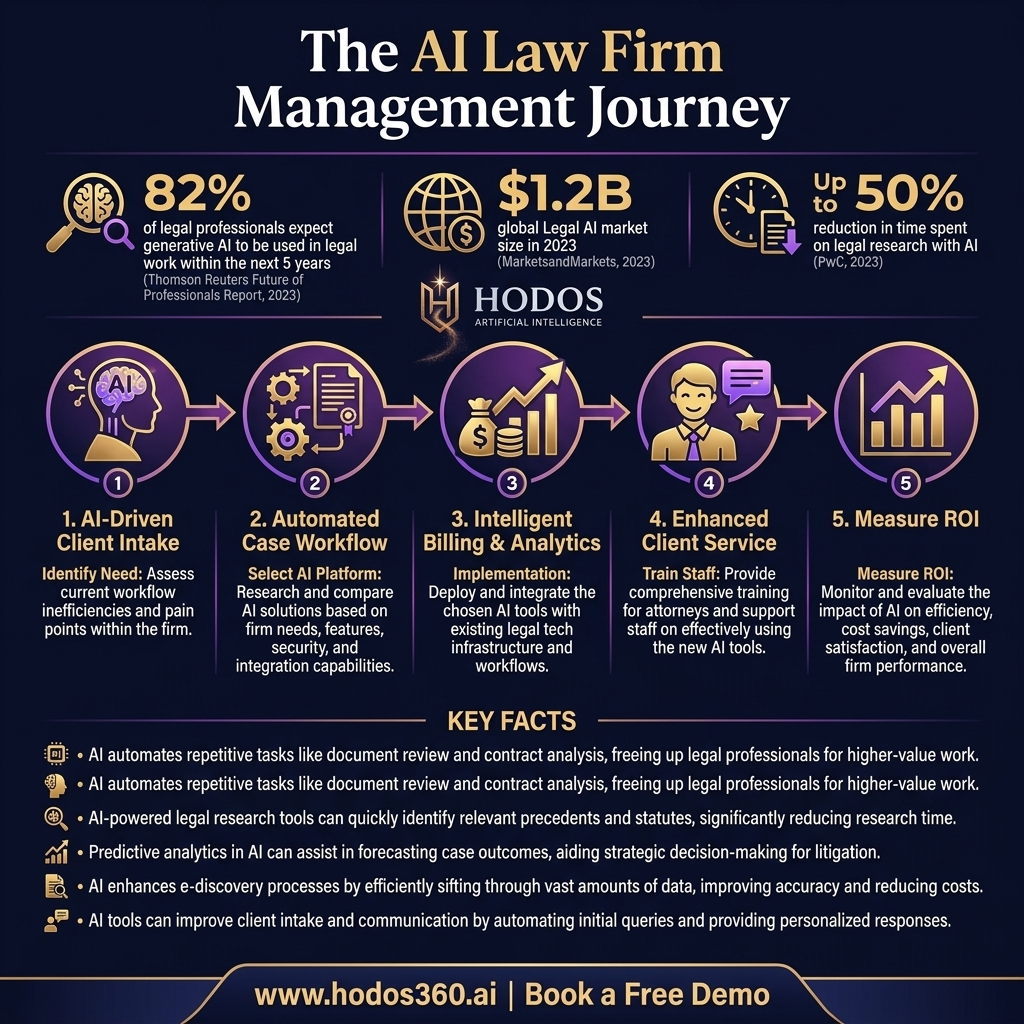
The client intake process is often the first touchpoint and a critical determinant of client satisfaction and retention. Traditionally, this involves lengthy forms, manual data entry, and time-consuming conflict checks. Intelligent AI transforms this experience entirely. AI-powered intake systems can engage prospective clients through dynamic questionnaires, extracting pertinent information using natural language processing (NLP). This data is then automatically populated into the firm's CRM and case management system, eliminating manual transcription errors and saving valuable administrative time. Learn more about Essential Safeguarding Legal Data Practices for AI Firms. Beyond data capture, AI can perform immediate lead qualification, assessing the potential value and fit of a new client based on predefined criteria, and even conducting preliminary conflict checks against existing client databases, flagging potential issues instantly. This not only accelerates the onboarding process but also ensures that only qualified leads consume precious attorney time, optimizing resource allocation and improving the overall client experience from the very first interaction. This proactive, data-driven approach positions firms to grow efficiently.
The Strategic Advantage: Data-Driven Decisions and Revenue Growth
Beyond operational efficiency, AI law firm management systems offer a profound strategic advantage through data-driven decision-making. These platforms collect and analyze vast amounts of operational and financial data, transforming raw numbers into actionable insights. For instance, AI can identify patterns in billing and expenses, flagging potential revenue leakage or inefficiencies in resource allocation. It can forecast cash flow with greater accuracy, helping firms make informed decisions about investments, hiring, and expansion. By analyzing historical client data, AI can also pinpoint the most profitable practice areas, the most effective marketing channels, and even predict client churn, allowing firms to proactively adjust their strategies. This level of granular insight was previously unattainable for most firms, requiring extensive manual analysis or expensive consulting services. Now, it's an inherent feature of advanced AI platforms, empowering firm leaders to steer their practice towards sustained growth and increased profitability.
Consider the competitive landscape: firms that leverage AI for strategic insights are demonstrably outpacing those relying on traditional, intuition-based decision-making. A McKinsey report from 2024 highlighted that companies across industries adopting AI for strategic planning reported an average of 10-15% higher revenue growth compared to their non-AI counterparts. Learn more about AI Web Development: Essential Collaboration for Law Firms. In the legal sector, this translates to firms that can quickly identify emerging market trends, optimize their service offerings, and tailor their client engagement strategies with precision. For example, an AI law firm management system might reveal that a particular type of litigation in a specific industry is experiencing rapid growth, prompting the firm to allocate more resources to that area or even launch a targeted marketing campaign. This agility allows firms to respond to market dynamics with speed and accuracy, securing a significant competitive edge.
Furthermore, AI's ability to provide objective, data-backed insights helps mitigate risks and optimize financial health. Predictive analytics can identify potential challenges before they escalate, whether it's a looming cash flow issue or a potential slowdown in a particular practice area. This early warning system allows firm management to implement corrective measures proactively, safeguarding the firm's stability and long-term viability. The integration of AI into billing and financial management, for example, can automate invoice generation, track payment statuses, and even predict the likelihood of timely payment, significantly improving collections and reducing administrative overhead. This holistic approach to financial oversight, driven by intelligent data analysis, is crucial for any firm aiming for sustainable revenue growth and operational excellence in today's dynamic legal market.
Optimizing Financial Management with AI Analytics
Financial health is the bedrock of any successful law firm, and AI analytics are revolutionizing how firms manage their finances. Traditional billing and expense tracking can be cumbersome and prone to error, often leading to missed revenue opportunities or delayed payments. AI-powered financial modules within a law firm management system automate these processes, ensuring accuracy and timeliness. Beyond automation, AI offers predictive capabilities: it can analyze historical billing data to forecast future revenue, identify potential payment delays, and even suggest optimized billing rates based on market benchmarks and attorney performance. Learn more about Agentic Marketing: The Ultimate Guide for Law Firms. This allows firms to proactively manage cash flow, allocate budgets more effectively, and identify areas for cost reduction. By transforming raw financial data into clear, actionable intelligence, AI empowers firm leaders to make strategic decisions that drive profitability and ensure long-term financial stability, moving beyond reactive accounting to proactive financial stewardship.

Navigating Ethical Considerations and Data Security in AI Adoption
As law firms increasingly adopt AI law firm management systems, navigating the complex landscape of ethical considerations and data security becomes paramount. The legal profession is bound by stringent rules regarding client confidentiality, data privacy, and professional competence. The American Bar Association (ABA) Model Rules of Professional Conduct, particularly Rule 1.1 (Competence) and Rule 1.6 (Confidentiality), implicitly require lawyers to understand the risks and benefits associated with technology. This means firms must exercise due diligence when selecting and implementing AI solutions, ensuring that these systems are not only effective but also compliant with all relevant data privacy regulations like GDPR, CCPA, and the forthcoming EU AI Act. The responsibility falls on the firm to ensure that client data, often highly sensitive, is protected from breaches and that AI algorithms are transparent and unbiased in their operations. This requires a robust framework of technical safeguards and ethical guidelines.
One of the primary concerns revolves around data security. AI systems process vast amounts of information, including privileged and confidential client data. Therefore, the chosen AI law firm management platform must incorporate state-of-the-art cybersecurity measures, including end-to-end encryption, multi-factor authentication, regular security audits, and robust access controls. Firms must also ensure that their AI vendors adhere to the highest industry standards for data protection and have clear protocols for data handling and disaster recovery. The consequences of a data breach in the legal sector can be catastrophic, leading to severe reputational damage, significant financial penalties, and loss of client trust. Learn more about AI Chatbot Development: The Essential Guide for Law Firms. Therefore, security should never be an afterthought but a foundational element in the evaluation and deployment of any AI solution. Firms must engage with their IT and compliance teams to thoroughly vet potential AI partners and ensure their systems meet or exceed regulatory requirements.
Beyond security, the ethical implications of AI in legal decision-making are profound. While AI can augment human capabilities, it must not replace human judgment, especially in areas requiring nuanced ethical considerations or complex legal interpretation. The concept of "human in the loop" is critical here, ensuring that AI-generated insights or recommendations are always reviewed and validated by a qualified legal professional. Furthermore, firms must guard against algorithmic bias, which can arise if AI systems are trained on unrepresentative or skewed data, potentially leading to unfair or discriminatory outcomes. Transparency in AI operations and the ability to audit AI decisions are essential for maintaining ethical standards and ensuring accountability. As Professor Ryan Abbott of the University of Surrey School of Law often emphasizes, the responsible integration of AI requires a continuous dialogue between technologists, legal professionals, and ethicists to ensure that innovation serves justice, not undermines it. Firms adopting AI law firm management must proactively develop internal policies and training programs to address these ethical challenges, fostering a culture of responsible AI use.
Safeguarding Client Data in the AI Era
The proliferation of AI in legal practice necessitates a renewed focus on safeguarding client data, which is often among the most sensitive information a firm handles. An AI law firm management system must be built on a foundation of robust cybersecurity. This includes advanced encryption protocols for data at rest and in transit, stringent access controls based on roles and permissions, and regular vulnerability assessments. Firms must ensure their AI vendors comply with global data privacy regulations like GDPR, CCPA, and the upcoming EU AI Act, which impose strict requirements on how personal data is collected, processed, and stored. Implementing multi-factor authentication, maintaining comprehensive audit trails, and having a clear incident response plan are not optional but essential. The firm's reputation and legal obligations demand that client data, processed by AI or otherwise, remains secure, confidential, and handled with the utmost care, preventing breaches that could have devastating consequences.

Key Takeaways and Next Steps for Law Firms
The narrative of Magnar AI's successful funding round is not just a story of a startup's triumph; it's a microcosm of a larger, irreversible trend in the legal industry. AI law firm management is no longer a luxury but a strategic imperative for firms aiming for sustained growth, operational excellence, and a competitive edge. The benefits are clear: unprecedented efficiencies in daily operations, data-driven insights for strategic decision-making, and the empowerment of legal professionals to focus on higher-value work. Firms that embrace this technological evolution are positioning themselves not just to adapt, but to thrive in a rapidly changing legal landscape, attracting top talent and discerning clients who value innovation and efficiency.
For law firms contemplating their next steps, the journey into advanced AI adoption doesn't have to be overwhelming. Start by identifying your firm's most significant pain points—whether it’s client intake bottlenecks, inefficient document review, or a lack of clear financial insights. Seek out integrated solutions that offer a comprehensive suite of AI-powered tools, rather than piecemeal applications that may not communicate effectively. Prioritize platforms that emphasize robust data security, ethical AI principles, and transparent operations, ensuring compliance with professional obligations. Most importantly, foster a culture within your firm that is open to technological change and continuous learning, as the capabilities of AI will only continue to expand.
The future of legal practice is inextricably linked with intelligent technology. Platforms like HODOS 360 offer a comprehensive suite of AI services, from AI Law Firm Management Systems that streamline every aspect of your practice to AI Marketing Platforms, AI Voice Assistants, and Web & Mobile Development. These tools are designed to provide a holistic approach to modernization, helping firms not only manage cases and clients more efficiently but also attract new business and enhance their digital presence. By integrating AI strategically, law firms can unlock new levels of productivity, profitability, and client satisfaction, securing their place at the forefront of the legal profession. Don't wait to embrace the future; begin your transformation today.
- ✓AI-Powered Case Management: Utilizes predictive analytics for optimal resource allocation, scheduling, and strategy, significantly reducing manual oversight.
- ✓Automated Client Intake and Lead Qualification: Streamlines the onboarding process, from initial contact to conflict checks, ensuring efficient and accurate client acquisition.
- ✓Intelligent Document Drafting and Review: Employs AI to generate complex legal documents, review contracts for inconsistencies, and analyze discovery materials with unparalleled speed and accuracy.
- ✓Integrated Billing and Financial Forecasting: Automates invoicing, tracks expenses, and provides predictive insights into cash flow and profitability, optimizing financial health.
- ✓AI-Driven Legal Workflow Optimization: Creates adaptive workflows that automate routine tasks and intelligently route information, freeing legal professionals for high-value work.
- ✓Advanced Analytics for Firm Performance: Offers granular data insights into practice area profitability, attorney productivity, and market trends, informing strategic growth decisions.
- ✓Robust Security and Compliance Features: Incorporates state-of-the-art cybersecurity measures and ethical AI frameworks to protect sensitive client data and ensure regulatory adherence.
Frequently Asked Questions
What specifically does AI Law Firm Management entail beyond basic software?+
AI Law Firm Management goes beyond basic software by integrating machine learning and natural language processing to offer predictive analytics, intelligent automation, and sophisticated data insights. It can anticipate legal outcomes, optimize workflows dynamically, and provide strategic recommendations based on vast datasets, transforming operations from reactive to proactive. This enables firms to make data-driven decisions for efficiency and growth, unlike traditional systems that primarily manage data.
How can AI improve client intake and satisfaction?+
AI improves client intake by automating lead qualification, performing instant conflict checks, and populating client information into systems, reducing manual errors and saving time. It can also personalize initial client interactions and streamline onboarding processes. This efficiency translates to faster service, a more professional first impression, and increased client satisfaction, as attorneys can engage more quickly and effectively with qualified leads, enhancing the overall client experience.
What are the primary ethical considerations when adopting AI in a law firm?+
Primary ethical considerations include safeguarding client confidentiality (ABA Model Rule 1.6), ensuring algorithmic transparency and fairness, and maintaining human oversight in critical decision-making. Firms must guard against potential biases in AI systems, comply with data privacy regulations like GDPR, and ensure AI tools enhance, rather than diminish, professional competence (ABA Model Rule 1.1). Continuous ethical review and lawyer engagement are crucial for responsible AI deployment.
Is AI Law Firm Management only for large firms, or can small firms benefit?+
AI Law Firm Management is highly beneficial for firms of all sizes. While large firms can leverage AI for complex, high-volume tasks, small firms can use it to level the playing field, automating administrative duties and gaining access to sophisticated analytics typically reserved for larger operations. This allows smaller practices to increase efficiency, compete more effectively, and provide high-quality services without needing extensive support staff, making advanced tech accessible to all.
How does AI contribute to a law firm's revenue growth?+
AI contributes to revenue growth by enhancing efficiency, which increases billable hours and reduces operational costs. It provides data analytics to identify profitable practice areas, optimize pricing strategies, and forecast financial performance, enabling strategic investment decisions. By streamlining client intake and improving client satisfaction, AI also helps attract and retain more clients. Ultimately, AI transforms operational data into actionable insights that directly fuel the firm's profitability and expansion.