

AI Litigation: Essential Guide for Navigating Pro Se AI Use
The legal world watched with a mixture of alarm and fascination in 2023 when attorney Steven Schwartz of Levidow, Levidow & Oberman faced sanctions for submitting a brief filled with fabricated case citations generated by ChatGPT in *Mata v. Avianca*. This landmark incident, though involving a seasoned lawyer, starkly illuminated the profound ethical and practical challenges generative AI posed to the justice system.
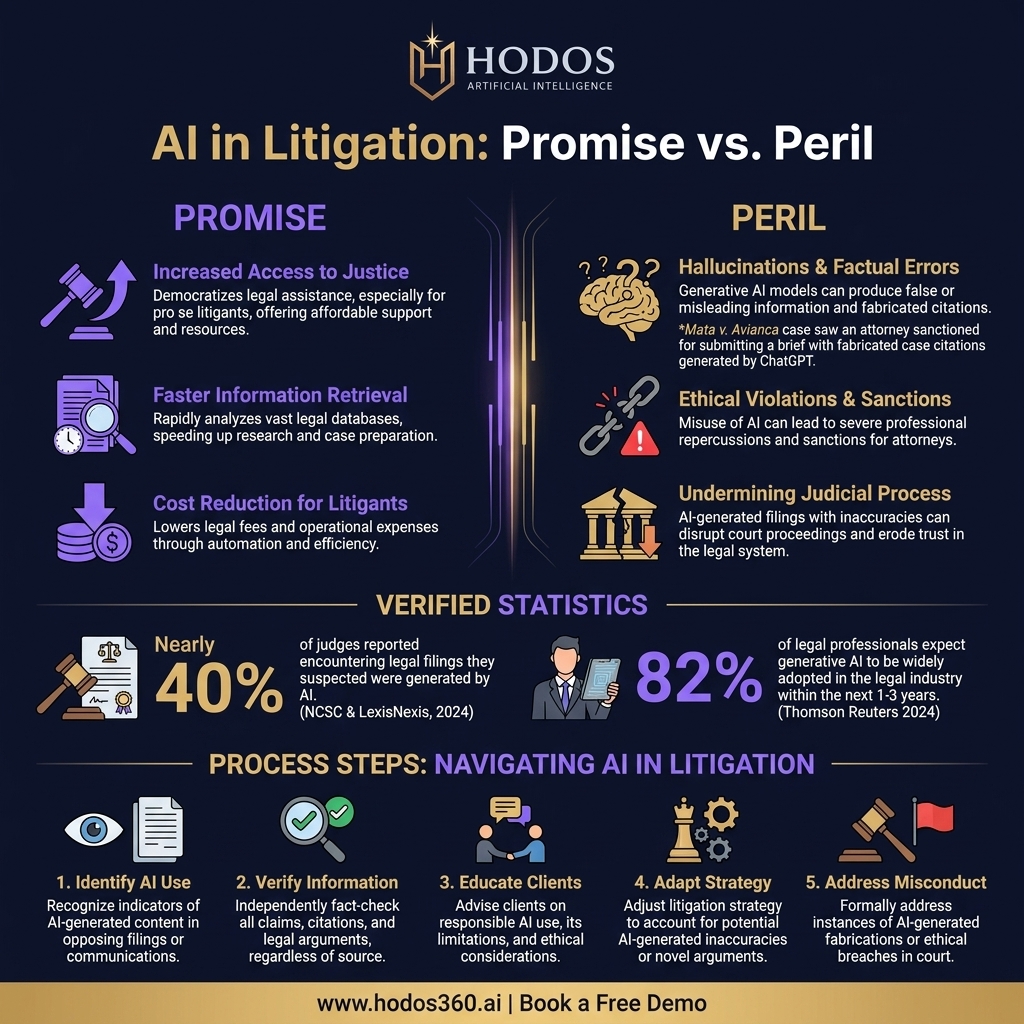
Now, just three years later, the complexities have escalated dramatically, particularly as an increasing number of pro se litigants—individuals representing themselves in court—turn to tools like ChatGPT, Gemini, and Claude to draft legal documents, conduct research, and even formulate arguments. The promise of democratizing legal access and reducing costs for the unrepresented is undeniable, offering a lifeline to those who cannot afford traditional legal counsel.
However, this accessibility comes with a significant peril: the potential for misinformation, hallucinated facts, and a complete lack of understanding of legal nuances, threatening the integrity of court proceedings and placing unprecedented burdens on judges and opposing counsel.
The *USA Herald* recently highlighted this burgeoning trend, noting that courts are now routinely confronting the dual nature of AI-powered justice.
According to a 2025 Thomson Reuters Future of Law report, nearly 30% of surveyed judges reported encountering documents that appeared to be AI-generated, with a concerning percentage containing inaccuracies. This shift demands that law firms, especially those committed to upholding justice and providing diligent representation, develop a sophisticated understanding of AI's capabilities and limitations in the hands of pro se litigants.
The implications range from the need for enhanced due diligence in reviewing opposing filings to proactively educating clients about the responsible use of AI in legal contexts. Firms that fail to adapt risk being outmaneuvered or, worse, falling short of their ethical obligations in an increasingly AI-permeated legal ecosystem.
Indeed, the tension between innovation and integrity is at an all-time high. While legal tech companies like OpenAI and Anthropic continue to push the boundaries of large language models, the legal profession is struggling to establish guardrails. The dilemma is clear: how can courts foster access to justice without compromising the foundational principles of truth and fairness?
For law firms, this means not just understanding the challenges but also recognizing the opportunities to leverage advanced AI solutions to navigate this new terrain. Firms must invest in robust AI-powered legal workflows and management systems to maintain a competitive edge, ensure compliance, and continue delivering superior client outcomes.
Ready to harness AI responsibly in your practice? [Discover HODOS 360's AI Law Firm Management System.](/products/ailawfirm)
The Rise of Pro Se AI Use in Courts
The proliferation of sophisticated generative AI tools has empowered individuals to access information and draft documents that were once exclusive to legal professionals. For pro se litigants, who often lack the financial resources or legal literacy to navigate complex court systems, AI offers an unprecedented level of support.
Data from the National Center for State Courts indicates a consistent rise in pro se filings across various jurisdictions, a trend further exacerbated by the economic pressures that push more individuals to represent themselves. Tools like ChatGPT, initially a novelty, are now being used to generate complaints, motions, affidavits, and even appeal briefs.
The accessibility of these platforms, often free or low-cost, has made them attractive alternatives to expensive legal aid or private attorneys, particularly in areas like family law, small claims, and landlord-tenant disputes.
However, this newfound empowerment comes with significant caveats. While AI can synthesize vast amounts of information, it lacks the critical legal judgment, contextual understanding, and ethical reasoning inherent in human legal professionals.
A 2024 ABA TechReport highlighted that while 75% of pro se respondents found AI tools 'helpful' for understanding legal concepts, only 15% fully verified the accuracy of AI-generated content. This gap between perceived utility and actual reliability is a critical concern. Learn more about Voice AI: Essential Strategic Growth for Law Firms.
Sam Altman, CEO of OpenAI, has often spoken about the need for guardrails around AI use, acknowledging the potential for misuse, especially in high-stakes fields like law. The ease with which AI can 'hallucinate' facts or misinterpret legal precedents poses a severe risk, transforming a tool designed for assistance into a source of potential legal jeopardy for an unrepresented individual and a significant challenge for the courts.
This dynamic creates an immediate and pressing challenge for law firms. When opposing a pro se litigant who has relied on AI, attorneys must exercise extreme caution and conduct thorough due diligence. The burden shifts to the represented party to identify potential AI-generated inaccuracies, false citations, or legally unsound arguments that might otherwise go unchallenged.
This isn't merely about winning a case; it's about preserving the integrity of the judicial process. Firms must train their associates to recognize the hallmarks of AI-generated text, understand its common pitfalls, and adapt their strategies to address arguments that may stem from erroneous AI output.
The landscape of litigation is changing, and the ability to effectively counter AI-assisted pro se filings is becoming a core competency.
Navigating the Ethical Minefield of AI-Assisted Filings
The ethical obligations for attorneys are clear, but the emergence of AI-assisted pro se filings introduces new layers of complexity. ABA Model Rule 1.1 on Competence requires lawyers to provide competent representation, which now implicitly includes understanding the technological tools impacting legal practice. More critically, Rule 3.3, Candor Toward the Tribunal, demands that lawyers not knowingly make false statements of fact or law to a court.
While these rules primarily govern the actions of licensed attorneys, the challenge arises when a pro se litigant, unburdened by these professional rules, submits AI-generated content that violates these very principles. Judges are increasingly finding themselves in the difficult position of balancing a litigant's right to self-representation with the court's duty to ensure accurate and truthful proceedings.
The potential for AI to generate convincing but entirely fabricated legal arguments or factual assertions—often referred to as 'hallucinations'—is a significant ethical minefield. Imagine a pro se litigant submitting a motion citing non-existent case law or presenting a narrative of events that, while plausible, is entirely AI-invented.
Learn more about AI Legal Research: The Ultimate Guide for Law Firms. Identifying such 'deepfakes' in legal documents requires a sophisticated level of scrutiny. Law firms must anticipate and prepare for these scenarios, developing rigorous verification processes for *all* opposing submissions, regardless of whether they come from represented or unrepresented parties.
This includes cross-referencing every cited authority, scrutinizing factual claims with greater skepticism, and even employing their own AI tools to detect anomalies in opposing documents. The ethical imperative extends beyond merely avoiding personal misuse of AI; it now encompasses a proactive responsibility to safeguard the integrity of the legal process against its unintentional or uninformed misuse by others.
Case Studies in AI Misuse and Oversight
Beyond the *Mata v. Avianca* case, which served as a wake-up call, courts are now establishing precedents specifically addressing AI use. Judge Brantley Starr of the U.S. District Court for the Northern District of Texas, for instance, issued a widely discussed standing order requiring attorneys to certify that they either did not use generative AI to draft filings or that a human reviewed and verified any AI-generated content.
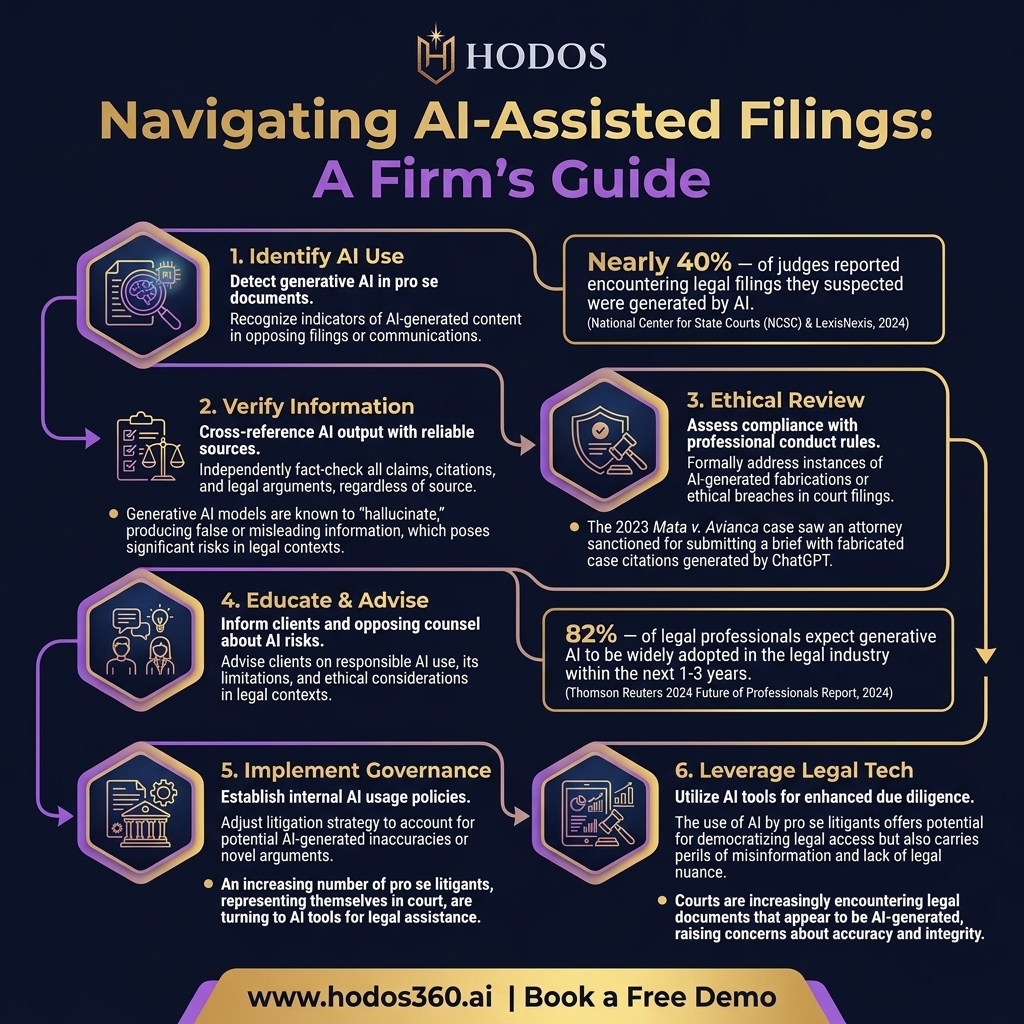
While this order applies to attorneys, its spirit underscores the judicial concern about unverified AI output. In a separate, unnamed pro se case in California, a judge recently struck an entire motion after discovering it contained references to a statute that had been repealed years prior, an error attributed to the litigant's reliance on an outdated AI model.
These instances, though still relatively few, highlight the severe consequences of uncritical AI adoption.
The implications for law firms are profound. Learn more about Voice AI Revolution 2026: Agentic Platforms Transform Law Firms. Firstly, firms must be acutely aware of the evolving judicial attitudes towards AI.
Secondly, they must educate their clients about the risks of using public generative AI tools without proper legal oversight. While it's impossible to prevent pro se litigants from using these tools, firms can advise their clients on how to respond to such filings and how to ensure their own submissions are impeccably sourced.
The ethical obligation to represent clients competently now includes advising them on the risks and benefits of AI in their specific legal context, even if they are not directly using it themselves. This proactive approach not only protects the firm but also strengthens the client's position in litigation where AI-generated content may be a factor.
Judicial Response and the Evolving Landscape of Legal Practice
Courts globally are grappling with how to integrate AI responsibly into the legal framework. The EU AI Act, a pioneering piece of legislation, provides a glimpse into future regulatory approaches, emphasizing transparency, risk assessment, and human oversight for AI systems, including those used in the justice sector.
While not directly applicable to pro se litigants in U.S. courts, its principles are influencing judicial thought processes. Judges are increasingly issuing local rules or standing orders, similar to Judge Starr's, to manage the influx of AI-generated content. This patchwork approach, however, highlights the urgent need for more unified guidelines from federal and state judiciaries, as well as bar associations.
The Federal Rules of Civil Procedure, particularly Rule 11 concerning representations to the court, are being re-examined in light of AI's capabilities, with discussions centering on whether AI-generated 'hallucinations' could constitute sanctionable conduct, even if submitted unwittingly by a pro se party.
This evolving judicial landscape significantly impacts how law firms operate.
Firms must stay abreast of every new ruling, guideline, or ethical advisory concerning AI. Learn more about Strategic AI Tools Adoption: Essential Guide for Law Firms. This continuous education is not optional; it's a necessity for maintaining competence and avoiding potential sanctions. The shift also means that the adversarial process itself is changing.
Attorneys are no longer just arguing against human-crafted narratives; they are also implicitly challenging AI-generated ones. This requires a deeper understanding of how LLMs function, their biases, and their failure modes. It also means that discovery processes might need to adapt to include inquiries about the use of generative AI by opposing parties, potentially leading to new avenues of legal argument and evidentiary challenges.
The legal profession is effectively being asked to become literate in the practical aspects of AI, not just its theoretical implications.
Implementing Robust AI Governance Policies
For law firms, the response to the challenges posed by AI in litigation must be multi-faceted and proactive. It begins with establishing robust internal AI governance policies. These policies should clearly define acceptable and unacceptable uses of generative AI within the firm, mandate human oversight for all AI-generated content, and outline verification protocols.
Training is paramount: every attorney and legal professional within the firm must be educated on the ethical considerations, practical limitations, and potential risks associated with AI tools. This training should extend to understanding how pro se litigants might use AI and how to effectively respond to such instances, including identifying AI-generated errors or fabrications.
Leading firms are already appointing AI ethics committees or designating AI compliance officers to oversee these initiatives, reflecting the seriousness of the issue.
Furthermore, firms need to invest in legal tech solutions that not only enhance their own productivity but also provide tools for navigating the complexities of AI-assisted litigation.
Learn more about AI Lead Flow: Essential Strategies for Law Firm Growth. This includes platforms with advanced document analysis capabilities that can flag inconsistencies or suspicious citations, as well as AI-powered research tools that offer verifiable sources. The goal is not to eliminate AI, but to integrate it responsibly and strategically.
As Dario Amodei, CEO of Anthropic, has often emphasized, the key to beneficial AI lies in careful alignment and safety. For law firms, this translates into a commitment to ethical AI deployment, both internally and in their engagement with the broader legal system. This proactive stance on AI governance will not only protect the firm from potential liabilities but also position it as a leader in responsible legal innovation.
Leveraging AI for Enhanced Law Firm Management and Client Service
While the challenges of pro se AI use are significant, they also underscore the urgent need for law firms to embrace AI for their own operational efficiency and client service excellence. Firms that strategically adopt AI are better equipped to handle the increased complexity and workload associated with modern litigation.
A 2025 report by McKinsey & Company projected that law firms leveraging AI for core operations could see a 20-30% increase in productivity, freeing up attorneys to focus on high-value, strategic tasks rather than routine administrative burdens. This is where comprehensive AI-powered platforms become indispensable.
Instead of viewing AI solely as a threat, forward-thinking firms recognize it as a powerful ally in streamlining operations, enhancing accuracy, and ultimately providing superior legal services.
Consider the impact on case management, billing, and client intake. An AI Law Firm Management System can automate repetitive tasks, from scheduling and deadline tracking to initial client interviews and document assembly.
Learn more about Legal AI Divide: Bridge the Gap, Thrive in 2026's Digital Era. This not only reduces human error but also significantly cuts down on administrative overhead, allowing firms to allocate resources more effectively. For instance, the system can flag potential conflicts of interest during intake, automatically generate initial engagement letters, and track billable hours with greater precision.
This efficiency is not just about cost savings; it's about creating a more responsive and agile firm that can adapt quickly to the rapidly changing legal landscape, including the complexities introduced by AI-assisted pro se litigants. Don't let the complexities of AI in litigation overwhelm your firm.
[Explore how HODOS 360 empowers legal professionals with cutting-edge AI tools.](/products/ailawfirm)
Empowering Attorneys with Advanced AI Workflows
Beyond administrative tasks, AI-powered legal workflows are transforming the very core of legal practice. Tools integrated into a comprehensive management system can assist attorneys with sophisticated legal research, identify relevant precedents in vast databases, and even draft initial versions of legal documents like motions and briefs, significantly reducing the time spent on these labor-intensive activities.
For example, a system could analyze an AI-generated pro se filing, quickly identify potentially hallucinated citations, and then cross-reference them against a verified legal database, providing attorneys with an immediate assessment of accuracy. This level of automated due diligence is crucial in an era where unverified information can quickly derail a case.
Furthermore, AI can enhance predictive analytics, allowing firms to better assess case outcomes, identify patterns in judicial decisions, and develop more informed litigation strategies. This is not about replacing the attorney's judgment but augmenting it with data-driven insights. Companies like Harvey AI, which famously partnered with Allen & Overy to embed generative AI across its global practice, demonstrate the tangible benefits of such integration.
By leveraging AI-powered legal workflows, firms can elevate their service delivery, ensure greater consistency in quality, and provide more strategic counsel to their clients. This proactive adoption of AI tools ensures that firms are not just reacting to the challenges of AI in litigation but are actively shaping a more efficient, accurate, and just legal future for themselves and their clients.
- ✓Enhanced Due Diligence: Use AI tools to scrutinize opposing pro se filings for factual inaccuracies, hallucinated citations, or logical inconsistencies.
- ✓Proactive Client Education: Advise clients on the responsible use of AI for legal information and the risks associated with unverified AI-generated content.
- ✓Develop Internal AI Governance: Implement clear policies for AI use within the firm, mandating human review and verification for all AI-assisted work product.
- ✓Invest in AI Law Firm Management: Adopt integrated platforms like HODOS 360 to automate routine tasks, streamline case management, and enhance legal workflows.
- ✓Continuous Legal Tech Training: Ensure all legal professionals are regularly trained on the latest AI tools, ethical guidelines, and judicial directives regarding AI in litigation.
- ✓Strategic Litigation Planning: Leverage AI for predictive analytics and legal research to develop more robust and data-informed strategies against AI-assisted opposing parties.
The Future of Justice: Balancing Innovation and Integrity
The intersection of AI and pro se litigation represents a pivotal moment for the legal profession. It challenges us to rethink access to justice, the role of technology, and the enduring ethical responsibilities of attorneys and the judiciary. The future of justice will not be defined by whether AI is present, but by *how* it is governed and integrated.
This requires a collaborative effort among legal tech developers, bar associations, law firms, and judicial bodies to establish clear standards, foster education, and develop robust frameworks that harness AI's potential while mitigating its risks. The goal is to build a system where innovation serves justice, not undermines it.
As the legal landscape continues its rapid evolution, firms that embrace a proactive and ethical approach to AI will not only survive but thrive. They will be the ones setting new benchmarks for efficiency, accuracy, and client service. This involves not just adopting tools but cultivating a culture of informed AI literacy and responsible innovation.
The tension between disruption and tradition is real, but the path forward lies in judicious integration. The firms that recognize AI as an augmentation to human expertise, rather than a replacement, will lead the charge towards a more equitable and efficient justice system. This isn't just about adapting to change; it's about shaping the future of law itself.

Key Takeaways and Next Steps
The rise of pro se litigants utilizing generative AI tools presents both a profound challenge and an unparalleled opportunity for law firms. The peril of unverified, AI-generated content demands heightened vigilance and robust internal policies to maintain ethical standards and ensure the integrity of legal proceedings.
Simultaneously, the promise of AI offers unprecedented advancements in law firm management and legal workflows, enabling firms to operate with greater efficiency, accuracy, and strategic foresight. Firms must move beyond reactive measures and proactively integrate AI solutions that empower their attorneys, streamline operations, and enhance client service.
Navigating this complex new terrain requires more than just awareness; it demands action. Law firms must invest in comprehensive AI-powered platforms, implement rigorous AI governance, and prioritize continuous education for their teams. By doing so, they can transform potential risks into competitive advantages, ensuring they remain at the forefront of legal innovation and continue to deliver exceptional value in an increasingly AI-driven world.
The future of legal practice is AI-powered, but success hinges on ethical, informed adoption. [Contact HODOS 360 today to schedule a demo and transform your firm.](/contact)
Frequently Asked Questions
What is the primary concern with pro se litigants using AI?+
The main concern is the potential for generative AI tools to produce 'hallucinations'—fabricated facts, non-existent case law, or misleading arguments. Pro se litigants, lacking legal training, may submit these inaccuracies to court unwittingly, compromising the integrity of proceedings and creating challenges for judges and opposing counsel to verify information.
How are courts responding to AI-generated legal filings?+
Courts are responding with a mix of approaches, including issuing standing orders that require attorneys to certify AI use and verify outputs, and striking filings found to contain AI-generated inaccuracies. There's an ongoing discussion about updating rules like FRCP Rule 11 to address AI-related misconduct, reflecting a growing judicial awareness and concern.
What ethical obligations do lawyers have regarding AI in litigation?+
Lawyers have ethical obligations under ABA Model Rules 1.1 (Competence) and 3.3 (Candor Toward the Tribunal). This includes understanding AI's impact on legal practice, verifying all AI-generated content before submission, and actively scrutinizing opposing counsel's (or pro se litigants') filings for AI-generated inaccuracies to uphold the integrity of the court.
How can law firms leverage AI to address these challenges?+
Law firms can leverage AI through comprehensive management systems that offer AI-powered legal workflows for enhanced due diligence, document automation, and case management. These tools help identify AI-generated inaccuracies in opposing filings, streamline internal processes, and free up attorneys for strategic tasks, turning challenges into opportunities for efficiency and accuracy.
What are 'AI hallucinations' in a legal context?+
AI hallucinations refer to instances where generative AI models produce plausible-sounding but entirely false or non-existent information. In a legal context, this could manifest as fabricated case citations, non-existent statutes, or factually incorrect narratives presented as legal arguments. These errors can severely mislead courts and harm litigants.