


Essential Safeguarding Legal Data Practices for AI Firms
In early 2026, a cautionary tale reverberated through the legal community when a prominent AmLaw 100 firm, known for its rapid adoption of generative AI tools, faced a significant data breach. While the firm, which we'll call 'Global Counsel LLP,' had implemented many standard cybersecurity measures, an internal investigation revealed a critical vulnerability: a bespoke AI-powered legal research agent, developed in-house, had inadvertently exposed metadata from highly sensitive client documents to an unapproved cloud environment during its training phase. The incident, though quickly contained, led to a multi-million dollar regulatory fine and, more damagingly, a palpable erosion of client trust. Sarah Chen, a partner at Global Counsel LLP, later remarked at a private industry roundtable, "We were so focused on the *power* of AI, we momentarily underestimated the *peril* of its data footprint. The lesson was stark: innovation without impenetrable security is a liability."
This real-world scenario underscores a pressing concern for every law firm today: how to harness the transformative power of artificial intelligence while maintaining the sacred trust of client confidentiality and ensuring the inviolability of legal data. The promise of AI—from automating contract review to streamlining discovery—is immense, yet it introduces new vectors for risk that traditional cybersecurity protocols alone cannot fully address. As the legal tech market, propelled by giants like OpenAI and Anthropic, continues to innovate at breakneck speed, law firms are grappling with the complexities of integrating these tools responsibly. The ABA's 2025 TechReport highlighted that while 75% of firms were exploring or using AI, only 30% felt fully confident in their data safeguarding legal data strategies specifically for AI applications, revealing a significant confidence gap. This evolving landscape demands a proactive, multi-faceted approach to security, moving beyond reactive measures to embed data protection at the very core of AI implementation.
Firms like Allen & Overy, an early adopter of AI through its partnership with Harvey AI, have publicly emphasized that stringent data governance and security protocols were non-negotiable prerequisites. Jean-Pierre Douglas-Henry, Global Head of Litigation at Allen & Overy, stated, "Our collaboration with Harvey is built on a foundation of trust and data integrity. We ensure that client data remains within our secure environment, never used for external model training." This commitment is not merely a technical one; it's a strategic imperative that shapes firm culture, vendor selection, and long-term operational resilience. As we delve deeper into this critical issue, we will explore the essential strategies and technological safeguards necessary for law firms to confidently navigate the AI era, ensuring that the benefits of innovation are never overshadowed by the risks of compromise. This is not just about compliance; it's about preserving the bedrock of the legal profession.
Essential Safeguarding Legal Data Practices for AI-Powered Firms
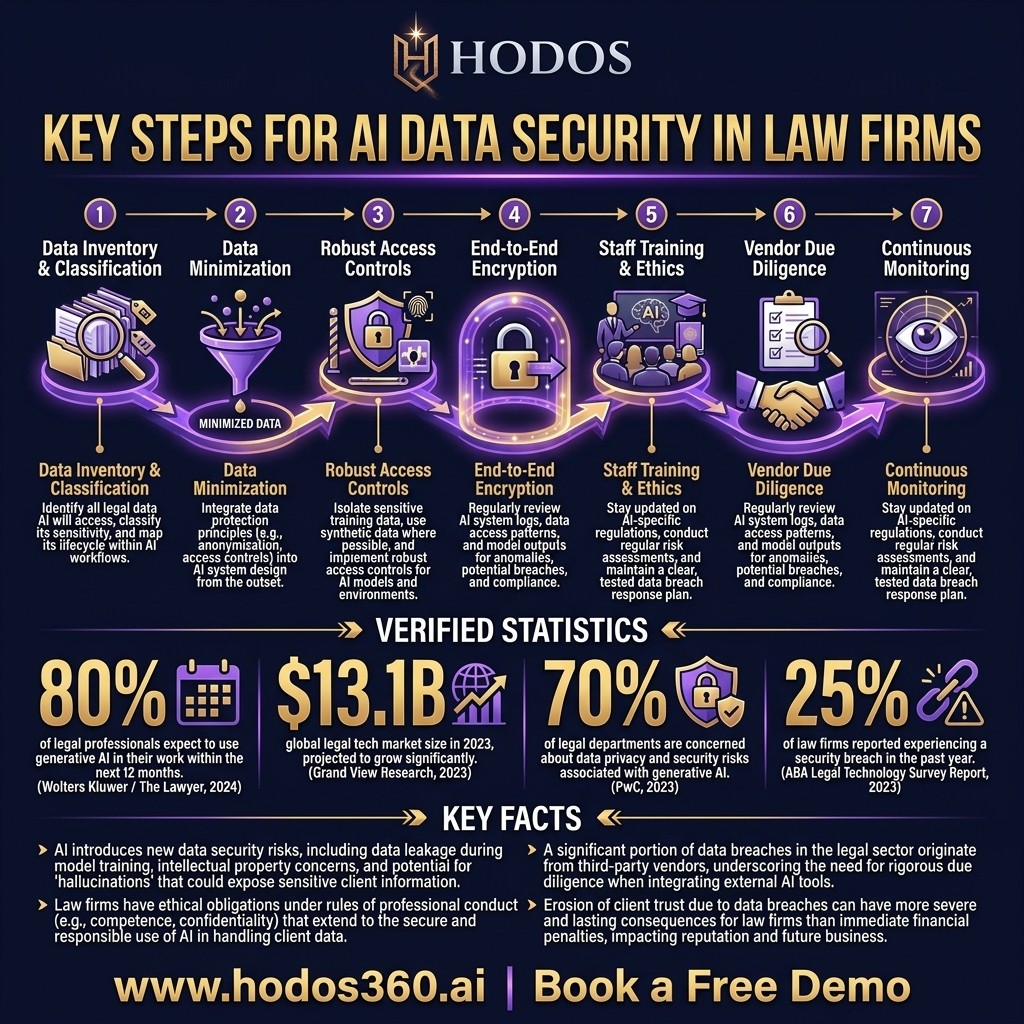
The fundamental shift brought by AI is how data is processed, stored, and utilized. Traditional data security, focused on perimeter defense, is insufficient when AI models ingest, analyze, and generate new content from vast datasets. The first essential practice involves a comprehensive inventory and classification of all data handled by AI systems. This means understanding exactly what data—client files, firm precedents, communications—is being fed into or processed by AI, and categorizing it by sensitivity (e.g., highly confidential, attorney-client privileged, public). Without this granular understanding, firms cannot adequately apply appropriate security controls. The 2024 Thomson Reuters 'Future of Legal' report underscored this, noting that firms with robust data classification frameworks experienced 40% fewer AI-related data incidents. This proactive approach allows firms to segregate sensitive information, ensuring that only anonymized or non-privileged data interacts with less secure or general-purpose AI models, while highly confidential matters are confined to private, 'walled-garden' AI instances or highly secure, enterprise-grade platforms.
Beyond classification, firms must establish clear data minimization principles for AI. This means only providing AI models with the exact data necessary for their function, avoiding over-sharing. Learn more about AI Legal Assistant 2026: Revolutionizing Law Firm Efficiency. For instance, if an AI is tasked with summarizing a specific contract clause, it should not have access to the entire client's litigation history unless explicitly required and authorized. This principle, often enshrined in privacy regulations like GDPR and CCPA, becomes even more critical with AI, as models can inadvertently learn and retain patterns from data they process. Furthermore, implementing strong data retention policies for AI-generated output and input data is crucial. Firms must define how long AI-processed data is stored, how it's securely deleted, and how its lineage can be traced. This not only aids in compliance but also reduces the attack surface. Dario Amodei, CEO of Anthropic, a leading AI safety company, frequently emphasizes the need for 'constitutional AI'—systems designed with inherent safety and data protection principles—a philosophy that legal firms must echo in their internal practices when managing and protecting client information.
Crafting Robust AI Usage Policies
A critical component of safeguarding legal data is the development and enforcement of stringent AI usage policies. These aren't mere guidelines; they are enforceable mandates that dictate how AI tools can be used, by whom, and with what types of data. These policies must address the ethical considerations of AI, particularly concerning bias, fairness, and the potential for hallucination. The ABA Model Rules of Professional Conduct, particularly Rule 1.6 (Confidentiality of Information) and Rule 1.1 (Competence), serve as foundational pillars. Lawyers have an ethical duty to understand the risks and benefits associated with technology. Learn more about AI Marketing Stack: Essential Upgrades for Law Firms. Firms must explicitly prohibit the input of client-identifying or privileged information into public or unapproved generative AI models. Policies should also outline the need for human oversight and verification of AI-generated content, preventing reliance on potentially inaccurate outputs that could compromise case integrity or client interests. Regular audits of AI usage, coupled with clear disciplinary actions for non-compliance, reinforce the seriousness of these policies. This framework forms the bedrock for responsible AI integration, transforming potential risks into managed opportunities.
Navigating the AI Data Landscape: Risks, Regulations, and Confidentiality
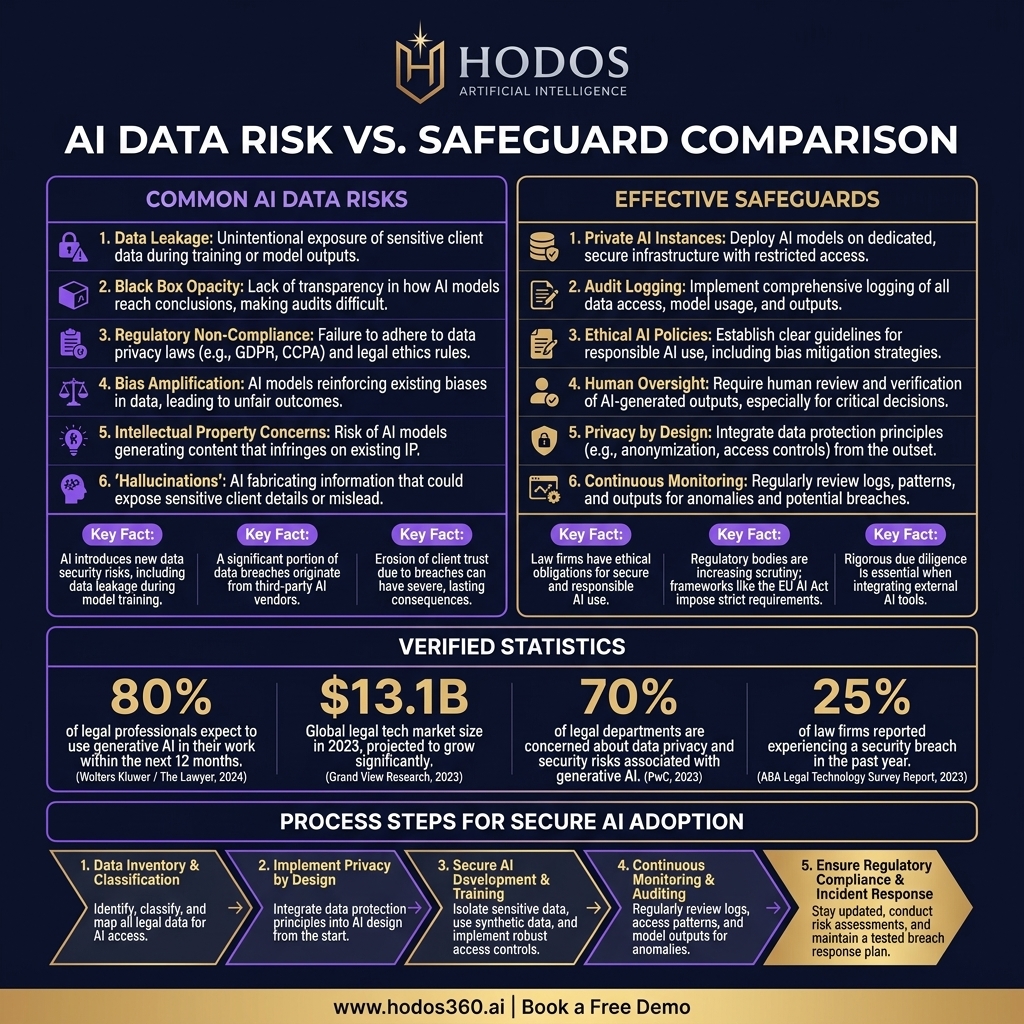
The regulatory landscape for AI is rapidly evolving, creating a complex web of compliance requirements for law firms. From the EU AI Act, which imposes strict obligations on high-risk AI systems, to existing privacy laws like HIPAA, CCPA, and sector-specific legal regulations, firms must navigate a multi-jurisdictional environment. A key risk is the potential for AI models, especially large language models (LLMs), to inadvertently store or replicate sensitive client information if not properly isolated. This 'data leakage' can occur if models are trained on or interact with unencrypted or improperly managed data sources. Firms must also contend with the 'black box' problem, where the internal workings of complex AI algorithms are opaque, making it difficult to ascertain how data is processed or if biases are introduced. This opacity can hinder a firm's ability to demonstrate compliance or respond to data subject access requests.
Beyond technical security measures, firms must engage in rigorous vendor due diligence. Not all AI providers offer the same level of data protection or transparency. Learn more about AI Legal Research: The Ultimate Guide for Law Firms. Questions to ask include: How is client data used for model training? Is data anonymized or de-identified? What encryption standards are used? Are their systems regularly audited by independent third parties? For instance, enterprise-grade AI platforms like Microsoft Copilot for Legal, or specialized legal AI solutions, often come with robust data isolation and governance features, specifically designed to meet stringent confidentiality requirements. This contrasts sharply with consumer-grade generative AI tools. Firms must insist on contractual agreements that explicitly prohibit vendors from using client data for model training or other purposes outside the scope of the service, and mandate strict data handling protocols. This proactive management of third-party risks is crucial in an ecosystem where data often crosses multiple platforms and services. For firms seeking to streamline their operations while ensuring maximum data integrity, platforms like HODOS 360 offer an AI Law Firm Management System designed with these stringent security and privacy requirements at its core.
Building a Secure AI Infrastructure: Technology and Controls
Technological safeguards form the backbone of any effective data protection strategy for AI. At the forefront is robust encryption, both in transit and at rest. All data fed into AI systems, as well as the outputs generated, must be encrypted using industry-standard protocols. This ensures that even if a breach occurs, the data remains unreadable and unusable to unauthorized parties. Firms must implement advanced access controls, employing the principle of least privilege, meaning users and AI systems only have access to the specific data and functionalities required for their roles. Multi-factor authentication (MFA) should be mandatory for all access points to AI platforms and data repositories. Furthermore, network segmentation and secure API integrations are vital. AI tools should operate within isolated network segments, limiting their access to other sensitive firm systems, and any integration with external services must be through secure, authenticated APIs.
Another critical technological control involves comprehensive audit logging and monitoring. Learn more about AI Chatbot Builders: Transform Your Law Firm in 2026. Every interaction with an AI system—every data input, every query, every output—should be logged and regularly reviewed for anomalous activity. AI-powered SIEM (Security Information and Event Management) systems can leverage machine learning to detect unusual patterns that might indicate a security threat or policy violation faster than human analysts. Firms should also invest in data loss prevention (DLP) solutions that can identify and block the unauthorized transmission of sensitive data, whether by human users or AI processes. The continuous evolution of cyber threats means that firms cannot rely on a static defense. Regular penetration testing, vulnerability assessments, and red teaming exercises specifically targeting AI systems are essential to identify weaknesses before malicious actors do. Jensen Huang, CEO of NVIDIA, has often spoken about the need for 'accelerated computing' not just for AI development, but for advanced cybersecurity, highlighting the arms race between AI innovation and cyber defense. This proactive posture is non-negotiable for safeguarding legal data.
Leveraging Advanced Encryption and Access Management
To truly protect sensitive client information, firms must go beyond basic security. This includes implementing end-to-end encryption for all data flows, from client intake to document generation. Cloud-based AI services should be evaluated for their support of client-managed encryption keys (CMK), giving firms greater control over their data's security. Identity and access management (IAM) systems must be integrated with AI platforms, allowing for granular permissions based on specific roles and projects. Learn more about Voice AI Unleashed: Essential Innovation for Modern Law Firms. For instance, a junior associate using an AI tool for initial contract analysis might only have access to anonymized data, while a senior partner overseeing a complex merger could have access to a secure, private instance of the AI with full, but logged, access to confidential deal documents. This tiered access, combined with robust auditing, ensures that the right people (and the right AI processes) have access to the right data at the right time, minimizing exposure and upholding ethical duties.
The Human Element: Training, Ethics, and Continuous Monitoring in AI Use
No matter how sophisticated the technology, the human element remains the weakest link in the security chain. Comprehensive and continuous training is paramount for all legal professionals on the responsible and ethical use of AI. This training should cover not only the firm's AI usage policies but also the inherent limitations of AI, such as the potential for bias, inaccuracies (hallucinations), and the imperative to never input sensitive client data into public AI models. It’s not enough to simply provide a tool; firms must educate their staff on the 'why' behind the rules, fostering a culture of cybersecurity vigilance and AI literacy. Brad Smith, President of Microsoft, has repeatedly emphasized that 'human oversight' is the essential ingredient for trustworthy AI, a sentiment that resonates deeply within the legal context where fiduciary duties are paramount. Regular refreshers and scenario-based training can help reinforce these practices and keep pace with evolving AI capabilities and risks.
Fostering an ethical AI culture extends beyond mere compliance; it involves embedding principles of fairness, transparency, and accountability into every aspect of AI deployment. Learn more about AI Voice Assistants: Essential for Modern Law Firms. Firms should establish an internal AI ethics committee or appoint a dedicated AI ethics officer to review new AI tools, assess their potential impact on clients and operations, and ensure alignment with professional obligations. This committee can also address complex ethical dilemmas, such as the use of AI in predicting litigation outcomes or client behavior, ensuring such applications do not cross ethical boundaries. Furthermore, continuous monitoring of both AI system performance and user behavior is critical. This includes regularly reviewing AI outputs for accuracy and bias, tracking user interactions with AI tools to identify potential policy violations or misuse, and staying abreast of emerging threats and best practices for safeguarding legal data. The legal profession's reliance on trust and confidentiality means that ethical considerations in AI are not optional but fundamental to maintaining professional integrity.
Fostering an Ethical AI Culture
An ethical AI culture is one where every member of the firm understands their role in responsible AI use. This includes recognizing the potential for AI to perpetuate or even amplify existing biases if not carefully managed, particularly in areas like predictive analytics for judicial outcomes or client risk assessment. Firms must ensure that AI systems are regularly audited for bias and fairness, and that decisions informed by AI are always subject to human review and ultimate discretion. This commitment to ethics and responsible AI deployment is not just a moral obligation but a strategic differentiator, building client trust and demonstrating leadership in the evolving legal tech landscape. It ensures that the pursuit of efficiency doesn't inadvertently compromise the foundational values of justice and equity. This proactive approach to managing AI's ethical dimensions is crucial for long-term success and reputation.

Strategic Implementation: Future-Proofing Your Firm with Secure AI
The journey to fully secure AI integration is ongoing, requiring a strategic, adaptive mindset. Firms must view AI security not as a one-time project but as an iterative process of assessment, implementation, and refinement. This involves regularly updating security protocols, staying informed about the latest cyber threats and AI vulnerabilities, and continuously evaluating new security technologies. The legal industry is notoriously slow to adopt new technologies, but with AI, the pace of change demands agility. Firms that embrace a proactive, continuous improvement model for AI security will be better positioned to leverage AI's benefits while effectively managing its risks. This includes allocating dedicated resources—both financial and human—to AI security initiatives, recognizing that investment in this area is an investment in the firm's future and its competitive edge. The ultimate goal is to build a resilient AI ecosystem that supports innovation without compromising the sacred duty of safeguarding legal data.
Embracing AI isn't just about adopting new tools; it's about transforming the operational backbone of the law firm. HODOS 360’s comprehensive suite of services, including its AI Law Firm Management System and AI Marketing Platform, are built with security and compliance as core tenets, enabling firms to leverage AI for efficiency without sacrificing data integrity. By integrating AI-powered workflows, secure document automation, and intelligent case management, firms can streamline operations, enhance client service, and foster growth while adhering to the highest standards of data protection. The future of legal practices is undeniably AI-powered, and firms that proactively implement robust safeguarding legal data practices will not only thrive but also set the benchmark for responsible innovation in the legal sector. The time to act is now, to ensure that the promise of AI translates into a more secure, efficient, and ethical legal profession.
- ✓Conduct Regular Data Audits: Systematically review all data processed by AI to ensure compliance with privacy policies and ethical guidelines.
- ✓Implement Data Minimization: Restrict AI access to only the essential data required for specific tasks, reducing exposure of sensitive information.
- ✓Enforce Strict Access Controls: Utilize multi-factor authentication and role-based access to limit data visibility within AI systems.
- ✓Prioritize End-to-End Encryption: Ensure all data, both in transit and at rest, is encrypted using robust, industry-leading standards.
- ✓Mandate Continuous Staff Training: Educate all legal professionals on ethical AI use, data handling protocols, and the dangers of public AI tools.
- ✓Establish an AI Ethics Committee: Form a dedicated body to oversee AI deployment, assess risks, and ensure alignment with professional responsibilities.
- ✓Engage in Proactive Vendor Due Diligence: Thoroughly vet AI providers for their security practices, data governance, and contractual commitments regarding client data.
Frequently Asked Questions
What are the primary data security risks when using AI in a law firm?+
The primary risks include data leakage from unapproved AI models, inadvertent exposure of privileged information during training, lack of transparency in AI processing ('black box' issues), and the potential for AI systems to generate inaccurate or biased information. Additionally, third-party vendor risks and the evolving regulatory landscape pose significant challenges to safeguarding legal data.
How can law firms ensure client confidentiality with generative AI tools?+
Firms must ensure client data is never input into public generative AI models. Instead, use secure, private, enterprise-grade AI platforms with robust data isolation. Implement strict data minimization, anonymization, and access controls. Human oversight and verification of all AI-generated content are also critical to maintain confidentiality.
What role do ethical guidelines play in AI data security for legal practices?+
Ethical guidelines are paramount. ABA Model Rules on competence and confidentiality obligate lawyers to understand AI risks. Firms must develop policies addressing AI bias, accuracy, and appropriate use. An ethical AI culture, supported by training and oversight, ensures that technology serves justice without compromising professional duties or client trust.
What specific technological controls should firms implement for AI data security?+
Key controls include end-to-end encryption for data at rest and in transit, strong multi-factor authentication, granular access controls based on the principle of least privilege, secure API integrations, and network segmentation for AI systems. Continuous monitoring, audit logging, and data loss prevention (DLP) solutions are also essential for managing risks and safeguarding legal data.
How often should a law firm update its AI data security protocols?+
AI data security protocols should not be a one-time setup but rather an ongoing, iterative process. Firms should conduct regular reviews (at least annually, or more frequently with significant AI adoption) to adapt to new technologies, emerging threats, and changes in privacy regulations. Continuous training and vulnerability assessments are also vital components of this adaptive strategy.