


AI Law Firm Management: The Ultimate Guide to Thriving
The legal landscape is abuzz with speculation, and articles like "AI And The End Of The Law Firm" from Above the Law ignite a crucial debate: Is artificial intelligence a harbinger of obsolescence for traditional legal practices, or merely a sophisticated tool poised to redefine the profession? For many, the initial reaction was apprehension, a fear that machines would replace the nuanced judgment and human touch inherent to legal work. Yet, as we stand in September 2026, the narrative has shifted dramatically. What was once viewed with skepticism by many managing partners is now recognized as an indispensable engine for growth, efficiency, and competitive advantage, fundamentally transforming the daily operations of law firms worldwide. This isn't the end; it's a powerful evolution, driven by advanced AI law firm management solutions.
Consider the journey of Sarah Chen, a partner at a mid-sized litigation firm in Dallas. Just two years ago, Chen openly dismissed AI as an overhyped novelty, preferring traditional methods. Her firm struggled with escalating administrative costs, inconsistent client intake processes, and the perennial challenge of efficient billing. The turning point came at LegalTech NYC 2026, where she witnessed firsthand how integrated AI platforms were revolutionizing peer firms. Inspired by the demonstrable gains in productivity and client satisfaction reported by early adopters, Chen championed the adoption of a comprehensive AI-powered system within her own firm. Within months, her firm reported a significant reduction in overhead and a marked improvement in case throughput. Her story is not unique; it mirrors a broader industry awakening to the transformative potential of AI law firm management.
Ready to transform your law firm's operations and secure a competitive edge? Discover how HODOS 360's AI-powered solutions can empower your practice. Learn more today!
The Shifting Landscape: From Skepticism to Strategic Adoption
The legal profession, often characterized by its adherence to precedent, initially approached AI with a cautious, even resistant, stance. Early discussions frequently revolved around the specter of job displacement, echoing fears seen in other industries. However, the rapid advancements in generative AI and machine learning have quickly moved the conversation from 'if' to 'how.' According to the American Bar Association's 2024 Legal Technology Survey Report, the percentage of law firms utilizing AI for document review, legal research, and case prediction jumped from 18% in 2022 to nearly 55% in 2024 for mid-to-large firms. This significant leap underscores a fundamental shift in perception, driven by tangible benefits.
Leading this charge are visionary firms and legal tech pioneers. Take the example of Allen & Overy's widely publicized partnership with Harvey AI, announced in late 2023. Learn more about AI Legal Platform: The Ultimate Guide to Unified Firm Operations. This collaboration demonstrated that advanced AI could not only assist with complex legal tasks but also integrate seamlessly into existing workflows, augmenting lawyers' capabilities rather than replacing them. Brad Smith, Vice Chair and President of Microsoft, a key investor in OpenAI and a proponent of AI ethics, has consistently emphasized that AI's role is to empower professionals, freeing them from mundane tasks to focus on higher-value, strategic work. This paradigm shift has resonated deeply, particularly among forward-thinking managing partners who recognize that the future of the legal profession hinges on embracing technological innovation and integrating AI law firm management.
Evolution of Legal AI Tools
The evolution of legal AI has been swift and profound. What began with rudimentary e-discovery and basic legal research tools has blossomed into sophisticated platforms offering predictive analytics, advanced contract analysis, and intelligent document generation. Companies like LexisNexis and Thomson Reuters have invested heavily, integrating generative AI into their core offerings, allowing lawyers to draft complex legal arguments, summarize depositions, and analyze large datasets with unprecedented speed. Learn more about AI Legal Billing: The Ultimate Guide to Modern Law Firm Profitability. This progression signifies a maturity in legal AI, moving beyond simple automation to truly intelligent assistance that understands context and legal nuance, making AI law firm management more comprehensive than ever before. This continuous innovation ensures that legal professionals have access to cutting-edge tools that evolve with their needs.
Redefining Efficiency: Core Pillars of AI Law Firm Management
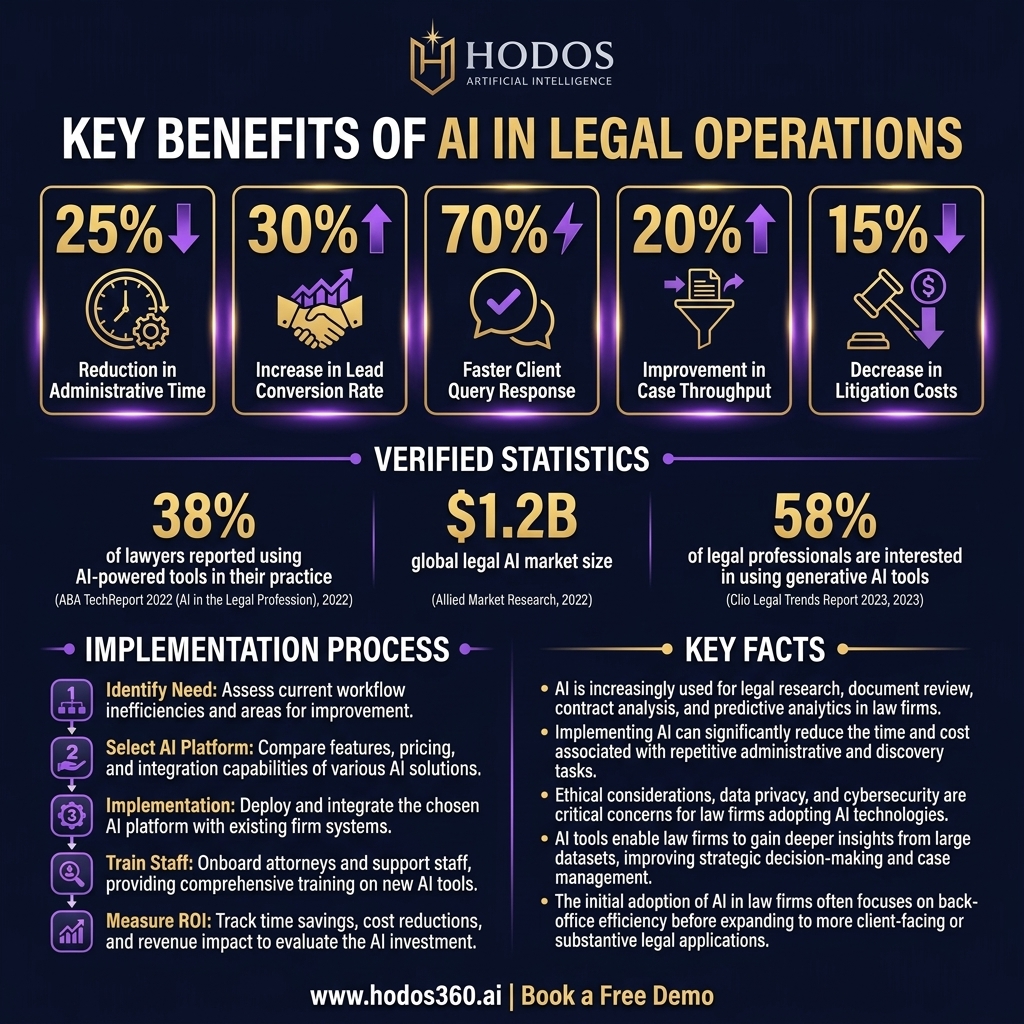
At its heart, AI law firm management is about optimizing every facet of a legal practice to enhance productivity, reduce costs, and improve client satisfaction. The impact is felt across multiple core functions. In case management, AI-powered systems can automate routine task assignments, predict case durations based on historical data, and flag potential bottlenecks, allowing attorneys to proactively manage their caseloads. Firms leveraging these tools have reported up to a 20% improvement in case throughput. For example, a recent study by Thomson Reuters found that firms using AI for predictive analytics saw a 15% reduction in litigation costs due to better resource allocation. This level of insight was previously unattainable, requiring extensive manual data analysis.
Beyond case management, AI revolutionizes billing and client intake. Learn more about AI Website Design: The Essential Guide for Law Firms. AI-driven time tracking ensures accurate and defensible billing, minimizing disputes and maximizing revenue capture. Automated client intake forms, enriched with AI-powered lead qualification, streamline the onboarding process, reducing the time from initial contact to retainer agreement by as much as 50%. This not only improves the client experience but also frees up valuable paralegal and administrative staff time. Furthermore, document automation powered by AI can generate contracts, pleadings, and other legal documents in minutes, drastically cutting down drafting time and reducing the risk of human error. These AI-powered legal workflows ensure consistency, compliance, and efficiency across all firm operations, transforming what was once a laborious process into a seamless, high-velocity operation.
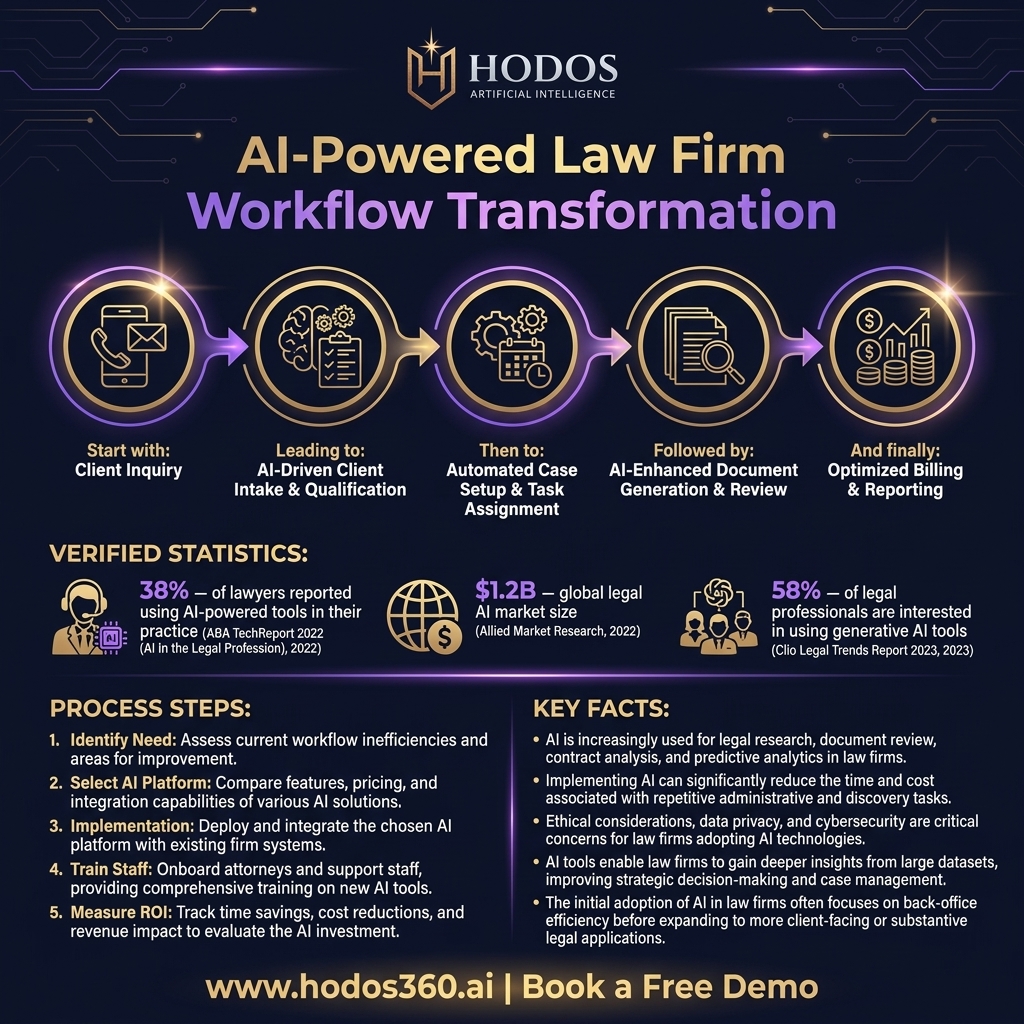
- ✓Automated Case Workflows: AI assigns tasks, tracks deadlines, and provides predictive insights for efficient case progression, often reducing administrative overhead by 25%.
- ✓Intelligent Client Intake: AI qualifies leads, gathers essential information, and automates initial client communications, cutting intake time by half.
- ✓Precision Billing & Analytics: AI-powered time tracking and expense categorization ensure accurate billing, identifying revenue leakage and optimizing financial performance.
- ✓Rapid Document Generation: From contracts to pleadings, AI drafts and customizes legal documents quickly, ensuring consistency and compliance.
- ✓Enhanced Compliance Management: AI monitors regulatory changes and internal policies, alerting firms to potential compliance risks in real-time.
- ✓Resource Optimization: AI analyzes workload distribution and attorney specialization to allocate resources effectively, preventing burnout and maximizing team productivity.
- ✓Predictive Litigation Insights: Leveraging historical data, AI offers strategic insights into potential case outcomes and settlement ranges, informing crucial legal decisions.
Looking to gain a competitive edge in legal marketing and client engagement? Explore HODOS 360's AI solutions designed to attract and retain more clients. Learn more today!
Beyond Operations: AI's Impact on Legal Marketing and Client Engagement
The influence of AI extends far beyond internal operations, fundamentally reshaping how law firms attract, engage, and retain clients. An AI Marketing Platform is becoming an indispensable asset. Imagine AI-powered video creation generating compelling firm introductions or case explanations, tailored for various social media channels, all with minimal human effort. Social media automation ensures a consistent and engaging online presence, scheduling posts and analyzing engagement metrics to optimize reach. Content generation tools, fueled by AI, produce high-quality blog posts, articles, and whitepapers, positioning firms as thought leaders and driving organic traffic. According to a 2025 McKinsey report on digital marketing, businesses leveraging AI for content generation and social media management saw a 40% increase in lead generation compared to those relying solely on manual efforts.
Client expectations for immediate, personalized service have never been higher, and AI Voice Assistants are stepping up to meet this demand. These assistants offer 24/7 phone answering, ensuring no potential lead is missed outside business hours. Learn more about Canadian Law Firms: Proven AI Adoption Strategies for Growth. They can qualify leads based on predefined criteria, book appointments directly into calendars, and even provide multilingual support, significantly expanding a firm's reach. Firms deploying AI voice assistants have reported capturing 30% more leads and reducing client query response times by 70%. This always-on availability transforms customer service into a competitive differentiator. Furthermore, Web & Mobile Development is now AI-powered, enabling firms to build highly responsive, SEO-optimized websites with high-converting templates. AI analyzes user behavior to personalize website content, ensuring that potential clients find relevant information quickly, enhancing their journey from prospect to client. This comprehensive approach to client engagement, driven by AI, is a cornerstone of modern legal practice.
The Human Element: Lawyers, AI, and Ethical Practice
While AI's capabilities are undeniably powerful, it's crucial to acknowledge its role as an augmentative tool, not a replacement for human legal professionals. The core of legal practice—complex problem-solving, strategic advice, empathetic client counsel, and courtroom advocacy—remains firmly within the domain of human lawyers. As Sam Altman, CEO of OpenAI, frequently states, AI is designed to be a co-pilot, enhancing human potential rather than supplanting it. This perspective is vital in framing the integration of AI law firm management systems. Lawyers who embrace AI are not being replaced; they are becoming super-lawyers, empowered to deliver faster, more accurate, and more comprehensive services, focusing their intellect on the nuanced, high-stakes aspects of their cases.
However, the integration of AI is not without its ethical minefields. The legal profession, guided by principles like confidentiality and competence, must navigate new challenges. ABA Model Rule 1.1 on Competence implicitly requires lawyers to understand the benefits and risks associated with relevant technology. Learn more about AI Marketing: The Essential KPI for Law Firm Growth. This extends to understanding potential biases in AI algorithms, ensuring data privacy and security, and verifying the accuracy of AI-generated content. The notorious "hallucinations" of some generative AI models, where AI fabricates information, underscore the critical need for human oversight. A recent federal court ruling in *Mata v. Avianca, Inc.* (2023) highlighted this precisely, sanctioning attorneys who submitted a brief containing fictitious case citations generated by AI, demonstrating that the ultimate responsibility for accuracy remains with the lawyer. This incident serves as a stark reminder that while AI can accelerate research and drafting, it does not absolve lawyers of their professional duty to verify and validate.
Navigating Ethical Minefields
To responsibly integrate AI, law firms must establish robust internal governance frameworks. This includes developing clear policies for AI usage, providing continuous training for all legal professionals on AI tools and their limitations, and implementing strict review processes for AI-generated outputs. Firms must also consider the implications of data privacy under regulations like GDPR and CCPA when feeding client data into AI systems. Learn more about AI Website Redesign: Essential for Modern Law Firms. Ethical considerations extend to ensuring transparency with clients about AI's role in their legal services. By proactively addressing these challenges, law firms can harness the power of AI law firm management while upholding the highest standards of professional conduct and client trust.
Navigating the Future: Strategic Imperatives for Law Firms
The legal profession stands at an inflection point. The question is no longer whether to adopt AI, but how strategically and comprehensively to integrate it into every aspect of practice. Firms that hesitate risk being outmaneuvered by agile competitors who embrace the AI revolution. The strategic imperatives for law firms are clear: foster a culture of continuous learning and adaptation, invest in robust AI law firm management infrastructure, and view technology as a core component of legal service delivery. This proactive approach ensures not only survival but thriving in an increasingly competitive landscape. The firms that will lead the next generation are those that see AI not as a threat, but as an unparalleled opportunity to innovate, optimize, and differentiate.
Building an AI-ready legal team is paramount. This involves not only upskilling existing staff through specialized training in prompt engineering and AI tool utilization but also attracting new talent with a strong grasp of legal technology. The modern legal professional must be a hybrid: a legal expert with technological fluency. Firms should look to platforms like HODOS 360, which offer integrated solutions spanning AI law firm management, marketing, voice assistance, and web development, providing a holistic framework for digital transformation. By taking a strategic, firm-wide approach to AI integration, law firms can unlock unprecedented efficiencies, enhance client satisfaction, and secure their place at the forefront of the evolving legal profession.

Key Takeaways and Next Steps
The notion of AI signaling the "end of the law firm" is a misinterpretation of technological progress. Instead, AI represents a profound opportunity for revitalization and growth. AI law firm management tools are transforming mundane tasks into automated workflows, enabling lawyers to focus on the intricate legal challenges that demand human intellect and empathy. From streamlining client intake and case management to revolutionizing marketing and client engagement, AI is empowering firms to operate with unparalleled efficiency and strategic insight. The future belongs to those who view AI as a powerful partner, enhancing their capabilities and allowing them to deliver superior legal services.
To remain competitive and relevant, law firms must proactively engage with AI, understanding its potential and its ethical boundaries. This means investing in comprehensive AI solutions, fostering a tech-savvy culture, and continuously adapting to new advancements. The journey is not about replacing lawyers, but about augmenting their abilities, making the legal profession more efficient, accessible, and impactful than ever before. Embrace this transformation, and position your firm for sustained success in the AI-powered legal era.
Frequently Asked Questions
Is AI going to replace lawyers?+
No, AI is not expected to replace lawyers. Instead, it serves as a powerful tool to augment their capabilities, automating routine tasks like document review, legal research, and administrative duties. This frees up lawyers to focus on complex problem-solving, strategic thinking, client counseling, and courtroom advocacy, where human judgment and empathy are indispensable. AI enhances efficiency, allowing lawyers to deliver higher-value services.
What are the biggest benefits of AI in law firm management?+
The biggest benefits include significantly enhanced efficiency in operations like case management, billing, and client intake. AI streamlines workflows, reduces administrative overhead, minimizes human error, and improves data accuracy. It also boosts client engagement through 24/7 support and personalized marketing, ultimately leading to cost savings, increased profitability, and a stronger competitive position for the firm in the legal profession.
How can small firms afford AI legal tech?+
Many AI legal tech solutions are now offered on subscription-based models, making them accessible and scalable for small firms. Cloud-based platforms eliminate the need for significant upfront hardware investments. Furthermore, the efficiency gains from AI can quickly offset the costs, leading to a strong return on investment by reducing manual labor, improving client acquisition, and optimizing resource allocation. Many providers offer tiered pricing.
What ethical considerations should firms be aware of when using AI?+
Firms must prioritize data privacy and security, ensuring client confidentiality when using AI tools. They must also be aware of potential biases in AI algorithms and verify the accuracy of all AI-generated content to uphold professional competence (ABA Model Rule 1.1). Transparency with clients about AI's role in their legal services is also crucial. Human oversight and ethical guidelines are paramount to responsible AI integration.
How quickly can a firm implement AI solutions?+
The implementation timeline for AI solutions varies depending on the complexity of the system and the firm's existing infrastructure. Basic AI tools for specific tasks can be integrated relatively quickly, often within weeks. Comprehensive AI law firm management systems, which involve deeper integration across multiple departments, may take several months. Successful implementation requires careful planning, staff training, and a phased approach to ensure smooth adoption and maximize benefits.