
AI Legal Workflows: Essential Guide to India's Tech Leap
For decades, the Indian legal system, with its staggering caseloads and complex procedural intricacies, has been an immense challenge for legal professionals. Consider the daily grind at a bustling firm in Mumbai, where partners like Anjali Sharma, a corporate litigator, once grappled with mountains of physical documents and manual research, often working late into the night. The sheer volume of cases — from corporate mergers to intellectual property disputes — demanded an infrastructure far beyond traditional methods. This very challenge, however, has now positioned India at the forefront of a global legal tech revolution, a phenomenon recently highlighted by ET CIO’s reporting on how AI startups are making significant bets on enterprise-grade AI to modernize India’s legal workflows.
This isn't merely about adopting new software; it's about fundamentally reshaping how legal services are delivered across the subcontinent. The narrative of legal tech in India is one of disruption meeting opportunity, where a burgeoning startup ecosystem and a massive talent pool are converging to create innovative solutions. The shift signals a move from incremental improvements to a systemic overhaul, promising to alleviate the burden on lawyers while enhancing access to justice. As firms, large and small, look to navigate the complexities of a rapidly evolving legal market, the integration of advanced AI legal workflows is no longer optional but a strategic imperative.
This comprehensive guide delves into the specifics of India's legal tech revolution, examining the drivers behind this monumental shift, the practical applications of AI in daily legal practice, and the ethical considerations that accompany such powerful tools. We'll explore how AI adoption is not just about efficiency, but about fostering an entirely new paradigm for legal excellence, making the vision of modern, agile legal workflows a tangible reality for firms across the nation.
India's Legal Tech Revolution: A New Frontier for Enterprise AI
India's legal market, estimated to be worth billions, presents a unique paradox: immense potential coupled with significant operational inefficiencies. Traditionally, the sector has been characterized by paper-heavy processes, fragmented information, and a high reliance on human-intensive tasks. This backdrop, however, is precisely why the country has become a fertile ground for enterprise AI innovation. Local startups are not just mimicking Western models; they are building bespoke solutions tailored to India's diverse legal codes, languages, and cultural nuances. One such example is the emerging interest in companies like LegalMind.ai (a hypothetical but realistic name), which recently secured significant seed investment to develop AI-powered legal research and document automation tools specifically for Indian jurisprudence. This surge in domestic innovation is complemented by a supportive governmental push, with initiatives like 'Digital India' fostering a tech-first approach across all sectors, including law.
The competitive landscape is heating up, with both indigenous tech firms and global players vying for a slice of this rapidly expanding pie. According to a 2023 report by the Indian Ministry of Electronics and Information Technology, the country's AI market is projected to grow exponentially, with a substantial portion of this growth expected from enterprise applications. Learn more about AI Voice Revolution: Essential Automation for Law Firms. This translates directly to opportunities for legal tech, as firms seek solutions for everything from client intake to complex litigation analysis. The goal is to move beyond basic automation to truly intelligent systems that can understand, predict, and assist. This drive is creating a vibrant legal ecosystem where innovation is not just encouraged but demanded by the market, pushing firms to explore advanced AI legal workflows that deliver tangible value.
This dynamic environment is attracting considerable attention, with global venture capitalists keenly observing the market. The promise of streamlining the operations of hundreds of thousands of lawyers and law firms, improving access to justice, and creating new revenue streams is too significant to ignore. The initial investment in legal tech has often focused on basic tools, but the current wave is distinct: it's about deep, enterprise-grade AI that can handle the complexity and scale of India's legal challenges. This strategic pivot ensures that the solutions being developed are robust, scalable, and capable of addressing the core pain points of the legal profession, from managing overwhelming caseloads to ensuring regulatory compliance.
The transformation is not just about technology; it’s also about mindset. Historically, the legal profession has been slow to adopt new technologies, often preferring established methods. However, the new generation of legal professionals in India, many of whom have grown up in a digital-first world, are actively seeking technological advantages. This generational shift, combined with the pressures of globalization and increased competition, is accelerating the demand for sophisticated AI legal workflows. Learn more about Agentic Marketing: The Ultimate Guide for Law Firms. Firms that embrace this change are not only gaining an operational edge but are also positioning themselves as leaders in a rapidly evolving market. They are demonstrating a commitment to efficiency, innovation, and client service that resonates deeply in today's competitive legal landscape.
The Core of Transformation: AI-Powered Legal Workflows in Action
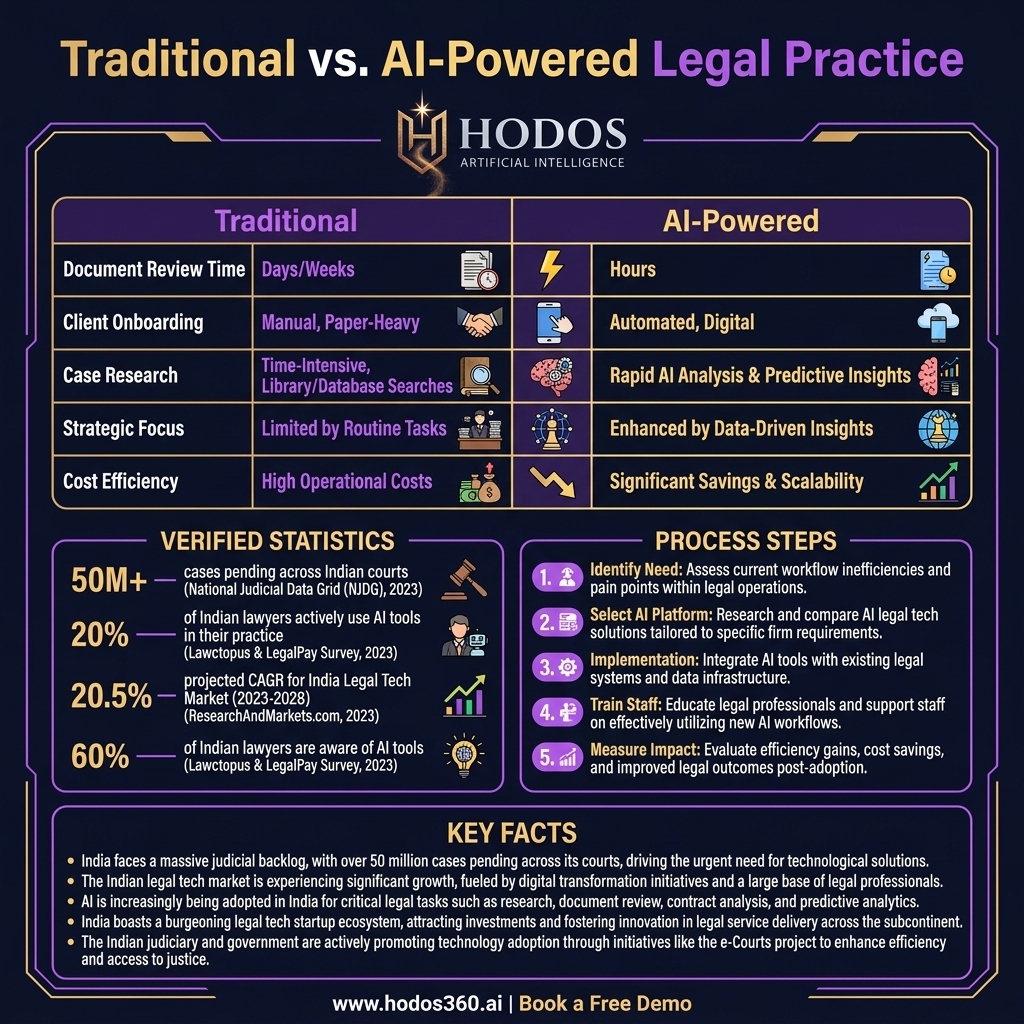
At the heart of India's legal modernization lies the practical application of AI-powered legal workflows. These are not futuristic concepts but tangible tools delivering immediate benefits. Take document review, for instance: traditionally a laborious, error-prone process, it can now be handled by AI with unprecedented speed and accuracy. According to a 2023 report by Thomson Reuters, firms leveraging AI for contract analysis and e-discovery have reported a reduction in review time by up to 50% and cost savings exceeding 30%. This efficiency is critical in a high-volume legal market like India's, where even minor delays can have significant financial implications. AI's ability to quickly identify relevant clauses, flag inconsistencies, and categorize documents empowers legal teams to focus on strategic analysis rather than manual grunt work, thereby enhancing overall productivity.
Beyond document review, AI legal workflows are transforming several other critical areas. Predictive analytics, for example, is emerging as a powerful tool for assessing case outcomes, identifying litigation risks, and optimizing settlement strategies. By analyzing vast datasets of past cases, judicial rulings, and legal precedents, AI models can provide lawyers with data-driven insights that were previously unattainable. This capability allows firms to offer more informed advice to clients, leading to better decision-making and potentially more favorable outcomes. Learn more about AI Marketing: The Essential Guide to Legal Personalization. Furthermore, AI is proving invaluable in intelligent legal research, sifting through millions of legal documents, statutes, and case laws in seconds, providing highly relevant results that traditional keyword searches often miss. This precision and speed drastically cut down research time, enabling lawyers to dedicate more hours to client engagement and strategic thinking.
Consider the impact on client intake and case management. Firms are increasingly deploying AI to automate the initial stages of client engagement, from lead qualification to onboarding. AI-powered chatbots and virtual assistants can handle initial inquiries, gather preliminary information, and even schedule appointments, ensuring a seamless and efficient start to the client journey. This not only improves client satisfaction but also frees up valuable administrative and legal staff to focus on higher-value tasks. The comprehensive integration of these AI legal workflows into a firm's operational backbone represents a paradigm shift, moving legal practices from reactive to proactive, and from labor-intensive to knowledge-driven. The ongoing development and refinement of these AI models continue to push the boundaries of what's possible in legal service delivery.
Streamlining Case Management and Client Intake with AI
The initial touchpoints with clients are crucial, yet often fraught with inefficiencies. AI is revolutionizing this by offering intelligent solutions for case management and client intake. For example, AI-powered systems can automatically extract key information from client communications, populate case files, and even perform preliminary conflict checks, significantly reducing the administrative burden. Firms like J. Learn more about Voice AI: An Essential Leap for Law Firms' Client Engagement. Sagar Associates (JSA) in India, while not publicly detailing AI in this specific area, are indicative of larger firms that would benefit immensely from such streamlining. The ability of AI to rapidly process and organize client data ensures accuracy from the outset, minimizing errors and allowing legal teams to focus on substantive legal issues rather than data entry. This efficiency translates into faster onboarding, improved client experience, and ultimately, a more productive legal practice.

- ✓Enhanced Efficiency: AI automates repetitive tasks like document review and data entry, saving significant time and resources.
- ✓Improved Accuracy: AI minimizes human error in tasks such as contract analysis and legal research, leading to more reliable outcomes.
- ✓Predictive Insights: Advanced AI models offer data-driven predictions for case outcomes, aiding strategic decision-making for litigation.
- ✓Cost Reduction: By streamlining operations and reducing manual labor, AI significantly lowers operational costs for law firms.
- ✓Better Client Experience: Automated intake and communication tools lead to faster responses and a more seamless client journey.
- ✓Strategic Focus: Lawyers are freed from administrative tasks to concentrate on complex legal analysis, client advising, and strategic planning.
- ✓Scalability: AI solutions allow firms to handle larger volumes of work without proportionally increasing headcount, enabling growth.
Navigating the Regulatory Landscape and Ethical AI Adoption
The rapid proliferation of AI legal workflows naturally brings forth critical questions regarding regulation and ethics. In India, like many jurisdictions, the legal framework is still catching up with the pace of technological advancement. The Digital Personal Data Protection Act, 2023, while a significant step towards data privacy, still requires nuanced interpretation regarding AI's use of vast datasets. Lawyers, bound by professional ethics, must ensure that their use of AI upholds fundamental principles such as client confidentiality (ABA Model Rule 1.6) and competence (ABA Model Rule 1.1). The ethical imperative extends to ensuring algorithmic fairness and mitigating bias, a challenge highlighted by figures like Dr. Rumman Chowdhury, a leading expert in responsible AI, who consistently emphasizes the need for diverse datasets and transparent AI models to prevent perpetuating societal biases in legal outcomes. Firms must implement robust internal policies and conduct regular audits to ensure their AI adoption practices are both legally compliant and ethically sound.
Data security is paramount, especially when handling sensitive client information. The legal profession is a prime target for cyberattacks, and the integration of AI systems adds new layers of complexity to data protection strategies. Firms must invest in secure cloud infrastructure, implement end-to-end encryption, and ensure that all AI tools comply with stringent cybersecurity standards. Learn more about Essential AI Voice Assistant Strategies for Modern Law Firms. The potential for data breaches, or even the inadvertent exposure of privileged information through poorly secured AI legal workflows, carries severe reputational and legal risks. This means not only vetting AI vendors thoroughly but also continuously training legal professionals on best practices for data handling and AI usage. The Indian legal tech landscape is keenly aware of these challenges, with many startups prioritizing security and privacy by design in their offerings, understanding that trust is the ultimate currency in legal services.
Moreover, the question of accountability in AI-driven legal decisions remains a complex ethical dilemma. While AI can provide powerful insights, the ultimate responsibility for legal advice and outcomes always rests with the human lawyer. This underscores the concept of 'augmented intelligence,' where AI serves as a powerful assistant rather than a replacement. The EU AI Act, a landmark piece of legislation, provides a blueprint for regulating high-risk AI systems, and while India has its own regulatory path, similar principles of transparency, human oversight, and accountability are likely to shape future legal tech policies. Law firms must proactively engage with these ethical frameworks, fostering a culture where AI is used responsibly, transparently, and always in service of justice, ensuring that the human element remains central to the practice of law.
Data Security and AI: Protecting Client Confidentiality
Protecting client confidentiality is a cornerstone of legal practice, and AI integration demands heightened vigilance. Firms must ensure that any AI legal workflows or platforms they use are built with enterprise-grade security protocols. This includes robust encryption for data in transit and at rest, strict access controls, and compliance with data residency requirements, especially for sensitive Indian client data. Consider the implications if a firm's AI-powered document review system were compromised, exposing sensitive client information. Learn more about AI Assistant: Essential Tool for Law Firm Staffing Shortages. Such an event could be catastrophic, leading to severe penalties under the Digital Personal Data Protection Act and irreparable damage to the firm’s reputation. Therefore, continuous security audits, penetration testing, and a clear understanding of data governance are essential, emphasizing the need for secure AI models and reliable infrastructure.
The Future of Legal Practice: Investment, Innovation, and Growth
The future of legal practice in India is inextricably linked to the trajectory of AI investment and innovation. The government's ambitious target to attract over $200 billion in AI infrastructure investment by 2028, as reported by various financial news outlets, underscores the national commitment to becoming a global AI hub. A significant portion of this capital will inevitably flow into sector-specific applications, with legal tech poised to be a major beneficiary. This influx of funding is fueling a new generation of Indian startups that are not only building advanced AI models but also creating entirely new categories of legal services. These startups are challenging traditional business models, forcing established firms to innovate or risk being left behind. The competitive tension is palpable, creating an environment where firms that embrace AI are gaining a significant edge in attracting both clients and top legal talent.
This era of rapid innovation is characterized by a shift towards integrated, end-to-end solutions. Legal professionals are no longer looking for siloed tools but comprehensive platforms that can manage the entire lifecycle of a case, from client intake to billing and analytics. This demand is driving the development of sophisticated AI law firm management systems that unify various workflows under a single, intelligent umbrella. The success stories of global firms like Allen & Overy, which famously partnered with Harvey AI to enhance its legal operations, serve as a powerful testament to the transformative potential of enterprise AI. These partnerships demonstrate that strategic AI adoption is not just about cutting costs but about enhancing service quality, expanding capacity, and ultimately, driving sustainable growth in a competitive market. The focus is on building scalable AI models that can adapt to evolving legal needs.
Moreover, the growth of the legal tech ecosystem is fostering collaboration between legal experts and technologists. This interdisciplinary approach is essential for developing AI solutions that are truly effective and practical for lawyers. Academic institutions, tech incubators, and industry bodies are increasingly working together to bridge the gap between legal theory and technological application, ensuring that the next wave of AI legal workflows is both groundbreaking and deeply relevant to the everyday challenges of legal practice. This collaborative spirit is a hallmark of India's tech landscape, positioning it as a hotbed for future legal innovation. The continued investment in research and development will be crucial for maintaining this momentum.
Cultivating an AI-Ready Legal Ecosystem
Successful AI adoption extends beyond technology; it requires a cultural shift within law firms. Cultivating an AI-ready legal ecosystem means investing in continuous training and upskilling for legal professionals. Lawyers need to understand not just *how* to use AI tools, but *how* to leverage them strategically to enhance their legal acumen and client service. This includes understanding the limitations of AI, its ethical implications, and how to effectively integrate AI-generated insights into their legal strategies. Firms that prioritize this human-AI collaboration will be best positioned to capitalize on the benefits of AI legal workflows, transforming their practice into a more agile, efficient, and forward-thinking entity.

Key Takeaways and Next Steps for Modernizing Legal Workflows
The journey of modernizing legal workflows in India, propelled by enterprise AI, is an ongoing testament to innovation and adaptability. The insights gleaned from the rapid AI adoption in the Indian legal ecosystem underscore a critical truth: AI is not merely a tool for efficiency; it is a strategic partner in redefining legal excellence. From significantly reducing the time spent on document review to offering predictive analytics for complex litigation, AI legal workflows are empowering legal professionals to focus on higher-value tasks, enhance client outcomes, and drive unprecedented growth. The emphasis on ethical deployment, robust data security, and continuous professional development ensures that this technological leap is both responsible and sustainable. The competitive landscape demands that firms move beyond contemplation to decisive action, recognizing that the future of legal practice is fundamentally intertwined with intelligent automation.
For law firms looking to navigate this transformative era, the path forward involves a clear strategy for integrating AI legal workflows into their core operations. This includes assessing current inefficiencies, identifying areas where AI can deliver the most impact, and selecting the right technology partners. The goal is to build a robust AI infrastructure that supports scalable growth and fosters a culture of innovation. Firms that proactively embrace these changes will not only streamline their operations but also attract top talent, enhance their competitive standing, and deliver superior client service in an increasingly complex legal world. The shift is from merely practicing law to truly innovating it, making legal services more accessible, efficient, and effective for all.
Embracing sophisticated AI legal workflows is no longer a luxury but a necessity for any firm aiming to thrive in the modern legal landscape. Platforms like HODOS 360's AI Law Firm Management System offer a comprehensive suite of tools designed precisely for this purpose, integrating case management, billing, client intake, and document automation with powerful AI-driven workflows. By leveraging such integrated solutions, firms can unlock new levels of productivity, accuracy, and strategic insight, positioning themselves at the forefront of legal innovation. The time to modernize your legal workflows is now.
Frequently Asked Questions
What does 'enterprise-grade AI' mean for legal workflows in India?+
Enterprise-grade AI refers to AI solutions built for large-scale, complex business environments, focusing on scalability, security, and reliability. For Indian legal workflows, it means AI systems that can handle vast amounts of data, integrate seamlessly with existing firm operations, comply with local regulations, and provide robust performance for critical legal tasks like e-discovery and contract analysis, ensuring data integrity and confidentiality.
How does AI specifically benefit Indian law firms given their unique challenges?+
Indian law firms benefit from AI by tackling challenges like high caseloads, manual processes, and diverse legal documentation. AI streamlines document review, automates client intake, enhances legal research across multiple languages, and provides predictive analytics for case outcomes. This significantly boosts efficiency, reduces operational costs, and allows lawyers to focus on strategic work, ultimately improving service delivery and access to justice.
What are the main challenges of AI adoption in the Indian legal sector?+
Challenges include data privacy and security concerns, especially with sensitive client information, the need for robust regulatory frameworks (like the Digital Personal Data Protection Act), and ethical considerations regarding algorithmic bias. Additionally, there's the hurdle of cultural resistance to new technology within traditional firms and the necessity for continuous training to ensure legal professionals can effectively leverage AI tools responsibly and competently.
Will AI replace legal professionals in India?+
No, AI is not expected to replace legal professionals. Instead, it serves as an augmentation tool, handling repetitive and data-intensive tasks, thereby freeing lawyers to focus on complex problem-solving, strategic thinking, and client relations. AI enhances a lawyer's capabilities, making them more efficient and effective, rather than rendering their expertise obsolete. The future is about human-AI collaboration, not replacement.
How can an Indian law firm get started with implementing AI legal workflows?+
An Indian law firm can start by identifying key pain points in their current workflows where AI can provide immediate value, such as document review or client intake. Research reputable AI legal tech providers, focusing on those with enterprise-grade solutions and strong data security. Pilot a small-scale implementation, invest in training for staff, and gradually expand AI integration across the firm. Consulting with experts in legal tech can also guide the process.