

Essential AI Marketing Governance: Taming Shadow AI for Law Firms
In the bustling corridors of "Sterling & Blackwood LLP," a prominent corporate law firm known for its innovative approach, Senior Partner Eleanor Vance recently uncovered a disconcerting truth. Her marketing department, eager to leverage cutting-edge tools for client acquisition and brand visibility, had independently adopted a suite of AI applications—from content generation bots to advanced social media schedulers—without central oversight. This unapproved proliferation, a phenomenon increasingly dubbed 'shadow AI,' exposed the firm to potential reputational damage, client data breaches, and significant compliance risks, illustrating a tension many legal leaders now face: the pull of rapid innovation versus the imperative of stringent governance.
The allure of AI in marketing is undeniable. Tools promise unprecedented efficiency, personalized outreach, and data-driven insights. However, as the CDOTrends article highlights, the unchecked use of these powerful AI agents can quickly outpace an organization's ability to manage them, creating vulnerabilities that are particularly acute within the highly regulated legal sector. Law firms, custodians of sensitive client data and reputation, cannot afford a 'Wild West' approach to AI. The challenge for legal leaders isn't to stifle innovation, but to channel it into a governed framework that safeguards client interests, maintains ethical standards, and ultimately turns the potential chaos of shadow AI into measurable enterprise value. This post will explore how firms can achieve this critical balance, moving beyond reactive damage control to proactive, strategic AI integration.
The Pervasive Threat of Shadow AI in Legal Marketing
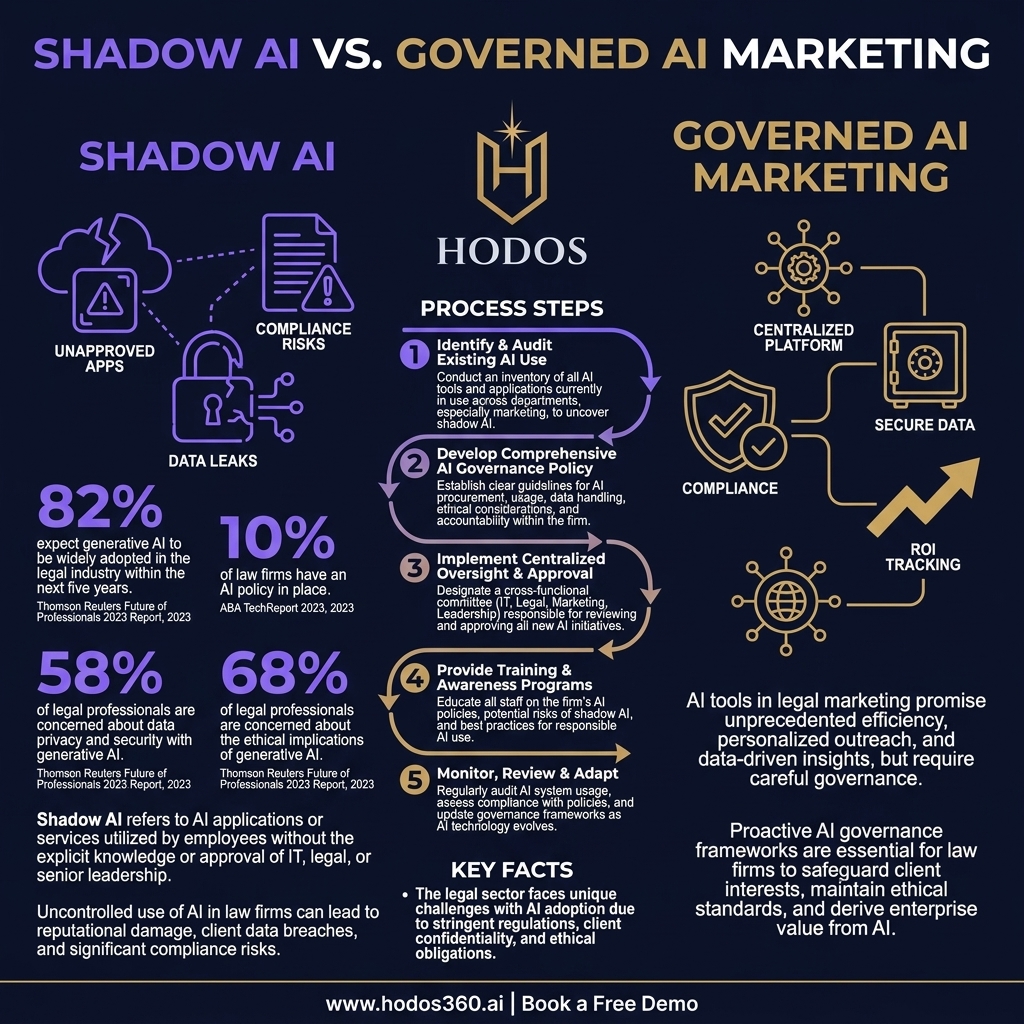
The concept of shadow AI extends beyond mere unauthorized software; it encompasses any AI application or service utilized by employees without the explicit knowledge or approval of IT, legal, or senior leadership. In legal marketing, this often manifests as associates or marketing specialists employing readily available generative AI for drafting blog posts, social media updates, or even client outreach emails. While seemingly innocuous, the risks are profound. For instance, using public generative AI models for client case summaries, even for internal marketing materials, can inadvertently expose confidential client information, directly violating ABA Model Rule 1.6 (Confidentiality of Information). The ease of access to tools like ChatGPT or Midjourney means that even well-intentioned employees can bypass established protocols, creating a significant blind spot for firm management.
A recent Thomson Reuters Institute report, published in early 2026, indicated that nearly 60% of law firm marketing departments globally acknowledged using AI tools, with over 30% admitting these tools were adopted outside of formal IT procurement channels. Learn more about Proven Strategy: AI-Built Websites Can Convert for Law Firms. This widespread, uncontrolled adoption introduces critical vulnerabilities. Data security is paramount; if an AI tool processes client data, even for a moment, and its security protocols are not up to legal industry standards, it becomes a potential vector for breaches. Furthermore, the ethical implications of AI-generated content—such as ensuring accuracy, avoiding misleading statements, and maintaining the firm’s distinctive voice—become incredibly complex when multiple, ungoverned AI agents are at play. Firms like "LexCorp Legal," a mid-sized firm specializing in M&A, learned this the hard way when an AI-generated social media campaign, produced by an enthusiastic junior marketer, inadvertently used copyrighted imagery and made unsubstantiated claims about their success rate, leading to a public relations nightmare and an ethical inquiry.
Navigating Data Privacy and Compliance Risks
The regulatory landscape surrounding AI is rapidly evolving, adding another layer of complexity to shadow AI in marketing. The enforcement of the EU AI Act, anticipated to begin in phases from early 2027, will impose stringent requirements on high-risk AI systems, including those used for public-facing communications. While many marketing AI tools might not fall under the 'high-risk' category, the principles of transparency, data governance, and human oversight are universally applicable. Firms operating globally must contend with a patchwork of regulations, from GDPR to CCPA, all of which demand careful handling of personal data. When a firm's marketing team uses an AI agent that scrapes public data or processes customer inquiries, the firm becomes responsible for that data's lineage and security. Learn more about AI Web Apps: Ultimate Legal Firms' Guide to Next-Gen Development. According to Gartner's 2026 predictions, enterprises that fail to establish robust AI governance by 2027 will face an average of three major AI-related compliance incidents annually, underscoring the urgency for law firms to bring their digital marketing under a structured framework.
Moreover, the very nature of AI, particularly large language models, often involves vast datasets for training, some of which may contain proprietary or copyrighted material. If a firm's marketing team uses such a model to generate content, there's a latent risk of unintentional plagiarism or infringement, which is particularly damning for a legal entity. The challenge for legal leaders is to ensure that every AI agent used, especially in client-facing channel marketing, adheres to the highest standards of data integrity and intellectual property respect. This requires a comprehensive understanding of where AI is already being used and a proactive strategy to bring it under central control.
Building a Robust AI Governance Framework for Law Firms
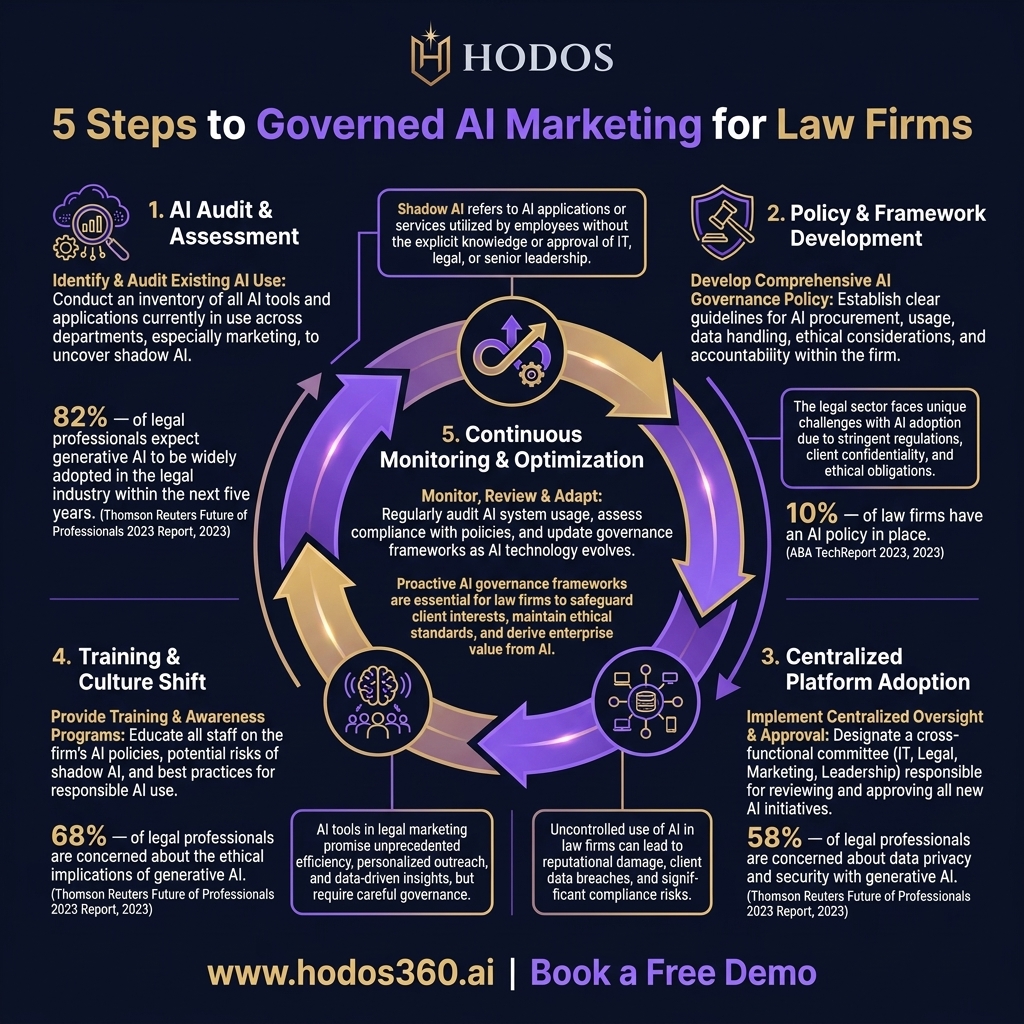
Transforming the chaos of shadow AI into governed enterprise value begins with establishing a clear, comprehensive AI governance framework. This isn't merely about blocking unauthorized tools; it's about creating a strategic approach that fosters innovation responsibly. A pivotal step is the formation of an interdisciplinary AI Governance Committee, comprising partners, IT directors, marketing leaders, and legal ethics counsel. This committee, as advocated by legal tech pioneer Karl Chapman, formerly of Riverview Law and now EY Riverview Law, should be tasked with developing firm-wide AI policies, assessing new technologies, and overseeing implementation. These policies must delineate acceptable use of AI, data handling protocols, content creation guidelines, and disclosure requirements for AI-assisted work, aligning with professional obligations like ABA Model Rule 7.1 (Communications Concerning a Lawyer's Services) to prevent misleading statements.
The framework must also include a clear process for evaluating and approving AI tools before they are integrated into any department, especially marketing. Learn more about AI Document Workflows: Unleash Firm Efficiency in 2026. This involves a rigorous due diligence process that scrutinizes vendor security, data privacy practices, ethical AI principles, and compatibility with the firm's existing IT infrastructure. For example, when "Davis & Partners" sought to implement an AI-powered lead qualification system, their newly formed AI Governance Committee conducted a six-month review, ensuring the vendor's data encryption met industry standards and that the AI's lead scoring algorithms were transparent and unbiased. This meticulous approach prevents the proliferation of unsecured or ethically questionable AI agents while still allowing for strategic adoption of valuable tools. The goal is to create an environment where AI is a trusted partner, not a lurking liability.
Centralizing AI Marketing with Strategic Platforms
One of the most effective strategies for bringing shadow AI under governance is the adoption of centralized AI platforms designed specifically for the legal sector. These platforms integrate various AI functionalities, such as content generation, social media automation, and analytics, within a controlled environment. By providing approved tools and workflows, firms can ensure consistency in branding, adherence to ethical guidelines, and robust data security. For instance, a platform that offers AI-powered content generation for blog posts would be pre-configured with the firm's style guide, compliance checks, and data privacy settings, drastically reducing the risk of accidental misrepresentation or confidentiality breaches. This approach empowers marketing teams to harness AI's benefits without compromising the firm's integrity.
Moreover, these integrated solutions often come equipped with built-in analytics and ROI tracking capabilities, allowing firms to measure the effectiveness of their AI-driven marketing efforts. Learn more about AI Marketing Mastery: Essential Strategies for Law Firms. This transparency is crucial for demonstrating the value of AI investments and for making data-driven decisions about future technology adoption. Firms like "Greenberg Traurig" have begun exploring integrated platforms that not only automate channel marketing tasks but also provide a clear audit trail for all AI-generated content, enhancing accountability. This shift from ad-hoc, individual AI tool usage to a structured, platform-centric approach is a cornerstone of effective AI governance in the modern legal digital landscape.
- ✓Policy Development: Establish clear, firm-wide guidelines for AI use, covering data privacy, content ethics, and intellectual property.
- ✓Governance Committee: Form an interdisciplinary committee to oversee AI strategy, review tools, and ensure compliance with already existing and emerging regulations.
- ✓Centralized Platforms: Implement integrated AI marketing platforms that provide governed access to AI tools for content creation, social media automation, and analytics.
- ✓Employee Training: Conduct regular training sessions for all staff, particularly marketing and client-facing teams, on approved AI tools, ethical use, and potential risks of shadow AI.
- ✓Vendor Due Diligence: Rigorously vet all AI vendors for security protocols, data handling practices, and compliance with legal industry standards.
- ✓Continuous Monitoring: Establish systems to monitor AI usage, identify potential shadow AI instances, and ensure ongoing adherence to governance policies.
Leveraging HODOS 360 for Governed AI Marketing Transformation
For law firms grappling with the complexities of shadow AI and the urgent need for a robust governance framework, platforms like HODOS 360's AI Marketing Platform offer a strategic solution. This platform is specifically designed to empower law firms to harness the full potential of AI for marketing without sacrificing control or compliance. By providing a centralized hub for AI video creation, social media automation, content generation, and comprehensive analytics, HODOS 360 ensures that all AI agents are operating within a predefined, governed ecosystem. This means every piece of AI-generated content adheres to firm standards, every social media post is compliant, and every channel marketing effort is trackable and accountable. Firms can empower their marketing teams with powerful AI tools, confident that client data is protected and ethical guidelines are upheld.
Imagine a scenario where a firm's marketing leaders can deploy AI to create compelling video testimonials, automate social media campaigns across multiple channels, and generate high-quality blog posts, all from a single, secure platform. Learn more about AI Marketing Automation: Law Firms' 2026 Growth Catalyst. This not only streamlines operations but also provides an unprecedented level of oversight and control. HODOS 360’s platform incorporates features for ROI tracking, allowing firms to clearly attribute success to their AI marketing efforts, moving beyond guesswork to data-driven insights. This ensures that the firm's investment in AI translates directly into tangible business growth, while simultaneously mitigating the risks associated with unchecked AI proliferation. The journey from the uncontrolled realm of shadow AI to a strategically governed digital marketing powerhouse is not just possible; it's essential for future-proofing your law firm.
Cultivating an AI-Literate Legal Culture
Beyond technological solutions, fostering an AI-literate culture within the firm is paramount. This involves continuous education and training for all legal professionals, from partners to paralegals, on the capabilities, limitations, and ethical considerations of AI. Firms that invest in comprehensive training programs see higher adoption rates of governed AI tools and a significant reduction in shadow AI instances. For example, "Allen & Overy's" well-publicized partnership with Harvey AI isn't just about using the tool; it's about educating their lawyers on how to effectively and ethically integrate AI into their workflows. This proactive approach ensures that every member of the firm understands their role in maintaining data integrity and upholding professional standards when interacting with AI agents.
An AI-literate culture also encourages open dialogue about AI's impact and potential. Learn more about Full-Stack AI Marketing: The Ultimate Strategy for Law Firms. It allows for a collaborative environment where new AI applications can be responsibly explored and integrated into the governance framework, rather than being hidden. This shift in mindset, from viewing AI as a potential threat to an invaluable asset that requires careful stewardship, is critical for long-term success. It empowers leaders to make informed decisions about AI investments and ensures that the firm's digital transformation is both innovative and secure, ultimately turning the potential disruption of AI into a competitive advantage in marketing and beyond.

Key Takeaways and Next Steps for Proactive AI Marketing Governance
The proliferation of shadow AI in legal marketing presents both significant risks and unparalleled opportunities. For law firms, the imperative is clear: embrace AI innovation but do so without compromising the ethical, legal, and reputational integrity that underpins the profession. Establishing a robust AI governance framework is not a luxury but a necessity, transforming potential liabilities into strategic assets. By centralizing AI tools, implementing clear policies, and fostering an AI-literate culture, firms can confidently navigate the digital landscape.
The journey to governed AI marketing begins with an honest assessment of your firm's current AI usage, followed by the strategic implementation of a comprehensive framework. Don't let shadow AI cast a pall over your firm's future. Discover how a structured approach can unlock the full potential of AI in your channel marketing efforts, ensuring compliance, enhancing efficiency, and driving sustainable growth. Take control of your firm's digital future today. Learn more about HODOS 360's AI Marketing Platform and schedule a free demo to see how our solutions can help your firm achieve governed enterprise value.
Frequently Asked Questions
What is 'shadow AI' in the context of law firm marketing?+
Shadow AI refers to the unauthorized or ungoverned use of AI tools and applications by employees within a law firm's marketing department. This often happens when individuals independently adopt readily available AI agents for tasks like content generation or social media automation, bypassing official procurement and governance frameworks, leading to unmonitored AI usage and potential risks for the enterprise.
Why is shadow AI a significant risk for law firms?+
Shadow AI poses significant risks due to potential client data privacy breaches, non-compliance with regulations like GDPR or the EU AI Act, ethical dilemmas from misleading AI-generated content, and inconsistencies in brand messaging. Without a clear governance framework, firms risk reputational damage and legal liabilities, as unchecked AI agents can compromise sensitive information and professional standards.
How can law firms establish effective AI marketing governance?+
Effective AI marketing governance involves creating an interdisciplinary AI Governance Committee, developing clear firm-wide AI policies, conducting thorough due diligence on all AI vendors, and implementing centralized AI marketing platforms. This structured approach ensures that all AI tools, especially those for channel marketing, are vetted, compliant, and operate within a governed framework, bringing all AI agents under control.
What role do centralized AI marketing platforms play in governance?+
Centralized AI marketing platforms, such as HODOS 360's solution, are crucial for governance as they provide a controlled environment for AI tool usage. They integrate functionalities like content generation and social media automation within predefined ethical and compliance parameters, ensuring consistency, security, and accountability. This helps firms manage AI agents effectively, transforming shadow AI into governed enterprise value.
What are the benefits of proactive AI governance for law firms?+
Proactive AI governance allows law firms to harness AI's benefits for marketing—like increased efficiency and personalized outreach—without the associated risks. It ensures compliance with legal and ethical standards, protects client confidentiality, maintains brand consistency, and enables data-driven decision-making. This strategic approach transforms shadow AI into a competitive advantage, driving sustainable growth and enhancing the firm's digital reputation.