
AI Scaling: Essential Change Management for Legal Leaders
The legal industry stands at a pivotal juncture, grappling with the profound implications of artificial intelligence. Just weeks ago, at a prominent Wolters Kluwer legaltech summit, industry luminaries like Brad Blickstein, the founder of the Blickstein Group, underscored a critical, often-overlooked truth: the successful integration and AI scaling within law firms isn't merely a technological feat.
It is, fundamentally, a human challenge, deeply rooted in change management and the strategic cultivation of human assets. While headlines often trumpet the latest AI breakthroughs, the real drama unfolds in the boardrooms and partner meetings where firms decide *how* to weave these innovations into their established practices.
This sentiment resonates deeply across the legal landscape. The initial hype surrounding AI has matured into a more nuanced understanding: technology, however powerful, is inert without human agency. Firms like Allen & Overy, with its high-profile collaboration with Harvey AI, exemplify the potential, yet even they acknowledge the extensive internal work required to prepare their lawyers for new workflows.
The tension lies between the undeniable efficiency gains promised by AI—from automated document review to predictive analytics—and the inherent resistance to altering long-standing professional routines. This article delves into the essential strategies for legal leaders to bridge this gap, ensuring that AI becomes a force multiplier rather than a source of organizational friction.
The journey toward an AI-powered future demands more than just investing in software; it requires a holistic transformation of culture, processes, and skill sets. As we navigate this complex terrain, understanding the interplay between cutting-edge legaltech and the invaluable human assets within a firm becomes paramount.
The firms that will thrive are those that recognize AI as a tool to augment human intelligence, not replace it, and strategically manage the profound organizational shifts this paradigm brings. Discover how your firm can effectively scale AI by prioritizing people and process alongside technology.
Learn more about integrating these crucial elements for sustainable growth and innovation.
The Indispensable Role of Human Assets in AI Legal Transformation
The narrative around AI in legal often focuses on algorithms and data, but the true differentiator for successful AI scaling is the human element. Legal professionals are not just users of technology; they are its architects, trainers, and critical evaluators. As Mark Cohen, CEO of Legal Mosaic and a respected voice in legal innovation, frequently asserts, the future of legal work is 'lawyers plus machines,' not 'machines instead of lawyers.'
This symbiotic relationship demands a proactive approach to talent development. Firms that invest in upskilling their workforce, equipping them with 'AI literacy' and prompt engineering skills, are seeing significant returns. According to a 2023 ABA TechReport, only 35% of lawyers reported receiving formal training on legal technology from their firms, highlighting a crucial gap that needs urgent attention for effective AI adoption.
Developing these human assets means fostering a culture of continuous learning. Firms must move beyond ad-hoc training sessions and integrate AI education into their professional development programs. This includes understanding the capabilities and limitations of AI tools, ethical considerations in their use, and how to leverage them for strategic advantage.
For instance, partners at firms like Dentons have championed internal 'AI academies,' recognizing that buy-in and proficiency start from within. Learn more about AI Legal Management: The Essential Future for Law Firms. This not only mitigates fear of job displacement but empowers lawyers to view AI as a powerful co-pilot, enhancing their ability to deliver higher-value legal services.
The objective is to augment, not automate, the core competencies of legal professionals, freeing them from mundane tasks to focus on complex problem-solving and client relationship building.
Moreover, the human element extends to leadership. Legal leadership must champion the change from the top, demonstrating a clear vision for AI integration and communicating its benefits transparently.
Without strong leadership, initiatives can falter due to internal resistance or a lack of strategic alignment. Catherine Krow, founder of Zeughauser Group and a prominent advisor on legal innovation, emphasizes that firm leaders must articulate a compelling 'why' for AI adoption, connecting it directly to improved client outcomes, competitive advantage, and enhanced attorney well-being.
This vision transforms AI from a daunting new technology into an exciting opportunity, ensuring that the firm's most valuable asset—its people—are engaged, informed, and enthusiastic participants in the digital transformation.
Cultivating AI Literacy and Ethical Competence
Beyond technical skills, AI scaling requires a deep understanding of the ethical implications of using AI in legal practice. The ABA Model Rules of Professional Conduct, particularly Rule 1.1 on Competence, implicitly mandate that lawyers understand the benefits and risks associated with relevant technology. This extends to AI.
Firms must establish clear internal guidelines for AI use, addressing issues such as client confidentiality (ABA Model Rule 1.6), data privacy, bias in AI outputs, and the ultimate responsibility for work product. Learn more about Voice AI Adoption: Essential for Law Firms' Future Growth. For example, recent court cases have highlighted instances where lawyers faced sanctions for submitting AI-generated content without proper verification, underscoring the critical need for human oversight.
The ethical use of AI is not merely about compliance; it's about maintaining client trust and upholding the integrity of the profession. This requires ongoing dialogue, training, and a commitment from all levels of the firm to navigate these complex ethical landscapes responsibly.
Strategic Change Management for Seamless AI Adoption
The greatest technological innovations often fail not due to technical flaws, but due to inadequate change management. This holds especially true for AI adoption in the inherently conservative legal sector. Implementing AI is not a one-time event; it’s a continuous process that requires meticulous planning, clear communication, and empathetic leadership.
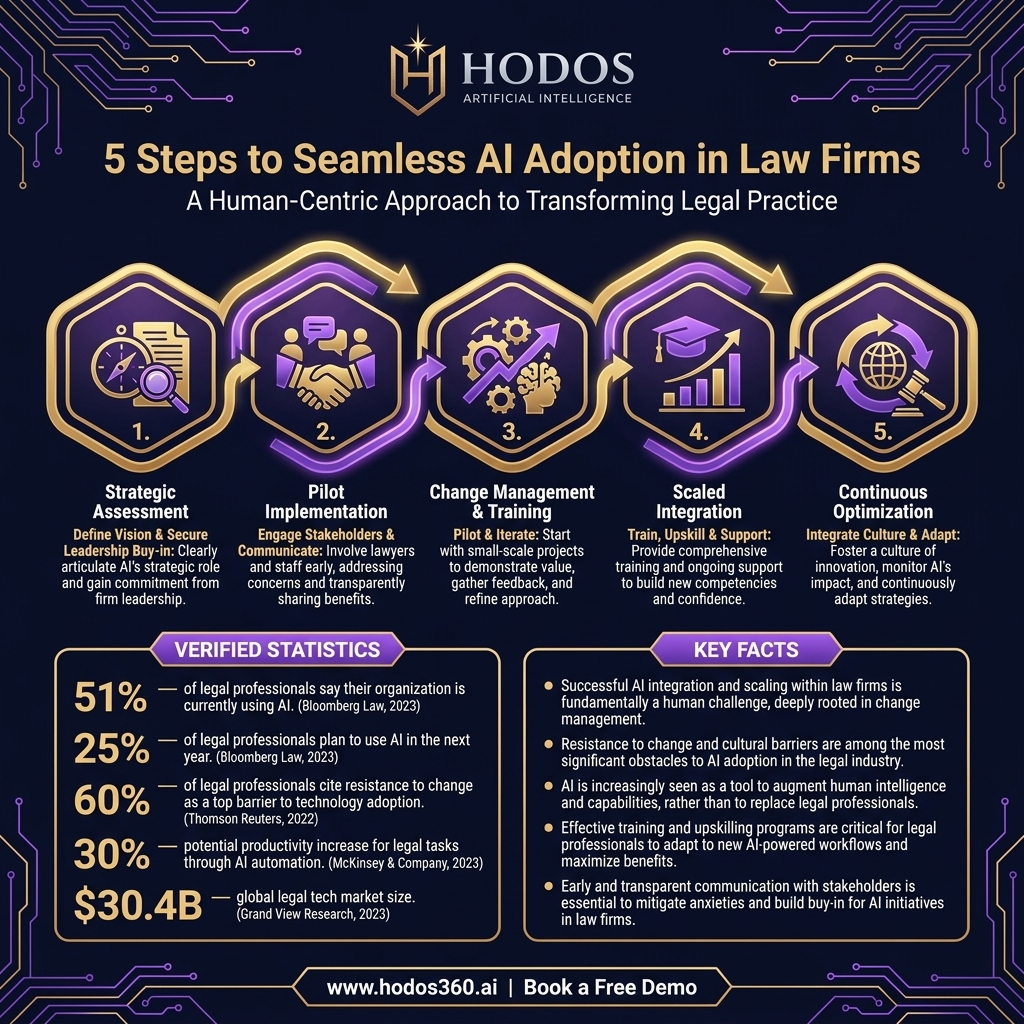
A 2024 Thomson Reuters report on the State of the Legal Market found that firms with a structured approach to technology adoption reported significantly higher satisfaction and ROI compared to those with ad-hoc strategies. Key to this success is creating a detailed roadmap that anticipates resistance, identifies key stakeholders, and articulates clear milestones.
This proactive approach helps mitigate the 'implementation dip' that often accompanies new technology, ensuring a smoother transition and sustained enthusiasm among staff.
Effective change management begins with transparent communication. Law firms must clearly articulate *why* AI is being introduced, *what* benefits it will bring to individual lawyers and the firm, and *how* it will impact daily workflows.
This includes addressing concerns about job security directly and emphasizing AI's role as an augmentation tool. Pilot programs, starting with a small, enthusiastic group of early adopters, can be invaluable. Learn more about Autonomous AI Marketing: The Ultimate Guide for Law Firms. These 'AI champions' can then share their positive experiences and best practices, building internal momentum and credibility.
For instance, a medium-sized firm, Smith & Jones LLP, successfully piloted an AI-powered contract review tool with a single practice group, allowing them to refine workflows and gather user feedback before a firm-wide rollout, leading to a 30% reduction in review time for that group.
Moreover, training must be continuous, context-specific, and accessible. It's not enough to conduct a single training session; ongoing support, Q&A forums, and accessible resources are vital. Lawyers need to see how AI directly solves their pain points and makes their work more efficient and enjoyable.
The legal profession thrives on precision and accuracy, and any new tool must meet these high standards. Therefore, demonstrating AI's reliability and providing clear guidelines for its use—including when human review is absolutely critical—is paramount. This builds trust and encourages widespread adoption, turning initial skepticism into genuine advocacy for the new tools.
By prioritizing people and process, firms can ensure that AI scaling becomes a driver of progress rather than a source of disruption.
Key Pillars of Successful AI Implementation
- ✓Visionary Leadership & Communication: Clearly articulate the 'why' behind AI adoption, emphasizing benefits for both the firm and individual attorneys, fostering transparency and trust.
- ✓Stakeholder Engagement & Buy-in: Involve key personnel from all levels—partners, associates, paralegals, and administrative staff—in the planning and feedback process to ensure broad acceptance.
- ✓Phased Implementation & Pilot Programs: Start with smaller, manageable pilot projects to test AI tools, gather feedback, and demonstrate tangible successes before scaling firm-wide.
- ✓Comprehensive & Ongoing Training: Provide continuous, hands-on training tailored to specific roles and workflows, focusing on practical application and ethical use of AI tools.
- ✓Dedicated AI Champions & Support: Appoint internal advocates who can guide peers, troubleshoot issues, and promote best practices, creating an internal support network.
- ✓Performance Metrics & Feedback Loops: Establish clear KPIs to measure AI's impact on efficiency and productivity, using feedback to iteratively refine and optimize implementation strategies.
Integrated AI for Modern Law Firm Management
Beyond core legal work, AI is revolutionizing the operational backbone of law firms. The true potential of AI scaling lies in its ability to integrate across all facets of firm management, transforming everything from client intake to billing and marketing. Consider the inefficiencies inherent in traditional law firm operations: manual data entry, repetitive document generation, and reactive client communication.
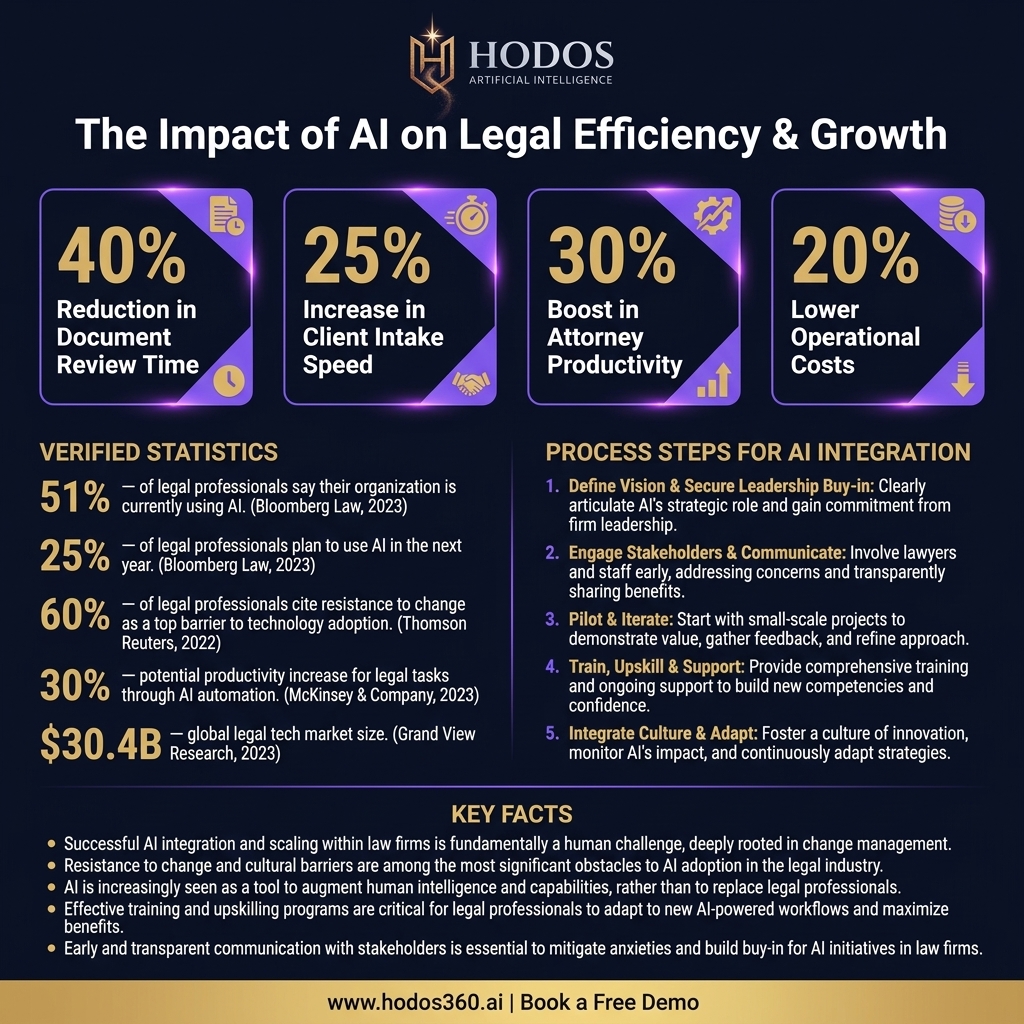
AI-powered platforms are now addressing these directly, offering integrated solutions that streamline these processes. For instance, an AI-powered client intake system can not only capture data more accurately but also pre-qualify leads and even suggest relevant legal services, significantly reducing the administrative burden on staff and improving client experience from the very first touchpoint.
This is where a comprehensive platform like HODOS 360’s AI Law Firm Management System becomes invaluable. By integrating case management, billing, document automation, and AI-powered legal workflows into a single ecosystem, firms can achieve unprecedented levels of efficiency and insight. Imagine an AI assistant that automatically schedules follow-ups, drafts initial client communications based on intake data, or identifies potential conflicts of interest with greater speed and accuracy than human review alone.
This centralization of data and automation of routine tasks frees up significant attorney time, allowing them to focus on complex legal strategy and client advocacy—the high-value work that generates revenue and satisfaction. Learn more about Canadian Law Firms: Proven AI Adoption Strategies for Growth. The shift is from reactive management to proactive, data-driven decision-making, powered by intelligent automation.
Moreover, the benefits extend to financial management and resource allocation. AI can analyze billing data to identify trends, predict future revenue, and optimize resource deployment, ensuring that firms operate leanly and profitably. For example, an AI-driven system can flag potential billing discrepancies, identify underutilized resources, or even forecast caseload demands based on historical data and market trends.
This level of granular insight was previously unattainable for many firms, requiring extensive manual analysis. Now, with AI-powered legal workflows, firms can make informed strategic decisions, optimize their service delivery, and enhance their competitive edge. The future of law firm management is not just about technology; it's about intelligent, integrated technology that empowers human ingenuity.
Enhancing Efficiency and Client Experience with AI
The direct impact of integrated AI on client experience is profound. Beyond internal efficiencies, AI tools enable faster responses, more personalized communication, and a more transparent legal process. AI voice assistants, for example, can provide 24/7 client support, answering common queries, scheduling appointments, and even qualifying leads outside of traditional business hours.
This not only improves client satisfaction but also ensures that potential new business is never missed. Learn more about Legal AI ROI: Maximizing Law Firm Value in 2026. Furthermore, AI-powered marketing platforms can analyze client data to tailor communication strategies, ensuring that outreach is relevant and impactful.
This allows firms to build stronger relationships and demonstrate a commitment to innovation that directly benefits their clients. The result is a more agile, client-centric legal practice that leverages technology to deliver superior service.
Future-Proofing Legal Practice: Cultivating an AI-Ready Culture
As we look to the horizon, the continuous evolution of AI means that future-proofing legal practice is less about adopting a single technology and more about cultivating an adaptive, AI-ready culture. This involves a commitment to ongoing experimentation, learning from both successes and failures, and fostering an environment where innovation is encouraged, not feared.
The role of the Chief Legal Officer and other legal leadership positions is rapidly evolving from risk management to strategic innovation stewardship. They are now tasked with not just ensuring compliance but also identifying emerging technologies, assessing their potential impact, and guiding the firm through transformative change.
This shift requires a proactive, forward-thinking mindset that embraces disruption as an opportunity for growth.
Cultivating this culture also means investing in the next generation of legal talent. Law schools are increasingly integrating legal tech and AI into their curricula, producing graduates who are more comfortable with digital tools.
Firms must capitalize on this by creating mentorship programs that pair seasoned attorneys with tech-savvy new hires, facilitating a reciprocal learning environment. Learn more about AI Adoption: The Ultimate Guide for Law Firm Success. This intergenerational knowledge transfer is crucial for embedding AI capabilities deeply within the firm's DNA.
Moreover, firms should actively participate in legal tech communities, attend conferences like Legalweek NYC, and engage with startups to stay abreast of the latest developments. This external engagement provides valuable insights and helps firms benchmark their AI innovation efforts against industry best practices.
Ultimately, an AI-ready culture is one that views technology as an enabler of human potential, not a replacement.
It's a culture that understands that while AI can automate tasks, it cannot replicate human empathy, strategic judgment, or the nuanced ethical reasoning that defines the legal profession. Firms that empower their lawyers to leverage AI, providing them with the tools and training to do so effectively, will be the ones that not only survive but thrive in the increasingly complex legal landscape.
The journey of AI scaling is continuous, demanding constant adaptation and a steadfast commitment to the human element at its core.

Key Takeaways and Next Steps for Legal Leaders
The message from legaltech leaders is clear: effective AI scaling is inextricably linked to robust change management and prioritizing human assets. The future of the legal profession is not a binary choice between human and machine, but a powerful synergy where AI augments human intelligence, streamlines operations, and enables legal professionals to deliver unparalleled value.
Firms that proactively invest in their people, cultivate an adaptive culture, and strategically implement integrated AI solutions will be best positioned to navigate the complexities of the digital age.
For legal leaders, the next step is to move beyond contemplation to action. Evaluate your firm's current technological infrastructure, assess your team's AI literacy, and develop a comprehensive change management strategy.
Embrace pilot programs, foster continuous learning, and champion ethical AI use. Platforms like HODOS 360 offer comprehensive AI-powered solutions designed specifically for law firms, from AI Law Firm Management to AI Marketing and Voice Assistants, providing the tools necessary to support this transformation. The time to build an AI-ready culture is now, ensuring your firm remains competitive, efficient, and client-centric in the years to come.
Frequently Asked Questions
Why is change management crucial for AI adoption in law firms?+
Change management is vital because AI introduces new workflows and requires lawyers to adapt traditional practices. Without a structured approach, firms face resistance, low adoption rates, and failed implementations. Effective change management ensures buy-in, addresses concerns, and provides the necessary training and support for a smooth transition, maximizing the ROI of AI investments and fostering an adaptive culture.
How do 'human assets' contribute to effective AI scaling?+
Human assets—lawyers, paralegals, and staff—are essential because they are the ultimate users and strategists of AI. Their ability to understand, apply, and ethically manage AI tools determines success. Investing in AI literacy, training, and fostering a collaborative environment empowers these assets to leverage AI for higher-value work, ensuring the technology serves human expertise, not replaces it.
What are the primary ethical considerations when integrating AI into legal practice?+
Primary ethical considerations include client confidentiality, data privacy, ensuring AI outputs are not biased or discriminatory, and maintaining attorney responsibility for work product. Lawyers must understand AI's limitations, verify AI-generated content, and ensure its use complies with professional conduct rules like ABA Model Rules 1.1 (Competence) and 1.6 (Confidentiality). Transparency with clients about AI use is also key.
Can AI truly enhance law firm management beyond legal research?+
Absolutely. AI significantly enhances law firm management by automating administrative tasks like client intake, billing, document generation, and scheduling. It provides data-driven insights for resource allocation, financial forecasting, and even marketing strategies. This frees up lawyers and staff from mundane tasks, allowing them to focus on strategic work, improve client service, and enhance overall operational efficiency and profitability.
What steps can law firms take to cultivate an AI-ready culture?+
Firms can cultivate an AI-ready culture by fostering visionary leadership, promoting continuous AI literacy training, encouraging pilot programs, and establishing clear ethical guidelines. Engaging with legal tech communities, facilitating intergenerational knowledge transfer, and prioritizing a mindset of continuous adaptation and innovation are also crucial. This ensures AI is seen as an augmentation tool, not a threat, integrated into the firm's long-term strategy.