

AI Voice Agent: Essential Legal Firm Automation for 2026
The relentless pace of the modern legal world often leaves law firms grappling with an overwhelming volume of client inquiries, missed calls, and the perpetual challenge of effective lead qualification. Consider Sarah Chen, managing partner at the fictional but all-too-real LexBridge Legal. For years, her firm struggled with a receptionist desk constantly flooded, leading to frustrated potential clients and overworked staff.
The firm knew it needed to innovate, but the solution wasn't immediately clear. Then, the recent buzz around advancements like "Thanks AVA Introduces Next-Generation AI Voice Agent" highlighted a burgeoning trend: sophisticated AI voice technology was no longer a futuristic concept but a present-day reality, poised to redefine business communication across industries, including legal.
This isn't merely about answering phones; it's about deploying a strategic asset. The evolution of artificial intelligence has birthed a new generation of AI voice agents – systems far more advanced than the basic interactive voice response (IVR) menus of the past. These are intelligent, agentic entities capable of understanding nuanced requests, qualifying leads with precision, and seamlessly integrating into a firm's operational fabric.
For law firms, this represents a paradigm shift, promising to transform everything from initial client contact to the efficiency of daily legal workflows, ensuring no valuable call goes unanswered or opportunity missed.
In an era where client expectations for immediate service are at an all-time high, and competition among legal practices intensifies, the adoption of advanced AI voice technology is becoming less of an option and more of a necessity.
This comprehensive guide will delve into how these next-generation AI voice assistants are not just automating the front desk but are actively enhancing client experience, streamlining operations, and providing a critical competitive edge for forward-thinking legal professionals. We will explore the capabilities, implementation strategies, and ethical considerations surrounding this powerful technological advancement, charting a course for law firms to thrive in 2026 and beyond.
The Dawn of Agentic AI Voice Agents in Legal
The legal sector, often perceived as slow to adopt new technologies, is now at the cusp of a significant transformation driven by agentic AI voice agents. These are not the rudimentary chatbots or rule-based systems of yesteryear that offered limited, script-bound interactions. Instead, modern AI voice agents leverage advanced natural language processing (NLP), machine learning, and deep learning algorithms to understand context, intent, and even emotional cues in human speech.
This allows for fluid, natural conversations that mimic human interaction, a capability that was once confined to science fiction. Learn more about AI SEO: Ultimate Content Strategy for Law Firms. The recent launch of products like the "Thanks AVA" agent underscores a broader industry trend where general-purpose AI voice solutions are rapidly maturing, providing a robust foundation for specialized applications within the legal field.
These systems are designed to act autonomously, performing tasks and making decisions based on learned patterns and real-time information, fundamentally redefining the role of a virtual assistant.
The shift to agentic AI is profound. Unlike traditional systems that merely follow a flowchart, agentic AI voice agents can perform complex reasoning, adapt to unexpected turns in a conversation, and even infer unspoken needs. For a law firm, this translates into a front desk that never sleeps, capable of handling diverse inquiries ranging from simple office hours to more complex questions about legal service offerings.
Learn more about Essential Risk Management for Law Firms in the AI Era. According to a 2023 Gartner report, conversational AI platforms are projected to be integrated into 70% of customer interactions by 2027, a stark indicator of their growing ubiquity and effectiveness across industries.
While this data isn't legal-specific, it highlights the broader societal acceptance and expectation of AI-powered interactions, which legal clients will increasingly demand.
Leading figures in the tech world, such as Microsoft's Vice Chair and President Brad Smith, have repeatedly emphasized the transformative power of AI across all sectors, including the highly regulated legal industry. Smith, speaking at various forums, has highlighted AI's potential to augment human capabilities, not replace them.
For law firms, this means leveraging AI voice agents to extend their reach and capacity without proportionally increasing overhead. Learn more about AI Marketing Automation: Law Firms' 2026 Growth Catalyst. Imagine an AI voice agent handling initial client screening, freeing up a senior paralegal or attorney to focus on strategic legal work rather than administrative triage.
This strategic deployment allows firms to allocate human talent to tasks that truly require legal expertise and empathy, while routine, high-volume interactions are managed by AI.
The core value proposition of these advanced AI voice assistants lies in their ability to provide consistent, high-quality service 24/7, irrespective of time zones or staffing limitations. This constant availability ensures that potential clients calling late at night or on weekends receive an immediate, professional response, significantly reducing the likelihood of them contacting a competitor.
Furthermore, the multilingual capabilities often built into these systems allow law firms to cater to a broader client base, a crucial advantage in diverse communities. Learn more about Generative AI Marketing: Law Firms' 2026 Growth Engine. This technological leap allows legal practices to maintain a professional and responsive image around the clock, cultivating trust and accessibility that traditional models simply cannot match.
Beyond Answering: AI's Role in Client Intake and Lead Qualification
The true power of an AI voice agent extends far beyond simple call answering; it lies in its sophisticated capabilities for client intake and lead qualification. When a potential client calls a law firm, the AI can engage in a dynamic conversation, asking targeted questions to ascertain the nature of their legal need, gather essential contact information, and even perform an initial conflict check.
This intelligent pre-screening process ensures that only genuinely qualified leads are passed on to human staff, saving valuable time and resources. Learn more about AI Marketing Transforms Legal Web: Webflow's Vidoso Acquisition 2026. For example, an AI can identify if a caller's issue falls within the firm's practice areas, or if they meet specific criteria for a pro bono case, effectively acting as a highly efficient, automated legal front desk.
This advanced lead qualification process significantly impacts a firm's conversion rates. Instead of relying on a human receptionist who might miss critical details or struggle with complex legal terminology, the AI voice agent consistently applies predefined qualification criteria. It can automatically schedule appointments with the appropriate attorney, send follow-up information, and even initiate the necessary paperwork through document automation, all while the potential client is still on the line.
Learn more about AI App Development: Essential for Law Firms' Digital Future. This seamless, efficient process not only enhances the prospective client's experience but also dramatically reduces the administrative burden on attorneys and support staff, allowing them to focus on substantive legal work from the outset.
This precision in intake and qualification is a game-changer for firms looking to optimize their growth strategy.
Operational Efficiency: Integrating AI into Legal Workflows
Integrating AI voice agents into existing legal workflows represents a profound opportunity for operational efficiency. Modern law firms grapple with myriad administrative tasks that consume significant attorney and paralegal time, from scheduling and client updates to initial consultations. The ABA Legal Technology Survey Report consistently highlights administrative tasks as a major time sink for legal professionals.
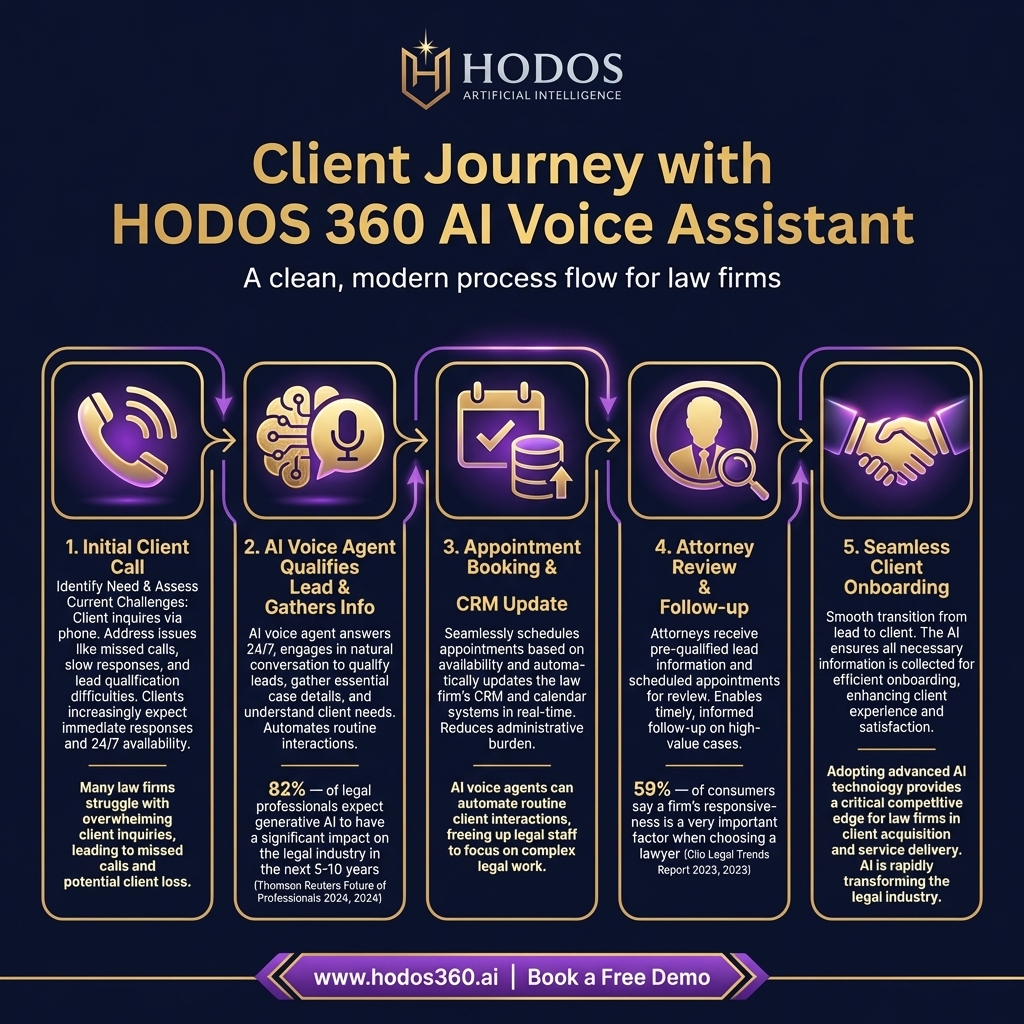
An AI voice agent can alleviate much of this burden by automating routine interactions. For instance, it can handle requests for case status updates, confirm court dates, provide directions to the office, or even guide clients through payment processes, all while accurately logging every interaction within the firm's case management system.
This integration ensures that every call is productive and documented, enhancing accountability and transparency.
Beyond simple informational queries, advanced AI voice assistants can trigger downstream processes. After qualifying a lead and booking an appointment, the AI can automatically create a new client file in the firm's CRM, populate it with the gathered information, and send automated confirmation emails or SMS messages.
This level of automation significantly reduces manual data entry errors and ensures consistency across all client touchpoints. Moreover, for existing clients, the AI can act as a reliable point of contact for non-sensitive inquiries, freeing up human staff to focus on complex legal research, drafting, and client advocacy.
This seamless integration transforms the traditional front desk from a reactive bottleneck into a proactive, intelligent hub for client engagement and data management.
The impact on staff productivity is substantial. By offloading repetitive and time-consuming tasks to AI voice agents, law firms can empower their human teams to concentrate on high-value legal work that requires critical thinking, empathy, and strategic judgment. This not only boosts efficiency but also improves job satisfaction among legal professionals, reducing burnout associated with administrative drudgery.
Firms can reallocate resources more effectively, investing in specialized legal talent rather than expanding their administrative support staff. This strategic shift allows firms to scale their operations more efficiently, taking on more cases and serving a larger client base without compromising the quality of service or overstretching their human capital.
Furthermore, the data generated by these AI interactions provides invaluable insights into client needs, common queries, and operational bottlenecks. Firms can analyze call patterns, frequently asked questions, and lead qualification rates to refine their service offerings, improve their marketing strategies, and optimize their legal firm automation efforts.
This data-driven approach, coupled with the efficiency gains, positions firms to be more agile and responsive in a competitive market. For example, if the AI consistently identifies a particular type of legal query, the firm can consider specializing further in that area or developing specific resources to address that demand, demonstrating a proactive approach to market needs.
Ethical Considerations and Oversight in AI Voice Agent Deployment
While the benefits of AI voice agents are clear, their deployment in legal settings necessitates careful consideration of ethical guidelines and robust oversight. The American Bar Association (ABA) Model Rules of Professional Conduct, particularly Rule 1.1 (Competence) and Rule 1.6 (Confidentiality of Information), are paramount.
Firms must ensure that their AI voice agent solutions maintain client confidentiality, protect sensitive data, and do not engage in the unauthorized practice of law. This means clearly defining the scope of the AI's capabilities, implementing stringent data security protocols, and ensuring transparent communication with clients about when they are interacting with an AI versus a human.
Ethical deployment requires a clear understanding of the AI's limitations and a commitment to human supervision.
Moreover, firms must establish clear protocols for escalating complex or sensitive inquiries to human attorneys. The AI should serve as an augmentation, not a replacement, for human legal expertise and judgment. Regular audits of AI interactions, coupled with continuous training and refinement of the AI's knowledge base, are crucial to maintaining ethical standards and ensuring accuracy.
The goal is to leverage AI for efficiency while preserving the fundamental principles of client care, professionalism, and legal integrity. This balanced approach ensures that the technological advantage gained does not come at the expense of ethical responsibility or client trust.
Strategic Implementation: Choosing and Deploying Your AI Voice Agent
The successful integration of an AI voice agent into a law firm requires a strategic approach, beginning with the careful selection of the right solution. Not all AI voice platforms are created equal, especially when considering the unique demands of the legal industry. Firms must look for providers that offer robust security features, including end-to-end encryption and compliance with data privacy regulations like HIPAA (for health law practices) and various state bar rules regarding client data.
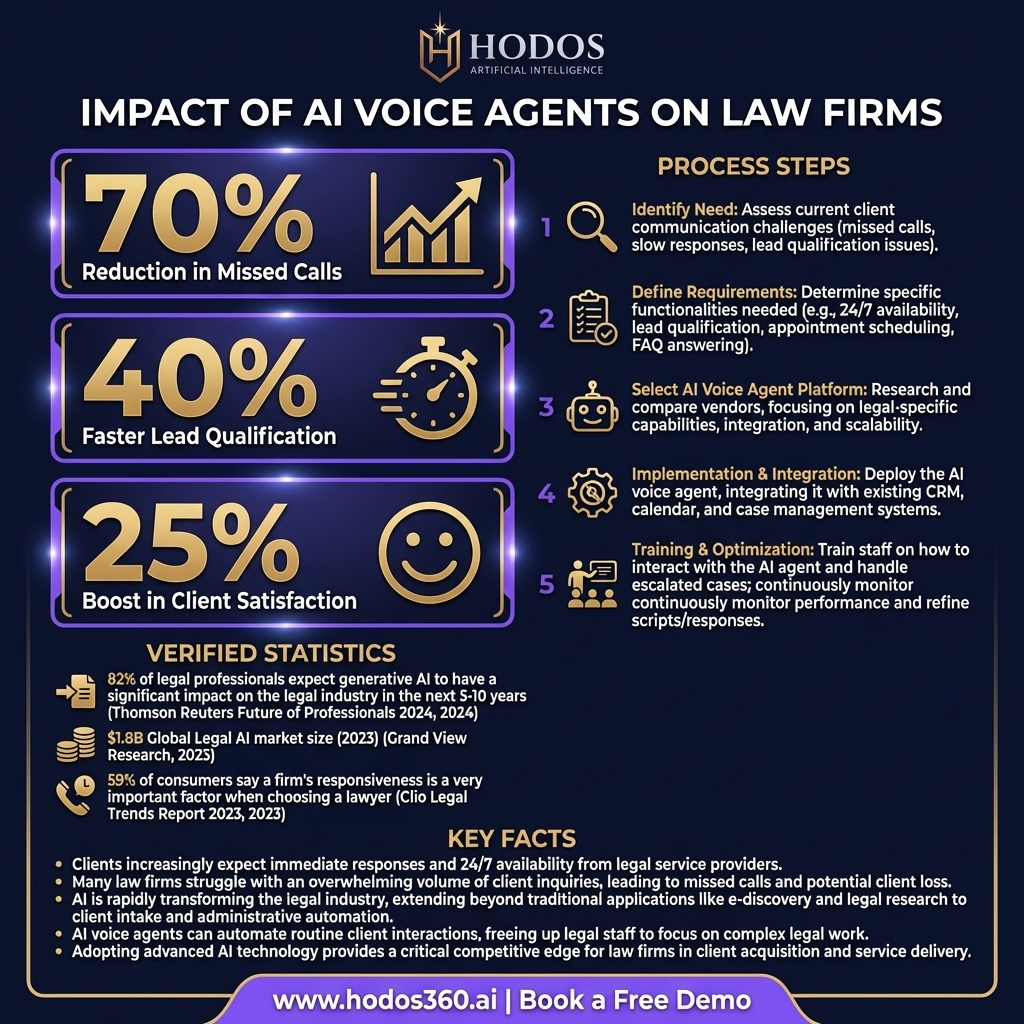
Scalability is another critical factor; the chosen solution should be able to grow with the firm, handling increasing call volumes and expanding service offerings without disruption. Integration capabilities with existing AI Law Firm Management Systems, CRM software, and billing platforms are also essential for creating a truly seamless and efficient legal firm automation ecosystem.
This holistic view ensures the AI voice agent becomes a central, rather than isolated, component of the firm's technology stack.
Beyond technical specifications, the customization potential of the AI voice assistant is paramount. A generic AI solution designed for retail might not understand the nuances of legal terminology, client empathy in sensitive situations, or the specific requirements of legal lead qualification. Firms should seek platforms that allow for extensive customization of scripts, knowledge bases, and interaction flows to accurately reflect their specific practice areas, branding, and client service philosophy.
This might involve training the AI on specific legal jargon, common client questions for their firm, or even the tone of voice they wish to convey. A tailored solution ensures that the AI truly acts as an extension of the firm's professional identity, providing a consistent and high-quality front desk experience.
The deployment process itself should be phased and iterative. Starting with a pilot program in a specific department or for a defined set of inquiries allows firms to test the AI voice agent's performance, gather feedback, and make necessary adjustments before a broader rollout. Training for human staff is also crucial, not just on how to use the AI, but on how to collaborate with it effectively.
This includes understanding when to hand off a call to the AI and when to intervene, ensuring a smooth client experience. Continuous monitoring and analytics are vital post-deployment to track key performance indicators (KPIs) such as call resolution rates, client satisfaction scores, and lead conversion rates.
This data-driven optimization ensures the AI voice agent is continually improving and delivering maximum value.
Firms like HODOS 360 are at the forefront of developing comprehensive AI-powered platforms specifically designed for the legal industry. Their AI Voice Assistants are built to integrate seamlessly with other services like AI Law Firm Management Systems, offering a unified solution for case management, client intake, and legal workflows.
By choosing a provider with deep legal tech expertise, firms can mitigate implementation risks and accelerate their journey towards advanced legal firm automation. This integrated approach ensures that the AI voice agent is not a standalone tool but a powerful component of a larger, intelligent ecosystem designed to optimize every facet of a law firm's operations and client interactions.
This holistic vision is key to unlocking the full potential of AI in legal practice.
Competitive Advantage and Market Shift: Firms That Embrace vs. Firms That Lag
The legal market is increasingly bifurcating into firms that embrace technological advancements like AI voice agents and those that lag. The former are gaining a significant competitive advantage, not just in efficiency but in client perception and market share. In a world where immediate gratification is often the expectation, a firm that can offer 24/7, intelligent client service through an AI voice assistant will invariably outcompete one that relies solely on traditional, limited-hour reception services.
This isn't just about speed; it's about reliability and accessibility, which are powerful differentiators in attracting and retaining clients. Firms that harness this technology are perceived as modern, forward-thinking, and client-centric, appealing to a new generation of legal consumers.
The market shift is inevitable. As more firms adopt sophisticated legal firm automation tools, the baseline expectation for client service will rise. Firms that fail to adapt risk being left behind, struggling with higher operational costs, missed leads, and a diminished ability to compete for top talent who prefer working in technologically advanced environments.
The drama unfolds not in a courtroom, but in the subtle erosion of market position for those resistant to change. The choice for law firm owners and attorneys is clear: proactively invest in the future of legal communication or face increasing pressure from more agile, AI-powered competitors.
The narrative is one of disruption, where innovation becomes the key to survival and prosperity.
The Future of Legal Communication: Beyond the Call
The trajectory of AI voice agents in the legal sector extends far beyond their current capabilities, promising even more transformative applications in the near future. We are on the cusp of seeing these AI voice assistants evolve into true "digital paralegals" or "virtual legal assistants," capable of handling a wider array of complex tasks.
Imagine an AI voice agent not only qualifying a lead but also proactively identifying potential legal issues based on initial client statements, cross-referencing them with relevant statutes or case law, and even drafting preliminary client communications for attorney review. This enhanced capability would further streamline legal workflows and empower attorneys with pre-analyzed information even before their first human interaction with a client.
The integration with generative AI models, akin to those developed by OpenAI (e.g., GPT-4), will allow AI voice agents to engage in even more sophisticated and contextually aware conversations. This means greater ability to synthesize information, provide more nuanced answers to client queries, and adapt their communication style based on client needs and emotional tone.
The AI could potentially assist in managing firm-wide AI marketing platform efforts, generating content for social media, or even assisting in the creation of AI-powered website building elements. This convergence of AI technologies will create a highly intelligent, interconnected ecosystem that optimizes every aspect of a law firm's operation, from client acquisition to case management and beyond.
The future of legal communication is intelligent, personalized, and omnipresent.
Further advancements will likely include hyper-personalized client experiences, where the AI voice agent learns individual client preferences and communication styles over time, making each interaction feel even more tailored and efficient. This could extend to proactive outreach for client check-ins, reminders for upcoming deadlines, or even delivering personalized legal insights based on a client's case progression.
The goal is to foster deeper client relationships through intelligent, automated engagement, ensuring clients feel consistently supported and informed. This evolution underscores the shift from mere automation to intelligent augmentation, where AI empowers legal professionals to deliver superior service with unprecedented efficiency and personalization.
The ongoing development of AI ethics and regulation, such as the EU AI Act, will also shape the future of these technologies. As these frameworks mature, they will provide clearer guidelines for responsible AI deployment in sensitive sectors like legal, ensuring that innovation proceeds hand-in-hand with accountability and client protection.
Law firms that stay abreast of these developments and prioritize ethical implementation will be best positioned to leverage the full potential of future AI voice agents, securing their place at the forefront of legal innovation. This continuous adaptation to both technological advancements and regulatory landscapes is crucial for long-term success.

Key Takeaways and Next Steps for Your Firm
The emergence of advanced AI voice agents represents a pivotal moment for the legal industry. These intelligent AI voice assistants are far more than just automated phone systems; they are agentic tools capable of transforming your firm's client interaction, streamlining operational workflows, and providing a significant competitive edge.
From offering 24/7 front desk support and precise lead qualification to automating client intake and integrating seamlessly with your existing legal firm automation systems, the benefits are clear and compelling. Firms that embrace this technology are not just adopting a new tool; they are investing in a future of enhanced efficiency, superior client experience, and sustainable growth.
The choice is no longer whether to adopt AI, but how to strategically integrate it to maximize its impact. For law firm owners and attorneys, the path forward involves understanding the capabilities of these new systems, evaluating potential solutions, and implementing them with a keen eye on ethical considerations and continuous optimization.
This means moving beyond generic solutions and seeking partners who understand the unique demands and regulatory landscape of the legal sector. The goal is to augment human expertise, not replace it, thereby freeing up your valuable legal talent to focus on the complex, nuanced work that truly requires their unique skills.
To remain competitive and meet the evolving expectations of today's clients, exploring the potential of AI voice agents is a strategic imperative. Firms must actively seek solutions that offer comprehensive legal communication capabilities, robust security, and seamless integration with other essential firm management tools. Discover how a tailored AI voice assistant solution can revolutionize your practice by providing unparalleled efficiency, client engagement, and operational intelligence.
Learn more about how to empower your firm with next-generation AI. Visit HODOS 360 to explore our AI Voice Assistants and integrated legal tech solutions designed for the modern law firm.
- ✓24/7 Client Engagement: Ensure no lead or client inquiry is ever missed, regardless of business hours or holidays.
- ✓Precision Lead Qualification: Automate initial client screening to identify high-value prospects, saving attorney time and resources.
- ✓Streamlined Client Intake: Expedite the onboarding process by gathering essential information and initiating paperwork automatically.
- ✓Enhanced Operational Efficiency: Reduce administrative burden on staff, allowing legal professionals to focus on substantive legal work.
- ✓Multilingual Support: Cater to a diverse client base with AI voice agents capable of communicating in multiple languages.
- ✓Seamless Workflow Integration: Connect AI voice interactions with your existing case management, CRM, and billing systems for a unified approach.
Frequently Asked Questions
What is an AI voice agent for law firms?+
An AI voice agent for law firms is an advanced conversational AI system that handles inbound and outbound calls, engages with clients, qualifies leads, schedules appointments, and provides information. Unlike traditional IVR, it uses natural language processing to understand complex queries, offer personalized responses, and integrate seamlessly into legal workflows, essentially acting as an intelligent, 24/7 virtual receptionist and assistant tailored for legal practice.
How do AI voice agents improve client intake?+
AI voice agents significantly improve client intake by automating the initial information gathering and qualification process. They can ask targeted questions to ascertain legal needs, collect contact details, perform preliminary conflict checks, and even initiate necessary documentation. This streamlines the process, ensures consistency, and allows human staff to engage with pre-qualified leads, dramatically increasing efficiency and conversion rates for new clients.
Are AI voice assistants secure for sensitive legal information?+
Yes, reputable AI voice assistant providers for the legal sector prioritize robust security measures. This includes end-to-end encryption, compliance with data privacy regulations like HIPAA (where applicable), and adherence to ethical guidelines for client confidentiality. Firms must choose solutions with strong security protocols and ensure clear disclaimers are in place for clients, always maintaining human oversight for sensitive or complex legal matters.
Can AI voice agents integrate with existing law firm software?+
Absolutely. A key benefit of modern AI voice agents is their ability to integrate seamlessly with existing law firm software, including case management systems, CRM platforms, billing software, and document automation tools. This integration ensures that all client interactions and gathered data are automatically logged and updated across the firm's technological ecosystem, creating a unified and efficient workflow that avoids data silos and manual entry errors.
What ethical considerations should law firms be aware of when using AI voice agents?+
Law firms must uphold ethical duties such as competence (ABA Model Rule 1.1) and client confidentiality (ABA Model Rule 1.6). This means ensuring the AI does not engage in the unauthorized practice of law, clearly disclosing AI involvement to clients, safeguarding data privacy, and having clear protocols for escalating complex issues to human attorneys. Regular audits and continuous training are essential to maintain ethical standards and client trust.