
Essential AI Voice Assistant Development for Law Firms
The rhythmic ping of an unanswered phone. The frantic scramble to qualify a lead amidst a busy court schedule. For Sarah Chen, a partner at a mid-sized litigation firm in Seattle, these were once daily stressors, contributing to missed opportunities and client frustration. Her firm, Chen & Associates, was growing, but their traditional intake process simply couldn't keep pace with the demands of a modern, always-on clientele.
It's a tension felt across the legal landscape, where client expectations for instant responsiveness clash with the finite resources of human staff. This fundamental conflict is precisely where the strategic deployment of an AI Voice Assistant is proving to be a game-changer, transforming the very fabric of legal client engagement and operational efficiency.
This isn't merely about automating calls; it's about embedding intelligent, empathetic, and always-available conversational AI into the core of a law firm's operations. Visionaries like Sam Altman, CEO of OpenAI, and Jensen Huang, CEO of NVIDIA, have consistently articulated a future where AI agents become ubiquitous, acting as intelligent interfaces for complex tasks.
For the legal sector, this translates into a powerful tool that can not only answer calls 24/7 but also perform sophisticated lead qualification, schedule appointments, and provide preliminary information, all while adhering to the stringent ethical and confidentiality standards of the profession. Firms that embrace this technological shift are not just keeping up; they are setting a new benchmark for client service and operational excellence, gaining a distinct competitive edge in an increasingly crowded market.
Indeed, the imperative to innovate is no longer a luxury but a necessity. The legal industry, traditionally conservative, is now recognizing the transformative power of AI. Firms are grappling with rising operational costs, the constant pressure to improve client satisfaction, and the need to streamline administrative burdens that divert valuable attorney time.
An AI Voice Assistant offers a compelling solution to these challenges, promising to unlock new levels of productivity and client satisfaction. By understanding the intricacies of AI Voice Agent development and strategic implementation, law firms can navigate this complex technological landscape and emerge stronger, more agile, and more client-centric than ever before.
This guide delves into the essential steps and considerations for building and deploying these transformative tools.
The Strategic Imperative of AI Voice Assistants in Legal
The modern legal client expects immediate gratification, a departure from the traditional 9-to-5 availability of law firms. Missed calls often translate directly into lost cases and revenue. According to a 2023 Thomson Reuters report, law firms spent an average of 15% of their budget on administrative tasks, much of which could be automated, highlighting a significant drain on resources that could otherwise be directed towards core legal work.
The advent of sophisticated AI Voice Assistant technology addresses this directly, moving beyond simple call answering to encompass crucial functions like initial lead qualification, intelligent routing, and even preliminary conflict checks. This strategic shift is vital for firms looking to not only meet but exceed client expectations in an increasingly competitive environment.
Moreover, the legal industry, like many others, has faced significant staffing challenges, often referred to as the 'Great Resignation' in administrative roles. This has left many firms struggling to maintain consistent service levels. Firms that have been proactive in adopting AI, such as some divisions within Allen & Overy with their integration of tools like Harvey AI for legal research, demonstrate a clear competitive advantage.
These firms are not only attracting top talent by offering technologically advanced workplaces but are also retaining clients through superior responsiveness. An AI Voice Agent serves as a force multiplier, allowing human staff to focus on high-value, complex tasks that require nuanced legal judgment, rather than routine inquiries.
Consider the economic implications. Learn more about Essential AI Web Development for Law Firms: Harvard's Impact. A recent ABA survey indicated that client acquisition costs continue to rise, making efficient client intake and retention paramount. An AI Voice Assistant can significantly lower these costs by ensuring every inbound inquiry is addressed promptly and professionally, regardless of volume or time of day.
This 24/7 availability transforms a firm's capacity, turning after-hours calls into qualified leads rather than voicemail black holes. The initial investment in AI Voice Agent development is quickly offset by increased client conversion rates and reduced overhead from administrative staff, presenting a compelling ROI for forward-thinking legal practices.
The strategic imperative extends to brand reputation. In an age of instant reviews and digital word-of-mouth, a firm's responsiveness directly impacts its public image. Firms that leverage AI Voice Assistants project an image of modernity, efficiency, and client-centricity. This technological adoption signals a commitment to leveraging the best tools available to serve clients better, fostering trust and loyalty.
Platforms like HODOS 360, with their comprehensive suite of AI tools, including AI Voice Assistants, are designed to empower law firms to streamline client intake, manage cases more effectively, and ultimately, build stronger, more profitable practices by embracing innovation.
Deconstructing AI Voice Agent Development for Law Firms
Building an effective AI Voice Agent for a law firm is far more intricate than deploying an off-the-shelf chatbot. It requires a meticulous, multi-stage process that begins with a deep understanding of the firm's unique operational needs and client interaction patterns. The first critical step in AI Voice Agent development is to clearly define the business objectives and key performance indicators (KPIs).
Is the primary goal to reduce missed calls, improve lead qualification, or automate appointment scheduling? Each objective dictates a different conversational flow and technical architecture. Without precise objectives, the project risks becoming a costly endeavor with limited tangible benefits, echoing common pitfalls highlighted in analyses of 'AI Voice Agent Challenges'.
Following objective definition, the next crucial phase involves mapping conversations and client journeys. This requires analyzing existing call logs, common client queries, and the typical pathways clients take from initial contact to engagement. For instance, a personal injury firm might map out inquiries about accident types, insurance details, and initial consultation bookings.
This mapping informs the design of the AI Voice Assistant's dialogue trees, ensuring it can handle a wide range of legal-specific scenarios with accuracy and appropriate legal disclaimers. The complexity of legal terminology and the need for precision make this step particularly challenging, demanding a robust understanding of natural language processing (NLP) tailored for the legal domain.
Training data is the lifeblood of any AI Voice Agent. Learn more about Legal AI ROI: Proven Strategies for Measuring Investment Return. For law firms, this means curating vast datasets of legal terminology, common client questions, and firm-specific protocols. Unlike generic AI, a legal AI Voice Assistant must understand nuances like 'prima facie', 'habeas corpus', or the difference between 'negligence' and 'malpractice'.
This specialized training ensures the AI can accurately interpret client intent and respond appropriately, reducing errors and improving client satisfaction. The quality and breadth of this training data directly correlate with the effectiveness of the deployed AI Voice Assistant, making its collection and annotation a significant part of the overall AI Voice Agent development cost and timeline.
Finally, the development process must account for seamless integration with existing legal tech infrastructure. A standalone AI Voice Assistant offers limited value. It must connect with the firm's case management system, billing software, and client relationship management (CRM) platforms to automate workflows effectively. This integration allows the AI to, for example, check an attorney's calendar for availability or log a new lead directly into the firm's database.
This holistic approach to AI Voice Agent development ensures that the technology enhances, rather than disrupts, the firm's existing operational ecosystem.
Defining Legal-Specific Use Cases
The power of an AI Voice Assistant in a law firm lies in its ability to address specific, high-volume, and often repetitive tasks that consume significant staff time. Beyond simply answering calls, these agents excel at initial client screening, performing preliminary conflict checks against existing client databases (with appropriate data security protocols), and gathering essential intake information.
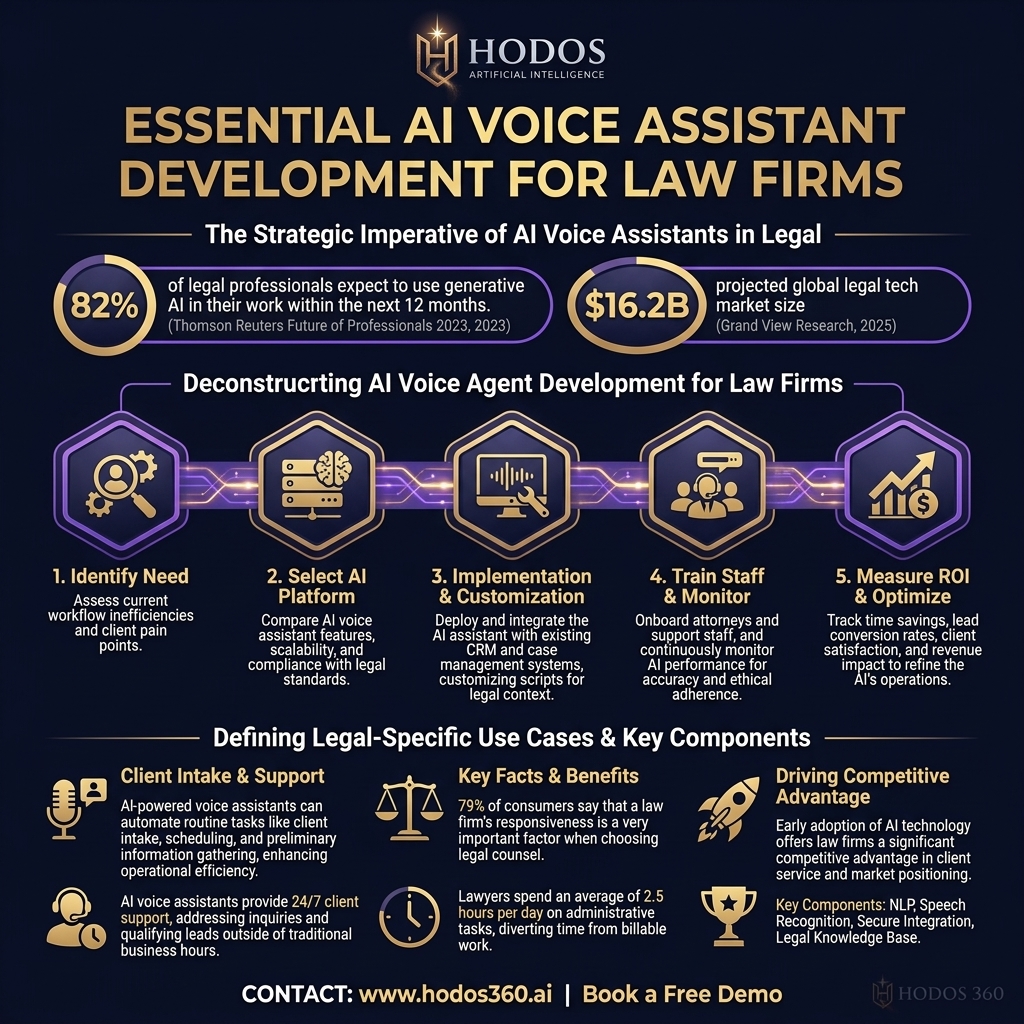
Imagine an AI agent efficiently collecting details for a potential new client — their name, contact information, a brief summary of their legal issue, and even identifying the relevant practice area — all before a human ever engages. This capability significantly streamlines client intake processes, reducing the burden on receptionists and paralegals.
Furthermore, AI Voice Agents can effectively manage appointment scheduling, integrating directly with attorneys' digital calendars to book consultations based on real-time availability. They can also handle routine inquiries such as directions to the office, operating hours, or basic FAQs about the firm's services. Learn more about Voice AI Landscape: Essential Strategies for Law Firms.
For existing clients, the AI can provide payment reminders or updates on case status (within pre-defined, secure parameters). HODOS 360's AI Voice Assistants are specifically designed to offer 24/7 phone answering, robust lead qualification, efficient appointment booking, and crucial multilingual support, ensuring no potential client is ever left unheard.
This specialized functionality directly supports a firm's commitment to competence under ABA Model Rule 1.1 (Competence) by ensuring efficient and effective service delivery.
Key Components and Technologies Driving Legal Voice AI
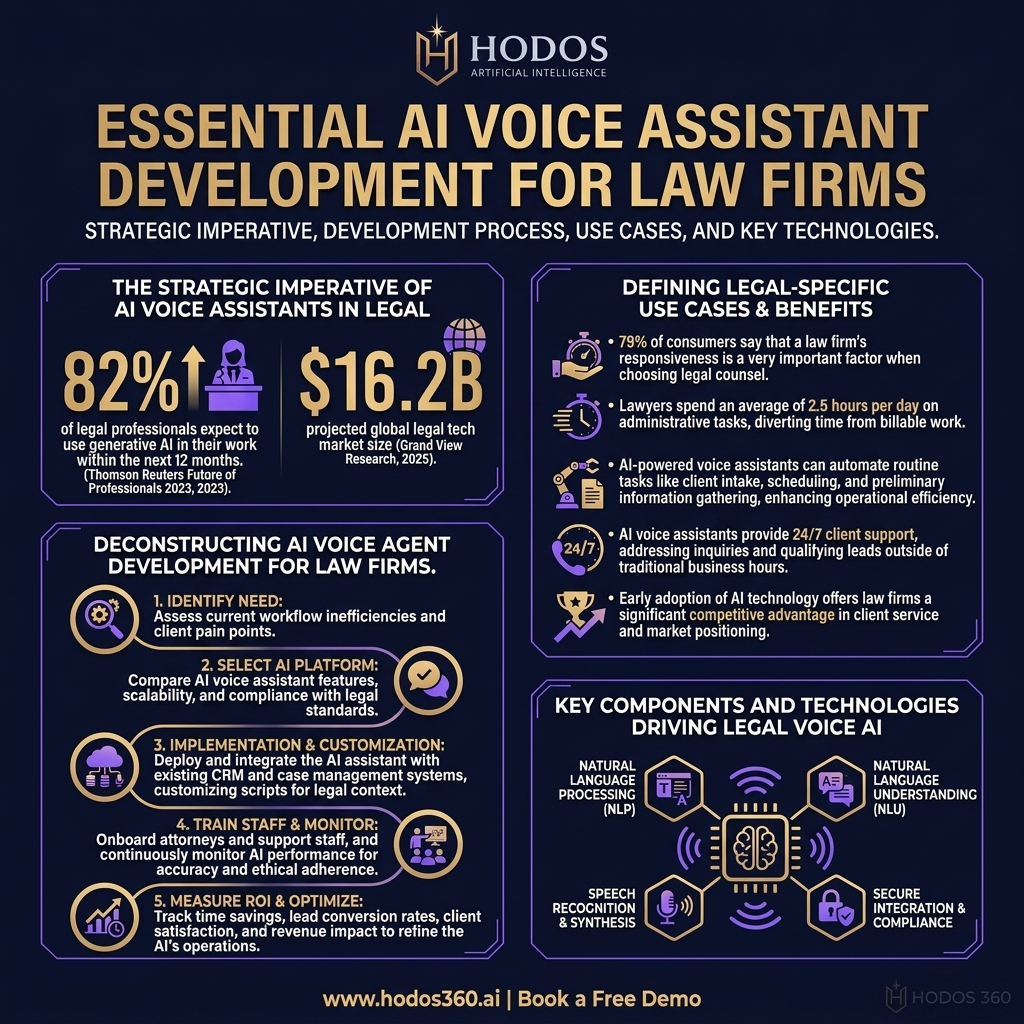
At the heart of every sophisticated AI Voice Assistant lies a complex interplay of cutting-edge technologies. Natural Language Processing (NLP) and Natural Language Understanding (NLU) are paramount, enabling the AI to not only recognize words but comprehend the underlying intent and context of legal queries.
This is particularly challenging in the legal field, where precision in language is critical. For instance, an AI must differentiate between a client asking 'What is a subpoena?' versus 'Can you subpoena my ex-partner?', understanding the difference between a definitional query and an action-oriented request.
Advances in large language models (LLMs), driven by innovations from companies like OpenAI (under Sam Altman's leadership) and Anthropic (co-founded by Dario Amodei), provide the powerful linguistic foundation for these capabilities.
Speech-to-Text (STT) and Text-to-Speech (TTS) technologies form the auditory interface of the AI Voice Agent.
STT accurately transcribes spoken words into text for the AI to process, while TTS converts the AI's textual responses back into natural-sounding speech. The quality of these components is crucial for a positive client experience; a system with poor STT accuracy can misinterpret critical legal details, leading to errors, while an unnatural TTS voice can alienate callers.
The pursuit of highly accurate and natural-sounding speech synthesis is an ongoing area of research, with companies like Google and Amazon continually pushing the boundaries, which directly benefits AI Voice Assistant development for specialized fields like law.
Seamless integration with existing legal software ecosystems is another non-negotiable component.
Learn more about Voice AI: Essential Strategies for Law Firms' Future. An effective AI Voice Assistant must be able to pull information from and push data to a firm's case management systems (e.g., Clio, MyCase), client relationship management (CRM) platforms, and even document automation tools.
This interoperability ensures that the AI's actions, such as logging a new lead or scheduling an appointment, are reflected across all relevant systems, maintaining data consistency and eliminating manual data entry. HODOS 360’s AI Law Firm Management System is designed with this integration in mind, allowing for a cohesive technological environment where an AI Voice Assistant can truly thrive and contribute to efficient legal workflows.
Underpinning these components is a robust, secure, and scalable cloud infrastructure. The processing power required for advanced NLP and real-time speech synthesis necessitates powerful computing resources, often provided by cloud giants like AWS, Google Cloud, or Microsoft Azure. Furthermore, the handling of sensitive client information demands stringent security protocols, including encryption, access controls, and compliance with data privacy regulations.
The choice of platform and architecture for AI Voice Agent development significantly impacts its performance, reliability, and most importantly, its adherence to the strict confidentiality requirements of the legal profession, a principle enshrined in ABA Model Rule 1.6 (Confidentiality of Information).
Implementing AI Voice Agents: Best Practices and Pitfalls
Successful implementation of an AI Voice Assistant in a law firm hinges on a strategic, phased approach, rather than a 'big bang' deployment. Best practices dictate starting with a pilot program focused on a well-defined, manageable set of use cases, such as initial client intake for a specific practice area or handling routine FAQs.
This allows the firm to gather real-world data, identify conversational gaps, and fine-tune the AI's responses in a controlled environment. Continuous learning and iteration are paramount; an AI Voice Agent is not a static product but an evolving system that improves with every interaction. Establishing feedback loops, where human agents review AI conversations and provide corrective training, is crucial for refining accuracy and naturalness, mitigating the 'AI Agent Challenges' of misinterpretation.
One significant pitfall to avoid is over-automation. While the allure of fully automated client interaction is strong, it's essential to recognize the limitations of current AI technology, particularly in the nuanced and emotionally charged context of legal issues. A well-designed AI Voice Assistant includes clear escalation paths, ensuring that complex, sensitive, or high-stakes inquiries are seamlessly handed off to a human attorney or staff member.
This blend of AI efficiency and human empathy ensures that clients receive the best of both worlds – instant access for routine matters and personalized attention when it matters most. Firms must invest in training their human staff on how to effectively collaborate with the AI, viewing it as a powerful assistant rather than a replacement.
Data privacy and ethical considerations are not merely technical hurdles but foundational principles that must guide every stage of AI Voice Agent development and deployment. Learn more about AI in MarTech: The Ultimate Guide to Predictive Power. The collection, storage, and processing of client data through an AI system must strictly comply with regulations such as GDPR, CCPA, and, crucially, the ethical obligations outlined by the American Bar Association.
Firms must ensure transparency with clients about AI interaction, obtain necessary consents, and implement robust security measures to protect sensitive information. Failure to do so can lead to severe reputational damage, regulatory fines, and breaches of professional responsibility, as underscored by the increasing focus on AI governance, exemplified by the EU AI Act.
Furthermore, the success of an AI Voice Assistant is directly tied to its ongoing maintenance and optimization. This involves regular performance monitoring, analyzing call resolution rates, identifying common points of failure or misunderstanding, and updating the AI's knowledge base and conversational flows. The legal landscape is constantly evolving, with new laws, regulations, and client needs emerging.
An effective AI Voice Agent must be agile enough to adapt to these changes. Partnering with a legal tech provider that offers continuous support and updates for their AI Voice Assistant development services is critical for long-term success, ensuring the technology remains relevant and high-performing.
Navigating Data Privacy and Ethical AI
The deployment of an AI Voice Assistant in a law firm introduces significant data privacy considerations, demanding strict adherence to existing legal and ethical frameworks. Client communications, often privileged and confidential, must be handled with the utmost care. This necessitates robust encryption for all data in transit and at rest, secure storage solutions, and stringent access controls to prevent unauthorized access.
Firms must be transparent with clients about how their data is collected, processed, and used by the AI, obtaining explicit consent where required. Compliance with regulations like GDPR and CCPA is non-negotiable, and any AI Voice Agent development must bake in privacy-by-design principles from the outset, ensuring that legal and ethical responsibilities are met.
Beyond technical privacy, ethical AI demands careful attention to issues of bias, transparency, and accountability. Learn more about WordPress AI Unlocked: Legal Websites Mastered 2026. An AI Voice Assistant trained on biased datasets could inadvertently lead to discriminatory outcomes in lead qualification or case assessment.
Firms must actively mitigate such biases through diverse training data and regular auditing of AI performance. The ABA's Formal Opinion 498 on lawyers' ethical obligations regarding generative AI provides crucial guidance, emphasizing the duty of competence, confidentiality, and supervision when utilizing advanced AI tools. Lawyers remain ultimately responsible for the advice and services provided, even when augmented by AI, underscoring the necessity for human oversight and ethical governance in all AI Voice Agent deployments.
The Future of Client Engagement: Beyond the Automated Call
The current capabilities of AI Voice Assistants are just the tip of the iceberg. The future of client engagement in law firms will see these agents evolve into deeply integrated, proactive, and predictive legal support systems. Imagine an AI Voice Agent that not only answers calls but also analyzes sentiment during conversations, flagging potential client dissatisfaction or high-priority emotional distress, prompting a human intervention.
This level of personalized client experience moves beyond transactional interactions to foster deeper relationships and proactive problem-solving. Such advancements are fueled by continuous innovation in conversational AI and machine learning, pushing the boundaries of what an automated assistant can achieve in a professional service context.
Furthermore, the integration of AI Voice Assistants with other AI-powered legal tech tools will create a seamless, end-to-end client journey. Picture an AI Voice Agent qualifying a lead, then automatically generating an initial client intake form, populating it with collected data, and even drafting a preliminary engagement letter using document automation capabilities.
This interconnected ecosystem, where the voice agent acts as the primary interface, will drastically reduce administrative overhead and accelerate legal workflows. The vision articulated by leaders like Jensen Huang for ubiquitous AI, where intelligent agents permeate every aspect of business, is rapidly becoming a reality for the legal sector, transforming how firms operate and interact with their clients.
The evolution will also involve predictive analytics. By analyzing patterns in client inquiries, lead conversion rates, and case outcomes derived from AI Voice Assistant interactions, law firms can gain invaluable insights into their market, client needs, and operational bottlenecks. This data-driven approach allows firms to anticipate client demands, optimize their service offerings, and even refine their marketing strategies, moving from reactive service to proactive engagement.
For instance, if the AI consistently identifies a specific type of legal query leading to high conversion, the firm can allocate more resources or marketing efforts to that area, enhancing legal marketing efforts and maximizing growth potential.
Ultimately, the future of client engagement is about creating a hyper-efficient, highly personalized, and always-available legal service experience.
The AI Voice Assistant will be central to this transformation, acting as the intelligent concierge for law firms. It will free attorneys and staff from mundane tasks, allowing them to focus on complex legal strategy and client advocacy. This paradigm shift will not only improve client satisfaction but also empower law firms to scale their operations, enter new markets, and deliver legal services with unprecedented efficiency and impact, solidifying the role of AI Voice Agent development as a cornerstone of modern legal practice.
Measuring ROI and Continuous Optimization
Demonstrating the return on investment (ROI) for AI Voice Agent development is crucial for sustained adoption and future innovation. Key performance indicators (KPIs) should include call resolution rates, lead conversion percentages, average client wait times, and the measurable reduction in administrative staff hours dedicated to phone-based tasks.
For example, a firm might track a 30% increase in qualified leads or a 25% reduction in operational costs related to reception services. These concrete metrics provide a clear picture of the financial and operational benefits. HODOS 360’s AI Marketing Platform offers robust analytics and ROI tracking capabilities, allowing firms to precisely measure the impact of their AI Voice Assistant and other AI investments.
Continuous optimization is the engine of long-term success. This involves regularly reviewing performance data, identifying areas for improvement in the AI's conversational flows or knowledge base, and implementing updates. Feedback from human staff and client satisfaction surveys should also feed into this iterative process. An AI Voice Assistant that is consistently refined based on real-world interactions will become an increasingly valuable asset, ensuring it remains aligned with the firm's evolving needs and client expectations.
This commitment to ongoing enhancement maximizes the value derived from the initial AI Voice Agent development and ensures the technology remains a competitive advantage.

Key Takeaways and Next Steps
The journey into AI Voice Assistant development for law firms is not merely an adoption of new technology; it's a strategic reimagining of client engagement and operational efficiency. From mitigating the perennial challenge of missed calls to revolutionizing client intake and administrative workflows, the benefits are profound.
Firms that proactively engage with this technology are not just improving their bottom line; they are cultivating a reputation for innovation, responsiveness, and client-centric service in an increasingly demanding legal landscape. The integration of advanced conversational AI, when implemented thoughtfully and ethically, empowers legal professionals to focus on the complex, human-centric aspects of law, while routine tasks are handled with unparalleled efficiency.
For law firms ready to embrace this transformative power, the next step involves a clear-eyed assessment of current operational bottlenecks and client interaction points. Identify specific areas where an AI Voice Assistant can deliver immediate, measurable impact – be it 24/7 client answering, lead qualification, or appointment booking.
Engage with trusted legal tech partners who understand the unique demands of the legal sector and can guide you through the intricacies of AI Voice Agent development, ensuring compliance, security, and seamless integration. The future of legal practice is conversational, intelligent, and always on. Law firms that strategically invest in an AI Voice Assistant today will undoubtedly lead the charge into tomorrow's more efficient and client-focused legal world.
Frequently Asked Questions
What are the primary benefits of an AI Voice Assistant for a law firm?+
An AI Voice Assistant offers numerous benefits, including 24/7 client availability, significantly reducing missed calls and improving client satisfaction. It automates lead qualification and appointment booking, freeing up administrative staff and attorneys for higher-value tasks. This leads to increased operational efficiency, reduced overhead costs, faster client intake, and a more modern, responsive image for the law firm, ultimately enhancing client acquisition and retention.
How does an AI Voice Agent handle sensitive client information securely?+
Secure AI Voice Agents employ robust encryption for all data, both in transit and at rest, along with strict access controls and compliance with data privacy regulations like GDPR and CCPA. Firms must ensure transparency with clients about AI interaction and obtain necessary consents. Ethical development prioritizes privacy-by-design, safeguarding privileged communications and upholding professional confidentiality standards, crucial for legal compliance and client trust.
What is the typical development process for a custom AI Voice Assistant?+
The development process typically begins with defining specific business objectives and legal use cases. This is followed by mapping out conversational flows and client journeys unique to the firm. Extensive training data, including legal terminology, is then collected and used to train the AI's Natural Language Processing (NLP) and Understanding (NLU) models. Finally, the AI is integrated with existing legal management systems, tested rigorously, and continuously optimized based on real-world interactions.
Can an AI Voice Assistant integrate with our existing legal software?+
Yes, a key aspect of effective AI Voice Assistant development is seamless integration with a law firm's existing software ecosystem. This includes case management systems (e.g., Clio, MyCase), client relationship management (CRM) platforms, and billing software. Integration allows the AI to access and update client information, check attorney calendars, and log new leads directly, ensuring data consistency and automating workflows across all relevant systems for maximum efficiency.
What are the ethical considerations when deploying Voice AI in a law firm?+
Ethical considerations are paramount. These include ensuring transparency with clients about AI interaction, protecting client confidentiality (ABA Model Rule 1.6), and mitigating potential biases in AI responses. Lawyers retain the duty of competence (ABA Model Rule 1.1) and supervision over AI tools, ensuring that the AI's advice is accurate and appropriate. Robust security, accountability frameworks, and adherence to legal ethics (like ABA Formal Opinion 498) are essential for responsible AI deployment.