


Essential AI Voice Features for Law Firms: Unpacking I/O Innovations
The legal profession, often characterized by its meticulous dedication to detail and tradition, now stands at the precipice of a profound technological shift. For years, partners like Sarah Chen, a litigation specialist at a bustling mid-sized firm in Chicago, grappled with an ever-growing deluge of client inquiries, administrative tasks, and document reviews.
The promise of artificial intelligence felt distant, a futuristic concept confined to tech conferences, until Google I/O 2026. The recent announcements, particularly the integration of advanced AI voice features into Google Workspace and the debut of Gemini Spark, signal a definitive turning point, transforming AI from a theoretical concept into an indispensable tool for daily legal practice.
This isn't merely about dictation; it's about a symbiotic partnership between human legal expertise and intelligent machines, promising to redefine operational efficiency and client interaction.
This year's Google I/O underscored a pivotal moment in the broader AI landscape, demonstrating how general-purpose AI is rapidly maturing into specialized applications.
While tech giants like OpenAI, led by CEO Sam Altman, and Anthropic, under the guidance of Dario Amodei, have pushed the boundaries of large language models, Google's strategy at I/O focused on embedding these powerful capabilities directly into the fabric of everyday professional tools. The introduction of sophisticated AI voice features means that attorneys can now interact with their digital environments in a far more intuitive and less cumbersome manner.
The implications for firms that embrace this paradigm shift are immense, creating a stark contrast with those that continue to rely solely on traditional methods, risking diminished productivity and client satisfaction in an increasingly competitive market.
For law firms navigating this transformative era, understanding and integrating these new AI voice features is no longer optional but essential for maintaining a competitive edge.
According to the 2023 ABA TechReport, while 70% of legal professionals acknowledge the potential of AI, only 30% have actively implemented it in their practices, citing concerns about cost, data security, and integration complexity. However, with Google's latest advancements, the barriers to entry are significantly lowered, making intelligent voice assistance accessible across core legal functions.
This article will delve into the specific innovations from Google I/O 2026 and illustrate how these, coupled with specialized platforms like HODOS 360, are set to revolutionize everything from client intake and case management to document automation, empowering legal professionals to focus on high-value work and strategic counsel.
The Dawn of Conversational AI in Legal Workflows
Google I/O 2026 marked a significant leap for conversational AI, embedding sophisticated AI voice features directly into the ubiquitous Google Workspace ecosystem. Imagine a lawyer, preparing for a complex deposition, who can now simply speak commands to their Gmail inbox to summarize all correspondence related to 'Project Phoenix,' or verbally instruct Google Docs to draft an initial memorandum based on specific evidentiary notes.
This goes far beyond rudimentary dictation; it's about a proactive digital assistant that understands context, anticipates needs, and executes complex tasks with voice commands. Learn more about AI Alliances Reshuffle: Essential Legal Tech Strategy for Firms. This level of seamless interaction promises to drastically reduce the cognitive load associated with navigating multiple applications and manual data entry, freeing up valuable time for strategic legal thought.
The introduction of Gemini Spark further amplifies these capabilities, offering a more personalized and context-aware interaction across various Google services. For legal professionals, this means being able to verbally query vast databases of case law, summarize lengthy legal documents, or even generate initial drafts of legal correspondence with unprecedented speed and accuracy.
Firms that have historically invested heavily in specialized legal research platforms are now seeing a powerful, integrated alternative emerge from a familiar productivity suite. Learn more about AI Marketing: The Ultimate Playbook for Law Firms. This shift democratizes access to advanced AI tools, making them available to a broader range of firms, not just the tech-forward giants.
This integration isn't just about individual productivity gains; it's about transforming entire firm-wide workflows. Consider the impact on legal support staff, who can now leverage AI voice features to manage calendars, update client records, or even initiate billing sequences with simple verbal cues. A recent report by McKinsey & Company on generative AI in professional services estimates a potential productivity boost of 15-20% in knowledge-intensive roles, a figure that resonates deeply within the legal sector.
Learn more about WordPress AI Unlocked: Legal Websites Mastered 2026. This allows firms to reallocate human capital to more complex, client-facing, and revenue-generating activities, fostering a more efficient and agile operational model.
Voice-Enabled Legal Research and Analysis
The ability to conduct legal research using AI voice features represents a significant advancement. Attorneys can verbally pose complex legal questions, ask for summaries of specific precedents, or request comparative analyses of statutes. This hands-free approach accelerates the initial stages of legal inquiry, allowing for rapid hypothesis testing and information retrieval.
Learn more about Legal AI Gap: Bridging the Divide for Law Firms in 2026. Imagine asking Gemini Spark to 'find all appellate cases in the 9th Circuit regarding digital copyright infringement from the last five years' and receiving a concise, actionable summary almost instantly, complete with links to primary sources.
This capability streamlines the often-laborious research process, moving beyond keyword searches to true semantic understanding.
Furthermore, voice-enabled analysis can extend to reviewing discovery documents or client depositions. A lawyer could verbally highlight key passages, ask for cross-references within a document set, or even identify potential inconsistencies, all without touching a keyboard. This deep integration of conversational AI into analytical tasks empowers legal professionals to extract critical insights more efficiently, making the review process less about manual sifting and more about strategic evaluation.
Learn more about Voice AI: Essential for Law Firms, Touting Twilio's Success. This level of sophisticated interaction with legal data marks a profound evolution in how legal professionals will approach information management and synthesis.
The potential for ethical dilemmas with AI in research, particularly concerning accuracy and hallucination, remains a critical area of focus. Firms must exercise due diligence, cross-referencing AI-generated insights with traditional research methods to ensure the integrity of their legal advice. However, the speed and breadth of initial inquiry offered by these AI voice features are undeniable, serving as a powerful force multiplier when used responsibly and competently.
Learn more about AI Legal Research: The Ultimate Guide for Law Firms. This dual approach ensures both efficiency and adherence to professional standards, aligning with the principles outlined in ABA Model Rule 1.1 on Competence, which requires lawyers to keep abreast of changes in the law and its practice, including the benefits and risks associated with relevant technology.
Revolutionizing Client Intake and Communication with Voice AI
Beyond internal workflows, the advent of advanced AI voice features is poised to fundamentally reshape how law firms interact with prospective and existing clients. The traditional bottleneck of client intake, often limited by office hours and human availability, is being dismantled by 24/7 AI voice assistants.
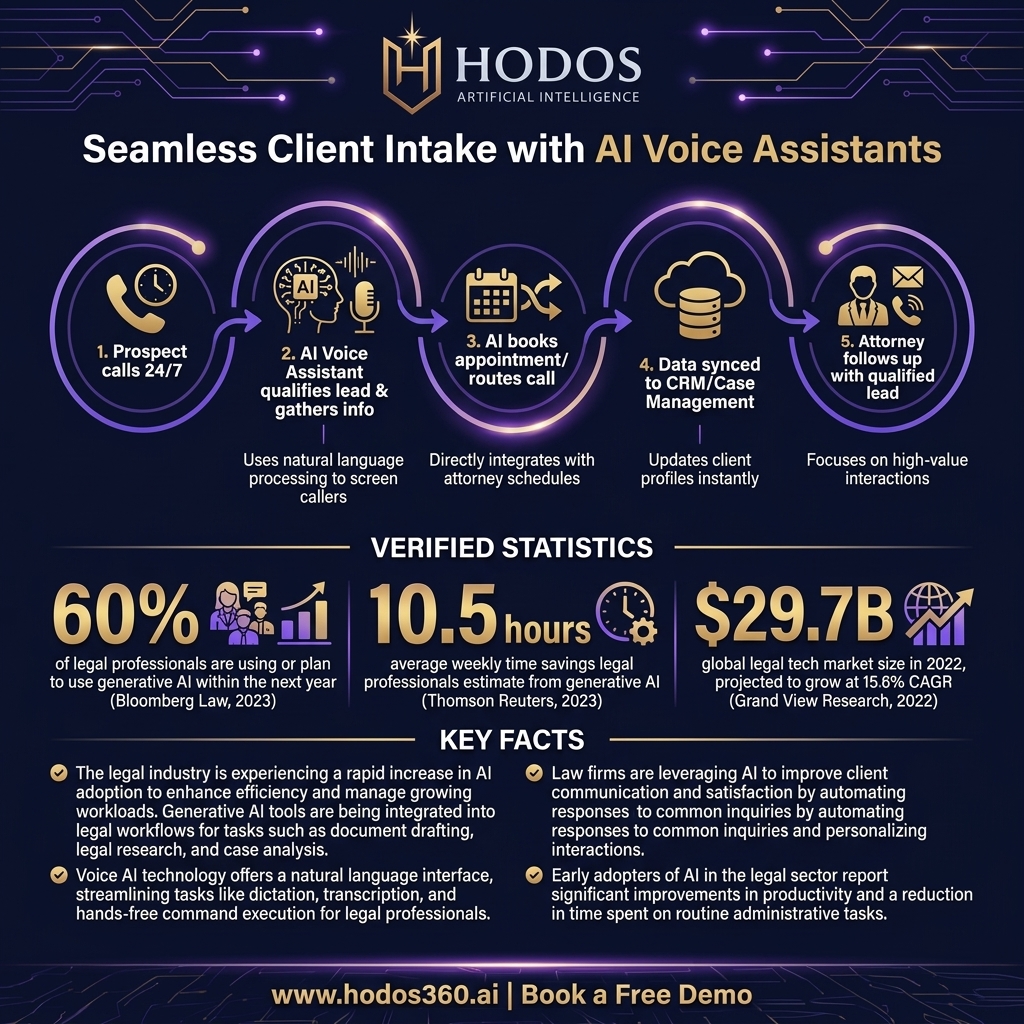
Imagine a potential client facing an urgent legal issue late on a Friday night; instead of reaching an answering machine, they are greeted by an intelligent voice assistant that can empathetically qualify their needs, gather essential preliminary information, and even book an appointment directly into a lawyer's calendar.
This immediate responsiveness significantly enhances the client experience and drastically improves lead conversion rates, a critical metric for firm growth.
Plataformas like HODOS 360's AI Voice Assistants exemplify this transformation, offering multilingual support to cater to diverse client bases and intelligent call routing to ensure urgent matters reach the right human attorney when necessary. This level of automated, yet personalized, client interaction provides a distinct competitive advantage.
Firms that are slow to adopt such technologies risk losing potential clients to competitors who offer instant, accessible engagement. A 2024 Clio Legal Trends Report highlighted that 68% of clients expect immediate responses from their legal providers, a demand that traditional methods struggle to meet without significant overhead.
The impact extends beyond initial intake. For ongoing communication, AI voice features can assist with appointment confirmations, routine updates, and even answering frequently asked questions, freeing up legal staff from repetitive tasks. This allows attorneys and their teams to dedicate more time to complex legal strategy and direct client counsel, ultimately enhancing the quality of service.
The shift isn't about replacing human interaction but augmenting it, ensuring that clients receive timely, accurate information while preserving the invaluable human touch for critical engagements. This strategic allocation of resources drives both efficiency and client satisfaction.
Ensuring Ethical AI in Client Interactions
The integration of AI voice features into client interactions necessitates a robust framework for ethical deployment. Central to this is maintaining client confidentiality, a cornerstone of legal practice enshrined in ABA Model Rule 1.6. Firms must ensure that any AI system handling client data employs state-of-the-art encryption, adheres to strict data privacy regulations (like GDPR or CCPA), and provides clear disclosures to clients about the use of AI.
Transparency builds trust, and clients should be informed when they are interacting with an AI assistant versus a human, allowing them to make informed choices about the information they share. The stakes are high; a breach of confidentiality, even by an automated system, can have severe repercussions for a firm's reputation and legal standing.
Furthermore, firms must address the potential for bias in AI, ensuring that AI voice features do not inadvertently discriminate or misinterpret client needs due to flaws in their training data. Regular audits and continuous monitoring are essential to mitigate such risks, upholding the ethical obligations of competence and fairness.
The responsible adoption of AI voice features in client communication requires not just technological sophistication but also a deep commitment to legal ethics and client welfare. Firms must partner with vendors who prioritize these ethical considerations, demonstrating a clear understanding of the unique demands of the legal sector.
Enhancing Document Automation and Case Management through Voice
The synergy between AI voice features and existing legal tech infrastructure, particularly in document automation and case management, is unlocking unprecedented efficiencies. Imagine a lawyer completing a client meeting and, instead of manually inputting notes or delegating to a paralegal, simply dictating key action points directly into the firm's case management system.
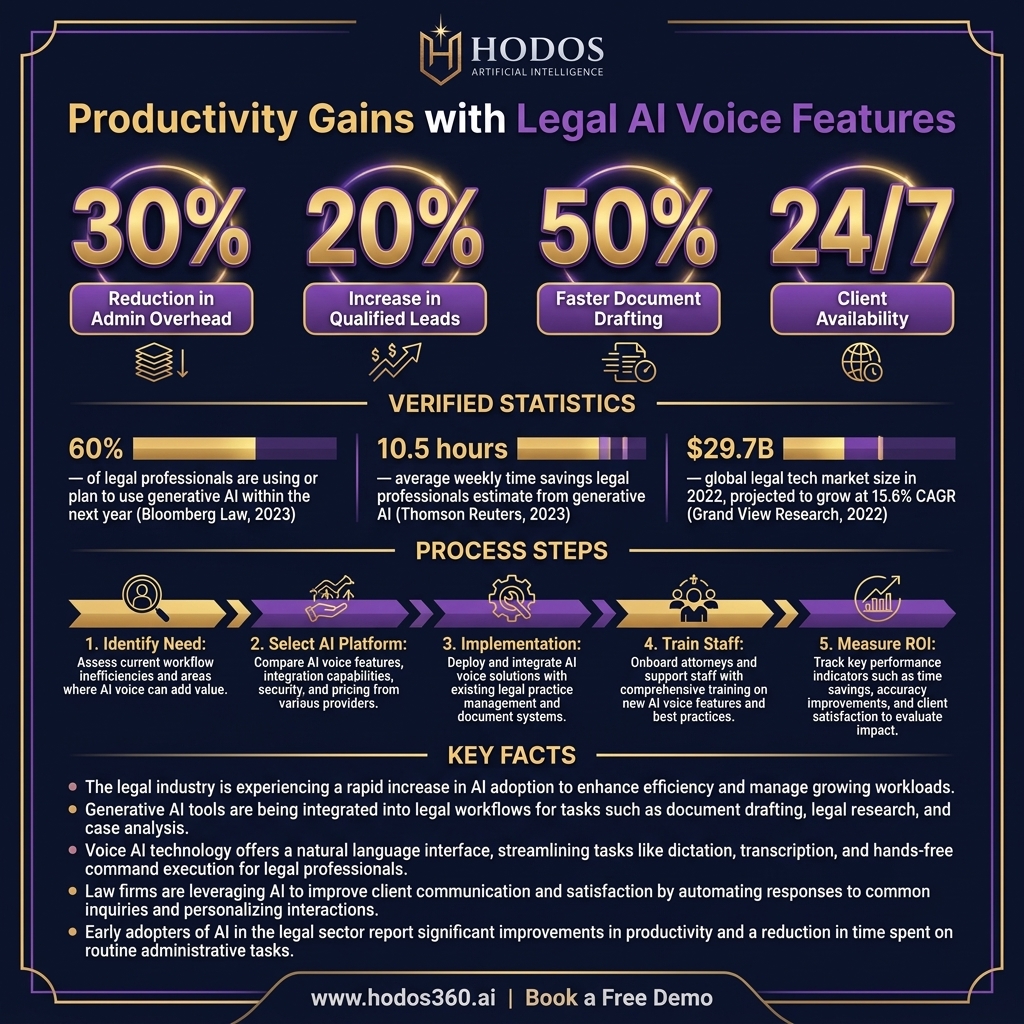
Voice commands can trigger the creation of new tasks, update client profiles, or even initiate the generation of standard legal documents like engagement letters or discovery requests. This eliminates multiple steps in the workflow, reducing errors and ensuring real-time data accuracy across all case files, a critical component of effective legal practice.
Platforms like HODOS 360's AI Law Firm Management System, with its integrated document automation and AI-powered legal workflows, are perfectly positioned to leverage these advancements. Lawyers can verbally instruct the system to 'generate a motion to compel for the Smith v. Jones case, using the standard template,' and the system intelligently populates the document with relevant case details, client information, and court deadlines.
This level of integration transforms document creation from a labor-intensive process into a swift, voice-activated command. Firms that adopt such sophisticated tools report significant reductions in administrative overhead, allowing legal professionals to focus on the nuanced legal strategy rather than repetitive drafting.
The impact on billing and time tracking is equally transformative. Attorneys can log billable hours simply by speaking, detailing tasks performed and time spent. This eliminates the often-dreaded manual entry at the end of the day or week, leading to more accurate and timely billing.
According to a Thomson Reuters report, law firms that effectively utilize document automation tools can reduce drafting time by up to 50%, directly translating into cost savings and increased capacity. The future of legal operations is one where voice becomes the primary interface for managing the entire lifecycle of a case, from initial intake to final billing.
The Evolution of Voice in AI-Powered Legal Workflows
The evolution of AI voice features in legal workflows extends beyond simple commands; it's about creating intelligent, adaptive systems that learn from user interactions. As legal professionals increasingly rely on voice interfaces, these systems will become more adept at understanding legal jargon, recognizing specific firm templates, and even anticipating next steps in a complex legal process.
This predictive capability means that a voice assistant could, for example, prompt an attorney about an upcoming deadline or suggest relevant clauses based on the context of a verbal brief, significantly enhancing proactive case management and risk mitigation. The voice interface is no longer a mere input method but an active participant in the legal workflow, providing intelligent assistance at every turn.
This advanced integration promises to streamline even the most intricate legal processes, from orchestrating multi-party discovery to preparing for trial. Imagine a trial attorney verbally assembling exhibits, requesting deposition summaries, and coordinating witness schedules, all through an intelligent voice interface connected to their case management system.
This level of hands-free, intuitive control empowers legal teams to maintain focus on strategy and advocacy, rather than getting bogged down by logistical complexities. The future of legal practice is one where voice serves as the central command for dynamic, AI-powered legal workflows, making legal professionals more efficient, responsive, and ultimately, more effective.
The Competitive Edge: Firms Embracing Voice-Enabled AI
In an increasingly competitive legal landscape, the adoption of advanced AI voice features is rapidly becoming a key differentiator for law firms. Those who proactively integrate these technologies are not just improving internal efficiencies; they are fundamentally reshaping their market position. Firms embracing voice-enabled AI are reporting significant advantages in client acquisition, operational costs, and overall service delivery.
For instance, a firm that can offer 24/7 client intake via a multilingual AI voice assistant will invariably attract and convert more leads than one restricted by traditional office hours and language barriers. This is the new battleground for legal market share, where technological agility translates directly into tangible business growth.
Consider the insights from David Wakeling, Head of AI at Linklaters, who has consistently championed the strategic adoption of AI within large legal enterprises. While his focus has often been on generative AI for document review and contract analysis, the underlying principle of leveraging technology for competitive advantage applies equally to voice AI.
Firms that empower their attorneys with hands-free, intelligent interfaces for managing their workload are cultivating a more productive and engaged workforce. This investment in cutting-edge tools signals to both clients and talent that the firm is forward-thinking, efficient, and committed to leveraging the best available technology to deliver superior legal services.
The "disruption vs. tradition" narrative is playing out vividly in the legal sector. Firms clinging to outdated manual processes are finding themselves at a distinct disadvantage, struggling to keep pace with client expectations for speed and responsiveness, and facing higher operational costs. Conversely, firms that have strategically implemented AI voice features are experiencing a virtuous cycle: improved efficiency leads to better client service, which in turn drives client loyalty and attracts top talent.
This creates a powerful competitive moat, securing their position in a rapidly evolving market. The message is clear: innovation in AI voice technology is no longer a luxury but a strategic imperative for sustained success.

Key Takeaways and Next Steps for Law Firms
The announcements at Google I/O 2026 regarding enhanced AI voice features in Workspace and Gemini Spark are more than just product updates; they represent a fundamental shift in how legal professionals will interact with technology. From streamlining internal workflows and document automation to revolutionizing client intake and communication, voice-enabled AI is poised to become an indispensable component of the modern law firm.
The competitive landscape demands that firms move beyond contemplation and towards strategic implementation, recognizing that these tools offer not just incremental improvements but transformative advantages in efficiency, client satisfaction, and overall operational agility.
For law firms looking to harness this power, the next steps involve a thoughtful assessment of current pain points and a strategic exploration of available solutions. Begin by identifying areas where manual processes create bottlenecks or where client engagement could be significantly improved. Research vendors offering specialized legal AI solutions, paying close attention to their security protocols, integration capabilities, and commitment to ethical AI development.
Consider piloting AI voice features in a specific department or for a defined set of tasks to evaluate their impact and refine implementation strategies before a wider rollout.
The future of legal practice is intrinsically linked to intelligent automation, and AI voice features are emerging as a primary interface for this transformation. By embracing these innovations, law firms can not only enhance their productivity and profitability but also elevate the quality of their legal services, ensuring they remain relevant and competitive in an increasingly digital world. The time to act is now, to position your firm at the forefront of this technological revolution and secure a sustainable, prosperous future.
Frequently Asked Questions
What are the primary benefits of AI voice features for law firms?+
AI voice features offer numerous benefits, including enhanced operational efficiency by automating routine tasks, faster client intake and improved lead conversion through 24/7 availability, streamlined document automation, and more accurate time tracking. They free up legal professionals to focus on higher-value strategic work, ultimately boosting productivity and client satisfaction across the firm.
How do AI voice assistants handle client confidentiality?+
Ensuring client confidentiality is paramount. Reputable AI voice assistant providers, like HODOS 360, employ robust security measures including end-to-end encryption, secure data storage, and strict adherence to privacy regulations such as GDPR and CCPA. Firms must also implement clear policies, obtain client consent for AI interaction, and conduct due diligence on vendors to safeguard sensitive information, aligning with ABA Model Rule 1.6.
Can AI voice features integrate with existing legal software?+
Yes, modern AI voice features are designed for integration. Many platforms offer APIs and connectors to link with existing legal practice management software, case management systems, and document automation tools. This allows for a seamless workflow, where voice commands can update client records, generate documents, or log billing entries directly within your firm's established ecosystem, enhancing efficiency without requiring a complete overhaul.
What's the difference between simple dictation and advanced conversational AI?+
Simple dictation converts spoken words to text. Advanced conversational AI, like Google's Gemini Spark or HODOS 360's voice assistants, goes much further. It understands context, processes complex queries, executes multi-step commands, and can engage in natural, back-and-forth dialogue. It acts as an intelligent assistant, summarizing documents, scheduling appointments, or retrieving specific information based on verbal instructions, providing proactive support.
How can my firm start implementing AI voice features?+
Begin by identifying specific pain points in your firm's workflows that AI voice features could address, such as client intake bottlenecks or manual administrative tasks. Research reputable legal tech providers offering voice AI solutions, focusing on security and integration capabilities. Consider a pilot program in a single department to test effectiveness and refine implementation strategies before a broader rollout, ensuring a smooth transition and maximum benefit.