
AI Website Audit: Essential Tools for Law Firm Growth
The partners at Sterling & Hayes LLP, a mid-sized corporate law firm in Chicago, faced a familiar challenge in early 2026. Despite a robust referral network and a strong reputation, their online lead generation lagged. Managing Partner Eleanor Vance recalled a pivotal moment during a firm strategy meeting: 'Our website looked professional, but it wasn't converting. We were pouring money into digital ads, but the ROI was flat. We knew we needed a competitive edge, but the traditional SEO audits were slow, costly, and often delivered outdated recommendations.' This sentiment mirrors a broader industry trend, where many law firms grapple with digital efficacy, often unaware of the underlying technical and strategic deficiencies hindering their online potential. The sheer volume of data, from user behavior to search algorithm changes, makes manual auditing an almost impossible task, leaving firms vulnerable to missed opportunities and declining visibility.
The solution for Sterling & Hayes, as for an increasing number of forward-thinking legal practices, lay in the burgeoning field of AI website audit tools. These sophisticated platforms leverage machine learning and natural language processing to dissect every facet of a website's performance, from technical SEO to user experience, content relevance, and competitive positioning. Firms like Sterling & Hayes are discovering that these tools offer a speed and depth of analysis previously unattainable, transforming vague assumptions about website performance into actionable, data-driven insights. According to the 2025 ABA TechReport, over 40% of law firms reported plans to invest in AI-driven marketing and website optimization tools in the next two years, a significant jump indicating a clear shift in legal digital strategy. This investment is not merely about staying current; it’s about establishing a dominant digital presence that directly translates to client acquisition and revenue growth in an increasingly crowded market.
The era of merely having an online presence is long past. Today, a law firm's website must be a meticulously optimized, high-performing digital asset, serving as the frontline for client engagement and brand building. The ability to conduct comprehensive, real-time AI website audit and implement rapid improvements is no longer a strategic advantage but a fundamental requirement for survival and growth. This guide will explore how these essential tools are reshaping the digital landscape for law firms, offering unprecedented insights and opportunities to outmaneuver competitors and secure a strong future. From identifying hidden technical issues to forecasting market trends and enhancing user journeys, AI-powered audits are the bedrock of a successful modern legal practice's online strategy.
Ready to revolutionize your law firm's digital presence? Discover how HODOS 360’s Web & Mobile Development services, powered by cutting-edge AI website audit tools, can transform your online strategy. Book a Free Demo Today!
The Rise of AI Website Audits: Beyond Basic SEO
The evolution of website auditing has mirrored the broader advancements in artificial intelligence. Historically, law firms relied on manual SEO audits, often performed by external agencies, which involved painstaking analysis of keywords, backlinks, and basic on-page elements. These processes were inherently slow, prone to human error, and struggled to keep pace with Google's ever-evolving algorithms. However, the advent of sophisticated AI models has fundamentally altered this landscape. Companies like Semrush and Ahrefs have integrated AI into their core offerings for years, but the latest generation of dedicated AI website audit tools goes further, employing advanced neural networks to process vast datasets at speeds unimaginable even five years ago. This allows for not just identification of issues but also predictive analysis of potential impacts and automated generation of corrective strategies.
The shift is particularly critical for law firms, where the nuances of legal terminology, ethical considerations for online content (e.g., ABA Model Rule 7.1 (Communications Concerning a Lawyer's Services)), and the high-stakes nature of client acquisition demand precision. Traditional audits often missed subtle technical glitches, such as crawl budget inefficiencies or JavaScript rendering issues that could severely impact a site's ranking in search results. AI, however, can swiftly identify these granular problems. For instance, a study by Gartner in 2025 indicated that firms leveraging AI-driven SEO tools saw an average 30% improvement in organic search visibility compared to those using traditional methods. This isn't just about finding broken links; it’s about understanding the complex interplay of hundreds of factors that determine a website's authority and relevance in the eyes of search engines and, more importantly, prospective clients.
One of the most compelling aspects of AI-driven website analysis is its ability to learn and adapt. Learn more about AI in Legal Practice: Ultimate Guide to What Comes Next. Unlike static rule-based systems, these tools continuously ingest new data from search engine updates, user behavior patterns, and competitor strategies. This dynamic learning capability ensures that the audit recommendations remain relevant and effective, even as the digital landscape shifts. Consider the rapid changes in mobile-first indexing or the increasing emphasis on Core Web Vitals. An AI tool can instantly flag non-compliance and suggest specific code-level changes, a task that would require extensive manual effort and specialized knowledge from a human auditor. This real-time adaptability provides law firms with a significant competitive advantage, enabling them to stay ahead of algorithm changes and maintain optimal online performance without constant, costly human intervention.
Moreover, AI website audits extend far beyond mere technical checks. They delve into content quality, identifying gaps, suggesting topics based on search intent, and even analyzing the sentiment and tone of legal content to ensure it resonates with the target audience. For example, if a firm's practice area pages are underperforming, an AI tool can analyze top-ranking competitor content, cross-reference it with search queries, and provide specific ideas for improving comprehensiveness, readability, and persuasiveness. This level of granular insight transforms a reactive SEO strategy into a proactive, data-informed content marketing powerhouse, directly supporting a firm's efforts in client acquisition and thought leadership.
Predictive Analytics for Legal Trends
Beyond current performance, AI website audit tools offer a powerful window into future trends. By analyzing vast amounts of historical and real-time data, including search query volumes, emerging legal topics, and competitor movements, these platforms can forecast shifts in client demand and identify nascent practice area opportunities. For instance, a tool might detect a surge in queries related to 'AI liability in healthcare' or 'data privacy class actions' months before these become mainstream legal issues. This predictive capability allows law firms to adapt their content strategies, develop new service offerings, and even adjust their hiring plans to align with future market needs. Learn more about Proven Legal AI ROI: Essential Strategies for Law Firms. John Smith, a partner at TechLaw Group, noted at LegalTech NYC 2026, 'The ability to predict legal trends through our website analytics and AI audit reports has been a game-changer. We're no longer just reacting to the market; we're anticipating it and positioning ourselves as leaders.' This strategic foresight, powered by intelligent trend hunter capabilities, is invaluable in a legal market characterized by rapid technological and regulatory change.
Leveraging AI for Enhanced User Experience and Conversion
A visually appealing and technically sound website is only half the battle; it must also deliver an exceptional user experience (UX) that guides potential clients seamlessly towards conversion. AI website audit tools are instrumental in optimizing UX by analyzing user behavior patterns with unprecedented accuracy. These tools can track scroll depth, click-through rates, bounce rates, and even eye-tracking patterns (through aggregated anonymized data) to identify pain points in the user journey. For example, if an AI analysis reveals a high drop-off rate on a particular contact form, it can suggest specific design modifications, content adjustments, or even A/B test variations to improve completion rates. This granular understanding of how users interact with a website transforms guesswork into data-driven design, ensuring that every element contributes to a positive and productive client interaction.
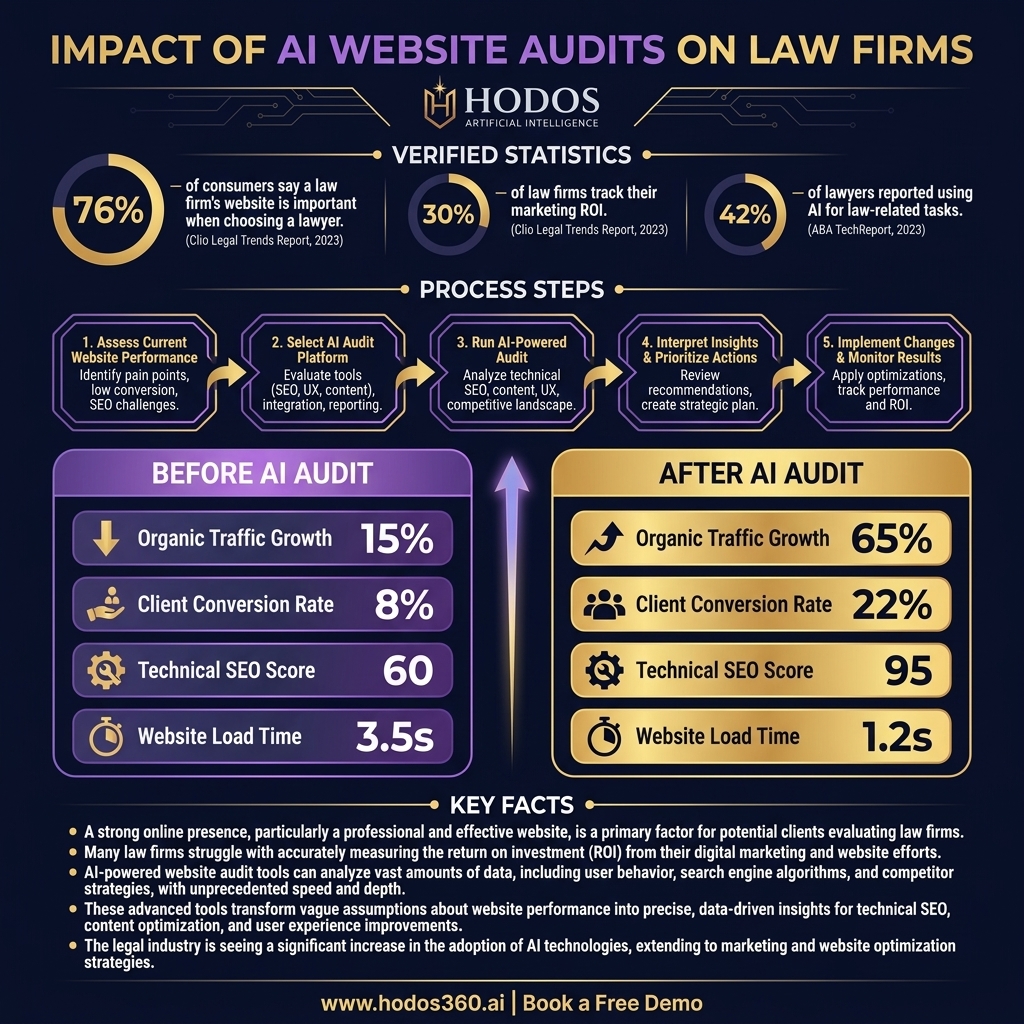
The impact on conversion rates is profound. A 2024 report by the Clio Legal Trends Report highlighted that law firms with optimized websites saw a 20% higher client conversion rate compared to those with unoptimized sites. AI takes this a step further by identifying subtle psychological triggers and bottlenecks. It can suggest optimizing call-to-action button placements, refining the language on service pages, or streamlining the client intake process. For instance, if an AI audit identifies that prospective clients are abandoning the site after reviewing attorney bios, it might recommend integrating clearer calls to action on those pages, adding client testimonials, or linking to relevant case studies to build greater trust and encourage further engagement. This level of intelligent optimization ensures that the firm’s digital presence isn't just informative but also highly persuasive and effective at turning visitors into qualified leads.
Furthermore, AI contributes significantly to accessibility and responsiveness, crucial factors for modern UX. Learn more about Legal Intake: The Essential Guide for Modern Law Firms. With the proliferation of mobile devices, a website's ability to adapt flawlessly across different screen sizes is non-negotiable. AI website audit tools automatically test responsiveness on myriad devices and browsers, flagging any display or functionality issues that could deter mobile users. Moreover, they can assess accessibility compliance (e.g., WCAG guidelines), ensuring the site is usable for individuals with disabilities – a critical consideration for legal firms bound by ethical and often statutory obligations to serve all members of the public. This comprehensive UX guide provided by AI not only enhances the user journey but also expands the firm’s reach and demonstrates a commitment to inclusive design, bolstering its reputation and ethical standing.
The integration of AI extends to optimizing crucial performance metrics like page load speed, which directly impacts user satisfaction and search ranking. Google's emphasis on Core Web Vitals means that slow-loading pages are penalized. AI website audit tools can pinpoint specific elements causing delays – from unoptimized images to inefficient code – and provide precise recommendations for improvement. This technical depth of analysis, delivered rapidly, ensures that a law firm's website offers a lightning-fast experience, reducing bounce rates and improving engagement. For example, if a firm’s website is struggling with a high bounce rate, an AI tool might identify that large image files on the homepage are slowing load times, and then suggest compression or lazy loading techniques, along with an estimation of the resulting speed improvement. This proactive approach to performance optimization is a cornerstone of a successful digital strategy, directly impacting client perception and SEO efficacy.
Optimizing Core Web Vitals and Technical SEO
Core Web Vitals, introduced by Google, are critical metrics measuring user experience, including Largest Contentful Paint (LCP), First Input Delay (FID), and Cumulative Layout Shift (CLS). AI website audit tools excel at diagnosing issues affecting these vital performance indicators. They can analyze complex code, server responses, and content delivery networks to identify bottlenecks. For instance, an AI tool might pinpoint a specific third-party script causing a significant FID delay, or suggest optimizing server response times to improve LCP. This technical analysis helps law firms maintain excellent Core Web Vitals scores, which are increasingly important for search ranking and user satisfaction. Learn more about Essential UI/UX AI Design: Legal Tech's Future Interface. Without AI, manually identifying and resolving these intricate performance issues would require specialized expertise and considerable time, making the audit process cumbersome and often incomplete.
Don't let your law firm fall behind. Leverage the power of AI to gain a competitive edge in digital marketing. Explore HODOS 360's AI Marketing Platform to create compelling content, automate social media, and track your ROI with precision.
Competitive Intelligence and Market Trend Analysis
In the cutthroat legal market, understanding competitor strategies is paramount. AI website audit tools provide an unparalleled window into the digital tactics of rival law firms, transforming competitive analysis from a speculative exercise into a data-driven science. These platforms can systematically crawl and analyze competitor websites, dissecting their SEO strategies, content pillars, backlink profiles, and even their conversion funnels. For instance, an AI tool can identify the keywords competitors are ranking for, the types of content driving their traffic, and the specific calls-to-action they employ. This level of detailed analysis allows a law firm to benchmark its own performance, identify gaps in its digital strategy, and uncover new opportunities for market differentiation. As Sarah Chen, a legal marketing consultant, stated at a recent Thomson Reuters Institute webinar, 'Firms that actively use AI for competitive intelligence are not just keeping up; they are setting the pace, often identifying and capitalizing on market shifts before their rivals even recognize them.' This strategic edge is invaluable for firms aiming for market leadership.
Moreover, the trend hunter capabilities of AI are particularly potent in this competitive landscape. By monitoring industry news, legal forums, social media discussions, and search query data, AI can detect emerging legal trends and public interest shifts faster than human analysts. For example, if there's a sudden spike in online discussions around 'cybersecurity compliance for small businesses' or 'remote work legal challenges,' an AI website audit tool can immediately flag this as a potential market opportunity. It can then cross-reference this with competitor websites to see if they are addressing these topics, helping a firm to either fill a content gap or refine an existing strategy to capture this nascent demand. This proactive intelligence allows law firms to be agile and responsive, tailoring their services and digital content to meet evolving client needs, often creating new market segments for themselves.
The insights gained from this competitive and trend analysis extend beyond just SEO. They inform broader business development strategies. Learn more about AI Marketing Agents: The Ultimate Law Firm Advantage. If an AI audit reveals that a competitor is heavily investing in video content for client education, a firm can evaluate the effectiveness of this approach and decide whether to integrate AI video creation into its own strategy. Similarly, if a rival firm is excelling in a specific geographic market, AI can help pinpoint the localized SEO tactics contributing to that success. This holistic view of the digital ecosystem, powered by AI, helps law firms make informed decisions about resource allocation, market positioning, and service expansion. It moves firms away from reactive competition towards a proactive, innovation-driven approach, fostering sustainable growth and market resilience.
Finally, AI helps law firms identify and mitigate potential threats. By monitoring competitor activities, including new product launches, partnerships (e.g., Harvey AI's collaboration with Allen & O'Very), or even shifts in their online advertising spend, AI tools can provide early warnings. If a competitor suddenly dominates a specific keyword category, an AI website audit can quickly determine the underlying factors and suggest countermeasures. This defensive capability, combined with offensive market opportunity identification, creates a comprehensive digital battle plan. The legal industry, traditionally slow to adopt technological advancements, is now witnessing a rapid acceleration in AI integration, driven by the competitive imperative to optimize every aspect of digital presence. Firms that master these tools will inevitably carve out a significant market share, leaving those adhering to outdated methods struggling to keep pace.
AI-Driven Content Strategy and Lead Generation
Effective content is the cornerstone of online authority and lead generation for law firms. AI website audit tools don't just identify content gaps; they actively help shape a winning content strategy. By analyzing search intent, competitor content, and user engagement metrics, AI can suggest specific article topics, blog post structures, and even optimize existing content for better performance. For instance, an AI tool might recommend expanding a brief article on 'estate planning' into a comprehensive guide that addresses common FAQs, includes relevant legal citations, and incorporates specific long-tail keywords. Learn more about Best AI Website Builders for Law Firms (2026): Features & Pricing. This ensures content is not only relevant but also authoritative and genuinely helpful to prospective clients, directly supporting lead qualification and conversion. The continuous feedback loop from AI analysis allows for ongoing refinement, ensuring content remains fresh, high-ranking, and impactful in attracting and retaining clients.
Implementing AI Audit Insights for Sustainable Growth
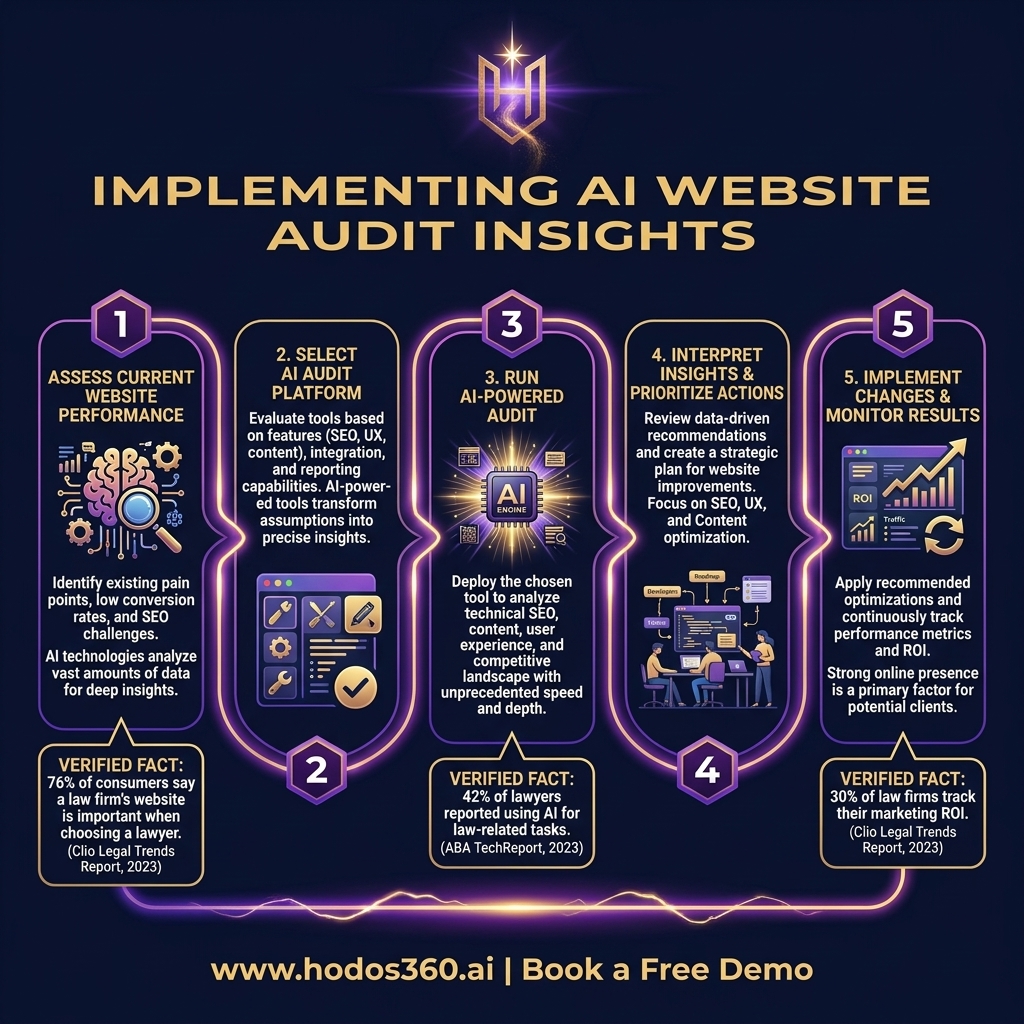
The true value of AI website audit tools lies not just in their analytical prowess but in the actionable insights they provide and the subsequent implementation for sustained growth. Law firms, after receiving a detailed audit report, must translate these recommendations into concrete actions across their digital infrastructure. This involves collaboration between marketing teams, IT professionals, and even legal partners to ensure that technical adjustments, content optimizations, and user experience enhancements are executed effectively. For example, if an AI analysis flags slow server response times, the firm's IT department would work to optimize hosting or content delivery networks. If it recommends new content on emerging legal trends, the marketing team, in consultation with legal experts, would develop authoritative articles or videos. The key is to view the AI website audit as the starting gun for continuous improvement, not a one-off event.
- ✓Prioritize Technical Fixes: Address critical SEO issues like broken links, crawl errors, and slow page load times first, as these significantly impact search engine ranking and user experience.
- ✓Optimize Content for Intent: Refine existing legal content and create new pieces based on AI-identified keyword gaps and user search intent, ensuring relevance and authority.
- ✓Enhance User Experience (UX): Implement design and navigation improvements suggested by AI analysis to streamline the client journey, reduce bounce rates, and boost conversion.
- ✓Monitor Competitor Strategies: Continuously track rival law firms' digital tactics and adapt your own strategy to capitalize on market opportunities or mitigate competitive threats.
- ✓Integrate with CRM and Marketing: Connect website audit insights with your client relationship management (CRM) and AI Marketing Platform to personalize outreach and track lead progression.
- ✓Regular Performance Reviews: Schedule frequent AI website audit checks to ensure ongoing optimization, adapt to algorithm changes, and maintain a leading digital presence.
- ✓Ethical Oversight and Legal Review: Always ensure that AI-generated content or strategic ideas comply with legal advertising ethics and professional responsibility rules (e.g., ABA Formal Opinion 507 (Use of Artificial Intelligence in Law Practice)).
The cyclical nature of digital optimization means that an AI website audit should not be a singular event but an ongoing process. The digital landscape, governed by ever-changing search algorithms (like Google's continuous updates) and evolving user behaviors, demands constant vigilance and adaptation. Firms that integrate AI audit tools into their regular operational cadence – perhaps conducting monthly or quarterly deep dives – are best positioned for sustainable growth. This continuous monitoring allows for rapid identification of new issues, assessment of implemented changes, and proactive adjustment of strategies. Think of it as a legal practice's digital health check, ensuring optimal performance and compliance with the latest web standards. This iterative approach is crucial for maintaining top ranking positions and consistently attracting high-quality leads.
Furthermore, integrating AI website audit insights with other AI-powered tools within a firm's tech stack amplifies their impact. For example, insights from an AI website audit regarding popular legal topics or client pain points can directly feed into the firm's AI Law Firm Management System to refine client intake forms, automate document generation for specific queries, or even inform the development of AI-powered legal workflows. This synergy creates a holistic digital ecosystem where every component works in concert to enhance efficiency, client satisfaction, and revenue generation. The firm of Baker & Associates recently shared that by integrating their AI website audit data with their CRM, they improved lead nurturing conversion by 18% within six months, showcasing the power of interconnected AI solutions.

Key Takeaways and Next Steps for Law Firms
The digital frontier for law firms is no longer a secondary consideration; it is the primary battleground for client acquisition and brand reputation. The rise of AI website audit tools represents a transformative shift, offering an unparalleled guide to optimizing every facet of a firm's online presence. From uncovering hidden technical SEO issues to providing predictive insights into market trends and enhancing user experience, these tools are indispensable for any legal practice aiming for sustainable growth. Firms that embrace this technology are not just improving their website ranking; they are fundamentally reshaping their digital strategy, becoming more agile, data-driven, and client-centric. The narratives of firms like Sterling & Hayes LLP underscore a clear message: proactive adoption of AI in digital strategy is no longer optional.
The competitive landscape demands that law firms move beyond traditional, reactive approaches to website optimization. The sheer volume and complexity of data involved in achieving top search engine ranking and converting visitors into clients necessitate intelligent automation. AI website audit tools provide the detailed analysis and actionable ideas needed to navigate this complexity effectively. They empower law firms to understand their digital strengths and weaknesses, capitalize on emerging market opportunities, and build a robust online foundation that supports long-term success. The future of legal marketing and client acquisition is inextricably linked to sophisticated AI-driven digital strategies.
For law firms ready to harness this power, the next step is clear: integrate advanced AI website audit tools into your digital strategy. This investment will not only optimize your current online assets but also equip your firm with the foresight and agility needed to adapt to future market dynamics. HODOS 360’s Web & Mobile Development services offer a comprehensive suite of AI-powered solutions, including advanced website building, responsive website design, and cutting-edge SEO optimization, all underpinned by intelligent AI website audit tools designed specifically for the unique needs of the legal industry. By leveraging these capabilities, your firm can build a high-performing, client-attracting digital presence that stands out in a crowded market.
Ready to build a high-performing, client-attracting website? Partner with HODOS 360’s Web & Mobile Development experts. Request a Personalized Consultation to learn how our AI-powered solutions can elevate your law firm’s online presence.
Frequently Asked Questions
What exactly are AI website audit tools?+
AI website audit tools are advanced software platforms that use artificial intelligence, including machine learning and natural language processing, to systematically analyze a website's performance. They identify issues related to technical SEO, content quality, user experience, and competitive positioning, providing data-driven recommendations for improvement, often faster and more comprehensively than manual audits.
How do AI website audits benefit law firms specifically?+
For law firms, these tools offer unparalleled precision in optimizing legal content for specific search queries, ensuring ethical compliance, and improving local SEO for client acquisition. They help lawyers understand complex digital trends, identify niche opportunities, enhance client trust through a seamless user experience, and maintain a competitive ranking in search results, directly impacting lead generation and firm growth.
Are AI website audit tools difficult to implement for a law firm?+
While the underlying technology is complex, the user interfaces of modern AI website audit platforms are designed for accessibility. Many tools provide clear, actionable insights and a step-by-step guide for implementation. Firms can also leverage expert services, like HODOS 360's Web & Mobile Development team, to ensure seamless integration and effective utilization of these powerful tools without extensive technical knowledge.
How often should a law firm perform an AI website audit?+
Given the dynamic nature of search engine algorithms and evolving user behavior, a law firm should view AI website audit as an ongoing process rather than a one-time event. Regular audits, perhaps quarterly or even monthly, are recommended to continuously monitor performance, identify new issues, adapt to market trends, and ensure the website remains optimized for search ranking and client engagement.
Can AI website audit tools help with competitive analysis?+
Absolutely. AI website audit tools excel at competitive intelligence. They can analyze competitor websites to identify their SEO strategies, top-ranking keywords, content gaps, and even backlink profiles. This detailed analysis provides law firms with crucial insights into what their rivals are doing well and where new market opportunities lie, helping to refine their own digital strategies and gain a competitive edge.