
Essential UI/UX AI Design: Legal Tech's Future Interface
Just two years ago, Attorney Sarah Chen, a managing partner at a mid-sized corporate law firm, found herself wrestling with an outdated client portal. Clients frequently called for status updates they should have been able to access themselves, and onboarding new corporate accounts was a laborious, document-heavy process.
Her firm’s website, while professional, offered little in the way of interactive support, forcing her team to dedicate valuable hours to answering repetitive queries. This friction wasn't unique to Sarah; it was a silent drain on productivity and client satisfaction across the legal industry. Today, however, firms like Sarah's are embracing a paradigm shift, driven by the rapid evolution of UI/UX AI design.
The recent TyN Magazine article, "Top UI/UX AI technologies reshaping product design in 2026," underscores a critical development: artificial intelligence is no longer merely automating back-office functions; it is now at the forefront of crafting the very interfaces through which legal services are delivered and consumed.
This isn't just about making things look pretty; it's about intelligent design that anticipates needs, streamlines interactions, and personalizes experiences. From adaptive client intake forms to predictive case management dashboards, AI is embedding itself into every layer of user interaction, creating legal digital products that are not only intuitive but also remarkably proactive.
The legal sector, traditionally cautious, is now recognizing that superior user experience, powered by AI, is a non-negotiable competitive advantage.
This shift is being championed by technology leaders and legal innovators alike. Satya Nadella, CEO of Microsoft, has consistently highlighted the importance of AI in user interfaces across Microsoft 365 Copilot, emphasizing how AI can augment human creativity and productivity.
Similarly, leaders in legal tech are pushing for more human-centered, AI-enhanced solutions. For law firms, understanding and integrating these advanced UI/UX AI design principles into their web and mobile development strategies isn't just about keeping pace; it’s about defining the future of legal service delivery.
The firms that invest in these intelligent interfaces today will be the ones attracting and retaining the most discerning clients tomorrow, setting new benchmarks for efficiency and engagement.
Ready to transform your firm's digital presence with cutting-edge AI? Discover how HODOS 360's Web & Mobile Development can build your future-ready interfaces. [Learn More About AI-Powered Web & Mobile Development]
The Transformative Power of AI in Legal UI/UX Design
The fundamental fabric of legal software design is undergoing a profound transformation, driven by advancements in AI. No longer confined to static forms and clunky navigation, legal applications are evolving into dynamic, intelligent ecosystems. This evolution is largely thanks to the integration of AI capabilities that learn from user behavior, predict needs, and adapt interfaces in real-time.
Consider the sophisticated AI features embedded in mainstream design tools like Adobe Sensei, which automates tedious design tasks, or Figma's growing ecosystem of AI plugins that can generate design elements based on prompts. These innovations are quickly trickling down to specialized sectors like legal tech, reshaping everything from how a client initiates contact to how attorneys manage complex litigation.
In the legal sphere, this translates into more intuitive case management systems that can prioritize tasks based on deadlines and potential impact, or document review platforms that highlight critical clauses with unprecedented accuracy. The goal is to minimize cognitive load for legal professionals, allowing them to focus on high-value analytical work rather than navigating cumbersome software.
For instance, companies like Harvey AI, which recently secured a significant funding round and partnered with firms like Allen & Overy, are not just building large language models for legal research; they are meticulously crafting user interfaces that make complex AI outputs accessible and actionable for lawyers.
Learn more about AI Settlement Rates: An Essential Guide to Maximizing Outcomes. Their focus on intuitive design ensures that the power of their underlying AI is truly leveraged by legal practitioners, minimizing friction and maximizing utility. The trend is clear: the future of legal tech design hinges on seamlessly integrating AI to create experiences that are both powerful and inherently user-friendly.
This shift also redefines the role of legal tech designers. They are no longer just interface builders but architects of intelligence, tasked with understanding how AI can enhance every interaction. This involves deep research into legal workflows and user psychology, translating complex AI capabilities into simple, effective user journeys.
Jack Newton, CEO of Clio, a leading legal practice management software company, has consistently emphasized the importance of user experience in legal technology, stating that "great software is invisible." This philosophy aligns perfectly with AI-driven UI/UX AI design, where the technology works seamlessly in the background, making the user's job easier without drawing attention to its complexity.
The result is legal products that feel less like tools and more like intelligent assistants, capable of adapting to individual user preferences and evolving legal trends.
Enhancing Client Experience with AI-Driven Interfaces
For law firms, the most immediate and impactful benefit of advanced UI/UX AI design lies in dramatically improving the client experience. Gone are the days when a law firm's digital presence was merely an online brochure. Today, clients expect sophisticated, personalized, and responsive interactions, mirroring their experiences with leading consumer brands.
AI-driven interfaces empower law firms to deliver precisely this. Imagine a client portal that doesn't just store documents but actively curates updates relevant to their specific case, anticipates their next question based on historical interactions, and even offers proactive advice derived from similar legal precedents.
This level of personalized engagement is becoming a baseline expectation, moving beyond basic communication tools to truly intelligent digital assistants.
AI-powered chatbots and virtual assistants are revolutionizing the initial client touchpoints. Instead of a generic contact form, prospective clients can engage with an AI voice assistant that provides 24/7 phone answering, accurately qualifies leads, and even books initial consultations directly into the firm’s calendar.
This not only significantly reduces the administrative burden on staff but also ensures that potential clients receive immediate, knowledgeable assistance, regardless of time zones or office hours. Learn more about Ultimate AI Video Marketing: Legal Firms Master Content Creation. HODOS 360’s AI Voice Assistants exemplify this capability, offering multilingual support and smart call routing to ensure clients feel heard and valued from their very first interaction.
A 2023 report by the American Bar Association (ABA) indicated that client satisfaction with law firms significantly correlated with the availability of digital communication tools and self-service options, a trend only amplified by AI's predictive capabilities.
This paradigm shift extends to the very accessibility of legal services.
AI-driven interfaces can dynamically adjust content presentation, offer multilingual translations, and ensure compliance with accessibility standards like those outlined in the Americans with Disabilities Act (ADA) for web content. This ensures that legal services are not only efficient but also inclusive, reaching a broader demographic of clients who might otherwise face barriers.
The focus on experience design is paramount, as firms strive to create digital products that are not just functional but genuinely empathetic to client needs. The future of client engagement is conversational, adaptive, and intelligently designed to remove friction at every turn, cultivating trust and loyalty through seamless digital interactions.
Predictive Personalization and Accessibility
One of the most compelling trends in UI/UX AI design for legal services is the move towards predictive personalization. AI algorithms analyze client data—with strict adherence to privacy protocols—to tailor interfaces, content, and communication. This means a client logging into their portal might see priority alerts for upcoming court dates, relevant documents highlighted, or even AI-generated summaries of recent case developments pertinent to their matter.
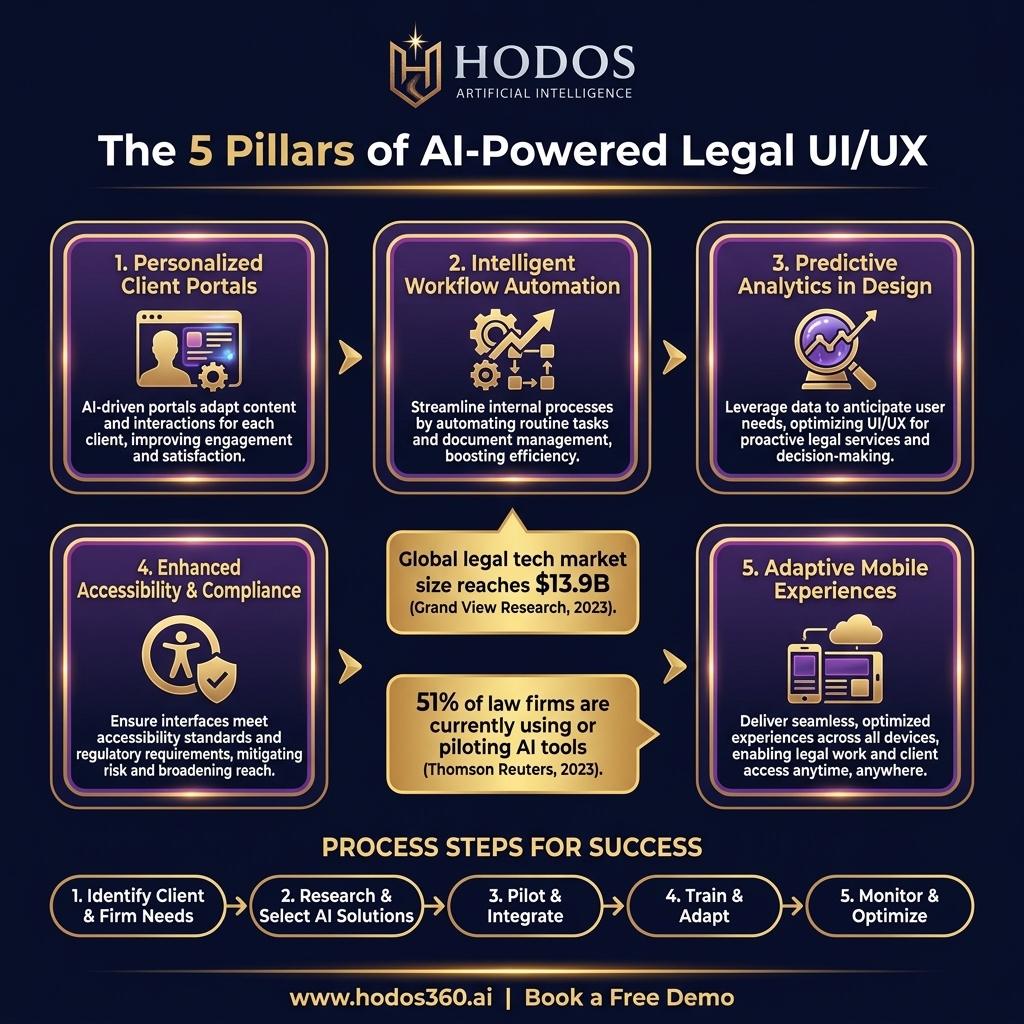
This proactive approach, powered by sophisticated AI, transforms passive information consumption into an active, guided experience. Furthermore, AI is a powerful ally in ensuring digital accessibility. Learn more about Essential AI Vibe Coding: Elevate Law Firm Web Development. By dynamically adjusting font sizes, color contrasts, or offering voice-activated navigation, AI can ensure that a firm’s digital assets comply with evolving legal standards, such as those derived from the ADA, which mandates equal access for individuals with disabilities.
This commitment to inclusive design not only broadens a firm's reach but also reinforces its ethical standing within the community. The future of client interaction is one where every digital touchpoint is uniquely tailored and universally accessible.
Streamlining Legal Workflows Through Intelligent Design
Beyond client-facing applications, UI/UX AI design is revolutionizing internal legal workflows, transforming the operational backbone of law firms. The traditional legal practice is often characterized by repetitive administrative tasks, manual document generation, and fragmented information systems. AI-powered interfaces are directly addressing these inefficiencies, creating intelligent systems that learn from human input and automate low-value, high-volume activities.
Consider a legal practice management system that, through AI, can predict billing cycles, suggest optimal staffing for specific case types, or even pre-populate complex legal documents based on minimal initial inputs. This is not just about automation; it's about intelligent augmentation, where AI acts as a smart co-pilot, guiding legal professionals through their daily tasks with unprecedented efficiency.
Real-world adoption highlights this impact. Firms like Baker McKenzie have openly discussed their investment in AI-driven platforms to streamline global operations, recognizing that consistent, intuitive interfaces across diverse practice areas are crucial for efficiency. The integration of AI into tools that manage case files, automate billing, and facilitate client intake through a single, cohesive interface significantly reduces the time lawyers spend on administrative overhead.
HODOS 360’s AI Law Firm Management System embodies this comprehensive approach, offering an integrated platform for case management, billing, document automation, and AI-powered legal workflows. By centralizing these functions within an intelligently designed UI, firms can achieve a level of operational synergy previously unimaginable. Learn more about Low-Code No-Code AI: Transformative Tools for Law Firms.
The system learns from each interaction, continuously optimizing workflows and identifying bottlenecks, thereby freeing up legal professionals to focus on strategic legal work.
This intelligent streamlining extends to how legal designers approach the creation of new internal tools. The focus is on creating adaptive products that evolve with the firm’s needs, rather than static software requiring constant manual updates.
AI can analyze usage patterns to suggest interface improvements, identify frequently used features, and even anticipate potential user errors, proactively offering solutions. This iterative, AI-driven design process ensures that legal tools remain relevant and highly efficient. The ultimate goal is to create an environment where the technology fades into the background, allowing legal professionals to engage directly with their work, unencumbered by clunky interfaces or inefficient processes.
The impact on productivity is substantial, directly translating to improved profitability and attorney well-being. This is where the true power of AI-enhanced UI/UX AI design shines brightest for law firm operations.
Curious about optimizing your firm's operations with AI? Explore HODOS 360's AI Law Firm Management System for streamlined workflows and enhanced efficiency. [Request a Demo of AI Legal Workflows]
Navigating Ethical Considerations and Data Privacy in AI UI/UX
As law firms increasingly adopt UI/UX AI design principles, navigating the ethical landscape becomes paramount. The very power of AI to personalize and predict user behavior raises significant questions about data privacy, bias, and transparency. A major point of contention, and a source of considerable market competition, is how legal tech companies manage client data, especially sensitive information.
The EU AI Act, set to be fully enforced, serves as a global benchmark, imposing strict regulations on high-risk AI systems, including those that interact directly with users. Firms must ensure that their AI-powered interfaces are not only compliant with such legislation but also designed with ethical principles at their core, fostering trust rather than eroding it.
This requires a proactive approach to design, where privacy-by-design and ethical-AI-by-design are foundational elements, not afterthoughts.
One of the most critical ethical considerations revolves around data confidentiality. ABA Model Rule 1.6 (Confidentiality of Information) mandates that lawyers protect client information, a responsibility that extends to the digital tools they employ.
Law firms must conduct thorough due diligence on any AI-powered UI/UX provider, ensuring robust data encryption, secure storage, and clear policies on how AI models are trained and what data they access. Learn more about AI Voice Assistants: Essential Balance for Law Firms. The interface itself must provide clear consent mechanisms and transparency regarding AI involvement.
For instance, when an AI assistant provides legal research summaries, the interface should clearly indicate the source and potential limitations of the AI-generated content, adhering to ABA Model Rule 1.1 (Competence) by ensuring lawyers understand the tools they use.
The potential for algorithmic bias in AI-driven interfaces is another pressing concern.
If AI models are trained on biased datasets, their outputs, and thus the user experience, could perpetuate or even amplify existing prejudices. This could manifest in anything from subtly influencing search results to inadvertently prioritizing certain client demographics over others. Developers of UI/UX AI design for legal products must employ rigorous testing and auditing processes to mitigate bias, ensuring fairness and equity in their systems.
This means designing interfaces that are not only efficient but also ethically sound, providing users with control and clarity over how their data is used and how AI influences their interactions. The tension between innovation and responsibility is a defining characteristic of this era, demanding careful consideration from all stakeholders involved in developing and deploying AI in legal tech.
Ensuring Transparency and User Control
Building trust in AI-powered interfaces hinges on transparency and user control. Law firms must insist on design that clearly communicates when a user is interacting with AI versus a human, and how their data is being utilized to personalize their experience. This includes providing accessible privacy policies, granular consent options, and mechanisms for users to review or delete their data.
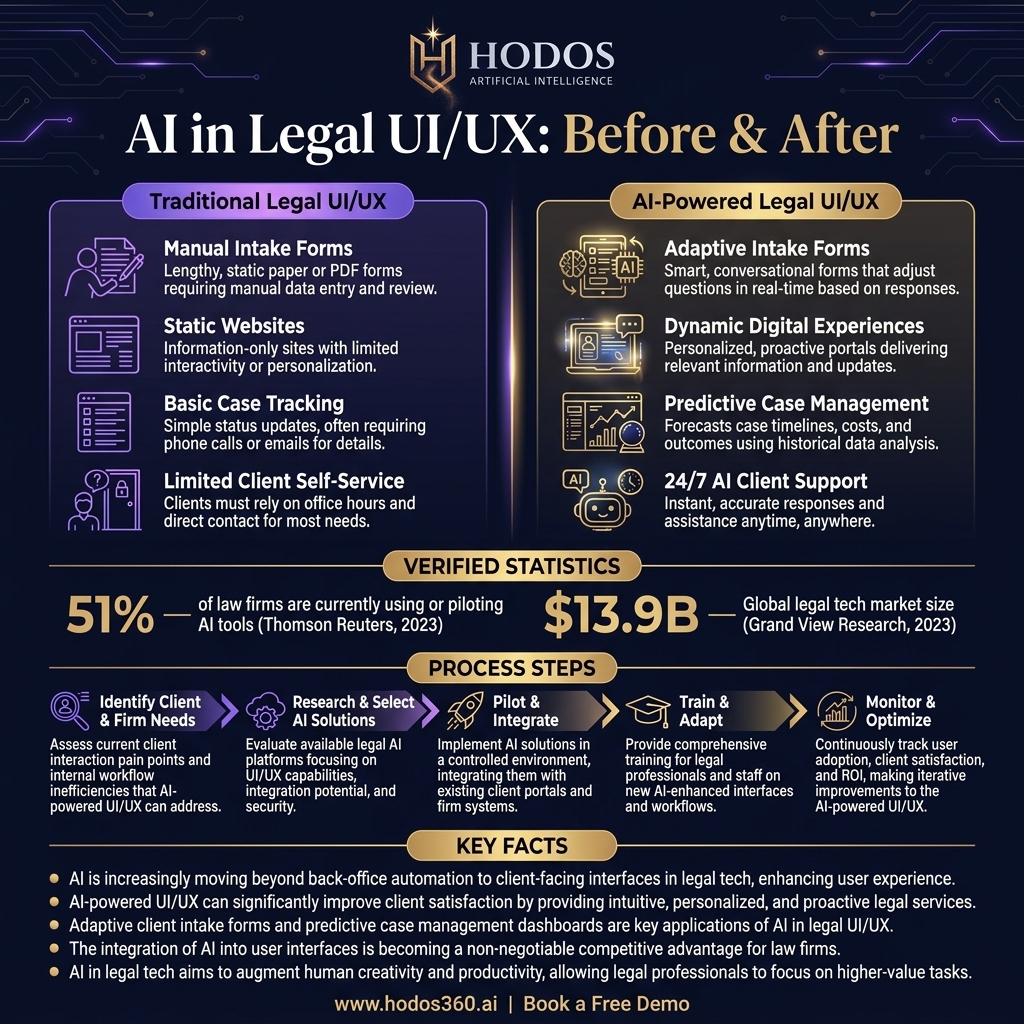
For example, a legal AI platform should allow users to easily opt-out of certain personalization features or request an explanation for an AI's recommendation. Learn more about AI Website Design: Essential Prompts for Law Firms. This level of transparency is not just good practice; it's increasingly becoming a legal requirement, especially with evolving data protection laws.
Firms that prioritize open communication about their AI integration will build stronger relationships with clients and mitigate potential ethical pitfalls, demonstrating a commitment to responsible innovation in their digital products.
The Future Landscape: Web & Mobile Development with AI for Law Firms
Looking ahead, the convergence of UI/UX AI design with web and mobile development promises an even more dynamic and responsive legal landscape. Law firms are no longer just building websites; they are crafting intelligent, adaptive digital ecosystems that serve as the primary interface for their services.
Gartner predicts that by 2027, generative AI will be embedded in 80% of enterprise applications, fundamentally altering how users interact with software. For legal tech, this means a shift towards hyper-personalized legal websites that dynamically adjust content based on visitor profiles, location, and expressed interests.
Imagine a law firm's website that, upon recognizing a corporate client, immediately highlights relevant whitepapers, attorney profiles, and case studies, while a pro bono seeker sees information tailored to community legal aid. This level of intelligent adaptation is the future of legal web presence.
Mobile development will also see profound changes.
AI-powered legal apps will move beyond simple document access to offer sophisticated, context-aware assistance. This could include AI that transcribes and summarizes client meetings in real-time, or mobile interfaces that guide attorneys through complex court filings with integrated compliance checks. The focus will be on creating seamless, intuitive mobile experiences that mirror the functionality and intelligence of desktop applications, ensuring legal professionals and clients can access critical services anytime, anywhere.
Furthermore, emerging technologies like augmented reality (AR) and virtual reality (VR) could soon find their place in legal UI/UX AI design, offering immersive client consultations or interactive courtroom visualizations, although these are still in nascent stages of adoption.
Law firms that partner with providers specializing in AI-powered web and mobile development, such as HODOS 360, gain a significant competitive edge.
HODOS 360 offers AI-powered website building with responsive design, SEO optimization, and high-converting templates, all infused with intelligent AI features. This enables firms to build not just aesthetically pleasing but also highly functional and adaptive digital products that anticipate user needs and drive engagement. The ability to quickly deploy and iterate on these AI-driven interfaces will be crucial in a rapidly evolving market, ensuring that a firm's online presence is always at the forefront of technological innovation and client expectation.
The era of static web development is over; the age of intelligent, adaptive, and AI-powered interfaces is here, offering unprecedented opportunities for growth and client satisfaction.
The Role of Low-Code/No-Code AI Platforms
The democratization of UI/UX AI design is largely being driven by the rise of low-code and no-code AI platforms. These tools empower law firms to build sophisticated, AI-enhanced interfaces without requiring extensive programming expertise. This means that firms can rapidly prototype and deploy custom client portals, internal dashboards, or specialized legal applications, tailoring them precisely to their unique workflows and client needs.
This agility is a game-changer, allowing firms to quickly respond to market trends and client demands. Platforms that offer AI-powered website building and responsive design, like HODOS 360's Web & Mobile Development service, are at the forefront of this movement, enabling law firms to create high-converting, intelligent digital products with minimal technical overhead.
This approach accelerates innovation, reduces development costs, and ensures that even smaller firms can leverage the power of advanced AI in their digital presence.

Key Takeaways and Next Steps
The landscape of legal service delivery is irrevocably altered by the advancements in UI/UX AI design. From enhancing client experience to streamlining internal workflows and building future-ready digital products, AI is no longer a peripheral technology but a central pillar of modern legal practice. Firms that embrace these intelligent interfaces will not only achieve operational efficiencies but also cultivate deeper client relationships and secure a competitive advantage in an increasingly digital world.
The journey involves careful consideration of ethical implications, a commitment to data privacy, and a strategic investment in flexible, AI-powered development platforms. The tension between tradition and innovation is real, but the path forward for law firms is clear: integrate AI into the very fabric of your user experience.
The actionable takeaway for law firms today is to conduct a thorough audit of their existing digital touchpoints – their website, client portals, and internal management systems. Identify areas where friction exists for both clients and internal teams. Then, explore how advanced UI/UX AI design principles and technologies can address these pain points.
Partnering with a comprehensive legal tech provider like HODOS 360, which offers integrated solutions from AI Law Firm Management to AI-powered Web & Mobile Development, can provide the strategic framework and practical tools needed to navigate this transformation successfully. The future of legal tech is not just about AI, but about intelligently designed AI that puts the user at the center.
By investing in superior UI/UX AI design, law firms can build a more efficient, client-centric, and profitable practice for years to come.
Frequently Asked Questions
What is UI/UX AI design in the context of law firms?+
UI/UX AI design in law firms refers to leveraging artificial intelligence to create more intuitive, personalized, and efficient user interfaces and experiences for both clients and legal professionals. This includes AI-powered client portals, adaptive legal websites, intelligent document automation, and predictive case management systems, all designed to streamline interactions and enhance satisfaction.
How does AI improve client experience in law firms?+
AI enhances client experience by enabling personalized communication, 24/7 support via AI voice assistants, and proactive information delivery. It can anticipate client needs, customize content on portals, and ensure accessibility, making legal services more approachable and responsive. This fosters greater client satisfaction and builds stronger, more trusting relationships with the firm.
What are the main benefits of AI in legal workflow design?+
AI in legal workflow design significantly boosts efficiency by automating repetitive tasks, optimizing case management, and streamlining document generation. It provides intelligent insights for resource allocation and reduces administrative overhead, allowing legal professionals to focus on high-value legal work. This leads to increased productivity and overall operational effectiveness for the firm.
Are there ethical concerns with AI in legal UI/UX?+
Yes, ethical concerns primarily revolve around data privacy, potential algorithmic bias, and transparency. Firms must ensure AI systems comply with regulations like GDPR and the EU AI Act, protect client confidentiality (ABA Model Rule 1.6), and disclose AI's role in interactions. Mitigating bias and ensuring user control are critical for responsible AI adoption in legal UI/UX.
How can law firms get started with AI-powered web and mobile development?+
Law firms can start by assessing their current digital infrastructure and identifying key areas for improvement in client experience and internal workflows. Partnering with a specialized legal tech provider like HODOS 360 offers tailored AI-powered website building, responsive design, and integrated legal management systems to seamlessly transition to an intelligent, adaptive digital presence.