

Low-Code No-Code AI: Transformative Tools for Law Firms
The legal landscape, traditionally cautious in its adoption of new technologies, is now at the precipice of a significant transformation, largely fueled by the burgeoning capabilities of low-code and no-code AI tools. Imagine Sarah Chen, a partner at Lex Innova LLP, a mid-sized firm specializing in intellectual property.
For years, Lex Innova struggled with the prohibitive costs and lengthy development cycles associated with custom software to manage their intricate patent application workflows and client communications. They yearned for a bespoke client portal but lacked the in-house technical expertise or the budget for traditional development.
Then, inspired by insights from the MarkTechPost's 2026 report on the 'Best 21 Low-Code and No-Code AI Tools,' Sarah's team began exploring these platforms, realizing they could finally build the custom solutions they needed, in-house and without a single line of complex code. This shift isn't just about efficiency; it's about democratizing innovation, empowering legal professionals to become 'citizen developers' and directly address their operational pain points.
This paradigm shift is reshaping how law firms approach everything from client intake to complex litigation support. The core promise of low-code no-code AI is simple yet profound: to enable rapid application development by abstracting away the complexities of traditional programming. For law firms, this means moving beyond off-the-shelf software limitations and crafting tailored digital experiences that differentiate their services and enhance their internal processes.
As the legal industry continues its march towards digital maturity, understanding and strategically implementing these transformative tools will be paramount for firms looking not just to survive, but to thrive in an increasingly competitive and technology-driven market. This article will explore how these platforms are empowering law firms to innovate, streamline operations, and deliver superior client experiences, all while sidestepping traditional IT bottlenecks.
Ready to explore the possibilities? Discover how low-code no-code AI can redefine your firm's operational capabilities.
The Rise of Low-Code No-Code AI in Legal Innovation
For decades, custom software development in the legal sector was a luxury reserved for the largest firms, requiring substantial capital investment, lengthy development cycles, and a dedicated team of IT specialists. This created a significant barrier to entry for mid-sized and smaller firms seeking to leverage bespoke digital tools to gain a competitive edge.
The reliance on generic, one-size-fits-all solutions often meant compromising on specific workflow needs or enduring clunky integrations. However, the advent of low-code and no-code AI platforms has fundamentally altered this landscape. These tools are democratizing application development, allowing legal professionals with minimal to no coding background to design, build, and deploy sophisticated applications tailored precisely to their firm's unique requirements.
This empowers legal teams to rapidly prototype and iterate solutions, drastically reducing the time and cost associated with digital transformation initiatives.
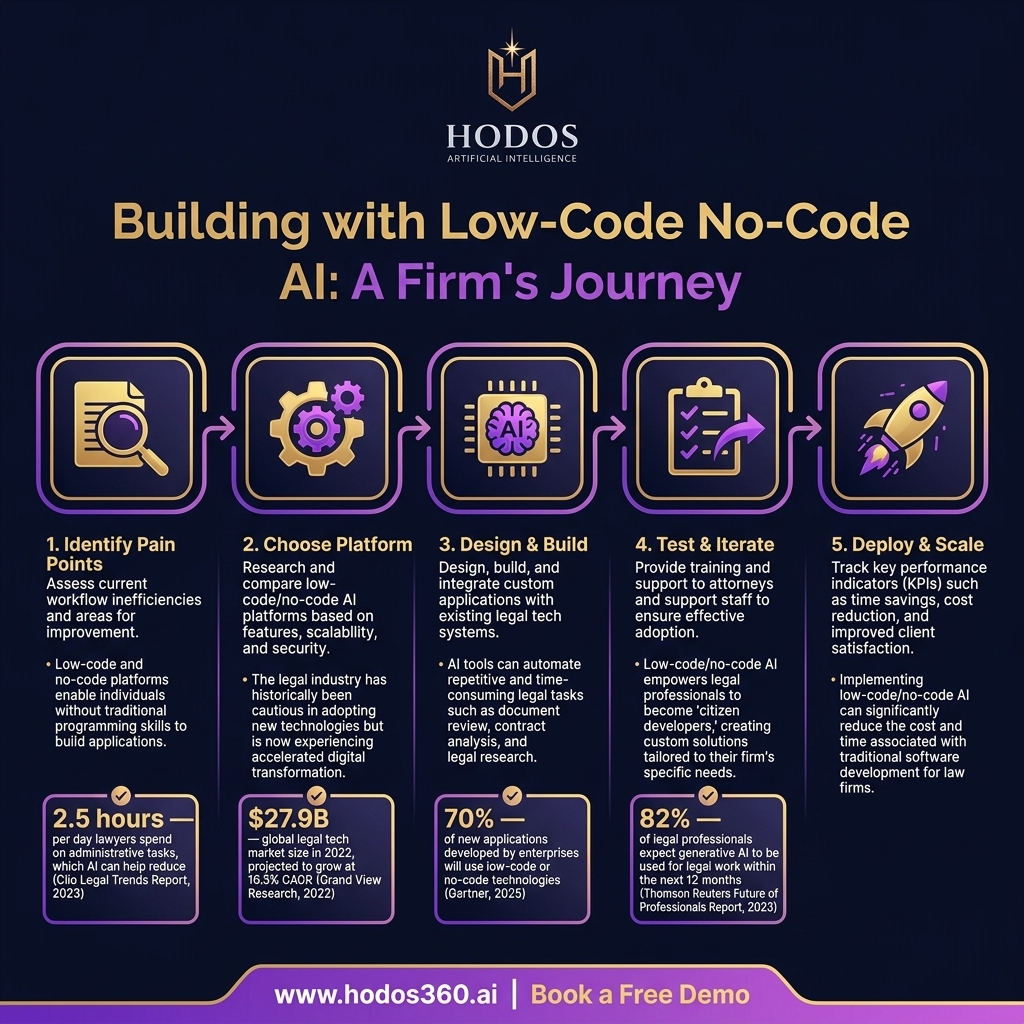
This trend is not merely anecdotal; it's a strategic imperative. Learn more about Siri AI Revolution: Essential Legal Voice Assistant Strategies. Gartner predicts that by 2025, 70% of new applications developed by enterprises will use low-code or no-code technologies, a significant leap from under 25% in 2020. In the legal realm, this translates into firms gaining agility previously unimaginable.
We're seeing firms like LegalFlow Solutions, a boutique firm specializing in environmental law, utilize no-code platforms to rapidly build internal compliance trackers following new regulatory changes, a process that would have taken months with traditional development. This ability to quickly adapt and innovate is becoming a critical differentiator, enabling firms of all sizes to compete effectively with larger, tech-savvy counterparts, moving beyond generic platforms to create truly functional and tailored digital environments.
Bridging the Gap: From IT Bottlenecks to Agile Development
Historically, IT departments in law firms were often seen as gatekeepers, their resources stretched thin, leading to long backlogs for new feature requests or bespoke tool development. This created significant bottlenecks, stifling innovation and delaying the implementation of solutions that could improve efficiency or client service.
Low-code no-code AI platforms effectively bridge this gap by empowering 'citizen developers' within the legal team itself. Lawyers, paralegals, and legal operations specialists, who intimately understand the firm's workflows and client needs, can now directly contribute to software creation. Learn more about AI for Small Law Firms: The Essential Hub for Growth.
This shifts the focus from waiting for IT to developing solutions collaboratively and iteratively, fostering an agile development environment. The result is a dramatic reduction in time-to-market for new applications, allowing firms to respond more quickly to market demands, client expectations, and internal operational challenges, moving away from seeking external recommendations for every minor customization.
Demystifying Low-Code vs. No-Code for Law Firms
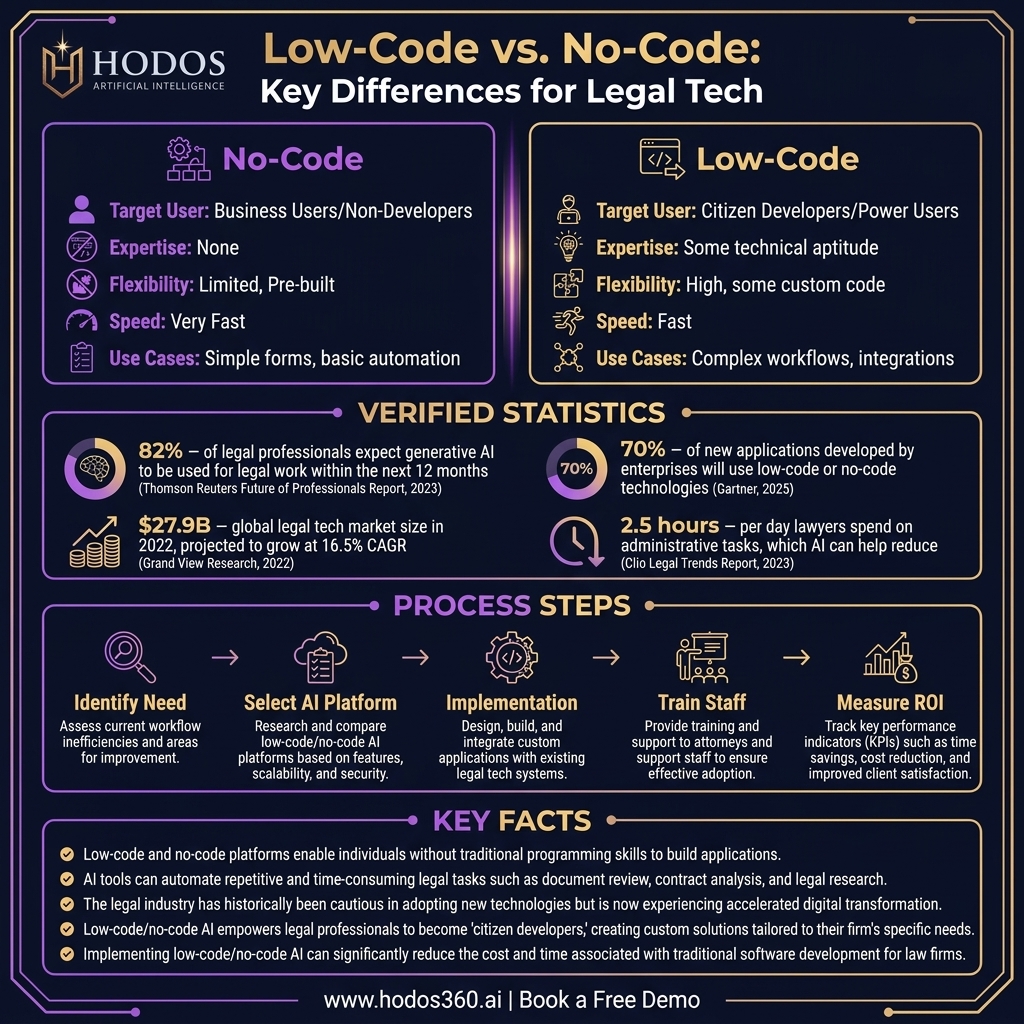
While often used interchangeably, understanding the nuanced differences between low-code and no-code platforms is crucial for law firms to make informed strategic decisions. No-code platforms are designed for business users with absolutely no programming experience. They rely entirely on visual interfaces, drag-and-drop functionalities, and pre-built components to create fully functional applications.
Think of building a website or automating a simple workflow by visually arranging blocks. These platforms excel at rapid deployment for straightforward tasks like client intake forms, automated email sequences, or simple internal databases. They are about empowering immediate creation without writing any code at all, making development accessible to everyone on the team.
In contrast, low-code platforms cater to a slightly different audience: 'citizen developers' or power users who possess some technical aptitude but are not professional programmers. Learn more about AI Document Workflows: Unleash Firm Efficiency in 2026. While still heavily reliant on visual development environments, low-code platforms allow for minimal coding when necessary, offering greater flexibility and extensibility.
This might involve writing small snippets of code to integrate with complex legacy systems, customize specific logic, or connect to unique APIs. Low-code is ideal for more sophisticated applications, such as integrating with existing case management systems, building complex legal workflows that require conditional logic, or creating robust client portals with advanced features.
Both approaches significantly reduce development time and cost compared to traditional programming, allowing firms to explore and create powerful applications.
Curious about which platform is right for your firm? Book a consultation with HODOS 360 to explore tailored low-code and no-code AI solutions.
Practical Applications of Low-Code No-Code AI in Legal Practice
The versatility of low-code no-code AI tools means their applications within a law firm are vast and impactful, ranging from enhancing client interaction to optimizing internal operations. Firms are no longer limited to the functionalities of their existing software; they can now create bespoke solutions that perfectly align with their unique practice areas and client demands.
This capability is not just about incremental improvements; it’s about a fundamental transformation of how legal services are delivered and managed. Consider a firm specializing in M&A, where due diligence is a labor-intensive process. Learn more about Voice AI Revolution 2026: Agentic Platforms Transform Law Firms.
With a low-code platform, they could build an AI-powered document review tool that flags specific clauses or risks, significantly reducing manual review time and increasing accuracy, ultimately delivering more value to their clients. Similarly, for a personal injury firm, a no-code platform could automate the initial client screening process, ensuring only qualified leads reach an attorney, thereby optimizing resource allocation.
- ✓Automated Client Intake & Onboarding: Streamline the initial client journey by creating dynamic forms, automating conflict checks, and initiating welcome sequences, reducing administrative burden and improving first impressions.
- ✓Document Automation & Generation: Build intelligent templates that auto-fill client-specific data into contracts, pleadings, and other legal documents, ensuring consistency and significantly speeding up document creation.
- ✓Custom Legal Workflows: Design and automate complex litigation support tasks, compliance checklists, or transactional processes, ensuring adherence to protocols and reducing human error.
- ✓Client Portals & Self-Service: Develop secure, branded portals where clients can upload documents, track case status, communicate securely with their legal team, and access relevant information 24/7, enhancing transparency and satisfaction.
- ✓Internal Knowledge Management: Create searchable, AI-powered databases for precedents, research, firm policies, and best practices, making institutional knowledge readily accessible to all team members.
- ✓Marketing & Business Development: Build custom landing pages for specific campaigns, automate lead nurturing sequences, and track ROI for marketing efforts, integrating with HODOS 360's AI Marketing Platform for comprehensive outreach.
- ✓AI Voice Assistant Integration: Connect no-code platforms to automate initial client queries, schedule appointments, or route calls intelligently, leveraging the power of HODOS 360's AI Voice Assistants for seamless client communication.
Revolutionizing Client Engagement and Operational Efficiency
The direct impact of these tools on client engagement and operational efficiency cannot be overstated. By automating repetitive tasks, legal professionals are freed from mundane administrative work, allowing them to focus on high-value, strategic legal work. This not only boosts internal productivity but also translates into better service for clients—faster responses, more personalized interactions, and transparent access to case information.
Firms that embrace these solutions gain a significant competitive advantage, demonstrating a commitment to innovation that resonates with modern clients. Learn more about Legal AI Divide: Bridge the Gap, Thrive in 2026's Digital Era. As outlined in ABA Model Rule 1.1 on Competence, lawyers have a duty to stay abreast of changes in the law and its practice, including the benefits and risks associated with relevant technology.
Leveraging low-code no-code AI is a clear demonstration of fulfilling this ethical obligation, enhancing both service delivery and the firm's overall standing.
Implementing Low-Code No-Code AI: A Strategic Approach
Successful adoption of low-code no-code AI within a law firm requires more than just selecting a platform; it demands a strategic, phased approach. Firms should begin by identifying specific pain points or inefficiencies that these tools can address, rather than adopting technology for its own sake.
Start with small, manageable pilot projects—perhaps automating a simple client intake form or creating a basic internal dashboard. This allows teams to gain experience, understand the platform's capabilities, and demonstrate quick wins, building internal momentum and buy-in. Comprehensive training for legal professionals on how to utilize these platforms effectively is also critical, fostering a culture of continuous improvement and empowering them to become active participants in the firm's digital transformation journey.
Platforms like HODOS 360’s AI Law Firm Management System provide a robust foundation that can integrate with or provide a framework for many of these custom low-code/no-code solutions, offering a comprehensive suite for firms seeking to optimize their operations.
While the allure of rapid development is strong, law firms must also be mindful of potential pitfalls.
Learn more about Wordsmith AI's $100M Valuation: An Essential LegalTech Milestone. These include vendor lock-in, where reliance on a single platform can limit future flexibility, and the critical need for robust data security. According to a 2024 Thomson Reuters Institute report, cybersecurity remains a top concern for legal professionals, highlighting the importance of due diligence when selecting any cloud-based solution.
Firms must carefully evaluate a platform's security protocols, data privacy policies, and compliance certifications to ensure sensitive client information is protected. Over-reliance on citizen developers without proper oversight can also lead to 'shadow IT' or applications that lack scalability or security best practices. Therefore, a collaborative approach involving both legal professionals and IT or legal operations specialists is essential to ensure that low-code no-code initiatives are secure, compliant, and aligned with the firm's broader technological strategy.
Navigating Data Security, Compliance, and Ethical Considerations
The ethical obligations of lawyers extend to the technological tools they employ, particularly concerning client confidentiality and data integrity. ABA Model Rule 1.6 on Confidentiality of Information mandates that lawyers make reasonable efforts to prevent the inadvertent or unauthorized disclosure of, or unauthorized access to, information relating to the representation of a client.
This rule is directly applicable to the selection and deployment of low-code no-code AI platforms. Firms must conduct thorough due diligence, ensuring that chosen platforms meet stringent data privacy standards (e.g., GDPR, CCPA, HIPAA where applicable) and have robust security measures in place. It's not enough for a platform to be easy to use; it must also be secure by design.
Furthermore, firms must consider the ethical implications of AI itself—ensuring algorithms are fair, unbiased, and transparent, especially when used in client-facing applications or decision-support tools. Proactive engagement with these considerations is not just a best practice; it's a professional responsibility.

Key Takeaways and Next Steps
Low-code no-code AI tools represent a profound shift in how law firms can approach technology and innovation. They are not merely efficiency hacks but strategic enablers that empower legal professionals to craft bespoke solutions, automate complex legal workflows, and significantly enhance client engagement without deep programming expertise.
From automating client intake to building sophisticated client portals and streamlining internal operations, these platforms offer unparalleled agility in a rapidly evolving legal market. The future of legal practice is one where technology is not just supported by IT, but actively shaped by the legal professionals themselves, fostering a culture of innovation and adaptability.
To truly harness the power of this revolution, law firms must embrace a mindset of experimentation, start with clearly defined problems, and prioritize security and ethical considerations in their implementation strategy. It’s about empowering your team to build the future of your firm, one tailored application at a time.
The firms that strategically leverage these tools will be best positioned to attract top talent, satisfy demanding clients, and maintain a competitive edge in the years to come. Empower your firm's digital future. Visit HODOS 360 to explore our AI-powered solutions and custom web development services.
Frequently Asked Questions
What is low-code no-code AI for law firms?+
Low-code no-code AI for law firms refers to platforms that enable legal professionals to build custom applications and automate tasks using visual interfaces and pre-built components, with minimal to no traditional coding. These tools integrate artificial intelligence capabilities to enhance automation, data analysis, and decision support, allowing firms to create tailored solutions for case management, client intake, document automation, and more, without relying on extensive IT expertise.
How do low-code and no-code platforms differ?+
No-code platforms are designed for users with no programming experience, offering purely visual drag-and-drop interfaces for rapid application development. Low-code platforms, while also visual, allow for some minimal coding to extend functionality or integrate with complex systems, catering to 'citizen developers' with basic technical aptitude. The primary difference lies in the level of technical knowledge required and the flexibility offered for customization, with low-code providing more granular control.
What are common applications of these tools in legal practice?+
Common applications include automating client intake and onboarding processes, generating legal documents from templates, building custom workflows for litigation or transactional tasks, creating secure client portals for communication and document exchange, and developing internal knowledge management systems. These tools can also be used for marketing automation, lead qualification, and even integrating with AI voice assistants for enhanced client service, making legal operations more efficient.
Do law firms need technical expertise to use low-code no-code AI?+
No-code platforms are specifically designed for users without technical expertise, allowing legal professionals to build applications using intuitive visual tools. Low-code platforms may require some basic technical understanding or a willingness to learn minimal scripting for advanced customizations. The goal of both is to empower non-developers, or 'citizen developers,' within law firms to create solutions, significantly reducing the reliance on traditional IT departments and external programmers.
What are the security implications of using these platforms?+
Data security and client confidentiality are paramount. Law firms must conduct thorough due diligence on any low-code no-code AI platform, ensuring it meets stringent security standards, complies with relevant data privacy regulations (e.g., GDPR, CCPA), and has robust data encryption and access controls. It is crucial to understand where data is stored and how it is protected. Ethical considerations regarding AI bias and transparency must also be addressed, aligning with professional responsibilities like ABA Model Rule 1.6.
How can HODOS 360 assist with low-code no-code AI adoption?+
HODOS 360 provides a foundational AI-powered platform for law firm management, marketing, and web development that can seamlessly integrate with or serve as a base for low-code no-code AI initiatives. Our Web & Mobile Development services can assist firms in leveraging these tools to build AI-powered websites and custom applications, ensuring responsive design and SEO optimization. Additionally, our comprehensive AI Law Firm Management System provides the infrastructure for automating legal workflows, complementing bespoke solutions created with low-code no-code tools.