

Building an Essential AI Meeting Assistant for Law Firms
Sarah Chen, managing partner at Ascend Law Group, often found herself in a familiar dilemma: fully present during a high-stakes client strategy meeting, yet mentally juggling the need to capture every nuance, every action item, and every subtle client concern. Traditional note-taking pulled her focus, while relying solely on memory was a professional gamble.
This tension is magnified across the legal industry, where precision is paramount and missed details can have significant repercussions. The promise of building a "production-ready AI meeting assistant" in a short timeframe, as highlighted by tech publications like SitePoint, sparks curiosity, but for law firms, the journey from concept to secure, reliable implementation requires a deeper understanding of legal specificities.
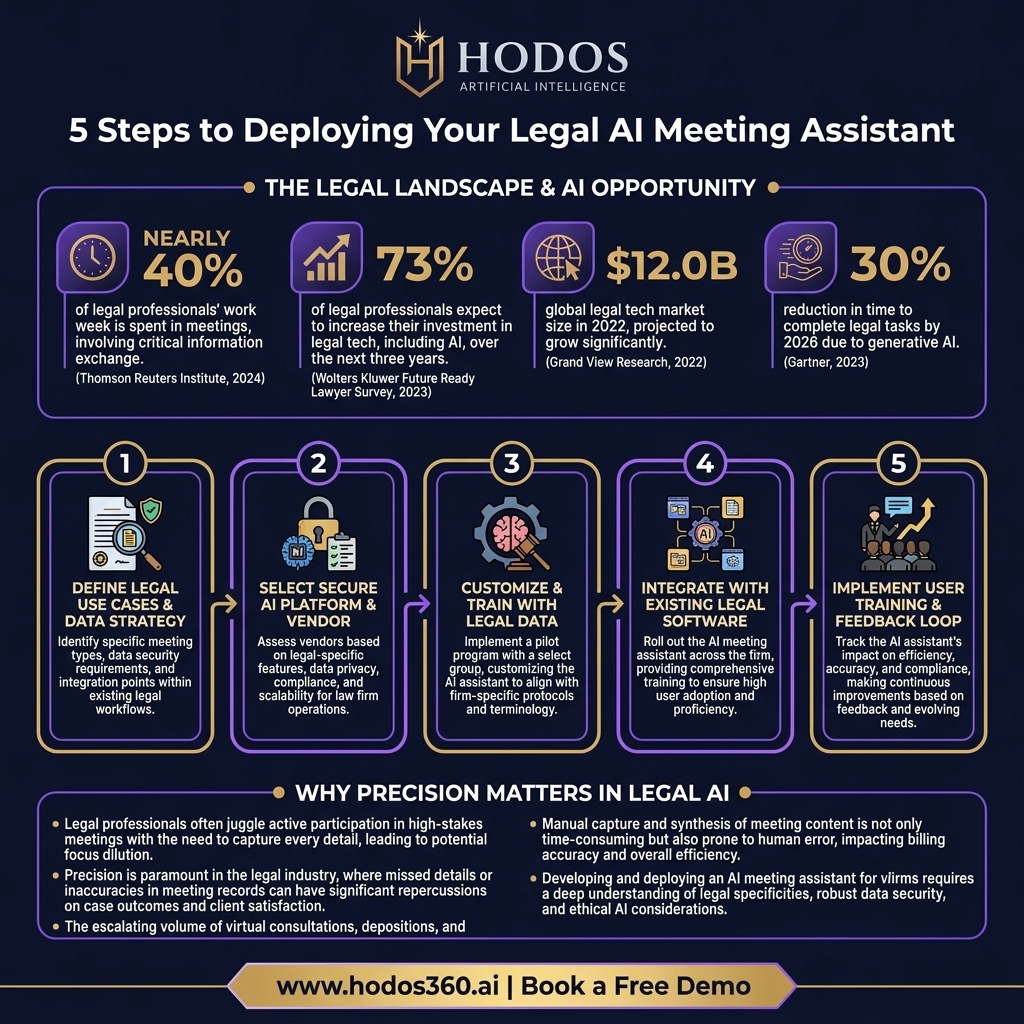
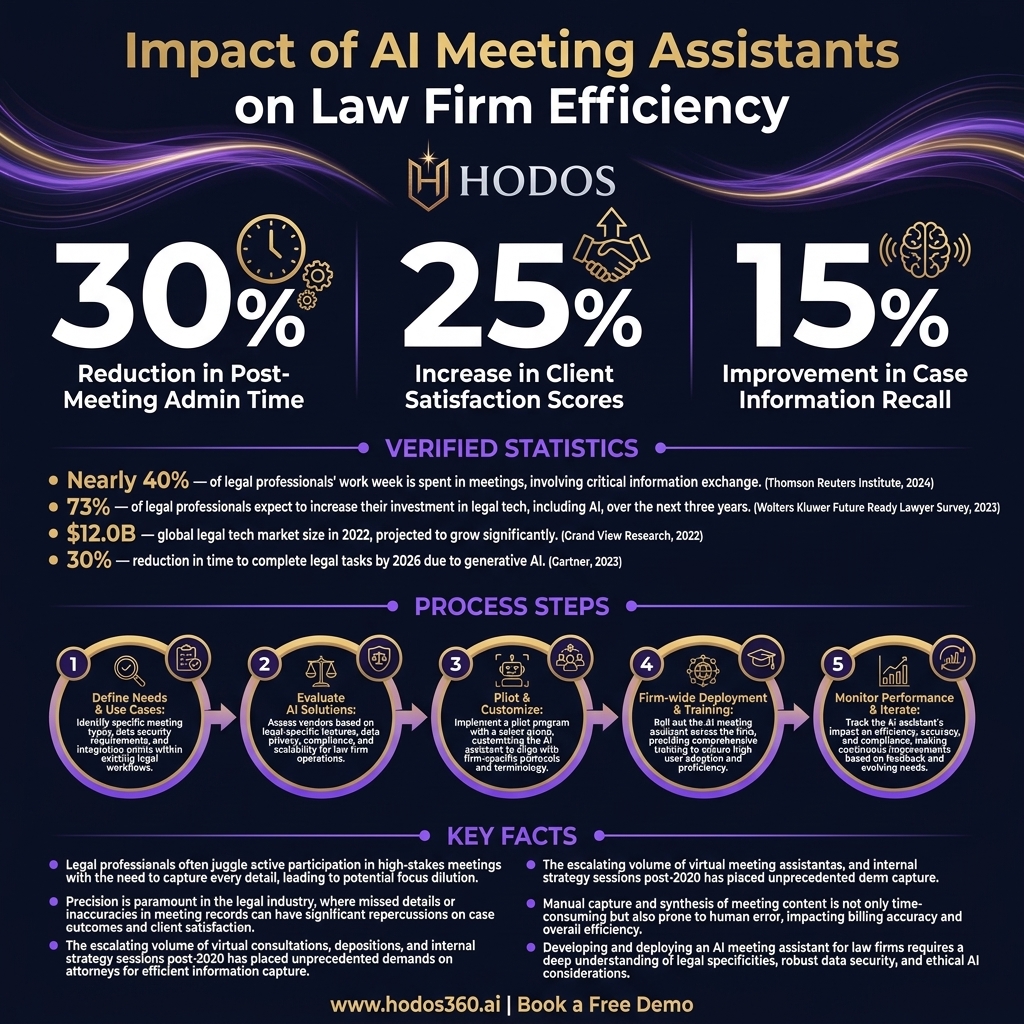
The escalating volume of virtual consultations, depositions, and internal strategy sessions post-2020 has placed unprecedented demands on attorneys. According to a 2024 Thomson Reuters Institute report, legal professionals spend nearly 40% of their work week in meetings, a substantial portion of which involves critical information exchange.
This data underscores a pervasive inefficiency: the manual capture and synthesis of meeting content is not only time-consuming but prone to human error, potentially impacting case outcomes, client satisfaction, and billing accuracy. The challenge isn't merely to transcribe, but to intelligently process, summarize, and integrate crucial information into existing legal workflows.
This article delves into how law firms can move beyond basic digital dictation to strategically develop and deploy an advanced AI meeting assistant. We explore the essential components, the critical considerations for data security and ethical AI, and how such a powerful tool integrates seamlessly with broader legal tech ecosystems.
The goal is to empower legal professionals with a robust solution that ensures no critical detail is ever missed, transforming client interactions and internal operations. Ready to transform your firm's productivity? Explore how HODOS 360's AI solutions can empower your legal team.
The Strategic Imperative: Why Law Firms Need a Dedicated AI Meeting Assistant
The legal landscape demands unwavering attention to detail, a requirement often at odds with the multitasking inherent in modern practice. A 2023 survey by the American Bar Association (ABA) TechReport revealed that while AI adoption is growing, many firms still grapple with basic automation, let alone sophisticated AI solutions for meeting management.
Generic transcription services, while useful, lack the contextual understanding necessary for legal discourse. They struggle with specialized jargon, identify parties incorrectly, or miss the subtle implications of legal arguments. Learn more about AI for Law Firms: Essential Guide to Scaling Legal AI. For a partner like David Lee at Global IP Partners, whose daily routine involves intricate patent discussions and complex contractual negotiations, a standard meeting notetaker simply cannot capture the precise language required for drafting airtight legal documents or preparing for litigation.
The imperative for a specialized AI meeting assistant stems directly from these unique demands, moving beyond simple audio-to-text conversion to provide intelligent insights.
The competitive advantage for firms that embrace this evolution is clear. While some firms might resist, citing cost or complexity, pioneers are already seeing significant returns. Consider the dramatic shift at Allen & Overy, which famously partnered with Harvey AI, demonstrating a commitment to integrating advanced AI into core legal operations.
This isn't just about efficiency; it's about elevating the quality of legal service. Learn more about Essential AI Marketing Automation for Law Firms. An AI meeting assistant acts as a silent, ever-present junior associate, meticulously recording, analyzing, and organizing information. This frees up attorneys to focus on strategic thinking, client advocacy, and complex problem-solving, rather than the clerical burden of post-meeting follow-up.
The ability to quickly recall specific statements from a deposition or client consultation, without sifting through hours of audio or handwritten notes, represents a tangible improvement in legal workflow automation.
Deconstructing the Advanced AI Meeting Assistant for Legal Practice
At its core, a sophisticated AI meeting assistant for law firms relies on advanced Natural Language Processing (NLP) models specifically trained on legal datasets. Unlike general-purpose NLP, which might falter with highly technical terms like "res ipsa loquitur" or "inter partes review," a legal-centric model can accurately transcribe and understand these nuances.
This specialized training allows the AI to not only convert speech to text with high fidelity but also to identify key entities (parties, courts, statutes), extract critical arguments, and even flag potential conflicts of interest or compliance issues. Learn more about AI Marketing Automation: Essential Growth for Law Firms.
For example, during a complex M&A negotiation, the AI could highlight specific clauses discussed, identify proposed amendments, and track stakeholder commitments, ensuring no detail is overlooked. This level of intelligent processing is what truly differentiates a "production-ready AI agent" from a basic recording device.
Beyond transcription, the power of these assistants lies in their ability to perform real-time summarization and action item identification. Imagine a live dashboard during a client intake session where the AI meeting assistant automatically generates a concise summary of client needs, identifies key information for conflict checks, and even pre-populates forms for document automation.
This capability dramatically reduces post-meeting administrative tasks, freeing up paralegals and associates. Learn more about AI Voice Assistants: The Ultimate Evolution for Law Firms. The system can be designed to monitor for specific keywords or phrases, triggering alerts for urgent matters or automatically scheduling follow-up tasks within a firm's case management system.
The ability to quickly access precise information from past meetings, such as a specific instruction from a client or a judge's ruling, significantly enhances an attorney's recall and preparedness, turning vast amounts of unstructured data into actionable intelligence.
Customizing AI for Specific Practice Areas
One size does not fit all in legal AI. A robust AI meeting assistant must be customizable to the unique demands of different practice areas. For a family law firm, the AI might be trained to identify emotional cues or specific financial disclosures, while a criminal defense firm would prioritize precise transcription of witness testimonies and procedural details.
Learn more about Conversational AI: Essential Strategies for Legal Success. This customization involves fine-tuning pre-trained models with a firm's specific data, ensuring the AI understands the lexicon, common abbreviations, and typical interaction patterns of that practice. This iterative process, often overseen by a firm's legal tech specialist or a partner like Elena Rodriguez, who champions innovation at Veritas Litigation, ensures the AI becomes an indispensable, highly specialized tool rather than a generic utility.
Building a Robust AI Meeting Assistant: A Strategic Blueprint for Deployment
The aspiration to "build a production-ready AI meeting assistant with Recall.ai in 48 hours," as featured on SitePoint, highlights the rapid advancements in AI development tools. However, for law firms, deployment is a strategic undertaking that extends far beyond initial coding. It demands meticulous planning for data governance, system integration, and user adoption.
Learn more about AI-Powered Web Development: Essential SaaS Optimization for Law Firms. The first step involves a clear definition of use cases: which types of meetings will benefit most? What specific data points are crucial? Firms must assess their existing IT infrastructure, considering whether to deploy on-premise for maximum control or leverage secure cloud environments offered by specialized legal tech vendors.
This foundational work ensures the AI meeting assistant is not just functional but truly valuable and seamlessly integrated into daily legal operations.
A critical aspect of successful deployment is the data strategy. Law firms possess a wealth of unstructured data in their existing meeting transcripts, client communications, and case files. Leveraging this anonymized data to train and refine the AI's understanding of legal concepts is paramount. This process, often involving collaboration with AI experts, enhances the AI's accuracy and relevance.
The legal tech market is seeing substantial investment, with companies like LexisNexis and Thomson Reuters continually enhancing their AI offerings, providing robust frameworks that firms can build upon. The challenge often lies in securely accessing and preparing this proprietary data for AI training, a task that requires careful adherence to client confidentiality and data privacy regulations.
Ensuring Data Privacy and Ethical AI in Legal Applications
The ethical implications and data privacy concerns surrounding AI in legal practice are profound. ABA Model Rule 1.6, addressing client confidentiality, mandates that lawyers protect client information. Deploying an AI meeting assistant necessitates robust security measures, including end-to-end encryption, strict access controls, and data residency policies that comply with local and international regulations like GDPR or the California Consumer Privacy Act (CCPA).
Firms must scrutinize vendors for their data handling practices and consider "privacy-by-design" principles. As noted by Dario Amodei, CEO of Anthropic, the development of "safe and responsible AI" is paramount, especially in sensitive sectors like law, where the stakes of a data breach or misuse of information are exceptionally high.
Successful implementation also hinges on user adoption and change management. Even the most technologically advanced AI meeting assistant will fail if attorneys and staff are reluctant to use it. This requires comprehensive training, clear communication of benefits, and demonstrating how the AI augments, rather than replaces, human expertise.
Firms that have successfully integrated AI, such as Innovate Legal, led by tech-forward partner Dr. Anya Sharma, often implement pilot programs and gather user feedback to iterate and improve the system. This human-centered approach ensures the AI becomes a trusted tool, fostering efficiency and innovation across the firm.
Unlock unprecedented efficiency and accuracy in your legal practice. Speak with a HODOS 360 expert to design your firm's AI strategy.
Beyond Meetings: Integrating AI Voice Assistants into Your Firm's Ecosystem
The technological backbone enabling a sophisticated AI meeting assistant extends far beyond mere meeting transcription. It powers a broader suite of AI Voice Assistants capable of transforming various aspects of law firm operations, particularly client engagement. Imagine a 24/7 virtual receptionist that can answer common queries, qualify leads based on pre-defined criteria, and even book appointments directly into an attorney's calendar.
This capability is a significant leap from traditional answering services, ensuring no potential client inquiry is missed, even outside business hours. Firms can leverage this technology to provide instant support, reduce client wait times, and project an image of cutting-edge efficiency, directly impacting lead conversion rates and client satisfaction.
Furthermore, these AI Voice Assistants can provide multilingual support, significantly expanding a firm's reach to diverse client demographics. The ability to seamlessly route calls to the appropriate department or attorney based on the AI's initial qualification adds another layer of operational efficiency. This integration of voice AI into client intake processes, for example, can pre-fill client information into a CRM or case management system, initiating the client intake process before a human interaction even occurs.
This proactive approach not only streamlines administrative tasks but also allows legal professionals to dedicate their valuable time to actual legal work, rather than routine data entry or initial screening.
Streamlining Client Engagement and Law Firm Operations
The synergy between an AI meeting assistant and broader AI Voice Assistants creates a powerful, integrated ecosystem for law firms. Insights gleaned from client meetings can directly inform automated follow-up communications, trigger document assembly for retainer agreements, or update case files with new information. For instance, if an AI meeting assistant identifies a new legal entity during a consultation, the voice assistant could then verify details or initiate a conflict check.
This seamless flow of information, driven by AI, reduces manual handoffs, minimizes errors, and accelerates the entire client lifecycle, from initial contact to case resolution. It embodies the vision of integrated workflow automation that companies like HODOS 360 are bringing to the legal market.
This intelligent automation extends to internal operations as well. Voice commands could activate legal research queries, generate summaries of case precedents, or even manage internal team meetings more effectively. As Jensen Huang, CEO of NVIDIA, often emphasizes, AI is fundamentally a new form of computation that enhances human capability across all sectors.
For law firms, this means empowering attorneys to handle more cases, provide more personalized attention, and innovate their service delivery. The competitive advantage of a firm that has embraced this level of technological integration is undeniable, setting them apart in a crowded legal market.

The Future of Legal Practice: Empowering Attorneys with Intelligent Automation
The journey towards a fully optimized, AI-powered law firm is an ongoing evolution, not a single destination. An AI meeting assistant, while a powerful tool in itself, represents just one facet of a comprehensive digital transformation. The true potential of AI in legal practice lies in its ability to create a synergistic environment where various AI tools work in concert.
This means an AI managing client intake, an AI assisting with document review, and an AI powering marketing efforts, all contributing to a more efficient, accurate, and client-centric firm. Attorneys are not being replaced; they are being augmented, freed from the drudgery of repetitive tasks to focus on the strategic, empathetic, and uniquely human aspects of law.
Embracing this future requires a proactive mindset and a willingness to invest in robust legal technology. Firms that delay risk being outpaced by more agile competitors who leverage AI for everything from enhancing their online presence to optimizing their internal workflows. The integration of an advanced AI meeting assistant into a broader platform, such as the comprehensive suite offered by HODOS 360, provides a holistic solution.
This platform not only offers AI Law Firm Management, AI Marketing, and AI Voice Assistants but also Web & Mobile Development to ensure a firm's digital footprint is as advanced as its internal operations. The goal is to build a legal practice that is not only ready for today's challenges but also future-proofed against tomorrow's uncertainties, ensuring sustained success and unparalleled client service.
Future-proof your law firm. Discover how HODOS 360's integrated AI solutions are redefining legal efficiency and client engagement. Book a free demo today.
Frequently Asked Questions
What is an AI meeting assistant for law firms?+
An AI meeting assistant for law firms is a specialized artificial intelligence tool designed to capture, transcribe, summarize, and analyze legal meetings. It goes beyond basic transcription by understanding legal jargon, identifying key entities, extracting action items, and integrating with legal workflows to enhance accuracy, efficiency, and client confidentiality.
How does an AI meeting assistant ensure client confidentiality?+
Ensuring client confidentiality is paramount. A production-ready AI meeting assistant for law firms employs robust security measures such as end-to-end encryption, secure data storage (often on-premise or compliant cloud solutions), strict access controls, and adherence to regulations like ABA Model Rule 1.6 and GDPR. Firms must choose vendors committed to privacy-by-design principles.
Can an AI meeting assistant integrate with existing legal software?+
Yes, a key feature of an advanced AI meeting assistant is its ability to integrate seamlessly with existing legal software. This includes case management systems, document automation platforms, client intake tools, and billing software. Such integration ensures that meeting insights flow directly into relevant workflows, minimizing manual data entry and optimizing firm operations.
What are the key benefits of using an AI meeting assistant in a law firm?+
The benefits are substantial: enhanced accuracy in record-keeping, significant time savings for attorneys and staff, improved client satisfaction through better service, reduced risk of missed details or deadlines, and streamlined post-meeting administrative tasks. It allows legal professionals to focus on high-value strategic work.
How long does it take to implement a production-ready AI meeting assistant?+
While basic AI tools can be set up quickly, building a truly production-ready AI meeting assistant for a law firm requires strategic planning, customization, and integration. This process can range from a few weeks for highly adaptable off-the-shelf solutions to several months for deeply integrated, custom-trained systems, depending on firm size and specific needs.
Is an AI meeting assistant suitable for all practice areas?+
Yes, an AI meeting assistant can be adapted for nearly all practice areas. Its effectiveness is enhanced through customization, where the AI is trained on specific legal terminology and nuances relevant to areas like litigation, corporate law, intellectual property, or family law. This ensures it provides relevant, actionable insights regardless of the legal field.