


Data Readiness: The Essential Key to AI Success in Law
In early 2024, a mid-sized corporate law firm, 'LexCorp Partners,' proudly announced a significant investment in a cutting-edge AI-powered contract review platform. The partners envisioned streamlined workflows, reduced costs, and a substantial competitive advantage. However, six months into the implementation, the platform was underperforming, generating inconsistent results, and failing to deliver on its promises.
Senior Partner Eleanor Vance, a vocal proponent of the AI initiative, admitted to her frustration at LegalTech NYC 2026, stating, "We bought the Ferrari, but our garage was full of junk." LexCorp's experience is not isolated; it’s a stark illustration of a pervasive issue across the legal industry: the AI imperative isn't an AI problem—it's a data readiness problem.
As the MarketingProfs article, "Your Data Is the Problem: Why Data Readiness Is the Real AI Imperative," succinctly puts it, the efficacy of any AI tool, no matter how sophisticated, is directly proportional to the quality and structure of the data it consumes.
The initial hype around generative AI often overshadowed the foundational work required to make these powerful tools truly effective.
Many law firms, eager to capitalize on the perceived benefits, rushed into adopting AI solutions without first assessing or preparing their internal data infrastructure. This oversight often leads to costly failures, disillusionment, and a missed opportunity to genuinely transform legal practice. The reality, as articulated by Daniel Katz, Professor of Law at Illinois Tech Chicago-Kent College of Law, is that "data is the new oil, but only if it's refined."
Unrefined, siloed, or inconsistent data acts as a major bottleneck, preventing AI from delivering accurate insights, automating tasks reliably, or enhancing client service efficiently. Firms like LexCorp, despite their significant investment, found their AI tools struggling to interpret messy, disparate case files, legacy documents, and unstructured client communications.
This isn't merely a technical hurdle; it’s a strategic challenge that impacts every facet of a law firm's operation, from client intake and case management to marketing and business development. Without a clear and comprehensive data readiness strategy, law firms risk not only squandering their AI investments but also falling behind competitors who are strategically leveraging their data assets.
The path to successful AI adoption begins not with selecting the most advanced algorithm, but with a meticulous and proactive approach to data governance, quality, and accessibility. This journey requires a cultural shift, a commitment from leadership, and a willingness to invest in the often-overlooked preparatory steps that ensure AI tools can genuinely augment human intelligence and drive tangible value.
The question for law firms today is no longer *if* they will adopt AI, but *how effectively* they will prepare their data to ensure that adoption translates into real-world success.
Ready to transform your firm's approach to AI? Discover how HODOS 360 can help you build an AI-ready foundation. [Book a Free Demo Today]
The Data Dilemma: Why AI Initiatives Stall in Law Firms
The legal industry, traditionally cautious, is now at an inflection point regarding AI. Yet, many ambitious AI projects, despite substantial funding and high hopes, falter before they can demonstrate their true potential. The underlying problem is rarely the AI model's capability itself, but rather the quality, accessibility, and structure of the firm data it's fed.
A 2023 report by McKinsey & Company highlighted that only 13% of companies successfully scale AI across their enterprise, with data issues being the primary barrier for over 60% of failed initiatives. This statistic resonates deeply within the legal sector, where proprietary client information, diverse document formats, and legacy systems create a unique data landscape.
Consider the journey of 'Global Legal Solutions,' a large international firm that invested in an AI platform for due diligence. Their expectation was a dramatic reduction in review time. However, the system struggled with documents scanned decades ago, handwritten annotations, varied naming conventions across jurisdictions, and data stored in disparate, unconnected databases.
The AI, designed for structured input, could not effectively process this chaotic mix. Learn more about Voice AI: Essential Transformation for Modern Legal Workflows. Casey Flaherty, a prominent legal tech consultant and founder of Procertas, has often emphasized that "garbage in, garbage out" isn't just a cliché; it's a fundamental truth in AI.
The firm's AI tools often produced irrelevant or erroneous results, leading to a lack of trust among attorneys and eventual abandonment of the project.
This scenario is exacerbated by the legal industry's inherent complexity. Unlike other sectors, legal data is not just transactional; it's contextual, nuanced, and often highly sensitive.
The challenge of achieving data readiness is compounded by the ethical obligations lawyers have regarding client confidentiality (ABA Model Rule 1.6) and competence (ABA Model Rule 1.1). Attorneys must ensure that any technology used maintains these standards, which necessitates meticulous data governance before AI deployment.
Firms that fail to address these fundamental data challenges often find their AI initiatives leading to frustration rather than innovation, becoming expensive ornaments rather than transformative tools for success.
Demystifying Data Readiness: A Legal Sector Perspective
Data readiness isn't about having perfect data, a mythical state rarely achievable. Instead, it’s about having clear, connected, well-governed data that is fit for purpose and accessible to AI systems. For law firms, this means a multi-faceted approach that considers everything from document management systems to client intake forms.
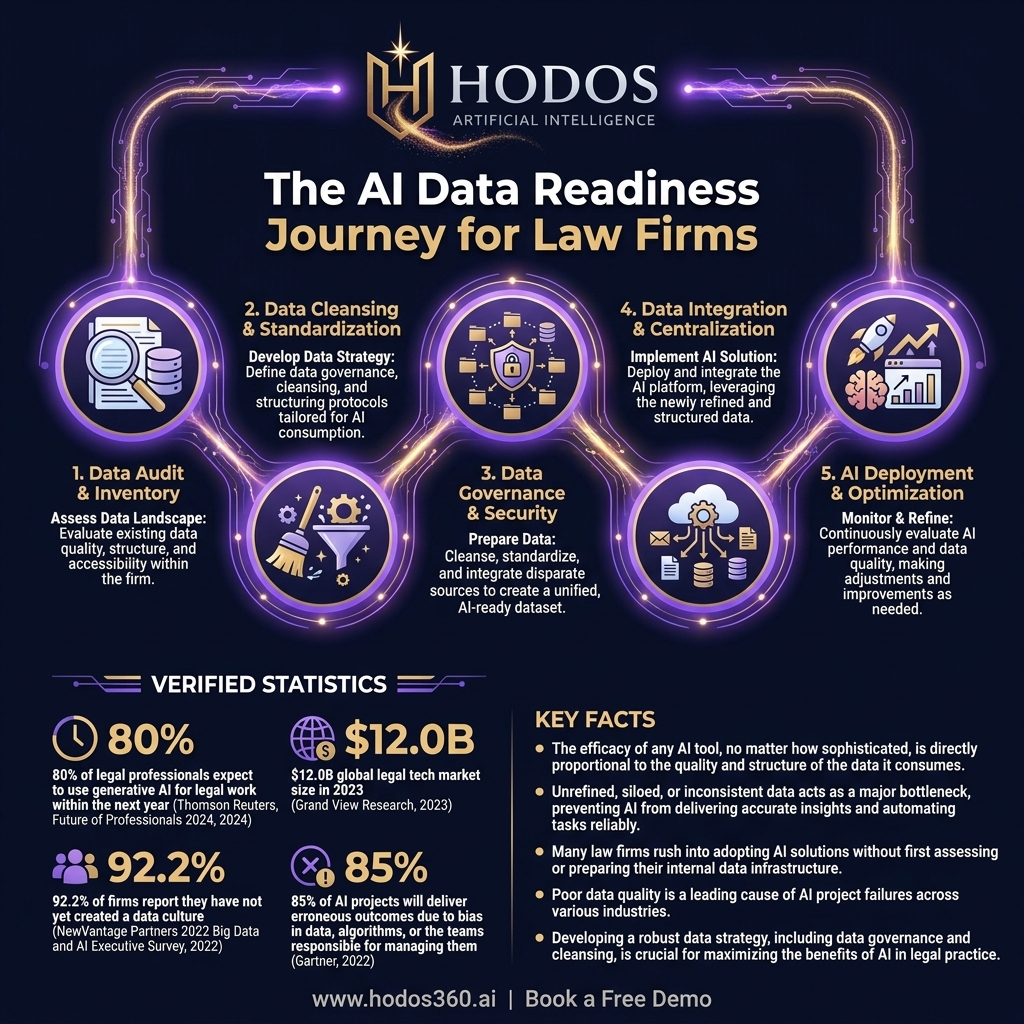
According to the 2023 ABA Legal Technology Survey Report, while 58% of lawyers believe AI will impact their practice, only a fraction report having robust data strategies in place to support it. This significant gap underscores the urgent need for a more pragmatic understanding of what data readiness truly entails for legal professionals.
At its core, data readiness for the legal sector involves several key pillars. First, data quality: ensuring accuracy, completeness, and consistency across all datasets. This includes cleaning up redundant, outdated, or erroneous information that can skew AI outputs. Second, data accessibility: breaking down silos that trap valuable information in isolated systems.
Many firms struggle with client data in CRM, case data in practice management software, and document data in separate repositories. Learn more about Legal AI Adoption: An Essential Roadmap for Law Firms. Third, data governance: establishing clear policies for data collection, storage, usage, and security.
This is crucial for compliance with regulations like GDPR, CCPA, and ethical guidelines, especially when leveraging AI for sensitive legal tasks. Lastly, data structure: transforming unstructured text (e.g., emails, PDFs) into formats that AI can easily process and analyze. This often involves metadata tagging, categorization, and standardization.
Harvey AI, a generative AI startup, has seen rapid adoption by global firms like Allen & Overy, partly because these firms recognized the need for structured, high-quality input to maximize the platform's utility. Their partnership success highlights that even the most advanced AI benefits immensely from a well-prepared data environment.
Neglecting these fundamental aspects of data readiness is akin to trying to build a skyscraper on a shaky foundation. The result will inevitably be instability and eventual collapse, no matter how impressive the architectural plans. Firms must proactively invest in understanding and improving their data landscape to unlock the true transformative power of AI.
Unlock the full potential of your firm’s data for AI. Explore HODOS 360’s AI Law Firm Management System and AI Marketing Platform. Learn more about AI Web Development: Ultimate Guide to Law Firm Lead Generation. [Learn More About HODOS 360]
Strategizing for Success: Building Your Firm's AI-Ready Data Architecture
Building an AI-ready data architecture is a strategic imperative, not merely an IT project. It requires a holistic approach that integrates technology, process, and people. Firms that are ready for AI systematically address their data challenges rather than patching them reactively. A key starting point is a comprehensive data audit to identify existing data sources, assess their quality, and pinpoint areas of fragmentation.
This audit should evaluate everything from client intake forms and billing records to historical case documents and internal knowledge bases. Without a clear picture of your data landscape, any attempt at AI integration will be a shot in the dark.
### Addressing Data Silos and Legacy Systems One of the most significant hurdles for law firms is the prevalence of data silos—information trapped in separate, often incompatible, systems.
A typical firm might have client data in an outdated CRM, case files on a network drive, billing data in another system, and communications scattered across email archives. This fragmentation makes it nearly impossible for AI to glean comprehensive insights or automate multi-step workflows. Modern legal tech, such as an integrated AI Law Firm Management System, offers solutions to consolidate these disparate data points, creating a connected and unified data environment.
Learn more about Wordsmith AI's $100M Valuation: An Essential LegalTech Milestone. This consolidation is crucial for AI tools to function effectively, allowing them to access a broader, more coherent dataset for analysis and automation. Firms must prioritize migrating data from legacy systems and establishing protocols for new data to be entered into a centralized, structured database.
### Implementing Robust Data Governance and Quality Protocols Beyond consolidation, establishing strong data governance is paramount. This involves defining who is responsible for data quality, how data is classified and stored, and what security measures are in place. Thomson Reuters' 2024 Future of Legal Report emphasized that data governance is no longer optional but a core component of risk management and competitive advantage.
Firms must develop clear policies for data entry, ensuring consistency in naming conventions, metadata tagging, and categorization. Regular data cleansing processes are also essential to remove duplicates, correct errors, and update outdated information. This continuous commitment to data quality ensures that the AI systems are always learning from the most accurate and reliable information, thereby enhancing their output and fostering trust among legal professionals.
Unlocking Growth: Data Readiness for AI Marketing & Client Acquisition
The impact of data readiness extends far beyond internal operations; it is a game-changer for a law firm's growth and client acquisition strategies. In an increasingly competitive legal market, understanding potential clients and tailoring outreach efforts is critical. AI Marketing Platforms, for instance, can analyze vast amounts of market data, competitor activity, and client demographics to identify high-potential leads and optimize marketing campaigns.
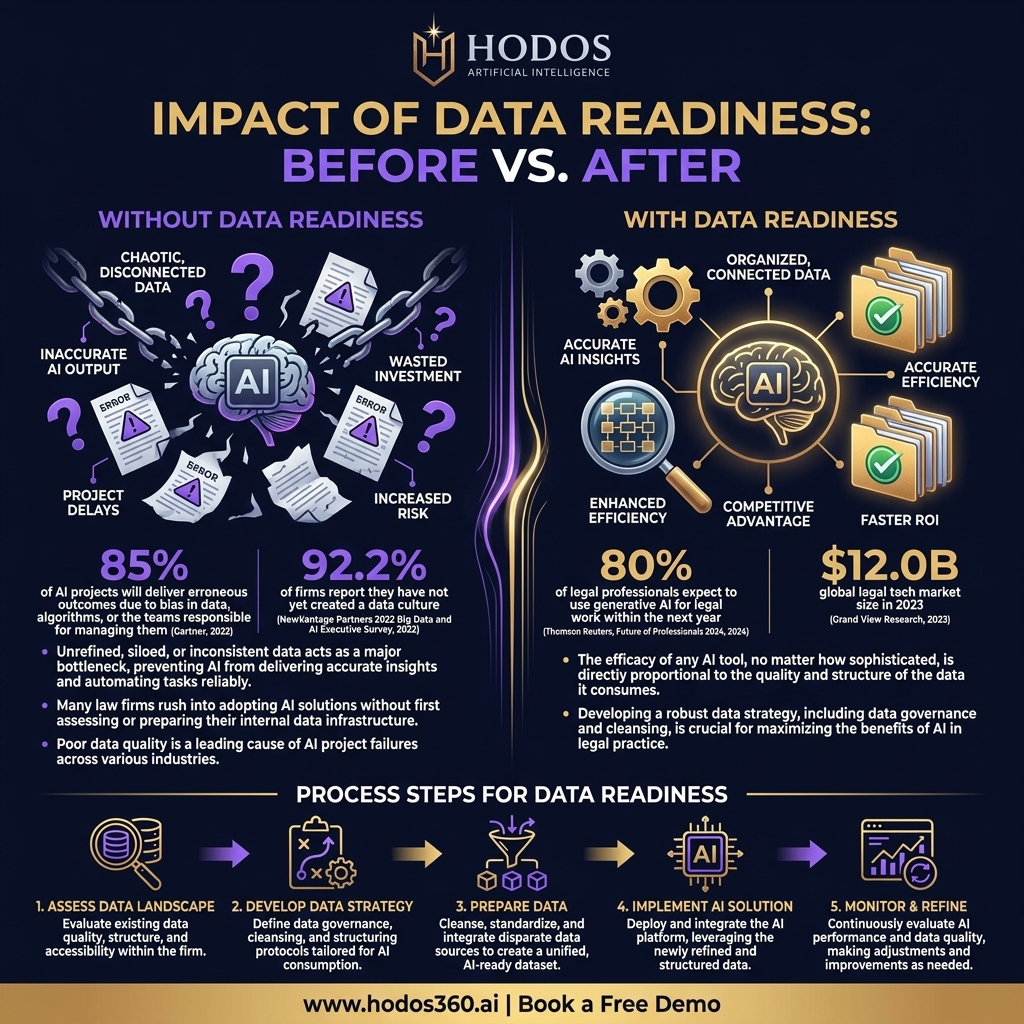
However, the effectiveness of these platforms is entirely dependent on the quality and structure of the underlying marketing data—from website analytics and social media engagement to past client interactions and referral sources.
Without clear, connected marketing data, AI-powered tools struggle to generate meaningful insights. For example, if a firm's website analytics are not properly integrated with its CRM, or if client engagement data from email campaigns is siloed, an AI marketing platform cannot accurately track ROI or personalize outreach.
This is a common problem for many companies in the legal sector. Gartner predicts that by 2026, organizations that have successfully operationalized AI governance will see their AI models generate 50% more business value than those that haven't. For law firms, this translates directly into more effective lead qualification, targeted content generation, and ultimately, a stronger client pipeline.
Learn more about Voice AI: Ultimate Competitive Landscape for Law Firms. Firms must ensure that their marketing data is not only collected but also organized and integrated in a way that AI can leverage for predictive analytics and personalized client journeys.
### Leveraging AI-Powered Analytics for Client Insights The true power of data readiness in marketing lies in its ability to enable AI to deliver predictive insights.
Imagine an AI Marketing Platform that can predict which potential clients are most likely to convert based on their online behavior and firm interactions, or identify emerging legal trends that present new service opportunities. This requires granular, well-structured data on past client successes, industry-specific pain points, and effective communication channels.
By feeding an AI system with high-quality, segmented data, law firms can move beyond generic marketing campaigns to highly personalized, data-driven outreach. This not only enhances the client experience but also significantly boosts the firm's marketing ROI, making every dollar spent more effective. The ability to forecast client needs and adapt marketing strategies in real-time is a powerful competitive advantage that only firms with robust data readiness can truly achieve.
The Competitive Edge: Future-Proofing Your Law Firm with Data-Driven AI
In an era of rapid technological advancement, data readiness is no longer a luxury but a fundamental necessity for law firms aiming to maintain a strategic competitive edge. The firms that are actively investing in their data infrastructure today are the ones poised to dominate the legal landscape tomorrow.
Consider the insights from Sam Altman, CEO of OpenAI, who often emphasizes that the future of AI is not just about raw computational power, but about the quality and breadth of data it can access. For law firms, this means that those with superior, well-governed data will naturally achieve superior outcomes from their AI tools, whether for legal research, document review, or client management.
This isn't merely about efficiency; it's about building a future-proof practice. Firms that have embraced data readiness are better equipped to adapt to evolving legal demands, regulatory changes, and client expectations. For instance, the enforcement of the EU AI Act will place significant emphasis on data quality and transparency in AI systems, pushing firms to prioritize these aspects even further.
Learn more about Voice AI: An Essential Leap for Law Firms' Client Engagement. Firms with a strong data foundation can more easily pivot to new AI applications, leverage emerging technologies, and continuously optimize their legal workflows. This proactive stance ensures that they are not just reacting to market changes but actively shaping their future, attracting top talent, and securing high-value clients who increasingly expect tech-forward legal services.
Ultimately, the firms that master data readiness will be the ones that effectively bridge the gap between AI's potential and its practical application. They will be the companies that avoid the common pitfalls of AI adoption, transforming initial investments into tangible returns. This strategic advantage extends beyond operational efficiency to encompass enhanced client satisfaction, improved risk management, and the ability to innovate at a pace unmatched by their less data-prepared counterparts.
The commitment to data readiness today is a direct investment in the long-term viability and success of the law firm in a rapidly evolving digital world.

Empowering Your Firm: Actionable Steps for Data Readiness
The journey to data readiness for AI is multifaceted but actionable. Law firms can start by conducting a comprehensive data inventory, mapping out all data sources, formats, and current storage methods. This initial step is critical for understanding the scope of the challenge and identifying immediate areas for improvement.
Following the inventory, prioritize data cleansing and standardization, focusing on high-impact areas like client intake forms and core case management data. Establishing a cross-functional data governance committee, involving partners, IT, and administrative staff, can ensure buy-in and consistent implementation of new data protocols. Remember, this is an ongoing process, not a one-time fix.
Leveraging integrated legal tech tools is also crucial. Platforms like HODOS 360, with its AI Law Firm Management System and AI Marketing Platform, are designed to centralize and structure data, making it inherently more ready for AI. These systems can automate data collection, enforce consistent data entry, and provide a unified view of client and case information, significantly reducing data silos.
Investing in such platforms helps firms build a robust digital backbone that supports current and future AI initiatives, ensuring that their data is always clear, connected, and optimized for performance. By taking these proactive steps, law firms can confidently move from merely contemplating AI to successfully implementing it, transforming their operations and securing a competitive future.
Frequently Asked Questions
What is data readiness in the context of law firms and AI?+
Data readiness for law firms means having high-quality, structured, accessible, and well-governed data that AI systems can effectively process and analyze. It involves cleaning, organizing, and standardizing diverse legal data (e.g., case files, client communications, billing records) to ensure AI tools deliver accurate insights and reliable automation, avoiding the 'garbage in, garbage out' problem.
Why is data readiness more critical than just acquiring AI tools?+
Acquiring AI tools without data readiness is like buying a high-performance car without fuel or proper roads. AI algorithms are only as effective as the data they consume. Poor or unorganized data leads to inaccurate results, unreliable automation, and wasted investment. Data readiness ensures AI can operate at its full potential, providing genuine value and a return on investment for law firms.
What are common data challenges preventing AI adoption in law firms?+
Common challenges include data silos (information trapped in disparate systems), legacy data in unstructured formats (e.g., scanned PDFs, handwritten notes), inconsistent data entry, lack of clear data governance policies, and concerns over data security and client confidentiality. These issues make it difficult for AI to access, interpret, and learn from the firm's collective knowledge.
How can law firms begin to improve their data readiness?+
Firms should start with a comprehensive data audit to identify sources and quality issues. Then, focus on data cleansing, standardization, and consolidation. Implementing robust data governance policies, migrating from legacy systems, and adopting integrated legal tech platforms that centralize and structure data are crucial steps. Continuous data quality monitoring is also essential.
What role does data readiness play in AI marketing for law firms?+
For AI marketing, data readiness enables platforms to analyze client demographics, engagement, and market trends accurately. Well-structured data from CRMs, website analytics, and past campaigns allows AI to personalize outreach, identify high-potential leads, and track ROI effectively. Without it, AI marketing efforts will be generic and less impactful, hindering client acquisition and growth.