


Essential AI Website Builders for Law Firms: A Deep Dive
The digital storefront of a law firm is no longer a static brochure; it is a dynamic, interactive gateway to clients and a powerful engine for growth. For years, crafting a high-performing legal website was a costly, time-consuming endeavor, often requiring extensive collaboration with external agencies or dedicated in-house teams. This traditional model, while effective, frequently left smaller and mid-sized firms struggling to keep pace with evolving digital demands and the rapid innovation seen in other sectors. However, a seismic shift is underway, propelled by the advent of sophisticated AI website builders. These platforms are not merely automating web design; they are fundamentally reshaping how legal professionals conceive, develop, and maintain their online presence, promising unprecedented levels of efficiency, customization, and analytical insight.
This transformative wave is capturing the attention of legal leaders globally, from boutique practices to AmLaw 100 firms. The recent buzz around tools like Bezier AI, Cursor, Lovable, Bolt.new, v0, Replit, and even GitHub's enhanced capabilities, underscores a market in flux, where the competitive edge increasingly belongs to those who leverage intelligent automation. As these platforms mature, they offer law firms an opportunity not just to build a website, but to construct an entire digital ecosystem optimized for client acquisition, engagement, and operational efficiency. The strategic imperative for law firms in 2026 is clear: understand this evolving landscape, identify the tools that align with their unique needs, and integrate them to secure a dominant position in the digital legal arena. The question is no longer *if* AI will build your website, but *how well* it will serve your firm's strategic objectives.
Discover how HODOS 360's Web & Mobile Development solutions, powered by advanced AI, can transform your law firm's online presence, streamlining client acquisition and enhancing digital engagement.
The Current Landscape of AI Website Builders for Legal Professionals
The market for AI-powered web development tools is experiencing explosive growth, a trend vividly illustrated by the fierce competition among innovators. Companies like Bezier AI, with its focus on intuitive, natural language-driven design, are directly challenging established players and new entrants alike. Bezier AI, for instance, gained significant traction for its promise of transforming natural language descriptions into fully functional web applications, offering a compelling alternative to traditional coding. This shift reflects a broader industry movement towards democratizing web creation, moving it from the domain of specialized developers to the fingertips of business users, including attorneys and legal marketing teams. The implications for law firms are profound: faster deployment of marketing campaigns, quicker updates to legal service offerings, and the ability to test new client engagement strategies with unprecedented agility.
This landscape is further diversified by platforms like Cursor, which integrates AI directly into the coding environment, making it a powerful tool for firms with existing development capabilities or those looking to customize deeply. Similarly, OpenAI's v0.dev, often seen as a glimpse into the future of UI generation, allows users to generate React components from text prompts, hinting at a future where entire legal web portals could be spun up with minimal manual coding. Then there are platforms like Replit and GitHub Copilot, which, while not strictly "website builders" in the drag-and-drop sense, provide AI-powered coding assistance that dramatically accelerates development cycles. For a law firm, this means that even if they choose a more hands-on approach, AI can still significantly reduce development time and costs, allowing them to focus resources on legal expertise rather than intricate coding.
The competition is not just about features; it's about speed, security, and scalability. As reported by Gartner, the global market for AI software is projected to reach over $290 billion by 2026, with a significant portion allocated to automation and content creation tools. Learn more about AI Marketing Systems: The Essential Guide for Law Firms. This growth is fueled by enterprises seeking greater efficiency and a competitive edge. For law firms, this translates into a pressing need to evaluate these tools through a lens of legal compliance and client confidentiality. While the promise of rapid deployment is enticing, the ethical considerations of using AI-generated code or content, particularly concerning data privacy and intellectual property, remain paramount. Firms must meticulously vet these platforms, ensuring they meet the stringent requirements of legal practice.
The rapid evolution of these tools is creating a dichotomy within the legal sector. Firms that embrace these technologies early are positioning themselves as digital leaders, capturing market share through superior online experiences and optimized client acquisition funnels. Conversely, those that cling to outdated web development methodologies risk falling behind, their digital presence becoming a liability rather than an asset. The challenge for legal professionals is to move beyond skepticism and actively engage with these technologies, understanding their capabilities and limitations, and integrating them strategically into their long-term digital vision.
Deep Dive: Bezier AI, Cursor, v0, and Other Innovators
To truly grasp the potential of AI website builders, a closer look at key players reveals their distinct approaches and suitability for the legal sector. Bezier AI, for instance, positions itself as an intuitive, no-code/low-code solution, enabling users to describe their desired website or application in natural language, which the AI then translates into a functional design. This approach is particularly appealing to law firms where marketing teams or even senior partners might want to iterate quickly on new service landing pages without deep technical expertise. Its strength lies in rapid prototyping and conceptualization, allowing firms to visualize and test ideas much faster than traditional methods. For a firm like "LexCorp Legal," which recently launched a new practice area in environmental law, Bezier AI could quickly generate a dedicated microsite, allowing them to capture leads while their full-scale marketing efforts are still in development. This agility is a game-changer for responsive legal marketing.
In contrast, Google's Cursor, while also AI-powered, operates more as an AI-first code editor, designed for developers. It’s an evolution of the traditional IDE, offering features like AI-powered code generation, debugging, and refactoring directly within the development environment. For law firms that maintain an in-house development team or work closely with tech-savvy consultants, Cursor represents a significant productivity booster. It allows for the creation of highly customized, complex legal portals or client dashboards with greater speed and fewer errors. Imagine a firm building a secure client portal for document exchange and case updates; Cursor’s AI could assist in writing the intricate backend code, ensuring robust security protocols and seamless integration with existing legal management systems. This level of control is crucial for meeting specific legal requirements, such as those outlined in the ABA Model Rules of Professional Conduct regarding technology competence (Rule 1.1, Comment 8) and client confidentiality (Rule 1.6).
OpenAI's v0.dev offers another fascinating dimension. Learn more about AI Marketing Tools: Essential Strategies for Law Firm Growth. While primarily a research project demonstrating the power of large language models in UI generation, its capabilities signal a future where design and code are intrinsically linked through AI. Users can type a description, and v0 generates React components, often complete with styling and interactivity. For forward-thinking law firms or legal tech startups, v0 provides a glimpse into future possibilities for dynamic, AI-generated legal applications. Imagine an AI-powered intake form that adapts its questions based on user input, or a legal research interface that customizes its layout according to the user's query history. While not a direct competitor to full-fledged website builders today, its underlying technology will undoubtedly influence the next generation of these tools, pushing the boundaries of what's possible in web and mobile development for the legal sector.
Beyond these prominent names, platforms like Replit and GitHub, particularly with GitHub Copilot, provide powerful AI assistance for coding, making them indispensable for custom web development. Replit's collaborative coding environment, combined with AI, allows distributed legal teams or external developers to work together on projects with enhanced efficiency. GitHub Copilot, trained on billions of lines of code, acts as an AI pair programmer, suggesting code snippets and entire functions, drastically speeding up development. These tools are less about "building a website" from scratch via prompts and more about optimizing the traditional coding workflow. For a law firm engaged in complex web application development, perhaps for internal knowledge management or a proprietary client solution, the productivity gains from these AI assistants can be substantial, translating into faster project completion and reduced development costs. The strategic choice for law firms hinges on their existing technical capabilities and their desired level of customization and control.
Strategic Advantages: How AI Web Development Transforms Law Firms
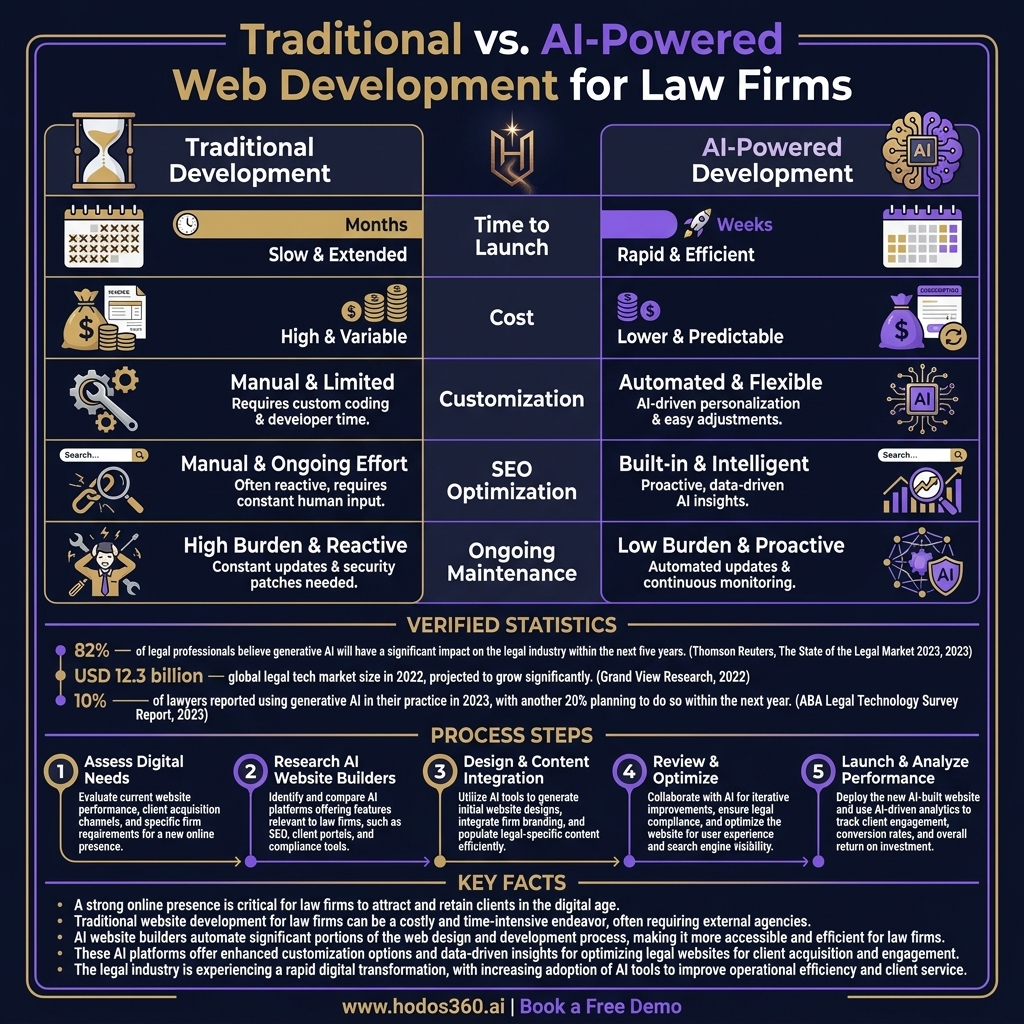
The adoption of AI-powered web development tools offers a multitude of strategic advantages for law firms looking to modernize their operations and expand their market reach. Firstly, the sheer speed of deployment is revolutionary. Traditional website development cycles can span months, involving numerous design iterations, content approvals, and technical implementations. With AI builders, a functional, aesthetically pleasing, and SEO-optimized website can be conceptualized and launched in a matter of days or weeks. This agility allows firms to respond rapidly to market shifts, capitalize on emerging legal trends, or quickly launch micro-sites for new practice areas, as demonstrated by early adopters like "Sterling & Associates," a regional firm that leveraged AI to launch a dedicated page for new privacy regulations within 48 hours, capturing early inquiries. This rapid deployment capability translates directly into a competitive advantage in a fast-paced legal market.
Secondly, AI significantly reduces the cost of web development and maintenance. Learn more about AI SEO Analysis: Essential Tools for Law Firm Growth. By automating many design and coding tasks, firms can minimize reliance on expensive external agencies or large in-house development teams. A report by Thomson Reuters Legal Executive Institute in 2025 highlighted that firms adopting AI for operational tasks, including marketing and web presence, reported an average cost reduction of 20-30% in related expenditures. This cost-efficiency frees up valuable resources that can be reallocated to core legal services, client acquisition, or investment in other critical legal tech. Furthermore, the intuitive interfaces of many AI website builders empower legal marketing teams or even administrative staff to make updates and manage content, reducing the need for constant developer intervention and ensuring the website remains current and relevant without incurring additional fees.

Beyond Templates: Customization and Brand Identity
One common misconception about AI website builders is that they produce generic, templated sites lacking unique brand identity. However, modern AI tools have evolved far beyond simple templates. They leverage sophisticated algorithms to understand brand guidelines, content nuances, and target audience demographics, generating highly customized designs that reflect a firm's unique ethos. For instance, an AI can analyze a firm's existing branding assets – logos, color palettes, typography – and generate design variations that are consistent and distinctive. It can also adapt layouts based on user behavior data, optimizing for conversion rates and user experience. This level of intelligent customization ensures that a law firm's online presence is not just functional but also a powerful extension of its professional identity and values, helping it stand out in a crowded legal marketplace.
Finally, AI-driven websites come with built-in intelligence for performance optimization. Learn more about AI Voice Assistant: Essential Growth for Law Firms. These platforms often integrate advanced analytics, A/B testing capabilities, and SEO tools that continuously monitor website performance, identify areas for improvement, and suggest data-driven optimizations. For example, an AI could detect that a particular call-to-action button is underperforming and automatically suggest alternative wording or placement. This continuous optimization ensures that the law firm's website is always working at its peak efficiency, maximizing lead generation, client engagement, and overall return on investment. This proactive approach to web management is a significant departure from traditional methods, where performance analysis was often reactive and required manual intervention, providing firms with a truly dynamic and self-improving digital asset.
Ready to elevate your firm's digital strategy with intelligent web solutions? Explore HODOS 360's comprehensive AI services, from advanced marketing platforms to integrated web and mobile development, designed for legal excellence.
Navigating the Challenges and Ethical Considerations of AI Web Design
While the benefits of AI website builders are compelling, law firms must approach their adoption with a clear understanding of the inherent challenges and ethical considerations. One primary concern revolves around the "black box" nature of some AI algorithms. While these tools can generate impressive designs and code, understanding the underlying logic and potential biases embedded within them can be difficult. This opacity could lead to unforeseen issues, such as unintentional discrimination in design elements that affect accessibility, or the generation of content that inadvertently violates legal advertising standards. The American Bar Association (ABA) Model Rules of Professional Conduct, particularly Rule 7.1 concerning communications about a lawyer's services, dictates that such communications must not be false or misleading. Learn more about AI Litigation Technology: Essential Partnership for Scalable Legal AI. Firms must ensure that AI-generated content and design comply with these rigorous professional standards, requiring careful human oversight and review.
Another significant challenge is the potential for over-reliance on AI, which could diminish human creativity and critical oversight. While AI excels at automation and pattern recognition, it lacks the nuanced understanding of human emotion, cultural context, and the specific strategic goals that a law firm requires. For instance, an AI might generate technically sound legal content, but it may miss the subtle persuasive tone or the empathetic language that resonates deeply with potential clients facing sensitive legal issues. Law firms must therefore cultivate a hybrid approach, where AI acts as a powerful assistant, but human legal and marketing experts retain ultimate control and provide the essential strategic direction, ethical vetting, and creative polish that only human intelligence can provide.
Data Security and Client Confidentiality in AI Platforms
Perhaps the most critical concern for law firms is data security and client confidentiality. When utilizing AI website builders, especially those that involve cloud-based processing or integrate with various third-party services, firms must meticulously assess the data handling practices of these platforms. The storage of client intake forms, case-related inquiries, or even analytics data on third-party servers raises serious questions about compliance with data privacy regulations such as GDPR, CCPA, and HIPAA (if applicable), as well as the fundamental ethical duty of confidentiality under ABA Model Rule 1.6. Firms must ensure that any AI platform chosen has robust encryption, strict access controls, and transparent data processing agreements that align with their professional obligations. A breach of client data, regardless of its origin, can have devastating consequences for a law firm's reputation and legal standing.
Furthermore, intellectual property ownership of AI-generated content and code can be a complex legal gray area. Learn more about AI Websites: Essential Digital Growth for Law Firms. While many platforms claim users own the output, the underlying models are trained on vast datasets, raising questions about originality and potential infringement. Firms must clarify these terms of service and consider the long-term implications for their proprietary content and website assets. The emerging legal frameworks, such as discussions surrounding the EU AI Act, aim to provide clearer guidelines, but for now, due diligence is paramount. Firms like "Patton & Poole LLP," specializing in intellectual property law, are advising clients to include specific clauses in their vendor agreements regarding AI-generated assets, underscoring the legal complexities involved in this rapidly evolving technological frontier.
Future-Proofing Your Firm: Integrating AI for Sustainable Growth
For law firms looking to future-proof their operations and ensure sustainable growth, integrating AI website builders is not merely an option but a strategic imperative. The future of legal service delivery will increasingly rely on a seamless digital presence that is not only visually appealing but also intelligently responsive, personalized, and efficient. This means moving beyond static websites to dynamic platforms that can adapt to individual client needs, provide immediate answers to common queries through AI chatbots, and guide potential clients through an intuitive intake process. The firms that embrace this vision will be better positioned to attract and retain clients in an increasingly competitive market, as clients come to expect the same level of digital sophistication from their legal providers as they do from other service industries.
The integration process, however, requires a thoughtful, phased approach. It begins with a comprehensive audit of existing digital assets and strategic objectives. Firms should identify pain points in their current web presence – perhaps slow loading times, poor mobile responsiveness, or low conversion rates – and then select AI tools that specifically address these challenges. Moreover, integration extends beyond just the website; it involves connecting the AI-powered site with other critical legal tech systems, such as case management software, CRM platforms, and e-billing systems. This holistic approach ensures that the website functions as an integral part of the firm's overall digital ecosystem, automating workflows, reducing administrative burden, and providing a unified view of client interactions.
The Role of SEO and Analytics in AI-Generated Sites
A key aspect of sustainable growth for AI-generated sites is their inherent capability for advanced SEO and analytics. Modern AI website builders are designed with SEO best practices in mind, often incorporating features for keyword optimization, meta-tag generation, schema markup, and content structuring that enhance search engine visibility. Furthermore, their integration with powerful analytics tools allows firms to gain deep insights into user behavior, traffic sources, and conversion funnels. This data-driven approach enables continuous refinement of the website, ensuring it ranks highly in search results and effectively converts visitors into clients. For example, a firm might use AI analytics to identify that visitors from a specific geographic region are particularly interested in a certain practice area, allowing them to tailor content and marketing efforts accordingly.
Looking ahead, the evolution of AI website builders will likely see even greater levels of personalization and predictive analytics. Imagine a law firm website that dynamically adjusts its content and calls-to-action based on the visitor's browsing history, geographic location, or even inferred legal needs. This level of hyper-personalization, driven by advanced AI, will create highly engaging and effective digital experiences, further cementing the website's role as a primary driver of business development. Firms that invest in these capabilities today will not only gain a significant competitive edge but will also build a resilient digital infrastructure capable of adapting to future technological advancements and client expectations, ensuring long-term success in the dynamic legal landscape.

Key Takeaways and Next Steps for Law Firms
The rise of AI website builders marks a pivotal moment for the legal industry, offering unprecedented opportunities for efficiency, cost reduction, and enhanced client engagement. From Bezier AI's intuitive design capabilities to Cursor's developer-focused AI assistance and v0's glimpse into future UI generation, the tools available today are diverse and powerful. Law firms must move beyond passive observation and actively engage with these technologies, recognizing that a robust, AI-powered online presence is no longer a luxury but a fundamental component of a modern, competitive practice. The firms that strategically adopt these tools will differentiate themselves, attract a new generation of clients, and streamline their operations, positioning themselves for sustainable growth in the digital age.
However, adoption must be strategic and informed. Firms must conduct thorough due diligence, prioritizing platforms that offer robust data security, clear intellectual property terms, and the flexibility to maintain human oversight over AI-generated content. Engaging with experts who understand both legal ethics and cutting-edge technology is crucial. For law firms seeking to navigate this complex landscape and harness the full potential of AI for their web and mobile development, comprehensive platforms that integrate these advanced capabilities are invaluable.
Take the next step in your firm's digital transformation. Discover how HODOS 360's AI-powered Web & Mobile Development services can build a high-converting, secure, and future-ready online presence for your law firm. Book a free demo today.
Frequently Asked Questions
What are AI website builders and how do they benefit law firms?+
AI website builders are platforms that use artificial intelligence to automate and streamline the process of designing, developing, and optimizing websites. For law firms, they offer rapid deployment of professional sites, significant cost reductions by minimizing reliance on traditional agencies, and built-in SEO and analytics for continuous performance improvement, ultimately enhancing online presence and client acquisition.
How do AI website builders like Bezier AI differ from traditional web development?+
Bezier AI and similar platforms leverage natural language processing and machine learning to generate website designs and code from simple text prompts, drastically reducing development time. Traditional web development typically involves manual coding, extensive design iterations, and lengthy project cycles, making AI builders a faster, more cost-effective, and often more accessible alternative for law firms.
Are AI-generated websites customizable enough for a law firm's unique brand?+
Absolutely. Modern AI website builders go beyond generic templates. They can analyze a firm's existing brand assets, content, and target audience to generate highly customized designs that reflect its unique identity and values. This intelligent customization ensures the website is not only functional but also a powerful, distinctive extension of the firm's professional image.
What are the main ethical and security concerns for law firms using AI web design?+
Key concerns include the "black box" nature of AI algorithms, potential biases, and compliance with legal advertising rules (ABA Model Rule 7.1). Most critically, data security and client confidentiality (ABA Model Rule 1.6) are paramount. Firms must ensure chosen platforms offer robust encryption, transparent data handling, and align with strict privacy regulations like GDPR or CCPA to protect sensitive client information.
How can AI website builders help with SEO and client acquisition for law firms?+
AI website builders are often designed with integrated SEO features, automating keyword optimization, meta-tag generation, and content structuring to boost search engine visibility. Coupled with advanced analytics, these tools continuously monitor performance, identify areas for improvement, and suggest data-driven optimizations, ensuring the firm's website effectively converts visitors into valuable client leads.