
GenAI Governance: Essential Frameworks for Law Firms
The legal profession, often seen as a bastion of tradition, is currently navigating an unprecedented wave of technological disruption fueled by generative AI (GenAI). Just last year, the legal community watched in dismay as attorney Steven Schwartz faced sanctions in *Mata v. Avianca, Inc.* for submitting a brief replete with fictitious case citations generated by ChatGPT.
This widely publicized incident wasn't merely a cautionary tale about unchecked AI use; it starkly illuminated a fundamental truth: the burgeoning GenAI governance gap in law firms.
Indeed, a recent Thomson Reuters article, aptly titled "The GenAI governance gap: Why current law firm policies fall short," underscored this critical oversight.
The piece highlighted how many existing firm policies, drafted in a pre-GenAI era, are woefully inadequate for the complex ethical, data privacy, and professional responsibility challenges posed by sophisticated AI tools. This isn't just about avoiding public embarrassment; it's about maintaining client trust, ensuring regulatory compliance, and upholding the very integrity of legal practice.
As managing partner Sarah Chen of a prominent AmLaw 100 firm recently remarked at LegalTech NYC 2026, "We're past the point of asking *if* AI will impact us; the question now is *how* we govern its use responsibly to harness its power without sacrificing our core values."
The imperative is clear: law firms must move beyond piecemeal reactions and develop comprehensive, forward-looking frameworks. Discover how your firm can build a resilient AI governance strategy now.
The Perilous Landscape: Why Current Law Firm Policies Fall Short
The speed at which generative AI has evolved has caught many legal institutions off guard. While companies like OpenAI, led by CEO Sam Altman, and Anthropic, co-founded by Dario Amodei with a strong emphasis on AI safety, push the boundaries of what's possible, law firms have struggled to keep pace with policy development.
The Thomson Reuters report vividly details this disconnect, noting that "few law firm policies govern which cognitive functions lawyers can safely delegate to AI and which must remain exclusively done by humans." This ambiguity creates a dangerous vacuum, where individual lawyers might experiment with powerful generative tools without a clear understanding of the associated risks to client confidentiality, data integrity, or the ethical practice of law.
The result can be catastrophic, as seen in the *Mata v. Avianca* case, where a lack of proper oversight led to the submission of fabricated legal research, resulting in judicial condemnation and severe professional repercussions.
Many firms initially reacted to GenAI's emergence with outright bans, viewing it as an uncontrollable risk.
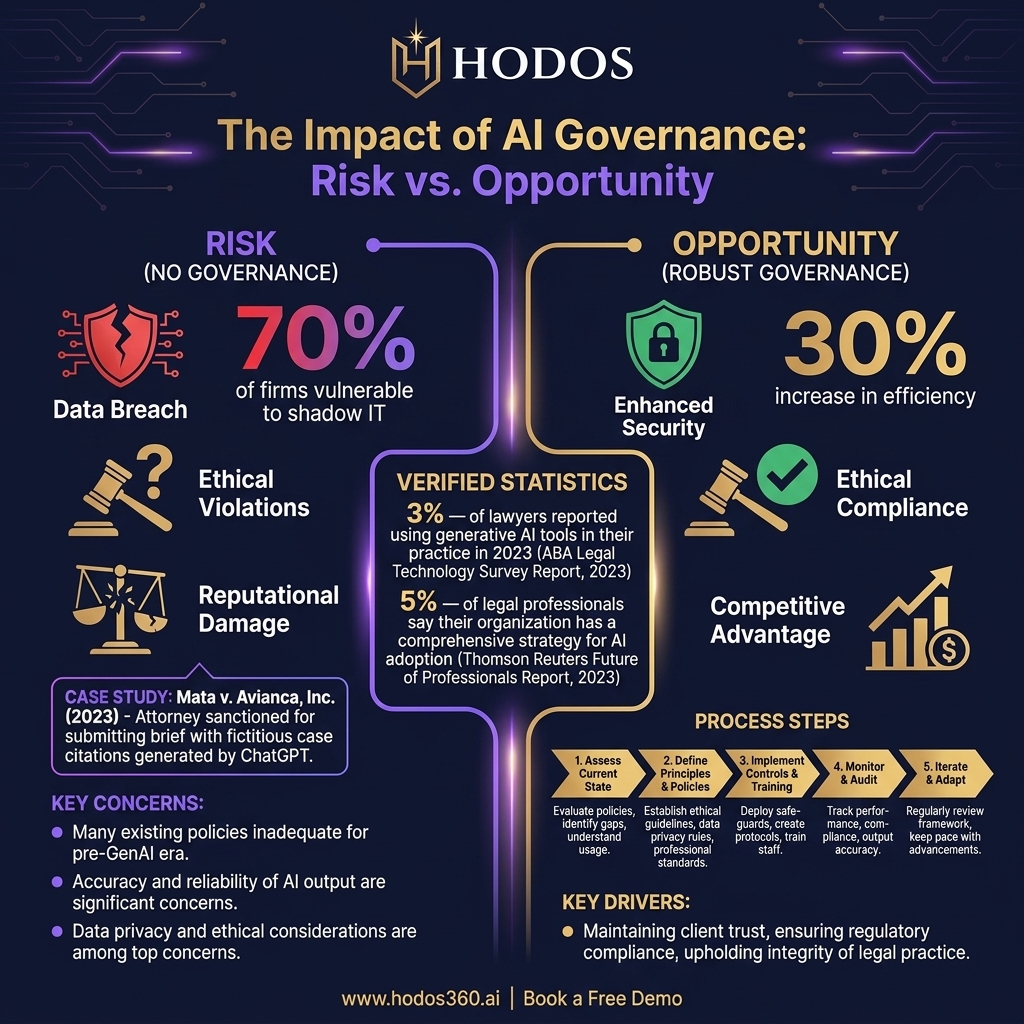
However, this approach, while seemingly cautious, often proves counterproductive. As the 8am Legal Industry Report highlighted last year, "Banning generative AI was the worst decision law firms made in the last 3 years." Such bans often fail to prevent shadow IT, where lawyers, seeking efficiency or curiosity, bypass official channels to use AI tools, creating unmonitored data flows and exposing firms to unquantified risks.
Learn more about AI Marketing: Essential Legal Safeguards for Law Firms. This conflict between innovation and tradition creates internal drama, pitting tech-forward associates against cautious partners. The challenge isn't to stop the tide of AI but to channel it safely, much like a river needs well-engineered banks.
Firms must acknowledge that AI tools are now an intrinsic part of the legal ecosystem, and their responsible integration, not their prohibition, is the only sustainable path forward.
Beyond the anecdotal, concrete data underscores the urgency. A recent ABA Legal Technology Survey Report found that while over 50% of lawyers were aware of GenAI, only a fraction of their firms had updated their internal policies to specifically address its use.
This significant gap leaves firms vulnerable to ethical breaches, regulatory non-compliance, and potential malpractice claims. The core issue, as legal tech expert David Simon articulated, is that "AI decisions are falling through the cracks between business, IT, and legal." Without a unified, interdisciplinary approach to govern these powerful technologies, firms risk not only falling behind competitors but also jeopardizing their professional standing and client relationships.
The Illusion of Control: Banning vs. Embracing AI
The initial knee-jerk reaction of many law firms to ban GenAI tools created an illusion of control that quickly dissolved. While intended to safeguard client data and professional ethics, these bans often pushed AI usage underground, fostering a 'shadow IT' environment. Lawyers, driven by efficiency and the demands of their practice, began using public AI models for tasks ranging from drafting client communications to summarizing complex documents, often without firm oversight or security protocols.
This creates a far greater risk than a properly governed system, as sensitive client information could inadvertently be exposed to public models, violating attorney-client privilege and ABA Model Rule 1.6 on Confidentiality of Information.
Embracing AI, on the other hand, means establishing clear guidelines, providing robust training, and integrating AI into secure, managed workflows.
Learn more about Legal Tech Adoption: Mastering AI for Law Firms in 2026. Firms that adopt this proactive stance, such as Allen & Overy with its partnership with Harvey AI, demonstrate a commitment to innovation while prioritizing risk management. This approach acknowledges that AI, when properly governed, can enhance legal services, improve efficiency, and free up lawyers for higher-value work, rather than being an existential threat.
The key lies in understanding that effective AI governance isn't about restriction, but about strategic enablement within defined ethical and security parameters.
Crafting a Robust GenAI Governance Framework
Building an effective GenAI governance framework requires a holistic and proactive approach, moving beyond reactive policy statements. It starts with establishing a dedicated AI governance committee, comprising partners from various practice areas, IT specialists, and risk management personnel. This committee's mandate should be to continuously assess new AI technologies, evaluate their potential benefits and risks, and develop dynamic internal policies that align with legal ethics and regulatory requirements.
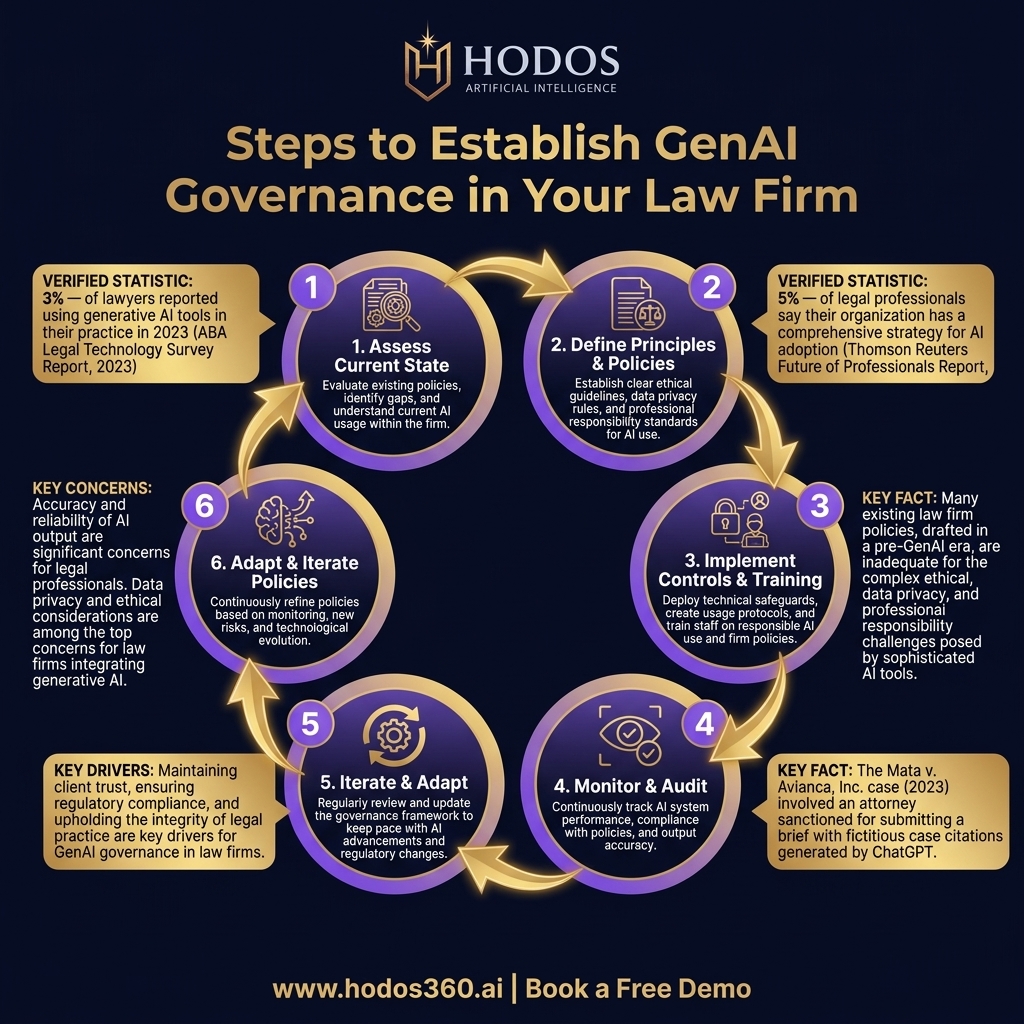
For instance, the committee should define permissible uses of AI for tasks like legal research, document review, and contract drafting, while explicitly prohibiting its use for tasks requiring independent legal judgment or client advice without human oversight. The framework must also address data residency and security protocols, ensuring that client data processed by AI tools remains within secure, firm-controlled environments, a critical aspect often overlooked with public AI models.
Furthermore, a robust framework must encompass rigorous vendor due diligence. As firms consider integrating third-party AI solutions, they must scrutinize vendors' data privacy practices, security certifications, and liability provisions. This proactive vetting helps mitigate risks associated with data breaches or AI errors originating from external providers.
Microsoft's President Brad Smith has often spoken about the shared responsibility in AI deployment, emphasizing that both developers and users have a role in ensuring ethical use. Learn more about AI Website Coding: An Essential Guide for Law Firms. Firms must demand transparency from their AI vendors regarding data handling, model training, and potential biases.
Without this level of scrutiny, firms expose themselves to significant reputational and legal harm, as the responsibility for safeguarding client information ultimately rests with the firm, irrespective of the tool used. This is particularly relevant given the increasing legal scrutiny around AI, such as the upcoming enforcement of the EU AI Act, which will impose strict requirements on high-risk AI systems.
Finally, the framework needs to be a living document, subject to regular review and updates. The pace of AI innovation dictates that a policy written today may be obsolete tomorrow. Regular audits of AI usage, performance, and compliance with internal and external regulations are essential.
This continuous feedback loop allows firms to adapt their governance strategies, incorporate lessons learned from real-world applications, and stay ahead of emerging risks. This agile approach to AI governance ensures that the firm's policies remain relevant, effective, and capable of supporting both innovation and responsible practice.
- ✓Data Security & Privacy Protocols: Implement strict rules for handling client data with AI, ensuring PII and confidential information are never exposed to public models. Mandate secure, private AI environments for sensitive tasks.
- ✓Ethical Guidelines & Responsible Use: Develop clear directives on AI's role in legal advice, prohibiting independent AI judgment. Emphasize human oversight and validation for all AI-generated outputs.
- ✓Comprehensive Training Programs: Educate all legal professionals on AI capabilities, limitations, and the firm's specific GenAI governance policies. Foster AI literacy and ethical awareness.
- ✓Vendor Due Diligence & Contractual Safeguards: Thoroughly vet AI solution providers for security, privacy, and liability. Ensure contracts include data protection clauses and audit rights.
- ✓Bias Detection & Mitigation: Establish processes to identify and address potential biases in AI tools, particularly those affecting diverse client populations or legal outcomes.
- ✓Audit Trails & Monitoring: Implement systems to track AI usage, inputs, and outputs for accountability, compliance, and ongoing performance evaluation.
- ✓AI Oversight Committee: Form an interdisciplinary committee to continuously review AI developments, update policies, and address emerging ethical and practical challenges.
Implementing Ethical AI: Training, Oversight, and Transparency
Effective GenAI governance isn't merely about drafting documents; it's about embedding a culture of ethical AI use throughout the firm. This begins with comprehensive and continuous training for all lawyers and support staff. The ABA Model Rule 1.1 on Competence now explicitly includes a duty to keep abreast of changes in the law and its practice, including the benefits and risks associated with relevant technology.
This means educating legal professionals not just on *how* to use AI tools, but *when* and *why* they should be used, emphasizing their limitations and the critical need for human review. Training should cover topics like prompt engineering for better results, identifying AI 'hallucinations,' and understanding the implications of data input on client confidentiality.
Firms like Linklaters have already invested heavily in internal AI training programs, recognizing that an informed workforce is the first line of defense against misuse.
Beyond training, robust oversight mechanisms are crucial. An AI oversight committee, as previously mentioned, serves as the firm's internal arbiter, reviewing new AI applications, setting usage parameters, and investigating any reported missteps.
This committee should regularly report to firm leadership, ensuring that AI governance remains a top strategic priority. Moreover, firms must cultivate an environment where lawyers feel comfortable reporting potential AI errors or ethical concerns without fear of reprisal. Learn more about AI Legal Startup Sandstone: Unlocking 2026's Legal Tech Future.
This transparency fosters a learning culture, allowing the firm to adapt and refine its policies in real-time. The goal is to create a safety net that catches issues before they escalate, preventing situations akin to the *Mata v. Avianca* debacle.
Transparency with clients is equally vital.
As generative AI becomes more integrated into legal workflows, clients have a right to understand how their matters are being handled and what role technology plays. Firms should develop clear communication strategies to inform clients about their AI usage policies, emphasizing the safeguards in place to protect confidentiality and ensure the accuracy of legal work.
This proactive disclosure builds trust and demonstrates a commitment to ethical practice. Firms that shy away from this transparency risk eroding client confidence and potentially facing legal challenges related to informed consent.
The Human-AI Teaming Imperative
The notion that AI will replace lawyers is largely a misconception; the reality is that AI will augment human capabilities, making the concept of 'human-AI teaming' an imperative. This collaboration means leveraging AI for its strengths—data processing, pattern recognition, and rapid drafting—while reserving critical thinking, strategic judgment, and client relationship management for human lawyers.
Legal tech luminaries often stress that the value lies not just in the AI's output, but in the human lawyer's ability to critically evaluate, refine, and apply that output within the nuanced context of a client's legal needs. This requires a shift in mindset, viewing AI as a powerful assistant rather than a fully autonomous agent.
For instance, while an AI might draft an initial contract, a human lawyer must review it for compliance with specific jurisdictional laws, client-specific clauses, and overall strategic alignment. Learn more about Agentic AI Unleashed: 2026's Power in Legal Work. The European Union's AI Act, a landmark piece of legislation, underscores this by classifying certain AI applications in legal services as 'high-risk,' necessitating robust human oversight, data quality checks, and transparency requirements.
This legislative trend reinforces the need for firms to train their legal teams not just in using AI, but in becoming expert 'AI supervisors,' ensuring that the ethical and professional responsibilities always remain firmly with the human practitioner.
Leveraging AI Management Systems for Compliance and Efficiency
In an increasingly complex legal landscape, a robust GenAI governance framework cannot exist in a vacuum; it must be supported by technological infrastructure. This is where dedicated AI law firm management systems become indispensable. These platforms are designed to not only enhance efficiency but also to embed governance and compliance directly into daily legal workflows.
Imagine a system where document automation is seamlessly integrated with AI-powered legal workflows, but with built-in safeguards: client data is anonymized before being processed by external models, AI-generated content is flagged for mandatory human review, and audit trails meticulously record every interaction with AI tools.
This level of control is crucial for managing the inherent AI risk associated with these powerful technologies.
Such systems provide a centralized hub for managing client intake, case files, billing, and document automation, all while incorporating AI responsibly. For example, an AI-powered legal research tool within a managed system can be configured to only access approved, secure legal databases, preventing the accidental use of unreliable sources.
Similarly, AI-driven contract analysis can highlight potential risks or deviations from standard clauses, empowering lawyers to make more informed decisions while ensuring that the final output is always human-vetted. Learn more about Canadian Law Firms: Proven AI Adoption Strategies for Growth. This integrated approach not only minimizes the governance gap but also transforms it into a competitive advantage, allowing firms to leverage AI's benefits without compromising ethical or professional obligations.
One such platform, HODOS 360, offers an AI Law Firm Management System that exemplifies this integrated approach. By providing tools for case management, billing, client intake, and document automation, it allows firms to build AI-powered legal workflows within a controlled environment. Its architecture is designed to support custom policies and access controls, ensuring that AI usage aligns precisely with the firm's ethical guidelines and data security requirements.
This means firms can deploy AI for tasks like initial draft generation or complex data extraction with confidence, knowing that the system facilitates compliance and maintains the necessary human oversight, transforming potential liabilities into strategic assets. This systematic integration is the future of responsible legal tech adoption, ensuring firms are not merely reacting to GenAI but proactively shaping its role in their practice.
The HODOS 360 Advantage in Governance
The HODOS 360 AI Law Firm Management System is specifically engineered to address the GenAI governance challenges faced by modern law firms. Its robust framework allows for the creation of customized AI-powered legal workflows that prioritize compliance and ethical use. For instance, firms can configure document automation to use AI for initial drafts while requiring mandatory partner review before client delivery, effectively building human oversight directly into the process.
Furthermore, its secure client intake and case management modules ensure that sensitive data handled by AI remains within a protected environment, adhering to strict confidentiality policies and regulatory standards. This proactive integration of governance features within core operational tools sets HODOS 360 apart, offering not just efficiency but peace of mind.

The Path Forward: A Strategic Imperative for Law Firms
The era of reactive AI governance in law firms is over. The "GenAI governance gap" highlighted by Thomson Reuters is not merely a technical challenge but a strategic imperative that demands immediate and comprehensive action. Firms that fail to develop robust, dynamic frameworks for managing generative AI will not only risk ethical breaches and regulatory penalties but will also fall behind in a rapidly evolving competitive landscape.
The future of legal practice belongs to those who can master the art of integrating cutting-edge technology with unwavering ethical standards, ensuring that AI serves as an enabler of justice, not a source of professional peril. This requires continuous vigilance, investment in both technology and training, and a firm-wide commitment to responsible innovation.
Ultimately, the successful adoption of GenAI hinges on a proactive, well-defined governance strategy. By embracing comprehensive frameworks that prioritize data security, ethical use, continuous training, and transparent client communication, law firms can transform potential AI risk into a powerful competitive advantage. The firms that lead in GenAI governance today will be the ones that thrive tomorrow, delivering superior legal services, attracting top talent, and maintaining the trust that is the bedrock of the legal profession.
Don't let your firm be defined by the governance gap; instead, lead the way in responsible AI adoption. Learn more about securing your firm's future with advanced AI solutions.
Frequently Asked Questions
What is the GenAI governance gap in law firms?+
The GenAI governance gap refers to the inadequacy of existing law firm policies to address the unique ethical, data privacy, and professional responsibility challenges posed by generative AI tools. Many current policies were drafted before GenAI's widespread adoption, leaving firms vulnerable to misuse, data breaches, and ethical missteps due to a lack of specific guidelines for these powerful technologies.
Why is a robust GenAI governance framework essential for law firms?+
A robust GenAI governance framework is essential to mitigate risks like client data exposure, AI 'hallucinations' leading to inaccurate legal work, and ethical breaches. It ensures compliance with professional rules (e.g., ABA Model Rules), protects client confidentiality, maintains firm reputation, and allows for the safe and efficient integration of AI to enhance legal services and competitive advantage.
What are the key components of an effective AI governance framework?+
Key components include establishing a dedicated AI governance committee, implementing strict data security and privacy protocols for AI use, developing clear ethical guidelines for responsible AI application, conducting thorough vendor due diligence for third-party tools, providing continuous training for legal professionals, and establishing audit trails and monitoring mechanisms for AI interactions. It must be a living document.
How can law firms overcome the challenge of 'shadow IT' with AI?+
Overcoming 'shadow IT' involves moving beyond outright bans and instead providing secure, firm-sanctioned AI tools and comprehensive training. Firms should educate lawyers on approved AI uses and the risks of unapproved tools, fostering a culture of transparency where staff feel comfortable using and reporting on AI within a governed framework. Integrated AI management systems also help channel usage into compliant workflows.
What role do AI law firm management systems play in GenAI governance?+
AI law firm management systems integrate governance directly into daily operations. They provide controlled environments for AI-powered workflows, ensuring data security, enforcing ethical guidelines, and maintaining audit trails. These systems enable firms to leverage AI for efficiency (e.g., document automation, case management) while embedding safeguards like mandatory human review and access controls, ensuring compliance and reducing risk.