

AI Marketing: Essential Legal Safeguards for Law Firms
The digital landscape for legal professionals is rapidly evolving, with AI marketing at the forefront of innovation. Yet, as the recent Dua Lipa v. Samsung lawsuit starkly illustrates, this technological leap comes with significant legal complexities, particularly concerning image rights and consent. The pop superstar is reportedly seeking $15 million from Samsung, alleging the tech giant used her copyrighted image without authorization to promote televisions.
This high-profile case serves as a potent warning for law firms increasingly leveraging generative AI for marketing campaigns, from social media content to video creation. The line between creative automation and legal infringement is becoming increasingly blurred, demanding a proactive, informed approach to digital ethics and compliance.
For law firm owners and attorneys, the implications extend far beyond celebrity endorsements. Every piece of content generated by AI, every digital likeness created, and every marketing message deployed carries potential legal risk. Firms must grapple with the nuances of intellectual property, the right of publicity, and data privacy in an era where AI tools can replicate voices, images, and styles with uncanny accuracy.
This article delves into the critical legal safeguards law firms must implement to harness the power of AI marketing responsibly, protecting their brand, their clients, and their ethical obligations in a rapidly changing digital world. We will explore the challenges posed by AI-driven content generation and outline a strategic framework for compliance, drawing lessons from real-world events and expert insights.
Table of Contents
- ✓The Dua Lipa Precedent: Navigating Image Rights and Consent in AI Marketing
- ✓Data Privacy, Copyright, and Generative AI: A Minefield for Legal Marketers
- ✓Ethical AI Governance: Building Trust and Mitigating Risk
- ✓The Strategic Advantage: AI Marketing with Built-in Safeguards
- ✓Key Takeaways and Next Steps
The Dua Lipa Precedent: Navigating Image Rights and Consent in AI Marketing
The Dua Lipa v. Samsung Electronics lawsuit, making headlines as of May 2026, highlights a growing tension between technological innovation and established legal rights. The core of Lipa's claim centers on the alleged unauthorized use of her copyrighted image to market Samsung televisions. This isn't just about a celebrity's likeness; it’s a bellwether for how AI-generated content might infringe upon individuals' right of publicity—a state-level right protecting against the unauthorized commercial use of one's name, likeness, or other identifying characteristics.
In California, for instance, Civil Code Section 3344 explicitly provides for damages and injunctive relief against such unauthorized appropriation. As generative AI models become increasingly sophisticated, capable of producing photorealistic images, videos, and even voices, the risk of inadvertently infringing on these rights escalates dramatically for any entity, including law firms, employing AI marketing strategies.
The challenge is compounded by the sheer volume and speed at which AI can generate content. Learn more about AI Hallucinations: Essential Lessons for Legal Practice. A firm might use AI to create social media posts featuring diverse, seemingly generic individuals, only to discover later that these creations bear an uncanny resemblance to real people, or worse, are composites derived from copyrighted source material.
This scenario exposes firms to potential litigation, reputational damage, and significant financial penalties. Legal experts like Professor Ryan Calo of the University of Washington, a leading voice in AI and law, have consistently emphasized the need for clear consent mechanisms and robust attribution, arguing that current legal frameworks struggle to keep pace with AI's capabilities.
The lawsuit against Samsung, a global technology leader, serves as a stark reminder that even large corporations are not immune to these challenges, making it imperative for law firms to scrutinize their AI marketing practices. To fortify your firm's digital presence and ensure compliance, explore HODOS 360's AI Marketing Platform.
The Evolving Landscape of Digital Likeness and AI
The concept of digital likeness is rapidly expanding beyond traditional photographs and videos. Deepfake technology, synthetic media, and AI-powered voice cloning tools can now create convincing digital replicas that blur the lines between reality and simulation. The highly publicized Writers Guild of America (WGA) and SAG-AFTRA strikes of 2023, for example, prominently featured demands for protections against studios using AI to replicate actors' likenesses and voices without explicit consent or fair compensation.
This industrial action highlighted the profound anxieties within creative industries about AI's potential to devalue human talent and exploit individual identities. Learn more about AI-Native Law Firms: Essential Blueprint for Future Legal Success. For law firms, this means a heightened responsibility to ensure that any AI-generated marketing content, even if seemingly innocuous, does not infringe upon the unique identifying characteristics of any individual, whether a public figure or a private citizen.
The legal precedent for such infringement is still evolving, but the direction is clear: unauthorized use, regardless of intent, carries substantial risk.
Data Privacy, Copyright, and Generative AI: A Minefield for Legal Marketers
Beyond image rights, the deployment of generative AI in marketing opens a Pandora's Box of data privacy and copyright concerns. Many generative AI models are trained on vast datasets scraped from the internet, often containing copyrighted material and personal information without explicit consent. This raises fundamental questions about the legality of the training data itself and the potential for AI-generated output to infringe on existing copyrights.
The ongoing lawsuit of Getty Images v. Stability AI, where Getty alleges massive copyright infringement due to Stability AI's use of its images in training data, underscores the gravity of this issue. For law firms utilizing AI marketing platforms to generate articles, social media updates, or video scripts, the provenance of the AI's knowledge base becomes a critical due diligence point.
Firms must ensure their AI tools are sourcing information ethically and legally, preventing the inadvertent publication of infringing content.
Furthermore, data privacy regulations like the GDPR and CCPA impose strict requirements on how personal data is collected, processed, and used. Learn more about AI Virtual Assistant: Essential for Modern Law Firms.
If an AI marketing platform collects user data for personalization or analytics, firms must ensure that these practices are fully compliant, transparent, and secure. The ABA Model Rules of Professional Conduct, particularly Rule 1.6 (Confidentiality of Information) and Rule 1.1 (Competence), mandate that lawyers understand and mitigate the risks associated with technology.
This includes ensuring that any AI tools used in marketing do not compromise client confidentiality or expose the firm to data breaches. A lapse in this area could not only lead to regulatory fines but also severe damage to client trust and the firm's professional standing.
Law firms must adopt a meticulous approach to vendor selection, ensuring that their chosen AI solutions adhere to the highest standards of data security and privacy.
Ethical AI Governance: Building Trust and Mitigating Risk
To navigate these complexities, law firms must establish robust ethical AI governance frameworks. This involves developing clear internal policies for the responsible use of AI in marketing, encompassing everything from content creation to data handling. Transparency is paramount; firms should consider disclosing when AI is used to generate content, particularly if it involves synthetic media.
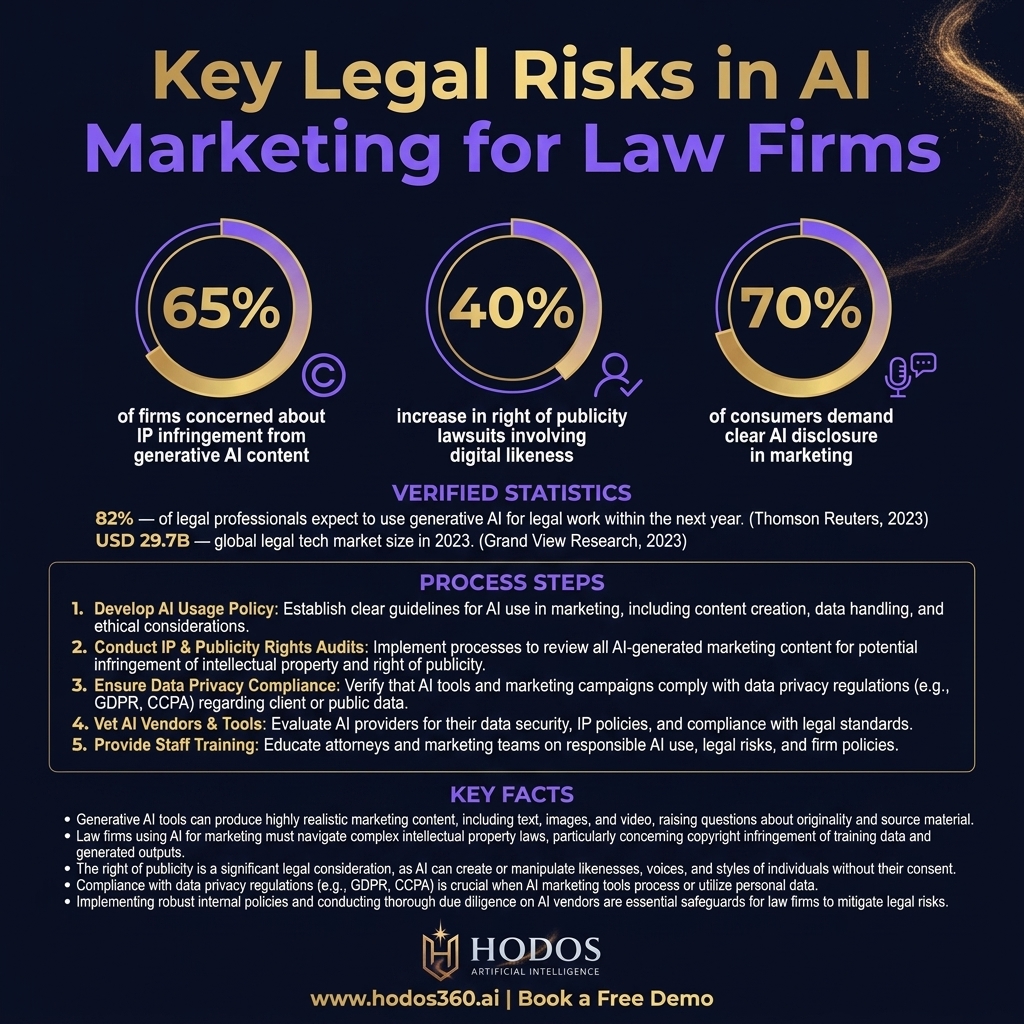
The burgeoning EU AI Act, slated for full enforcement in the coming years, emphasizes transparency and risk management for AI systems, setting a global precedent that even firms operating outside the EU should heed. Firms might consider appointing a Chief AI Officer or forming an AI Ethics Committee to oversee the ethical deployment of AI technologies across all operations, including AI marketing.
Industry leaders are already stressing the importance of ethical guardrails. Learn more about AI Chatbot Builders: Transform Your Law Firm in 2026. Andrew Arruda, co-founder of ROSS Intelligence and a prominent voice in legal tech, has consistently advocated for responsible AI deployment, emphasizing that technology should augment human capabilities while upholding ethical principles.
A recent McKinsey report highlighted that firms with strong AI governance frameworks are 2.5 times more likely to realize significant business value from AI while simultaneously mitigating risks. This isn't merely about avoiding lawsuits; it's about building and maintaining client trust, a cornerstone of the legal profession.
Clients expect their legal counsel to be both innovative and scrupulously ethical, especially when leveraging advanced technologies.
Implementing Robust AI Marketing Compliance Frameworks
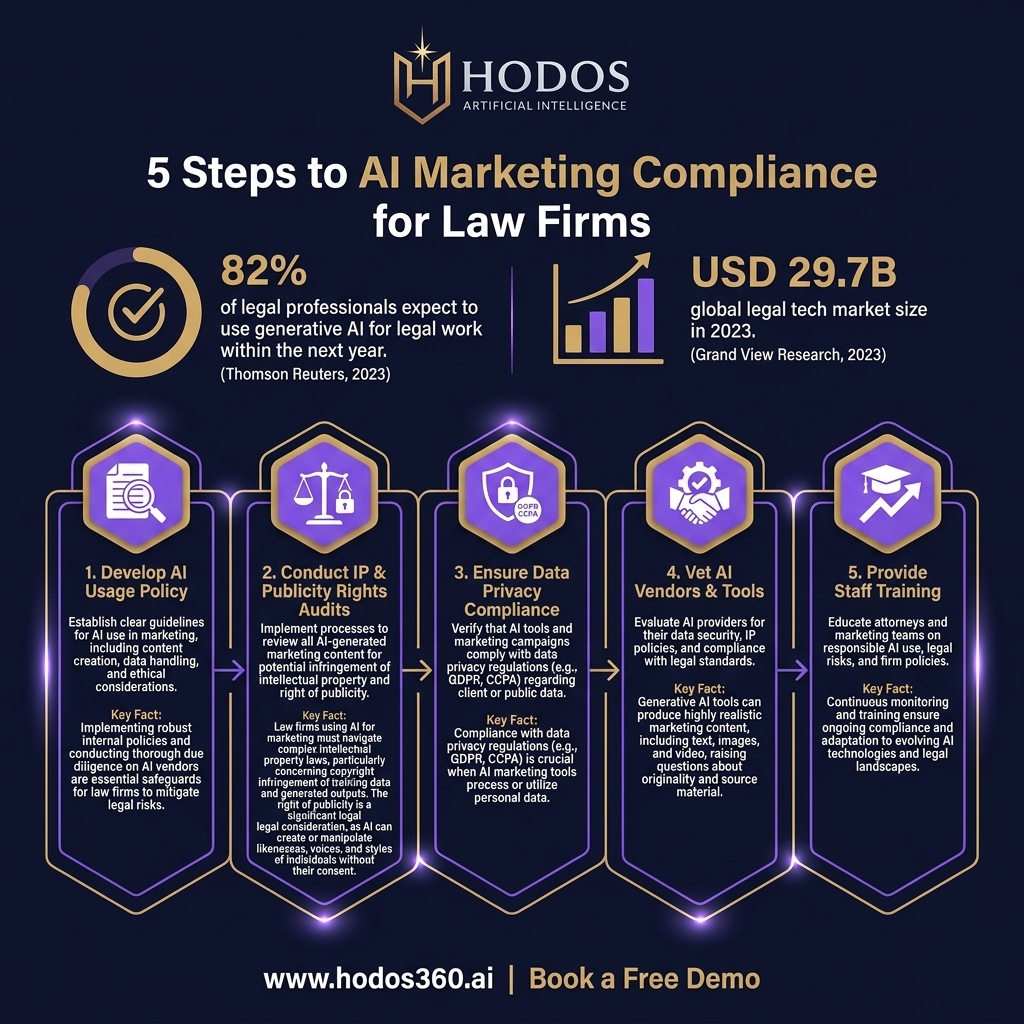
Practically, implementing an AI marketing compliance framework involves several key steps. First, conduct a thorough audit of all AI tools currently in use or under consideration, assessing their data sources, output generation methods, and inherent biases. Second, establish clear consent protocols for any marketing activity involving client testimonials, staff likenesses, or third-party content.
Third, integrate automated IP checks and originality scanners into your content creation workflows to identify potential infringements before publication. Learn more about Voice Search Optimization: The Ultimate Guide for Law Firms. Fourth, invest in continuous training for your marketing and legal teams on evolving AI ethics, intellectual property law, and data privacy regulations.
Lastly, prioritize vendor due diligence, selecting AI solutions providers that offer transparent data practices, robust security features, and a commitment to ethical AI development. This comprehensive approach ensures that your firm's AI marketing efforts are both innovative and legally sound.
The Strategic Advantage: AI Marketing with Built-in Safeguards
Despite the legal complexities, the strategic advantages of AI marketing for law firms are undeniable. When implemented with robust safeguards, AI can revolutionize client acquisition, engagement, and retention. Firms can leverage AI for hyper-personalized content generation, targeted social media campaigns, and predictive analytics that optimize marketing spend and ROI.
Imagine an AI-powered platform that not only drafts compelling blog posts but also ensures they are original, ethically sourced, and compliant with all relevant regulations. This allows attorneys to focus on legal work while their marketing efforts achieve unprecedented reach and efficiency. Firms like Allen & Overy, through their partnership with Harvey AI, exemplify how leading legal institutions are embracing AI, not as a replacement, but as an enhancement, integrating it into core operations responsibly.
The key is to choose the right technology partner—one that understands the unique regulatory environment of the legal industry. A platform designed with legal compliance in mind can transform potential liabilities into competitive advantages. Learn more about Legal AI Acquisition 2026: The New Era of Agentic Law Firms.
For example, a sophisticated AI Marketing Platform can include features like automated consent management for client testimonials, built-in copyright infringement checks for generated content, and customizable workflows that require legal team review before publication. This ensures that while the speed and scale of AI are utilized, the integrity and ethical standards of the firm remain uncompromised.
Firms that adopt such a strategic approach will not only avoid the pitfalls seen in cases like Dua Lipa v. Samsung but will also emerge as leaders in an increasingly AI-driven legal landscape.
Ensure your firm’s AI marketing strategy is both innovative and compliant. Learn how HODOS 360 integrates ethical AI into every campaign.
- ✓Robust Consent Management: Tools to track and manage explicit consent for all likenesses, testimonials, and personal data used in marketing materials.
- ✓Content Originality & IP Compliance: Features that scan AI-generated content against vast databases to prevent copyright infringement and ensure uniqueness.
- ✓Transparent Data Usage Policies: Clear guidelines and controls over how client and prospect data is collected, processed, and utilized by AI for marketing.
- ✓Customizable Workflow Automation: Ability to integrate legal review and approval steps into AI content generation and deployment processes.
- ✓Scalable Analytics with Privacy Safeguards: Advanced ROI tracking and performance metrics that adhere to data privacy regulations and protect sensitive information.
- ✓Ethical AI Sourcing: Assurance that the AI models are trained on ethically sourced data, minimizing bias and legal risks.
- ✓Multilingual Support & Local Compliance: Tools to adapt marketing campaigns for diverse audiences while ensuring adherence to local legal standards.
Key Takeaways and Next Steps
The Dua Lipa v. Samsung lawsuit is a critical reminder that while AI marketing offers transformative potential for law firms, it also introduces significant legal and ethical challenges. Navigating the complex landscape of image rights, copyright, and data privacy requires vigilance, proactive governance, and the strategic adoption of compliant technologies.
Firms must prioritize ethical AI deployment, establishing clear policies, conducting thorough due diligence, and fostering a culture of continuous learning.
By integrating robust safeguards into their AI marketing strategies, law firms can leverage the power of artificial intelligence to enhance their brand, attract new clients, and streamline operations, all while upholding the highest standards of professional responsibility.
The future of legal marketing is undeniably AI-driven, but success will belong to those who master the delicate balance between innovation and compliance. Ready to future-proof your firm's marketing? Request a demo of HODOS 360's AI Marketing Platform today.
Frequently Asked Questions
What is the significance of the Dua Lipa v. Samsung lawsuit for AI marketing?+
The lawsuit highlights the critical risks of unauthorized use of likeness and copyrighted material in marketing, especially as AI makes replication easier. It underscores the need for explicit consent and robust intellectual property checks when using AI to generate marketing content for law firms, setting a precedent for future digital rights cases.
How does AI marketing impact a law firm's compliance with data privacy regulations?+
AI marketing platforms often collect and process vast amounts of data for personalization and analytics. Law firms must ensure these platforms comply with regulations like GDPR and CCPA, particularly regarding client data confidentiality (ABA Model Rule 1.6). This includes transparent data usage policies, secure data handling, and obtaining proper consent for data collection.
What are the main copyright concerns with using generative AI for legal content?+
Generative AI models are trained on existing data, potentially including copyrighted works. This raises concerns about AI-generated content inadvertently infringing on existing copyrights. Law firms must implement tools and policies to verify the originality of AI output and ensure that the AI platform itself uses ethically sourced training data to avoid legal challenges like Getty Images v. Stability AI.
How can law firms ensure proper consent for using likenesses in AI-generated marketing?+
Firms should establish clear, explicit consent protocols for any marketing content involving individual likenesses, including AI-generated synthetic media. This involves obtaining written consent, specifying the scope of use, and ensuring that AI tools have features for consent management. Adherence to right of publicity laws, such as California Civil Code Section 3344, is crucial.
What role does an AI governance strategy play in a law firm's marketing efforts?+
An AI governance strategy provides a framework for the ethical and compliant use of AI in marketing. It includes developing internal policies, conducting AI audits, establishing an AI ethics committee, and ensuring transparency. This proactive approach helps mitigate legal risks, builds client trust, and ensures the firm's AI marketing aligns with professional standards and regulatory requirements.