


Legal AI Assistant: The Ultimate Guide to Firm Growth
The legal profession stands at a pivotal juncture, marked by unprecedented technological advancement and a burgeoning investment landscape in artificial intelligence. A recent headline from Law360, announcing that Vikk AI, a legal tech startup focusing on an attorney ad platform and legal AI assistant, has successfully raised $4.2 million, serves as a potent reminder of this transformative shift. This significant funding round is not an isolated event but rather a clear indicator of the accelerating momentum behind AI legal technology, signaling to law firm owners and legal professionals that the era of intelligent assistance is not just arriving—it's already here, demanding attention and strategic integration.
This capital injection into Vikk AI highlights a broader trend: investors are increasingly recognizing the immense potential of AI to streamline operations, enhance client engagement, and unlock new revenue streams for law firms. From the sophisticated large language models developed by OpenAI, championed by CEO Sam Altman, to strategic partnerships like Harvey AI's collaboration with Allen & Overy, the industry's embrace of generative AI solutions is no longer a futuristic concept but a present-day reality. Firms that were once hesitant are now actively exploring how these tools can reduce administrative burdens, improve legal research, and provide a competitive edge in a saturated market. The question is no longer *if* AI will impact your practice, but *how* quickly you can adapt and leverage it.
For law firms striving for sustained growth and operational excellence, understanding and implementing an effective legal AI assistant is becoming an essential differentiator. These platforms offer more than just incremental improvements; they promise a fundamental rethinking of legal workflows, from initial client contact to final case resolution. This guide will delve into the comprehensive impact of AI, exploring how advanced systems can revolutionize various facets of your practice, from enhancing efficiency and client acquisition to navigating ethical considerations and securing your firm's future in an increasingly AI-driven legal ecosystem.
The Rise of AI Legal Assistants: A New Era for Law Firms
The evolution of artificial intelligence in the legal sector has been swift and profound, moving far beyond the early days of e-discovery tools and basic document review. Today's legal AI assistant platforms, powered by advancements in machine learning and natural language processing, represent a quantum leap in capability. These sophisticated systems are designed to understand context, analyze vast datasets, and even generate legal content, fundamentally altering how attorneys approach their daily tasks. The $4.2 million raised by Vikk AI underscores investor confidence in this new wave of innovation, positioning such legal tech startup companies as crucial players in shaping the future of legal service delivery.
This shift is fueled by foundational breakthroughs from companies like OpenAI, whose GPT series has demonstrated unprecedented linguistic capabilities, prompting significant investment from tech giants like Microsoft, whose President Brad Smith has consistently advocated for responsible AI integration across industries. Law firms are no longer just looking for tools; they're seeking comprehensive platforms that can integrate seamlessly into their existing infrastructure, offering solutions for everything from predictive analytics in litigation to automating routine client communications. Learn more about AI Agents Marketing: Your Essential Guide for Law Firms. According to a 2024 report by Thomson Reuters, over 60% of law firms anticipate increasing their investment in AI technologies over the next three years, indicating a clear trajectory towards widespread adoption and integration.
While some firms initially approached AI with skepticism, fearing job displacement or a loss of the 'human touch,' the narrative has shifted dramatically. Progressive firms, such as Allen & Overy, have publicly embraced AI, notably through their partnership with Harvey AI to develop custom generative AI tools for their lawyers. This move exemplifies a growing understanding that AI is not a replacement but an augmentation, designed to free up attorneys from mundane, repetitive tasks, allowing them to focus on higher-value strategic work, client relationships, and complex legal analysis. The competitive chasm between firms that proactively adopt these technologies and those that lag behind is widening, making strategic AI integration a matter of survival and growth, not just innovation.
Beyond Case Management: How AI Transforms Operations
The modern legal AI assistant extends far beyond traditional case management, reshaping the operational backbone of law firms. These systems integrate seamlessly into various administrative and legal processes, creating efficiencies that were previously unattainable. From automating document generation to intelligent scheduling and resource allocation, AI-powered solutions are designed to optimize every facet of a firm's day-to-day operations. This holistic approach means attorneys can spend less time on administrative overhead and more time practicing law, directly impacting profitability and service quality. The synergy between human expertise and AI efficiency defines the next generation of legal practice.
One of the most immediate and impactful areas for AI integration is in client-facing processes and financial management. Learn more about Legal AI: Microsoft's Essential Tool Reshapes Law Practice. Firms often struggle with the initial bottlenecks of bringing in new clients and the ongoing challenges of accurate billing. AI offers robust solutions to these pain points, transforming them from time sinks into streamlined, efficient workflows. Platforms like HODOS 360's AI Law Firm Management System offer comprehensive tools that address these critical areas, providing firms with a competitive edge by improving both client experience and financial health.
Streamlining Client Intake and Billing with AI
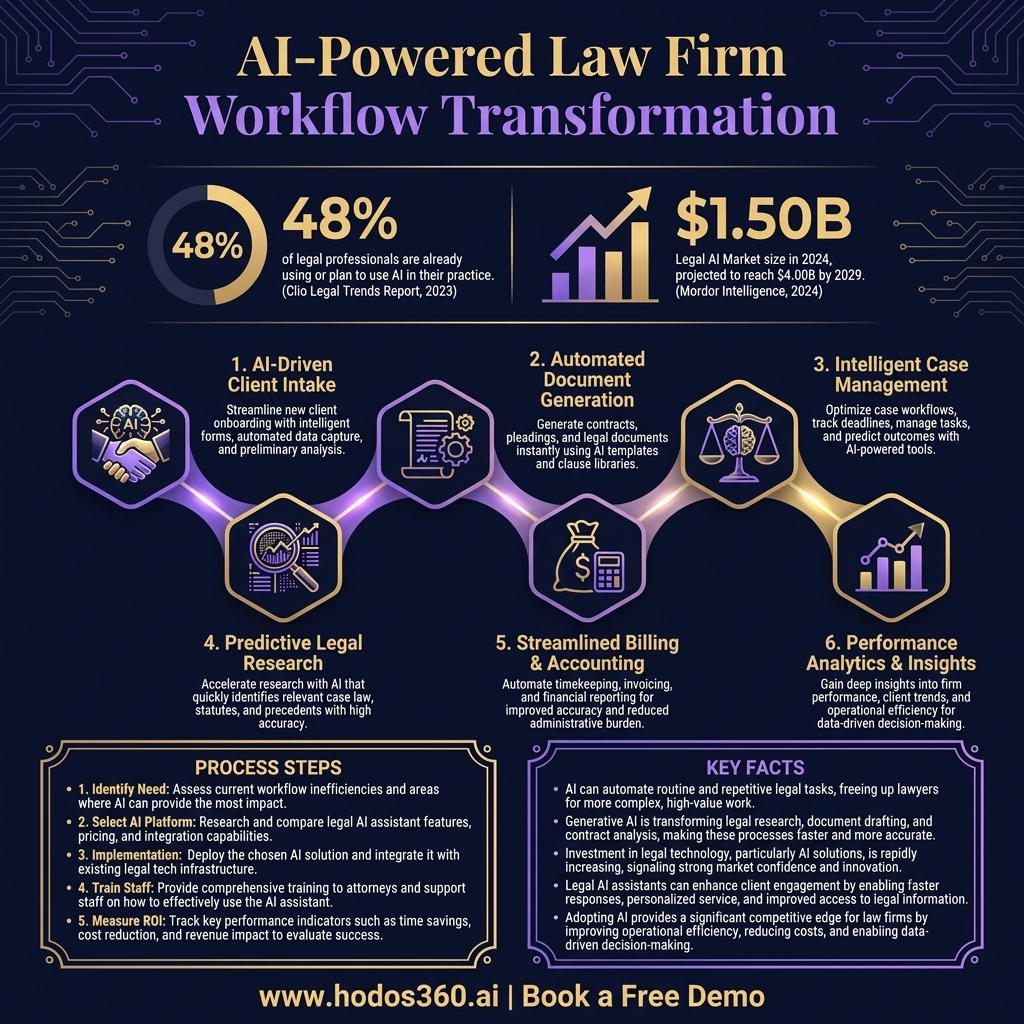
Automating client intake is a game-changer for law firms. An AI legal assistant can manage the initial client outreach, conduct preliminary conflict checks, and gather essential information through intelligent questionnaires, significantly reducing the administrative burden on support staff. This not only speeds up the onboarding process but also ensures accuracy and consistency, providing a superior first impression for potential clients. Moreover, AI's capabilities extend to sophisticated document automation, allowing firms to generate standard legal documents, contracts, and filings with unparalleled speed and precision, minimizing human error and ensuring compliance.
In the realm of financial management, AI-powered tools revolutionize billing and time tracking. These systems can accurately log billable hours, categorize expenses, and even identify patterns in spending, providing valuable insights for fee structures and budget management. Learn more about AI Law Firms: Essential for Construction Contract Mastery. This level of granular detail, often tedious for human staff, ensures greater billing accuracy and reduces revenue leakage. The ABA TechReport 2023 indicated that firms leveraging automation in billing reported a 15% increase in collected revenue and a 20% reduction in billing disputes, underscoring the tangible financial benefits of embracing these technologies. By optimizing client intake automation and billing processes, firms can enhance their operational efficiency and focus on delivering exceptional legal services.
Strategic Advantages: Marketing, Growth, and Client Experience
Beyond internal operations, AI offers powerful tools for law firms to expand their reach, attract new clients, and cultivate an unparalleled client experience. In today's competitive legal market, a strong digital presence and responsive client communication are non-negotiable. AI-driven platforms provide the strategic advantage needed to stand out, enabling firms to connect with potential clients more effectively and nurture existing relationships with greater personalization and efficiency. This holistic approach to client engagement, from initial contact to ongoing support, is critical for sustainable growth in the digital age.
Consider the impact of specialized marketing and communication platforms. Learn more about AI Legal Revolution: Corporate Use Jumps 87% by 2026. Vikk AI’s focus on an attorney ad platform alongside its legal AI assistant capabilities highlights the growing recognition that technology must serve both the internal operational needs and the external growth ambitions of law firms. This integrated approach allows for seamless marketing campaigns, lead generation, and client support, all powered by intelligent automation. Firms can leverage these tools to understand their target audience better, personalize their outreach, and measure the effectiveness of their marketing efforts with unprecedented accuracy.
AI-Powered Legal Marketing: Reaching New Clients
AI marketing platforms, such as those offered by HODOS 360, empower law firms to transcend traditional marketing limitations. Imagine generating compelling video content for social media, automating posts across multiple platforms, and creating personalized email campaigns, all with AI assistance. These platforms not only streamline content creation but also provide advanced analytics and ROI tracking, allowing firms to precisely measure the effectiveness of their marketing spend. This level of data-driven insight ensures that marketing efforts are always optimized for maximum impact, targeting the right clients with the right message at the right time.
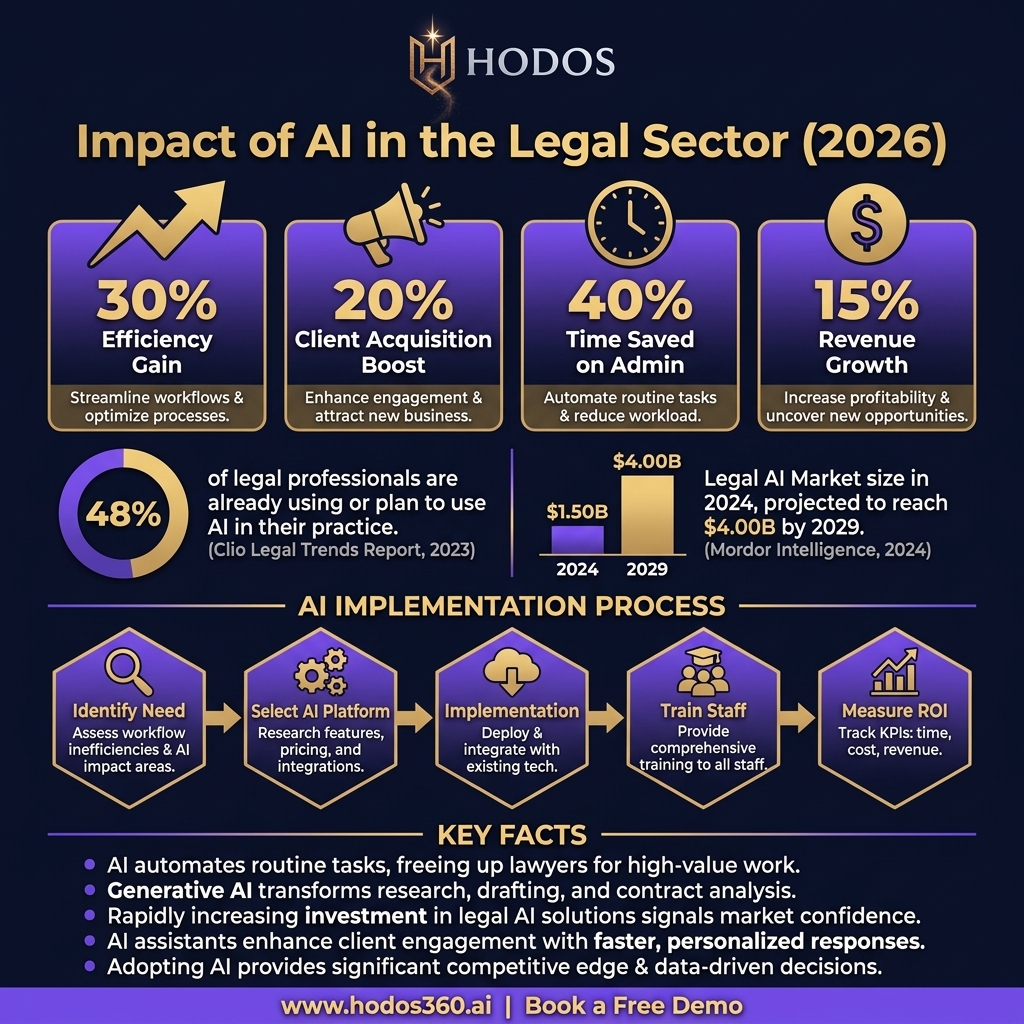
Complementing these marketing efforts are AI voice assistants, which are transforming client service and lead qualification. Learn more about AI SaaS Builders: The Ultimate Blueprint for Law Firms. Operating 24/7, these intelligent assistants can answer phone calls, qualify leads based on predefined criteria, book appointments, and even offer multilingual support, ensuring that no potential client query goes unanswered, regardless of time or language barrier. This level of responsiveness significantly enhances the client experience, converting inquiries into retained clients more efficiently. Firms that implement AI marketing strategies and 24/7 AI voice assistants report a significant increase in client acquisition rates and improved client satisfaction scores, making these technologies indispensable for modern legal practices.
Navigating the Ethical and Practical Landscape of AI Integration
While the benefits of legal AI assistant technologies are compelling, their integration into legal practice is not without its complexities. Law firms must navigate a landscape fraught with ethical considerations, data security challenges, and the practicalities of implementation. The legal profession is inherently conservative, valuing precedent, precision, and trust, making the adoption of rapidly evolving AI tools a delicate balance. Ensuring that AI serves to enhance, rather than compromise, these core values is paramount for responsible innovation.
One of the primary concerns revolves around data privacy and client confidentiality. AI systems often require access to sensitive client information to function effectively, raising questions about how this data is stored, processed, and protected. Learn more about Ultimate Legal Intake Checklist: Choosing Your Provider. Firms must ensure that any AI platform they utilize adheres to the highest standards of cybersecurity and complies with stringent data protection regulations, such as GDPR or CCPA. Furthermore, the potential for bias within AI algorithms is a critical ethical challenge. If trained on biased historical data, AI tools could perpetuate or even amplify existing societal inequities, making careful oversight and regular auditing of AI outputs indispensable.
Ethical Considerations and Responsible AI Adoption
Attorneys have a professional obligation to maintain competence in legal practice, which now extends to understanding the technology they employ. ABA Model Rule 1.1 on Competence implicitly requires lawyers to keep abreast of changes in the law and its practice, including the benefits and risks associated with relevant technology. Similarly, ABA Model Rule 1.6 on Confidentiality of Information mandates that lawyers make reasonable efforts to prevent the inadvertent or unauthorized disclosure of, or unauthorized access to, client information. This means firms must exercise due diligence in selecting and implementing AI tools, ensuring they do not inadvertently compromise client data or provide unreliable legal advice.
Practical implementation challenges also exist, including integrating AI with legacy systems, training staff, and managing the cultural shift within a firm. The EU AI Act, expected to be fully implemented in the coming years, provides a robust framework for governing AI, particularly high-risk applications, which will undoubtedly impact legal tech. Firms must develop internal policies and best practices for AI use, emphasizing human oversight and critical review of AI-generated content. The goal is not to replace human judgment but to augment it, allowing attorneys to leverage AI's speed and analytical power while retaining ultimate responsibility for legal accuracy and client outcomes. This balanced approach ensures that AI serves as a powerful assistance tool, enhancing efficiency without compromising ethical duties.
The Future-Ready Law Firm: Embracing AI for Sustainable Success
The trajectory of AI legal technology is clear: it will continue to redefine the boundaries of legal practice. For law firms aiming for sustainable success, embracing AI is no longer optional but a strategic imperative. The firms that proactively integrate intelligent tools will be better positioned to attract top talent, serve clients more effectively, and adapt to the ever-changing demands of the legal market. This forward-looking approach involves not just adopting individual tools but building a comprehensive, AI-powered ecosystem that supports every aspect of the firm's operations and growth.
Consider the broader digital footprint of a modern law firm. Beyond internal efficiencies and targeted marketing, an AI-powered website building capability ensures that a firm's online presence is not only visually appealing but also highly functional, responsive, and optimized for search engines. This includes features like AI-driven chatbots for instant queries, personalized content delivery, and seamless integration with client portals. Platforms offering responsive web design and SEO optimization are vital for converting online visitors into genuine leads, creating a holistic digital strategy that complements the internal AI efficiencies.
Ultimately, the future-ready law firm will be one that skillfully blends human intellect with artificial intelligence, creating a synergy that elevates service quality, operational efficiency, and strategic decision-making. The investment in firms like Vikk AI, alongside the rapid advancements from established players and innovative startups, confirms that the legal sector is on an irreversible path towards AI integration. Firms that embrace this transformation will not only survive but thrive, setting new benchmarks for legal excellence and client satisfaction in the decades to come. Discover how HODOS 360 can empower your firm.

Key Takeaways and Next Steps
The landscape of legal practice is undeniably being reshaped by artificial intelligence. From the significant funding rounds for legal tech startup companies like Vikk AI to the strategic adoption by major law firms, the message is clear: AI is no longer a peripheral tool but a central pillar for modern legal operations. Firms that embrace AI can expect substantial gains in efficiency, a bolstered capacity for client acquisition through sophisticated attorney ad platform capabilities, and an enhanced client experience facilitated by responsive AI voice assistants and streamlined AI-powered workflows. The competitive advantage lies with those willing to innovate and integrate.
For law firm owners and legal professionals, the next steps involve a strategic evaluation of current workflows and identifying areas where AI can deliver the most impact. This means looking beyond basic automation to comprehensive platforms that offer integrated solutions for case management, marketing, and client communication. Investing in robust, secure, and ethically sound AI solutions, such as those offered by HODOS 360, is crucial for future-proofing your practice. The goal is to leverage AI to amplify human expertise, fostering a more efficient, client-centric, and ultimately, more profitable legal practice. The future belongs to the intelligent law firm.
- ✓Embrace AI for Efficiency: Leverage AI to automate routine tasks, from document review to legal research, freeing up attorney time for complex, high-value work.
- ✓Enhance Client Acquisition: Utilize AI-powered marketing platforms for targeted campaigns, content generation, and social media automation to reach and convert more clients.
- ✓Optimize Client Experience: Implement AI voice assistants for 24/7 client support, lead qualification, and appointment booking, ensuring rapid and consistent responsiveness.
- ✓Streamline Operations: Deploy AI for comprehensive law firm management, including client intake, billing, and case workflows, ensuring accuracy and reducing administrative burden.
- ✓Prioritize Ethical Adoption: Integrate AI responsibly, adhering to ethical guidelines, ensuring data privacy, and maintaining human oversight to safeguard client interests and professional integrity.
- ✓Invest in Integrated Platforms: Seek out solutions that offer a holistic approach to AI integration, connecting various aspects of your firm's operations and growth strategies.
- ✓Stay Ahead of the Curve: Continuously educate your team on the latest AI advancements and legal tech trends to maintain a competitive edge and adapt to future industry shifts.
Frequently Asked Questions
What is a Legal AI Assistant?+
A Legal AI Assistant is an artificial intelligence-powered platform designed to support law firms and legal professionals by automating, optimizing, and enhancing various legal tasks and administrative functions. These tools can range from sophisticated legal research and document review to client intake, billing, and even marketing automation, leveraging machine learning and natural language processing to improve efficiency and decision-making.
How can AI improve law firm efficiency?+
AI significantly improves law firm efficiency by automating repetitive and time-consuming tasks such as document generation, contract analysis, legal research, and conflict checks. This frees up attorneys and staff to focus on more complex, strategic work. AI also streamlines client intake, billing, and case management, reducing administrative overhead and accelerating workflows, leading to substantial time and cost savings for the firm.
Are Legal AI Assistants ethical and secure?+
The ethical and secure use of Legal AI Assistants is paramount. Reputable AI platforms are built with robust cybersecurity measures to protect client data and ensure confidentiality, adhering to industry standards and regulations. Ethical considerations include ensuring transparency in AI's use, mitigating algorithmic bias, and maintaining human oversight for critical legal decisions. Law firms must exercise due diligence in selecting compliant and trustworthy AI solutions.
What is the ROI of investing in legal AI?+
The return on investment (ROI) for legal AI can be substantial, manifesting in various forms. Firms typically see increased operational efficiency, leading to reduced overhead costs and higher billable hours. AI also contributes to enhanced client satisfaction and acquisition through improved responsiveness and targeted marketing, directly impacting revenue growth. Early adopters often report a competitive advantage, attracting more clients and top talent.
How does AI help with legal marketing?+
AI revolutionizes legal marketing by enabling firms to create highly targeted and personalized campaigns. AI platforms can automate social media posting, generate compelling content (e.g., blog posts, video scripts), and analyze market trends to identify ideal client segments. They also provide advanced analytics to track campaign performance and ROI, ensuring marketing spend is optimized for maximum impact, leading to more effective client acquisition.
Will AI replace lawyers?+
No, AI is not expected to replace lawyers. Instead, it serves as a powerful assistant, augmenting human capabilities rather than substituting them. AI handles routine, data-intensive tasks, allowing lawyers to focus on higher-level strategic thinking, complex problem-solving, client relationships, and the nuanced application of legal judgment. The future of law involves a collaborative synergy between human legal expertise and AI's analytical power.