


Ultimate Legal Intake Checklist: Choosing Your Provider
Just last year, Sarah Chen, managing partner at Chen & Associates, faced a familiar dilemma plaguing countless small to mid-sized law firms. Their manual client intake process was a bottleneck, costing them an estimated $50,000 annually in missed calls, unqualified leads, and administrative overhead. Potential clients, frustrated by voicemail mazes or slow response times, often simply moved on to the next firm.
This isn't just an anecdote; it reflects a systemic challenge highlighted by the ABA TechReport 2024, which found that only 35% of small firms utilize dedicated client intake software, leaving a vast majority vulnerable to inefficient lead capture and conversion. The stakes are higher than ever, with market competition intensifying and client expectations for immediate, personalized service reaching new peaks.
The digital transformation in legal services is no longer a futuristic concept but a present imperative. From the latest OpenAI news detailing advancements in conversational AI to the rapid adoption of AI tools by firms like Allen & Overy (in partnership with Harvey AI), the legal landscape is shifting.
For law firm owners and managing attorneys, the choice of a legal intake provider is paramount, directly impacting revenue, client satisfaction, and operational efficiency. It’s not merely about answering phones; it’s about strategically capturing, qualifying, and converting every potential lead into a loyal client, setting the foundation for sustained growth.
This guide provides an Ultimate Legal Intake Checklist designed to help you navigate the complex ecosystem of legal intake solutions. We delve into the critical factors beyond just pricing and coverage, exploring the nuanced requirements for modern law firms. From assessing the technological prowess of AI-powered platforms to evaluating the human element in answering services and the imperative of CRM integration, we'll equip you with the knowledge to make an informed decision.
The goal is to move beyond generic solutions to find a system that truly aligns with your firm's unique needs and ambitions, ensuring no valuable lead slips through the cracks.
Beyond Basic Answering: The Evolution of Legal Intake
The era of simple answering services for legal intake is rapidly fading. Today's clients expect instant gratification and intelligent interaction, a trend accelerated by widespread consumer adoption of AI voice assistants like Amazon's Alexa and Google Assistant. This expectation has profoundly reshaped the first touchpoint between a potential client and a law firm.
Firms that rely solely on voicemail or generic call centers risk alienating leads before a conversation even begins. The transformation isn't just about efficiency; it's about establishing trust and professionalism from the very first interaction. According to a Thomson Reuters report on the State of the Legal Market 2025, firms with optimized client intake software and processes reported up to a 30% increase in lead conversion rates compared to their less technologically advanced counterparts.
Learn more about Privilege & AI: The Ultimate Guide After US v. Heppner. This stark difference underscores the competitive advantage of a sophisticated intake strategy.
The modern legal intake provider offers a holistic solution, integrating AI voice assistants for 24/7 availability and initial lead qualification, sophisticated client intake software for automated data capture, and seamless CRM integration to track the client journey.
Consider the story of David Lee, founder of Lee & Partners, who initially resisted adopting AI for his firm's intake, fearing a loss of the 'human touch.' However, after seeing competitors rapidly scale, he invested in an AI-powered system that handled initial queries, booked appointments, and even provided multilingual support.
Lee quickly realized that AI didn't replace human connection but augmented it, freeing his staff to focus on complex legal work while ensuring no calls were missed. This shift from reactive reception to proactive engagement is fundamental to thriving in today's legal environment.
The Imperative of Speed-to-Lead
In the digital age, speed-to-lead is a non-negotiable metric for law firms. Research consistently shows that the faster a firm responds to a new inquiry, the higher the likelihood of conversion. A study by MIT found that responding to a lead within five minutes makes you 21 times more likely to qualify them than if you wait 30 minutes.
This critical window of opportunity often determines whether a potential client chooses your firm or a competitor. Learn more about AI Website Builder: The Ultimate Guide for Law Firms. Traditional methods, relying on office hours or limited staff availability, inherently fail to meet this demand.
The most effective legal intake providers leverage AI and automation to ensure near-instantaneous responses, whether through AI voice assistants, automated email replies, or immediate routing to available specialists. This rapid engagement not only captures interest but also conveys a firm's responsiveness and dedication, setting a positive precedent for the client relationship.
Assessing Technological Prowess: AI, CRM, and Automation
When evaluating legal intake providers, a deep dive into their technological capabilities is paramount. The mere presence of 'AI' or 'automation' isn't enough; true value lies in how these technologies are implemented to solve specific pain points for law firms. Does the client intake software utilize advanced natural language processing (NLP) to understand complex legal inquiries and accurately route them?
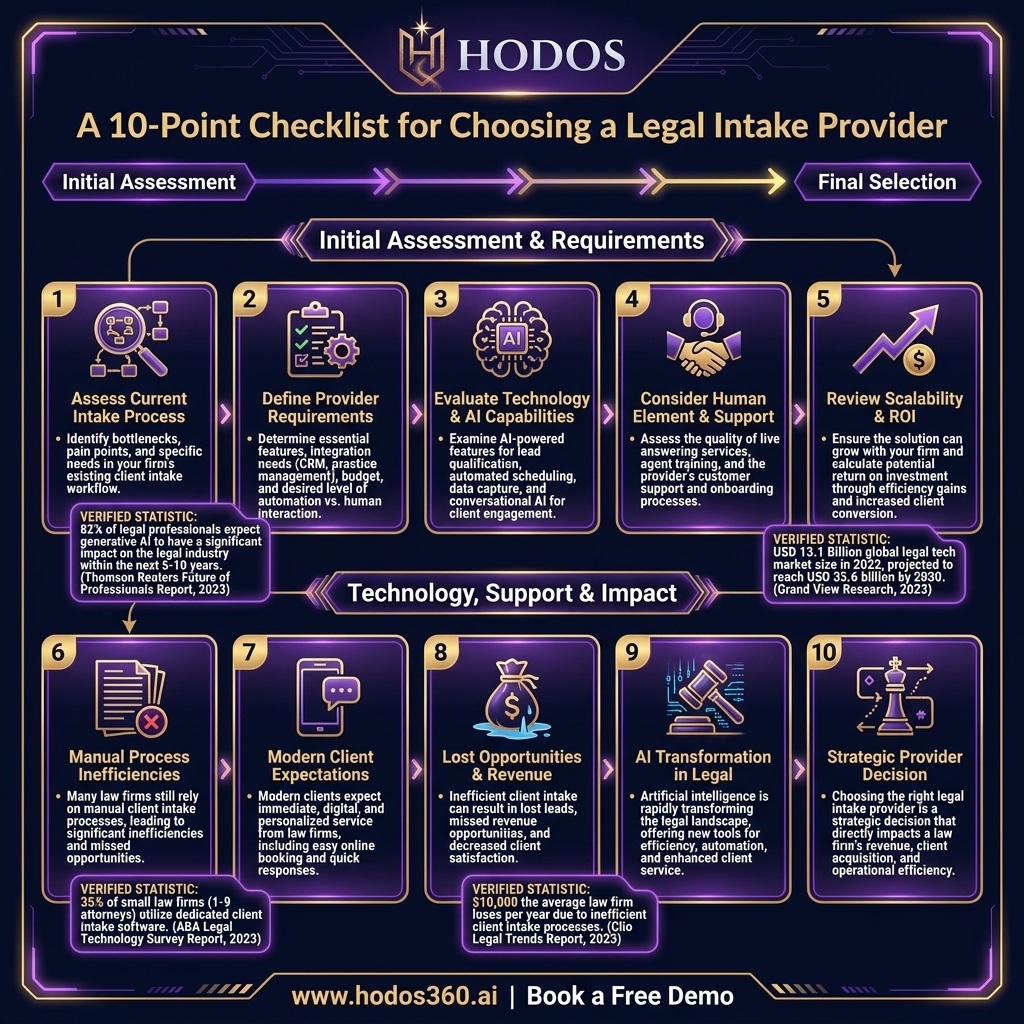
Can it automatically generate initial client agreements or engagement letters based on predefined templates, saving hours of staff time? Consider the competitive landscape where firms like 'LegalTech Innovators' are securing significant funding rounds, driven by their sophisticated AI-driven platforms. As Jensen Huang, CEO of NVIDIA, often articulates, the future is about accelerated computing enabling AI to tackle complex, real-world problems – and legal intake is no exception.
Firms that embrace this level of technological sophistication are not just improving efficiency; they are fundamentally reshaping their operational models.
Crucially, the chosen solution must offer robust CRM integration. A fragmented tech stack, where intake data resides in a silo separate from your case management system, creates more problems than it solves.
Learn more about Legal AI Deployment: The Ultimate Firmwide Strategy for Torys. Seamless integration means that once a lead is qualified, their information flows directly into your AI Law Firm Management System, populating client profiles, initiating case files, and scheduling follow-ups without manual data entry.
This not only eliminates errors but also provides a 360-degree view of the client journey, from initial contact to case resolution. Firms like 'Global Legal Solutions' have reported a 25% reduction in administrative tasks post-integration, allowing their paralegals and attorneys to focus on billable work.
This holistic approach to technology is what differentiates a truly transformative legal intake provider from a basic service, ensuring that your firm's entire operational workflow benefits from enhanced efficiency.
Leveraging AI for Enhanced Qualification
The true power of AI in legal intake extends beyond simple chat functionality to sophisticated lead qualification. This involves AI models trained on vast datasets of legal inquiries, enabling them to ask pertinent follow-up questions, assess the urgency and nature of a case, and even perform initial conflict checks.
For instance, an AI voice assistant might ask a caller, "Have you previously consulted with another attorney regarding this matter?" or "Could you briefly describe the nature of your legal issue?" Such intelligent questioning ensures that by the time a human specialist or attorney engages, they are already equipped with a preliminary understanding of the case and the client's needs.
Learn more about AI Legal Guidance: Your Essential Compass for Regulatory Complexity. This capability is particularly critical for firms with diverse practice areas, ensuring that calls are routed to the most appropriate department or specialist, optimizing both client experience and internal resource allocation. The precision of AI-driven lead qualification minimizes wasted time on unqualified leads, allowing staff to focus on high-potential cases.
Human Touch and Expertise: Staffing and Training
Despite the advancements in AI, the human element remains irreplaceable in legal intake. The best providers strike a crucial balance, using technology to handle routine tasks and empower human staff to excel in complex, empathetic interactions. When evaluating answering services or call centers, scrutinize their training protocols.
Are their specialists trained specifically in legal terminology, client empathy, and legal ethics, particularly regarding confidentiality and unauthorized practice of law (UPL), as outlined in ABA Model Rule 5.5? Firms should inquire about the coverage model – is it 24/7, and are the staff adequately supervised and regularly assessed for quality assurance?
Consider the case of 'Justice Advocates,' a firm that switched from a generic call center to a specialized legal intake provider. They noted a significant improvement in client satisfaction scores, primarily because the new provider's staff demonstrated a deeper understanding of legal nuances, asking more informed questions and conveying genuine empathy.
This human expertise, backed by robust training, is critical for building immediate client trust.
Furthermore, bilingual support is no longer a luxury but a necessity for law firms operating in diverse communities. Learn more about AI Studio Update: Essential Web App Creation for Law Firms.
The ability to communicate effectively with clients in their native language significantly broadens a firm's reach and enhances client comfort. A provider offering comprehensive bilingual support ensures that language barriers do not become barriers to justice. This extends beyond merely having staff who speak another language; it involves cultural competency and an understanding of how to navigate legal issues across different linguistic backgrounds.
As legal markets become increasingly globalized, the capacity to serve a diverse clientele is a powerful differentiator. The choice between an in-house intake staff and outsourced services often hinges on this specialized training and bilingual coverage, with many firms finding that dedicated legal intake providers offer a higher caliber of specialized expertise than they could realistically cultivate internally.
Ensuring Seamless CRM Integration
The efficiency of your legal intake process is severely hampered if it operates in a silo. A top-tier legal intake provider must offer seamless CRM integration with your existing client intake software or AI Law Firm Management System. This means that all data captured during the initial interaction—contact details, case summaries, conflict checks, and preferred communication methods—automatically populates relevant fields in your CRM.

This eliminates manual data entry, reducing errors and saving valuable administrative time. Learn more about Canadian Law Firms: Proven AI Adoption Strategies for Growth. More importantly, it ensures that your entire team, from attorneys to paralegals, has immediate access to up-to-date client information, facilitating smooth handoffs and consistent client communication.
Firms like 'Innovate Legal' have reported that strong CRM integration has reduced their client onboarding time by 40%, allowing them to focus on legal strategy rather than administrative overhead. This level of integration is a hallmark of a truly efficient and modern legal operation.
Navigating the Financials: Pricing Models and ROI
Understanding the pricing models of legal intake providers is crucial for law firms to ensure cost-effectiveness and a clear return on investment (ROI). Pricing structures can vary widely, from per-call fees and per-minute charges to flat-rate monthly subscriptions, or even tiered models based on call volume or service level.
Some providers may offer a hybrid model that includes a base fee plus additional charges for specific features like bilingual support or advanced lead qualification. It's imperative to meticulously analyze your firm's typical call volume, peak hours, and specific service needs to determine which pricing model aligns best with your budget and operational demands.
Don't just look at the raw cost; consider the total value proposition. For example, a slightly higher-priced service that offers superior speed-to-lead and lead qualification might convert significantly more clients, ultimately generating a far greater ROI than a cheaper, less effective option.
The calculation of ROI extends beyond direct cost savings to encompass the intangible benefits of an optimized legal intake process.
Reduced staff workload, improved client satisfaction, enhanced firm reputation, and increased client intake software conversion rates all contribute to a positive ROI. Consider the firm 'Precedent Legal,' which initially chose the cheapest answering services only to find their intake conversion rates stagnating. After switching to a higher-tier provider that offered AI-powered qualification and immediate follow-up, their new client acquisition jumped by 20% within six months.
This demonstrates that investing in a robust legal intake solution is not an expense but a strategic investment in the firm's growth. Firms should request detailed pricing breakdowns and, if possible, case studies or testimonials demonstrating the ROI achieved by other firms of a similar size and practice area.
Transparency in pricing and a clear understanding of what's included are vital for making an informed decision.
- ✓24/7 Coverage & Availability: Does the provider offer round-the-clock service, ensuring no potential client call is missed, regardless of time zones or holidays? This is critical for maximizing lead capture.
- ✓Speed-to-Lead Response Time: What is the average response time for new inquiries? Aim for near-instantaneous contact to significantly increase conversion rates.
- ✓Bilingual & Multilingual Support: Can the provider effectively communicate with clients in multiple languages, particularly Spanish, to serve diverse communities?
- ✓Advanced Lead Qualification: Does the system use AI or trained specialists to accurately qualify leads, identifying high-potential cases and filtering out unqualified inquiries?
- ✓Seamless CRM & Case Management Integration: How well does it integrate with your existing client intake software or AI Law Firm Management System to ensure data consistency and reduce manual entry?
- ✓Customization & Workflow Automation: Can the intake process be customized to match your firm's specific practice areas, branding, and unique legal workflows?
- ✓Reporting & Analytics: Does the provider offer comprehensive analytics on call volumes, conversion rates, and staff performance to help optimize your strategy?
Strategic Integration: Future-Proofing Your Firm's Growth
The decision of choosing a legal intake provider is not merely an operational one; it's a strategic move that dictates your firm's capacity for future growth and resilience. A truly effective provider acts as an extension of your firm, seamlessly integrating into your broader technological ecosystem.
This means not only robust CRM integration but also compatibility with other essential tools such as AI Marketing Platform for lead generation and AI Voice Assistants for initial client engagement. The ideal scenario is a unified platform that centralizes client data, automates workflows, and provides actionable insights.
Firms that have adopted such integrated systems, like the aforementioned Chen & Associates after their overhaul, are better positioned to scale, adapt to market changes, and maintain a competitive edge. This holistic approach ensures that as your firm grows, your legal intake infrastructure can evolve with you, supporting an increasing volume of inquiries and diversifying service offerings without compromising quality or efficiency.
The long-term vision should be to create a scalable, intelligent client acquisition pipeline.
Looking ahead, the legal tech landscape will continue to be shaped by rapid advancements in AI. The prudent choice today is a provider that is not only current but also forward-looking, investing in continuous innovation.
This means seeking out solutions that are actively developing new AI capabilities, enhancing data security, and anticipating future client demands. The ai news today is filled with breakthroughs that will inevitably impact legal practice, from predictive analytics in lead qualification to hyper-personalized client communication. By selecting a partner committed to innovation, law firms can future-proof their operations, ensuring they remain at the forefront of client service and operational excellence.
This strategic foresight in legal intake is what differentiates thriving firms from those struggling to keep pace, ensuring that every new lead represents a tangible opportunity for growth and success.
Key Takeaways and Next Steps
The journey to optimizing your firm’s legal intake is pivotal for sustainable growth in an increasingly competitive market. As we've explored, the choice of a provider extends far beyond basic answering services, encompassing technological sophistication, human expertise, and strategic integration with your firm's entire operational framework.
By meticulously applying the 10-point checklist, law firms can identify a partner that not only meets immediate needs but also future-proofs their client acquisition strategy. The goal is to transform intake from a mere administrative task into a powerful engine for revenue generation and client loyalty.
This means prioritizing speed-to-lead, robust lead qualification, seamless CRM integration, and comprehensive bilingual support. The firms that proactively embrace these advancements will be the ones that thrive in the coming years.
At the heart of this transformation are platforms designed to integrate these crucial elements.
For law firms seeking to elevate their legal intake and overall practice management, exploring comprehensive solutions is essential. HODOS 360’s AI Law Firm Management System offers an integrated suite of services, including AI-powered legal workflows, client intake software, and AI Voice Assistants, designed to streamline operations from the first client contact.
By adopting such a unified approach, firms can ensure that every lead is handled with precision, professionalism, and unparalleled efficiency, securing their position at the forefront of the legal industry. Don't let your legal intake be a bottleneck; empower it to be your firm's most potent growth driver.
Discover how integrated AI solutions can revolutionize your firm's future. [Discover Your Firm's AI Advantage Today!]
Frequently Asked Questions
What is the most critical factor for `legal intake` success?+
The most critical factor is speed-to-lead. Studies show that responding to a lead within five minutes significantly increases the likelihood of qualification. Modern legal intake providers leverage AI and automation to ensure rapid response times, capturing potential clients' interest before they turn to a competitor, thereby maximizing conversion opportunities for law firms.
How does AI enhance `lead qualification` in `legal intake`?+
AI enhances lead qualification by using natural language processing to understand complex inquiries, asking intelligent follow-up questions, and performing initial conflict checks. This allows law firms to pre-qualify leads, accurately route them to appropriate specialists, and ensure that attorneys spend their time on high-potential cases, boosting efficiency and reducing wasted efforts.
Why is `bilingual support` important for `law firms`?+
Bilingual support is crucial for law firms to serve diverse communities effectively. It ensures that language barriers do not hinder communication or access to justice. Providers offering comprehensive bilingual support broaden a firm's market reach, enhance client comfort and trust, and demonstrate a commitment to inclusivity, which is vital in today's globalized legal market.
What should `law firms` look for in `CRM integration`?+
Law firms should look for CRM integration that automatically transfers all intake data—contact details, case summaries, and communication history—into their existing client intake software or AI Law Firm Management System. This eliminates manual data entry, reduces errors, and provides a unified client view for the entire team, streamlining workflows and improving client management.
How can `law firms` calculate the ROI of `legal intake` solutions?+
Law firms can calculate ROI by comparing the cost of the legal intake solution against quantifiable benefits such as increased lead conversion rates, reduced administrative time (and associated staff costs), improved client satisfaction, and enhanced firm reputation. A higher conversion rate from qualified leads often translates directly into significant revenue growth, outweighing the initial investment.