
AI Studio Update: Essential Web App Creation for Law Firms
Sarah Chen, managing partner at Innovate Legal Group, recounts the endless cycles of bespoke software development her firm endured just a few years ago. "Every custom client portal or internal tool required external developers, months of back-and-forth, and significant capital outlay," she explains, reflecting on the pre-AI era.
This narrative of friction and cost is a common refrain in a legal industry historically cautious about technology adoption, yet increasingly pressed for digital transformation. The recent announcement from Google, revealing a significant AI Studio update that allows for the creation of full web applications from simple prompts, represents not just an incremental improvement but a fundamental shift in this paradigm.
This development, widely reported, including by outlets like MSN, signals a new era where legal professionals, not just coders, can orchestrate sophisticated digital tools tailored to their precise needs, fundamentally altering the economics and timelines of legal tech innovation.
This move by Google is a direct response to the burgeoning competition in the AI space, particularly from rivals like Anthropic, whose Claude models have demonstrated remarkable capabilities in complex reasoning and code generation.
The AI Studio update from Google is a strategic play, aiming to democratize web application development, much like how platforms like WordPress democratized website creation decades ago. For law firms, this isn't merely a tech headline; it’s a strategic imperative. The ability to rapidly prototype and deploy custom web apps—from secure client intake portals to automated compliance checkers—without deep coding expertise promises to unlock unprecedented efficiencies.
Legal professionals are no longer passive consumers of technology but active architects of their digital infrastructure, a transition underscored by the increasing sophistication of large language models (LLMs) and their integration into development environments.
The implications for legal services are profound, offering a pathway to enhanced client experiences, streamlined internal operations, and a sharper competitive edge.
This shift empowers firms to move beyond off-the-shelf solutions, crafting bespoke digital tools that resonate with their unique service offerings and client base. Discover how HODOS 360’s Web & Mobile Development services, leveraging the latest AI innovations, can elevate your firm's digital presence and operational capabilities.
The Evolution of Web Development: Beyond Traditional Coding
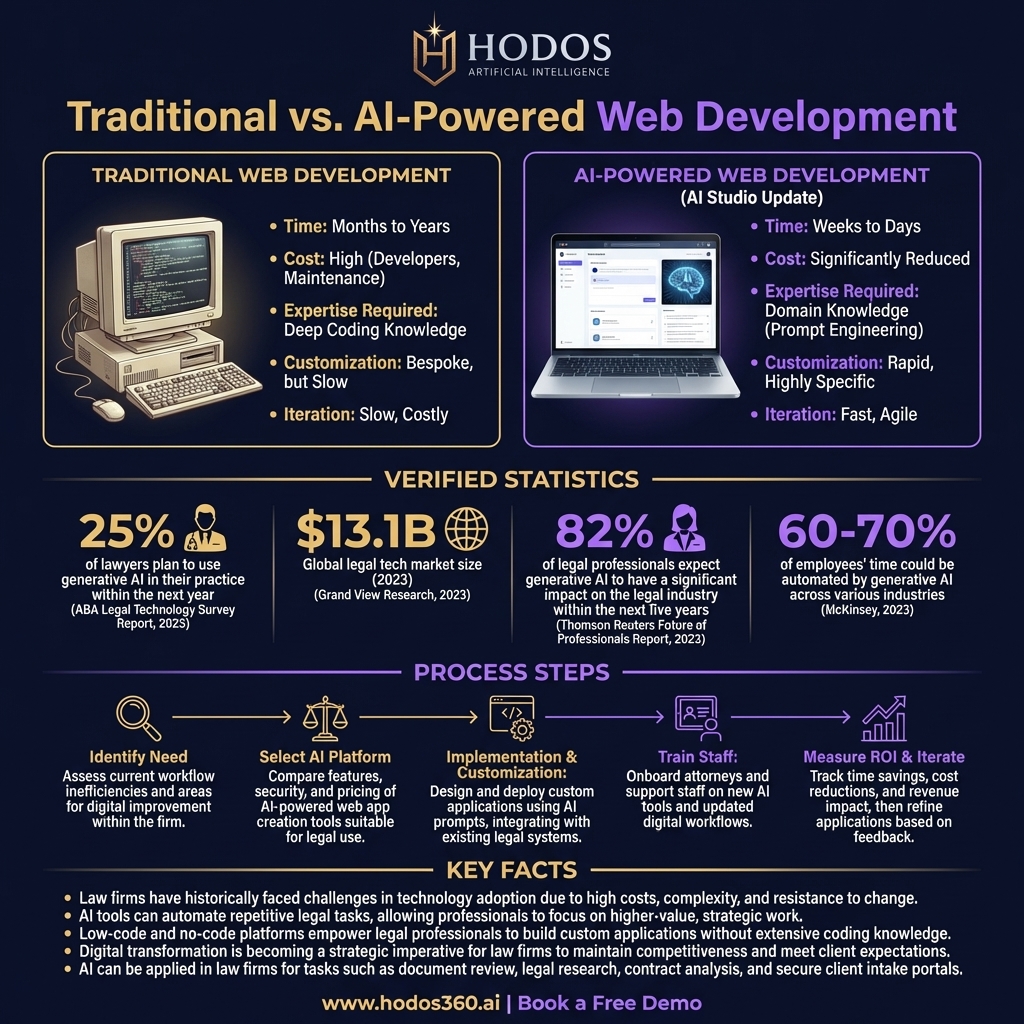
For decades, building sophisticated web applications was the exclusive domain of highly skilled software engineers. The process involved intricate coding languages like Python, Java, or JavaScript frameworks such as React and Angular, demanding months, if not years, of development cycles and substantial financial investment. Law firms, often late adopters of technology due to regulatory constraints and a preference for established methods, found themselves at a disadvantage.
Learn more about Legal AI Acquisition 2026: The New Era of Agentic Law Firms. Custom solutions for case management, document automation, or client portals were prohibitively expensive, leading many firms to rely on generic, one-size-fits-all software that rarely met their specific needs. This reliance on traditional development methodologies created a bottleneck, hindering innovation and preventing firms from fully leveraging digital capabilities to enhance service delivery and operational efficiency.
The advent of low-code and no-code platforms marked the first significant disruption to this traditional model. Companies like OutSystems and Bubble offered visual development environments, enabling users with minimal coding knowledge to build functional applications. While a substantial leap forward, these platforms often came with limitations in terms of scalability, customization, and integration with complex legal workflows.
Learn more about Strategic AI Tools Adoption: Essential Guide for Law Firms. They served as valuable tools for rapid prototyping and simpler applications, but the "last mile" of truly bespoke, deeply integrated legal solutions often still required traditional coding expertise. The market still yearned for a solution that combined ease of use with the power and flexibility of custom-coded applications, especially as client expectations for digital interaction continued to rise.
The recent AI Studio update from Google, described by MSN as a move to "make full web apps from simple prompts," signifies the true breakthrough in this evolution. This isn't merely an iteration of low-code; it's a paradigm shift driven by advanced large language models (LLMs) like Google Gemini.
These models can now interpret natural language commands, understand contextual requirements, and generate robust, production-ready code or even entire application architectures. Learn more about AI Legal Research: The Ultimate Guide to legalgain & Beyond. This capability fundamentally redefines the role of the developer and, more importantly, empowers domain experts—like attorneys—to directly translate their operational needs into functional software.
Instead of writing lines of code, a lawyer can articulate a need, such as "build a secure client portal that allows document uploads and appointment scheduling," and the AI generates the underlying structure and functionality.
The impact of this major upgrade extends far beyond mere convenience. It fosters an environment of rapid experimentation and innovation within legal tech. Firms can now test new service delivery models, automate niche legal processes, and create highly personalized client experiences with unprecedented agility. This responsiveness is critical in a competitive landscape where client satisfaction and operational efficiency are key differentiators.
Learn more about Voice Assistant Market: An Essential Guide for Law Firms. As Jensen Huang, CEO of NVIDIA, often emphasizes, the future of computing lies in enabling domain experts to leverage AI without becoming coding experts, and this AI Studio update is a stark realization of that vision within the legal sector.
Firms embracing this new paradigm will not just keep pace but will actively shape the future of legal service delivery.
Unpacking Google's AI Studio Update: A Game Changer for Legal Tech
Google's recent AI Studio update is a monumental leap, particularly in its capacity to generate "full web apps from simple prompts." This isn't a mere code snippet generator; it’s a comprehensive development environment powered by advanced versions of Google Gemini, offering a "vibe coding" experience that translates conceptual ideas into functional web applications.
Unlike previous iterations, which might have assisted with frontend design or backend logic in isolation, this major upgrade integrates the entire stack. From crafting user interfaces (UIs) and user experiences (UXs) to developing robust backend services and database structures, the AI orchestrates the entire process based on natural language inputs.
Learn more about AI Web Apps: Ultimate Legal Firms' Guide to Next-Gen Development. This level of holistic application generation is what truly sets it apart, positioning Google directly against rivals like Anthropic, whose Claude models have excelled in reasoning but perhaps not yet offered such an integrated development suite.
The update effectively lowers the barrier to entry for complex web development, enabling legal professionals to directly influence the creation of tools that perfectly align with their operational nuances.
At the core of this AI Studio update lies a sophisticated fusion of large language models (LLMs), code generation algorithms, and intelligent UI/UX frameworks. When a user inputs a prompt like "create a secure portal for family law clients to upload divorce documents and schedule consultations," the AI doesn't just search for existing templates.
Instead, it generates a unique application architecture, writes the necessary code in various programming languages, sets up database schemas, and even suggests authentication and authorization protocols tailored for legal security standards. Learn more about Voice AI Unleashed: Transforming Law Firms in 2026 with HODOS 360.
This process leverages Google's vast computational resources and its deep expertise in machine learning, allowing for rapid iteration and refinement. The ability to run complex models, even suggesting the possibility of running 397B models locally for enhanced privacy and speed, as some tech analysts have speculated, underscores the computational power at play.
The timing and scope of Google's AI Studio update clearly indicate a strategic move to "take on Anthropic" in the burgeoning generative AI market. While Anthropic has gained significant traction with its Claude models, particularly for their ethical AI framework and strong reasoning capabilities, Google's approach with this update focuses on practical, end-to-end application development.
Anthropic's recent launch of "Claude for Chrome," which allows AI to fully navigate and interact with web pages, showcased its prowess in contextual understanding and automation. However, Google's counter-move with the AI Studio update shifts the battleground towards creation rather than just interaction. As industry observer and venture capitalist Marc Andreessen noted, "The real winners in these AI wars are the enterprises that can harness these competing platforms to build their own competitive advantage."
This competitive dynamic accelerates innovation, benefiting legal professionals.
For law firms, the immediate benefits of this AI Studio update are multifold. Firstly, it drastically reduces the time and cost associated with custom software development. Firms can now rapidly prototype and deploy specialized tools for client intake, case management, document generation, and legal research without needing a team of dedicated developers.
Secondly, it empowers non-technical legal professionals to become creators, fostering a culture of innovation within the firm. Partners, associates, and paralegals can translate their intimate knowledge of legal workflows into functional applications. Thirdly, the enhanced capabilities of google ai in generating secure and robust applications address critical concerns around data privacy and compliance.
The simple prompts approach makes sophisticated web app creation accessible, ushering in an era of unprecedented digital autonomy for legal practices.
Streamlining Client Intake and Communication
One of the most immediate and impactful applications of the AI Studio update for law firms lies in streamlining client intake and communication. Consider the traditional intake process: manual form filling, disparate data entry across multiple systems, and often a slow, cumbersome back-and-forth for document collection.
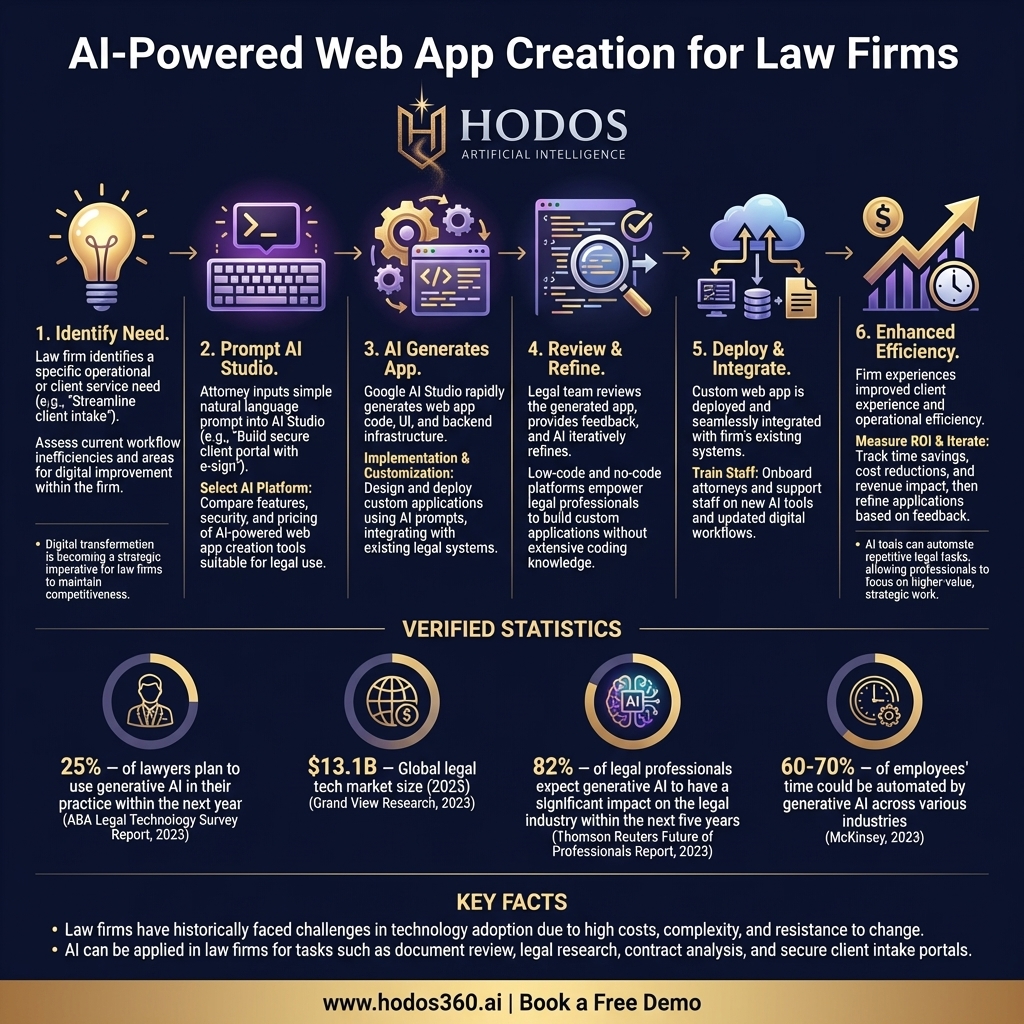
With the new AI Studio update, a firm can prompt the system to "build a secure, multilingual client intake web app that integrates with our CRM, allows document uploads, e-signatures, and automatically schedules an initial consultation." The AI can generate a sophisticated portal that guides prospective clients through a step-by-step process, collecting all necessary information and documents in a compliant and secure manner, dramatically cutting down the time from initial inquiry to retainer.
Beyond intake, the update facilitates the creation of bespoke communication hubs. Imagine a client portal that not only houses case documents but also provides real-time updates on case status, allows secure messaging with legal teams, and even offers AI-powered FAQs to answer common queries 24/7. This level of proactive, integrated communication, easily built with simple prompts, can drastically reduce the volume of inbound calls and emails, freeing up legal professionals for higher-value tasks.
Furthermore, the multilingual support capabilities inherent in Google's underlying AI models mean firms can cater to a diverse client base without additional translation services, ensuring equitable access to justice. This direct, transparent, and efficient communication fosters trust and strengthens client relationships.
Practical Applications: Web Apps for Law Firm Efficiency
While client intake and communication are obvious wins, the versatility of the AI Studio update extends far deeper into the operational fabric of a law firm. Consider the challenge of managing vast repositories of legal documents, ensuring compliance, and extracting critical information. With this major upgrade, firms can develop custom web applications for automated document review, leveraging google ai to quickly identify relevant clauses, flag anomalies, and ensure adherence to specific regulatory frameworks like GDPR or CCPA.
For instance, a firm specializing in corporate law could build an app that automatically reviews M&A contracts for specific indemnification clauses or intellectual property assignments, a task that traditionally consumes hundreds of billable hours, transforming document-intensive processes into efficient, AI-augmented workflows.
Another critical area ripe for transformation is case management and legal workflows. Existing practice management software, while functional, often lacks the bespoke customization required for highly specialized practices. The AI Studio update enables firms to create tailored case management modules that perfectly mirror their unique processes.
A personal injury firm, for example, could design an app to track medical records, lien statuses, and settlement negotiations with unprecedented granularity, integrating seamlessly with existing calendaring and billing systems. Similarly, a real estate law firm could build an application to automate property deed transfers, title searches, and escrow management, significantly reducing processing times and human error.
This level of customization, achievable through simple prompts, ensures that the technology truly serves the firm's specific needs.
The ability to generate custom web apps also opens new avenues for specialized legal research and knowledge management. Imagine an internal web app, built with the AI Studio update, that aggregates data from various legal databases, court dockets, and academic journals, presenting it in a customized, intuitive interface tailored to a specific practice area.
For instance, an environmental law practice could develop a tool that tracks evolving regulatory changes across multiple jurisdictions and alerts attorneys to potential compliance risks. This goes beyond simple search engines; it's about creating intelligent, context-aware research assistants that learn from the firm's specific cases and preferences.
Such tools not only enhance the quality of legal advice but also significantly reduce the time spent on routine research, a significant cost factor for clients.
As law firms increasingly leverage these powerful AI tools, the ethical considerations and compliance requirements become paramount. The AI Studio update, by offering robust control over the generated code and infrastructure, allows firms to embed ethical AI principles from the ground up. This includes designing for data privacy in accordance with regulations like HIPAA or the EU AI Act, ensuring transparency in AI decision-making, and implementing safeguards against bias.
For instance, when building an app for predicting litigation outcomes, firms can integrate explainability features that show the factors influencing the AI's prediction, aligning with the ABA Model Rules of Professional Conduct, particularly Rule 1.1 (Competence) and Rule 1.6 (Confidentiality of Information). This ensures AI-powered web apps adhere to the highest standards of legal and ethical practice.
Advanced Document Automation and Case Management
Document automation, while not new, reaches a new zenith with the capabilities unlocked by the AI Studio update. Firms can move beyond basic template merging to create dynamic, intelligent document generation systems. For example, a firm handling probate could prompt an app to "generate a complete set of estate planning documents based on client inputs, including wills, trusts, and powers of attorney, ensuring compliance with [State Specific Law]."
The AI can then assemble complex documents, incorporating jurisdictional nuances, pulling relevant data from client profiles, and even suggesting alternative clauses based on best practices or recent case law. This not only drastically reduces the time spent on drafting but also minimizes errors, leading to higher quality work product and reduced malpractice risk.
True integrated case management goes beyond merely tracking deadlines. With the AI Studio update, firms can build bespoke systems that intelligently link disparate data points—client communications, billing records, court filings, research notes—into a unified, contextualized view. Imagine a custom dashboard that not only shows upcoming deadlines but also flags potential conflicts of interest, identifies patterns in opposing counsel's tactics from past cases, or suggests optimal resource allocation based on historical project data.
This predictive and analytical layer, powered by google ai, transforms case management from reactive tracking to proactive strategic planning. The flexibility to create such specific, interwoven applications ensures that every aspect of a case, from initial client contact to final resolution, is managed with optimal efficiency and insight.
Navigating the Competitive Landscape: Google, Anthropic, and the Future of AI
The current landscape of AI development is characterized by intense competition and rapid innovation, with tech giants like Google and OpenAI, alongside well-funded startups like Anthropic, vying for supremacy. The recent AI Studio update from Google is a direct strategic move in this high-stakes game.
Dario Amodei, CEO of Anthropic, has often emphasized the importance of Constitutional AI and safety, building a reputation for ethical and robust models like Claude. OpenAI, under the leadership of Sam Altman, has pushed the boundaries with GPT models, demonstrating incredible versatility from content generation to complex problem-solving.
Google’s response, particularly with this major upgrade to its AI Studio, indicates a pivot towards empowering developers and domain experts with creation tools, making the power of google ai more accessible. This competitive tension is not just about market share; it's about defining the future architecture of digital interaction and productivity, a future that will profoundly impact the legal sector.
The ability to "make full web apps from simple prompts" is a critical differentiator in this competitive race. It democratizes development in a way that even sophisticated LLMs focused on reasoning, like Anthropic's Claude, haven't fully achieved in the application building space. While Claude excels at understanding complex instructions and generating coherent text or code snippets, Google's AI Studio update focuses on the entire application lifecycle, from conception to deployment, with minimal manual coding.
This approach directly addresses a major pain point for businesses, including law firms, that lack in-house development expertise but have clear needs for custom digital tools. The ease of use and speed of development offered by this update could significantly accelerate the adoption of AI-powered solutions across industries, giving Google a substantial advantage in the battle for enterprise mindshare.
Beyond core AI models, the battle extends to ecosystem integration. Google's existing suite of cloud services, developer tools, and vast data infrastructure provides a powerful backbone for its AI Studio update. The ability to seamlessly integrate newly created web apps with Google Workspace, Google Cloud services, and other APIs offers a compelling value proposition for firms already embedded in the Google ecosystem.
This contrasts with smaller, albeit innovative, players who might struggle with the breadth of integrations. For law firms, this means that the web apps built with the AI Studio update can communicate effortlessly with their existing calendars, document storage, and communication platforms, creating a cohesive digital environment.
This comprehensive integration capability is a key factor in the long-term viability and utility of these AI-powered development tools for legal professionals.
The ongoing AI race means that law firms must stay vigilant about emerging technologies. The capabilities demonstrated by Google with this AI Studio update are just the beginning. We can expect further advancements in AI's ability to understand context, generate more complex and resilient code, and even self-correct errors in application development.
The trend points towards increasingly autonomous development environments where AI acts as a co-pilot, or even a primary builder, for digital products. For legal tech, this translates into an accelerating pace of innovation, where firms can continuously refine and enhance their digital tools. The firms that invest in understanding and leveraging these advancements, such as those offered by HODOS 360's Web & Mobile Development services, will be best positioned to thrive in a future where digital agility is synonymous with legal excellence.
Ethical Considerations in AI-Powered Web Development
As AI takes on a more prominent role in web app creation for legal contexts, critical ethical considerations surrounding bias and transparency come to the forefront. AI models are trained on vast datasets, and if those datasets contain historical biases—whether in legal precedents, demographic data, or language—the applications generated by AI can inadvertently perpetuate or even amplify those biases.
For instance, an AI-generated app for predicting bail outcomes might disproportionately impact certain demographics if the training data reflects systemic inequalities. The AI Studio update provides tools for developers to scrutinize and refine the generated code, but firms must proactively implement rigorous auditing processes. This aligns with the principles outlined in the EU AI Act, which emphasizes transparency, human oversight, and accountability for high-risk AI systems.
Data privacy and security are non-negotiable in the legal sector. The AI Studio update allows for the creation of highly secure web applications, but the responsibility for ensuring compliance with regulations like HIPAA, CCPA, and various state bar rules ultimately rests with the law firm.
When building client portals or internal tools that handle sensitive information, firms must ensure that data encryption, access controls, and data residency requirements are meticulously implemented. The ability to generate custom code means firms can integrate specific security protocols that generic solutions might lack. However, it also demands a higher level of vigilance in verifying the security posture of AI-generated components.
Adherence to ABA Model Rule 1.6 (Confidentiality of Information) and 1.1 (Competence) dictates that lawyers maintain technological proficiency to protect client data.
- ✓Rapid Prototyping: Quickly conceptualize and deploy web apps for specific legal needs, dramatically cutting development time from months to weeks.
- ✓Cost Reduction: Significantly lower the expenditure on custom software development by minimizing the need for extensive coding and external development teams.
- ✓Enhanced Customization: Create bespoke client portals, case management systems, and internal tools perfectly aligned with unique firm workflows and client requirements.
- ✓Improved Client Experience: Offer modern, secure, and intuitive digital interfaces for client intake, communication, and document sharing, fostering greater satisfaction.
- ✓Operational Efficiency: Automate repetitive tasks like document generation, data entry, and compliance checks, freeing legal professionals for higher-value strategic work.
- ✓Competitive Edge: Differentiate your firm in the market by leveraging cutting-edge AI technology to deliver innovative services and streamline internal processes.
- ✓Empowered Non-Developers: Enable attorneys and paralegals to actively participate in the creation of digital tools, translating their domain expertise directly into functional applications.

Key Takeaways and Next Steps
The AI Studio update from Google marks a pivotal moment in the evolution of legal technology, transforming web application development from a specialized coding endeavor into an accessible, prompt-driven process. As we’ve explored, this major upgrade empowers law firms to rapidly build custom digital solutions—from secure client intake portals to advanced document automation systems—with unprecedented speed and efficiency.
The ongoing competition between giants like Google and Anthropic is fueling this innovation, pushing the boundaries of what AI can achieve in real-world applications. For law firms, this means moving beyond generic software and embracing bespoke tools that precisely address their operational nuances and client demands.
The era of the "citizen developer" in legal tech is truly upon us, allowing legal professionals to directly shape their digital future. This shift is not merely about adopting new tools; it's about fundamentally rethinking how legal services are delivered and managed in a digitally-first world.
For law firm leaders and legal professionals, the immediate imperative is to actively explore and understand these new capabilities. Begin by identifying key pain points within your firm that could be alleviated by a custom web application. Could a more intuitive client intake portal improve efficiency?
Could an AI-powered tool streamline discovery document review? Consider pilot projects to experiment with the AI Studio update or similar AI-powered development platforms. Investing in training for your team, not necessarily in coding, but in prompt engineering and understanding AI's capabilities, will be crucial. This proactive approach will allow your firm to harness the power of google ai and similar advancements, ensuring you remain competitive and efficient.
The legal landscape is shifting rapidly, and adaptability to these technological currents is no longer optional but essential for sustainable growth, as highlighted in the 2025 ABA TechReport.
Embracing these advancements requires strategic guidance and expertise. HODOS 360 is at the forefront of this transformation, offering specialized Web & Mobile Development services designed to help law firms leverage AI-powered platforms like Google's AI Studio update. Our team assists firms in conceptualizing, designing, and deploying custom web applications that are secure, compliant, and perfectly tailored to your unique practice needs.
We bridge the gap between cutting-edge AI and practical legal application, ensuring your firm maximizes the benefits of these innovations without the steep learning curve. The future of legal practice is digital, and with tools like the AI Studio update, combined with expert guidance, your firm can lead the way.
Ready to transform your firm's digital strategy and build the next generation of legal web applications? Contact HODOS 360 today for a personalized consultation and a free demo.
Frequently Asked Questions
What is the significance of Google's AI Studio update for law firms?+
The AI Studio update allows law firms to build custom web applications using simple natural language prompts, eliminating the need for extensive coding. This means faster development of client portals, case management tools, and document automation systems, significantly reducing costs and increasing operational efficiency. It democratizes technology creation for legal professionals, enabling them to tailor solutions precisely to their firm's unique needs without a large technical team.
How does this update compare to traditional web development or low-code platforms?+
Unlike traditional coding, which requires deep technical expertise, or low-code platforms that offer limited customization, Google's AI Studio update leverages advanced AI to generate full, robust web apps from simple descriptions. This offers unparalleled speed, flexibility, and the ability to create highly specialized legal tools tailored to a firm's exact needs, bridging the gap between ease of use and powerful functionality. It's a leap from template-based solutions to intelligent, generative development.
What kind of web applications can law firms build using this AI Studio update?+
Law firms can build a wide range of applications, including secure client intake portals, customized case management dashboards, automated document generation systems, internal knowledge management platforms, specialized legal research tools, and compliance trackers. The possibilities are vast, limited only by the firm's specific operational needs and the clarity of the prompts provided, allowing for truly bespoke solutions.
Are there ethical considerations for law firms using AI-generated web apps?+
Yes, ethical considerations are crucial. Firms must ensure AI-generated apps comply with data privacy regulations (e.g., HIPAA, CCPA), avoid algorithmic bias, and maintain transparency in AI decision-making. Legal professionals have a duty to understand the AI's limitations and ensure human oversight, aligning with ABA Model Rules of Professional Conduct regarding competence and client confidentiality. Proactive auditing and ethical design are paramount.
How can law firms ensure the security of client data when using AI-powered web development tools?+
While the AI Studio update helps generate robust code, firms must implement their own security best practices. This includes strong access controls, end-to-end encryption, regular security audits of AI-generated components, and ensuring data residency aligns with compliance requirements. Partnering with experienced legal tech providers can help integrate these safeguards effectively, ensuring that sensitive client information is protected in accordance with legal and ethical obligations.
What is "prompt engineering" and why is it relevant for attorneys using AI Studio?+
Prompt engineering is the art and science of crafting effective inputs (prompts) to guide AI models to generate desired outputs. For attorneys using AI Studio, mastering prompt engineering means clearly articulating their web app requirements in natural language, ensuring the AI understands the legal context, desired features, and security protocols. This skill is vital for maximizing the utility and accuracy of AI-generated applications, translating legal expertise directly into functional tech.