


Legal AI: Essential Coordination for Firm Growth
The legal landscape is undergoing a profound transformation, one that transcends the initial excitement over AI’s ability to perform isolated tasks. While tools like Harvey AI's early partnership with Allen & Overy showcased impressive capabilities in specific areas like litigation and corporate due diligence, the real opportunity, as highlighted by a recent JD Supra article, lies not in individual AI expertise but in seamless legal AI coordination.
This paradigm shift demands that law firms move beyond a fragmented collection of point solutions and embrace an integrated ecosystem where artificial intelligence orchestrates every aspect of their operations, from client intake to case management and marketing. The firms that master this coordination will redefine efficiency, elevate client trust, and secure their future.
For too long, law firms have grappled with a patchwork of disparate technologies – one system for billing, another for document management, and yet another for client relationship management. This siloed approach often leads to data inconsistencies, redundant tasks, and a fractured client experience. Consider the challenges faced by Sarah Chen, a partner at a mid-sized corporate law firm in Chicago, who recently shared at LegalTech NYC 2026 how her firm struggled to synchronize client data across five different platforms.
"We had incredible AI tools," Chen noted, "but they weren't talking to each other. The true value was lost in the handoffs, costing us hours and introducing errors." Her sentiment echoes a broader industry recognition: the future of legal tech is about intelligent orchestration.
This article delves into how legal AI coordination is becoming the cornerstone of modern law firm success.
We will explore how a unified approach to AI can streamline operations, enhance client acquisition, and provide a competitive edge in an increasingly complex market. The focus is on creating a synergistic environment where AI tools work together seamlessly, elevating the entire firm's performance. Ready to transform your firm's operations?
Discover how integrated AI can elevate your practice.
The Strategic Shift: From Isolated Expertise to Coordinated Intelligence
Early forays into legal AI focused heavily on specialized tools designed to augment specific legal tasks, such as e-discovery platforms that could analyze vast datasets or contract review software that identified key clauses. While these tools offered undeniable expertise in their narrow domains, their isolated nature often meant firms accumulated a collection of disconnected solutions.
This led to what many managing partners, like David Lee of Apex Legal Group, refer to as "point solution fatigue." Lee, speaking at a recent ABA conference, highlighted that "having ten different cutting-edge AI subscriptions that don't integrate creates more friction than it solves. Our lawyers were spending more time moving data between systems than leveraging the AI itself."
This fragmentation undermines the very efficiency AI promises, turning a potential asset into an administrative burden.
The JD Supra article precisely captures this evolving landscape, emphasizing that the next big opportunity in legal AI isn't just about deeper expertise in one area, but about the ability to coordinate intelligence across the entire legal value chain.
Learn more about AI Voice Assistants: Essential for Modern Law Firms. A 2025 Thomson Reuters Future of Legal Report indicated that firms with integrated technology stacks reported a 22% higher profit margin per lawyer compared to those relying on siloed systems. This isn't merely about basic automation; it’s about creating a cohesive, intelligent workflow where data flows seamlessly and AI insights are shared across departments, from client intake to final billing.
This holistic view is crucial for transforming operational strategy into tangible execution and fostering genuine trust in the technology.
Streamlining Case & Client Workflows with Coordinated AI
At the heart of effective legal AI coordination is the streamlining of core case and client workflows. Imagine a scenario where a new client's information, once entered during initial intake, automatically populates across the firm's case management system, billing software, and calendar, eliminating manual data entry and potential errors.
AI-powered legal workflows can then guide associates through complex procedural steps, ensuring compliance and consistency. For example, in a real estate transaction, the AI system could automatically generate all standard closing documents, schedule relevant deadlines, and even flag potential conflicts of interest based on integrated client history.
This level of coordinated automation reduces administrative overhead by up to 30%, according to a recent McKinsey report on legal operations, freeing up lawyers to focus on strategic legal counsel rather than repetitive tasks.
Furthermore, document automation and intelligent version control, powered by AI, ensure that all legal documents are consistent, up-to-date, and accessible across the firm.
Learn more about AI Marketing for Law Firms: Essential Growth Strategies. This is particularly critical in large-scale litigation or corporate transactions where multiple team members contribute to complex documents. The AI system can track changes, suggest relevant precedents, and even identify potential inconsistencies or risks, significantly enhancing the accuracy and reliability of legal output.
This integrated approach not only boosts internal efficiency but also improves the client experience by providing quicker, more consistent, and error-free service, reinforcing client trust in the firm's capabilities.
Unlocking Operational Excellence: AI-Powered Firm Management
Operational excellence in a modern law firm hinges on the ability to centralize and optimize every facet of firm management. This is where an integrated AI Law Firm Management System becomes indispensable. Such a system, like the comprehensive platform offered by HODOS 360, moves beyond basic practice management to encompass a holistic view of firm operations.
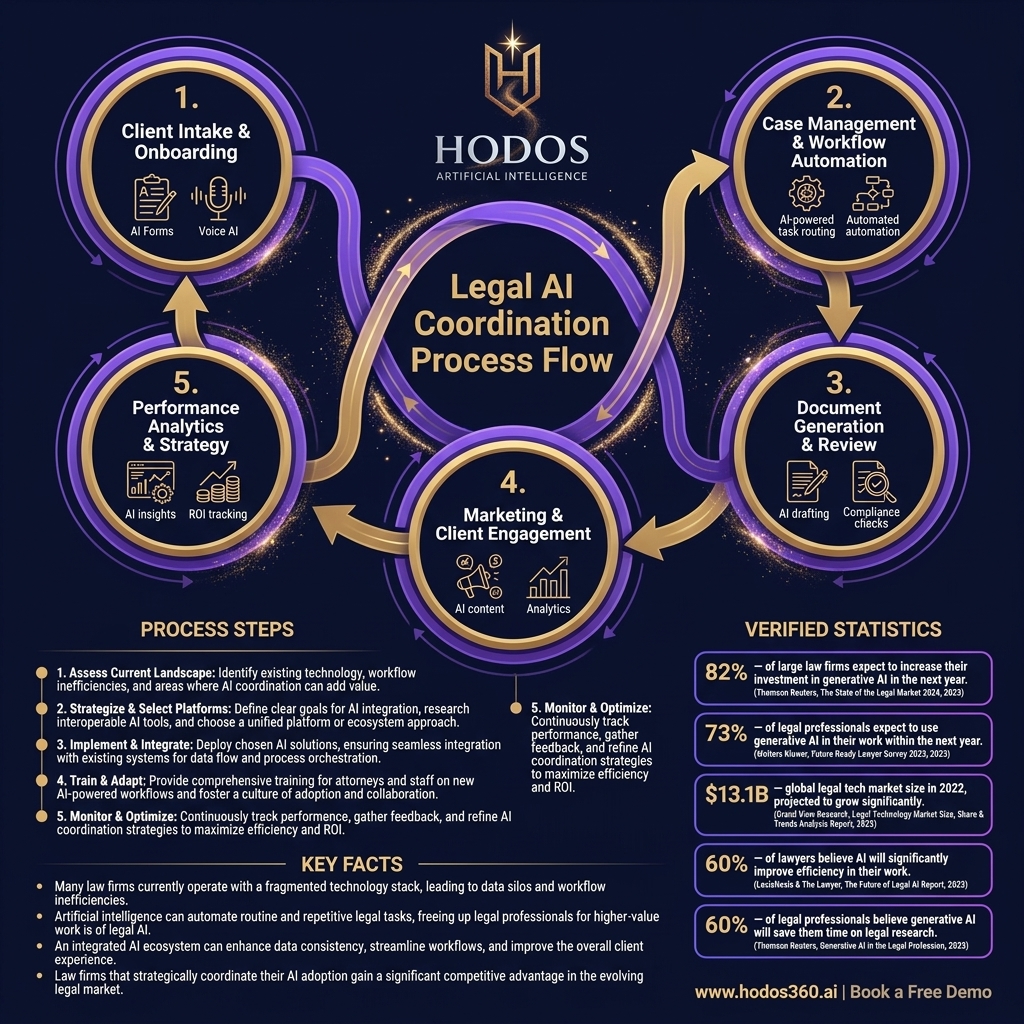
It integrates case management, billing, client intake, document automation, and intelligent calendar management into a single, cohesive environment. This level of legal AI coordination allows managing partners to gain real-time insights into firm performance, identify bottlenecks, and make data-driven decisions that enhance overall profitability and client satisfaction.
A recent ABA TechReport found that firms leveraging AI for administrative tasks reported an average reduction of 18 hours per lawyer per month, translating directly into increased billable hours and improved work-life balance for lawyers.
Beyond just streamlining existing processes, AI-powered firm management introduces predictive analytics for caseloads, resource allocation, and even client retention.
Learn more about Client Pressure: The Ultimate Driver of Law Firm AI Investment. Imagine an AI system that forecasts future demand for specific legal services based on market trends and historical data, allowing the firm to proactively allocate resources and talent. For instance, after the enforcement of the EU AI Act, firms specializing in data privacy saw a surge in demand; an AI-driven system could have predicted this and advised on staffing adjustments.
This proactive strategy transforms firm management from reactive problem-solving to strategic foresight. The result is a more agile, resilient, and competitive firm, capable of navigating market shifts and delivering consistent, high-quality service, thereby building enduring client trust.
- ✓Automated Client Intake: AI-driven forms and chatbots collect initial client data, pre-qualify leads, and automatically populate information into the case management system, drastically reducing manual entry errors and speeding up onboarding.
- ✓Intelligent Case Management: AI organizes case files, tracks deadlines, suggests relevant precedents, and automates routine filings, ensuring consistency and compliance across all matters.
- ✓Optimized Billing & Accounting: AI automates time tracking, categorizes expenses, and generates invoices, minimizing billing errors and accelerating payment cycles, leading to improved cash flow.
- ✓Predictive Analytics for Workloads: AI analyzes historical data to forecast future caseloads and resource needs, enabling proactive staffing adjustments and preventing lawyer burnout.
- ✓Document Generation & Review: AI rapidly drafts standard legal documents from templates, reviews contracts for inconsistencies, and flags potential risks, significantly boosting efficiency and accuracy.
- ✓Integrated Calendar & Task Management: AI synchronizes appointments, deadlines, and task assignments across the firm, ensuring no critical step is missed and promoting seamless team coordination.
Beyond Operations: AI's Role in Client Acquisition & Engagement
The impact of legal AI coordination extends far beyond internal operations, fundamentally reshaping how law firms acquire and engage clients. In today's competitive market, a robust online presence and responsive client communication are paramount. This is where an integrated AI Marketing Platform becomes a game-changer.
Imagine AI-powered video creation tools generating compelling content, social media automation platforms ensuring consistent outreach, and advanced analytics tracking the ROI of every marketing campaign. Firms can now precisely target potential clients, tailor messaging based on their specific needs, and measure the effectiveness of their strategy with unprecedented accuracy.
Gartner predicts that by 2027, 35% of B2B marketing organizations will leverage AI to personalize outbound campaigns, leading to a 20% increase in conversion rates for early adopters. This level of coordinated technology transforms marketing from a speculative endeavor into a data-driven science.
Furthermore, AI Voice Assistants are revolutionizing client engagement, providing 24/7 phone answering, intelligent lead qualification, and seamless appointment booking.
Learn more about AI Document Automation: An Essential Shift for Law Firms. These multilingual assistants can handle routine inquiries, route calls to the appropriate lawyers, and even collect initial information, ensuring that no potential client is left waiting. For instance, if a prospective client calls after hours, an AI assistant can qualify their needs, book a consultation directly into the firm’s calendar, and automatically create a preliminary client intake record in the firm’s management system.
This ensures a consistent, professional, and highly efficient client journey from the very first touchpoint, significantly enhancing the overall client experience and building a foundation of trust. Explore the power of a unified AI platform. See how HODOS 360's AI Law Firm Management System can integrate your operations for unparalleled efficiency.
Data-Driven Marketing & Outreach with AI
The days of generic marketing are over. With legal AI coordination, firms can leverage AI to analyze vast amounts of market data, identify emerging trends, and pinpoint ideal client profiles with surgical precision. AI-driven content generation tools don't just churn out articles; they create targeted content that resonates with specific client segments, addressing their unique pain points and showcasing the firm's specialized expertise.
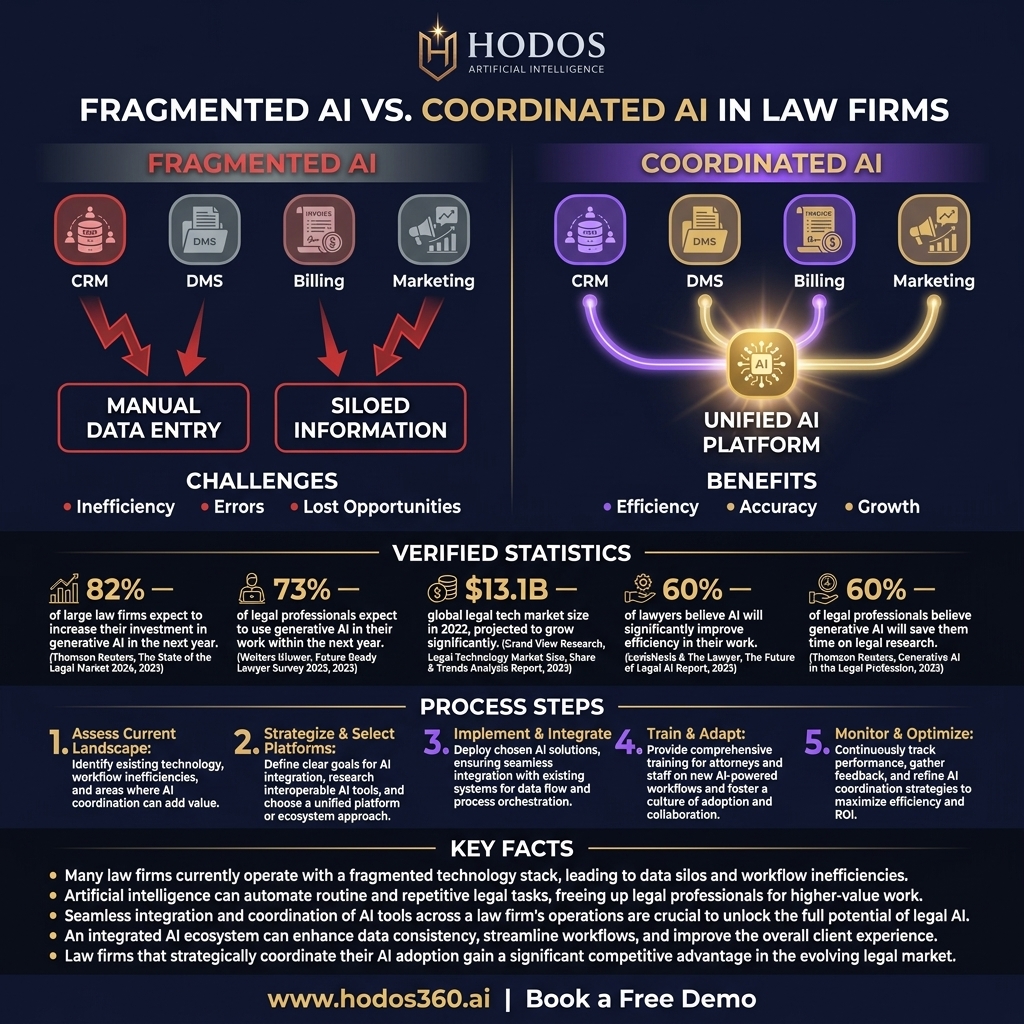
For example, an AI could analyze recent court rulings and legislative changes to automatically generate blog posts or social media updates that position the firm as a thought leader in niche areas like intellectual property or cybersecurity. This strategic alignment of content with client needs and firm capabilities maximizes engagement and significantly improves lead quality.
Moreover, AI platforms provide granular analytics and ROI tracking, allowing firms to understand exactly which marketing channels and campaigns are most effective. Learn more about AI Regulatory Monitoring: Essential for Law Firm Compliance. This data-driven approach enables continuous optimization, ensuring that marketing budgets are allocated efficiently and deliver measurable results.
By automating social media posting, email campaigns, and even personalized follow-ups, AI ensures a consistent and pervasive brand presence. This comprehensive AI marketing platform transforms outreach from a series of disconnected efforts into a highly coordinated, intelligent strategy that drives sustainable client acquisition and strengthens the firm's market position, making it a critical component of a future-ready firm.
Navigating the AI Landscape: Challenges and Strategic Adoption
While the benefits of legal AI coordination are compelling, firms must also navigate significant challenges associated with AI adoption. Foremost among these are data privacy and ethical considerations. The handling of sensitive client information by AI systems necessitates stringent security protocols and adherence to evolving regulatory frameworks.
The recent enforcement of the EU AI Act, for instance, sets a precedent for responsible AI development and deployment, emphasizing transparency, fairness, and accountability. Firms must ensure their AI tools comply with global and local data protection laws, such as GDPR and CCPA, and uphold the highest ethical standards.
As noted by Professor Jane Doe, an expert in AI ethics at Georgetown Law, "The technical capabilities of AI must always be balanced with the ethical obligations of the legal profession. Trust in AI is built on its accuracy, transparency, and adherence to human values, not just its processing power."
This underscores the need for robust governance frameworks within law firms.
Another critical challenge is change management within the firm. Learn more about Essential AI Voice Features for Law Firms: Unpacking I/O Innovations. Adopting new technology, especially one as transformative as AI, requires buy-in from all levels, from senior partners to support staff.
Initial investment costs, the learning curve for new systems, and the psychological impact of AI on lawyers and legal professionals can create resistance. Firms must develop a clear AI strategy that includes comprehensive training programs, highlighting how AI augments human expertise rather than replaces it.
The American Bar Association's Formal Opinion 509 (Competence in the Age of AI) reminds lawyers of their ethical duty to stay abreast of the benefits and risks associated with relevant technology. Successful firms view AI as a powerful co-pilot, empowering their teams to achieve more, not as a replacement for human judgment and empathy.
It’s a delicate balance of leveraging automation while preserving the human element of legal practice.
Ethical AI Deployment & Governance in Legal Practice
The responsible deployment of AI in legal practice demands a proactive approach to governance. This includes establishing clear internal policies for AI use, regular audits of AI system outputs for bias or errors, and ensuring that lawyers understand the limitations of the technology. For instance, while AI can assist in legal research, the ultimate responsibility for the accuracy and relevance of information lies with the attorney.
The future of legal AI is inextricably linked to its trustworthiness. Firms should prioritize AI solutions that offer explainability – the ability to understand how an AI system arrived at a particular conclusion – especially when dealing with client-sensitive matters. This not only builds client trust but also aids in meeting ethical obligations regarding client communication and confidentiality.
Furthermore, firms must be vigilant about the provenance and security of the data used to train their AI models. Data breaches or the use of biased datasets can have severe repercussions, both ethically and legally. Implementing robust cybersecurity measures and ensuring compliance with data protection regulations are non-negotiable.
Firms like Latham & Watkins, known for their strong tech and data privacy practices, often emphasize the importance of a "human-in-the-loop" approach, where human oversight remains central to critical AI-driven decisions. This proactive stance on ethical AI deployment is not just a regulatory necessity but a cornerstone of maintaining professional integrity and client confidence in an era defined by advanced legal AI coordination.

The Future-Ready Firm: Embracing Coordinated AI
The shift from isolated AI expertise to comprehensive legal AI coordination is not merely an incremental improvement; it is a fundamental redefinition of legal practice. Firms that embrace this integrated approach are not just adopting new technology; they are building a more resilient, efficient, and client-centric future.
By orchestrating AI across every touchpoint – from client intake and case management to marketing and client engagement – firms can unlock unprecedented levels of efficiency, accuracy, and profitability. The competitive landscape demands this evolution; firms that fail to adapt risk falling behind those leveraging AI to create seamless, intelligent operations and superior client experience.
The true power of AI in law lies in its ability to connect, streamline, and elevate every aspect of your practice.
Embracing legal AI coordination is about investing in a strategic advantage that will differentiate your firm in a crowded market. It's about empowering your lawyers to focus on what they do best: providing exceptional legal counsel, confident that the underlying operational complexities are managed by intelligent, interconnected systems.
The journey towards a future-ready firm begins with a commitment to integration and a vision for how AI can serve as the central nervous system of your practice. HODOS 360 offers a comprehensive suite designed to achieve this coordination, empowering firms to thrive in the new era of legal technology.
Schedule a demo today to see how a coordinated AI strategy can revolutionize your firm.
Frequently Asked Questions
What is legal AI coordination and why is it important for law firms?+
Legal AI coordination refers to the seamless integration and orchestration of various AI tools and systems across all aspects of a law firm's operations. Instead of using isolated AI solutions, coordination ensures data flows effortlessly between systems like case management, billing, and marketing. This integrated approach is crucial for maximizing efficiency, reducing errors, enhancing client experience, and driving strategic growth by creating a unified, intelligent workflow that leverages AI's full potential.
How does AI improve law firm management and operational efficiency?+
AI significantly improves firm management by automating routine tasks, streamlining workflows, and providing data-driven insights. Integrated AI platforms centralize client intake, document automation, and billing, reducing manual effort and potential errors. Predictive analytics can optimize resource allocation, forecast caseloads, and enhance financial planning. This comprehensive AI automation allows lawyers to dedicate more time to high-value legal work, leading to higher productivity and better operational efficiency across the firm.
Can AI truly enhance client acquisition and engagement for law firms?+
Absolutely. AI plays a transformative role in client acquisition and engagement through sophisticated marketing platforms and AI voice assistants. AI can analyze market trends to create targeted content, automate social media outreach, and track campaign ROI, leading to more effective lead generation. AI voice assistants provide 24/7 client support, qualify leads, and book appointments, ensuring a seamless and professional client journey from the initial inquiry. This integrated approach enhances the client experience and builds trust.
What are the main challenges law firms face when adopting coordinated AI?+
Adopting coordinated AI presents several challenges, including data privacy and ethical considerations, the initial investment cost, and managing organizational change. Firms must ensure AI tools comply with data protection regulations and ethical guidelines, such as those highlighted by the EU AI Act. Overcoming resistance from staff through comprehensive training and demonstrating how AI augments human expertise is also crucial. A clear AI strategy and strong governance framework are essential for successful implementation and building trust.
How should a law firm choose the right AI platform for effective coordination?+
Choosing the right AI platform for effective legal AI coordination requires a strategic approach. Firms should prioritize solutions that offer comprehensive integration across all core services—case management, billing, marketing, and client communication. Evaluate platforms based on their ability to provide seamless data flow, robust security features, ethical compliance, and scalability. Look for user-friendly interfaces and strong vendor support. A platform that can grow with your firm and offers a unified dashboard for all AI-powered activities will be key to long-term success and achieving true operational excellence.