


Legal AI Coordination: An Essential Shift for Law Firms
The legal landscape, long resistant to radical technological shifts, is now experiencing a profound transformation, not merely through the introduction of artificial intelligence but through its strategic coordination. Consider the journey of Sarah Chen, managing partner at Chen & Associates, a mid-sized litigation firm in Sacramento.
For years, Sarah’s firm, like countless others, adopted a patchwork of disparate legal tech solutions: one for e-discovery, another for document review, a separate CRM for client intake, and a clunky billing system. Each tool, while powerful in its niche, operated in a silo, creating data fragmentation, redundant data entry, and bottlenecks that stifled productivity.
Lawyers and paralegals wasted precious hours toggling between applications, manually transferring information, and correcting inconsistencies—a common "Frankenstein stack" problem that plagued firms globally. This fragmentation, far from delivering on AI's promise, highlighted a critical missing piece: the ability for these intelligent systems to communicate, share context, and coordinate efforts autonomously.
The recent JD Supra article, "Legal AI's Next Big Opportunity: Coordination Over Expertise," perfectly encapsulates this paradigm shift, asserting that the true value of legal AI coordination lies not just in deep individual expertise, but in its ability to orchestrate complex legal processes seamlessly across an entire firm.
This insight is not merely theoretical; it is reshaping the competitive dynamics of the legal industry.
This evolution is driven by the growing recognition that isolated AI tools, no matter how sophisticated, cannot unlock the full potential of AI within the intricate ecosystem of a law firm.
The initial wave of legal AI, exemplified by early e-discovery platforms or contract analysis tools, focused intensely on specialized tasks, performing them with unprecedented speed and accuracy. However, as firms scaled and client demands grew more complex, the limitations of these siloed solutions became glaringly obvious.
The challenge wasn't a lack of intelligent tools, but a lack of intelligent integration. Firms like Sterling & Stone LLP, which initially invested heavily in best-of-breed individual solutions, found themselves drowning in administrative overhead as they tried to manually bridge the gaps between systems. This internal friction often negated the efficiency gains promised by the individual AI components.
The market is now demanding a more holistic approach, where AI acts as a central nervous system, connecting every facet of a firm's operations from initial client contact to final case resolution.
The move towards legal AI coordination signifies a fundamental re-evaluation of how law firms leverage technology to deliver legal services.
It’s about creating a unified digital environment where client data flows effortlessly from intake to case management, where documents are automatically generated and filed, and where billing is seamlessly integrated with time tracking and project progress. This integrated approach not only eliminates inefficiencies but also provides invaluable insights into firm performance, client satisfaction, and resource allocation.
Firms that embrace this coordinated strategy are not just adopting new tools; they are fundamentally redesigning their operational DNA to be more agile, responsive, and ultimately, more profitable. This transformation allows legal professionals to dedicate more time to high-value, client-facing work, elevating the overall quality of legal service delivery and ensuring that the promise of AI is fully realized across all aspects of legal practice.
Discover how HODOS 360's AI Law Firm Management System can bring unparalleled coordination to your practice.
The Evolution of Legal AI: From Siloed Expertise to Unified Platforms
The early narrative around legal AI often centered on its capacity to replicate human expertise in specific, narrow domains. Tools like ROSS Intelligence, which once aimed to be "the world's first AI lawyer," epitomized this focus on deep, specialized knowledge. While impressive in their ability to analyze vast legal databases and identify relevant precedents, these systems often functioned as sophisticated research assistants, detached from the broader operational context of a law firm.
They excelled at finding answers but struggled to integrate those answers into ongoing case workflows, client communications, or billing cycles. This era, characterized by what some experts like Brad Blickstein of the Blickstein Group termed "point solution proliferation," left many firms with an array of powerful but disconnected technologies, each requiring its own login, data input, and learning curve.
The promise of AI was there, but its execution was piecemeal, leading to a significant "integration gap" that hindered true transformation.
The shift towards legal AI coordination is a direct response to this integration gap. It acknowledges that a law firm is not a collection of independent tasks but an intricate web of interconnected processes.
Consider the workflow of a typical M&A transaction: it involves due diligence, contract drafting, regulatory filings, client communication, and financial tracking. If each of these components is handled by a separate AI tool that doesn't communicate with the others, the firm incurs significant overhead in translating and transferring information between systems.
This is where the concept of a unified platform, as championed by companies like Clio, with its ecosystem approach, and newer entrants focusing on end-to-end solutions, gains traction. These platforms aim to provide a single source of truth, where data entered once is accessible and actionable across all modules, from client intake to document management and billing, ensuring that AI-driven insights are not isolated but integrated into every stage of the legal service delivery.
This move from specialized tools to integrated platforms is not merely a technological upgrade; it represents a strategic reorientation for law firms. Learn more about AI Website Builder: Essential Strategies for Law Firm Growth. Firms that continue to rely on a fragmented tech stack risk falling behind competitors who leverage coordinated AI to achieve superior efficiency and client outcomes.
A recent Thomson Reuters report highlighted that firms utilizing integrated practice management solutions reported a 15% higher profitability margin compared to those with disparate systems. This data underscores the tangible financial benefits of a unified approach. Moreover, the human element cannot be overlooked. Lawyers and support staff often express frustration with inefficient systems, leading to burnout and reduced job satisfaction.
By streamlining workflows through legal AI coordination, firms can empower their teams, freeing them from repetitive administrative tasks to focus on higher-value legal analysis and client engagement. This fosters a more productive and fulfilling work environment, which is crucial for talent retention in a competitive market.
The ultimate goal of this evolution is to create a "smart firm" where AI acts as an invisible hand, orchestrating operations behind the scenes. This doesn't mean replacing human expertise but augmenting it, allowing lawyers to leverage AI for predictive insights, automated document generation, and intelligent case routing, while maintaining oversight and applying their unique judgment to complex legal challenges.
The future of legal AI is less about a single, all-knowing AI entity and more about a network of intelligent agents working in concert, each contributing to a seamless, efficient, and client-focused legal practice. This integrated vision is where the true competitive advantage lies, allowing firms to optimize every touchpoint of their service delivery.
From Siloed Tools to Unified Platforms
The transition from a myriad of independent software solutions to a cohesive, integrated platform represents a monumental shift in legal technology adoption. Historically, law firms often purchased software based on specific departmental needs—a powerful e-discovery tool for litigation, a dedicated contract management system for corporate, or a standalone CRM for business development.
While each tool might be best-in-class for its particular function, the lack of interoperability created digital islands within the firm. Data duplication became rampant, security vulnerabilities increased due to multiple access points, and the firm’s overall data intelligence remained fragmented. Learn more about Voice Search Optimization: The Ultimate Guide for Law Firms.
This "best-of-breed" strategy, while well-intentioned, inadvertently created more administrative burden than it alleviated, forcing human intervention to bridge the gaps between systems. This is precisely the operational friction that unified platforms aim to eliminate, offering a single, comprehensive environment where all data and workflows are intrinsically linked, fostering genuine legal AI coordination across the entire firm.
Ready to transform your firm's operations? Explore the integrated solutions offered by HODOS 360.
Streamlining Legal Operations with Integrated AI Workflows
The core promise of legal AI coordination is the radical streamlining of legal operations. This goes beyond automating individual tasks; it involves creating intelligent workflows that span multiple departments and functions, ensuring that every step of a legal process is optimized and interconnected. Take client intake, for example.
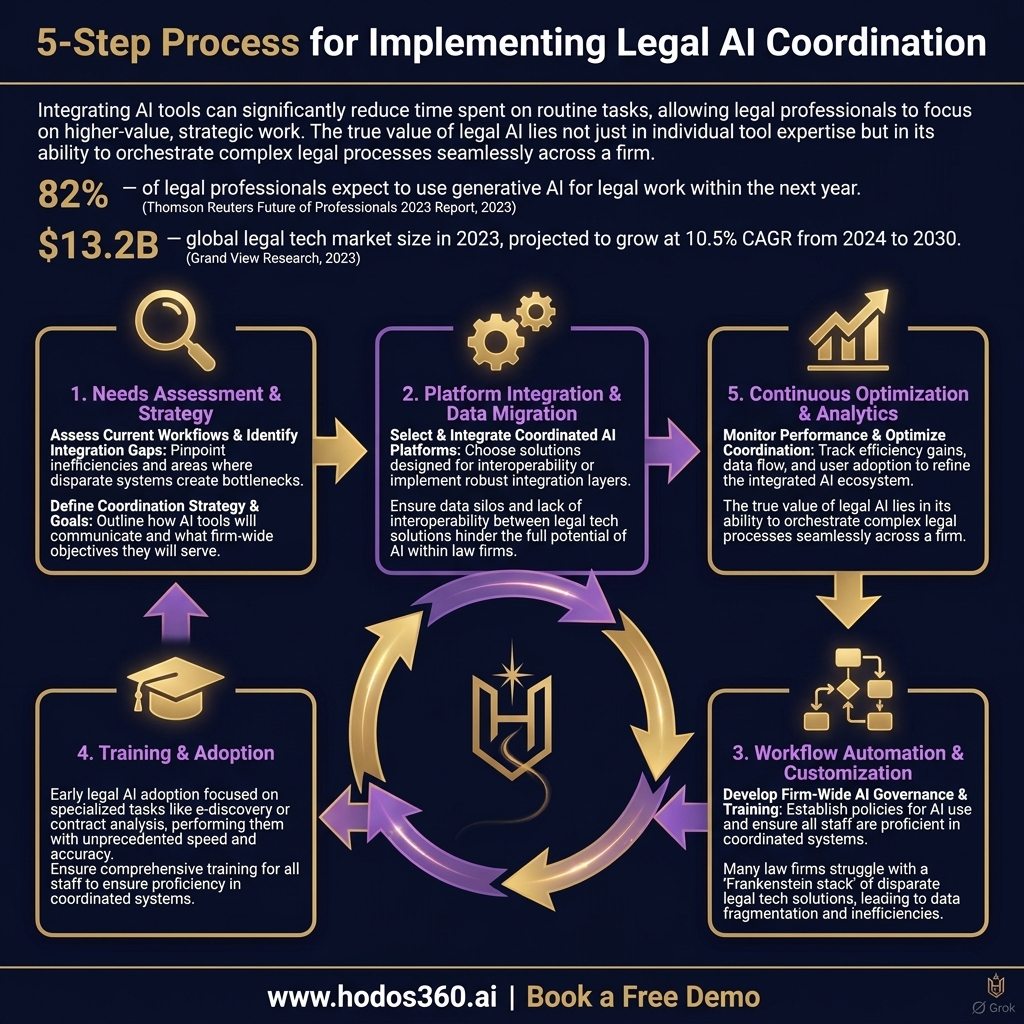
Traditionally, this involves manual data entry, forms, conflict checks, and initial document generation—a process prone to errors and delays. With a coordinated AI system, a prospective client's information can be captured once, automatically run through conflict checks, generate an engagement letter, populate a new case file, and even trigger initial billing setup, all without human intervention.
This not only dramatically reduces the time spent on administrative overhead but also significantly enhances the client experience, making the firm appear modern, efficient, and highly professional from the very first interaction. Firms like Baker McKenzie have been vocal about their investments in integrated platforms to manage their global client intake processes, citing improved accuracy and reduced onboarding times as key benefits.
Beyond intake, coordinated AI revolutionizes case management. Imagine an AI-powered system that not only tracks deadlines and court dates but also intelligently assigns tasks to team members based on their availability and expertise, monitors progress, and proactively flags potential issues. This level of oversight, often lacking in traditional systems, ensures that cases move forward smoothly and efficiently.
Document automation, a key component of this coordination, means that standard pleadings, contracts, and correspondence can be generated with a few clicks, pulling relevant client and case data directly from the unified platform. This capability, supported by AI-powered legal research and drafting tools, frees lawyers from the tedious work of drafting repetitive documents, allowing them to focus on strategic analysis and client advocacy.
The ABA's 2023 Legal Technology Survey Report noted a significant increase in firms adopting document automation tools, but highlighted that the most impactful gains were seen in firms where these tools were deeply integrated into broader case management systems.
The impact extends to financial management and resource allocation.
Learn more about Event Marketing: Essential Strategies for Live Events in the AI Era. Integrated AI workflows can automatically track billable hours, generate invoices, and reconcile payments, drastically reducing the administrative burden on accounting staff. Furthermore, by analyzing historical data on case types, durations, and resource consumption, coordinated AI can provide predictive insights into project costs and timelines.
This allows firms to provide more accurate estimates to clients, manage expectations more effectively, and optimize their resource allocation to maximize profitability. For instance, a firm might discover that certain types of cases consistently exceed their budget due to inefficient document review processes, prompting them to invest in more advanced, integrated e-discovery AI.
This data-driven decision-making is a hallmark of firms that have successfully implemented legal AI coordination.
Moreover, the integration of AI extends to the firm's marketing and client engagement strategies. A coordinated platform can track client interactions, identify cross-selling opportunities, and even automate personalized client communications based on their case progress or relevant legal updates.
For example, if a client's patent application reaches a certain stage, the system could automatically generate an update email, or suggest related services based on their industry. This proactive, intelligent client engagement strengthens relationships and fosters loyalty. By unifying client data, marketing efforts become more targeted and effective, allowing firms to measure the ROI of their marketing spend with greater precision.
This holistic approach ensures that AI is not just an internal efficiency tool but a strategic asset that drives business development and client satisfaction.
Enhanced Efficiency in Case Management and Billing
The operational backbone of any successful law firm lies in its ability to manage cases and process billing with precision and efficiency. Traditional methods often involve disparate systems, manual data entry, and a significant risk of human error, leading to delays, client dissatisfaction, and lost revenue.
Legal AI coordination transforms this landscape by integrating these critical functions into a seamless workflow. Imagine a system where, upon a case opening, all relevant client and matter data automatically populates, triggering conflict checks, generating initial documents, and setting up the billing structure. Learn more about Website Design Cost 2026: Strategic Investment for Law Firms.
As lawyers log their time, the system automatically categorizes it, applies billing rules, and prepares invoices, reducing the monthly billing cycle from days to hours. This not only minimizes administrative overhead but also ensures greater accuracy and transparency for clients, enhancing trust and streamlining financial operations.
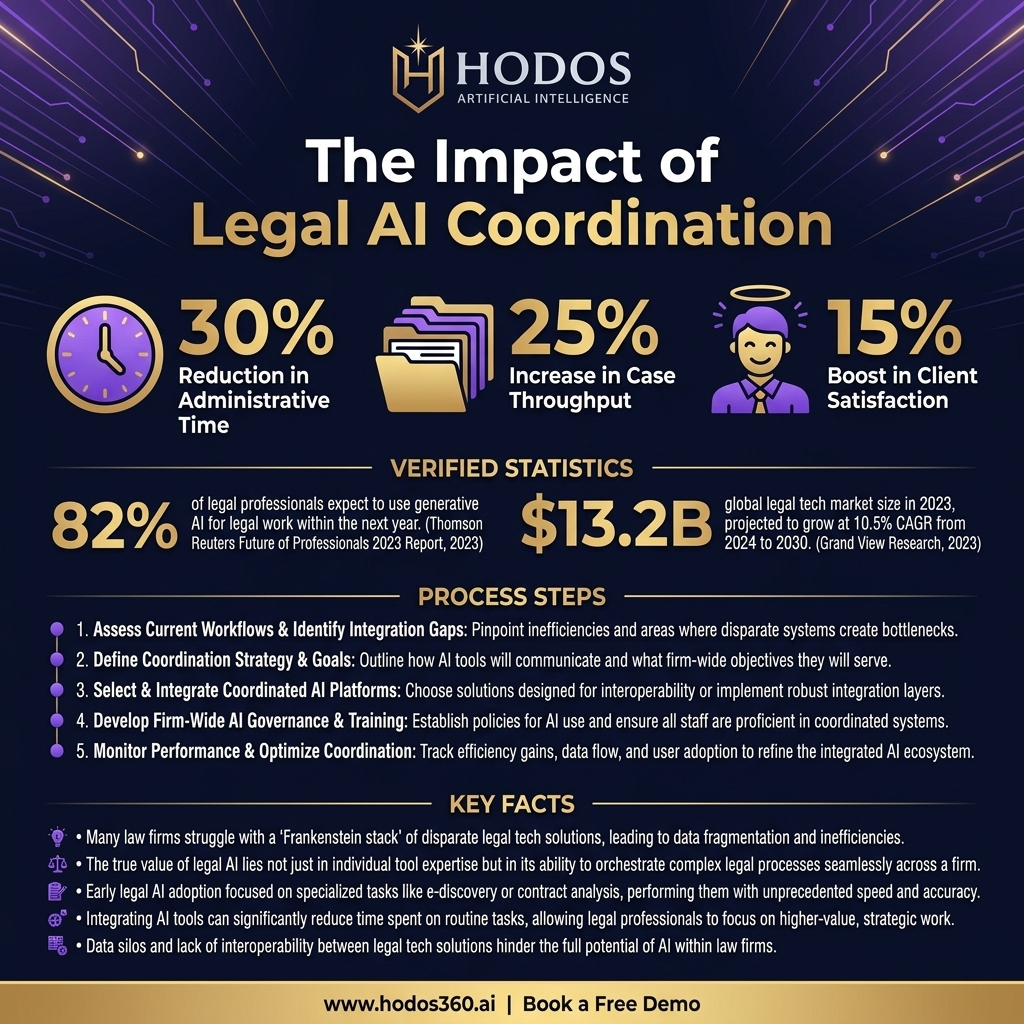
- ✓Enhanced Operational Efficiency: Automates repetitive tasks across departments, from client intake and conflict checks to document generation and billing, significantly reducing administrative overhead and freeing up valuable attorney time.
- ✓Improved Client Experience: Provides faster response times, personalized communications, and greater transparency through 24/7 AI assistants and automated case updates, fostering stronger client relationships and loyalty.
- ✓Data-Driven Decision Making: Centralizes firm data to enable advanced analytics, offering predictive insights into case outcomes, resource allocation, and market trends, informing strategic business development.
- ✓Optimized Resource Utilization: Intelligently allocates tasks, monitors project progress, and identifies bottlenecks, ensuring that legal professionals are deployed effectively and that cases stay on track.
- ✓Robust Compliance and Risk Management: Integrates compliance checks and ethical guidelines into workflows, reducing the risk of errors, ensuring adherence to professional rules (e.g., ABA Model Rule 1.6), and enhancing data security.
- ✓Accelerated Business Growth: Powers targeted AI marketing campaigns, identifies cross-selling opportunities, and provides the agility to expand into new practice areas, driving sustainable revenue growth.
- ✓Reduced Operational Costs: Minimizes manual effort, eliminates data duplication, and optimizes workflow, leading to significant cost savings across the firm's administrative and operational functions.
Driving Client-Centricity and Growth through Coordinated AI
In today's competitive legal market, client experience is paramount. Firms that prioritize client-centricity are the ones that thrive, and legal AI coordination is emerging as a powerful enabler of this strategy. When every aspect of a client's journey—from initial inquiry to ongoing case updates and final resolution—is managed through an integrated AI platform, the client experiences a level of responsiveness and transparency that sets the firm apart.
Imagine a client receiving automated, personalized updates on their case progress via their preferred communication channel, or having a 24/7 AI voice assistant available to answer routine questions and schedule appointments, freeing up human staff for more complex interactions. This continuous, intelligent engagement builds trust and strengthens the client-firm relationship, transforming what can often be a transactional interaction into a partnership.
The ability of coordinated AI to provide deeper insights into client needs and preferences is a significant growth driver. By analyzing aggregated data from client interactions, case outcomes, and service usage, AI platforms can identify trends, anticipate future legal needs, and even suggest proactive legal advice.
For instance, an AI system might identify that a significant portion of a firm’s corporate clients are facing similar regulatory challenges, prompting the firm to develop a new service offering or publish targeted content. This predictive capability allows firms to move beyond reactive service delivery to proactive, value-added legal counsel, positioning them as indispensable strategic partners.
Firms that leverage this intelligence are not just retaining clients; they are expanding their service offerings and capturing new market segments. The strategic advantage of this data-driven approach cannot be overstated in a market where differentiation is key.
Furthermore, legal AI coordination directly contributes to business development and marketing effectiveness.
By automating content generation for blogs and social media, creating AI-powered video explainers, and tracking the ROI of marketing campaigns, firms can reach a wider audience more efficiently and convert leads into clients more effectively. Learn more about AI Legal Research: The Ultimate Evolution of Legal Analysis.
Imagine an AI marketing platform that identifies ideal client profiles, crafts targeted ad campaigns, and even personalizes website content for different visitor segments. This level of precision ensures that marketing spend is optimized and generates a higher return. The integration of marketing data with case management and billing data provides a holistic view of the client lifecycle, allowing firms to understand which marketing channels are most effective at acquiring profitable clients and which services are most in demand.
This closed-loop feedback mechanism is crucial for sustainable growth.
The competitive landscape of the legal industry is intensely dynamic, with firms constantly seeking an edge. Those that adopt a coordinated AI strategy are not merely gaining incremental efficiencies; they are fundamentally reshaping their competitive position.
They can offer more competitive pricing due to reduced operational costs, provide faster turnaround times, and deliver a superior client experience. This allows them to attract and retain top talent, secure high-value clients, and expand into new practice areas with greater agility. As Professor John McGinnis of Northwestern Law School often discusses, the firms that master the integration of technology will be the ones that define the future of legal practice.
The drama of this transition lies in the stark contrast between firms that embrace this holistic transformation and those that cling to fragmented, outdated systems, risking obsolescence in an increasingly AI-driven world.
The Competitive Edge of Predictive Analytics
In an era where data is king, the ability to leverage predictive analytics offers a profound competitive advantage for law firms. Through legal AI coordination, firms can aggregate and analyze vast amounts of internal data—from historical case outcomes and billing records to client communication patterns and resource allocation.
This data, once siloed and underutilized, becomes a treasure trove of insights. Predictive analytics can forecast case durations, estimate litigation costs with greater accuracy, identify potential risks, and even predict client churn. Learn more about AI Studio Update: Essential Web App Creation for Law Firms.
For example, by analyzing past cases, an AI system might identify specific factors that lead to successful outcomes in intellectual property disputes, allowing attorneys to tailor their strategies accordingly. This foresight enables firms to make more informed decisions, manage client expectations proactively, and allocate resources optimally, ultimately enhancing their strategic positioning and delivering superior results for their clients.
Navigating the Ethical and Strategic Imperatives of AI Coordination
While the benefits of legal AI coordination are clear, its implementation comes with significant ethical and strategic imperatives that law firms must navigate carefully. The integration of AI across sensitive legal data raises critical questions around data privacy, client confidentiality, and cybersecurity. Firms must ensure that their AI platforms comply with stringent regulations like the GDPR, CCPA, and relevant ABA Model Rules of Professional Conduct, particularly Model Rule 1.6 on Confidentiality of Information and Model Rule 1.1 on Competence, which now implicitly includes technological competence.
The stakes are incredibly high; a data breach or misuse of client information through an AI system could lead to severe reputational damage, regulatory penalties, and loss of client trust. Therefore, robust security protocols, data anonymization techniques, and clear ethical guidelines for AI use are not optional but fundamental requirements for any firm embracing coordinated AI.
Another crucial imperative is ensuring the ethical use of AI in decision-making. While AI can automate tasks and provide insights, the ultimate responsibility for legal advice and client representation remains with the human lawyer. Firms must guard against over-reliance on AI outputs, especially in areas requiring nuanced judgment, empathy, or complex legal interpretation.
The "black box" problem, where AI's decision-making process is opaque, poses a challenge. Firms need to implement systems that allow for transparency and auditability of AI recommendations, ensuring that lawyers can understand and justify the basis for any AI-generated insight. This requires ongoing training for legal professionals on how to effectively collaborate with AI, understanding its limitations, and maintaining ethical oversight.
As Dario Amodei, CEO of Anthropic, often emphasizes, building trustworthy and interpretable AI systems is paramount, especially in high-stakes fields like law.
Strategically, firms must consider the long-term impact of AI coordination on their workforce and organizational structure. The fear of job displacement is a common concern among legal professionals.
However, a more accurate perspective is that AI will augment human capabilities, shifting roles rather than eliminating them entirely. Firms will need to invest in upskilling their workforce, training lawyers and support staff to work alongside AI, manage AI-powered workflows, and interpret AI-generated data. This involves fostering a culture of continuous learning and adaptability.
Moreover, the implementation of a comprehensive AI coordination strategy requires significant capital investment and a commitment to change management. Firms must develop a clear roadmap, allocate sufficient resources, and secure buy-in from all stakeholders, from senior partners to junior associates, to ensure successful adoption and prevent internal resistance.
The competitive landscape is also shaping these imperatives. Firms that fail to adopt integrated AI risk being outmaneuvered by more technologically advanced competitors who can deliver services faster, cheaper, and with greater precision. This creates a dynamic tension between the need for innovation and the responsibility to maintain ethical standards and protect client interests.
The challenge lies in striking the right balance—leveraging the transformative power of AI coordination while upholding the core values and professional obligations of the legal profession. This requires proactive engagement with regulatory bodies, ongoing dialogue within the legal community, and a commitment to responsible innovation.
The future of legal practice will be defined by firms that not only embrace AI but do so with a deep understanding of its ethical and strategic implications, ensuring that technology serves justice and client welfare above all else.
Ensuring Data Security and Ethical AI Use
The integration of advanced AI systems into law firm operations brings with it immense potential but also significant responsibilities, particularly regarding data security and ethical application. Law firms are custodians of highly sensitive client information, making them prime targets for cyber threats. A coordinated AI platform, while offering streamlined data flow, also consolidates this valuable information, making its protection paramount.
Firms must implement robust cybersecurity measures, including encryption, multi-factor authentication, and regular security audits, to safeguard client data. Furthermore, the ethical deployment of AI demands transparency, accountability, and a commitment to avoiding bias. Lawyers must understand how AI tools derive their insights, challenge their outputs when necessary, and ensure that their use aligns with professional obligations, such as client confidentiality (ABA Model Rule 1.6) and the duty of competence (ABA Model Rule 1.1), which now extends to understanding technology's risks and benefits.
Implementing a Coordinated AI Strategy: Practical Steps for Law Firms
For law firms looking to harness the power of legal AI coordination, a clear, actionable implementation strategy is essential. The journey begins with a thorough assessment of current operational bottlenecks and existing technology infrastructure. Before investing in new platforms, firms must understand where their inefficiencies lie and how an integrated AI system can specifically address those pain points.
This involves auditing current workflows, identifying manual processes ripe for automation, and evaluating the interoperability of existing software. A firm might realize, for instance, that their biggest time sink is in client intake and conflict checking, pointing towards a need for an AI-powered client management system that integrates seamlessly with their case management.
This initial diagnostic phase is crucial for tailoring the AI solution to the firm's unique needs rather than adopting a generic, one-size-fits-all approach.
Once needs are identified, selecting the right platform is paramount. Firms should look for comprehensive solutions that offer a broad range of integrated functionalities, such as case management, document automation, billing, and client communication, all within a single ecosystem.
Interoperability with other essential tools (e.g., specific e-discovery platforms, research databases) is also a critical consideration. Evaluate vendors not just on their AI capabilities but on their commitment to data security, user support, and continuous innovation. Platforms like HODOS 360, which offer an AI Law Firm Management System encompassing case management, billing, client intake, and document automation, alongside AI Marketing, AI Voice Assistants, and Web & Mobile Development, exemplify the kind of integrated approach necessary for true legal AI coordination.
These systems are designed to minimize data silos and maximize workflow efficiency across the entire firm, ensuring that AI enhances every aspect of operations.
Implementation is a phased process that requires careful planning and execution. Start with a pilot program in a specific practice area or department to test the system, gather feedback, and refine workflows before a firm-wide rollout.
Training and change management are critical success factors. Lawyers and staff must be adequately trained on how to use the new platform, understand its benefits, and adapt to new AI-powered workflows. This often involves overcoming initial resistance to change and demonstrating the tangible advantages of the new system in terms of reduced workload and improved outcomes.
Firms should appoint internal champions who can advocate for the new technology and provide peer support, fostering a culture of adoption. Regular communication about progress, challenges, and successes helps maintain momentum and buy-in throughout the transition.
Finally, a coordinated AI strategy is not a one-time deployment but an ongoing commitment to optimization and continuous improvement.
The legal tech landscape is constantly evolving, with new AI advancements emerging regularly. Firms must establish mechanisms for regularly reviewing the performance of their AI systems, gathering user feedback, and exploring new features or integrations that can further enhance efficiency and service delivery. This proactive approach ensures that the firm remains at the forefront of legal innovation, continuously adapting its AI strategy to meet evolving client demands and market conditions.
By embracing this iterative process, law firms can ensure that their investment in legal AI coordination delivers sustained value, driving long-term growth and competitive advantage in an increasingly digital legal world.

Key Takeaways and Next Steps
The shift towards legal AI coordination marks a pivotal moment for the legal industry, moving beyond isolated tools to integrated, intelligent platforms that orchestrate firm-wide operations. The insights from JD Supra emphasize that this coordination, rather than mere expertise, is the next frontier for competitive advantage.
Firms that embrace this holistic approach are not just streamlining administrative tasks; they are fundamentally transforming their service delivery model, enhancing client satisfaction, and unlocking new avenues for growth. From automated client intake and intelligent case management to predictive analytics and targeted marketing, coordinated AI empowers legal professionals to focus on high-value work, ensuring that human expertise is amplified, not replaced.
This strategic imperative demands careful consideration of ethical implications, robust data security, and a commitment to continuous adaptation.
For law firms seeking to navigate this complex yet rewarding transition, the path forward involves a strategic investment in comprehensive, integrated AI solutions. Platforms designed for end-to-end legal firm management are no longer a luxury but a necessity for those aiming to thrive in the modern legal ecosystem.
By centralizing data, automating workflows, and providing actionable insights, these systems enable firms to operate with unprecedented efficiency and responsiveness. The future belongs to firms that not only adopt AI but strategically integrate it, creating a seamless, intelligent practice that is prepared for the challenges and opportunities of tomorrow.
Ready to build a truly coordinated and efficient law firm? Visit HODOS 360 to schedule a personalized demo of our AI-powered solutions.
Frequently Asked Questions
What is the primary difference between traditional legal AI and coordinated legal AI?+
Traditional legal AI often focuses on specific, siloed tasks like e-discovery or contract review, excelling at deep expertise in narrow domains. Coordinated legal AI, conversely, emphasizes integrating these intelligent tools across an entire law firm's operations. It ensures data flows seamlessly between client intake, case management, document automation, and billing, creating unified workflows and maximizing overall efficiency rather than just optimizing individual tasks.
How does legal AI coordination benefit client satisfaction?+
Coordinated legal AI significantly enhances client satisfaction by improving responsiveness, transparency, and personalization. Clients receive faster, more accurate service through streamlined processes, automated updates, and 24/7 access to AI voice assistants for routine queries. This proactive, efficient engagement builds trust, strengthens relationships, and ensures clients feel consistently informed and valued throughout their legal journey.
What are the main challenges in implementing a coordinated AI strategy?+
Implementing a coordinated AI strategy involves several challenges, including overcoming resistance to change among staff, ensuring data security and compliance with ethical guidelines (like ABA Model Rule 1.6), and managing the initial investment in new platforms. Firms must also carefully integrate existing systems, provide comprehensive training, and select solutions that offer true interoperability to avoid creating new data silos.
Can coordinated AI replace human lawyers?+
No, coordinated AI is designed to augment, not replace, human lawyers. Its primary role is to automate repetitive, administrative tasks, streamline workflows, and provide data-driven insights, freeing up legal professionals to focus on higher-value activities such as strategic analysis, complex problem-solving, client advocacy, and applying nuanced legal judgment. AI enhances efficiency and provides tools for better decision-making, but human oversight and expertise remain crucial.
How does HODOS 360 support legal AI coordination for law firms?+
HODOS 360 provides an AI-powered platform designed for comprehensive legal AI coordination. Its AI Law Firm Management System integrates case management, billing, client intake, and document automation. Complementary services like the AI Marketing Platform, AI Voice Assistants, and Web & Mobile Development further unify firm operations, ensuring seamless data flow, enhanced efficiency, and strategic growth across all client touchpoints and internal processes.
What kind of data is crucial for effective legal AI coordination?+
Effective legal AI coordination relies on a wide array of integrated data, including client demographics, case histories, billing records, communication logs, document templates, and performance metrics. The ability to centralize and analyze this diverse data pool allows AI to identify patterns, automate complex workflows, provide predictive insights, and personalize client interactions, making every piece of information actionable across the firm.